PUBLISHED BY HARPER & BROTHERS
Reading edition
ROLFE'S SHAKESPEARE.
Shakespeare.* With Notes. By William J. Rolfe. Copiously Illustrated. 40 Vols., 16mo, Flexible Cloth, 56 cents per volume; Paper, 40 cents per volume.
The Friendly Edition of Shakespeare. 40 Vols, in 20. By William J. Rolfe. Illustrated. Per Set, 16mo, Sheets, $22.00; Cloth, $25.00; Half Leather, $35.00.
CHARLES DICKENS.
Harper's Household Dickens. In 16 vols., Royal 8vo, Paper, $14.00; Cloth, $22.00. Illustrated by E. A. Abbey and others.
TENNYSON.
Songs from the Published Writings of Alfred Tennyson. Set to Music by Eminent Composers. Edited by W. G. Cusins. Ill'd. Royal 4to, Cloth, Gilt Edges, $5.00.
HOMER*.
Iliad. The First Six Books. Edited by Dr. Anthon. $1.20.—Iliad.—(Books XVI. to XXIV.). By W. S. Tyler, D.D., LL.D. $1.50.—The Phæacians Episode of the Odyssey. With Introduction, etc., by Augustus C. Merriam, Ph.D. Illustrated. $1.50.—Iliad. Odyssey. Literally Translated by Theodore A. Buckley. 75 cents each.—Tales from the Odyssey. By C. M. B. 30 cents.
EURIPIDES.*
The Tragedies of Euripides. Literally Translated. 2 Vols., Cloth, 75 cents each.
An English Commentary on the Rhesus, Medea, Hippolytus, Alcestis, Heraclidæ, Supplices, and Troades. By Dr. Anthon. Cloth, 90 cents.
Text. Ex Recensione Frederici A. Paley. 3 vols., Cloth, 50 cents; Paper, 32 cents, each.
ÆSCHYLUS.*
Æschylus. Literally Translated by T. A. Buckley. 75 cents.
Æschylus. Ex Novissima Recensione F. A. Paley. Paper, 32 cents; Cloth, 50 cents.
VIRGIL.*
Text. Ex Recensione J. Conington. Cloth, 56 cents; Paper, 32 cents.
Eclogues and Georgics. Edited by Dr. Anthon. Sheep, $1.20.
Æneid. Edited by Dr. Anthon. Sheep, $1.20.
The Works of Virgil. Literal Translation. Cloth, 75 cents.
SOPHOCLES.*
Text. Ex Novissima Recensione Gulielmi Dindorfii. Cloth, 50 cents; Paper, 32 cents.
The Antigone. By M. W. Humphrey. Cloth, $1.50.
Literal Translation. Cloth, 75 cents.
Translated by T. Francklin. Cloth, 75 cents.
HORACE.*
Text. Quinti Horatii Flacci Opera Omnia. Ex Recensione A. J. Macleane. Paper. 32 cents; Cloth, 50 cents.—Text. And a Life of Horace by Milman. Edited by Dr. Anthon. Sheep, $1.20.—Translated by Philip Francis, D.D., and others. 2 vols. $1.50.
THACKERAY.
Harper's Household Edition. With Illustrations by George du Maurier and the Author. Novels, 6 Vols.; Miscellanies, 5 Vols. 12mo, Cloth, $1.25 per vol.; $12.00 per set.
SAMUEL TAYLOR COLERIDGE.
The Complete Works of Samuel Taylor Coleridge. With an Introductory Essay upon his Philosophical and Theological Opinions. Library Edition. Edited by Professor W. G. T. Shedd. With an Index. In 7 Volumes. 12mo, Cloth, $2.00 per Volume, or $12.00 per set.
GOETHE.
Faust. Translated by John Anster. 16mo, Cloth, 75 cents; Paper, 50 cents.
WILLIAM WORDSWORTH.
Poems. Chosen and Edited by Matthew Arnold. 32mo, Paper, 50 cents.
Select Poems.* By W. J. Rolfe. 16mo, Cloth, 56 cents; Paper, 40 cents.
A Selection from the Sonnets. With Numerous Illustrations by Alfred Parsons. 4to, Full Leather, Gilt Edges, $5.00. (In a Box.)
VICTOR HUGO.
Things Seen. With Portrait. 16mo, Cloth, 75 cents; 12mo, Paper, 25 cents.
JAMES RUSSELL LOWELL.
The Letters of James Russell Lowell. Edited by Charles Eliot Norton. With Portrait, 2 vols., 8vo, Cloth, $8.00; Half Calf, $12.50. (In a Box.)
* To the prices given above, in the cases of School and College Text-Books, as indicated by asterisks, 10% should be added for postage.
Life In the Regular Army.
Most people who see members of the National Guard in showy uniforms and on dress parade, and some people who see United States regular troops on pleasant Sunday afternoons, sitting on the banks at Fort Wadsworth, and enjoying the exquisite views of New York upper and lower bays, get the notion that a soldier's life is a jolly and a lazy one. I can speak from experience when I state that the life of an enlisted man in a heavy battery of the United States artillery is not always jolly, and not as lazy as it sometimes appears.
One needs good references and a better body to get into the regular army. Many American young men who have the inclination to enter the army have not the physique, and so it happens that the American service has, one might almost say, every nationality in it except Americans.
I belong to Battery D, First Artillery, which was stationed at Fort Wadsworth when I enlisted, but has since been transferred to Jackson Barracks, a few miles out of New Orleans. Although much under thirty, I have seen service in a foreign country's armed forces, and have been in many parts of the world. Like most other Americans who enter the army, I enlisted in small part because I thought I might like the service, and in great part because I could not, just then, find anything else to do. The physical examinations to get into the service are most rigid, and there is much of what people call "red tape," but I suppose all of the latter is necessary.
Recruits in the United States Army are called "Rookies"—why, I don't know. You can readily tell a rookie from a veteran. A rookie's earliest interest concerns his "kit," which is his personal property, although issued to him by the quarter-master. The kit comprises a great number of articles, including under-clothing, shoes, collars, white cotton and fur gloves, half a dozen styles of caps, a dress-coat, and a brown canvas suit for "fatigue" duty. Each man is allowed $60 the first year, $28 the second, and $30 the third to spend for clothing. The government loans to him a bedstead, mattress, sheets, pillow, clothes box and bag, besides gun, canteen, knife, fork, and some other odd things.
Barrack life is not one which every man can take a liking to at first. The enlisted man, in scores of cases, is a rover, to begin with. But a company of such men thrown together presently find their "bunkies." They pair off by a sort of natural selection. The accidents of the mess, or of walking post, or guard duty lead to a rough-and-ready friendship.
A trying period for the recruit is while he is in the sergeant's training, getting his first lessons in drill. This he begins without gun—or arms, as the gun is called in the army. It is not till he has had these private lessons for three months that he is turned over for duty, walks his first post, and comes to be regarded by his fellows as a full-fledged soldier.
THE YARD, JACKSON BARRACKS.
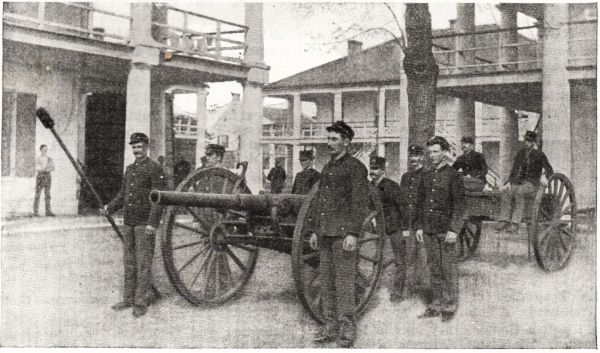
In the morning no one comes and tells a fellow that breakfast is ready. At Fort Wadsworth the bugle sounded at 5.30 in summer, and 6 in winter. Ten minutes later reveille sounds, a gun is fired, the flag is raised on the post staff—a large flag for a pleasant day, and a smaller one for a stormy day—and the fort is swarming with men running here and there, and going down stairs three steps at a bound. Assembly for roll-call is only five minutes after reveille—not a long time to wash and dress. But a fellow in the service has to do as he is commanded. You have heard of the captain who told the recruit that there were three things to do to make a good soldier. The first was to obey orders; the second, to obey orders; and the third, to obey orders. There are mess-call for breakfast, sick-call for hospital, and fatigue-call for men who are to do extra duty, like mowing weeds, moving guns, or maybe milking the colonel's cow, should he keep one. Then those remaining in barracks spend half an hour swinging clubs, running, jumping, or other exercise to develop the muscles. Each post commander fixes the hours for drills within certain limits, but guard-mount comes early in the fore-noon, is usually performed in full-dress uniform, and executed the same in all military posts. A new guard goes on and relieves the old one. There is quiet in the post, save for the bugle that marks the hours, till half past eleven, when recall is sounded. At twelve dinner is ready. At one work begins again, if there is work to do, and lasts till half past four. Supper is at five, and at sunset there is dress parade. The work done is, cleaning up the reservation, mounting or moving guns, digging ditches, and doing a lot of things that don't appear in accounts of military manœuvres and show parades.
In winter school is kept, usually by one of the commissioned officers, when there are classes in range-finding, knotting and splicing ropes, gunnery, and the like.
Sunset parade is what the soldier's lady friends always come to see. It is ceremonious. Let me tell you about it. All are obliged to answer the call for it, and fall in on their respective parade-grounds, neatly dressed, shoes polished, white gloves on, and arms bright. The first sergeant calls the roll, and brings the company or battery to parade rest. The adjutant, or officer of the day, now takes charge, and by a wave of the hand notifies the chief trumpeter to sound off retreat. At the last sound of the bugle the corporal of the guard fires the evening gun, and another member of the guard hauls down the flag. The first sergeants report the presence or absence of the men, and the corporal of the guard locks up the colors, to remain so till reveille next morning.
This ends the day's routine of a regular army enlisted man in barracks, and he may go where he pleases until eleven, when taps is sounded. At taps the lights must go out. A check-roll is taken to see if any men are absent. This is done by a sergeant or corporal, who takes a list of names of the men, and, with a lantern for light, goes through the rooms to see if each man is in bed.
Special permission is granted to men of good character to absent themselves from retreat, check-roll call, and reveille every day when not on special duty. At Fort Wadsworth, which, with Fort Hamilton, guards the entrance to New York harbor, most men have the afternoons off, and not a few of them put them in in sleep. There is a fascination about the soldier's life. And yet most men in it wish themselves out of it, and are always looking forward to the end of their enlistments, or speculating whether it will pay them to buy their releases. Sometimes we have entertainments in the post hall, and on Sundays the reservation swarms with sight-seers, who ask innumerable questions, some sensible, others otherwise. Do I like a soldier's life? Yes, though I often, as do others in the service, I fancy, build air-castles about what I would do if out of it.
Frederic Wilkens. Jackson Barracks, New Orleans.
Questions and Answers.
James F. Rodgers: The best researches in the line you indicate have been made by the national government, which has explored, measured, and dug over a great part of the ruins of the homes of former cliff dwellers and Aztec Indians. The Smithsonian Institution and the National Museum, Washington, contain many pictures, surveys, etc., of these ruins. We know of no society engaged in such study, or, at least, none that makes excavations.—Ethel R. Betts: Greek is now required for entrance to Barnard, but some changes are to be made in the requirements. See the answer of the Registrar published in this column, No. 902.—Bessie H. asks how she can get foreign postage-stamps. In several ways. She can buy them from a dealer; she can trade with friends for them; she can send the money to some post-office in the country the stamps of which she desires; or she can write to correspondents in foreign countries whose names she finds in the Round Table or other publication.
Marian E. P. Greene, Jamacha, Cal., writes: "A Swiss friend, much interested in autograph-collecting, has sent me one of her 'traders'—an autograph of Emile Zola—with the request that I exchange it for some well-known American or English writer. I also have the autograph of Princess Victoria of Schleswig-Holstein, generally known as Princess Christian. This I will be glad to trade for an American autograph, or will send it with Zola's in exchange for a very good one. I would much like to have the Round Table dated December 25, 1895, and will send ten cents in stamps to any Knight or Lady who can procure it for me. If a Lady of the Round Table has passed her eighteenth birthday, can she still write to the Table from time to time, and send questions to be answered, or must she give up this privilege?" She need not give up the privilege. The Table is glad to receive morsels descriptive of interesting places, people, and things.
An Orange subscriber asks where he can see pictures of the different ships of our navy. In Harper's Weekly, files of which you will find in your local library. If you wish to possess them, you can procure back numbers of the Weekly. Consult the file to see what numbers you desire. In the Weekly you will find not only pictures of all our naval ships, but pictures of some of the larger ones in several positions.—"A. H. S." asks: "If a picture takes a prize in your Camera Club Competition and is printed in your paper, are you the holder of a copyright on said picture? And also if it may be submitted for printing in another journal at some future time?" Each issue of most periodicals is copyrighted. That copyright covers everything in the issue. Where a photograph has been reproduced in a periodical, whether Harper's Round Table or some other, it is best to ask the publishers' permission about using it again. That permission can generally be obtained, or at least a plate purchased. Of course one would hardly enter a prize-picture in another prize competition. That might be fair, but one cannot afford to appear over-greedy.
Richard Stark, Jun., sends us the following:
"Where can I get setting-boards for setting butterflies and moths? Is a microscope costing from $3 to $5 powerful enough to properly examine plants and insects? Is there any Chapter or society of young naturalists for exchanging specimens of natural history? If so, I would like to hear from it." Make the setting-boards yourself. The Round Table published directions for using them only a short time since. A low-priced microscope will answer very well for examining plants, but a more powerful one is needed for insects. You say "properly" examining. Much depends on how important you regard the word "properly." As a general rule, it is poor economy to purchase cheap scientific instruments. If you can afford a microscope costing $8 to $20, you will find it much more satisfactory. Might you not secure one on approval?—A New York member asks for a proof of a prize-story which the Round Table desires to have illustrated. We regret to say we have no such story at present, and no plans have been made to have our prize-stories illustrated this year.
Woman's Bicycle Distance Record.
Here is an interesting query. "A. M." asks the woman's bicycle distance record. She says hers, ridden during one year, is 5700 miles. She asks if she holds the record. Let us hear from members on this interesting point.
THAT WONDERFUL SAIL.
Harper's Round Table has rarely published a puzzle that so exercised the minds of its young friends and led to so much instructive research. A curious thing about the contest was the fact that questions thought in advance to be difficult were answered readily, while some quite easy questions were missed by almost every solver. Such an outcome has never before been known in all of these many contests. For example, the sign at the boat-landing, and the three riddles 21, 22, and 23, were put into the puzzle as "stickers." Yet more than half the solvers answered all three of the riddles, and every one of them, save perhaps a half-dozen, discovered the keys to the landing sign, much to the astonishment of the puzzle's author. Of the riddles, the one that proved the most difficult was 22. On the other hand, the "Mad Yankee" and the "Bad Lands of the Say It," both quite easy, were missed by almost everybody. Such a fact is no less astonishing than that all should guess the hard questions.
The question was asked by one solver, if an answer fitting the question perfectly is thrown out or counted wrong, provided it does not chance to have been the propounder's answer to the question. The answer is an emphatic no. All answers that fit the questions are accepted, of course, and in case of doubt the solver is given the benefit. In the correct answers herewith given, those put down first are the propounder's answers; succeeding ones, if any, those found by the solvers, and accepted because they answer the questions. Solvers are asked to read them, and immediately afterward the explanation which follows:
1. Ba(Lear)ic—Prospero. 2. Edu(Cato)r. 3. Mis (Solon)ghi—Socrates. 4. Better leave bad company behind. 5. Noah Webster. 6. Elisha Kent Kane. 7. S(cave)nger. 8. Gras(shop)per—Para(a city in Brazil) site. 9. I(magi)nation—pre(sage). 10. Cor(rug)ation—(fur)row—s(cowl). 11. A(string)ent—(cord)ial—por(twine). 12. G(litter)ing—b(rig)ht. 13. Es(cap)ade—dis(turban)ce—false(hood). 14. Re(quire)ment. 15. S(corn)er. 16. Se(map)hore. 17. Ser(vice)able. 18. H(alb)erd. 19. B(ranch)ie. 20. In(scrip)tion—prescription. 21. Cheese. 22. A clay pipe. 23. Rabbit's foot. 24. Ce(rum)en—whiskey in ear of corn. 25. Re(cup)eration. 26. B(rake)man. 27. S(crib)e—S(cot)t—Al(cot)t—Pres(cot)t. 28. Hot(tent)ot—A(shanti). 29. S(heath)ing. 30. S(hut)ter. 31. Quad(rill)e. 32. Ro(pew)alk. 33. Sal(a man)der. 34. Sy(nag)ogue. 35. The Land of Steady Habits (Connecticut).
In 1 and 3 a doubt honestly arose whether hidden names or facts were intended. Hence both were allowed. In 6, "Mad" Anthony Wayne was not the mad Yankee, because he was born in Pennsylvania, of Irish parents. In 9, many gave "mage" in "image" for "magi," which was, of course, not allowed, and others gave "judge" in "judgement," meaning perhaps "judgment," as if it were expected solvers would misspell words. In 21, "milk" is not allowable because it is not subjected to great pressure. In 22, "iron" would not do for several reasons—see conditions. In 23, "horseshoe" does not fit, because not a serious loss to its owner, as is the rabbit's foot. That which is used by masons is the hair—in plaster. The last question, which almost everybody missed, is a simple anagram, not nearly so difficult to rearrange as the alphabetical cipher in 4.
The highest honor and a substantial prize of $20 were won by Bryant K. Hussey, who lives in Chicago and is 16 years of age. He gave correct answers to all save 6 and 35. The second honors, with prize of $5 to each, go to sisters who live in a pretty Virginia town. Their names are Amy Ralston and Katherine B. Rogers. The other prize-winners are Francis C. Péquignot, of Philadelphia, $4, and the following six, to each of whom $1 is awarded: Lewis P. Churchill, of Nova Scotia; Eunice K. Jones, of Ohio; Robert H. Mead, Raymond Tilley, and Joseph B. Eastman, of Pennsylvania; and Pierre W. Saxton, of Otsego County, New York.
In these awards an honor list is made—an unusual concession—and deservedly at the head of this list is placed the name of Master M. L. Hamlin, aged nine, who lives in Yonkers, New York. The others, whose names follow, correctly answered thirty of the thirty-five questions: Maddie C. Marshall, South Carolina; Roy Culbertson, Kentucky; Bayard B. Rodman, Long Island; Alice B. Tobey, Ohio; Harold F. Gaston and Bessie Jones, Pennsylvania; Maude G. Corcoran, Maryland; Kathryn A. Fisher, Michigan; Paul F. Case and Claude S. Smith, Monroe County, New York; Anna W. James, New Jersey; and L. J. Martin, Kansas.