Chapter XIX
Reading edition
WRECKED AGAIN.

was almost stunned at the news the carpenter brought, but I knew of the only thing to do, of course.
"Rig the pumps and get to work at them," I squeaked faintly, fearing to try to talk loud.
"Ay, ay, sir," he answered, "but it will do no good. Lord Harry! she's opened up like a sieve, sir!"
Soon we had the water from below pouring on to the deck and running into the scuppers and mingling with that that came on board of us over the rail. But the wind increased in strength until it seemed that it would take the aged masts out of the brig, and it actually threatened to blow the clothes from off our backs.
Chips had gone below again to sound the well, and I was holding on to a belaying-pin, and trying not to show how weak and sick I was. I noticed that one of the men, a narrow-headed fellow with an ugly gash of a mouth, was not putting all of the beef he might into his stroke on the pump handles. So I slid over to him and laid hold myself; but the man endeavored to push me to one side.
"Hands off, Captain Jonah," he said, "it might stop working! We had plenty of good luck until you came aboard of us. Hands off, I say!" he cried, "or we'll feed you to the whales."
I could have struck the man for his insolence, as his words had been heard by two of the men opposite; but I saw that the result might be bad for me, so I replied nothing, but taking a firmer hold of the beam, I wedged him out of his position, ready at any moment to fell him if he attempted violence. I was the stronger, and at last I broke his hold. Where the force I now felt command of came from I cannot tell. The man would have slid over against the bulwarks if I had not caught him by the shoulder.
"Go over on the other side and work, you shirker," I cried, and, to my surprise, my voice roared out the words in tones like those of a bull.
I gave the man a push up the slope of the deck, and began heaving up and down with all my might and main, but I had made a discovery.
It was only my lower tones, my demi-voix, that were gone. For three days afterwards this phenomenon continued. If I wished to talk, I had to use the full lung-power that I possessed, and the result was a sound that would do credit to a boatswain's mate in a typhoon. It was as unlike my former voice as a broadside to a pistol-shot. But I am wandering.
The effect of my treatment of the insolent sailor had been marvellous. Not a disrespectful glance was cast at me thereafter. Soon the carpenter came up from below.
"We may have gained some three or four inches, Captain, but no more," he panted, laying hold alongside of me. "I think the water is getting in forward too, sir," he added.
"Get out four of the prisoners and man the forecastle pump," I roared at him.
He jumped at the odd sound of my voice, but made no remarks, and scrambled to the hatch in a jiffy.
"Four of you up out of that!" he cried through the hole, at the same time battering away at the fastenings with a belaying-pin. The hatch was flung open, and instead of four, all ten of the Britishers came rushing to the deck. They probably had been dying of terror down below, and one glance at us working away for dear life told them the condition of affairs.
Without a word they set to work, under the direction of their own officers, to get the spare gear out of the way and start the forecastle pump going.
The carpenter soon reported from the hold that we had gained some four inches, and were now holding our own. This was at the end of an hour's work by all hands.
I perceived, however, that it would be foolishness to work all the men to death at the outset, and that the sensible way would be to divide them into relays, even if the water gained a little on us.
So I told off my own men into two divisions, and sent half of them into the galley to get rest and a bite to eat. But the prisoners I drove at it, as we had fully two hours' start of them. They needed no encouragement yet, and one of them even replied, "Ay, ay, sir," to my orders to hit up the stroke.
There is no use of prolonging this description. All night we worked away, and the gray dawn found us still at it.
Fisher, the wounded man, I had mounted guard over the prisoners, arming him with a cutlass and a brass blunderbuss that I had found in the mate's room. I hated to goad men the way I had to, but I think my own people worked almost as hard, and needed less urging; but the Englishmen had begun to fag.
By noon the sea had gone down, and, probably owing to the swelling of the timbers, the leak had apparently decreased. We had gained a foot and more on the water in the hold, and the carpenter found out that it was as he suspected, the water had been entering through a started seam, and he said that if we could get to anchor, he thought might be able to locate where it was. So I ordered all but four of the prisoners below. At first one of the mates demurred; but I would admit of no talking, and at the sight of the pistols he obeyed me.
Now the great question was to find out where we were. By two o'clock I made sail, and seeing that the old tub did better with the wind astern, I ordered the helmsman to steer the same course we had been holding, and I started to go below to rest.
I slept like a top, and it was six o'clock when Dugan ran in and awakened me, telling me that land was in sight off the starboard bow, distant about twelve miles.
But where were we? That was more than I could tell.
I had some idea of our position when we struck the storm, or, better, the latter had struck us, and I presumed that we must either, from the course we were steering, have entered the Irish Channel or gone up the west coast of Ireland itself; but it mattered little; we had to find some place to anchor and, if possible, to repair our damage, and besides, I intended to land the prisoners at the first chance, as they were a constant source of menace to us, and so many more mouths to feed.
Coming on deck, I took the glass and climbed into the foremast shrouds.
What an odd circumstance it was! Here I was a full-fledged Captain, and had never been aloft on a vessel but once before in my life, and that was when I had covered myself with tar and glory by climbing to the cross-trees of one of the ships at the wharfs of Baltimore. But I went up as far as the topsail-yard, hanging on harder than was necessary, perhaps, and from there I took a sight at the distant land. I made it out to be a collection of islands, with what might be the mainland farther on to the north. After I descended to the deck I changed the course a few points to the east, and in a little over two hours we had brought a high, rocky shore close to on the port beam. It was an island, as I had surmised.
The sky had now cleared to a glorious red sunset, and I could discern the conformation of the shore. Two arms ran out to the eastward, and—a remarkable sight!—I saw that the island was split in two by a narrow crevice, and that on the southern point it dwindled down into a narrow spit, at the end of which rose a sheer rock like a tremendous castle.
The carpenter had started the lead, with the result of finding no bottom until we were well within the water embraced by the extending arms. At last he reported suddenly fifteen fathoms; at the next heave, thirteen: and seeing that it was shoaling so rapidly, I feared to go in nearer, and we hove to and let go our anchor.
The water was as smooth as a carpet, and with the stopping of the strain and working of the hull, the leak ceased pouring in, the carpenter reporting, after a trip to the hold with the lantern, that she was only weeping a little along her inner skin. I had kept four of the prisoners at the pumps, however, and now I called every one, and in an hour's time we had her nearly dry.
Ordering the Englishmen back to where they belonged, Caldwell and I took the first anchor watch, and the rest turned in to sleep.
The huge shadow of the rocky cliff enshrouded us, and in rear of the black silhouette of the island I could see the pale greenish-blue of the sky in the west, with a few stars twinkling through it, and myriads of them gleaming in the deeper blue overhead. It was so peaceful and calm, and in such contrast to the scenes that we had been through, that were it not for the pain I still suffered, I could have felt almost joyous. But nature asserted herself, and lying there sprawled on the deck, I fell asleep.
I awakened with a start, to find it was daylight. I noticed that Caldwell must have staid awake after I did, for he had rolled up his jacket and placed it as a pillow beneath my head. But the honest fellow had given in at last, and there he was, snoring away on the top of the forward hatch, with his arms and legs straggled out like a jumping-jack on the floor of a play-room.
Now if what had happened before this calmly dawning day appears strange or improbable to any one who may read, and if they are tired of the relation of these facts, which, I can say without boasting, are unusual to have happened to any one being, let them lay aside for good and all the reading of what is to follow. For what has previously happened is nothing to what I am going to tell, in my opinion, as I am a truthful man.
I awakened Caldwell gently, and told him to go down and stir out the man who was doing the cooking for us, and have him brew some coffee and prepare breakfast. We had some fresh vegetables still left, for the Duchess of Sutherland had not been long from port when we had taken her.
Then, all alone, I gazed at the island in whose little bay we were resting.
A narrow stretch of beach ran from the foot of the cliff to the water's edge. The top was verdure-clad, and to the north some stunted underbrush grew along the crest. The strange crevice that I had noticed ran from the green slope, sheer and straight, to within twenty feet of the water's level. It looked as if it might have been made by the stroke of a giant's sword. The high rock at the end of the tongue of land to the southward resembled more closely than ever a moss-grown ruin; but all at once I jumped for the glass. A thin, twirling column of smoke arose from a little hollow a quarter of a mile up the shore, and by the aid of a telescope I could make out two or three huts, and some gray objects on the slope of the hill that resolved themselves into grazing sheep. I made up my mind, before I landed the prisoners and set to work stopping the seams, to row ashore and find out where we were. But hunger asserted itself, and the smell of cooking coming from the galley reminded me that with the exception of some sopped biscuit and a bit of fat meat that I had managed to worry down the night past, nothing solid had passed my lips since my struggle with the man in the passageway.
Running below, I asked the carpenter in to breakfast with me in the cabin. He was my First Lieutenant, as I have said, and of course I knew, without his saying so, that he had saved my life—with my own pistol, too, I surmise.
"Well, Captain Hurdiss," Chips said, "a busy day's before us. I think if we can careen the old hooker and get that opened strake so we can handle it from the outside, we can take her across, bar another such storm as we had last night."
"We'll make a try for it, Mr. Chips," said I, roaring out the answer after two or three futile attempts to speak quietly.
"You won't need a trumpet this voyage," was the carpenter's rejoinder to this, at which I laughed, for the hot coffee and food were restoring my spirits.
The men, too, were in an even frame of mind, and when I ordered out the boat they went about it like good ones. I saw that the prisoners were fed before I left the deck, and then going over the side, I gave the orders, man-of-war fashion, to "Shove off!" "Let fall!" etc., and after a pull of a few minutes the carpenter and I landed on the beach near the hollow in which the huts were, and finding a path, we ascended to them.
As we approached the door of the largest hovel, that was built of sods and stones, a nondescript figure, with just enough rags on to save it from appearing savage, emerged. The man appeared a little frightened at first, and was truly startled at the sound of my voice. His reply I could not translate, although I had merely asked him what island this was, and what was the name of the coast that we could discern to the eastward.
At last, by dint of signs and repeating the question, I made out something that sounded like "Innishkea," and when I pointed to the island to the north the same answer came. When the land to the eastward was designated he said Muhllet a Blackshod over and over. I gave him a bit of silver, and the meaning of that he understood quite well, for he grinned and closed his fist tight upon it, at the same time giving a pull to his long front lock. I never heard such outlandish lingo in my life as the man spoke, but I remembered the sounds of some of the words, and when I got back to the ship I went into the cabin, and the carpenter and I got out the map that showed the coast of Ireland, for Chips insisted that the man was talking Gaelic, and that it was either Ireland or Scotland whose shore lay off to the eastward.
"Hurrah! hurrah!" I cried suddenly, my attention arrested by a name. "Here we are, Mr. Chips. The island of Inniskea—and off here is the peninsula of Mullet that encloses the waters of Blacksod Bay."
So I knew where I was at last!
But there was lots to be done. Arming the crew, we took the fastenings off the hatch, and ordered the prisoners into the boat. We left them on shore with a barrel of ship's bread and a half-barrel of salt meat. And then we rowed back, and prepared to do some impromptu calking, and fit the old hulk in a better condition for putting to sea.
The Duchess of Sutherland was loaded with machinery for some sort of crushing business, and the rest of her cargo was cheap cloths and print-stuffs, probably for the East Indian market. According to her papers, she was bound for Calcutta.
The seam that had done most of the leaking was hardly a foot beneath the surface of the water as she lay on even keel, we discovered. It had opened up badly forward, and again amidships. So we set about lightening her first before we hove her down.
Rigging a block and tackle, we jettisoned some heavy bits of machinery, and found that the cargo had been very badly and loosely stowed.
The brig—she had been outfitted in a hurry—carried four guns, short carronades of heavy weight, on her deck, and we shifted these to starboard side, and then we rigged out an anchor at the end of a spar; and I was surprised to see what a purchase we got on her, and how well all this answered for our ends. As soon as they could, the carpenter and the crew set about calking her with hemp from an old cable, whistling and humming away merrily.
They progressed finely with the job, and as there was nothing for me to do, I went aloft. I could smell the tar that they were boiling in the galley, and was hoping that we could finish our work in time to get under way that evening, when all at once I felt a jar, as if the vessel had struck something below, and it appeared to me that we heeled a little more to port.
In fact our list was very evident now, and the masts had quite an angle on them. I saw that the carpenter, who was standing in a boat alongside, had stopped work, and was looking curiously up at me. The seam at which he had been tapping was now two feet above the surface of the water, and the ripped green copper of the brig's bottom was plain to view.
The carpenter laid his head against the side, and then shouted up, in a frightened voice:
"For heaven's sake, Captain Hurdiss," he cried, "there's water entering somehow! I can hear the sound of it from here."
He and the men in the boat hastily scrambled up the side.
Just then there came another jarring sound. It was the cargo shifting.
I was hastening to descend, when I cast a glance toward the shore, and there I saw one of the prisoners, whom I had noticed standing on the top of the hill, suddenly wave his arms about his head, and come tearing down the slope toward where the others were grouped about a fire.
But this was not all. Through the cleft in the hill-side I could see the waters on the other side of the island. And in this narrow space, framed by the walls of the cliff, I saw a vessel just coming about into the wind. Another instant and she was gone, hidden by the dark mass of land. But so firmly impressed was this quick vision upon my mind that I can see it to this day, as firmly fixed as were it a painting that I had studied in its every detail.
As I reached the deck the brig gave another lurch, and our bulwarks were almost in the water.
"The cargo all adrift, Captain Hurdiss," shouted the carpenter, coming up the ladder. "And we must have a bad leak in our top sides. The old thing is rotten to her heart," he added.
The men, without orders, were tumbling into the boats, and even with my small experience I could see that nothing could save the Duchess from sinking where she lay. I looked toward the shore, and saw the prisoners in a body running up the beach toward the north. Just as I caught sight of them, they rounded a point of rock and disappeared.
But a strange shifting motion in the brig warned me to hasten. What impelled me, I do not know, but seeing the glass wedged in the shrouds where I had planted it, I made for it, and picking it up, jumped into the boat.
SHE WENT DOWN LIKE A LITTLE "ROYAL GEORGE."
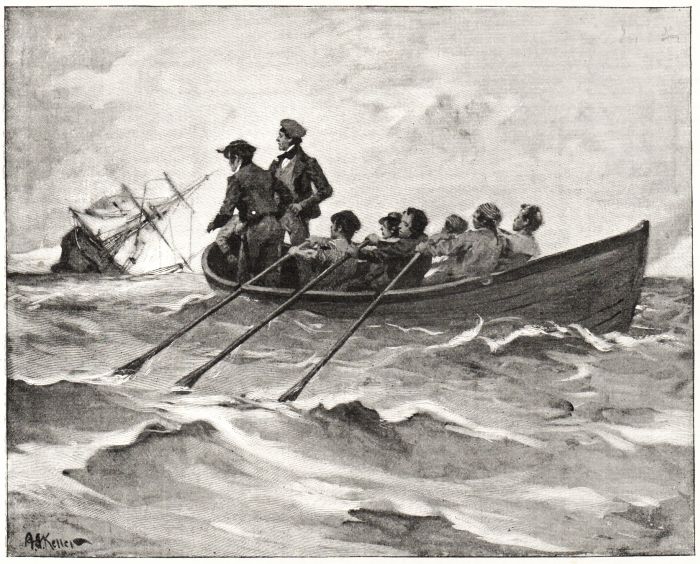
We had rowed but a few dozen strokes when, with a lurch, and a dull explosion as the forward deck blew out from the pressure of air, down went the Duchess of Sutherland, like a little Royal George. But the only living things she took with her were a few half-drowned chickens in a coop near the galley.
Even the carpenter now showed signs of despondency, and what I told him about the vessel that looked like a great lugger with one mast, that I had seen on the other side of the land, did not cheer him.
"We're in for it now," he grumbled. "There's no prize-money in this affair. She's one of their revenue-cutters, and she'll scoop us surely."
"That's what the prisoners were scampering for," spoke up Dugan, who was pulling stroke oar. "They've gone around to fetch her."
"Well, that's all they'll find," said Chips, pointing over the stern of the boat.
I looked back. Only a few feet of the Duchess's masts were visible, but there was a lot of debris floating on the water near them.
[to be continued.]

Next Saturday will occur the eighth annual in-door interscholastic championship games of the Boston schools at Mechanics' Hall, held under the auspices of the Boston Athletic Association. The events are all scratch, and include the 40-yard dash, 300-yard run, 600-yard run, 1000-yard run, half-mile walk, running high jump, putting 16-lb. shot, pole vault, and 45-yard hurdles (3 flights, 2 ft. 6 in. high). Besides, there will be special team-races arranged. This meeting is open to the members (under twenty-one years of age) of all schools in the vicinity of Boston. Each school will be allowed to enter three men in each event, except in the 1000-yard run, when only two are entered and but one may compete.
Ever since 1889 the schools have competed annually, and it has been the winter athletic event of the school world. In 1890 the Boston A.A. offered a large silver shield to run for nine years to be contended for by the different schools, the one winning it the greatest number of times to become the final possessor, and this generous action has had a stimulating effect in making every school anxious to have its name engraved on the blank spaces made for that purpose. Consequently, as the occasion comes around each winter, speculation is rife as to the probable champion school.
The outcome next Saturday, while based on relative comparisons, is more or less a matter of conjecture, as youthful athletic competition is an uncertain quantity. Not a first-prize winner, with the exception of E. W. Mills, of last year's meet, appears in the list again, and this fact should be encouraging to those who would otherwise have to struggle against established champions.
E. W. MILLS, CHAUNCY HALL.
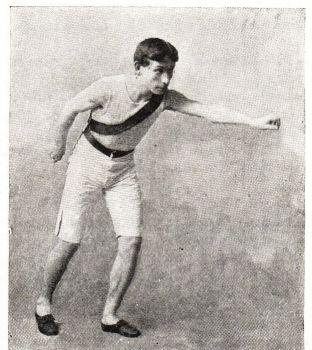
The New England Interscholastic records are about as low as it is possible to get them, and while no record-breaking is looked for, yet in one or two instances there may be some change of marks. In the 1000-yard run E. W. Mills, of Chauncy Hall, who now holds the record of 2 min. 33 sec., will be able to better that time if anybody can. It is traditional custom that the two winning schools of the year previous shall meet in a team-race, and this year English High and Worcester Academy will clash. The Worcester boys are bitterly aggrieved over losing the in-door championship of '96 by one point to English High, and will make strenuous efforts to regain some of their laurels by winning this event.
H. J. KANE, E.H.-S.
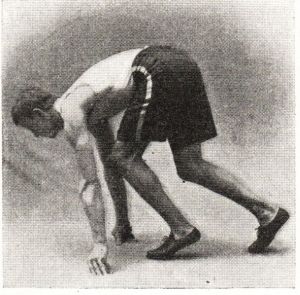
To prophesy correctly the winner of the first event on the programme, the 40-yard dash, would be impossible under existing circumstances. The string of foremost dash-runners that the schools will furnish are very evenly matched, and most of them are doing the distance in 4-4/5 sec.—record time—so that it will be less than a yard that separates the leaders in the final heat. English High is sure to have more than one of its runners in the final round, with H. J. Kane, H. C. Kennington, and A. F. Duffy wearing the colors. Kane was third in the 100 and 220 yard runs at the out-of-door championships, and ever since he has shown improvement. All three of these athletes are capable of doing 4-4/5 sec. H. C. Jones, of Phillips Exeter, who won the novice 40-yard at the B.A.A. games, February 6th, is predicted to keep pace with the swiftest, and will be a dangerous competitor.
Newton High has H. W. Owens, another dash-runner, who in several instances has done 4-4/5 sec. His inconsistency in running is his worst fault. The Worcester schools are likely to bring down a set of good sprinters. The high-school has in A. M. Butler a slashing sprinter, who won a handicap dash in his city a few weeks ago.
The Worcester Academy athletes, with the benefit of a fine out-door track of 150 yards in length, built on scientific principles, and also a well-known professional coach in attendance, should exhibit some redeeming strength at the meet. George Hersey won third in the 40-yard dash in '96, and ought to better that now. He circled the school track in the 300-yard dash considerably under the record, and if the corners at Mechanics' Hall do not bother him, he can justify the confidence imposed in him by his school.
G. H. HUNTRESS, HOPKINSON'S.
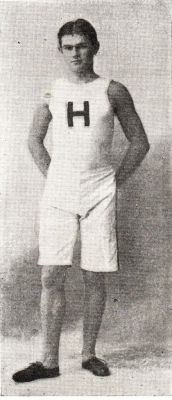
Captain G. H. Huntress, of Hopkinson's, will be that school's best entry for the 40 and 300 yard runs. He has good staying powers coupled with plenty of speed. Noble's School will contribute to the 40-yard dash A. T. Baker, who lately won prominence by taking the 40-yard handicap prize away from over a hundred entries at the B.A.A. games. J. W. Sever, of Brown and Nichol's School in Cambridge, is in the front rank of scholastic sprinters, and is running in trim form this year.
J. H. CONVERSE, E.H.-S.
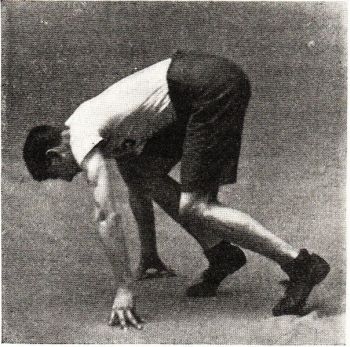
There have been rumors that Phillips Andover would not send a team, but this will not prevent individuals from entering, and in that case the appearance of J. J. Peters may be counted on. With the prestige obtained by his appropriating the hurdles at the big B.A.A. meet, he is given precedence over everybody in the hurdle contest. His elegant physique is a factor that will stand by him well if he is hard pressed. J. H. Converse, the national champion, who defeated A. H. Beers last June, is in this fight, and his reputation hangs in the balance on the result.
Hopkinson's School has a trio of clever timber-toppers in J. Hallowell, E. Cole, and E. Whitman. They are evenly matched, and finish on a line in practice, but Hallowell's past experience on the track would make him the favorite in a race. Worcester Academy will furnish a star in Hall, whose smooth movement over the sticks is bound to make him conspicuous.
Last year's calculations in the 600-yard run were all upset by the two probable winners failing to qualify, and by an unknown stepping into the breach. This contingency may have a repetition, for those thought to have the best chances are not to be depended upon. M. M. Marks, of English High, who recently won his heat at the B.A.A. games in 1 min. 20-3/5 sec. from 30 yards, is entitled to recognition. Those who have watched his running have great faith in his progress, and he certainly creates a favorable impression by his length of stride, which is wonderful, considering his slight body. Whether he can repeat is the doubtful question, and remains to be seen. C. I. Porter, of Hopkinson's, is going to make a strong bid for something in the 600. His practice trials have convinced his school that he is a valuable member of the athletic team. A. W. Lincoln, captain of Boston Latin's team, will be the grittiest runner in the bunch. He is game through and through, and if his speed stays with him he may catch a prize.
There is not a shadow of doubt in the minds of the prophets that E. W. Mills will capture the 1000-yard run. He is too much of a veteran to be jockeyed, and has speed and endurance enough to make him a winner. He will give the record most of his attention, and place it where future runners will never touch it. The only one now in view who is able to keep him company is D. T. Sullivan, of Worcester High, who is the national interscholastic mile-runner. E. W. Crawford, of Boston Latin, may win a place, as he is practising this distance daily, and has a beautiful stride. English High is relying upon F. A. Ferguson to keep its name from being tarnished at this distance. Hopkinson's has a couple of fair runners in Cunningham and Ladd, and they are expected to give a good account of themselves.
From present indications it seems as if Worcester Academy would make the most points in the field events, as some excellent marks have been made in practice. C. H. R. Howe has jumped as high as 5 ft. 8 in., which insures him a prominent place. He is credited with a height greater than this, but not in competition. H. B. Kendall, a schoolmate, is close behind Howe in jumping, but his specialty is pole-vaulting. From different sources comes the report that he will approach the record. As it is, he can go higher than 10 feet, and has done it repeatedly. J. H. Converse, of English High, has branched out as a high jumper, and his 5 ft. 6 in. in rubber-soled shoes means more when he gets on the floor at the interscholastic tournament. C. M. Rotch, of Hopkinson's, can reach 5 ft. 7 in., and is being carefully coached, so that this, together with his perfect style, will have a telling effect.
The shot-putters will be a stocky set of athletes, as no giants are in sight, and the list of foremost putters have muscle bred on the football field. W. W. Coe, of Noble's School, has the call for first honors, and he is deserving of whatever should befall him, as he has industriously kept at his endeavors to increase his distance. His stout arm, with a well-trained composition back of it, has sent the 16-lb. weight 38 ft., and this would win for him. Eaton of English High and Boyce of Brookline High are about in the same class, with the advantage on the latter's side. Worcester anticipates placing a "dark horse" in the shot.
The half-mile walk will have a scant gathering, as efficient walkers are scarce. Mohan, an English High pedestrian, with a point at the out-door interscholastic games last summer, is a reliable man in keeping his feet.
The championship of the ice-polo league of the schools in and about Boston has been won by the Arlington High-School. Space prevents any detailed comment upon this result in the present issue, but the ice-polo season will be reviewed in these columns at an early date.
It is announced that a track-athletic league, to be known as the Interscholastic Track Association, has been formed among St. Paul's School, Garden City; Lawrenceville School, of Lawrenceville; and the Hill School, of Pottstown. No meet will be held this year, but the first will take place in 1898 at Lawrenceville. The next in 1899 at St. Paul's, and in 1900 at the Hill School. The events agreed upon are the 100 and 220 yard dashes, 440 and 880 yard and mile run, 120-yard hurdle, 1-mile bicycle, pole vault, throwing 12-pound hammer, and high jump. A dual meet for this spring has been arranged between Lawrenceville and the Hill, the events to be those adopted by the triple league.
Although it is now somewhat late in the season for ice sports, the formation of a hockey league among the New York schools is nevertheless to be commended. The membership consists of Berkeley, Cutler, De La Salle, St. Austin's, and Montclair High-School. Of these schools Montclair High has probably done the most work at the sport this year, although Berkeley has developed a very fair team.
The banner at the Long Island A.A. in-door games, held in Brooklyn, February 20, was taken by Berkeley, with St. Paul's second, the scores of the competing teams, by points, being as follows: Berkeley, 25; St. Paul, 17; Barnard, 14; Pingry, 8; Adelphi, 7; Latin, 5; Dwight, Poly. Prep., and Collegiate, 3 each; High-School, 2; Columbia Grammar, Trinity, and Harvard, 1 each.
The in-door pole-vaulting record was broken by Paulding of Berkeley. He raised the figures from 9 ft. 10½ in. to 10 ft. 4 in. At the Knickerbocker A.C. games last year Paulding cleared 10 ft. This year, therefore, he will doubtless do much better, and should again win the event.
The 50-yard dash, as was expected, went to Robinson of St. Paul's. He lost his heat to Sulzer of Pingry, but took first place easily in the finals. Kinney of St. Paul's put the 12-pound shot 43 ft. 1 in., and the high jump was taken by Serviss, B.L.S., with 5 ft. 6½ in.
The entries for the big games at the Madison Square Garden, under the auspices of the Knickerbocker Athletic Club, close March 20. It is to be hoped that by that time all of the schools in this part of the country will be represented on the lists.
"TRACK ATHLETICS IN DETAIL."—Illustrated.—8vo, Cloth, Ornamental, $1.25.
The Graduate.
DR. NANSEN AND THIRTEEN.
The safe return of the Fram is regarded as a knock-down blow to the thirteen superstition. There were thirteen men in her crew, of whom the thirteenth joined at the last moment. All returned safe and well, and none of them was ill at any time, or a cause of anxiety. Then, too, it was on the 13th of August that Nansen reached home, and on the same day the Fram got quit of the ice, seven months to a day after (on January 13) she had struck a southerly current. To these coincidences it is added that three litters of thirteen pups were born in Nansen's pack of Eskimo dogs (though a greater number than six to a litter is unusual), and that just thirteen publishers bid for his book after his return.

Any questions in regard to photograph matters will be willingly answered by the Editor of this column, and we should be glad to hear from any of our club who can make helpful suggestions.
DEFECTS IN NEGATIVES, AND THE REMEDY.
The most common defect in negatives, and one which it is easy to avoid, is the small transparent spots which appear on the negative after developing and fixing. These spots are called pinholes, and are caused by small specks of dust which cling to the film, and which do not wash off when the developer is turned over the plate. When a print is made from a negative in which there are pinholes, small black spots appear in the finished print wherever there were pinholes in the film. These holes can be filled up by retouching, but they may be avoided altogether, and prevention is much better than cure. After the sensitive plate is in the holder, dust it over carefully with a small wad of surgeon's cotton before putting in the slide. If plates remain in the holder some time before they are used, it is a wise plan to dust them again before they are put into the developer. Pinholes are sometimes caused by using old developer which has not been filtered, and the tiny specks which are in the solution settle on the plate during development. Always filter developer after once using, and it saves time if it is filtered at once when through developing.
Larger spots with sharp dark edges are caused by air-bubbles forming on the plate when the developer is poured over it. If the tray is slanted a little when the solution is turned on the plate, air-bubbles are seldom formed. A piece of clean surgeon's cotton passed quickly over the plate will break the bubbles.
Where there are large irregular spots on the plate which are not fully developed, it shows that the developer did not cover all the plate immediately, and therefore acted longer on one part than on the other. There is no remedy for this; but such markings can be prevented by pouring the developer quickly over the plate and rocking the tray for a few seconds.
If the negative, after fixing, is covered with fine markings, the print looking as if the negative from which it was made was crackled, it shows that the tray was not rocked sufficiently during the process of development. The tray should be gently rocked in all directions, so that fresh developer is constantly passing over the sensitive film. (Not long ago one of the members of the club sent two prints to the editor, one of which was covered with fine markings. The letter stated that the negatives were made and developed one after the other; and while the first was all right, the second had the crackled appearance. An explanation of the cause was asked and received.)
If the negative after developing and fixing turns yellow it indicates that the plate was not left long enough in the fixing-bath. As explained in one of the papers on the chemistry of photography, when the negative is placed in the fixing-bath a new compound is formed of the unchanged chloride of silver and the hyposulphite of soda. They unite and form a double salts, called silver sodium hyposulphite or thisulphate. This double salt is soluble in a solution of hypo, and the fixing-bath must be strong enough not only to form this double salt, but also to dissolve it. When it is thoroughly dissolved it is quickly washed out of the film. If the fixing-bath is too weak, or if the plate is taken from the bath too soon, the plate will soon turn yellow, and in time the image will be destroyed. To prevent this the plate should be left in the fixing-bath for five minutes after the plate is cleared from the silver bromide.
When a negative after drying has a whitish appearance with a rough surface, it is because the plate was not washed long enough after removing from the hypo bath. Wash plates an hour in running water, or in eight or ten changes of water, changing at intervals of five minutes.
Arthur Nilsen asks if portraits can be made better with snap-shots than with time exposures; and if with time exposures, the length of the exposure. Snap-shots for portraits give too harsh contrasts. For a time exposure with good light simply taking off and replacing the cap quickly will be long enough; or if a hand-camera with drop shutter, open and close the shutter as rapidly as possible without making the exposure instantaneous. One must learn to regulate the exposure according to the light, and the rapidity of the lens and plate used. With a little careful practice one can learn to expose the plate correctly.
D. Saylor Wilson asks how to tell when a plate is fully developed. Examine the plate by looking through it toward the red light. If the detail is well out, and the negative looks as if it would be dense enough for a good print, return the negative to the developer, and rock it till the image is fading rapidly, then remove and wash and fix. With some kinds of developer the image must be allowed to fade entirely, but with hydrochinon developer the plate is developed far enough when the plate looks dense when examined by looking through it toward the light.
The Leading Chefs
Use only