THORNTON'S USELESS STUDY.
Reading edition
BY W. J. HENDERSON.
"I wish to gracious goodness that Thornton J. Seabury would make better use of his time!"
That was the earnest exclamation of Mrs. Seabury, mother of Thornton; and it was her earnest conviction that her son was going to turn out to be an idle, unpractical, shiftless young man.
"It's not that he's lazy," said Mrs. Seabury, when, in the distress of her heart, she went to consult the minister about her boy. "No, he's not exactly what you might call lazy; but he works on useless things. He spends hours and hours in studying things that may be very interesting and very fine to know; but what good will they ever do him? He's got to make his way in the world, and I'd like to know who's going to pay him for learning the names of the stars, and orbits, and diurnal motions, and such things as he talks about! He ought to be giving his attention to something that will help him to earn an honest living."
"But, my dear Mrs. Seabury," said the Rev. Thomas Tatter, who was a man of education, "there is hardly any study that cannot be turned to account in earning a living; though I must admit that I can't help admiring your son for loving a study for its own sake."
"Well, I'd admire him too," said Mrs. Seabury, "if he loved some such study as civil engineering or architecture."
"Yes, I dare say that these would promise a more brilliant future for him: but we must admit the fact that his gifts are for astronomy, and you know it is almost impossible to overcome the impulses of a boy's natural gifts. Even as an astronomer a man may earn a living."
"Well, I suppose there's no help for it," sighed Mrs. Seabury.
All this time, Thornton, grieved at his mother's opposition to his favorite pursuit, was nevertheless more passionately attached to it than ever. From early childhood he had always regarded the heavens with delight and devouring wonder. What were those beautiful golden stars that filled the splendid dome of night with their gentle radiance! Why had God put them there, and what were they doing? Little by little he began to absorb the elementary facts of astronomy, and after a time he found that he could make no further progress without becoming a thorough mathematician. So he set himself resolutely to work, and soon knew all that his school-teacher, a college graduate, could teach him. Thornton really was a complete master of geometry, trigonometry, higher algebra, and even the more advanced branches of mathematics. His advance in astronomy was now rapid. He even put in a summer at uncongenial labor in order to earn money enough to buy three or four second-hand instruments. He never dreamed that he might turn his knowledge to practical use; but he studied simply because he loved the subject. And in the course of time astronomy repaid him for his devotion in ways that had never entered his mind.
At the time when this story begins Mr. Seabury had left home, on the Maine coast, and had gone to New York to see about a good situation which had been offered him in that city. Times had been hard up in Maine, and Mr. Seabury had been out of work and could not get in again. One day he returned home and told his wife that he had secured an excellent situation in New York, but hardly knew how to stand the great expense of moving his family and his household goods such a distance. Fortunately, however, an old friend, Captain Josiah Whitby, of the schooner Three Elms, came to visit them that evening. As soon as he heard of the difficulty he slapped his stout knee and said:
"Why, lookee, my lad, it's lucky I came. I'm goin' to sail for New York on Saturday with the Three Elms in ballast to get a cargo there for Bermuda. Now it ain't agoin' to hurt me to carry all your fixin's for nothin', an' you an' your fam'ly for the price o' what you'll eat."
Mrs. Seabury had some feelings of timidity about the sea-voyage, but of course such a kind offer was not to be refused, and, moreover, Mr. Seabury and Thornton were both delighted at the prospect of the voyage. So during the next two days there was a great bustle in the Seabury household. All their furniture, carpets, and other belongings were carefully packed up and stowed in the capacious after-hold of the Three Elms, for Mr. Seabury's intention was to live in a little house at Williamsbridge. Early Saturday morning Mr. Seabury and Thornton superintended the storage of the last load of goods, including the trunks containing their clothing and Thornton's precious books and instruments. Then the little family sat down to breakfast with Captain Whitby in the schooner's cabin, and Mr. Seabury added to his unfailing prayer before eating a petition for their safety during the voyage which they were about to undertake.
"I can't get away from the wharf before three o'clock this afternoon," said the Captain, "because the Three Elms can't get over the bar here except at high water."
"It's spring tide to-day," remarked Thornton.
"Hello, boy!" exclaimed the Captain; "are you a sailor?"
"Oh no, sir," said Thornton. "I don't know one sail from another, but I know the age of the moon, and I know it's time for the spring tides here."
"Well, even that's worth knowin'," said the Captain, "and if you keep your eyes open while you're aboard here, you'll learn a lot of other useful things."
"It will be funny to see Thornton learning useful things," exclaimed Mrs. Seabury.
"Let the boy alone, mother," said Mr. Seabury, "he'll come out all right."
In the afternoon the schooner got under way, with a fine westerly breeze abeam, and stood out to sea. As she passed the lighthouse at the entrance to the little harbor, the Captain took certain bearings of it with his compass, while Thornton stood by and watched him with interest.
"I suppose you are fixing the schooner's position by bow-and-beam bearings," said the boy.
"That's what I'm doin'," said the Captain; "but how'd you know anything about them?"
"Oh, I've heard of them," said Thornton, modestly.
"Well, come and see me set the patent log," said Captain Whitby.
Thornton seemed to know something about that too, and the Captain decided that although the boy might have a good deal of useless knowledge in his head, he had hold of some facts worth knowing. He said as much to Mrs. Seabury, but she replied:
"What's the good of his knowing those things? He isn't a sailor."
"That's true enough," answered the Captain, remembering that the boy did not know one sail from another.
By six o'clock the schooner was well out to sea, and as it grew dark the Captain came on deck with his sextant. Thornton became intensely interested.
"Going to take Jupiter for latitude, Captain?" he asked.
"That's what," was the reply; "but what do you know about it?"
"Oh, I'm not so ignorant that I can't tell what latitude and longitude are," said Thornton; "and I know that Jupiter will be on the meridian at 8.32 to-night."
"Well, then, you know some more things that are worth knowin' to a sailor-man, anyhow," declared Captain Whitby.
For twenty-four hours the schooner glided along slowly and quickly, the wind constantly drawing ahead and forcing her off her course. Then it fell dead calm, and a heavy swell began to roll in from the southeast.
"Mother," said Thornton, "don't be frightened, but we're going to have a storm."
"Mercy sakes!" exclaimed Mrs. Seabury; "how do you know? The Captain hasn't said so."
"The barometer has fallen rapidly for the last six hours, and the wind has been backing from west to southwest and so on around to southeast," said Thornton, "and there's going to be a gale. The Captain hasn't said anything, because he does not wish to frighten you."
Two hours later it began to blow in short uneasy puffs from the southeast, and Captain Whitby ordered the top-sails and foretopmast stay-sail taken in. He laid the vessel by the wind on the starboard tack, intending to push out as far as possible from dangerous proximity to the coast. At six o'clock in the evening it was blowing freshly, and the long swells were cut up into foaming ridges.
"Get the fore-sail off her!" cried Captain Whitby to his little crew, and presently the big sheet of canvas was furled snugly on its boom.
"In jib, and lay aft to reef the mains'l!"
It was wild weather now, and no mistake. The big roaring green billows came raging down out of the dusk in the southeast, and as the schooner would lean far over to meet them it looked as if they were going to bury her. But as each sea approached, the schooner's bowsprit would swing upward with a great heave, the sea under-ran her, and down she came with a crash and a cloud of spray into the screeching hollow.
"I'll have to ask you all to go below," said the Captain; "it isn't safe for you to be on deck. You might get washed overboard."
Shut in the badly lighted little cabin, with the one lamp swinging madly, the agonized groaning of timbers all around them, and the thunder of tons of water falling on the deck above them, the Seaburys began to wish that they had never left their little home to go out on the treacherous ocean. They did not go to bed, but sat on the lockers, holding fast with both hands, and momentarily expecting that some terrible catastrophe would happen. About three o'clock in the morning they heard a loud shout and a heavy thump on the deck, followed by a rapid shuffling of feet.
"What can have happened?" exclaimed Mr. Seabury.
"Oh, they're coming to tell us that we must take to the life-boat!" cried Mrs. Seabury.
The cabin door was pushed open, and three sailors stumbled in, bearing the inanimate form of the Captain.
"One o' the main throat-halyard blocks fell from aloft," said a sailor, "an' hit him. I reckon he's hurt bad."
The Captain was laid in his bunk, and Mrs. Seabury forgot her fears in her anxiety to do something for him. And being one of those "handy" New England women, she could do a good deal, too. She could not find any broken bones, so she decided that the poor man had been struck on the body and injured internally. With the help of her husband, she prepared and administered a soothing drink which put the sufferer to sleep. Poor Thornton stood about idly, and keenly feeling his helplessness. But at eight o'clock he eased his mind a little by winding the chronometer.
In the mean time the storm had broken; it was only a summer gale, and at nine o'clock the wind shifted to northwest, and the sun came out. Thornton and his father went on deck, leaving Mrs. Seabury to attend to the Captain, who was awake and in much pain. The mate came up to Mr. Seabury, and said:
"This are a ser'ous business, sir."
"Yes," answered Mr. Seabury; "I suppose you're in command now."
"Waal, I am: but I wish I wasn't."
"Why, how's that?"
"Why, ye see," said the mate, scratching his head, "I kin sail the schooner all right: but I can't navigate her. I'm blowed ef I know w'ich way to steer now."
"Why not sail west till you sight land?"
"'Cause I might hit a shoal or rocks, not knowin' they was there."
"Please may I speak?" said Thornton.
"Well, what is it?" asked his father.
"I can navigate the schooner, though I can't sail her," said the boy, earnestly.
"You! Why, you never were at sea before!"
"That makes no difference," said Thornton; "sailors navigate by the sun, moon, and stars, and I know all about them. Father, I know that I can navigate this schooner into New York Bay. The chronometer is running; I know where the captain's sextant is, and I wish you'd let me try."
"We must speak to the Captain about this," said Mr. Seabury.
They went below and laid the matter before the Captain. In spite of his sufferings he became deeply attentive. He asked Thornton this question:
"How are you goin' to find the position o' the schooner now? I've lost her reckonin'."
"I'll take a chronometer sight right away, and another two hours from now, and work out the position by astronomical cross-bearings—Sumner's method, I think you sailors call it."
"Can you work Sumner's method?"
"Certainly, with sun, moon, or stars."
"Then you know more navigation than I do," said the Captain.
"It's nothing but applied astronomy, you know," said Thornton, "and I've always been studying astronomy."
"You go ahead and see what you can do, my boy," said the Captain. "Let Bowers, the mate, handle the schooner, and you tell him which way to steer."
Thornton went at once to the chronometer and set his watch by it. Then he went on deck with the Captain's sextant in his hand, and the crew stopped work to stare at him. He had a short talk with Bowers, who explained the situation to the men.
"If the Captain says it's all right," said one of the men. "I s'pose it is."
But, nevertheless, they could not understand how any person not a sailor could be a competent navigator, though the simple fact is that navigation has not necessarily anything to do with seamanship. The schooner was hove to for two hours, because Thornton explained to the mate that he desired to keep her in one place until he ascertained her position. At 11.15 the boy took his second sight and went below to work out his problem. His father stood over him in wonder while he filled a sheet of paper with sines, cosines, secants, and such things. At last the computation of the position was completed, and Thornton had to ascertain the course to be steered. He got the Captain's chart, and, marking the ship's place on it, went into the sufferer's cabin and showed it to him.
"I guess you must be about right, boy," said the Captain. "In settin' the course, you want to get well out here."
And the Captain indicated with his finger certain dangers that must be given a wide berth. Thornton set a safe course, and, going on deck, told the mate to get the schooner under way S. 1/2 W. The men sprang to their work willingly, and in a very few minutes the Three Elms was cleaving her way over a comparatively quiet sea. For three days Thornton continued his labors as navigator, and on the morning of the fourth he announced that the Highlands of Navesink ought to be sighted from the masthead at eleven o'clock. A sailor was sent up to look out for them. The hour of eleven came, and he was silent. The mate and the crew looked gravely at the anxious boy. Could he have been in error? Five minutes passed, and the men began to talk angrily. Then the man aloft cried:
"Land, ho! It's the bloomin' old Highlands! I know that lump!"
A CHEER WENT UP, AND THE MATE SHOOK HANDS WITH THORNTON.
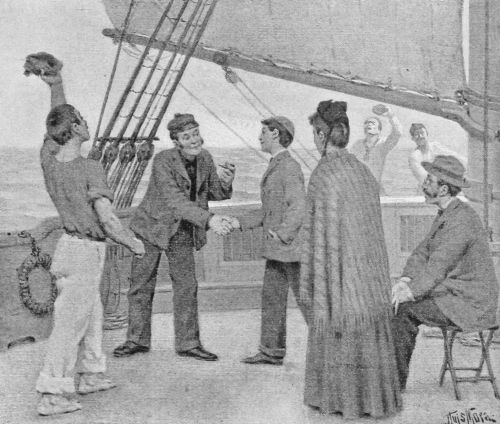
Then a cheer went up, and the mate shook hands with Thornton. Before supper the schooner was in tow of a tug, going up the Swash Channel.
"Well, mother," said Thornton, "do you think astronomy is such a useless thing now?"
And she was obliged to admit that she had never thought of it as the foundation of navigation. Thornton is at present the assistant to the government astronomer of a European country, and is receiving a comfortable salary.