HELEN'S CHOICE.
Reading edition
BY ANNIE HAMILTON DONNELL.
Helen set the baby down on the floor, and the pan of clothes-pins beside her. "There, now, we'll see," she said, gayly. She got down, too, and arranged the pins in an orderly little circle astride the pan's edge. They went way round, and then Helen, with a sweep of fingers, sent them all clattering into the pan again. The baby crowed in wide-mouthed, toothless glee.
"You do it now, baby—see, just as I do," Helen said.
She sprang lightly to her feet and went back to her dishes. The water was cold, and the teakettle almost empty, and mutton-chops did make such greasy plates. But Helen splashed in cheerfully. She was thinking of Uncle 'Gene's letter on the mantel-piece, and the final decision about it that very morning over the mutton-chops. It made her sing in sudden ecstatic anticipation. What did she care about cold dish-water and uncanny dishes, when she was going to— She filled out the thought with pantomimic action, running scales up and down the edge of the sink with dripping fingers, and executing intricate tuneless measures amid dying soapsuds.
"Helen, Helen!" called a sweet plaintive voice from the bedroom.
"Yes'm." The musical "selection" came to a quick stop. Helen hurried in, wiping her hands on her apron and rescuing the baby from an ignominious descent upon her nose on the way. "What is it, motherdie? is your head worse?" she asked, anxiously. "I'm afraid it's those noisy clothes-pins."
"No, dear, but there's a draught somewhere. I can feel it on my neck. And I wish you'd rub my shoulder again. It's unusually achy this morning."
Helen found the liniment bottle, and went to work with practised, gentle touch. It was one of the dear invalid's bad days, and she had not tried to get up. Her pale face looked up into Helen's with wistful appreciation of the loving care. She was thinking of Uncle 'Gene's letter too.
The clock out in the kitchen struck eleven ponderously as Helen set the bottle away and put the screen before the window. In half an hour the primary children would be home, and close on their heels the older ones. And what hungry, hurrying-scurrying little mortals they would be!
"Dear little mother, poor little mother, I'll shut the door and keep the Arabs as still as I ever can."
Helen always called them the Arabs when she spoke of them collectively. It was a family pet name for them. The baby had toppled into the big pan, and was fast asleep when Helen went out. She picked her up and laid her tenderly beside the mother. Then with wonderful ease she flew about, finishing the dishes, setting the table for lunch, and doing three things at once with nimble dexterity. She met the Arabs at the door with hushing forefinger. They trooped in on tiptoe, sniffing anxiously for dinner smells.
"I'm awful hungry!" Archie whispered, shrilly.
"So be I—awful!" Harry echoed. "Are there sweet-potatoes, Helen?"
"I smell 'em! I smell 'em!" Molly cried, under her breath, dancing across the floor.
"'Sh! 'sh! Yes, there are sweet-potatoes, but not for Arabs with dirty faces. Come here this minute, and let me polish you up. Oh, Harry, where ever did you tear your trousers so? A great big hog tear!"
"Folks oughter not have fences with splinters to 'em, then," Harry spluttered, with his mouth full of soapy water. "I was crawlin' under to see if Pat Curran's cow chews gum. Bill Miller says so."
"Does she?" Molly asked, eagerly.
"Well, I'm not certain sure, but I think so. She wouldn't open her month more'n a crack for me to look."
"I bet she does," little Archie chimed in, "'cause I've seen her my own self. She makes her jaws go just this way—look!"
Helen smiled in her sleeve, and laid the little discussion away in her memory for "Motherdie's" delectation. The older boys arrived, and dinner was presently in animated progress, though everybody tried to keep still—and didn't. As by magic the sweet-potatoes vanished under the eager forks and spoons, and the creamy rice followed rapid suit. The Arabs were a hearty little tribe. Nothing pleased Helen more than to have them appreciate her cooking. She sighed a little now over the thought that perhaps Mahala would scorch the rice after she was gone.
"Well, I dread her!" suddenly exclaimed Roy, as if in answer to Helen's sigh.
"Who?" asked Archie, between mouthfuls.
"Mahala. She'll scold us like sixty-nine when we make tracks over her floors, and Helen never does."
"She'll wear hoops," said Molly, holding her little silver fork in reflective suspension.
"And make-b'lieve bangs."
"And cloth slippers, with 'lastics criss-cross over her ankles."
"And white stockings!"
Helen contracted her eyebrows sternly. "Stop, children!" she chided. "Mahala's a good woman from the top of her head—"
"Make-b'lieve bangs," murmured irrepressible Archie.
"—to the soles of her feet."
"Cloth slippers, you mean."
Helen's eyes tried not to twinkle. "She's as much better than I am as—as—you can think," she ended, lamely.
The Arabs laughed in derisive chorus.
"But, honest, Helen, it's goin' to be so lonesome an' poky!" Molly wailed over her empty saucer. "We sha'n't have a speck of fun till you come home again."
"A whole year!"
"Twelve months. Four times twelve's forty-eight. Forty-eight times seven's—"
"Three hundred 'n' sixty-five!" concluded Roy, scornfully. Roy was in the grammar grade, and was regarded as an oracle in arithmetic.
The baby woke up and lifted her voice hungrily, and Helen ran away to her. The busy afternoon followed the busy morning on swift wings, and it was almost supper-time before she could sit down and think a minute. Then she held Uncle 'Gene's letter in her lap and thought about that. "Let her come soon," it said, "and stay anyway a year. She has real musical talent, and Bab's Professor Grafmann will develop it if anybody can. He's a genius. Besides, we all want her, and the child must need a breathing-spell after trying so long to tame those wild Arabs. Yon can surely find somebody else to tutor them."
Yes, oh yes, there was Mahala! She was all engaged to come and do it. She was good-hearted and strong. She would be sure to treat them all well and take splendid care of Motherdie. Helen rocked back and forth contentedly. They wanted her to go—father and mother, and the Arabs would soon get used to doing without her. Dear little Arabs! She looked down at the smallest one of them, still trying to stand the clothes-pins round the edge of the big bright pan. She was improving steadily.
Let's see—to-morrow—day after—day after that. Then she was going. It would be a new world opening suddenly to her, and she shut her eyes to dream the wonderful dreams more uninterruptedly. Ever since she had drummed baby tunes on the tin cake-box, by the hour at a time, she had been growing hungrier to learn to materialize the untamed melodies that ran riot in her mind, and made her fingers tingle with impotent longing. And now it was coming—her chance! Three days away! But as the three days came and went Helen's visions grew more clouded and overcast with secret misgivings. She found herself worrying for fear Mahala would not remember some of the little trivial comforts she herself had taken such delight in remembering for Motherdie. And there were the baby's soft little shoes that needed patching, and Harry's trousers, and the dish-towels were in dire need of replenishment. If she only had a dozen hands these last days, and a dozen times a dozen hours to use them! Her heart misgave her uncomfortably. But they wanted her to go—of course it was just right. Nevertheless, her face grew sober and thoughtful, and something tugged distressingly at her heart-strings.
The day after, and the day after that came. Helen kissed her mother over and over, and hugged the little Arabs fiercely, and went away. The houses and people on the way to the depot danced about dizzily in a mist, and she felt dizzy and topsy-turvy in acute sympathy with them. Her father walked beside her, talking briskly and constantly. Roy walked on ahead with her valise and umbrella, and never once looked around. Helen watched him through the same confusing mist, and his straight, slim little figure was oddly contorted. He had never looked bow-legged before, Helen thought in dismay!
The train puffed in and puffed out again, with a little maid, stricken with sudden, overwhelming forlornness, in the corner of one of its seats. A plump, benign-looking old lady sat just behind her, and watched her with curious sympathy. The baby two seats ahead leaned over toward her insinuatingly, and made her think of the baby and the clothes-pins. Mahala would never remember the clothes-pins—never! And she had forgotten Harry's patch, that she meant to see to last night surely. Mahala'd forget that, too. Helen started involuntarily to her feet.
"WHAT IS IT, DEARIE? YOU FORGOT SOMETHIN'?"
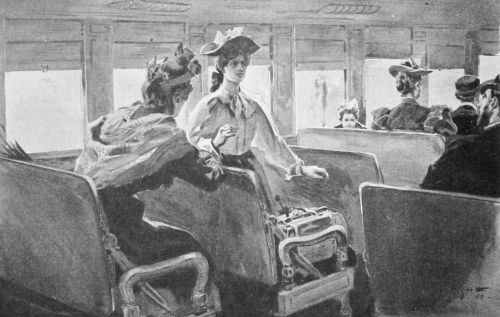
"What is it, dearie? You forgot somethin'?" The plump old lady leaned ahead and touched her arm in friendly solicitude.
"Yes, oh yes! I forgot the patches on Harry's pants." Helen lamented, "and the baby's clothes-pins."
"Oh lor, dearie, never mind—never mind! Patches ain't nothin' much, nor clo'es-pins, neither. I'm comin' over an' set with you. I guess you're sorter humsick, ain't you? I've got some pep'mints in my bag. I'm goin' to see if I can't chirk you up."
Helen moved her umbrella and hand satchel, and made room for her new neighbor. The arrangement had its immediate good effects. Somehow the little old lady reminded her of Mahala, though Mahala was angular and tall and wore steel-bowed spectacles; but she always associated Mahala and peppermints together—perhaps that was the reason. Anyway, if Mahala was as kind and thoughtful as this plump old lady, why need she be anxious and troubled? Helen was young, and travelling was a delightful novelty. She grew cheerful and chatty, and parted with her new friend at the Junction with real sorrow. There was nearly an hour to wait at the Junction. Her train met the down train home there, she remembered, and she might send a postal back. But when she began to write, all the old misgivings and conscience-twitchings surged upon her. She felt selfish and cruel and wicked. What business had she running away from home, where she belonged, taking care of Motherdie and the baby and the Arabs? They all needed her—they all needed her. The words said themselves over with dreary repetition in her heart. Back and forth, up and down the platform, she paced restlessly. Conflicting emotions fought in hand-to-hand struggles. She ought to go home again. She wanted to go the other way. The old tingling in her fingers grew almost irresistible—the longing to touch piano-keys and draw from them the music she knew was in her soul. No, of course she couldn't give it up now. And why need she?
Two whistles sounded in opposite directions. Helen walked faster than ever. Oh, dear, dear, dear, why must the two trains meet right before her eyes? There they were now. She watched the home train come jerkily to a standstill, and her train approach it on another track. She stood suddenly still, and began to talk aloud. "That train goes home," she said, "and that one doesn't. Which one are you going on, Helen Scott? Quick! Are you going home like a decent girl, or are you going to Uncle 'Gene's to practise scales like a heathen and a sinner?" The passengers were almost all aboard. "Well, you can do as you please, Helen Scott. I'm going home to patch Harry's trousers and rub my blessed mother with liniment!"
She darted ahead, and in another minute was on the train. She never knew how she got on, but there she was. She settled back in her seat with a deep sigh of relief. The other train started first, and she shut her eyes so she wouldn't see it. "Good-by," she murmured, wistfully; "good-by."
She felt weak and tired. It wasn't easy work having hand-to-hand conflicts in her heart. But she was glad she was going home. How the Arabs would shout! In her excitement she had not thought of getting a return ticket, and it didn't occur to her now. She put the ticket her father had bought for her in her button-hole, and leaning back in the seat, went sound asleep.
At an hour's end she woke up decidedly refreshed, and looked at her little silver watch. They would be just about at Thompson's Crossing now, she thought, glancing out of the window. But that wasn't Thompson's Crossing! They were drawing into a big bustling station that Helen didn't recognize in the least. Men were darting about hurriedly, and trucks were clattering by her. What did it mean? She clutched at the sleeve of a brakeman going down the aisle, and questioned him nervously. "Oh yes. Thank you." He passed on. Then that was it. She was going to Uncle 'Gene's, after all, in spite of herself! In her hurry and mental perturbation she had boarded the wrong train at the Junction, and it had been the one not going home to Motherdie and the Arabs. She had said "good-by" too. All her brave fighting in vain—no, it wasn't either. She would stay at Uncle 'Gene's a day, and then go home. When that was fully decided, Helen felt better, and began to rather enjoy the fun and complication of it all. Uncle 'Gene and Bab met her at the depot, and overwhelmed her with cordial welcoming.
"There's a letter up home for you, Helen," Bab announced. "I guess they're homesick and want you back."
"But they won't get you, you know," Uncle 'Gene said, fiercely, tucking her under his arm.
"No more they won't!" answered Bab.
Helen took the little home message up stairs with her into her pretty new room. She opened it wonderingly. Why, what was this?
"Dear Nell," father said. "This is for a bit of a welcome and surprise, to make you feel quite contented and easy about us all. Did you think the mother and I didn't notice your conscience-stricken little face, and know just how troubled you were? But we took a notion to make it a real surprise to you—that Aunt Dolly is coming to help Mahala out. There, now, open your eyes wide, my dear, and shut all the windows and squeal! Aunt Dolly's coming, as sure as you live. She has given up her boarder and rented her little nest, and is this blessed minute on her way usward. So you will not worry about us any more, for Aunt Dolly's a host in herself, and almost as good as our Helen (the Arabs would scalp me!), only, if you please, I'll swap her for Helen when the year's up!"
Helen forgot to shut the windows, but she squealed. A great weight of care slipped off her shoulders on to Aunt Dolly's.
"She won't forget the patch or the clothes-pins or anything!" she exclaimed. "Aunt Dolly's remember is miles, miles long!"
Downstairs a door opened, and through it was wafted up to Helen a low, sweet strain of music, that grew, second by second, fuller and deeper, till it seemed to embody all her own glad feelings, and to bear up on its wings beautiful, prophetic hints of the joy that was on its way to her.