STORIES OF OUR GOVERNMENT.
Reading edition
THE PRESIDENT'S CABINET.
BY THE HONORABLE THEODORE ROOSEVELT.
The executive business of the national government is divided into eight departments, and the heads of these eight departments are known as Cabinet officers, and form the President's Cabinet.
It often happens that we use the same name that is used in England for an officer or an institution, which is not, however, quite the same, and is sometimes widely different, and we must always be on our guard not to be confused by such seeming similarity. This is true in our political life, just as it is true in our sports. For instance, we could not get an international match between Harvard, Yale, or Princeton, and Oxford or Cambridge on the football field, because, although football is played at all of them, yet the game in the American colleges is so different from that played in the English universities that it would be impossible to have American and English teams meet on the same ground, any more than we could put a baseball nine against a cricket eleven. It is just the same way in our politics. The Senate is sometimes spoken of as corresponding to the House of Lords; but they really have few points of resemblance, save that they are both second chambers. So the Speaker of the House of Representatives is sometimes spoken of as if his position corresponded to that of Speaker of the House of Commons. This is not true at all. The Speaker of the House of Commons is, properly, merely a moderator, like the moderator of a New England town meeting, and his duty is to preside and keep order, but not to be a Speaker, in our sense of the word, at all, not to give any utterance to party policy. In the American House, on the contrary, the Speaker is the great party leader, who is second in power and influence only to the President himself. The functions of the two officers have nothing in common, save in the mere presiding over the deliberations of the body itself.
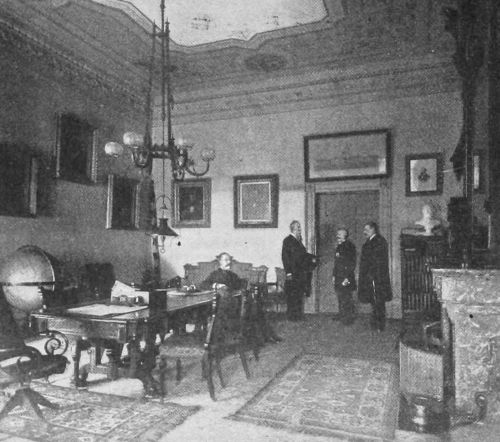
THE CABINET-ROOM.
So in England the cabinet officers are all legislators, exactly as the Prime Minister, their chief, and they are elected by separate constituencies just as he is. In America the cabinet officers are not legislators at all, and have no voice in legislation. Instead of being elected by their own constituencies, they are appointed by the President, and he is directly responsible for them. It is upon his Cabinet officers that the President has to rely for information as to what action to take, in ordinary cases, and he has to trust to them to see the actual executive business of the government well performed.
The chief of them all is the Secretary of State. At the Cabinet meetings he sits on the right hand of the President. He would take the President's place should both the President and the Vice-President die. It is he who shapes or advises the shaping of our foreign policy, and who has to deal with our ministers and consuls abroad. He does not have nearly as much work to do, under ordinary circumstances, as several other Cabinet officers; but whereas if they blunder it is only a question of internal affairs, and is a blunder that we ourselves can remedy, if the Secretary of State blunders it may involve the whole nation in war, or may involve the surrender of rights which ought never to be given up save through war. Questions of grave difficulty with foreign powers continually arise: now about fisheries or sealing rights with Great Britain, now about an island in the Pacific with Germany, now about some Cuban filibustering expedition with Spain, and again with some South-American or Asiatic power over insults offered to our flag, or outrages committed on our citizens. All of these questions come before the Secretary of State, and it is his duty to digest them thoroughly, and advise the President of the proper course to take in the matter. The Secretary of State very largely holds in his hands the national honor.
Next in importance to the Secretary of State comes the Secretary of the Treasury. The great economic questions which the country always has to face are those connected with the currency and the tariff, and the Secretary of the Treasury has to deal with both. On his policy it largely depends whether the business of our merchants is to shrink or grow, whether the workingmen in our factories shall see their wages increase or lessen, whether our debts shall be paid in money that is worth more or less than when they were contracted, or in money that is worth practically the same. I do not mean by this to say for a moment that the Secretary of the Treasury, or any other official, can do anything like as much for the prosperity of any class or of any individual as that class or individual can do for itself or himself. In the end it is each man's individual capacity and efforts which count for most. No legislation can make any man permanently prosperous; and the worst evil we can do is to persuade a man to trust to anything save his own powers and dogged perseverance. Nevertheless, the Secretary of the Treasury can shape a policy which will do great good or great harm to our industries; and, moreover, he has to work out the financial and tariff policies which he thinks the President and the party leaders demand. The position is therefore one of the utmost importance.
The Postmaster-General has to deal with more offices than any other official, for he has to control all the post-offices of the United States. He is the great administrative officer of the country. Unfortunately, under our stupid spoils system, postmasters are appointed merely for political reasons, and are changed with every change of party, no matter what their services to the community have been. This is a very silly and very brutal practice, and all friends of honest government are striving to overthrow it by bringing in the policy of civil service reform. Under this all these postmasters will be appointed purely because they will make good postmasters, and will render faithful service to the people of their districts, and they will be kept so long as they do render it, and no longer.
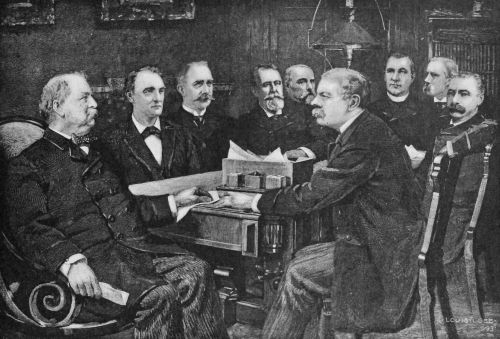
J. Harmon, Attorney-General. J. D. Morton, Agriculture. H. Smith, Interior. W. L. Wilson, Post. Gen. President Cleveland. J. G. Carlisle, Treasury. H. Herbert, Navy. R. Olney, State. D. Lamont, War. A MEETING OF THE CABINET.
The Secretary of the Interior has to deal with the disposal and management of the great masses of lands we have in the West, and also he has to deal with the management of the Indians, and with the administration of the pension laws. All three are most difficult problems, and their solution demands the utmost care, patriotism, and intelligence.
The Attorney-General is the law officer of the government. He sees to the execution of the Federal laws throughout the country, and appoints his agents to do this work in every district of every State, and he also advises the President and heads of departments on all legal matters.
The Secretary of Agriculture is a man of mixed duties. A good many bureaus of one kind and another are under his supervision, and most of the scientific work of the government is done under him. Some of the scientific bureaus, however, are under other departments. The work done by these scientific bureaus, as by the coast survey and the geological survey, and by the zoologists in the department, has been of the very highest value, and has won cordial recognition from all European countries. Much of the work of the early scientific explorers in the West reads like a veritable romance; and this governmental work has added enormously to our knowledge in all branches of science, from the natural history of mammals and birds, to the geological formation of mountains, and the contour of the coasts.
The remaining two officers are the Secretary of the Navy and the Secretary of War. The Secretary of the Navy, again, occupies a most important position, for upon the navy depends to a very great extent the nation's power of protecting its citizens abroad, and of enforcing the respect to which it is entitled. Most fortunately for the last ten or twelve years the secretaries of the navy have done admirable work. Each has built on the good work of his predecessor, so that we are gradually getting our navy to a pitch where it can worthily uphold the honor and dignity of the American flag.
The Secretary of War is an officer whose duties are usually not very important, as he has comparatively little of consequence to do during time of peace, but is perhaps the most important officer of the Cabinet, with the sole exception of the Secretary of State, whenever a war arises. He has all kinds of work to do even in peace, however. Thus during the last two or three years the experiment has been tried on a large scale of working the Indians in as soldiers; and although hitherto this experiment has not had the success its promoters anticipated, yet good has been obtained by it. But when war comes, the Secretary, if not a powerful man, will be crushed helplessly; and if a powerful man, can do great good for the country and win a great name for himself, for in war he stands as one of the supreme officers, and upon his energy and capacity depends much of the success of the contest.
A strong President will usually make up his mind on certain policies and carry them out without regard to his Cabinet, merely informing them that their duty is to do the work allotted to them; but except in the case of these few policies, to which the President is committed, and the workings of which he thoroughly understands, he has to rely on his advisers.
The necessary advice is given him in these Cabinet meetings as well as privately. At these meetings the business of the departments is discussed, and also all questions of public policy of sufficient importance to make the President feel he would like advice about them. Of course the importance of the questions thus discussed may vary much, ranging between the adoption of a course of policy which may force Great Britain into war with us on the one hand, and on the other the abolition of the annual football games between Annapolis and West Point. The average Cabinet officer has a great responsibility, and can exert a most powerful influence for good or for evil throughout the entire republic.
This Department is conducted in the interest of Girls and Young Women, and the Editor will be pleased to answer any question on the subject so far as possible. Correspondents should address Editor.
You can tell me nothing about it, girls, nothing that I do not perfectly understand when you confide to me that you find vacation days rather slow of pace. Jenny Lucille spent last year in college, studying hard, and under high pressure from her entrance as a Freshman till the day she passed her examinations triumphantly, and was ready to begin her work as a Sophomore. It was due to her parents, who were making a great sacrifice in sending her from home, that she should do her best, and be an honor and credit to them, and being a girl of acute sensitiveness and much devotion to duty, Jenny would have been incapable of wasting her time. Then it is, after the first feeling of homesickness wears off, a gay and exciting world, this college world where so many young women are gathered, where there are sports and games and pleasant social evenings, and the feeling that something worth while is happening every day. The time flies, especially the last half of the last term, and at last, when there is a breaking-up, and the girls separate and take their different ways for home, notwithstanding their gladness that they are going to meet their dear home people, tears fill many eyes, and overflow furtively, and wet dainty handkerchiefs, and not till the train or the boat is fairly off are the faces quite bright again.
Well, home is reached, and home is sweet. How kind and hearty the father's greeting, how loving the mother's word and look, how much the children have grown, how nice it is to be in one's own room again, and to sit in one's own old seat at the dear home table! But after a little, if the household be a quiet one, and the village or town a place in which little goes on, the girl is vexed to find herself a wee bit blue. She wouldn't let anybody divine it; she shakes herself, and calls herself names in private, but she has to fight to be cheerful, and now and then she sits down and writes a long letter to her chum, and indulges in a good comfortable cry, with nobody to guess that she is not entirely contented, as indeed all sensible people would say she ought to be. The chum at Bar Harbor or Put-in-Bay, or some nook in the White or Green or Blue Mountains, some perch in the Rockies, or springs, or beach, or other gay resort, has had no time to be blue, and her letter back will be a complete contrast to Jenny's.
Now, my dear Jenny, listen to me! This fit of low spirits will pass presently, and you will be none the worse for it, if you will just credit it to the account of reaction. Take hold of whatever work there is to do in the house, the harder the better, and do it with both hands. Read an entertaining book, not a study book, but a bright story, the novel people are talking about, or else the novel of yesterday, which you have always felt you ought to read, but have not yet had time to attack in earnest. Hawthorne, Wilkie Collins, Thackeray, Dickens, choose your author and your book, and float off into the life of imagination, which cheats the life of the actual of so much of its pain.
Whatever else you do, resolutely speak brightly and look cheerful. The brave effort to be bright and cheerful on the outside braces up the inside wonderfully, soul and body, as you know, being such inseparable partners.