BOYS AND GIRLS AS RULERS OF MEN.
Reading edition
ALFONSO XIII., KING OF SPAIN.
BY MRS. SERRANO.
There have been a great many Kings, since Kings first began to rule; but perhaps the little boy who to-day wears the Spanish crown is the only one among them all who was born a King; his father, Alfonso XII., having died more than five months before his birth, the throne remaining vacant during that time.
For the young people of America Alfonso XIII. possesses an interest apart from and superior to that which attaches to his exalted position as the ruler of a great nation, in being a descendant of the noble-minded and great-hearted Queen, the illustrious Isabella, who, by her encouragement and assistance, enabled Columbus to undertake the voyage across unknown seas which resulted in the discovery of a new world.
He is descended also from Henry of Navarre—the famous Henry of Navarre whose white plume so often led his soldiers on to victory—through Philip, Duke of Anjou, Henry's great-grandson, who succeeded to the Spanish crown, under the title of Philip V., on the death of his uncle Charles II. of Spain. Philip was the first of the Bourbon family who reigned in Spain, as Henry of Navarre was the first of that family who reigned in France.
THE KING OF SPAIN.
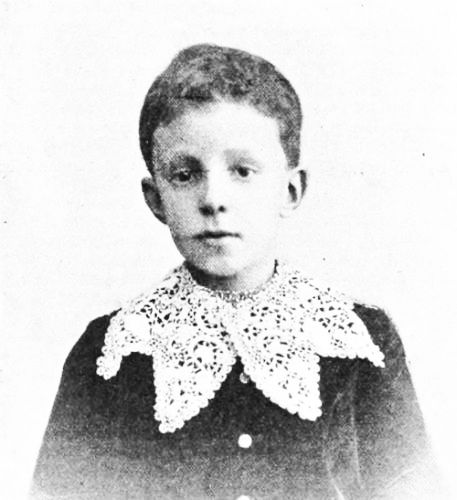
To the Spanish people, who sincerely mourned the death of Alfonso XII., who had endeared himself to them by his frank and amiable disposition and by his many good qualities, the birth of the young King, which took place in the royal palace in Madrid on the 17th of May, 1886, was a joyful event. It was announced to all Spain by the firing of twenty-one cannon in every city throughout the kingdom. On the same day the infant was proclaimed King, his mother, Queen Maria Cristina, who had acted as Regent from the time of the late King's death, continued to fill the same office during the young King's minority.
A few weeks afterward, Queen Maria Cristina went with the royal infant, in accordance with the Spanish custom, to the church of Atocha. She drove to the church in a magnificent state carriage drawn by six horses covered with plumes and glittering with gold, and followed by many other splendid carriages. The Queen was dressed in deep mourning, and from time to time she held up the little Alfonso, who wore neither cap nor other head-covering, to the view of the people, who cheered and crowded forward to obtain a sight of the infant King, while the band played the Royal March.
The little Alfonso grew and thrived, more or less like other babies, until he was two years old, when he was taken in state to several of the provinces to show him to his people. Then he first experienced the uneasiness to which the head that wears a crown is said by Shakespeare to be subject, for the incessant cheering of the people and the ear-piercing strains of the martial music, wherever he was taken, disturbed him so greatly at last that he would cry out in his baby accents, "Stop, stop, no more!" Very soon, however, he began to grow accustomed to the honors paid him, and when he was taken out walking by the Queen, whose greatest pleasure it was, after he had learned to walk, to go out walking unattended with her children, Alfonso holding her by the hand while his two sisters walked in front, he would wave his hand to every one who passed. Sometimes he would forget to return a bow or a wave of a handkerchief, and then the Queen would say to him, "Bow, Alfonso."
At this time the little King had to take care of him and to attend upon him a Spanish nurse and an English nurse and an Austrian and a Spanish lady, besides his own special cook. The Spanish nurse of the royal children is always brought from one particular part of Spain, the valley of Paz, in the province of Santander, where one of the court physicians goes to select the healthiest and most robust among the various candidates for the position. As the young King is of a delicate constitution, thought to have been inherited from his father, the greatest care has been lavished upon him ever since his birth, the Queen herself exercising a watchful supervision over every detail of his daily life.
About four years ago Alfonso had a very serious illness, which everybody feared would terminate fatally, and which was probably due to a cause that has made many another little boy ill. Being in the apartments of his aunt, the Infanta Isabel, the elder sister of the Princess Eulalia, whose visit to us at the time of the opening of the exposition at Chicago made so pleasant an impression upon everybody, the Infanta gave the little boy a box of bonbons of a particularly delicious kind, which, seeing that he was observed by no one, he went on eating until he had finished the box. During his illness he would often inquire after a little lame girl to whom he used to give money in his drives to the country, wonder what she was doing, and ask that bonbons should be sent to her. All Spain followed the course of his illness with profound anxiety, and there was no one who did not sympathize with the widowed mother in her affliction, and rejoice with her when the dangerous symptoms passed away and the sick boy began to recover.
In October, 1892, Alfonso had another serious illness, the result of a cold, contracted probably at the celebration of the fourth centenary of the discovery of America at Huelva, where he presided at the inauguration of the monument erected to Columbus on the hill of La Rabida. This sickness also caused for a time the greatest uneasiness.
The young King begins the day by saluting the national flag from his windows in the palace that look out upon the Plaza de Armas, where the relieving of the guard takes place every morning at ten o'clock, a ceremony which he loves to witness. He is passionately fond of everything military. He takes a great interest in the soldiers, in what they eat, and in other details of their life, and he often expresses pity for the cold which the sentinels on guard at the palace must feel. In the park at Miramar, when the troops are returning to their barracks after drill, he may often be seen delightedly watching the soldiers forming in line, and he returns their salute with a military salute. He is very fond of horses, and the bigger they are the better he likes them, as he himself says. He delights in military music and military evolutions, and a review of the troops is one of his great pleasures. On his seventh birthday he held a grand review of the troops, riding then for the first time in public. On that occasion 40,000 troops were reviewed.
Since that time his education has been directed less exclusively by women than before. His chief companions are his tutor, and the General who is the Captain of the King's guard, with whom he loves to talk about military matters. He still has his little playmates, however, and toys in abundance. He is fond of riding and driving, and he has a little carriage of his own, with two small Moorish donkeys to draw it, which looks very odd among all the large carriages in the royal stables in Madrid.
When the weather is fine he spends almost the whole of the day at the royal villa, called the Quinta del Pardo, situated a little outside Madrid. He is driven there in a carriage generally drawn by four mules, and is accompanied by his royal escort wearing their splendid uniforms and long white plumes. He knows personally all the soldiers who form his escort, and the moment he sees the Captain, as soon as the carriage leaves the palace gate, he speaks to him, and continues chatting with him all the way to the villa, the Captain riding beside the carriage door. He is accompanied by his tutor, his governess, and generally one other person.
In the villa he is instructed in the studies suitable to his age, particular attention being paid, however, to military science. The venerable priest, who is his religious instructor, teaches him also the Basque language, which is altogether different from the Spanish. In the afternoon his two sisters, Isabel Teresa Cristina Alfonsa Jacinta, the Princess of Asturias, who is now about fourteen years of age, and Maria Teresa Isabel Eugenia Patrocinio Diega, the Infanta of Spain, who is about twelve, often go out to take afternoon tea with him. In the gardens of the villa he runs about and plays, after lessons are over, just like other boys of his age, playing as familiarly with the children of the gardener as if they were the sons of princes. Whatever money he happens to have with him he gives to the children of the guard and to such poor people as he may chance to meet on the way, for he is extremely charitable and generous, both by nature and education, the Queen, his mother, instilling into his mind the best and noblest sentiments.
In appearance Alfonso is interesting and attractive. His complexion is very fair, his hair light and curly, his expression rather serious. His usual dress is a sailor jacket and knickerbockers, sometimes sent from Vienna by his grandmother, the Archduchess Isabel, sometimes ordered from London by the Infanta Isabel, his aunt.
He is a very intelligent child, is very vivacious, and his manners, notwithstanding the high honors that have been paid to him since his birth as the chief of a great nation, are entirely free from arrogance and self-conceit. When the Queen Regent is holding audience in her apartments in the palace, which are directly below his, he will often go down and salute those who are waiting in the antechamber, giving them his hand, even though he may never have seen them before, this frankness of manner being a trait of the Spanish people, who are of all people the most democratic.
ALFONSO XIII., WITH HIS MOTHER AND SISTERS.
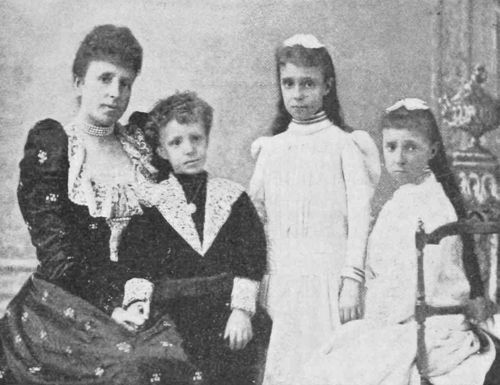
He is very affectionate in his disposition, although he has a very firm will; and he tenderly loves his mother, whom he also greatly respects, and his sisters, who are his favorite playmates.
He seems, as he grows older, however, to be perfectly conscious of his exalted position. He knows that he is the King, and in the official receptions and ceremonies at which he has to be present he rarely becomes impatient however long and solemn they may be. One of these rare occasions was during a royal reception in the throne-room. He was sitting at the right hand of the Queen, and all the high functionaries and courtiers were defiling past him, when he began to play with the white wand of office of the Duke of Medina-Sidonia, a great officer of the palace. Suddenly leaving his seat and the wand of the Duke he ran down the steps of the throne, and mounted astride one of the bronze lions that stand on either side of it. The act was so entirely childlike and spontaneous, and was performed with so much grace, that it gave every one present a sensation of real pleasure. Even the Queen herself, while she regretted that the young King should have failed in the etiquette of the occasion, could not help smiling.
On another occasion of a similar kind he amused himself greatly watching the Chinese diplomats, looking with wonder and delight at their silk dresses, which he would touch from time to time with his little hands.
What most attracted his attention, however, was the Chinese minister's pigtail. He waited a long time in vain for a chance to look at it from behind, for the Chinese are a very polite people, and the minister would never think of turning his back upon the King. At last it occurred to Alfonso to run and hide himself in a corner of the vast apartment, and wait for his opportunity, which he did. After a while the President of the Cabinet, seeing him in the corner, went over to him, and said, "What is your Majesty doing here?" "Let me alone," answered the boy; "I am waiting for the Chinese minister to turn round, so that I may steal up behind him, and look at his pigtail."
The boy King, like most other boys, is very fond of boats, as may be gathered from the following anecdote. About three years ago the Queen gave a musical at San Sebastian, a sea-port where the royal family spend some months every summer for the sea-bathing, at which the Commandant of the Port was present. The little Alfonso was very fond of the Commandant, and had asked him for a boat, which the Commandant had promised to give the boy. He had not yet done so, however, and seeing him at the concert, the young King ran from one end of the room to the other, when the concert was at its best, and, stopping in front of him, said, "Commandant, when are you going to bring me the boat?"
In San Sebastian the royal family have a magnificent palace called the palace of Ayete, where, however, they live very simply. Alfonso plays all day on the beach with his sisters and other children, running about or making holes in the sand with his little shovel, in view of everybody. He takes long drives also among the mountains and through the valleys. Sometimes there is a children's party in the gardens of the palace, when he mingles freely with his young guests. Indeed, it is not always necessary that he should know who his playmates are. Not long since he was getting out of the carriage with his mother at the door of the palace in Madrid, when two little boys who were passing stopped to look at the boy King. "Mamma, may I ask those two boys to come upstairs to play with me?" Alfonso asked the Queen. "If you like," was the answer. He accordingly went over to the two boys, and asked them upstairs to play with him, and all three ran together up the palace stairs to the King's apartments.
The young King's birthday is always observed as a festival in the palace, and on his Saint's day, also, which is the 23d of January, there is always a grand reception. On this day it is the custom to confer decorations on such public functionaries as have merited them.
As a descendant of Queen Isabella there is something appropriate in Alfonso having sent an exhibit—a small brass cannon—to the great Fair in Chicago, at which he was the youngest exhibitor.
It is fortunate for the young King and for the country over which he is to rule that the important work of forming his character and educating his heart has fallen to a woman so admirably qualified for the task as the Queen Regent.
Born on the 21st of July, 1858, Maria Cristina is now in the early prime of life. Her appearance is distinguished and majestic; her manners are simple and amiable. She has a sound understanding and a cultivated mind, well stored with varied information. She is of a serious disposition, and is religious without bigotry, and good without affectation. During the lifetime of King Alfonso, her husband, she took no part whatever in politics, so that when she was called upon to assume the important responsibilities of the regency she was able to place herself above political parties, and to be the Queen of the nation. She has had the good fortune, in the midst of her personal grief—for the death of her husband, whom she loved devotedly, was a terrible blow to her—to win the good-will of the greater part of the Spanish people, and the respect of all by the wisdom and discretion with which, through her ministers and according to the constitution, she has governed the country. She is exceedingly charitable, and delights especially in relieving the wants of children; she gives large sums to children's aid societies. She educates at her own expense the children of public functionaries who have been left in poverty; she is constantly taking upon herself the care of orphaned children, and no mother ever asks her help in vain.
"Tail-piece." This title Hogarth, the celebrated English painter, gave to his last work. It is said that the idea for it was first started when, in the company of his friends, they sat around the table at his home. His guests had consumed all of the eatables and et cætera, and nothing remained but the empty plates and glasses. Hogarth, glancing over the table, sadly remarked, "My next undertaking shall be the end of all things." "If that is the case," replied one of his friends, "your business will be finished, for there will be an end of the painter." "There will be," answered Hogarth, sighing heavily.
The next day he started the picture, and he pushed ahead rapidly, seemingly in fear of being unable to complete it. Grouped in an ingenious manner, he painted the following list to represent the end of all things: a broken bottle; the but-end of an old musket; an old broom worn to the stump; a bow unstrung; a crown tumbled to pieces; towers in ruins; a cracked bell; the sign-post of an inn, called the "World's End," falling down; the moon in her wane; a gibbet falling, the body gone, and the chains which held it dropping down; the map of the globe burning; Phœbus and his horses lying dead in the clouds; a vessel wrecked; Time with his hour-glass and scythe broken; a tobacco-pipe with the last whiff of smoke going out; a play-book opened, with the exeunt omnes stamped in the corner; a statute of bankruptcy taken out against nature; and an empty purse.
Hogarth reviewed this work with a sad and troubled countenance. Alas! something lacks. Nothing is wanted but this, and taking up his palette, he broke it and the brushes, and then with his pencil sketched the remains. "Finis, 'tis done!" he cried. It is said that he never took up the palette again, and a month later died.