HOW TO BUILD AN INEXPENSIVE SHOOTING-BOAT.
Reading edition
Any boy with ordinary intelligence and mechanical skill can build this inexpensive and useful shooting-boat. Because it is called a shooting-boat it does not mean that it can be used for shooting only; on the contrary, a great many of these little boats are used for tenders to cat-boats on Barnegat Bay.
THE LINES OF THE BOAT.
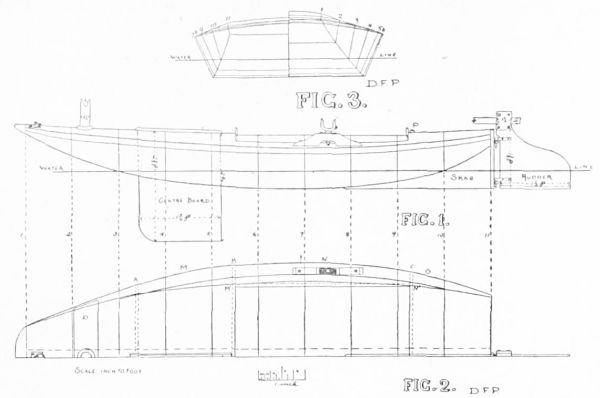
First, procure two hemlock boards—being the cheapest—10 feet long. Take off in the proper scale, from body plan of boat, Fig. 3, the sections numbered 1, 2, 3, 4, etc. Instead of cutting out curve of deck, as shown in body plan, make the part flat where the curve should be, as shown in mould No. 6. Carefully draw them upon pieces of planed pine boards. With a saw go over the lines and cut the sections out, taking great care, as the shape of your boat will depend upon these sections.
Lay the hemlock boards on the floor, and nail strips across them, leaving an opening of 8 inches between the boards. Turn the boards over, and with pencil marks divide them at every foot, and fasten the sections, narrower side up, strongly upon these boards in the order and manner shown in Nos. 6 and 7. It is better to fasten the mould (planks and sections) together with screws, as it will be easier to take apart when done with, thus enabling the wood in it to be used in the construction of the boat.
We will now commence on the boat proper. The work so far is only preparatory, it being necessary to have the mould to hold the planking of the boat in place until the braces and ribs can be put in. Take two half-inch pine boards 10-1/4 feet long, and nail one lightly on each side of the mould. With a fine gimlet bore a small hole through the board where it meets the angles formed by each section, as shown in No. 7 on mould. Take the board off again, and bending a thin moulding so that it passes through each gimlet hole, trace a pencil line around the outside of the moulding. After having done this with the four lines of holes, go over the pencil lines with a saw, and you have your side planks finished. Nail one of these on each side of the mould narrower ends to section No. 2, allowing the extra ends to project beyond 2, driving the nails in the holes made the first time, using as few nails as possible, and taking care that the upper edges of boards are on a level with the upper edges of the sections.
Select a nice piece of wood—oak, if possible—18 inches long, 6 inches wide by 3-3/4 inches thick, and make the horizontal stern-post (No. 9). The side and half-breadth plans are shown in the cut, but to get section through A B use section No. 1, body plan (Fig. 3) The rabbetting is half-inch deep, and is intended to receive the side, deck, and bottom planking.
Cut from a piece of three-quarter-inch plank the section numbered 11. This is the stern-board. Withdraw the nails holding the side planks to section 11 in the mould, and knock the section off the mould, substituting for it the stern-board. You are now ready to put on the bottom boards, which are of half-inch material. These are nailed on crosswise, the ends of the boards resting on the top of the sides. Screw on the stern-post, putting side B C uppermost.
We have now finished the shell of our boat, and we must dispense with the mould before the work can continue. Having placed braces between sides at M, N, and O, Fig. 2, carefully withdraw the nails that hold the sides to the sections, and lift the mould out.
Take a three-quarter-inch board 10 feet 5 inches long by 4 inches wide, and measure off from one of the ends two points 2 feet 4 inches and 4 feet 4-1/2 inches distant, respectively, marking these points with a pencil. Between these points cut with a chisel a slot 1-1/4 inches wide, extending through the board, and at each end, distant a half-inch from end of slot, cut a hole 1 inch long and half an inch wide. Nail this plank down the centre of the boat, inside, nailing it securely and with plenty of nails to the bottom boards, where the slot is cut in the plank (keelson). Now, with a chisel, continue the slot through the bottom boards. Take two pieces of wood 2-1/2 inches wide, 1-1/4 inches thick, and 12-3/4 and 10-7/8 inches in length, respectively, and cut them at one end, so that they will fit tightly in the little slots in keelson, and put them in place, the shorter one nearest bow (No. 5) Cut out deck beams B and C, fastening them at B and C, and knock away braces.
To get the curve of the deck beams A, B, and C (Fig. 2), we will take curve of A. To proper scale draw a line equal to width of boat at A. Measure height from gunwale to crown of deck at A, and draw a perpendicular at centre of line equal to this distance. Describe an arc touching the extremities of the line and passing through the top of the perpendicular, and this arc is the curve desired.
DETAILS OF THE BOAT.
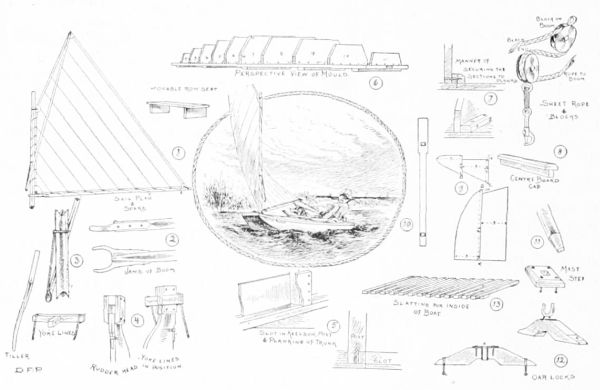
We will now plank the centreboard trunk, and this should be done with care, as there is nothing more annoying and troublesome than a leaky trunk. Put in brace A, which is in two pieces, extending from each side of trunk to gunwale. Nail on the keelson, alongside the board trunk, two strips of wood, which will serve as braces for the trunk. At the top, nail between A and B two strips of wood to support the top of trunk, making the upper edges of these braces come half an inch above the deck beams. Now fasten in the beams at sections 4 and 5, taking the curves of the beams from the respective sections. Make mast step, and bolt it to the middle of keelson. Take a piece of wood 2 feet 6 inches long, 6 inches wide, cut a hole in the centre of it, and shape and fit it in at D (Fig. 2). This is to serve as the mast brace. Cut from a piece of three-quarter-inch board two pieces of wood 3 feet 9 inches long and 2 inches thick, and fasten them between beams B and C, one on each side, and eighteen inches from the centre of the boat. Put in deck beams 6, 7, 8, and 9 from gunwale to these frames, taking the curves for the requisite length from the respective sections. Put in the rest of deck beams. Now with half-inch boards plank the deck. Between 6 and 7, 8 and 9, on each side, fit in a piece of three-quarter-inch board, which is to hold the oarlocks.
Take a quarter-inch board, 4 inches wide, and cut from it two pieces 3-3/4 feet long. These will form the side coaming of the cockpit, screwing them on so that their bottom edges shall be flush with bottoms of cockpit braces, M' N'(Fig. 2). From a piece of quarter-inch plank cut the two pieces of end coaming, making these follow the curve of the deck, and projecting 1-1/2 inches above it.
Cut from a piece of 1-3/4-inch stuff the oarlocks shown in No. 12. Through centre of raised part bore hole to receive iron ring. Screw projection at top to lock. The lock is now completed, and the next thing is to secure it to the deck of the boat with bolts. The skag comes next. Out of a three-quarter-inch board cut the pattern shown in Fig. 1, and with bolts and screws secure it to the boat's bottom in the position shown in Figs. 1 and 2. From a piece of oak 15 inches long, 2 inches wide, and three-quarters of an inch thick cut the stern-post shown in No. 10, and fasten it, broader side on stern-board and narrower side on end of skag. Screw in the stern-post the rudder braces, making one on narrow end 1-1/2 inches from end, and the other 10-1/2 inches above this.
Give the deck of your boat a good coat of paint, and after it has dried tack heavy canvas over it. The centreboard is of the "dagger" pattern so commonly seen in the small bateau and skiff on the Shrewsbury River and vicinity. Fig. 1 shows all the essential points. The rudder is of seven-eighths-inch plank, and after a careful study of No. 4 its construction can be readily understood.
The hull of the boat is now complete, and we will turn our attention to the rigging. The mast is 7 feet 3 inches long, and 2-1/2 inches thick at the deck, tapering towards the top. The boom is 9 feet 1 inch in length, excluding jaws, and should be about the same thickness throughout the whole length, having only a slight taper towards the end. Each jaw should be made of a separate piece of wood, in shape shown in No. 2, and fastened to boom in manner shown in cut. The sprit is a three-quarter-inch pole 9 feet 9 inches long.
The sail is the next thing to attend to, and being quite small, may be made at home. Its dimensions are: along the mast, 5 feet; on boom, 9 feet; top, 5 feet; from end of boom to end of sprit, 11 feet 4-1/2 inches. The general shape may be taken from drawing, and it will be necessary to give only a few hints in addition. The extra patches seen at corners of sail are pieces of heavy canvas put there to prevent it from ripping, the heaviest strain coming at the corners. The eyelets at the corners had best be formed by first cutting a round hole in the canvas, and then, with an "over-and-over" stitch, sewing a small iron ring in the hole. The edges are bound with strips of canvas enclosing a small cotton rope. The sail is laced to mast and boom in manner shown in cut, and in No. 3 is seen the manner of slinging lower end of sprit, whilst the upper end, which is sharpened, is poked through the eyelet.
To reef the sail it is only necessary to remove the sprit, and this will reduce the area of the sail nearly half. The sheet rope is rigged in the manner shown in No. 8, the boom block being fastened at Y (No. 1), boom rope at Z, and the snap-hook caught in the staple P in deck (Fig. 1). To take down sail, unhook snap-hook, take out sprit, raise boom up alongside the mast, and lift the mast out.

The controversy over Ehrich, the Harvard School catcher, has been settled by the I.S.A.A. Executive Committee, and the championship pennant has been awarded to the protested nine. More inconsistent and illogical action could not have been taken, and the way it was done reflects little credit upon the dignity of the association. Controversies such as this one are always regrettable; but when they do arise they ought to be settled upon their merits, and all personal feeling in the matter should be disregarded. Ever since De La Salle protested Ehrich, the delegates from the various schools to the I.S.A.A. have dodged around the question to be decided by them, and have adopted a policy of irresolution and delay. Several meetings have been called, but not until this last one was there a quorum present—and this was a quorum with a very small q. The delay between the time the protest was filed and the day the decision was made was put to very good use by the Harvard scholars. They did what politicians would call "some tall lobbying." They did it to such good effect that the vote stood 15 to 5 in favor of Ehrich.
The arguments advanced by them in favor of their man were truly amusing, and none but the most obliging of delegates would have consented to allow the wool to be so gracefully pulled over their drooping eyes. These arguments were to the effect that although Ehrich had spent a year in the sub-Freshman class of the College of the City of New York, he had failed to pass his entrance examinations into the Freshman class in 1894. Nevertheless, he was admitted to that class, and remained a member of it until the Christmas term examinations, when he failed again, and so left C.C.N.Y. for the more congenial precincts of the Harvard School. Therefore, according to the Harvard representatives, Ehrich was never really a member of the C.C.N.Y. Freshman class, because he did not pass his Christmas examinations. The mere fact that he attended recitations with the class, and enjoyed other privileges of Freshmen, has nothing to do with the case. This is inconsequential, and the De La Salle men were really drawing the line too fine when they referred to it. At least so must have thought the members of the I.S.A.A. committee, for they so decided. If Ehrich had passed his examinations he would have gone on with his class at C.C.N.Y. This was no doubt his intention before Christmas.
But the incident is closed now. Harvard School has the pennant, and the whole matter may as well be dropped. I don't suppose the members of the I.S.A.A. committee feel very proud of their work. They find themselves now in a peculiar position. By awarding the championship to Harvard they practically admit that they had no business sending the De La Salle nine to represent the League at Eastern Park four weeks ago. Their only justification for sending that team to Brooklyn would have been to award them the championship. But in all these incidents some lesson is to be learned. From this one I think we can gather that protestors should not wait until the last moment to make their objections, unless, of course, the act to be protested is not committed until this very last moment arrives. Another lesson is that executive committees ought to attend to their business promptly, and decide knotty points in time for their decision to be of some value—not a month after the contest to be affected has been settled.
The standing of the several nines in the N.Y.I.S.B.B. League, according to the games played, is therefore as follows:
FIRST SECTION.
April 23.—Harvard, 8; Berkeley, 7.
April 30.—Woodbridge, by default from Columbia Inst.
May 7.—Columbia Gram., 30; Barnard, 4.
May 14.—Harvard, 15; Woodbridge, 0.
May 21.—Harvard, 19; Columbia Gram., 1.
SECOND SECTION.
April 25.—Condon, 20; Columbia Inst., 19.
May 2.—Cutler, 7; Drisler, 3.
May 9.—De La Salle, by default from Hamilton.
May 16.—Cutler, 13; Condon, 0.
May 23.—De La Salle, 25; Cutler, 5.
FINAL GAME.
May 31.—Harvard, 12; De La Salle, 8.
The Harvard School team suffered no defeat, and had to play three games to win the first section series. The De La Salle team had only one game to play to win the second section, Hamilton defaulting on May 9th. Few of the games were close or exciting, as most of the scores will show, and it is to be hoped that next year a greater interest will be displayed in our national sport.
The authorities at St. Paul's School, Concord, go to the opposite extreme, in matters connected with outdoor sport, from the course adopted by many other large schools. I mean in regard to publicity. In New York, especially, many principals of schools believe that the welfare of the institutions over which they preside is best promoted by a reasonable amount of newspaper notoriety. The students at those schools hold the same opinion; and as a result we read a good deal about what is going on in the scholastic circles in this city, and we constantly see portraits of the rising young athletes printed in the daily papers. In Boston they go even further. For a column about schools printed in New York there is a page printed in Boston. The faces of the school athletes there are as well-known to the public as those of the most prominent amateurs or professionals. Too much of that sort of thing, of course, is bad, because there are young men who are thus led to believe themselves much more important than they are. Really, the worth of a man in this world—no matter what his sphere in life may be—is not gauged by the number of inches he can occasionally command in a double-leaded column with a spread head and a portrait.
The vice-rector of St. Paul's is of the conviction that school sports of late have run wild, and that the best way to keep them within bounds is to avoid any publicity whatever. I agree with the vice-rector that this is a good enough way, but I am not at all of the opinion that it is the best way. Newspaper enterprise and competition have become so great of late that it is very difficult to withhold from the public any matter of real importance. If one paper does not get it, another will. If the newsgatherer does not obtain all the facts, there will be just enough printed to give an erroneous and unfortunate impression to the reader. It is my opinion that a regulated publicity is best. Any newsgatherer who feels confident that he is getting just as much as his neighbor, and that the information given to him is reliable, will never abuse the privilege by making sensational use of the material. It is usually when information is withheld that sensationalism is called in. The reading public wants something, and the paper that has not got facts to give cooks up something as a substitute. The man who withheld the facts seldom likes the substitution.
These reflections have been called up by the reminiscence of the manner in which the Halcyon and Shattuck boat club races of St. Paul's were conducted three weeks ago. They were held on June 11th, at eleven o'clock in the morning; but as this fact had been withheld from public knowledge the spectators were practically limited to the boys of the school. Of course that is just what the vice-rector wanted. But is he right in this? Why not let the good people of Concord stand upon the shores of Penacook Lake and watch the race between these crews of healthy American boys? Is there anything about sport, as conducted at St. Paul's School, that the vice-rector, or any one else, should be ashamed of? Of course not! Then why not be open and aboveboard about it? Why race when the townsman's back is turned? Why deprive him of a little healthful cheering and an inspiriting sight? He would surely be the better for it, and the St. Paul's crew would be none the worse.
The races this year were most interesting, and one incident of the six-oared race was thrilling. At a point about half-way down the course, while the Shattucks and the Halcyons were still about even, Oglebay, who was rowing No. 2 in the Shattuck boat, broke his oar-lock. Of course his muscle was of no further avail, and thenceforth he could be but a passenger, so he did what every level-headed oarsman does under the circumstance—he leaped into the water. He was picked up by a boat near by. But with only five men the Shattucks were unable to win. It is a sandy thing to do, this jumping into the water from a racing-shell, and while Oglebay is entitled to praise for leaping, he would most certainly have deserved censure if he had not jumped. In the race between Yale and the Atalanta crew on New Haven Harbor, in 1890, Phil Allen, stroke and captain, broke his oar and jumped into the sea. He was picked up by the referee's tug, and stood at the bow dripping wet as he watched his seven men defeat the crack amateur crew of New York. Allen got his training at St. Paul's—in fact, most of the best oarsmen of Harvard and Yale learned to row on Lake Penacook.
The first race of the day at this regatta was a contest between the Halcyon and Shattuck four-oared shells, which was easily won by the former, in 11 min. 21 sec. by about six lengths. The second race was the one in which Oglebay jumped, and the last was the contest for the school championship between the two eight-oared crews of the same clubs. The outcome replaced the Shattuck blue above the Halcyon crimson—the latter having been the champions for the past four years. The Shattuck stroke started at 39 to the minute, but soon fell to 37, and about half-way down the course dropped to 36. The winning crew led the entire distance, and their time was 9 min. 14-1/2 seconds.
Rowing as a scholastic sport has never been much practised in this country except at St. Paul's School, which aims rather more than any other American institution to follow the manners and customs of our Eton and Rugby cousins. And, as far as following the athletic customs and usages of the Britons is concerned, they could not do better at Concord, or anywhere else. There have been races every year on Lake Penacook since 1871, when the Halcyon crew defeated its rivals over a one-mile course in 8 min. 32 sec. But St. Paul's has peculiar advantages for the sport that other schools are deprived of. Years ago there was rowing at St. Mark's School, Southboro', but it was given up for a number of reasons. The sport is to be resumed, however, next spring: but the contests will be inter-class affairs. The day when we shall see interscholastic boat-races is far distant, I am afraid; although there is no reason why it should be.
Exeter and Andover used to row, too; but I don't remember that there ever was an Exeter-Andover race. Exeter is situated near enough to the sea to feel tide-water; and the Swamscott River is very broad near the town. Above it is dammed off, and the upper portion is locally known as Fresh River. The rowing used to be done on Salt River, below the dam. Shells were sent up to the school Athletic Association by Yale and Harvard, who were anxious to encourage the sport so as to obtain good material for their own crews, and for a number of years there were class races in the fall and spring. But after the novelty of the thing had worn away, and no race was arranged with Andover, interest flagged, and in 1883 or 1884 the sport was abandoned, and the old boat-house was left to decay and fall to pieces. The colleges sent shells to Andover, too, and there was some desultory rowing there for a few years, but it was finally abandoned ten or twelve years ago, probably for the same reason that Exeter gave it up—because no interscholastic contest was arranged. It is to be hoped that it will be revived, for there is no better sport on the calendar, and, from a spectacular point of view, it is far ahead of many games that now enjoy wide popularity.
WISCONSIN INTERSCHOLASTIC A.A. FIELD-DAY AT MADISON, JUNE 8, 1895.
Events.Winners.
100-yard dashA. Kraenzlein, E.S.10-2/5sec.
120-yard hurdleA. Kraenzlein, E.S.17-3/5"
220-yard dashC. Meyst, S.S.24-3/5"
220-yard hurdleA. Kraenzlein, E.S.27-4/5"
440-yard runE. Baer, M.A.53-3/5"
880-yard runA. Donkle, M.H.-S.2m.14-1/5"
Mile runA. Donkle, M.H.-S.5"3/5"
Mile walkF. Shepard. M.H.-S.9"36"
Putting 12-lb. shotA. Kraenzlein, E.S.37ft.7-1/2in.
Throwing 12-lb. hammerR. Worthington, W.H.-S.103"11"
Running high jumpA. Kraenzlein, E.S.5"6-1/8"
Running broad jumpClifford, M.H.-S.20"6"
Pole vault{ Smith, E.H.-S. }
{ Doolittle, E.H.-S. }10"1/2"
Events.Second.Third.
100-yard dashJ. Fox, M.A.C. Meyst, S.S.
120-yard hurdleJ. Fox, M.A.C. Kratsch, S.S.
220-yard dashM. Price, Edg.A. Blodgett, E.S.
220-yard hurdleS. Lyle, M.H.-S.
440-yard runA. Blodgett, E.S.Berryman, M.H.-S.
880-yard runB. Steinel, E.S.Mueller, S.S.
Mile runP. Estes, S.S.K. Martin, M.A.
Mile walkH. Helms, S.S.Brown, M.H.-S.
Putting 12-lb. shotWorthington, W.H.-S.Knapp, M.H.-S.
Throwing 12-lb. hammerSchilling, M.H.-S.Knapp, M.H.-S.
Running high jumpJ. Fox, M.A.Wilson, W.H.-S.
Running broad jumpTrott, W.H.-S.Wilson, W.H.-S.
Pole vaultLean, W.H.-S.
Firsts count 5. Seconds 3. Thirds 1.
E.S., East Side, Milwaukee. S.S., South Side, Milwaukee. M.A., Milwaukee Academy. M.H.-S., Madison High-School. W.H.-S., Whitewater High-School. E.H.-S., Evansville High-School. Edg., Edgerton High-School.
The accompanying table shows what records were made by the athletes of the Wisconsin I.S.A.A. at their first annual field day which occurred on June 8th, on the campus of the University of Wisconsin at Madison. The 8th day of June was a great one for track and field sports all over the country, apparently. For a youngster this Wisconsin association is in a flourishing condition, and great is its prowess. Ten schools constitute its membership, and nearly one hundred entries were down on the programme for the field day. The Milwaukee East Side High-School took first place with 32 points, 25 of which were made by Kraenzlein, who won five firsts. He is a promising all-round athlete. When it is taken into consideration that he ran his three races within an hour or so, such time as 10-2/5 sec. for the 100, 17-3/5 sec. for the high, and 27-4/5 sec. for the low hurdles is remarkable. These records will doubtless stand at Madison for some years to come.
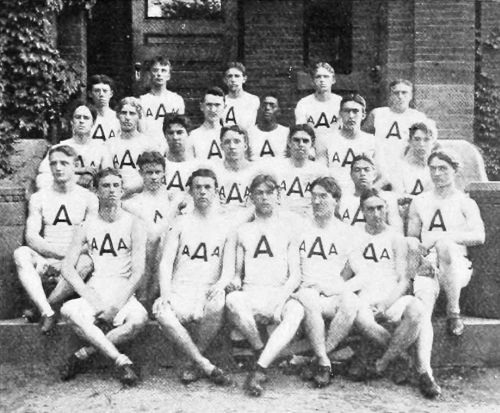
ANDOVER'S TRACK ATHLETIC TEAM.
The day after to-morrow will be another great day for outdoor sports. The biggest field meeting in the neighborhood of New York will be that of the New Jersey Athletic Club at Bergen Point. Several of the school athletes who have made records for themselves the past season have entered, and if they manage to do as well as they did at Travers Island on the 15th of last month they will soon establish a high reputation. Baltazzi will jump, but only high enough to win. He has been training hard lately, and can do six feet now beyond question. But he is keeping these extra inches up his sleeve for the Britishers in September.
The Graduate.
This Department is conducted in the interest of Girls and Young Women, and the Editor will be pleased to answer any question on the subject so far as possible. Correspondents should address Editor.
Warm? Well, what else can we expect? Here it is July, with our thoughts all flying out like banners in the breeze toward the day of which we are proudest in the whole year, The Fourth! No other day has "the" before it, and no other has so splendid a meaning for us Americans. I never think of it without a thrill of joy, and a sort of happy "Hail Columbia" feeling, and no matter how sultry it may be I want to go to the piano and play
"My country 'tis of thee, Sweet land of liberty— Of thee I sing; Land where my fathers died, Land of the pilgrims' pride, From every mountain-side Let freedom ring!"
In my childhood we used to keep Independence Day in a very patriotic spirit. Waking in the morning, our eyes saw flags and festoons of bunting—the red, white, and blue—interwoven with evergreens on churches, houses, and lamp-posts. Scaffolds were erected from which eloquent speakers addressed open-air meetings, churches held services, and everybody, young and old, listened to the Declaration of Independence read by some Senator, or ex-Governor, or other distinguished personage. The Sunday-schools walked in procession, all the girls in white, with badges or sashes of the dear colors we loved, the boys with white duck trousers, and blue jackets with brass buttons, and they had badges too. It was really fine. Soldiers and martial music—bugles, drums, fifes, playing their loudest—picnics, and fire-crackers galore signalized the day, which was further endeared to children by cherry-pie at dinner, and ice-cream following fireworks in the evening. Tired and happy we went to bed, and we were confirmed by these delightfully patriotic Fourths in our love of country.
Florence and Eva, looking languidly up at this point, observe that the Fourth in these days is too warm for so much exertion.
It is very much as one looks at it whether one is to suffer or enjoy most during the summer. Fretting and fidgeting and violent fanning add to one's discomfort. To go right on with one's work, and neither think nor care for the heat, often enables one to forget it, and if the mind be only held superior, the body does not so much mind being too warm or too cold. Some foolish people actually fuss and fume themselves into fevers, when summer is reigning in her bounty, ripening fruits and grains, and giving us her splendid skies and sunsets.
To keep the house cool in July, air it thoroughly in the early morning, then close the windows and screen doors, and darken bedrooms and parlors. A dark closed room will be comfortable at mid-day. Select a cool window, or a corner of the veranda, and carry your books and sewing there, or establish yourself under a tree. Eat cold dishes and ripe fruit. Fan moderately. Do not drink quantities of iced water. Do not let yourself be annoyed or vexed with any one. Bathe at least twice a day, and think pleasant thoughts.
A lawn party is charming for a late afternoon in summer. Invite your friends to come from five to eight o'clock. Spread rugs on the grass, and bring out some small tables and rocking-chairs. For refreshments have lemon sherbet, sponge-cake, ice-cream, snow-pudding, iced tea or coffee, thin sandwiches, or anything else you like. Play lawn-tennis or croquet, or any other game you choose.