STORIES IN AMERICAN LITERATURE.
Reading edition
BY HENRIETTA CHRISTIAN WRIGHT.
NATHANIEL HAWTHORNE.
In the old seaport town of Salem, with its quaint houses with their carved doorways and many windows, with its pretty rose gardens, its beautiful overshadowing elms, its dingy court-house and celebrated town pump, Hawthorne passed his early life, his picturesque surroundings forming a suitable setting to the picture we may call up of the handsome imaginative boy whose early impressions were afterward to crystallize into the most beautiful art that America has yet known. Behind the town stood old Witch Hill, grim and ghastly with the memories of the witches who had been hanged there in colonial times. In front spread the sea, a golden argosy of promise, whose wharves and store-rooms held priceless stores of merchandise.
ONE OF THE BOY'S FAVORITE OCCUPATIONS.
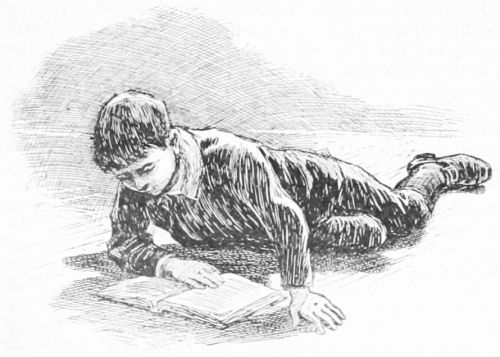
Hawthorne's boyhood was much like that of any other boy in Salem town. He went to school and to church, loved the sea, and prophesied that he would go away on it some day and never return, was fond of reading, and was not averse to a good fight with any of his school-fellows who had, as he expressed it, "a quarrelsome disposition." He was a healthy, robust lad, and life seemed a very good thing to him, whether he was roaming the streets of Salem, sitting idly on the wharves, or at home stretched on the floor reading one of his favorite authors. As a rule all boys who have become writers have liked the same books, and Hawthorne was no exception. When reading, he was living in the magic world of Shakespeare and Milton, Spenser, Froissart, and Pilgrim's Progress. This last was a great and special favorite with him, its lofty and beautiful spirit carrying his soul with it into those spiritual regions which the child mind reverences without understanding.
For one year of his boyhood he was supremely happy in the life of the wild regions of Sebago Lake, Maine, where the family moved for a time. Here, he says, he lived the life of a bird of the air, with no restraint, and in absolute supreme freedom. In the summer he would take his gun and spend days in the forest, shooting, fishing, and doing whatever prompted his vagabond spirit at the moment. In the winter he would follow the hunters through the snow, or skate till midnight alone upon the frozen lake, with only the shadows of the hills to keep him company, and sometimes passing the remainder of the night in a solitary log cabin, whose hearth would blaze with the burning trunks of the fallen evergreens.
He entered Bowdoin in 1821, and had among his fellow-students Henry Wadsworth Longfellow, Franklin Pierce, afterward President of the United States, and several others who distinguished themselves in later life. Long afterward Hawthorne recalls his days at Bowdoin as among the happiest of his life, and in writing to one of his old college friends speaks of the charm that lingers around the memory of the place, where he gathered blueberries in study hours; watched the great logs drifting down from the lumbering districts above along the current of the Androscoggin, fished in the forest streams, and shot pigeons and squirrels at odd hours which ought to have been devoted to the classics.
NATHANIEL HAWTHORNE.
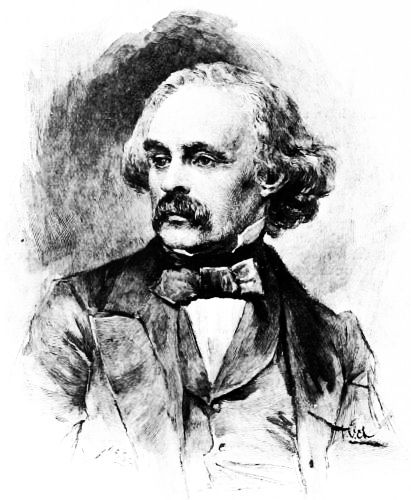
After leaving Bowdoin, Hawthorne returned to Salem, where he passed the next twelve years of his life, and during which he must have marked out authorship as his profession, as he attempted nothing else. Here he produced, from time to time, stories and sketches which found their way to the periodicals of the day, and which won for him a reputation among other American writers. But it is remarkable that the years which a man devotes usually to the best work of his life were spent by Hawthorne in a contented half-dream of what he meant to accomplish later on; for exquisite as is some of the work produced at this time, it never would have won for the author the highest place in American literature. These stories and sketches were collected later on, and published under the titles Twice-Told Tales and Snow Image. They are full of the grace and beauty of Hawthorne's style, but in speaking of them Hawthorne himself says that there is in this result of twelve years little to show for its thought and industry. But whatever may have been the cause of delay, the promise of his genius was fulfilled at last. In 1850, when Hawthorne was forty-six years old, appeared his first great romance. In writing this book Hawthorne had chosen for his subject a picture of old Puritan times in New England, and out of the tarnished records of the past he created a work of art of marvellous and imperishable beauty.
In the days of which he wrote a Puritan town or village was exactly like a large family bound together by mutual interests, in which the acts of each life were regarded as affecting the whole community. In this novel Hawthorne imprisoned forever the spirit of colonial New England, with all its struggles, hopes, and fears; and the conscience-driven Puritan, who lived in the new generation only in public records and church histories, was lifted into the realm of art.
In Hawthorne's day this grim figure, stalking in the midst of Indian fights, village pillories, town meetings, witch-burnings, and church councils, was already a memory. He had drifted into the past with his steeple-crowned hat and his matchlock. He had left the pleasant New England farm-lands with their pastures and meadows, hills and valleys and wild-pine groves, and lurked like a ghost among the old church-yards and court-houses where his deeds were recorded.
Hawthorne brought him back to life, rehabilitated him in his old garments, set him in the midst of his fellow-elders in the church, and gave him a perfect carnival of trials and worries for conscience' sake. He made the old Puritan live anew, and never again can his memory become dim. It is embalmed for all time by the cunning art of this master-hand.
This first romance, published under the title The Scarlet Letter, revealed both to Hawthorne himself and the world outside the transcendent power of his genius.
Hawthorne, when the work was first finished, was in a desperate frame of mind, because of the little popularity his other books had acquired, and told his publisher, who saw the first germ of the work, that he did not know whether the story was very good or very bad. The publisher, however, perceived at once the unusual quality of the work, prevailed upon Hawthorne to finish it immediately, and brought it out one year from that time, and the public, which had become familiar with Hawthorne as a writer of short stories, now saw that it had been entertaining a genius unawares.
Hawthorne's next work, The House of the Seven Gables, is a story of the New England of his own day. Through its pages flit the contrasting figures that one might find there and nowhere else. The old spinster of ancient family who is obliged in her latter years to open a toy and ginger-bread shop, and who never forgets the time when the house with seven gables was a mansion whose hospitality was honored by all, is a pathetic picture of disappointed hope and broken-down fortune. So also her brother, who was imprisoned under a false charge for twenty years, and who is obliged in his old age to lean upon his sister for support. The other characters are alike true to life—a life that has almost disappeared now in the changes of the half-century since its scenes were made the inspiration of Hawthorne's romance.
The House of the Seven Gables was followed by two beautiful volumes for children: The Wonder-Book, in which the stories of the Greek myths are retold, and Tanglewood Tales.
In The Wonder-Book Hawthorne writes as if he were a child himself, so delicious is the charm that he weaves around these old, old tales. Not content with the myths, he created little incidents and impossible characters, which glance in and out with elfin fascination. He feels that these were the very stories that were told by the centaurs, fairies, and satyrs themselves in the shadows of those old Grecian forests. Here we learn that King Midas not only had his palace turned to gold, but that his own little daughter Marigold, a fancy of Hawthorne's own, was also converted into the same shilling metal. We are told, too, the secrets of many a hero and god of this realm of fancy which had been unsuspected by any other historian of their deeds. No child in reading The Wonder-Book would doubt for a moment that Hawthorne had obtained the stories first hand from the living characters, and would easily believe that he had hobnobbed many a moonlit night with Pan and Bacchus and other sylvan deities in their vine-covered grottos by the famed rivers of Greece. This dainty ethereal touch of Hawthorne appears especially in all his work for children. It is as if he understood and entered into that mystery which ever surrounds child life and sets it sacredly apart. It is the same quality, nearly, which gives distinction to his fourth great novel, in which he is called upon to deal with the elusive character of a man who is supposed to be a descendant of the old fauns. We feel that this creation, which is named Donatello, from his resemblance to the celebrated statue of the Marble Faun by that sculptor, is not wholly human, and although he has human interests and feelings, Hawthorne is always a master in treating such a subject as this. He makes Donatello ashamed of his pointed ears, though his spirit is as wild and untamed as that of his crude ancestors. In this book—which takes its name from the statue—The Marble Faun, there is a description of a scene where Donatello, who is by title an Italian count, joins in a peasant dance around one of the public fountains. And so vividly is his half-human nature brought out that one feels as if Hawthorne must have witnessed somewhere the mad revels of the veritable fauns and satyrs in the days of their life upon the earth. In the whole development of this story Hawthorne shows the same subtle sympathy with natures so far out of the commonplace that they seem to belong to another world. The mystery of such souls having the same charm for him as the secrets of the earth and air have for the scientist and philosopher.
AT BROOK FARM.
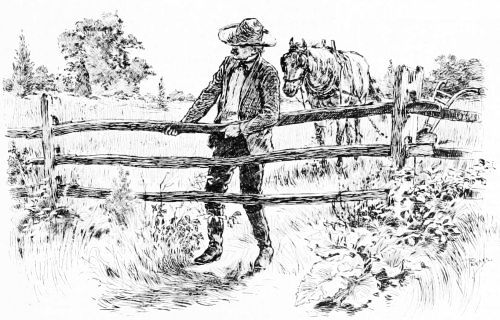
The book coming between The House of the Seven Gables and The Marble Faun is called The Blithedale Romance. It is founded partly upon a period of Hawthorne's life when he became a member of a community which hoped to improve the world by showing that to live healthily, manual labor must be combined with intellectual pursuits, and that self-interest and all differences in rank could only be injurious to a country. This little society of reformers lived in a suburb of Boston, and called their association Brook Farm. Each member was supposed to perform some manual labor on the farm or in the house each day, although hours were set aside for study and intellectual work. Here Hawthorne ploughed the fields like a farmer boy in the daytime, and in the evening joined in the amusements, or sat apart while the other members talked about art and literature and science, danced, sang, or read Shakespeare aloud.
Some of the cleverest men and women of New England became members of this community, the rules of which obliged the men to wear plaid blouses and rough straw hats, and the women to content themselves with plain calico gowns.
This company of serious-minded men and women, who tried to solve a great problem by leading the lives of Acadian shepherds, at length dispersed, each one going back into the world and working on as bravely as if the experiment had been a great success. The record of the life and experiences of Brook Farm are shadowed forth in The Blithedale Romance, although it is not by any means a literal narrative of its existence.
THE OLD MANSE.
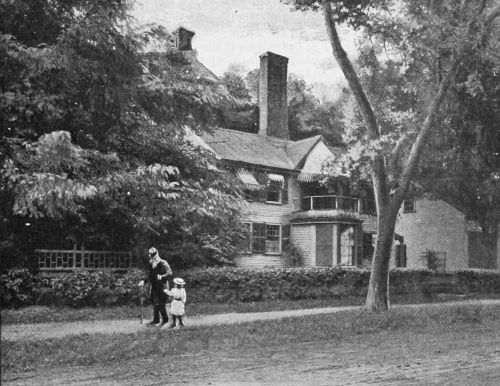
Hawthorne's early married life was spent at Concord, near Boston, in a quaint old dwelling called the Manse, and as all his work partakes of the personal flavor of his own life, so his existence here is recorded in a delightful series of essays called Mosses from an Old Manse. Here we have a description of the old house itself and of the author's family life, of the kitchen-garden and apple orchards, of the meadows and woods, and of his friendship with that lover of nature, Henry Thoreau, whose writings form a valuable contribution to American literature. The Mosses from an Old Manse must ever be famous as the history of the quiet hours of the greatest American man of letters. They are full of Hawthorne's own personality, and reveal more than any other of his books, the depth and purity of his poetic and rarely gifted nature.
In 1853 Hawthorne was appointed American Consul at Liverpool by his old friend and school-mate Franklin Pierce, then President of the United States. He remained abroad seven years, spending the last four on the continent. The results of this experience are found in the celebrated Marble Faun, published in Europe under the title Transformation. It was written in Rome, and it is interesting to know that the story was partly suggested to Hawthorne by an old villa near Florence which he occupied with his family. This old villa possessed a moss-covered tower, "haunted," as Hawthorne said in a letter to a friend, "by owls and by the ghost of a monk who was confined there in the thirteenth century, previous to being burnt at the stake in the principal square of Florence." He also states in the same letter that he meant to put the old castle bodily in a romance that was then in his head, and he carried out this threat by making the villa the old family castle of Donatello.
After Hawthorne returned to America he began two other novels, one founded upon the old legend of the elixir of life. This story was probably suggested to him by Thoreau, who spoke of the house in which Hawthorne lived at Concord, after leaving the old Manse, as having been the abode, a century or two before, of a man who believed that he should never die. This subject was a charming one for Hawthorne's peculiar genius, but the story, with another—the Dolliver Romance—was never completed, the death of Hawthorne in 1864 leaving the work unfinished.

This Department is conducted in the interest of Amateur Photographers, and the Editor will be pleased to answer any question on the subject so far as possible. Correspondents should address Editor Camera Club Department.
HOW TO DEVELOP CLOUD PICTURES.
Pictures taken simply of clouds, without special attention to the landscape, should be developed very slowly in order to bring out all the soft shadows, which are lost if the development is hurried.
Where clouds and landscape have been taken in one picture, the printing quality of the negative may be made uniform by careful development of the plate.
Place the plate in a rather weak developer, and as soon as the outlines of the landscape begin to appear take it out and place in a dish of clean water so as to arrest the development. Pour off the developer, put the plate back in the tray, and finish the plate with brush development. To do this take a soft camel's-hair brush or a small wad of surgeon's cotton, dip into the developer, and brush over the part of the plate which develops more slowly, which will be the landscape. As soon as this part is nearly developed flood the plate with a weak solution of developer, increasing it in strength till the sky is fully developed. Brush development requires a careful hand, but, like any other part of photography, becomes easy by repeated trials.
Another way of developing one part of the plate at a time is to take the plate from the tray as soon as the outlines appear; turn off the developer, and wash the plate. Put it back in the tray, and tip the tray so that the sky will be out of the developer, turn in the developer, and rock the tray gently to and fro, but do not allow any of the developer to touch the sky until the shadows in the landscape are well out.
When the shadows are nearly or quite developed flood the whole plate with the developer. The sky will develop very quickly, and if the process is carefully watched a fine even-printing negative will be the result. This plan of development is most successful where the horizon-line is not too much broken.
Having once succeeded in catching the clouds, one will never be quite satisfied with a landscape picture which has a perfectly clear sky.
We devote a little of our space this week to tell the Camera Club something about two publications which have been sent to the editor for inspection, and which are the work of some of the members of our club.
The first is entitled the Focus, a magazine issued by the Niepce Corresponding Club, and published by Sir Knight Arthur F. Atkinson, of Sacramento, California.
The literary matter is typewritten, and the illustrations are, with one exception, original photographs by members of the Chapter. The first illustration is a fine platinum print of the first-prize landscape picture which was published in Harper's Young People, March 26, 1895. The first article, entitled "Rural Photography," is a most amusing account of one J. Focus Snapschotte's attempt to take pictures in the country. The pen and-ink sketch of "Silas" does great credit to the artist, who we suspect is the publisher of the magazine, as the initials A. F. A. are the same.
The other articles are part of a continued story, a description of the prize landscape, an account of the capital of California, and matters connected with the club. The photographs do great credit to the members, and the whole magazine is very nicely arranged and embellished.
The second magazine is entitled Hints, and is published by Sir Knight George D. Galloway and Sir Knight George Johnson, Jun., of Eau Claire, Wisconsin.
As its name indicates, it is intended to help the amateur to do better work. Its object is stated at the beginning: "This is a practical periodical, and we know all who see it will say so too. From all the prints that are here exhibited you will get hints, and you will notice that your work will improve steadily in all respects."
This magazine is also illustrated with original photographs, among which we notice one which also appeared in the Camera Club Department a short time ago. It is by Sir Knight Andrew Phillips, of Nunda, New York, and is entitled "Knights and Ladies of the Camera Club."
Both of these publications cannot fail to be helpful to those members who have the privilege of examining them, for one is sure to learn something by "exchanging experiences." The Chapters which issue these magazines have reason to feel very proud of them.
A correspondent who signs herself "Sweet Marie" asks: 1. How to prepare the best and cheapest developer. 2. How to make sensitive paper. 3. How to prepare a polishing solution for ferrotype plates. 4. How to make a ruby lamp. 5. What is stronger water of ammonia. 6. What is bromide of ammonia.
As there are almost as many formulas for developers as there are amateur photographers, it would be quite impossible to say which one is the cheapest and best. Sir Knight William C. Davids, of Rutherford, New Jersey, sends the following formula, which he recommends very highly. We shall publish in our papers for beginners several formulas for developing solutions, with prices of chemicals.
Hydroquinon Developer.—Sodium sulphite, 460 grains; sodium carbonate, 960 grains; hydroquinon, 96 grains; water, 16 ounces.
1. Mix and filter before using. In No. 786 will be found a simple developer for instantaneous pictures. 2. Directions for preparing sensitive paper will be found in Nos. 786 and 803. 3. Directions for polishing ferrotype plates will be found in Nos. 797 and 805. 4. A ruby light for dark-room work may be made by taking a wooden starch-box, cutting a square hole in the cover, and pasting two thicknesses of red fabric over the opening. A hole must be made in one end of the box—which answers for the top of the lantern—to allow for ventilation. This must be shielded so as to prevent the escape of actinic rays. This may be done by pieces of tin bent so that air can enter, but no white light escape. A candle should be used with this style of lantern. 5. Ammonia in its pure state is a gas which combines readily with water, water taking up of the gas five hundred times its own volume. This is liquid ammonia, or stronger water of ammonia. By diluting it with water it becomes the spirits of hartshorn, or ammonia water. 6. Bromide of ammonia is formed in the simplest manner by the addition of bromine to water of ammonia. It is very useful in photographic work. It gives great sensitiveness to gelatine and collodion emulsions—combined with pyro for a developer it prevents fog—and is employed in the preparation of sensitive papers.
This Department is conducted in the interest of Girls and Young Women, and the Editor will be pleased to answer any question on the subject so far as possible. Correspondents should address Editor.
Lillie M—— came to see me yesterday, and after she had gone, Maria G——, who was putting a new braid on my second-best gown, said:
"That Miss Lillie uses very nice perfumery. It's so faint and fine, not anything you can smell a long way off, but something which makes you think of roses or violets when she passes you on the street. How does she manage it?"
Maria G—— likes perfumes, but does not know how to use them.
"Not by putting cologne on her handkerchief," I answered, decidedly. "Nobody should carry about scents poured on their garments." I had to say this.
Perfumes are used sparingly by elegant people, yet a touch, a vague sense of fragrance, does add something of daintiness to a girl's toilette. It is right for you to have perfumes about you if you love them.
Fresh rose-leaves thrown into your bureau drawers and scattered in the boxes where you keep your laces and handkerchiefs, and sprigs of lavender or lemon verbena left there to dry will impart a pleasant sweetness to whatever lies among them. Orris-root powder in little sachet bags of China silk, or strewn lightly between folds of tissue-paper, will give to your clothing in closet or wardrobe a delightful faint odor of violet. If you use delicate soap with a sweet clean perfume, not of musk or anything strong and pronounced, and put a few drops of alcohol or ammonia in the water when you bathe, you need not be afraid of any unfavorable comment on your daintiness. Perfect cleanliness is always dainty. Soil and stain, dust and dirt, are never anything but repulsive.
Rose-leaves pulled from the perfect flower and laid in your box of note-paper when they are fresh will dry there, and insure your sending to your friends notes which will associate you with fragrance. There is an exquisite perfume in dried roses.
How do you seal your letters, by-the-way? I hope you have at hand a bit of sponge and a tiny glass of water with which to moisten the mucilage on the flap of your envelope. Better still is a little glass cylinder in a glass jar, a very ornamental and thoroughly clean affair, which can be procured at any stationer's. The glass jar holds water. You turn the cylinder, and on its wet surface place your envelope. Postage stamps may be moistened in the same way.
When friends call, on these very sultry days, you offer them fans, do you not, and, if they wish it, a glass of cold water or lemonade? Palm-leaf or Japanese fans should be in every room in profusion during the summer solstice. When fans are broken at the edges renew them by a ribbon binding, and tie a jaunty bow on the handle. Very few things should be thrown aside as useless. While an article can be mended or renovated it is worth keeping, and a thrifty person never discards a household implement of any kind until she is convinced that it is worn out.
Ribbon plays an important part in decoration. A bow on the corner of mamma's sewing-chair, on the dressing-glass which hangs over the table, on the little birthday package you send your friend, gives each a sort of gala look. The plainest furniture in the plainest bedroom may be brightened and made attractive by good taste, a few yards of cheap netting or lace, and the judicious use of ribbon. Clever fingers can accomplish wonders with very little money.
A girl showed me one day a beautiful sewing-chair, white and gold as to frame-work, and cushioned with a lovely chintz, a white ground thickly sprinkled with daisies.
"There!" she said. "Mamma gave me permission to use anything I could find in our attic, and I hunted around till I came across this chair. Such a fright! It was dingy and broken, and fit for nothing but firewood. Look at it now. Two coats of white paint, some gilding, and this lovely cushion, and then this ravishing frill and box of yellow satin ribbon! Isn't it a triumph?"
I said, very sincerely, that I thought it was.
Bertha wishes me to tell her why lemonade is not always the rich refreshing drink it should be. Well, Bertha, everybody does not know how to make lemonade. I squeeze my lemons in a glass lemon-squeezer, mix in my granulated sugar with a lavish hand, and add the thinly pared rind of a lemon, dropping it in in circular strips. On this I pour boiling water, setting it by to cool, and, when cold, putting it away in the refrigerator. Then when served I add a strawberry, or a bit of sliced orange or banana, and some pounded ice, and the lemonade is delicious.