QUILL-PEN, ESQUIRE, ARTIST.
Reading edition
BY JOHN KENDRICK BANGS.
Jimmieboy had been looking at the picture-books in his papa's library nearly all the afternoon, and as night came on he fell to wondering why he couldn't draw pictures himself. It certainly seemed easy enough, to look at the pictures. Most of them were made with the fewest possible lines, and every line was as simple as could be; the only thing seemed to be to put them down, and in the right place.
"Why don't you try?" said somebody.
"Eh?" asked Jimmieboy, with a sudden start, for he had supposed he was alone.
"I say why don't you try?" replied the strange somebody.
"Try what?" queried Jimmieboy, who, not having spoken a word on the subject of drawing pictures, was quite sure that the question did not apply to that matter—in which certainly he was very much mistaken, as the strange somebody's next remark plainly showed.
"Try drawing pictures yourself?" said the voice.
"I can't draw," said Jimmieboy, peering over into the corner whence the voice came, to see who it was that had spoken.
"You can't tell unless you try," said the voice.
"A man might do a million things If he would be less shy, That all his life he never does, Because he will not try.
"Why don't you try?"
"Who are you, anyhow?" asked Jimmieboy. "Tell me that, and maybe I will try."
"Why, you know me," said the voice. "I am the Quill-pen over here on your mamma's table. Don't you remember how you nearly drowned me in the ink yesterday?"
"I didn't want to drown you," said Jimmieboy, apologetically. "I wanted you to write a letter for me to my Uncle Periwinkle, asking him to send me everything he thought I'd like as soon as he could."
The Pen laughed. "I'll do it some time—along about Christmas, perhaps," he said. "But about this picture business. I think you could make pictures."
"Can you make 'em?" queried Jimmieboy.
"I never tried, so I don't know," answered the Pen.
"Then you try, and let's see how trying works," suggested Jimmieboy. "I'll get a piece of paper for you."
"I'm afraid we can't," said the Pen. "I'm very dry, and don't think I could make a mark, unless you get me a glass of ink.
"For just as skates are not much use Without a skating rink, So pens—of steel or quills of goose— Are worthless without ink."
"Oh, I'll get plenty of ink," returned Jimmieboy, "though I think water would be saferer. Water would look pleasanter on the carpet if we upset it."
"I can't make a mark with water," laughed the Pen.
"How do you know?" asked Jimmieboy. "Did you ever try?"
"No, I never tried. Because why? What's the use?" replied the Pen.
"I do not try to touch the sky Or jump upon the stars; I do not try to make a pie Of rusty iron bars; I do not try to change into A baby elephant, Because I know—and always knew— 'Tis useless, for I can't."
"That's all very good," retorted Jimmieboy; "but a minute ago you were saying that
"'A man might do a million things, If he would be less shy, That all his life he never does, Because he will not try.'"
"You've got me there," said the Pen, with a smile. "Perhaps we had better use water. Now that I think of it, I have enough dried ink on me to make a mark if I am moistened up a bit with water. You get the water and the paper, and I'll see what I can do."
Jimmieboy ran into the dining-room and brought a glass brimming over with water to the Pen, and in another minute he had a large pad of paper ready.
"NOW," SAID THE PEN, "LET US BEGIN."
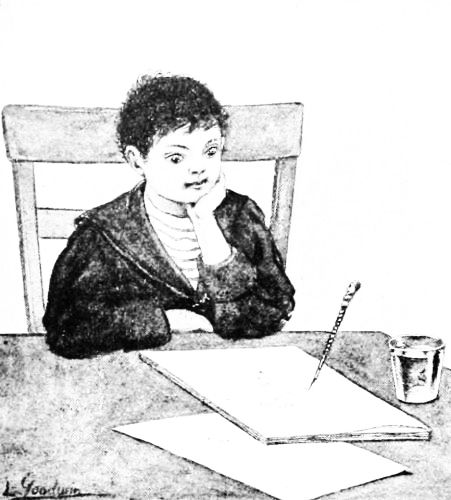
"Now," said the Pen, "let us begin. What shall I draw first?"
"I don't know," Jimmieboy replied. "Why not make a—er—a zebra.'"
"What's a zebra?" asked the Pen, who had never been to the circus, as Jimmieboy had, and who was therefore, of course, ignorant about some things of very great importance. "Is it a piece of furniture?"
"The idea!" laughed Jimmieboy. "Of course not. It's a sort of a small animal like a horse, and has—"
"Oh, I know," interrupted the Pen. "Here's one." Then he dipped his head lightly into the water, and wiggled himself about on the pad for a minute. "There," he said, "How's that for a zebra?"
ZEBRA.
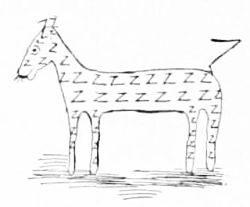
Jimmieboy laughed long and loud. "What on earth are those wiggle-waggles all over him?" he asked.
"Those are the Zees," explained the Quill. "Isn't that right?"
"No!" roared Jimmieboy. "He hasn't a Z to his name."
"Oh yes, he has," replied the Quill. "I know that much, anyhow. I have written many a zebra, though I never drew one before. They always begin with a Z, and end with a bray—like a donkey."
"I don't mean it that way. I mean he hasn't any Zees printed on him," explained Jimmieboy. "He's striped like the American flag."
"Why didn't you say so in the beginning?" said the Quill.
"I was going to, but you interrupted me, and said you knew all about it, and I supposed you did," said the boy.
"Well, let's try it again. He's a horse that looks like the American flag, you say?"
"Yes," said Jimmieboy—a little dubiously, however. He thought perhaps the zebra more closely resembled a piece of toast, but as he had mentioned the flag, he thought it would be better to stick to it.
"How is this!" asked the Quill, presenting the following picture to Jimmieboy. "Is that any more like a zebra?"
ZEBRA.
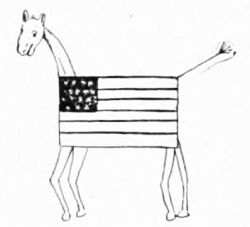
"It's the most ridiculous thing I ever saw," said Jimmieboy. "I didn't say he had stars on him."
"I know you didn't," retorted the Pen. "But that square might pass for a chest-protector, if any body ever criticised it."
"Well, it isn't anything like a Zebra," said Jimmieboy, firmly. "You'd better try making an elephant."
"That's easy," returned the Quill. "I never saw an elephant, but I've heard what they look like. Sort, of like pigs, with two tails, big flop ears, and paper-cutters for teeth, and great big huge large legs that look like bolsters. Oh, I can draw an elephant with my eyes shut."
L-EPHANT.
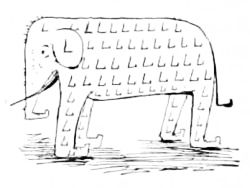
This the Pen proceeded to do at once, and here is his idea of the L-ephant.
"That's more like an elephant than either of the two zebras was like a zebra," said Jimmieboy, with a grin.
"Thank you," said the Pen, simply. "Which part have I done best, the L or the 'ephant?"
"Well, it's hard to say," smiled Jimmieboy. "I think the hair on his forehead is very much like that of the elephants I have seen, and then you've got his eye just right. I've seen elephants look exactly like that when they have caught sight of a peanut."
THE SWARM OF BEES.
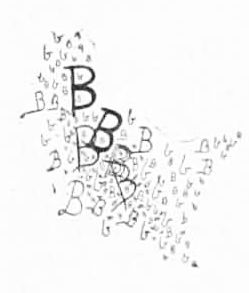
"How is this for a swarm of bees?" asked the Quill, gratified at his success, and dashing off this little artistic gem in an instant.
"Ho!" ejaculated Jimmieboy. "What kind of bees are those? They aren't the honey kind that sting."
"No, they are bees you can spell with, and don't sting," returned the Pen. "I like 'em better than the other kind."
"Can you draw ostriches?" asked Jimmieboy.
THE OSTRICH.
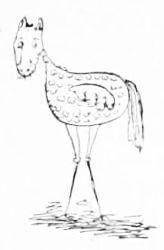
"I can try one," said the Pen. "How will this do?" he added, producing the following. "The horse part is all right, but I'm afraid the strich isn't so good," said the artist, as Jimmieboy threw himself on the floor in a paroxysm of laughter. "I never saw a strich, so why should I make a good one? I think it's real mean of you to laugh."
"Well, really, Penny," said Jimmieboy, "I don't want to hurt your feelings, but that's the worst-looking animal I ever saw. But never mind; it's a better-looking creature than most monkeys."
"I never saw a monkey," said the Pen. "How many legs has it?"
"Two legs, two arms, a tail, and a head," Jimmieboy answered.
THE MON-KEY.
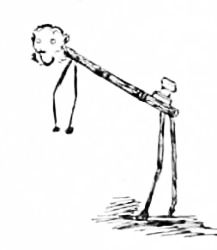
"Something like this?" queried the Quill, dashing off a picture complacently—he felt so sure that this time he was right.
"Very much like that," Jimmieboy replied, smothering his mirth for fear of offending the Quill, though if you will refer to the drawing you will see that the Quill was quite as inaccurate in his picture of the monkey as he was with his zebras.
"I thought I'd get you to admit that that was a good monkey," observed the Quill, regarding his work with pride. "I've seen a good many keys, and, of course, when you said the creature had two legs, two arms, a tail, and a head, I knew that he was nothing but a key to whom had been given those precious gifts of nature. To draw a key is easy, and to provide it with the other features was not hard."
Jimmieboy was silent. He was too full of laughter even to open his mouth, and so he kept it tightly closed.
"What'll I draw next?" asked the Quill, after a minute or two of silence.
"Can you do mountains?" queried Jimmieboy.
"What are they?" asked the Quill.
"They're great big rocks that go up in the air and have trees on 'em," explained Jimmieboy.
The Quill looked puzzled, and then he glanced reproachfully at Jimmieboy.
"I think you are making fun of me," he said, solemnly.
"No, I'm not," said Jimmieboy. "Why should you think such a thing as that?"
"Well, I know some things, and what I know makes me believe what I think. I think you are making fun of me when you talk of big rocks going up in the air with trees on 'em. Rocks are too heavy to go up in the air even when they haven't trees on 'em, and I don't think it's very nice of you to try to fool me the way you have."
"I don't mean like a balloon," Jimmieboy hastened to explain. "It's a big rock that sits on the ground and reaches up into the air and has trees on it."
"I don't believe there ever was such a thing," returned the offended Quill. "Here's what one would look like if it could ever be," he added, sketching the following:
MOUNTAIN.
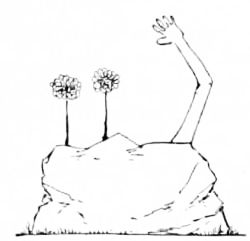
"What on earth!" ejaculated Jimmieboy.
"What? Why, a mountain—that's what!" retorted the Quill. "Don't you see, my dear boy, you've just proved you were trying to fool me. I've put down the thing you said a mountain was, and you as much as say yourself that it can't be."
"But—how do you make it out? That's what I can't see," remonstrated Jimmieboy.
"It's perfectly simple," said the Quill. "You said a mountain was a rock; there's the rock in the picture. You said it had trees on it; those two things that look like pen-wipers on sticks are the trees."
"But that other thing?" interrupted Jimmieboy. "That arm? I never, never, never said a mountain had one of those."
"Why, how you do talk!" cried the Quill, angrily. "You told me first that the rocks went up in the air, and when I showed you why that couldn't be, you corrected yourself, and said that they reached up into the air."
"Well, so I did," said Jimmieboy.
"Will you kindly tell me how a rock could reach up in the air, or around a corner, or do any reaching at all, in fact, unless it had an arm to do it with?" snapped the Quill, triumphantly.
Again Jimmieboy found it best to keep silent. The Quill, thinking that his silence was due to regret, immediately became amiable, and volunteered the statement that if he knew the names of flowers he thought he could draw some of them.
"Pansies, cowslips, and geraniums," suggested Jimmieboy.
"Good! Here you are," returned the Quill, rapidly sketching the following:
A PANSY. A COWSLIP. A POTTED G-RANIUM.
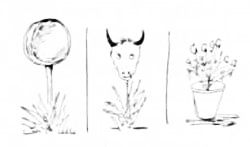
"That pansy," he said, as Jimmieboy gazed at his work, "is a frying-pansy. How is this for a battle scene?" he added, drawing the following singular-looking picture.
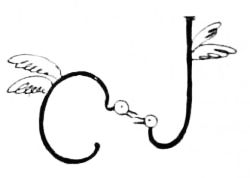
"Very handsome!" said Jimmieboy. "But—er—just what are those things? Snakes?"
"No, indeed," said the Quill. "The idea! Who ever saw a snake with wings? One is a C gull and the other is a J bird."
"Can you draw a blue bird?" asked Jimmieboy.
"I think so," answered the Quill, as he carefully drew this strange creature.
A BLUEBIRD.
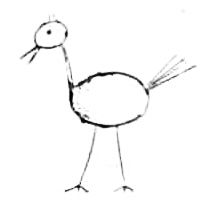
"You haven't given him any wings," said Jimmieboy, after carefully examining the picture.
"No: that's the reason he is blue. He has to walk all the time. That's enough to make anybody blue," explained the Quill. "Here's a puzzle for you!" he added. "Guess what it is, and I'll write to your Uncle Periwinkle and tell him if he'll come up here on Saturday with two dollars in his pockets, you will show him where you and he can get the best soda-water made."
STEEPLE-CHASING.
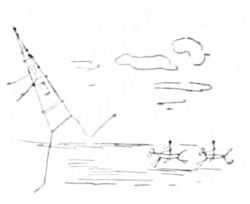
This is the picture the Quill then presented to Jimmieboy's astonished gaze.
"Humph!" said Jimmieboy. "It looks like two men on horseback running after something, but what, I'm sure I don't know."
"What does it look like?" asked the Quill.
"Nothing that I ever saw."
"Nonsense!" returned the Pen. "Does it look like a fox, or a Chinese laundry, or a what?"
"It doesn't look like any of 'em," insisted Jimmieboy.
"Dear me! How dull you are!" cried the Quill. "Why, boy, it's a church steeple, that's what. Now what is the whole thing a picture of?"
"A steeple-chase!" cried Jimmieboy.
"Exactly," said the Quill, very much pleased that after all Jimmieboy had guessed it. "And now I'll write that letter to Uncle Periwinkle."
And so he wrote;
P. S.—Dear Uncle Periwinkle,
Come up on Saturday. Bring all the money you've got, and the soda-water we'll have will sail a yacht. If you can't come, send the money, and I'll look after sailing the yacht.
Yours affectionately, Jimmieboy.
"Will that do?" asked the Quill.
"Yes," said Jimmieboy. "And now put it in an envelope, and I'll put it with the letters to be mailed."
"Now draw some more," he said, after this had been mailed.
But the Quill answered never a word. He had evidently fallen asleep. Strange to say, Uncle Periwinkle never got his letter, and the pictures the Quill made all faded from sight, and so were lost.