SAVING A TORPEDO-BOAT.
Reading edition
ONE OF THE OLD SAILOR'S YARNS.
BY W. J. HENDERSON.
It was a day of southwesterly weather, one of those days on which shower follows shower across the murky and writhing sky, and the air feels like water atomized. The boys had grown tired of sitting in the house, and having donned oil-skins and rubber boots, they had gone down to the pier in hope of seeing some interesting sight at sea. They found the Old Sailor in his favorite position, and sat down beside him. He too was clad in oil-skins, and was shaking his head in solemn discontent because he could not get a good view of the ocean. The sea-water was quite cold and the rain was much warmer; consequently the surface of the great deep was covered with a wavering veil of light gray mist, through which the eye could not penetrate more than two hundred and fifty yards.
A few minutes after the boys sat down another thunder-storm broke, and rain fell in torrents. The lightning flashed fiercely and the thunder bellowed mightily. Suddenly, in the very height of the tumult, out of the curtain of the gray mist came a wild, unearthly shriek, rising in pitch and intensity each second. The boys started to their feet, pale to the lips, and gazing at the Old Sailor with appealing eyes. The next instant a long, low, lean, olive-colored hull shot out of the mist. From two funnels, one forward and one aft, great streamers of oily black smoke went swirling away over the stern, while under the bows a snowy jet of gleaming spray spurted high along the craft's sides. From her crouching stern the water sprang outward and upward in a boiling wave, lashed into silver and emerald by the whizzing screws. She shot past the end of the pier, not a hundred yards away, with her whistle shrieking wildly as she went. The boys had barely time to catch the outline of her and to see the crouching figure of the seaman who tried to peer into the mist ahead of her, before she had hissed out of sight, and left only the troubled wake to tell the story of her passage.
"What was that?" gasped Henry, when he could catch his breath.
"That, my son," said the Old Sailor, solemnly, "were the United States torpedo-boat Cushing, bound fur Sandy Hook, an' no time to spare."
"But I should think she'd be in danger of running into some vessel."
"Oh, they can stop her an' back her in twice her own length," said the Old Sailor.
"But why does she go so fast?" asked George. "Do they wish to get out of the rain?"
"No, I reckon they ain't afraid o' rain," said the Old Sailor, with a grave sidewise movement of his head. "But mebbe she are in the same fix as the torpedo-boat Hop-lo were at the battle o' Yalu, w'ich the same I were her bosun's mate, an' also, moreover, kep' her from sinkin'."
"Oh, tell us about that!" exclaimed George.
"W'ich are the werry identical thing wot I'm agoin' fur to come fur to do. It so happened as how I were in Hong-kong w'en that misfortinate disagreeability atwixt China and Japan come to a head. Pussonally I 'ain't never had no werry high respeck fur a Chinaman, but w'en I l'arned as how my friend Li Hung-Chang were a-offerin' double wages an' double prize-money fur American sailors to ship in the Chinese navy, w'y, sez I to myself, sez I, 'Ef I don't get killed, a Chinaman's money are as good as a Jap's, an' there's twicet as much on 't; an' ef I do get killed, w'y, I reckon as how I won't be no deader under one flag than under t'other.' An' with that I ups an' I ships. An' they orders me to a bloomin' torpedo-boat.
"I won't say as the Hop-lo weren't a werry good boat, though she'd orter been called the Hop-hi, seein' as she were a thirty-knot boat, one o' the best ever built by old Thorneycroft in England. She looked a good deal like this 'ere Cushing wot jes scooted past, 'ceptin' as how she were higher in the bows an' used to get more down by the stern w'en she were goin' fast, w'ich the same it were owin' to that I saved her. As I said afore, it were at the battle o' Yalu wot it happened. I ain't agoin' far to make no circumstigious attempt fur to tell the story o' that battle; 'cos w'y, w'en you're into a battle you don't know nothin' 'bout it. All I knowed was that the torpedo-boats in gineral was a-cruisin' around outside o' the battle-ships, like so many porpoises in the wake o' whales. The Admiral, w'ich the same I could see him without glasses, were a-prancin' around on one leg an' sendin' up signals every minute. Waal, the fight was on putty soon, an' ye couldn't see a thing 'ceptin' smoke. The noise o' them big guns was enough to skeer ye blue, but that are not wot I started out fur to tell ye. We got orders fur to launch a torpedo at one o' the Japanese battle-ships, an' we went an' done it. Wot that there torpedo hit I never rightly knowed—but it didn't hit that battle-ship. But she hit us with one o' her five-inch guns right under the starboard bow an' blowed a bloomin' big hole below our water-line.
"WEI! WEI! WE GO DLOWNEE NOW ALLEE SAMEE STONEE!"
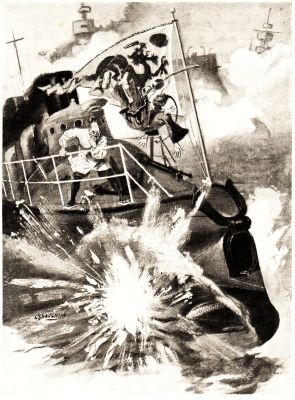
"'Wei! Wei!' yells the Cap'n, a pug-faced Chinaman with one eye. 'We go dlownee now allee samee stonee! Wei! Wei!'
"An' with that the hull crew took to catterwaulin' an' squealin' like a lot o' pigs at feedin'-time.
"'Avast there, ye leather-faced slobs!' sez I to them, sez I. 'Run the bloomin' boat on the beach!'
"'Melican man biggee foolee!' screamed the Cap'n. 'Beachee allee samee twently mile.'
"'Waal, go ahead, anyhow!' sez I to he, sez I, 'an' don't be layin' still here. They'll shoot your bloomin' boat full o' holes an' make a marine sponge out o' her,' sez I, jes like that, him bein' Cap'n with epaulets on, an' me a bosun's mate with nothin' finer 'n a quid o' 'baccy. Werry good. I rings the bell myself an' the engineer starts her ahead full speed. It weren't two minutes afore we was out o' the wust o' the fight, but them there Chinks was still scared blue. Nex' minute they was scared bluer than ever, fur up comes a feller yellin' like a Bowery boy at a four-story fire:
"'We sinkee! Sinkee!'
"'Wei! Wei!' screamed the Cap'n; 'we sinkee; allee samee sharkee eat us! Wei! Wei!'
"'Shut up, ye doughnut-headed son of a sea-cook!' sez I to he, sez I. 'What makes ye think we'll sink?'
"'Watee comee in chop-chop; allee samee whole ocean come! Welly bad! U-u-u-gh!'
"'Wei! Wei!' begin the Cap'n agin, jumpin' up an' down like he thought he was a jig-dancer in a variety show.
"'Stow yer jaw-tackle there, ye moon-eyed monkey!' sez I, to he, sez I, me havin' lost my respeck for him, though he were a Cap'n an' wore a sword, w'ich the same it didn't cut no ice. 'Man the pumps, ye batherin' screechers!'
"Waal, o' course that weren't edzackly the right kind o' order to give; 'cos w'y, she were a modern torpedo-boat an' her pumps was run by steam; but anyhow it started 'em goin'. Chunk-chunk! chunk-chunk! chunk-chunk! they pounded along fur a little while, and then one on 'em stopped all on a suddent, with a big crack.
"'Wei! Wei!' squeals the Cap'n.
"'Shut up, ye molasses-colored parrot!' sez I to he, sez I, 'or I'll stick ye into one o' yer own torpedo-tubes an' pull the string.'
"'Melican man welly wicked,' he muttered, as he walked forward.
"'Wot are the matter below there?' sez I.
"'Pumpee brokee!' hollered the engineer.
"'Both on 'em?'
"'No, only onee. He heap much brokee. No go any moree.'
"'Keep the other one at it,' sez I.
"Then I goes down below myself fur to see where the bloomin' trouble were. Waal, it were not no cheerin' sight wot I seed down there. The water sartainly were a-pourin' into the blessed old pot at a werry discouragin' gait, and the one pump were not able for to gain any ground on it. So sez I to myself, sez I, 'I got to git this 'ere water out o' her somehow, or else I'm agoin' to git more water 'n I want myself.' So sez I, 'How are I going fur to persuade this 'ere water fur to run out o' this 'ere weasel?' An' the werry minute I sez it, I seed how 'twere to be done. I jumps on deck an' I sings out fur the crew o' the three-pounder rapid-fire gun.
"'Stan' by here, ye clay-colored scaramouches, an' git the gun below!'
"'Wei! Wei!' begins the Cap'n, and with that I ups an' grabs him by the pigtail. I hauled him forrad an' I made him fast by that pigtail to the ring o' the starboard anchor.
"'Now,' sez I, 'ye howlin' son o' darkness, if I hear another sound out o' ye, I'll heave to an' let go the anchor.'
"'Melican man welly wicked,' he moaned.
"I got the gun down into the hold of her, an' I run it away aft. Then I loaded it an' p'inted it at the lowest part of her starn. The haythen set up a werry commojious amount o' weepin' an' whoopin' w'en they seed wot I were a-doin'; 'cos w'y, they thort it would make two holes an' sink the boat jes that much faster. But I pulled the trigger an' blowed a bloomin' big hole into her starn right alongside o' the rudder-post an' underwater. The water did come in right off, an' the Chinks broke fur the deck an' commenced to cast off the boat falls. I stood at the door o' the fire-room, an' sez I to the engineers an' firemen, sez I:
"'Turn her up to her hottest gait, an' mind that I'll shoot the first man that leaves his post.'
"W'ich the same I would 'a' done it; 'cos w'y, they might as well 'a' ben shot as drownded.
"'Now, ye gallopin' haythen,' sez I to they, sez I, 'shovel coal fur yer lives. Hop, now, hop! Fill the furnaces full; put a ton o' lead on the safety-valve; turn on the forced draught, an' turn up the screws till they make the water hot astarn on us.'
"Waal, my sons, ye never in all yer born days seed any such hustlin'. It warn't fifteen minutes afore they had the furnaces red-hot, an' the screws was agoin' round at the rate o' a hundred an' thirty-seven turns a minute. It took the wessel a little while to git agoin', but in ten minutes she were a-vibratin' like a fiddle-string, so that she jes actooally hummed like one. An' go! Waal, ye 'ain't never seed nothin' like it in water. W'y, the waves goin' past her looked like the tracks o' one o' Farmer Hulick's harrows. Then my scheme beginned fur to work. I told ye that the Hop-lo always went down by the starn when she got to goin' fast, didn't I?"
"Yes," answered both boys.
"Waal, that were what I were countin' on partly—that an' her speed. The water inside o' her commenced fur to run out o' the hole wot I'd blowed in her starn. More come in the hole forrad an' flowed aft, so w'en she got to goin' at a twenty-five-knot gait, wot come in forrad couldn't stop; but jes ran right through her an' out the hole in the starn. The faster she went the faster the water went through her, but it couldn't stop inside, an' so it didn't get no deeper. Say, ye ort to seed the faces o' them Chinamen w'en they seed how my scheme were a-workin'! W'y, them fellers mos' killed theirselves a-heavin' coal on an' keepin' her goin' faster an' faster. The Cap'll he come down below, looked at the water a-runnin' through her, an' sez he to me, sez he,
"'Melican man biggee head.'
"'Werry good,' sez I to he, sez I; 'but wot I want o' you is silence, an' that o' the werry quietest sort.'
"'Allee lightee,' sez he.
"'Now,' sez I, 'you stay down here an' keep these bloomin' engineers an' firemen at work, an' I'll go an' do the navigatin'.'
"So I left him there, an' I went up an' headed the boat fur the port o' Yu-hi, where I knowed there were a ship-yard an' we could git hauled out an' repaired. An' in an hour the bloomin' harbor were right over our bow. An' now I were puzzled agin; 'cos w'y, ef I stopped her she'd sink, an' ef I run her onto the beach the way she were agoin', I'd smash her all to splinters no bigger'n rope-yarns. While I were a-walkin' around on the deck an' a-worryin', I tuk a look ahead through the marine-glass, an' blow me fur a pickled oyster ef I didn't see the werry way out o' my trouble."
"What was it?" asked Henry, excitedly.
"A marine railway wot they hauls out wessels on fur to repair 'em. There wasn't nothin' on to it, an' there was the rails runnin' with a nice slant right down into the water. Waal, I headed her right fur it, an' I opened up the whistle an' let out a yell that would wake the town. People came out runnin' like they was crazy, an' wavin' their hands fur me to stop her; but I didn't pay no 'tention. I hadn't time fur to stop. I put my head down the hatchway an' yelled,
"'All hands on deck!'
"Up come the blatherin' chinks a-fallin' all over each other, an' w'en they seed how we was headin', they squealed dreadful.
"'Wei! Wei!' sez the Cap'n.
"An' bein' tired o' that, I jes ketched him by the pigtail an' swung him overboard an' let him swim ashore. The next minute we struck the marine railway head on, going square atween the rails, jes as I counted to do. An' o' course we skated our whole length right up the tracks.
"'Over all hands?' I yelled.
"The Chinamen came to life an' seemed to understan', fur over they went, an' had chocks under her quicker'n ye could say 'ahoy'; an' there she were, comf'able an' snug as an old woman in bed, with all the water run out o' her, an' nothin' to do but to plug up the holes an' get to sea agin. But d'ye s'pose them bloomin' beggars was grateful to me, fur wot I done fur 'em? Not a bit. They court-martialled me fur firin' on my own wessel."
The All-Boston Interscholastic Football Team for 1896 is as follows:
J. W. Hallowell, Hopkinson'send.
F. Gillispee, Brookline Hightackle.
F. W. Lowe, Boston Latinguard.
F. R. Hutchins, Brookline Highcentre.
O. Talbot, Brookline Highguard.
W. D. Eaton, English Hightackle.
E. W. Manahan, English Highend.
G. A. Sawin, Cambridge Manualquarter-back.
W. B. Boyce, Brookline Highhalf-back.
Cato Thompson, Cambridge Manualhalf-back.
A. Stillman, Hopkinson'sfull-back.
E. W. MANAHAN, End.
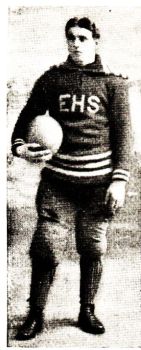
F. W. LOWE, Guard.
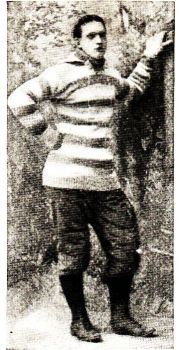
W. B. BOYCE, Half-back.
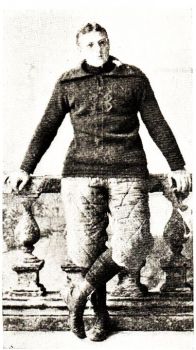
F. GILLESPIE, Tackle.
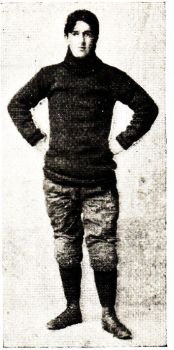
OLIN TALBOT, Guard.
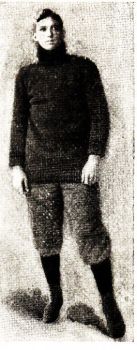
G. A. SAWIN, Quarter-back and Captain.
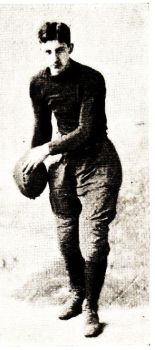
W. D. EATON, Tackle.
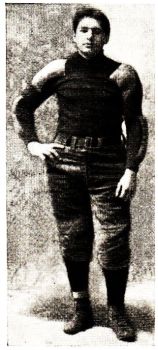
J. W. HALLOWELL, End.
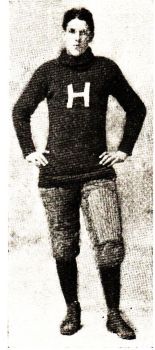
A. STILLMAN, Full-back.
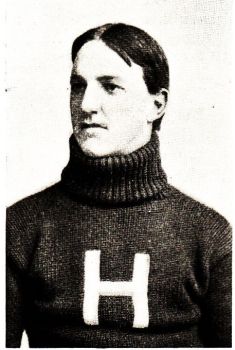
C. M. THOMPSON, Half-back.
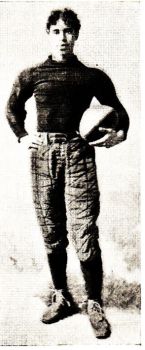
F. R. HUTCHINS, Centre.
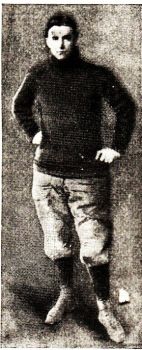
The substitutes are W. Murphy, English High, end; C. W. Jaynes, Hopkinson's, tackle; C. Shea, Hopkinson's, guard; R. Hazen, Cambridge Manual, centre; E. F. Sherlock, English High, quarter-back; G. L. Huntress, Hopkinson's, half-back; T. F. Teevens, Boston Latin, full-back.
In picking a representative All-Boston Team the first consideration given to the individual has been his ability to play his position as near perfection as it is proper to expect. The player who has displayed the most talent in this direction has earned the title to become a member of this team. To reach a standard above the average an All-Boston player must necessarily have the essential qualities that define a football expert—namely, courage, pluck, reliance, and a true conception of collective strength.
For quarter-back, that most important position so difficult to fill satisfactorily, there is only one choice, and that is George A. Sawin, of Cambridge Manual. He has exemplified the execution of accurate passing and the propagation of complicated trick plays, born of natural aptitude and experience. Cambridge Manual was reputed to have the most intricate formation plays of any team in the league, and their ultimate successful completion depended entirely on Sawin's steadiness. That he never slipped up was proved by the prosperity that attended the team. Sawin's station on the defence is directly behind the centre, where he can close up holes at either side of the pivot of the line. As a tackler his real value is felt, for he backs up the line and makes it impregnable. Sawin has done all the punting for his team, and whenever a kick was wanted he exchanged places with a half-back to receive the ball. His long punts were constantly commented on, and no one in the league excelled him.
The command of the team should also be assumed by Sawin, not alone because of his point of vantage in the field, but for his excellence as a strategist, and as a leader who inspires confidence in his players, and exacts their respect.
The centre of the line can well be taken care of by Hutchins of Brookline, who, for a centre, has been unusually active throughout the season. He has outclassed every centre that faced him, though outweighed in many cases. His football personality lies in his strength to make a pathway for a rusher and his conspicuousness in tackling back of the line.
No one guard has given evidence of having star abilities, and there are several ranking on about the same plane. Talbot of Brookline High, who was substitute on last year's All-Boston team, is inferior to nobody now, and easily takes a permanent place. He has had excellent coaching from an old Harvard guard all the season, and it is no wonder that he exhibits all the capabilities of a finished guardsman. For the other guard the competition is much closer, but should go to Captain Fred Lowe, of Boston Latin, who has had three years' experience, and in that time has always stood at the front.
There is no disputing the fact that the tackle positions belong to Eaton of English High and Gillispee of Brookline High. Eaton was a member of the All-Boston team a year ago as guard, but exigencies arising, he was moved to tackle, and his all-round proclivities cropped out there, where he has played the same aggressive, straight-forward game that characterized him in '95. As a rushing linesman he can claim superiority over any man who stood on the scholastic gridiron this fall.
Gillispee of Brookline High has proved his worth as a tackle as the season advanced. He has earned his position by hard, untiring effort, and in every game he has been prominent in smashing interference and making his position invulnerable.
With Hallowell, of Hopkinson's, and Manahan on the ends, the team would have an almost perfect line. Hallowell occupied a similar position last year, and has sustained his reputation this season. He was the most difficult end in the league to circle, for he can wade through the most compact interference and nail the runner.
Manahan has played tackle all the year, but this was because he found a better end player than a tackle. His position is end, where he demonstrated last season his talents, and where he should have been this fall. As it was, he played an excellent game at tackle, although generally handicapped by the weight of his opponent. The players in this team to whom the burden of rushing the ball would fall are Cato Thompson, Cambridge Manual, Walter B. Boyce, Brookline, and A. Stillman, Hopkinson's.
Thompson and Boyce, the half-backs, are good at line-breaking or end plays. The former is especially clever at sprinting around the extremities of the line, and has exceptional speed. Boyce is the best individual back in the association, and his bucking the line has been Brookline's chief mode of gaining ground. Both players are fine defensive workers, and would aid Sawin on the line. Stillman gets placed not so much for his rushing game as his fearless punting. He can always be relied upon to follow his interference closely, and goes into a hole like a shot. Teevens of Boston Latin pushes Stillman for the position, as he is the surer at gaining through the line.
The following tables complete the records of the New York, Connecticut, and Cook County football leagues:
N.Y.I.S.A.A. FOOTBALL CHAMPIONSHIP.
SECTION I.
GamesGamesGamesPointsPoints
won.lost.tied.won.lost.
De La Salle2112616
Berkeley1113014
Barnard1201232
SECTION II.
Trinity200500
Dwight1[1]20842
Cutler120108
FINAL CHAMPIONSHIP GAME.
De La Salle2Trinity0
SCORES OF GAMES PLAYED.
De La Salle4Barnard6
De La Salle6Berkeley6
De La Salle6Berkeley0
De La Salle10Barnard4[2]
De La Salle2Trinity0
Trinity32Dwight0
Trinity18Cutler0
Berkeley24Barnard2
Cutler10Dwight8
Cutler0Dwight6[3]
COOK COUNTY FOOTBALL LEAGUE.
T
o
u
Gc
ohS
a-a
ldf
soe
wt
fni
rse
os
mf
aB
TiyP
olPoG
uiOoiGa
cnpinam
hgpntme
-otses
dGnss
ooell
wanWowo
nltosos
sssntnt
Englewood123..1181290
Hyde Park1411..1285481
Lake View114..401662
Evanston114..825053
North Division176..1267254
English High31..222445
Northwest Division31..228636
Manual-Training11..107827
Oak Park63..4814218
West Division02..88418
CONNECTICUT I.S.F.B.A.
NORTHERN DIVISION.
October 31—New Britain H.-S., 42; Hartford H.-S., 6.
November 7—New Britain H.-S., 50; Norwich[4] F. A., 0.
SOUTHERN DIVISION.
October 31—Meriden H.-S., 54; Hillhouse H.-S., 12.
October 31—Bridgeport H.-S., 12; Waterbury H.-S., 8.
November 7—Meriden H.-S., 20; Bridgeport H.-S., 12.
CHAMPIONSHIP GAME.
November 14—New Britain H.-S., 30; Meriden H.-S., 6.
TRINITY SCHOOL FOOTBALL TEAM, OF NEW YORK.
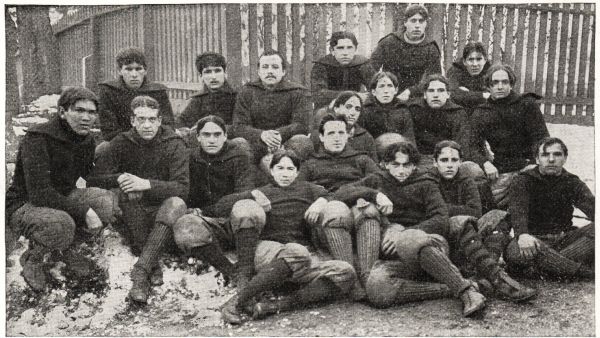
The Trinity School Football Team this year was the strongest that that school has ever put into the field; and although it did not win the New York championship, it made an enviable record for itself during the season. Thirteen games in all were played as follows:
Trinity10Yonkers High-School0
Trinity28St. Austin's School0
Trinity4Montclair High-School2
Trinity44Packard Business College4
Trinity0St. Paul's School30
Trinity6Rutger Prep. School0
Trinity10Staten Island C. C., 2d team6
Trinity0Princeton Prep. School10
Trinity*32Dwight School0
Trinity*18Cutler School0
Trinity*0De La Salle School2
Trinity10Columbia Freshmen0
The contests marked with a star were games played in the New York Interscholastic championship series.
For the first time in several years the Trinity players this season had a regular coach, to whom much of the credit of their success is due. The '95 team knew nothing of systematic interference, whereas this year's eleven was well trained in that branch of the sport, and developed a special strength on end plays. Only four of the '95 team returned to school this fall. These were Page, centre; Brown, left guard; Stromeyer, left half-back, and O'Rourke, full-back. Page and Brown were moved to tackles, and proved efficient in those positions.
On looking over the new material at the beginning of the season Captain O'Rourke found that he had an abundance of men capable of playing end and back, but there were not many heavy players for the centre of the line. Consequently in the early games Trinity's opponents made most of their advances through the centre; but this weakness was finally remedied, and the eleven developed a strong defence. With the experience acquired this season next year's eleven should prove particularly strong.
With the great development of football among all the schools, it has now come to be an important matter with the colleges to keep track of the scholastic players, and to depend upon them for material for the university elevens. In connection with this it is interesting to look over a list of the graduating football-players which has been recently compiled.
Beginning with the New York League we find that of the seven members of the Berkeley team who graduate next spring, Bien, Gilson, and Rice will go to Yale, Walker and Hasbrouck will go to Columbia, Wiley will enter Princeton, and Pell will not go to college at all. From the Cutler team Yale will get Kimball, Kip, and Lee, Harvard will get Hoffman and Sands, and McElroy will go to Columbia. Columbia will get four men from Drisler's eleven—Agate, Ballin, Furnald, and Wolff. Columbia also gets Brooks from Hamilton Institute; and from the same school Carey will go to Princeton, and Foster to Technology, Boston. Of the Dwight football-players, Bogart, Cameron, McCord, and Vinton go to Yale, Adler to Pennsylvania, Slawson to Princeton, and Eickemeyer to Columbia. From the champion team of De La Salle only two go to college—Tilford to Yale, and Bennett to Manhattan College.
Not so many men go to college from the Long Island League. Pratt Institute will send Bowie and Warner to Cornell, and Nevins to Columbia. Brooklyn Latin will send three men to Harvard—Lawrence, E. Motley, and J. L. Motley; Auchincloss, Brown, and Hoppin will go to Yale. From the championship team of St. Paul's, Garden City, Loraine, Symonds, and White will enter Harvard; and Cluett will go to Yale.
The Connecticut League will naturally send more football-players to Yale than to any other college. From Hotchkiss School six men will go down to New Haven—Hixon, Hoysradt, Montague, Noyes, Reynolds, and Savage. Two of the substitutes of the team, Coy, also a tennis-player, and Robertson, will likewise go to Yale. Fincke, football man and tennis champion, will go to Harvard. From the Hartford High-School Wood goes to Cornell; and Cutter, Gibb, Hanford, and Lockwood go to Yale. From Meriden Hubbard will go to Yale, and also possibly Gibson and Lane; Collins will enter Tufts College. From the champion New Britain team Yale will get Buckley, Corbin, and Flannery.
From other schools not in any of the large interscholastic leagues the larger colleges will also get a number of good men. From Andover, Yale will get Holladay, Swift, Wheeler, and White, and also one or more substitutes. Exeter will probably send three players to Harvard. From Lawrenceville, Cadwalader, Dudley, and Richards go to Yale; Loy and Mattis to Princeton. From the football team of St. Paul's, Concord, Henderson and Hollingsworth will enter Harvard; Vredenburg will go to Princeton; and Yale will get Campbell, Phipps, and Richardson, besides three or four substitutes of the team. Groton will send six football-players to Yale—Allen, Gillett, Smith, Strong, Twichell, and Whaples. Sturtevant will go to Trinity.
From St. Mark's, Southboro', Harvard will receive Wittemore; Technology of Boston will get Adams; while Hare and Nash will go to Yale. Westminster School will probably send six of the players of its team to Yale—Fabbri, Knapp, McLean, Nisbet, Scott, and Wells. From the Hill School only two of the first football team graduate—Keifer, who will go to Yale, and Fincke, who is undecided. Taft's School will send seven of its football men to New Haven—Bell, Barnett, Lear, Merriman, Townshend, Welch, and White.
"FOOTBALL FACTS AND FIGURES."—By Walter Camp.—Post 8vo, Paper, 75 Cents.
The Graduate.