THE BUFFALO DOLL SHOW.
Reading edition
BY ELIZABETH FLINT WADE.
All the Jenny Wrens of Buffalo were busy for weeks beforehand, preparing for the event of the season—the News Doll Show at Music Hall—and when the opening day arrived the result of their labor must have surprised even these industrious little workers. The first impression as one entered the great hall was that not only all the dolls in Buffalo, but in all the towns in the vicinity, had accepted the invitation to be present. There were dolls everywhere. They hung from the balcony, and clung to the fronts of the boxes; they clustered in pyramids against the walls, and crowded the boughs of huge Christmas trees; they stood on tables, and filled the evergreen arches; and each one seemed to be doing her "sawdust best" to make this the finest doll show ever given.
A more democratic gathering of dolls could hardly be imagined. They came in silks and velvets, in calicoes and muslins, in wools and in laces; they wore gorgeous Worth costumes, tailor-made gowns, and party, walking, and working gowns. Two came in bloomers, but seemed rather ashamed of themselves, and tried to hide behind a group of demure-faced nuns. There were newsboys, college-boys, Indian warriors, boy choristers, brave knights in shining armor, and solemn priests with gown and book. There were nurses in caps and aprons, milkmaids with milking stools and pails, Salvation-Army lasses, royal queens of England, and Quakers in soft gray gowns, with looks of mild astonishment at finding themselves in such a mixed company.
The doll show was planned for the purpose of giving to every little girl in Buffalo, between the ages of two and ten years, whom Santa Claus seldom if ever visits, a doll at Christmas. All the dolls were to be given away, except some of the groups, and those which were to compete for prizes, and be afterward sold. The money taken for admission and from the sale of dolls was to be divided between the Buffalo Fitch Crèche and free kindergartens, so it was no wonder that every one was interested.
Dolls were arranged to illustrate scenes from stories and from real life, and, of course, the two charities which were to have the benefit of the show were represented. A perfect fac-simile of the interior of the crèche nursery, even to the wall-paper, was shown in miniature. The nurses and babies were dolls. Baby dolls were sleeping in cradles; others were playing in the fenced and cushioned "pond," where the little one learns to creep; and others were sitting in the laps of doll nurses, taking real milk out of tiny bottles. This group was made and donated by the pupils of St. Margaret's School, and over the nursery was suspended a beautiful doll representing St. Margaret, made after the figure of St. Margaret in the famous painting in Glasgow.
The representation of the other charity—the free kindergarten—was so perfect in every detail that it seemed as if a fairy must have touched a real kindergarten with her magic wand, causing both room and pupils to shrink to Lilliputian size. So natural were the attitudes of the dolls at their work, play, and study, that one almost expected them to move about like real kindergartners.
THE MAYPOLE DANCE.
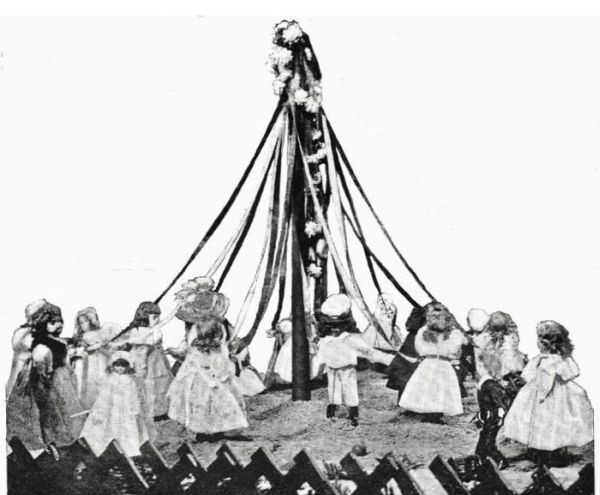
One of the gayest groups was arranged on a raised platform in the centre of the hall. This was the Maypole dance, where, holding the ends of bright ribbons, merry-faced dolls danced about two Maypoles, which were festooned with flowers. "How natural!" was the exclamation of each spectator, while the dolls in the balcony looked down on this group as if envying them their good time, and wishing themselves in their places.
Two groups of special interest to the boys—for even boys condescended to visit the doll show—were the football game and the bowling-alley. For the football a ground had been marked off on green baize, and here a lively scrimmage was going on; the make-up of the players was exact, even to the long hair. One poor fellow, who had doubtless been in the thickest of the "rush," was limping off the ground, his clothes torn and muddy, his face stained with blood, and his football hair standing out in every direction. In direct contrast to this scrambling group were the tenpin-players in the bowling-alley. Two were playing—for it was a double alley—while the others stood in order, watching the game and waiting their turn at the bowls, each of them as silent and as grave as the famous tenpin-players of the Kaatskills.
THE CANTERBURY PILGRIMS.
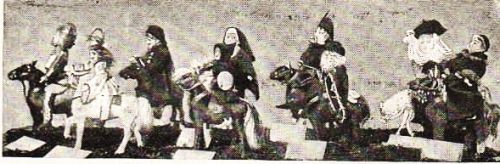
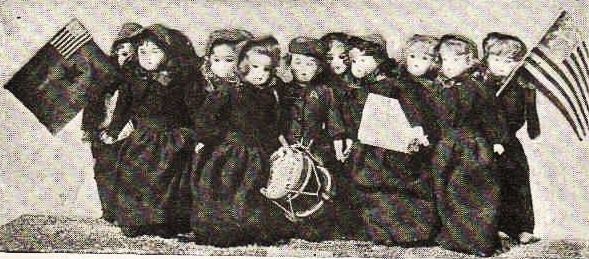
Whoever had read Chaucer's enchanting Canterbury Tales could not fail to recognize in one quaintly attired group the pilgrims on their way to Canterbury, with Chancer riding in their midst. The stately knight was at the head; following him was the "younge squire," and "short was his gown with sleeves long and wide"; and bringing up the rear was the fat and jolly priest. Having seen this merry company, one longed to hear again the charming tales they told at the old Tabard Inn in Canterbury. Next to this Old-World group was what might be called nineteenth-century pilgrims—a band of Salvation-Army lasses marching to the sound of drum, waving their banners, and shouting their "War-Cry."
THE SALVATION ARMY.
The most elaborate group exhibited was called "A Hunt Breakfast" (reproduced at the beginning of this article), representing the annual "meet," when the Duke of Beaufort and the Earl of Bathurst join in a fox-hunt, an event of great importance among English sportsmen. The group surround a breakfast-table spread with every eatable found on an English breakfast-table on a "meet" morning, the food, both in form and color, being an exact imitation. The men were dressed in hunting costumes, the Duke of Beaufort and his huntsmen wearing blue broadcloth coats with buff facings, while the Earl of Bathurst and the "Vale of White Horse" men wore pink broadcloth, the cloth being imported from England expressly for these tiny huntsmen. Both parties wore white twill hunting-breeches and high top hunting-boots, and the latter would have taxed the skill of a fairy's boot-maker. At a side table one of the hostesses was pouring tea, the tea-set being of Dresden china, decorated in pink and blue, the sportsmen's colors. The whole scene was duplicated in a three-panelled mirror at the back, which was twined with holly and evergreens. At either side of the room was arranged an English park scene. Pink water-lilies floated on tiny ponds, statues showed amid the shrubbery, and a background of evergreen gave the appearance of a real wood. This peep at the way English aristocracy amuses itself was originated and arranged by Mrs. Harry Hamlin, of Buffalo, whose husband takes an active part in the well-known Genesee Valley hunts, which were described a short time ago in Harper's Magazine.
The doll which attracted the most attention was one which had come all the way from Paris—where she had just taken a prize at a doll show there—to attend the Buffalo doll show, and see how such things were done in America. From the tip of her fluffy parasol to the toe of her slender boot she was a true Parisian. Her gown was of pink brocaded satin, her coat and high poke bonnet were of moss-green velvet. In one hand she held a lace fan, and in the other a ruffled chiffon parasol, and a point-lace handkerchief peeped from a jewelled shopping-bag which she carried on her arm. Her clothing was not her chief attraction, for Mademoiselle could do wonderful things—for a doll. She turned her head, fanned herself, twirled her parasol, bowed gracefully, winked in a most coquettish manner, and shrugged her shoulders now and then as if the great doll show was all very well for America, but couldn't compare with Paris.
"THE LAST ONE!"
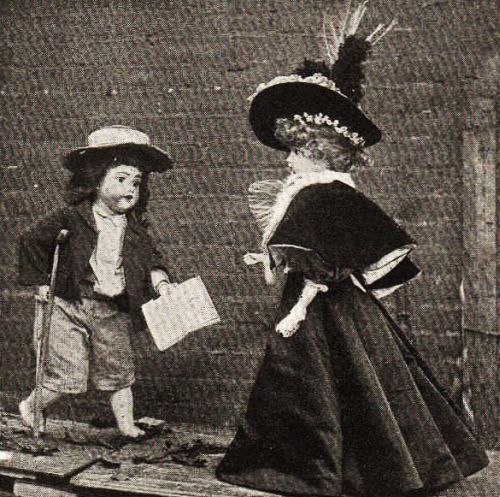
One group that attracted a great deal of attention represented a little newsboy, who is a well-known figure in Buffalo, selling his "last one" to a lady. The doll which won first prize was a copy of Bartholdi's Statue of Liberty in New York Harbor, and was of perfect proportion, even to the base on which it stood. Instead of a torch, she held in her hand an incandescent light.
Saturday was children's day, and all of that day the hall was filled with them. All the children's institutions had been given tickets of admission, and not one child missed the show. To them it must have been a glimpse into fairy-land. An East-Side free kindergarten teacher took the precaution of tying the children under her charge all together with a rope, after the fashion of a Swiss mother who passed through Buffalo a few years ago on her way to the far West, with her ten children tied together with a clothes-line. The children exclaimed over and admired the grown-up dolls, but not one was heard to wish for one for her very own.
"Wouldn't you like that nice doll for yours?" said an older sister to the little maid in her charge, pointing to a doll in a wonderful Worth gown.
"No, I would not," came the quick reply. "She's far too old. Do you think I want to be a grandmother?"
"They're just lovely," said one little girl, as she walked round the stage looking at the prize dolls; "but they're not nice to play with. I want a doll that will wash."
"Here is the doll I like best of all," said a brown-eyed maid, stopping before a two-year-old baby doll with curly hair and laughing black eyes.
"And I! And I too!" said half a dozen others, crowding closer. "She's just the doll you could cuddle and take comfort with."
An agent of Santa Claus was at the show on children's day. A poorly clad child was gazing wistfully at a table loaded with "every-day" dolls. "Which of those would you like best?" said a voice at her elbow, and there stood a stout gentleman looking down at her in the most friendly manner. "This, sir, if you please, sir," pointing to a doll in pink gingham. In a moment it was in her arms, and the gentleman was gone; but he was heard from at various tables, though no one could keep track of him very long; and owing to his kindness many children who never had a "boughten" doll before carried one home then. No one found out who he was, but one five-year-old, who hugged a flaxen-haired doll to her heart, said she "guessed he was Santa Claus's brother."
There were ten thousand dolls at the doll show, and the day before Christmas the police force and the members of the charity organizations distributed them, and on Christmas morning there were many happy doll mothers in Buffalo who, for the first time in their little lives, tended doll babies—thanks to the News Doll Show at Music Hall.