THAT BIT OF LOOSE FLAGGING.
Reading edition
BY GEORGE GRANTHAM BAIN.
That piece of loose flagging should have been fixed long before. It was one of those wicked, insidious suggesters of temptation which are quite as bad in their moral effect as the temptation itself. Probably not a man or woman stepped on that wobbling piece of stone but thought of the possibilities that lay below it. Directly beneath were the vaults in which were kept the millions on millions of silver and gold dollars belonging to the government Treasury. The first thought that the loose flagging suggested to the mind was always: Suppose it should turn over and drop me into the vault where the gold is kept; and suppose it was as easy to get out as to get in; and suppose—for I do not believe there was any one wicked enough to want to steal the coin—suppose there was no objection on the part of any one to carrying away as much gold as the pockets would hold. What a jolly time one could have with it!
That is what Harry Holt thought every night when he left the Western Union Telegraph Building and started home. He always crossed over to the Treasury Department sidewalk and walked on the loose piece of stone. There was no harm, he thought, in imagining all of the delightful things that he could do with a pocketful of the gold. For he was quite sure that even if the flagging was as loose as it seemed to the pressure of his foot, and even if he could move it—and he was tempted often to stoop and see—the top of the vault below was of heavy steel, and the only thing he would get if the flagging gave way was a good bumping, if not a broken leg. So the loose flagging was only a touchstone to a little world in which Harry lived on his way home each night from his telegraph desk—a world where all the hot summer days were made of trips to Nova Scotia, and the winter of sunny sojourns in the everglades of Florida.
"My wire's clear at both ends; I think I'll go home," said Harry to the chief operator one hot night. It was five minutes before his time for leaving the operating-room, and Western Union orders are strict. The chief operator shook his head and went on. Harry turned sulkily back to his desk and picked up a fan. On a night like this, when every one in the room was steaming with the heat of the overcrowded room, the click of the instrument before him and the hum of the other instruments all about jarred on his nerves. He wanted to get to his little room uptown, where at least he could take a plunge in the bath-tub if his blood was overheated. He hated the slavery of the operating-room, and the set rules that made him only a part of the machine to earn dividends for a lot of New York people in whom he had no interest. Harry was not a philosopher, or he would have said to himself that the surest way of heating his blood still more, and increasing his discomfort on this trying night, was to worry about something, to fret, to be discontented.
Well, five minutes is not a very long time. Harry took his coat on his arm and his hat in his hand; for it was long past the hour when every one but a few night-workers and an occasional policeman had gone to bed. The electric lights sputtered and spit as he came out of the building, and the hot white light dazzled him a little. Then the steam from the overheated asphalt came up into his face as he cut across diagonally toward the Treasury building. It looked cool and comfortable in its dress of white marble, and Harry thought how pleasant the air must be down in the sub-basement, far below the heat of the street. Then he stepped on the loose flagging, his steps turning to it as naturally as though there had been no other path, and the flagging gave way. It was so sudden that he had no chance to struggle or to try to regain the solid ground. Before he could even spread his arms to catch the edges of the stones about the opening, he had fallen below the surface of the sidewalk.
He had an awful consciousness that he was doing something wrong—as though his dreams about that loose flagging had exercised some weird influence on it, and so far loosened it as to make it give way under the weight of his body. And he suddenly remembered that he had read somewhere of a little army of watchmen who guarded the treasure vaults with weapons in hand, and who had been known to shoot first and make inquiries afterward. That would be very awkward, thought Harry; and all of this passed through his mind in the little space of time which it took for a fall of—well, he thought it was one hundred yards, but every one knows that the Treasury vaults have ceilings no higher than the ceiling of your room.
"Hello!" said a voice at his elbow. Harry had alighted somewhere. Just how he had managed to do it after that tremendous fall without breaking a leg he could not understand; but here he was on his feet, with no evidence of any damage done, and opposite him was a pleasant-faced old gentleman with a white beard, wearing a pair of steel-bowed spectacles which gave his face a benevolent aspect. Just behind the old gentleman was a stack of wooden boxes as high as the ceiling—-and Harry saw now that the ceiling was not so very high after all—and lying around the room were white canvas bags with figures stencilled on them. There was a table not far away, with a delightful-looking cold luncheon spread on it, and there was a bowl of lemonade or something that looked like lemonade with a big square piece of ice floating on its surface. Harry's tongue had been parched all evening in the hot operating-room. He longed for a little of that lemonade, but he hesitated to ask the stranger for it.
"You came by the balloon route," said the old gentleman, not inquiringly, but as though he stated a recognized fact.
"I really don't know how I came, sir," said Harry, finding his tongue. "I didn't know I was coming."
"I fancied you came in a hurry. I see you haven't had time to put on your coat," said the old gentleman.
Harry felt very much ashamed of his shirt sleeves, and he tried very hard to put his coat on. But, curiously enough, whether it was from embarrassment or some other reason which he could not understand, he could not get his arms into the sleeves. Moreover, the more he tried, the more the sleeves of his shirt showed a disposition to come off his arms and leave him in a more embarrassing condition. In fact, all of his clothing felt loose and unstable, and Harry was much worried for fear that he would find himself in the presence of this critical old gentleman without a stitch of clothing on. The old gentleman came to his rescue.
"Never mind," he said; "we must make some allowance for the Czar's messenger. I suppose it is hot in America for one so recently in Russia."
Harry thought that the best way to do with his strange new acquaintance was to agree with him. He seemed kindly disposed, if he was a little eccentric. So Harry ventured to stammer out: "It is a little colder in St. Petersburg."
"Of course it is," said the old gentleman, sitting down on a pile of the canvas bags and rubbing his hands together. "The last messenger was actually sunstruck. But he came in his fur-lined robes of office. You were sensible to leave yours behind."
Harry accepted the tribute with a vague smile. He was a little puzzled, but even in his uncertain mental condition he felt reasonably sure that he had never owned any fur-lined robes. Still he was certain that any one who left fur-lined robes behind on a day like this, whether they were his own robes or those of some one else, was a very sensible person and deserving of commendation.
"I suppose you have come after the fifteen millions for the Grand Duke!" said the old gentleman.
"Not at all," said Harry, for he was seized with a fear that the old gentleman might deliver to him some other man's property, and then have him arrested for theft when the mistake was discovered.
"That's all right," said the old gentleman, reclining on the canvas bags, and nodding his head encouragingly. "You can trust me."
"But I have not come from the Grand Duke," said Harry.
"What's that?" said the old gentleman, jumping up and speaking very fiercely. Then he sat down again. "Of course you have," he said, calmly. "Otherwise how would you be here, and how would you be able to carry it away?" And Harry thought it best not to contradict him again.
"There is the lot over there," said the old gentleman, indicating another pile of canvas bags just beyond, and to Harry's left. "It isn't much of a load when you know how to carry it."
"Am I to carry all that?" asked Harry; for the bags looked as though they might weigh a ton.
"And a very light load," said the old gentleman, nodding and smiling. "Sit down." He pointed at the bags.
Harry was glad of the invitation, though an invitation to supper or to a drop of that cooling lemonade would have pleased him more. The old gentleman seemed to divine his thoughts, for he pointed at the lemonade bowl, and said, with a smack of his lips, "A little later." Then he motioned again to the pile of coin-bags. Harry threw himself down on them. Then a dreadful feeling went through him. He felt as though he were afire. The bags were hot—as hot as boiling water—so hot that he sprang from them with a scream.
"YOU ARE AN IMPOSTOR. YOU ARE A THIEF."
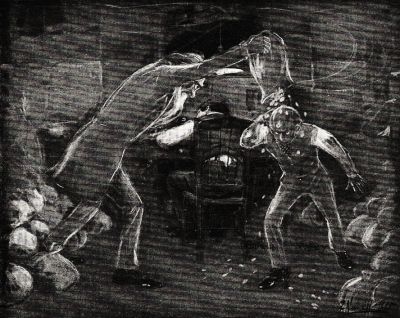
"What's that?" said the old gentleman, springing up. "Then you're not the Czar's messenger. You haven't the key. You are an impostor. You are a thief."
He caught up one of the canvas bags on which he had been sitting. It burst, and the yellow gold pieces flew out in a shower on Harry's head. Each of them seemed to burn a hole where it struck. Harry fell to the floor. The old gentleman caught up another bag and poured its contents over Harry. His face had the expression of a fiend now. More and more gold he poured on Harry's prostrate form, until all but his head was quite hidden from view. Each gold piece burned, and burned, and burned. The heat was intolerable. Harry screamed with the pain of it.
"What's the matter with you, Holt?" said a voice in his ear. The chinking of the gold pieces as they fell seemed like some old familiar sound. Some one took hold of his shoulder, and the voice said again, "Here, what's the matter with you!" The chinking now was like the clicking of the telegraph instruments in the operating-room. Harry opened his eyes and looked about him. The old gentleman was gone; the bags of gold were gone. The old desk was under his arm, and the chief operator was bending over him.
"Your time's up, Harry," he said. "I thought you were in a hurry to get home. This isn't a very good place to sleep on a hot night, anyhow."
The clock on the wall opposite said half past two; it was twenty-five minutes past when Harry had told the chief operator that he wanted to go. He had been asleep perhaps three minutes, and every garment on him was wet with perspiration. His hat and coat were not in his hands. He looked for them, and then he remembered. They were still in the closet. He got them, and walked slowly down the four flights of stairs. When he came out on Fifteenth Street his footsteps turned instinctively in the direction of the Treasury building. But Harry resolutely turned them the other way.
"I don't want any more dreamland riches," he said, as he thought of the old gentleman and his red-hot coin.
In the lull following upon the activity of football, and preceding track athletics and baseball, I shall devote as much space as possible in this Department to comment on seasonable sports, and on the methods for training and preparation for spring work. So many letters come each week asking for suggestions about training, especially for the running events, and requesting information on the various outdoor sports for ice and snow, that it seems advisable to award to these subjects the preference, for the next few weeks at least. Concerning training for field sports, I shall endeavor to treat of putting the shot in an early number of the Round Table, and soon afterward we shall have hints and advice on training for the sprints and the middle distances. This week I want to devote almost all available space to the prime winter sport of curling, about which I have been asked for a description by a number of correspondents in the Northern and Western States and Canada.
A CURLING-MATCH.
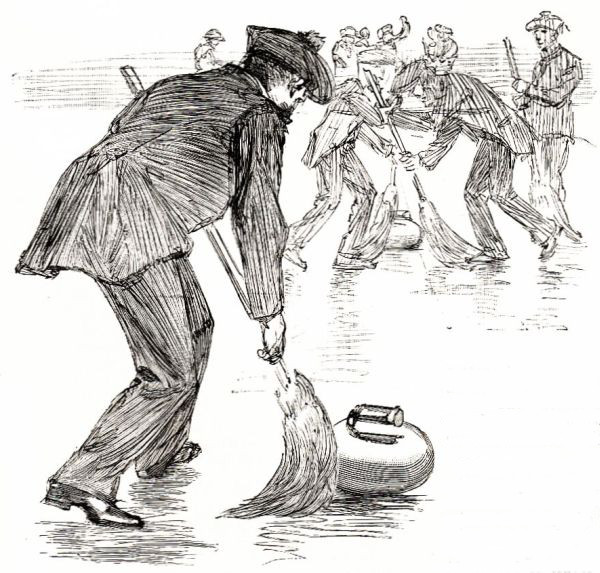
Curling is essentially a Scottish game, and one over which the stolid Scotsmen manage to work up considerable enthusiasm and excitement. It has been imported into this country, and especially in Canada have American curlers become almost as proficient as any in the world. Few games afford better sport and exercise, and a certain amount of muscular strength is demanded of the players. The game is played on ice, of course, and the space marked out for playing is called a "rink." This is usually a strip of ice on a pond or a stream, forty-two yards long and eight or nine yards wide, swept clear of snow. A "tee," or goal, is set down at each end of the rink. The tees are 39½ yards apart. Seven feet behind each tee is a small circle called a "foot-circle," from which the curlers launch their stones. From each tee as a centre a circle must be drawn, with a radius of seven feet, and every stone which is not outside of this circle when it has stopped moving counts as one point in the reckoning. Outside and beyond the tee circle a line is drawn across to the rink, and the stones which pass this boundary are called dead—that is, they do not count. Seven or eight yards inside of each tee another line is drawn across the rink, and every stone that does not pass this "hog-score," as this line is called, is removed from the ice, out of the way of coming stones. The "middle line" is drawn half-way between the tees across the rink. Perhaps a better idea of this complicated delineation of a curling-rink may be gathered from the diagram at the top of the next page.
DIAGRAM OF A CURLING-RINK.

There are usually four players on a side, and each player is armed with two stones. These stones are of circular shape, with flattened sides, and must not weigh more than fifty pounds nor less than thirty pounds. Neither must they be more than thirty-six inches around, nor less in height than one-eighth of the greatest circumference. Curling enthusiasts attach great importance to their stones. They have them of various weights to suit their own fancy, and of every possible variation of form. Some players prefer flat stones, while others have a liking for high ones. As a rule, however, the favorite is that which is neither very flat nor very high, the reason for this being that such a stone is well "centred," having the centre of gravity about in the middle, and being therefore more easily handled. These stones are usually cut out of granite; they are then highly polished, and frequently fitted with very ornamental and highly expensive handles.
The players are also provided with brooms, with which they sweep off the snow and other obstacles from the rink. One point of judgment in curling is to know when to sweep the way clear for a coming stone and when not to, the sweeper knowing about how fast the stone will go for its weight, and about where it will land if allowed to travel over a rough or a smooth surface. The number of points ordinarily appointed as decisive of a curling-match is thirty-one, and the side which first scores that total is the winner. The chief aim in the game is to hurl the stone with the proper amount of strength, so that it will take its place close to the tee. Then a certain amount of generalship must be used by one side to so distribute its stones that the opponents may not be able to dislodge those nearest to the centre of the tee circle. It will be seen that curling is a sort of giant game of shuffle-board, but much more susceptible to scientific work than the latter. A close finish in curling frequently arouses both parties to the highest excitement, and many funny stories have been written about staid Scottish squires and dignified dominies who have found themselves hotly disputing with one another on a curling-rink. For those who may be interested in the sport, and who care to become more familiar with it or to learn the many rules which experience and practice have shown to be necessary, I recommend an article on curling in the volume on skating in the Badminton Library.
The many protests in the recent contests held by the New York I. S. A. A. have led the officers of that organization to formulate and adopt some new rules which will now make the conditions of contests perfectly clear. The changes in the constitution recently adopted are good ones, and have all been framed with a view to purifying sport, and with the intention of holding all New York school-boy athletes to the closest interpretation of the spirit of amateurism.
A very vague idea of the rules and regulations which govern amateur sport has been held by the majority of school athletes in this city until recently. I think this must have been because they were not as familiar as they might have been with the laws enacted by their own association. These laws were perhaps not as strict as they should have been, and I am now glad to see that the managers are tightening the reins. Every boy who goes into athletics here or anywhere else should know exactly what his rights and his duties are in matters of sport, and especially in the matter of eligibility in these days, when professionalism is so steadily trying to steal into the camp. I cannot but believe that if every scholar in this town had known by heart the N. Y. I. S. A. A. rules of eligibility last year, the errors of some misguided athletes would never have been made.
The new rules governing eligibility are clear and unequivocal, and it is hard to see how even the most professionally inclined can now beat about the stump. The first section of the new Article XI. states that "no one shall represent any school as a competitor in any athletic contest who has not been a member of that school from the first of January of the school year in which the contest is held, or who has actually been paid wages for services during the school year, or who has been enrolled as a member of any college, or who has attained the age of twenty years, or who is not in good standing with the Amateur Athletic Union of the United States."
The article proceeds to explain that having been a member of the sub-Freshman class of the College of the City of New York does not debar a scholar from competing, and this is eminently just. A most important provision follows, and I cannot urge too strongly upon the I.S.A.A. committee to enforce this rule to the letter if it results in having only one contest a year. It is to the effect that any school wishing to enter a team for the baseball, football, tennis, or track-athletic championship must file a list of all players or competitors with the chairman of the committee governing that special branch before such team can enter any contest. The next two sections specify that in such list the ages of all players or competitors shall be given, and the list must be signed by the principal of the school, to certify that all the intended players or competitors are eligible.
In view of recent events, the revision of Article XIV. also cannot be too gladly welcomed: "Section 1. No school shall, through any of its officers or by any other means, directly or indirectly, by offering any inducements, influence or try to influence a pupil of any other school to sever his connection with said school. Section 2. The offering of a regularly established or other scholarship by any school or officer thereof, as an inducement to change from one school to another, shall be considered an inducement." Much annoyance would have been saved if these paragraphs had been in the constitution when it was first formulated, and I think that this revision might be even further fortified by inserting the words "directly or indirectly" in the second section as well as in the first.
It is a wise provision also that any school entering a team for the baseball or football championship must play all games for which they are scheduled under penalty of $5 fine for each game forfeited. My only criticism is that the penalty might be doubled or trebled. The championship series of football games last fall, in Brooklyn, was greatly interfered with by the continual forfeiting of games by the weaker teams. This Department spoke of the evil at the time, and I would now urge the Long Island League legislators to insert some such by-law in their code as the New Yorkers have just established.
Athletics are progressing so vigorously in Philadelphia that a new interscholastic league, in addition to the Inter-Academic A. A. of some years standing, has been organized. Tho new association held a meeting a few weeks ago, at which delegates from the Central High-school, Wilmington High-school, and the Central and Northeast Manual Training schools were present. A committee was appointed to see the Friends' Central, Catholic High and Swarthmore College Grammar Schools, and invite them to join the association. The meeting then adjourned to meet at the call of the chair to receive the report of this committee. This committee should at once communicate with the officers of the National I. S. A. A., and apply for membership. The new league has some strong schools in it, as readers of this Department may see by glancing over the list. The Central High-school of Philadelphia is probably the largest school in that city, and both the Wilmington and Swarthmore Grammar schools have already acquired enviable records in sport.
An Interscholastic Polo League has been formed in Boston, under the auspices of the B.A.A., with the following schools as members: Melrose High, Cambridge High and Latin, Roxbury Latin, and English High. A provisional schedule has been arranged, but as the weather is an important factor in polo, it may be necessary to postpone several of the contests. The dates chosen are:
CAMBRIDGE H. AND L.
Dec. 31.—E. H. S. on Spy Pond.
Jan. 17.—Roxbury Latin on Spy Pond.
Jan. 25.—Melrose on Spy Pond.
ENGLISH HIGH.
Dec. 31.—Cambridge on Spy Pond.
Jan. 14.—Roxbury Latin (undecided).
Jan. 17.—Melrose at Melrose.
ROXBURY LATIN.
Jan. 14.—English High (undecided).
Jan. 17.—Cambridge on Spy Pond.
Jan. 21.—Melrose at Melrose.
MELROSE HIGH.
Jan. 17.—English High at Melrose.
Jan. 21.—Roxbury Latin at Melrose.
Jan. 25.—Cambridge at Spy Pond.
It is to be hoped, if the season proves a successful one and the cold weather holds out, that the winner in this Boston League will arrange for a championship game with the winner in the Connecticut League.
H. D. CAREY, JUN., Hamilton Institute.
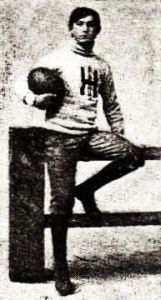
THEODORE LUTKINS, Brooklyn Latin School.
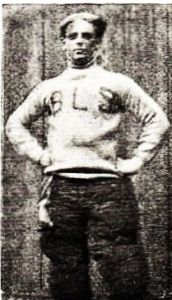
On account of this delay in receiving the portraits of Messrs. Carey and Lutkins, who were selected for members of the All-New-York football team, the pictures could not be reproduced until this week. Carey of the Hamilton Institute would play right half-back, and Lutkins would rank as first substitute on the All-New-York eleven, the full details of which were given in the Round Table of January 7th.
The game of basket-ball promises to become popular among the colleges and the larger schools of the country this winter. This Department will devote some space to the game at an early date, which is taking up the attention of scholastic sportsmen in Connecticut.
J. A. Baker, B. Bay, Massachusetts.—There is no rule prohibiting tackling above the shoulders, unless Section B of Rule 27 of the Football Rules of 1895 can be construed as such. It is a matter for the umpire to decide in every case.
H. C. Morris, Evanston, Illinois.—There will be an article on running in this Department some time during the winter. I should advise you to use sprinting shoes without spikes to train in, but wear spikes in a contest or when running for time.
W. H. B., Minneapolis.—You can find out what you want to know in Walter Camp's Book of College Sports (The Century Company, New York), or in the American Boy's Handy Book (Charles Scribner's Sons, New York).
J. J. Smith, Ridgewood, New Jersey.—There is a very good chapter on "Toy-boat Making and Sailing" in Coventry Pastimes for Boys (Longmans, Green, & Company, New York).
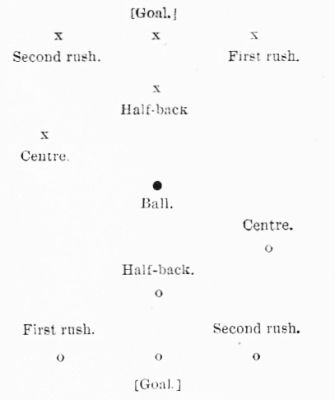
H. C. D., Meriden.—The arrangement of players for the game of ice polo, described briefly in Harper's Round Table for January 14th, is as follows:
The Graduate.
A POUND OF FACTS
is worth oceans of theories. More infants are successfully raised on the Gail Borden Eagle Brand Condensed Milk than upon any other food. Infant Health is a valuable pamphlet for mothers. Send your address to N. Y. Condensed Milk Co., N. Y.—[Adv.]