ODDITIES IN BICYCLES.
Reading edition
It is probable that the great Madison Square Garden in New York never was so full as it was during the Bicycle Show of a fortnight ago. Twenty thousand people filled the great theatre on the last night of the show, and all through the week the throng proved how popular bicycling and bicycles are now. Those who were in the city and could go saw many wheels and many queer inventions in seats, pedals, frame, tires, and all the other parts of the machine. Each bicycle-maker had his own little compartment, with samples of his bicycles, and a big sign with his name in electric lights upon it for the evening. Even if you knew nothing at all about a wheel you were intensely interested in all you saw, and the more intimately you knew bicycles the greater was your interest. There were thousands of bicycles of all kinds, besides wheels for girls and boys of six and eight years of age; and there was one wheel, perfect in every way, with its pneumatic tires and ball-bearings, which was just large enough for a baby two or three years old, if only some one could have found a baby that age capable of riding it. The little pedals were about an inch and a half wide, and the diameter of the wheels was not over eight or nine inches. This was hardly what could be called a model, for it was too large for that. Yet many a boy and girl thought of "little brother" at home when he or she saw that tiny wheel.
MADE BY THE FARMER'S BOY.
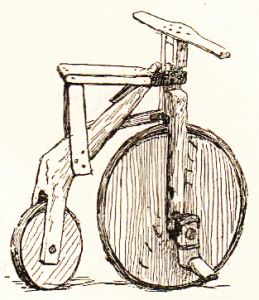
Some ingenious "farmer's boy"—so the sign attached informed the spectator—in New Jersey must have been very anxious to ride a wheel some time ago, for he had made a wooden machine, with solid wheels and a wooden seat, which he rode as a bicycle. It was on exhibition at the show, and was an interesting bit of workmanship, standing by the side of a '96 model, as well as an interesting exhibition of what a boy in New Jersey can do if he has the inclination. The most extraordinary part of this extraordinary wheel was the barn-door hinge which attached the forks and handle-bars to the rest of the wheel. The seat was hard, but it must have given that New Jersey boy a great deal of satisfaction to feel that he was riding on a machine made entirely by his own hands and from designs out of his own bright brain. On the card which was attached to the machine was a statement that this was a "spokeless bicycle," made by a farmer's boy in Monmouth County, New Jersey; that it had "hose-pipe tires" (these are pieces of ordinary lawn hose nailed on the outer edges of the wheels, but sadly wanting in wind), and that it was "actually ridden by him and apparently enjoyed."
RIDDEN A THOUSAND MILES.
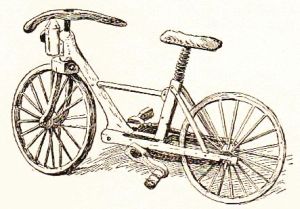
This bicycle, however, as you can see in the accompanying illustration, is old style, for the cranks act on the front instead of the rear wheel. In fact the whole machine is like the tall bicycle first used in this country. Another wooden affair which was also on exhibition was much more elaborate, and was really an interesting piece of work. It was made by an Indiana boy, and used by him for a long time. He has covered over 1000 miles on it in riding to and from school, and in making short trips in the vicinity of his home. The bicycle is entirely of wood, so far as its frame and its wheels go. Old carriage-wheel hubs have been used, and the wheel rims are wide, strong pieces of wood. Even the lantern is "home made," for it was constructed from old tin cans. The seat has a wonderful spring arrangement which allows the solid shaft of wood on which it rests to sink in the hollow "tubing" of the frame as far as the steel spiral will permit, and the young builder has made the seat itself comfortable by covering the wood with a leather cap over some hair taken out of a mattress. Any one who can build such a bicycle as this deserves to have a fine new one presented to him, and that was precisely what happened, for the company gave him a new '96-model wheel in exchange for his own crude but serviceable machine.
THE ICECYCLE.
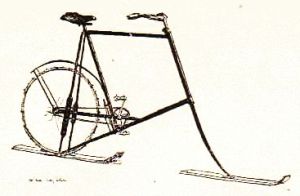
Turning from these two pieces of Young America's ingenuity, you could easily find some remarkable examples of the skill of older Americans at the show. There was one wheel that looked like a huge grasshopper. It had a system of cranks which permitted a man to ride with a gearing of 100 as easily as the ordinary wheel carries him along with a 60 gear, but of course he covered much more ground at every revolution. Still another machine had a frame in the shape of a triangle, instead of a diamond, with the seat at the apex, and one wheel at each end of the base. It was a strange-looking affair, but, of course, it could be built much lighter than the ordinary bicycle, while the frame is said to be stronger. Still another and very interesting novelty was a bicycle for use on the ice. Everything about it is much like any bicycle of to-day, except that runners instead of wheels are used. There is a rear wheel which is fitted with a tire of spikes that catch the ice through a slit in the rear runner, and in this way the "icecycle" is sent ahead. When a good velocity has been attained the rider can shift this spiked wheel by a movement of his foot in such a manner as to raise it off the ice and allow the machine to coast. But an icecycle must be a very slippery affair, and rather inclined to slide in any direction, as easily sideways as forward.
THE GIRAFFE.
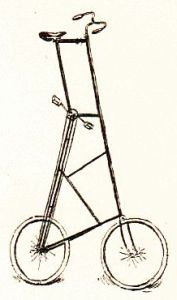
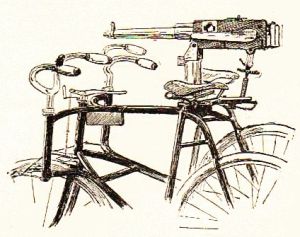
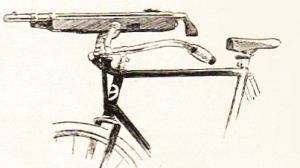
Further on in the show was the giraffe bicycle, which looked about as much like a giraffe as it did like a bicycle. It is used only in trick riding, and would naturally be useless as an ordinary roadster. It is 9 feet 3 inches high from ground to the top of the handles. But if the giraffe is useless as a practical affair, the cannon bicycles certainly are not. These wheels are made to carry a Maxim gun or a howitzer on a "duplex," or double bicycle, and a single bicycle can carry one of the Colt's new automatic guns. There seems to be no reason why this use of the bicycle in war should not be feasible. At any rate, the armed wheels looked very symmetrical and ship-shape.
A MAXIM GUN ON A DUPLEX.
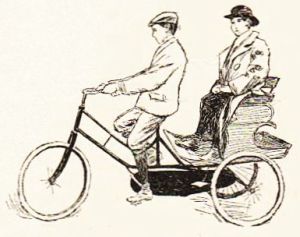
A still more practical use of the pneumatic tire and other bicycle features, especially for a city paved with asphalt, were demonstrated by some of the tricycles for delivering parcels or carrying baggage of any light kind. One, a picture of which is given with this article, was for invalids—for use in the parks of a city. Indeed, why should not nursery girls ride around on tricycle baby-carriages, with places for the babies in front or behind? And why should not old ladies who are timid about horses go out in little bicycle landaus and broughams? But all these will come in time.
THE COLT AUTOMATIC GUN ON A BICYCLE.
A dozen other novelties might be enumerated, but we have space for only two more. One of these was a bicycle on which six men can ride at once. We have all seen tandems and "quads," but bicycles with six saddles are not common, even at a national bicycle show. The first man does the steering, and the gear on his chain is very small. The second man's gear is larger, the third's larger still until the sixth man has a huge gear, something like 125 or 150. The speed that can be obtained on this wheel, or rather the speed that is said to be obtainable, is something too great to set down in type until it is actually recorded as having been done; but there is a story afloat that a wager has been made to build a track alongside the New York Central road, in order that one of the six-man bicycles may race with the Empire State Express.
INVALID'S TRICYCLE.
Another interesting and possibly very useful development of the bicycle is the power to change the gear. This wheel has a rod under the right handle-bar, very much like a brake handle. When you are riding along level ground, and do not touch the "brake," the gear is at 80. Soon you come to a hill. Then by pulling the "brake" handle up half-way the gear of the wheel is changed from 80 to 60, and thus you can go up hill, slower, to be sure, but much easier. After reaching the top of the hill you pull this rod up close to the handle-bar of the wheel, and the gearing is thrown off entirely, so that the bicycle will coast down hill without turning the cranks. Of course the rider can keep his feet on the pedals all the time.
This bicycle will be of great practical service if its machinery is solid and durable, for there are many bad places along a country road where a change of twenty in the gearing would save a large amount of strength in the total of a day's work, and at the same time, on level ground, much more distance can be covered by changing back to eighty. Then also with the ability to keep your feet on the pedals, you can feel sure of not losing the control of the machine when coasting.
Meantime the great bicycle show had many another novelty, for the description of which there is not space enough in this periodical. Taken altogether, the show was an enormous success, and though many of the novelties were covered up by thousands of ordinary '96 machines, still they were there, and could be found by any one who was looking for them carefully.