Collection?
Reading edition
It is a Collection which no one who loves music should fail to own; it should find a place in every home. Never before, it may truthfully be said, has a song book been published at once so cheap, so good, and so complete.—Colorado Springs Gazette.
This Song Collection is one of the most notable enterprises of the kind attempted by any publisher. The brief sketches and histories of the leading productions in the work add greatly to the value of the series.—Troy Times.
Sold Everywhere. Price, 50 cents; Cloth, $1.00. Full contents, with Specimen Pages mailed, without cost, on application to
Harper & Brothers, New York.

The Editor will be pleased to answer any question on the subject. Our maps and tours contain much valuable data kindly supplied from the official maps and road-books of the League of American Wheelmen. Recognizing the value of the work being done by the L. A. W., the Editor will be pleased to furnish subscribers with membership blanks and Information so far as possible.
Copyright, 1896, by Harper & Brothers.
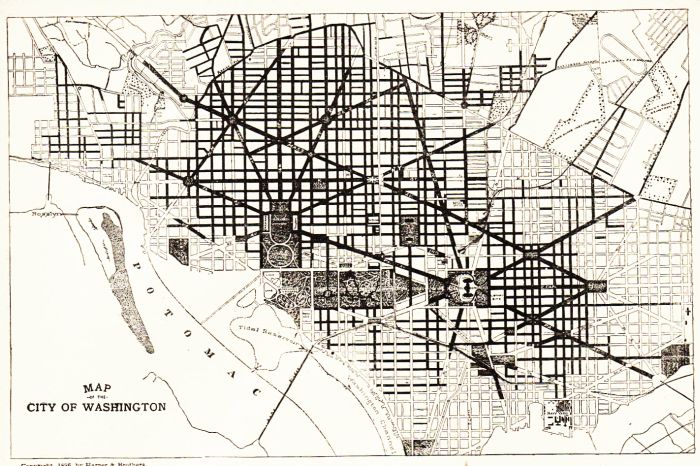
The city of Washington is perhaps the finest city in the United States for bicycling, and it deserves to be given a place in this Department simply on account of its asphalt streets, to say nothing of its importance as the capital. In the better parts of the city, towards the west and the north, almost every street is asphalted, and where asphalt is not used, macadam or some smooth block pavement of one kind or another is. But through the whole city most of the streets are rideable, and it would therefore be absurd to give here any directions for getting about from one part of Washington to another. Certain things there are, however, which should be said regarding Washington. There is a good deal of riding of late in the parks and grounds about the Smithsonian, and it should be remembered that these park roads are kept in the best condition, as are all the avenues that run up to the Capitol. These are so wide that one need not fear crowding from carriages, as is the case in most cities, Baltimore especially. New York is, of course, almost impassable, except above Fourteenth Street, but the magnificent avenues of Washington are a joy to the wheelman. The District of Columbia is, indeed, filled with many good roads, and there are consequently several trips well worth taking in the vicinity of the city. It will be impossible for us to go into these trips, giving maps, since we must begin in the Chicago wheelman's vicinity, as was promised some time ago.
An opportunity is now given to explain a little more fully why the longest bicycle route from Philadelphia to Washington was given in these columns. It has already been said that the reason was because the road was better and less hilly. It is naturally taken for granted that any one riding a bicycle from Philadelphia to Washington is in no great hurry. If he were, he would possibly think of the railway. Consequently, unless the time occupied on the journey is a wager (in which case the wager might just as well be laid over the long route), the wheelman is probably out for pleasure. And one of the greatest pleasure creators, so to speak, in the bicyclist's world is a good road. Hence, if you are going by bicycle from Philadelphia to Washington, you will do well to go the route given during the last six weeks. The trouble comes between Philadelphia and Baltimore. Of course there are other routes, and they are shorter. For example, one route runs from Philadelphia, through Darby, Moore's, Chester Station, Linwood, Practical Farmer, Wilmington Court-House (Delaware), Middleton, Warwick, Cecilton, Frederictown, Galena, Locust Grove, Hainesville, Fairlee, Tolchester Beach (Maryland), and thence to Baltimore by boat. This is a 92-mile trip as compared with our 160-mile trip, or at least 68 miles shorter; but from Chester Station on the road is apt to be bad. Another route is from Philadelphia, through Moore's Station, Chester, Linwood, Practical Farmer, Wilmington (Delaware), Hare's Corner, Glasgow, Elkton (Maryland), Northeast, Perryville, and on direct to Baltimore, crossing at Havre de Grace. Much of this road is sandy, and between Elkton and Perryville it is usually easier to walk the whole 15 miles. The distance is, all told, 105 miles, though any one who had done it once would choose the 160 miles by the other route the next time.
On the above map the black streets are asphalt or macadam.
Note.—Map of New York city asphalted streets in No. 809. Map of route from New York to Tarrytown in No. 810. New York to Stamford, Connecticut, in No. 811. New York to Staten Island in No. 812. New Jersey from Hoboken to Pine Brook in No. 813. Brooklyn in No. 814. Brooklyn to Babylon in No. 815. Brooklyn to Northport in No. 816. Tarrytown to Poughkeepsie in No. 817. Poughkeepsie to Hudson in No. 818. Hudson to Albany in No. 819. Tottenville to Trenton in No. 820. Trenton to Philadelphia in No. 821. Philadelphia in No. 822. Philadelphia-Wissahickon Route in No. 823. Philadelphia to West Chester in No. 824. Philadelphia to Atlantic City—First Stage in No. 825; Second Stage in No. 826. Philadelphia to Vineland—First Stage in No. 827; Second Stage in No. 828. New York to Boston—Second Stage in No. 829; Third Stage in No. 830; Fourth Stage in No. 831; Fifth Stage in No. 832, Sixth Stage in No. 833. Boston to Concord in No. 834. Boston in No. 835. Boston to Gloucester in No. 836. Boston to Newburyport in No. 837. Boston to New Bedford in No. 838. Boston to South Framingham in No. 839. Boston to Nahant in No. 840. Boston to Lowell in No. 841. Boston to Nantasket Beach in No. 842. Boston Circuit Ride in No. 843. Philadelphia to Washington—First Stage in No. 844; Second Stage in No. 845; Third Stage in No. 846; Fourth Stage in No. 847; Fifth Stage in No. 848.
Getting Ready for a "Backward Dance."
In the "Questions and Answers" column a Lady asks how to get ready for a "backward dance." Comb your hair over your face, but do not put it in a knot. Put a false face on the back of your head and try to get as queer clothes as you can. Wear very large shoes, so that when you walk they will clatter. In the dance you walk frontward, but you look as if you were walking backward. You should wear also a very large hat with lots of feathers and ribbons bobbing about on it.
Amy Du Puy. Allegheny, Pa.
Any questions in regard to photograph matters will be willingly answered by the Editor of this column, and we should be glad to hear from any of our club who can make helpful suggestions.
PREPARATION OF TINTED SENSITIVE PAPERS.
NO. 1.—HOW TO MAKE RED PRINTS.
Learning how to prepare sensitive papers is one of the most interesting of photographic processes, and an art that is quite easily mastered. While for general work the brown or black tones are more desirable, still for decorative work the tinted papers are very effective, and in these papers some simple directions on the preparation of tinted papers will be given.
A few general hints, which will not be repeated in the other papers, are as follows:
1. See that all dishes and utensils used in the preparing of solutions are perfectly clean. The traces of chemicals used in some other process left in the dishes will sometimes spoil the entire solution.
2. Follow the directions exactly. In the preparation of sensitizing solutions one must be careful to put in the amount given, and no more.
3. In handling chemicals care must be taken not to get any on the hands if one has a wound or sore. Some chemicals are very poisonous, and some are quite harmless, but by using rubber finger-tips one will not only avoid all danger of blood-poisoning, but will keep the fingers free from stains.
With the salts of uranium one may obtain several colors by treating the prints with different solutions in developing. To make red prints, take suitable photographic paper—which may be found at any dealer in photographic goods all ready for sensitizing—and sensitize it as follows:
Make a solution of 96 grs. of nitrate of uranium and 4 oz. of distilled water. Put in a flat tray, and float the paper on this solution for twenty seconds; drain, and dry it in a dark room. If the paper is dried by artificial heat it is much more sensitive to the light. As soon as the paper is thoroughly dry, cut it in sheets a suitable size for printing, and wrap first in post-office paper, and then in black needle-paper, and lay away in a drawer or covered box till wanted.
To print, place in the printing-frame and expose to the light. If the negative is thin, three minutes in bright sunlight will be sufficient, or one hour in the shade or on a dull day. If a strong negative is used, expose for ten minutes to bright sunlight, or two hours in the shade. Negatives vary in the time required to print from them, and the printing may be judged by the time which it takes to print with other papers, and gauged accordingly.
Have ready a solution of red prussiate of potash, made with 80 grs. of red prussiate of potash and 8 oz. of distilled water. As soon as the print is removed from the printing-frame wash it for twenty-five or thirty seconds in hot water (120° Fahr.), then place it face up in a toning-tray and flood it with the potash solution. Keep the tray in motion so that all parts of the paper may be affected equally. In a few moments the picture will begin to appear, and will develop into a beautiful blood-red color. As soon as the right tone has been reached and the detail is well out, remove from the solution, and wash in several changes of water till no trace of coloring matter shows in the water. Pin the print by the corners to a flat board, and set the board in an upright position till the prints are dry. These pictures may be applied to glass by optical contact, as described in No. 788.
One of these colored prints makes an attractive decoration for the cover of a collection of photographs. Make the cover of heavy water-color or picture-mat paper; cut a square in the upper right-hand corner, and place the picture back of the opening. Letter the cover in red, and tie with red ribbon or heavy red silk cord.