THE SON OF LUTHER
Reading edition
BY ELBRIDGE S. BROOKS.
igh on a Saxon hill-side overlooking the pleasant valley of the Itz, and in the shadow of the loftier Frankenwalds, stands an old castle now gray with age and rich in memories. In one of its many guest rooms, near an open window, about which crows and jackdaws hung with swirl and clamor, there sat, many years ago, a stockily-built, firm-featured, fearless-eyed man writing a letter.
Armed men fill the castle; upon its walls and on its highest turrets watchmen stand on guard; above it floats the standard of the Elector of Saxony; and the great gate opens only to the summons of those who come with credentials or password.
The time is one of anxiety and excitement, for the Protestant Princes of northern Germany have taken a bold stand against their lord the Emperor. Messengers ride daily to and from the castle, and letters are sent now this way and now that, freighted with important measures or hot with words of protest, counsel, and appeal, strengthening those who waver, restraining those who are over-bold.
As by his open window in the ancient castle of Coburg, where his presence is honored and his word is law, the strongman sits at work. What is the letter that he writes? Who is the Prince or preacher for whom his words of wisdom are penned? Is he a soldier issuing commands, or a councillor sending advice to Elector, Duke, or King?
We draw near the writer, and as we look over his shoulder, following the queer old German script his quick quill traces on the paper, this is what we read:
"Grace and peace in Christ. My dear little son, I am glad to hear that thou learnest well and prayest diligently. Do this, my son, and continue it; when I return home I will bring thee a fine fairing.
"I know a beautiful cheerful garden, in which many children walk about. They have golden coats on, and gather beautiful apples under the trees, and pears and cherries and plums; they sing, and jump about, and are merry; they have also fine little horses with golden bridles and silver saddles. And I asked the man, 'Whose children are they?' He replied, 'These are the children who like to pray and learn and are pious.' Then I said, 'My good man, I have a son; his name is John Luther, may he not also come to this garden to eat such nice apples and pears, and ride such fine little horses and play with these children?' And the man said, 'If he likes to pray and learn and is pious, he shall come to this garden with Philip and James; and when they all come together they shall have pipes and cymbals, lutes and other musical instruments, and dance, and shoot with little cross-bows.'
"And he showed me a fine meadow in the garden prepared for dancing, there being nothing but golden pipes, cymbals, and beautiful silver cross-bows. But it was yet early and the children had not dined. Therefore I could not wait for the dancing, and said to the man, 'My good master, I will go quickly and write all this to my dear little son John, that he may pray diligently, learn well, and be pious, that he also may be admitted into this garden; but he hath an Aunt Lena whom he must bring with him.' The man answered, 'So be it; go and write this to him.'
"Therefore, my dear little son John, learn and pray with all confidence; and tell this to Philip and James, that they also may learn and pray; and ye will all meet in this beautiful garden. Herewith I commend thee to Almighty God. Give greetings to Aunt Lena, and also a kiss from me. Thy father who loves thee.
"19th June, 1530. "Martin Luther."
A cheery, bright, helpful, storylike letter to a boy, is it not? And written from that old German castle in a time of danger and of controversy. And the writer is neither soldier, prince, nor priest, but greater than soldier, prince, or priest, the one man who gave the death-blow to the ignorance of the Dark Ages, and changed the history of the world. For the writer was Martin Luther, the apostle of the Reformation, the "renegade monk" who dared, in spite of Pope and Orders, to tell the world that alike the Word of God and the conscience of man were free, and who, in the year 1521, commanded by Pope and Emperor to take back his bold words, heroicly said, in the midst of enemies, and in the face of almost certain death: "I may not, I cannot retract; for it is neither safe nor right to act against conscience. Here stand I. I cannot do otherwise. God help me."
And the little four-year-old boy to whom this storylike letter was written was Luther's first-born, the dearly loved "son John." He was named for his grandfather Hans (or John) Luther, the Saxon miner, and he was born in June, 1526, in the cloister-home in Wittenberg, where his father, Martin Luther, had first lived as monk, and afterwards as master. For when that monk made his heroic stand, and the men of North Germany followed him as a leader, the Prince of his homeland, the Elector of Saxony, gave him as his home the Augustinian convent at Wittenberg, deserted by the monks, who would not follow him whom they called "the renegade."
Here in the cloisters of the old convent, close to the city wall, and almost overhanging the river Elbe, Martin Luther and his wife Catherine made their home; here they received into their household students, professors, travellers, and guests—men anxious to hear the glad tidings of religious freedom that this great leader proclaimed to Germany and the world, and here, as I have told you, in June, 1526, little "Hanschen," or "Johnny" Luther was born.
Luther was a man who loved home and family ties, and from babyhood little John was most dear to him. The Reformer's letters to his friends are full of references to the small stranger who had come into the Wittenberg home; and neither hot religious disputes, knotty theological problems, nor grave political happenings could crowd Johnny out of the father's heart.
We get these glimpses of "our John" frequently. "Through the grace of God there has come to us," he writes to one of his friends, "a little Hans [John] Luther, a hale and hearty first-born"; and a few days later he says that, with wife and son, he envies neither Pope nor Emperor. Of the year-old boy he writes, in May, 1527, "My little Johnny is lively and robust, and eats and drinks like a hero."
That year of 1527 some terribly contagious disease, called, as all such "catching" illnesses then were, "the plague," visited Wittenberg and converted the Luther household "into a hospital." "Thy little favorite, John"—thus he closes a letter to a friend—"does not salute thee, for he is too ill to speak, but through me he solicits your prayers. For the last twelve days he has not eaten a morsel. 'Tis wonderful to see how the poor child keeps up his spirits; he would manifestly be as gay and joyous as ever, were it not for the excess of his physical weakness." It was in the midst of the poverty and worry that the plague and the other crosses he endured brought about that Luther wrote his great hymn, "Ein feste Burg ist unser Gott," one of the grand and triumphant "Hymns of the Ages," and we can imagine that, with his powerful voice, he rang the hymn out gladly when, in December, 1527, he could write thankfully, "Our John is well and strong again."
Luther was a great letter-writer, and in the midst of pressing duties and important deeds, away from his loved ones, he could always find time to write home. Many of these "letters home" remain on record, beginning "To the gracious dame Catherine Luther, my dear spouse, who is tormenting herself quite unnecessarily"; or, "To my sweet wife Catherine Luther von Bora. Grace and peace in the Lord. Dear Catherine, we hope to be with you again this week, if it please God." But one of the most famous of the Luther letters is that one which, when "our John" was just four years old, his father wrote from the old castle of Coburg, in the shadow of the Saxon mountains, and in the midst of stirring times, sitting at the window, as we have seen, while outside the crows were cawing and the jackdaws were chattering, and armed men guarded the great letter-writer as the most precious of Germany's possessions.
Five boys and girls blessed that cloister-home at Wittenberg. The Luthers were never "well-to-do"; sometimes they were so short of money—for Luther was overgenerous in his charities—as to feel the pinch of poverty. But Luther had friends in high places who would not let him want, and he was therefore able to give his boys tutors at home and good instruction later on in life.
"Son John" could scarcely be called a brilliant scholar. Indeed, he was a bit dull, and inclined to take things easy. In this his mother seems to have been just a trifle partial to her first-born, and inclined to help him thus take things easy. So, when he was sixteen, "son John" was sent away to school.
From the letter which he bore from his father to Mark Crodel, the teacher of the Latin school in the Saxon town of Torgau, young John seems to have entered the school as a sort of "pupil-teacher," for thus the letter runs:
"According to our arrangement, my dear Mark, I send thee my son John, that thou mayst employ him in teaching the children grammar and music, and at the same time superintend and improve his moral conduct. If thou succeedest in improving him, I will send thee two other sons of mine. For, though I desire my children to be good divines, yet I would have them sound grammarians and accomplished musicians."
Young John would seem to have been sent to Torgau as one needing correction; and, indeed, I am afraid he was not always a good or a dutiful son; otherwise it is hard to explain the words of Luther when one of his friends spoke of the boy's frequent attacks of illness. "Ay," said Dr. Luther, "'tis the punishment due to his disobedience. He almost killed me once, and ever since I have but little strength of body. Thanks to him I now thoroughly understand that passage where St. Paul speaks of children who kill their parents not by the sword, but by disobedience."
Just how the son "nearly killed" his father we cannot say. It may have been the great man's strong way of putting things, but evidently "son John" also needed reformation.
JOHN WAS THE COMPANION OF HIS FATHER IN MANY EXPEDITIONS.
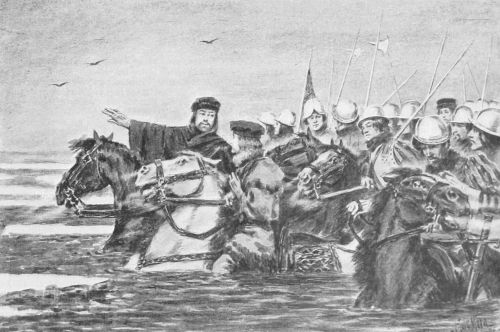
However that may be, we catch more glimpses of John's good side than of his bad. He was the companion of his father in many of his expeditions about Germany, and he was with him on that fatal trip to Eisleben in January, 1546, to reconcile the quarrelsome Counts of Mansfeld.
With his boy he forded the icy rivers Mulde and Saale, where they nearly lost their lives, and where the Reformer doubtless "caught his death." Escorted by horsemen and spearmen, Luther and his son entered Eisleben; the Counts of Mansfeld were reconciled, but Luther fell sick, and that very night, the 18th of February, he died.
All Germany mourned the great man's death; all Germany hoped that his sons might follow in the father's steps. But the three boys seem only to have turned out respectable men, without any of the elements of greatness or leadership.
John Luther made a fairly good lawyer. He married the daughter of one of his professors at Königsberg University; served as a soldier in the German army; settled down, and died at Königsberg, in the year 1576, at the age of fifty. His name is chiefly remembered as the "dear Johnny" and "son John" of his great father's letters, and of the happy home circle in the cloister-house at Wittenberg. He left neither name nor deed to make his memory a word in the mouths of men; yet we cannot but feel that, as the son of Luther, he must have been proud of the great father whom he remembered only with love and reverence, and, let us hope, rejoiced to see the regard the world paid to the masterful ways of the great Reformer and leader, whose gifts the son did not inherit, and whose name he but feebly upheld.
This Department is conducted in the interest of Girls and Young Women, and the Editor will be pleased to answer any question on the subject so far as possible. Correspondents should address Editor.
The last Pudding Stick was especially designed for young people who wish to write for the papers. This one is also to be about writing, but in rather a different line. I hope none of you will be offended if I urge upon you the importance of learning to spell. It always gives me a little quiver of pain—something like the sudden start of a nerve in a tooth which is sensitive—when I read a letter from one of my girls, and find that she uses two "l's" where she should use one, or one "t" where two are required. I think it is easier for some than for others to spell correctly. Spelling is largely a matter dependent on attention. You may not know it, but your eyes are always teaching you how to spell, and, unconsciously, as you read interesting books or the daily paper, you see how words are spelled, and learn to spell correctly yourself. There is no excuse for any girl who has both sight and hearing to blunder in her spelling, when Helen Keller, who can neither see nor hear, spells without ever making a mistake. Helen writes a beautiful legible hand, and uses a type-writer to perfection, and yet she has never had the advantages which most of us possess, having been blind and deaf ever since her babyhood. The thing is to pay close attention if you desire to be a good speller.
Very much more than we fancy we are dependent for our style of speech in writing and conversation on the authors we read. Here, too, we need to be attentive. No bright American girl can afford not to read a few pages of some good author every day of her life. Mere story-books are not sufficient. Keep on hand a book which is a serious undertaking, and plod straight through it. I have made this a rule all my life, and I advise you to do the same.
Those who have had the good fortune to be early taught another language besides your own, and who understand French or German, should keep on hand a book in one of those languages, and read a chapter or two every day. If I could I would like to persuade you of the importance of doing something along the line of a study or an accomplishment every single day. Even a few minutes regularly devoted will tell in time to advantage. The president of one of our great New England colleges used to say to the students, "Nothing can stand before the day's works." People who set apart a little while every morning or every afternoon for a definite purpose, and then never allow themselves to lose that time, making it up if they are interrupted by extra effort on the next day, soon surpass the brilliant people who are capable of great exertions now and then, but never do anything patiently day by day. I wish, too, that I could say to you as strongly as I feel, "love your work." "The labor we delight in physics pain." It seems to me a dreadful thing to go to one's work with the spirit of a slave. We should always put into our work our best thoughts, our best hope, and the motive of true love. No matter what the work, the way we go about it gives it worth and dignity, or makes it petty and mean.
Another caution is, do not talk very much about what you are doing. Nothing is so weak as vanity. Somewhere in the world there is always somebody doing such work as ours quite as well as we can do it, and we have no right to inflict upon our friends the story of our personal endeavors or failures. It is well to omit from our daily conversation as much as possible references to ourselves and to what we are engaged upon. I want my girls to become interesting women, and the woman who is really interesting thinks and talks of others more than of herself.
It is a good plan, in order to fix on your mind what you read and wish to remember, to keep a commonplace book. Here you may copy poems which please you, dates of striking events, bits of description, and entertaining anecdotes. One girl friend of mine succeeded thus in making a very beautiful compilation, which was afterwards published, and which gave great pleasure to her friends.