Chapter IV
Reading edition
The animals poured into the Ark like the tide through a sluice. They pushed and shoved and crowded, and many tried to get to the Purser's window ahead of their turns. The big ones brushed the little ones aside with a total disregard of gentleness or consideration. But the Bull soon put a stop to this sort of thing. He stuck his head out of the window and said all sorts of horrible things, and vowed he would have the doors closed if the beasts did not preserve better order. Things went along better after that.
The larger animals came in first: Lions, Tigers, Elephants, Hippopotami, Rhinoceroses, Camels, Giraffes, Dromedaries, Buffaloes, Polar Bears, Grizzly Bears, and every other kind of Bear. Tommy thought he had never seen so many different animals in all his life. It beat a circus all hollow, and it reminded him of the college song his Uncle Dick used to sing about:
"The animals came in two by two, Hurrah! Hurrah! The animals came in two by two. Hurrah! Hurrah! The animals came in two by two, The Elephant and the Kangaroo, And they all got into the Ark before it began to rain!"
After the large animals followed a long procession of deer—Elk, Antelopes, Gazelles, Chamois, Moose, and Caribou. Behind these came dogs of every kind—big dogs, little dogs, thin dogs, fat dogs, gay dogs, sad dogs, shaggy dogs, sleek dogs, and all colored dogs; Greyhounds, Mastiffs, Pugs, St. Bernards, Fox Terriers, Setters, Pointers, Poodles, Great Danes, Skyes, Black-and-Tans, and Collies. Toward the end of the procession came a long-bodied brown dog with big ears and long straight legs. Tommy had never seen that kind before.
"What is he?" he said, pointing downward.
The ex-Pirate shook his head, but the Gopher answered, "That's a Dachshund."
"A Dachshund?" repeated Tommy: "I guess not. Dachshunds are not built like that. Look at his long legs."
"Well, that is a Dachshund," insisted the Gopher; and then he pulled his sunbonnet over his head and closed his eyes for a nap.
The French Poodle was the only one that had any trouble with the Bull, because the Bull could not speak French, and refused to understand what the Poodle said. Tommy plainly heard the dog muttering to himself as he left the window:
"Espèce de John Bull! Il est toujours comme ça!"
But the little boy could not understand what the Poodle meant anymore than the Bull could, because he had not gotten along any further in his French exercise-book than "Have you seen the good General's red slippers under the green table of the wine-merchant's beautiful mother-in-law?" And he did not recognize any of the words in the Poodle's plaint.
The Bull had been losing his temper pretty rapidly ever since the doors opened, and he seemed to be waiting for a chance to do or say something ugly. Pretty soon a couple of harmless and sleepy-looking Oxen came plodding up the gang-plank and strolled through the doorway.
"Look here!" the Bull shouted at them, "you've got to leave your chewing-gum outside! No gum-chewing allowed on the Ark!"
One of the Oxen protested, but the Bull asserted that if the Ox made any trouble he would come outside and settle the matter himself; and so both Oxen regretfully stuck their chewing-gum under the gang-plank and passed in. A little while later a Lizard came along and handed in his ticket through the small window near the floor. The Bull looked at it and frowned, and then stuck his head out over the counter and glared at the little Lizard, who positively turned green with fright.
"What do you mean by presenting this ticket?" asked the Bull, savagely.
"Please, sir, I want to come into the Ark," replied the Lizard, meekly.
"Well, you can't get in on this ticket—see?"
"Please, sir, it's the only one I have," continued the Lizard, trembling.
"Well, look here, young fellow," snorted the Bull, getting angrier as he spoke; "this ticket is your shape, but it is not your size. You bought it from a speculator outside!"
"Oh no, sir!" exclaimed the Lizard.
"I don't care what you say. This is the Crocodile's ticket, and it ain't your size, and you can't get in on it!"
"Please, sir. I did not know," mildly protested the Lizard. "I can't read, sir."
"Well, don't you know that the pauper, the insane, and the illiterate are not allowed on this Ark?" roared the Bull, apparently deriving much pleasure out of the fact that he was scaring the Lizard half to death. The little fellow did not in the least understand the meaning of these big words, but he was so frightened by the Bull's ferocious manner that he turned away and scurried frantically down the gang-plank, and hid under a big stone in the sand.
"How awfully mean for the Bull to talk like that to such a little animal!" whispered Tommy to the ex-Pirate.
"That's what he always does. Never takes a fellow his size," answered the ex-Pirate. "He bullies the little ones: that's why he's called a Bull."
Presently a Crocodile came stamping up the gang-plank. He had a business-like expression in his eye, and a cold sarcastic smile displayed his glistening rows of sharp teeth. He stepped right up to the ticket-window, and thrust his long snout in so suddenly that he almost knocked the Bull off his stool.
"WHAT DO YOU MEAN BY SENDING ME A MINIATURE TICKET LIKE THIS?"
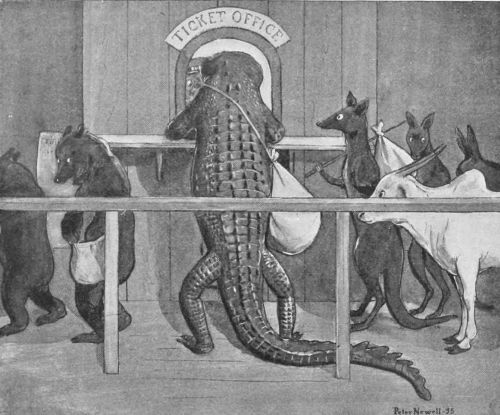
"What do you mean by sending me a miniature ticket like this?" he shouted, fiercely.
The Bull stuttered, "I beg your pardon, sir; but won't you allow me to look at the ticket?"
The Crocodile passed the paper in.
"Oh, it's all a mistake," began the Bull, apologetically. "I assure you it is all a mistake—"
"I should say it was," interrupted the Crocodile, who appeared to be in an exceedingly unpleasant frame of mind. "Do you think for a moment that I am going to take any such accommodations as that? Do you think I can sleep in any berth that was built for a Lizard?"
"It's a mistake," repeated the Bull, affably. "Your quarters are on the main-deck, starboard side, No. 417," and he passed out the ticket he had taken away from the Lizard.
The Crocodile did not appear satisfied. He stuck his nose through the window again and shouted:
"Well, I want satisfaction! I want satisfaction, and I'm going to have it—"
But the crowd of animals in line behind the Crocodile, tired of waiting, gave a push that sent the latter past the window and out into the main hall, still mumbling something about "satisfaction." The Bull looked out of his office, much relieved, and shouted down the line,
"Somebody tell that Lizard he can come in."
It did not take so long as Tommy thought it would for all the animals to get on board. When the last one had passed in, preparations were made to haul up the gang-plank, for the wind had freshened, the skies had darkened, and the general appearance of the heavens betokened the approaching storm. Just as the big plank was about to be taken aboard, faint voices were heard from the ground outside:
"Wait a moment! wait a moment!" they cried. "Wait for us; we're almost there!"
It was the Turtles. By so close a margin did they get into the Ark. The Bull scolded them as they passed, and then slammed down the window, and the Gopher, on the rafter next to Tommy, heaved a sigh of relief.
Soon afterwards it began to rain. The big drops fell noisily upon the shingled roof of the Ark, and pattered on the window-panes.
"What is that noise?" asked a little Armadillo.
"That's the rain, dear," replied its parent.
"Oh no," said the little one; "the reindeer are sleeping down-stairs."
And then there was a great jolt, and the Ark floated off on the flood.
[to be continued.]

The interscholastic matches at Newport promise to be more interesting this year than ever before. The game put up by the various players who are to represent the schools in the national tournament has been of so much higher an order than that of any previous season, that it has attracted more than the usual amount of attention from sportsmen not directly interested in the schools. There is better material blossoming this August than has come forward for many years, and most of it is coming out of the schools. The new players who are making themselves prominent are all young men—not men who have been playing many years and have finally developed skill. Thus it is very evident that the formation of the Interscholastic Tennis Association has been a good thing, and if properly supported—as I have no doubt it will be—it is bound to aid materially the progress and refinement of the game. It means the early development of good players and a higher standard in inter-collegiate tennis. Already interscholastic tennis, in its first champion, has given us a national representative who last year saved our trophy from foreign hands.
The history or the movement may be summed up in few words. It was initiated by the Harvard University Lawn-Tennis Club at the suggestion of its secretary, William D. Orcutt, in 1891, when the first tournament was held upon the college grounds, Saturday, May 2d, ten schools having replied to the circulars and letters by sending representatives—twenty-five in all. The tournament, played off in two days without a default, was won by R. D. Wrenn, of the Cambridge Latin School, and created no small amount of interest both in college and schools as the large audience at the courts testified. From this beginning grew the idea of an Interscholastic Association, with an annual tournament as a national fixture. In 1892, therefore, Harvard sent out further circulars inviting preparatory schools to send representatives to a second tournament, to be held under the auspices of the United States National Lawn-Tennis Association, by the Harvard Club, with the intention of forming a permanent association of the schools at a meeting to be called on the day of the tournament. In response sixty-six entries were received, representing at least twenty-four schools. The tournament, held May 7th, was won by M. G. Chace, another who has since distinguished himself among our ranked players, and afterwards, as had been proposed, the association was formed.
The formation of the Harvard Interscholastic Association was an incentive to other colleges to attempt similar organizations, and in 1893, Yale, Princeton, and Columbia started such associations, and held tournaments. The four winners of these events met that year in Newport, at the time of the national tournament, to determine the Interscholastic champion, and again in 1894, after similar preparatory tournaments.
The following table shows the Interscholastic champions up to date:
Year.Played at.Singles.School.
1891CambridgeR. D. WrennCambridge Latin.
1892CambridgeM. G. ChaceUniv. Grammar, Prov.
1893NewportC. R. BudlongHigh, Providence.
1894NewportW. G. ParkerTutor, New York.
These Interscholastic lists have already introduced several fine tennis players. R. D. Wrenn is the present national champion. M. G. Chace ranked fourth in the ten of 1893, and by the new method is in '94 ranked in Class 2. C. R. Budlong entered the first ten the year of his interscholastic championship, and now, with W. G. Parker, is placed in Class 4, (1/2 15). It is natural that the older players should watch the ranks of the interscholastics with some interest, for it is here that the coming players are most apt to show themselves first.
This year the contestants at Newport will be L. E. Ware, Roxbury Latin School, of the Harvard I.S.L.-T.A.; M. W. Beaman, Lawrenceville, of the Princeton I.S.L.-T.A.; and Waltz, Leal's School of the Columbia I.S.L.-T.A. J. P. Sheldon, Jun., of Hotchkiss Academy, Lakeville, won the Yale Interscholastic tournament, but may not be able to be present at Newport this week. Of these four players the chances seem in favor of Ware, who has already some practical tournament experience to back his good play. Last year he won the Harvard Interscholastic, but was defeated at Newport by W. G. Parker, winner of the championship. At Longwood, last year, he showed excellent form in his match against Larned, from whom he won the first two sets, and at Saratoga he was "runner-up" in the tournament for the New York State Championship. This season he has also appeared in several tournaments. At Longwood, having reached the semi-final round, he lost to M. D. Whitman, whom he had before defeated in the Harvard Interscholastic. In the double contests at Elmira, Ware and W. M. Scudder played a close match in the finals against Fisher and Paret. In his game, Ware's strong ground stroke, quick judgment, and self-possession give good promise of a future player.
The names of the other three contestants do not figure so conspicuously in large tournaments. Sheldon has played in Western State championships, winning in Ohio, but he has not had the experience of Ware against our best Eastern players. He easily won the Yale Interscholastic, not losing a set even to the winner of that event last year. He is good both back and at the net, placing with some accuracy, and certainly in these preliminary contests he showed a very good understanding of the game. If he keeps his steadiness and coolness under the excitement of closely contested matches he should prove a formidable adversary for Ware. Concerning Beaman and Waltz it is more difficult to pass judgment, these, as yet, having given little public exhibition of their games. Waltz ranks as a third-rate local player, having been easily beaten in local matches by the Miles and by Holcombe Ward at Orange.
It is to be regretted that Whitman is ineligible for the Newport event, for he is a strong man, and has shown wonderful improvement since Ware defeated him on Holmes Field in May. He is sure to become a prominent player in the early future. Some of the other good men that the schools have produced, and who will doubtless be at Newport, are Beals, Wright, Henderson, and Moeran of Southampton, and Palmer of Hobokus.
It cannot be debated that larger co-operation by the different colleges in this field of interscholastic tennis would be of the greatest benefit to the game in this country. It would offer early incentive to young players throughout the land, and carry a step further the general system of sectional tournaments already instituted by the central association to spur our players to greater and more scientific effort. The contests last year at Newport, and again this spring at the Neighborhood Club, West Newton, Massachusetts, where our men came in contact with foreigners, brought out both our weakness and our strength; it showed clearly that our worst fault is the unsteadiness of American players. That this early tournament playing, accustoming young men to watch their strokes and play carefully, must aid in remedying this evil among the rising players hardly needs to be pointed out, while the new opportunity of meeting equal or better players must also promote skill and brilliancy in play. Add to this the closer contact of school and college, and there seems strong argument for the more vigorous support of such a cause.
In less than a month football will be taking up most of the time and attention that school athletes can devote to sport. The coming season should be a notable one in the history of the game too, for it will show whether or not the schools are going to allow themselves to be influenced by the better or the worse element that is identified with the game. The better element is the one which has been trying for years to arrange a code of rules that would purge the sport as much as possible of opportunities for the practice of rough and unsportsmanlike methods. The other element is the one which has been trying for just as many years to evade the rules laid down. If the school players will frown upon all unfair methods, and refuse to countenance sharp practice in the game, if they will insist upon adhering to the spirit as well as to the letter of the law, they will soon swell the ranks of the better element of football men to such proportions that the other class will find itself entirely overruled.
It is unfortunate that we should be forced to admit that sharp practice occurs in football to a greater extent, probably, than in any other sport. But, nevertheless, I think this is true. More acts of meanness are performed in the course of one football game almost than in a whole season of baseball or tennis or track athletics. Men will punch and kick one another when the referee is not looking, and they will resort to all sorts of small tricks that they would blush to acknowledge afterwards. But, remember, this is not the fault of the game, it is the fault of the man. And the endeavor of every true sportsman should be to get this sort of man out of the way. We don't want him. He does more harm than good, even if he is the best player on the eleven.
It is considered clever by many to do as many small and mean acts as possible in a match game of football. To resort to petty practices is looked upon by them as good playing. But there is no good playing, except fair and honest playing. These same men who will kick their opponents in the shins when the umpire is not looking are those who encourage players to attend school during the football season, not caring whether they remain afterwards or not. It is surprising how much of this is done, and I have actually heard men say (instead of refusing to play with a team composed of such men) that they, too, have hired or obtained players to meet their rivals' crooked tactics. What an argument! Where would the ethics of sport end up if such logic were to be accepted? Why cannot we all become thoroughly imbued with the idea of sport for sport's sake only? We do not play to win. We play for the sake of playing—for the sake of the sport, the exercise, the fellowship, and good blood that is to result.
Last year and the year before there was more than one school in the Connecticut High-School League that resorted to practices not entirely consistent with true sportsmanship. I speak of these now because my attention has been directly called to them, and because I believe from personal investigation that they were guilty certainly of a portion of the misdeeds that rumor credited them with. In the other scholastic football associations I have known of irregularities, but of none quite so flagrant as those of Connecticut. There several football players have suddenly been seized with a desire to attend school just as the season opened, and have lost all inclination to study immediately after Thanksgiving.
It is, of course, impossible to say outright that these men are improperly induced to enter school, for such a thing is very hard to prove. But it is perfectly just to say that no Captain of an amateur eleven or of a school eleven should allow any man to play on his team whom he does not believe to be a bona fide scholar who means to remain in school until the end of the year—a scholar who has come to learn what is taught in the class-room, not what is practised on the football field.
It is ridiculous for any Captain to assert that he does not know what the men on his team intend doing a month hence. It is his business as Captain to know this. He should know where his players come from, how long they are to be in school, and all about their football experience. If he does not know all this he is a mighty poor Captain, and ought to be replaced. And the Captain who allows a man to play on his eleven whom he suspects of having intentions of leaving school before the year closes is not a fit leader for an honest school's football team, and should likewise be replaced. The best Captain in the end is the most honest Captain, and the most honest Captain is the best sportsman.
While speaking of sportsmen and sportsmanship I should like to call the attention of all the readers of this Department to a definition of "sportsman," published in the "Amateur Sport" columns of Harper's Weekly of August 17th: "A sportsman engages in sport for sport's sake only, and does by others as he would be done by. A 'sporting man' or 'sport' enters sport for mercenary motives, and prefers to 'do' others." This is only one sentence from a very good sermon. I recommend the entire article to every one interested in the welfare of sport.
The Academic Athletic League of California has track-athletic sports as well as football in the autumn term. Their next semi-annual field-day is to be held September 28th, and from present reports the new material in the schools is going to make a showing. As the meet is to be held on the University of California track, which has the fastest 100-yard course on the Coast, the A.A.L. sprinting records, which are at present 10-4/5 and 25-1/5 secs., ought to be reduced. Parker, Hamlin, and Chick are the most promising men to do the work, Chick being a new man and a brother of the University of California sprinter. Lynch of the B.H.-S. has gone to Oakland to live, and will wear the O.H.-S. colors at the next field-day. He has improved greatly in his hammer throwing. The O.H.-S. team, by-the-way, stands a good chance of retaining the interscholastic championship of the Coast, and if the teams are increased from seven to ten men, as is now proposed, the other schools will have to work hard to defeat them.
The California school athletes certainly go ahead of their Eastern brethren in enthusiasm and true love of sport. This Department has for some time been urging the formation of a general Interscholastic Association; but as yet nothing has been done toward any such organization, although I understand that active steps in this direction are to be taken here as soon as the schools open next month. It may be due to the long summer vacation that nothing has been done yet. But in California interest in sport seems to be so lively that there is no vacation interference. In a recent letter from Oakland, one of the prominent men of the A.A.L. says: "In regard to your proposition for a general American Interscholastic League, I can say that it meets with the approval of the boys here, and we would be glad to join it if it is formed. The only difficulty to our participating in such a field-day would be the expense for travelling to and fro. If we joined such a league we would try to raise the necessary sixteen hundred dollars. For it would take that much, at least, which is quite a good deal for High-School boys to raise. Will you kindly let me know of any advances in this direction, and also give me an outline of what is intended?"
With such a spirit as is displayed in this letter the sportsmanship of the Pacific coast is bound to thrive. These lads are not only willing to join the Interscholastic Association at once, but they believe they can collect enough money to pay expenses to come East and be present at the first meet. I hope they will have the chance, and from the letters I have received from sportsmen along the Atlantic seaboard, I believe that in a very few months the much-needed association of the schools of the country will be in running order. Perhaps one reason why the Californians are so anxious to come here and try their skill is that they believe they can win. Their records are not up to those of the Eastern leagues, but another writer from the A.A.L. says: "One of the University of California team told me the Eastern schoolboys are clever, but that an Oakland High-School team could pull a field-day away from the best school of 'em. That makes me wish we had a 220 straight-away here to see how Dawson and Woolsey would appear alongside of Syme." Dawson holds the local high-hurdles record at 19-1/4 sec., and Woolsey holds the low-hurdles record at 31 sec. The sticks are 3 ft. 6 in. and 2 ft. 6 in. high, respectively.
In other matters of sport the Californians are just as progressive as they are in their desire to come East. They have recognized the justness of the Round Table's advocacy of uniformity in field and track programmes, and are trying to adjust the A.A.L. list to the university schedule. They have already adopted a 440-yard run, which they did not have before, and at an early meeting of the executive committee on athletics a motion will be made to use a 16-lb. hammer instead of a 12-lb. weight at the coming games. The shot is already a sixteen-pounder.
The Graduate.
This Department is conducted in the interest of stamp and coin collectors, and the Editor will be pleased to answer any question on these subjects as far as possible. Correspondents should address Editor.
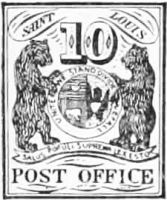
One of the greatest "finds" in the history of stamp collecting has just been made in Kansas City. The letters of an old firm were about to be destroyed when the attention of a stamp-collector was called to them. He immediately bought the entire lot of letters for a small sum. Among the lot were about one hundred letters each bearing one or more of the rare St. Louis stamps issued in 1843, and remaining in use until 1847. The 5c. stamp has hitherto brought from $150 to $200 at auction; the 10c. about $75, and the only copy of the 20c. in the market was sold in 1894 by the veteran dealer J. W. Scott, usually called "the father of philately," to a collector in Bangor, Maine, for $1500. This gentleman, it is said, refused an offer of $2500 for the stamp.
In this new lot are a number of pairs of all three varieties and several strips of three. The immediate result will probably be lower prices on all three St. Louis stamps, but the demand will probably fully equal the supply.
Fred.—No premium on the English shilling, 1817.
J. Hall.—Very few gold dollars were ever coined, and many have found their way to the melting-pot, or have been practically destroyed by conversion into bangles. Hence the dealers ask from $1.50 upward for all U.S. dollars in gold.
H. Stevens.—It is impossible to give anything more than a rough estimate as to the number of stamp-collectors and dealers, or the value of the stamps now in existence in albums, or the amount of annual business done in stamps. I hope to give some statistics on all these points in a future issue.
M. C. W.—It would be very difficult to explain the differences in the Brazils and Guatemalas without illustrations, or within the narrow limits of this column. I congratulate you on your "find" of Wurtembergs.
R. B. Haddock.—The 1864 and 1866 2c. coppers are quoted by dealers at 10c. each for "good," and 50c. each for "fine."
Philatus.