GREAT MEN'S SONS.
Reading edition
THE SON OF CHARLEMAGNE.
BY ELBRIDGE S. BROOKS.
n the summer days of the year 781 an odd sort of a procession marched through France.
There were fluttering standards and melodious trumpets; there were gallant knights, and grave men in robes and gowns, and noble ladies, and a long train of servants; there were spearmen and bowmen and horsemen in martial array; and the central figure of all this parade and pomp was a very small boy of but three years old.
Strangest of all was this small boy's dress. He was but little more than a baby, and yet he rode upon a stately war-horse housed in purple and gold. He was clad in complete armor of polished steel; on his head he wore a casque of steel and gold, surmounted with a tiny golden crown; in his small hand he bore a truncheon, and about his neck was slung a cross-handled sword of steel and gold.
A stalwart knight rode at the little boy's bridle-rein, his protecting arm holding the small rider firmly in the saddle; the royal banner fluttered ahead, and at the boy's right hand rode his governor and guardian, Count William, called the snub-nosed—well, because it was.
From castle and cottage, from town and hamlet, came thronging men and women, boys and girls, with smile and cheer and shout of hearty welcome: "Heaven bless his little Grace! God guard our little King! Long live King Louis!"
"HEAVEN BLESS HIS LITTLE GRACE."
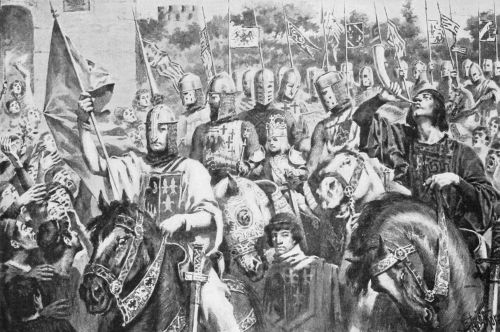
For this very small boy of three was indeed a King entering his dominion. He had been crowned by the Pope at Rome King of Aquitaine. Then, from his father's splendid palace in Aachen, or what is now the German city of Aix-la-Chapelle, he had started with his glittering escort to take possession of his kingdom in southwestern France. Over the first part of the route he was carried in his cradle; but when he left the city of Orleans, and, crossing the Loire, set foot within his own dominions, this cradle-travelling, so the old chronicle tells us, "beseemed him no longer." He was a King, and this was his kingdom; therefore like a King he must make his royal progress. So upon this little three-year-old was put a suit of shining armor, made expressly for him, with sword and truncheon "equally proportioned"; they set him on horseback, and thus royally attended he entered Aquitaine, and marched on to his own royal palace at Toulouse. He must have looked "awfully cunning"—this three-year-old in armor—but just think how tired the poor little fellow must have been.
Aquitaine was that large section of southwestern France that stretched from the river Loire to the Pyrenees, and from the Bay of Biscay eastward to the banks of the Rhone. It had been brought under subjection by the conquering monarch whose short-lived empire embraced all of Europe from Rome to Copenhagen, and from the English Channel to the Iron Gates of the Danube, and who, parcelling out his dominion among his boys, had set over the principality of Aquitaine as King his little three-year-old Louis, forever famous as the son of Charlemagne.
Here, in his palace at Toulouse, did Louis rule as King of Aquitaine for thirty-two years, subject only to his renowned father, Charles the Emperor, called Carolus Magnus, or Charlemagne. This mighty man, "the greatest of Germans"—great in stature, in aim, in energy, and in authority—looked sharply after the small boy he had made King of Aquitaine. He had the lad carefully and thoroughly educated, and Louis grew to be an intelligent, bright-faced, clear-eyed, sturdy, and strong young man, but he was sober and sedate, skilled in the Scriptures and learned in Latin and Greek, unsuited to the rough war days in which he lived, more a scholar than a soldier, and more a priest than a prince.
So the years slipped by. Then trouble came to the great Emperor. One by one the sons of Charlemagne sickened and died—those brave and stalwart boys upon whom the father had relied as the stay and help of his old age, his successors in his plan of empire. At last only Louis the Clerk was left.
Hludwig Fromme he was called by his subjects of Aquitaine—that is, Louis the Kind; and thus, though wrongly rendered, the name of this good and peace-loving son of Charlemagne has come down to us as Louis the Pious, or Louis le Debonair.
Nowadays we are apt to think of debonair as meaning gay, careless, fashionable, and "dudish"; but Louis, the son of Charlemagne, was anything but this. He was kind, courteous, loving, gentle, and true; but he was also strict, dutiful, and just. He was strong of limb and stout of arm; none could bend bow better nor couch lance truer than he; but he never cared for sport nor the rough "horse-play" of his day; he seldom laughed aloud: he was grave, prudent, and wise, "slow to anger, swift to pity, liberal in both giving and forgiving."
He won the loyalty of his subjects of Aquitaine by love and not by tyranny; he kept at bay the pagan Moors of Spain, and, under wise counsellors, sought to govern his kingdom justly and well.
But when his brothers died, and he, the youngest of the three, was summoned to his father's side, he left his palace by the Garonne, in pleasant Toulouse, and hastened to Aix-la-Chapelle, his father's capital.
It was the year 813. An assembly of the nobles of the empire met the great King in his capital, and promised to recognize King Louis of Aquitaine as heir to the throne of Charlemagne. Then in the great church that he had built at Aix-la-Chapelle the old monarch, dressed in magnificent robes (which he never liked and would but rarely put on), stood before the vast assembly of princes and nobles of Germany, leaning upon the shoulder of his sturdily built and kindly looking son.
The sounds of prayer and song that opened the ceremony were stilled, and then the old Emperor, facing his son, told him that the lords and barons of the empire had sanctioned his appointment as associate and heir.
"You will reign in my stead," he said. "Fear God, my son, and follow His law. Govern the Church with care, and defend it from its enemies. Preserve the empire; show kindness to your relations; honor the clergy as your fathers, and love the people as your children. Force the proud and the evil ones to take the paths of virtue; be the friend of the faithful and the helper of the poor. Choose your ministers wisely; take from no man his property unjustly, and keep yourself pure and above reproach in the eyes of God and man."
Then Charlemagne bade Louis take up the iron crown of Rome and the empire that lay upon the altar, and place it upon his head. "Wear it worthily, O King, my son," the father said, "as a gift from God, your father, and the nation."
And when the son of Charlemagne had thus crowned himself Emperor, turning to the great assembly the old man said: "Behold, I present to you your sovereign and your lord. Salute him, all people, as Emperor and Augustus!"
A mighty shout of loyalty and welcome filled the crowded church, and thus was the son of Charlemagne crowned as his great father's associate and successor. And when, in the year 814, Charlemagne, still a sturdy old man, suddenly fell sick of a fever, and died in his palace at Aix-la-Chapelle, at the age of seventy-one, Louis ascended the throne of what was called the Holy Roman Empire as its sole and sovereign lord.
He came to his vast power with high hopes and lofty aims. The solemn words of his father upon his coronation day lived in his memory, and he determined to rule in peace, in justice, in wisdom, and in love. He would abstain from war; he would lift his people higher; he would make his court learned, refined, and pure; he would be father and friend to all his people, and make his realm rejoice. Louis, called the Pious and the Kind-hearted, should rather have been called Louis the Well-intentioned.
But alas for good intentions if strength of will be wanting! Louis lived in harsh and brutal days, and men could appreciate neither his gentle manners nor his worthy aims. He had neither his father's strength of mind nor firmness of will, nor had he what is called magnetism—the power to compel men to do as one elects. His noble aims were speedily brought to naught; his high purpose was swiftly overthrown; his ambitious sons opposed him, quarrelled with him, defied him, assailed and dethroned him; and after a stormy reign of twenty-six years, during which he many times wished to give up his crown and become a monk, Louis the Well-intentioned died, in the summer of the year 840, on one of the little islands in the river Rhine, a discrowned, defeated, and sorrowing King, conquered by his sons.
The great empire his father had left him was speedily broken asunder, and from its remains, after long years of disorder and of blood, came at last the nations of France and Germany—the outgrowth of that vast heritage of power which the son of Charlemagne had received from his mighty father, but had neither wit nor will enough to govern or hold unbroken.
A noble man in many ways was Louis, the son of Charlemagne. But he lived in advance of his times, for stormy seas demand a strong hand at the helm, and great matters require the head to plan and the will to do. In all of these requirements for royalty was Louis deficient; and while history accords him praise for honesty of purpose, gentleness of heart, good intentions, and lofty aims, it still writes him down as an unsuccessful ruler, because a weak-willed son could not uphold the heritage of a father who indeed was great.