Chapter III
Reading edition
Tommy often wondered afterwards why it was that he did not feel frightened when he found himself so close to this great congress of wild animals. But at the time he did not feel in the least alarmed, and he and the ex-Pirate sat together for some time under the oak planning as to what they had better do. Perhaps Tommy felt no fear, because all the animals seemed to be on such good terms with one another, and so gave evidence that they would not harm any one else. The little boy noticed the Lion and the Lamb lying down together; the Fox was playing tag with the Geese ("Fox and Geese, I suppose," thought Tommy); the Red Wolf was strolling about, arm in arm, with a bearded Goat and his kids; and half a dozen Mice were having all sorts of fun with an old Tom Cat who wanted to sleep.
"I guess the only thing for us to do," remarked the ex-Pirate at last, "is to just walk over and go aboard. There's no use sitting here any longer. We have not any umbrellas, and it is liable to begin to rain at any moment. Let's try our luck."
"Perhaps it would be best for us to walk around to the other side," suggested Tommy. "There doesn't seem to be so many animals there."
His companion approved of this, and they started off together, making a circuit which soon brought them to the other side of the huge house-boat. There were scarcely any beasts in sight, and so they boldly approached the great craft which towered high up above their heads. When they had come quite close, the ex-Pirate's keen eye caught sight of a small port-hole near the stern, and after calling Tommy's attention to it they decided to try to get in that way. The port-hole was very narrow, and it was with the greatest difficulty that the two managed to squeeze through. But they succeeded, nevertheless, and found themselves in a sort of dark chamber where there was a ladder that led to the upper regions of the Ark.
"We're all right now," said the ex-Pirate. "Do you think this will be too much for you?"
"What?" asked Tommy, who did not quite understand.
"The ladder."
"Not a bit. Why?"
"It's more than you."
"How do you mean?" asked the little boy, now somewhat puzzled.
"You are a lad, aren't you?" said the ex-Pirate.
"Yes."
"Well, this is a ladder."
There was not anything that Tommy could very well answer to any such statement; but then he had long since given up any idea of following the peculiar arguments and reasonings of the ex-Pirate. Yet in order to show him that, even if the ladder was more than he, he was certainly equal to climbing it, he seized the rungs and clambered up. It ended at a trap-door which, when lifted, opened into a very large room that appeared to occupy the entire length of the Ark.
"Aha!" exclaimed the ex-Pirate. "This is where they have the boxing-matches."
"Will they have any?" asked Tommy, eagerly, and his eyes opened very wide.
"I don't know," returned the ex-Pirate, "but this is the spar-deck."
"How did you get here?" suddenly asked a familiar voice from behind them, which so startled Tommy that he almost stepped into the open trap. When he looked around he saw, to his great joy, that it was the Sheep.
"Oh, we just came," answered the ex-Pirate, quickly. "Things come and things go, you know."
"Yes, I've heard that before," interrupted the Sheep. "But if Noah catches you, he'll put you ashore."
"But we don't want to go ashore," said Tommy, who at seeing his old friend the Sheep had entirely recovered from his momentary alarm.
"Well, I'm very busy now," continued the latter, "and the animals will be coming in pretty soon. If you want to see them, you had better go up to the other end of the Ark and sit on a rafter over the entrance. But don't let the Bull see you. He's in a mighty bad humor. Good-by," and the Sheep trotted off and disappeared almost as suddenly as he had come.
"Guess we'd better do that," said the ex-Pirate, meditatively. "We don't want to get put out." So they walked to the other end of the big room, being very careful to make as little noise as possible, and when they came to the large arched entrance with the heavy bolted doors the ex-Pirate helped Tommy climb up a post, and the two slid out on a rafter, from which they could obtain a first-rate view of anything that might happen. Just below where they sat, and directly opposite them, was a window with a small counter in front of it and the words "Ticket Office" painted over it. Below the counter, nearer the floor, was another window, only smaller—"for the little animals, I suppose," thought Tommy. When their eyes had become accustomed to the semi-obscurity of their surroundings they found that they were not the only occupants of balcony seats. A few feet away from them sat a Gopher. He wore a pink sun-bonnet, and looked somewhat timidly at the intruders. As soon as the ex-Pirate saw him, he said: "What are you doing up here? Why aren't you outside?"
"WHAT ARE YOU DOING UP HERE? WHY AREN'T YOU OUTSIDE?"
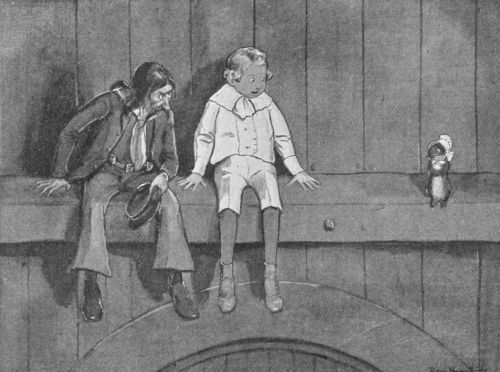
"Lost my ticket," answered the Gopher, timorously.
"Lost your ticket?" repeated the ex-Pirate.
"Yes, sir," continued the little animal, meekly. "Not exactly lost it. I put it in my mouth, and forgot, and swallowed it. I've got it inside."
"Oh," said the ex-Pirate. "Well, you'll get it back as soon as we start."
"Please may I stay?" asked the Gopher.
"Why, certainly," replied the ex-Pirate, affably, waving his hand in a grandiose way, just as if he had been the proprietor of the Ark; whereupon the Gopher looked much pleased and relieved, and settled down comfortably again at his end of the rafter.
Just then the shutter of the ticket window was thrown up with a loud bang that made Tommy jump, and the Bull stuck his head out and peered up and down the large room. He was a very fierce-looking Bull, and he wore on his head a cap with the word "Purser" embroidered on it in gold letters.
"All aboard!" he bellowed, in a voice that fairly made the timbers tremble, and scared the Gopher half out of his wits. And then some one from the outside opened the heavy doors and the animals began coming in.
[to be continued.]

The annual meet of the American Canoe Association, which is now in progress on Lake Champlain, is decidedly the most important sporting event of the year to canoe lovers. For the past week hundreds of enthusiasts have been paddling and sailing and racing off Bluff Point, and every known kind of canoe has been seen on the water. It is only twenty-five years since canoeing as a sport found favor in this country, but since then it has grown steadily, and now there are canoe clubs in every State. Although the canoe, both as a paddling and a sailing craft, is distinctly American in its origin, it is a fact, nevertheless, that canoe cruising and the sport of canoe sailing were introduced from England. About thirty years ago a Scotchman named John MacGregor built a canoe, which he called the Rob Roy. It resembled an Esquimau kayak, being low and narrow and decked all over, except for a narrow space in the middle. It had a small lateen-sail, but the mode of propulsion used most by MacGregor was his two-bladed paddle. In this queer little boat he explored many of the waters of Great Britain, and cruised extensively in Holland, Germany, Norway, and Sweden, meeting with many adventures, an account of which he afterwards published under the title of A Thousand Miles in the Rob Roy Canoe. He has also written several other interesting accounts of other trips. The most delightful account ever written of a canoe cruise, however, is Stevenson's Inland Journey. Any young man who has the slightest inclination toward the sail and the paddle will surely take them up with enthusiasm after reading these books.
The choice of a craft is always difficult, especially to one who has had little or no experience in canoeing. I told last week how an inexpensive canoe might be built of canvas, but for cruising purposes a boat made of wood is necessary. It is taken for granted that any one who can afford the time for a cruise can also afford the money to purchase a suitable craft for his journey. A good cedar canoe nowadays costs from $80 to $150, but boats made of less-expensive woods may be had for as little as $30. The building of these light canoes has become such a big business that there are over fifty varieties made now where there were only half a dozen fifteen years ago. But in spite of all the varieties there are only about three classes—the racing-canoe, the paddling canoe, and the cruising canoe—which use both sail and paddle.
BIRCH-BARK CANOES.
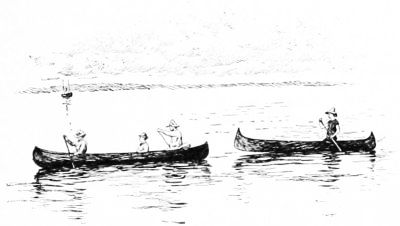
Although Mr. Vaux, one of the most experienced of canoeists, said, "There is no such thing as a best canoe," he did not mean that there was no such thing as the best kind of canoe for certain purposes. He was particularizing. He meant that it was impossible for any man to tell another what particular make of canoe would suit his tastes best. It really depends entirely on what you want to do with your boat. If you wish to cruise in inland lakes and deep open rivers where there is plenty of wind, but no very heavy seas, and where you will use sail and paddle in about equal proportion, get a canoe of the "Nautilus" type. But for narrow streams and running rapids I should recommend a "Peterborough." The latter are of different sizes and varieties, and are built at the Canadian town of Peterborough. They are modelled after the Indian birch-bark canoe, and are made of basswood or cedar. They cost from $30 to $50, according to finish, and are very serviceable. The basswood boats are not so liable to leak as others.
SAILING BEFORE THE WIND.
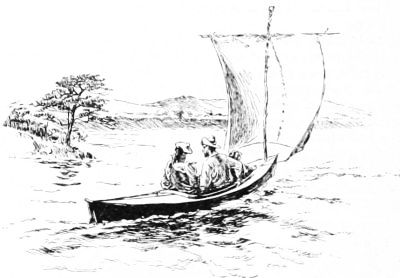
Another advantage of the "Peterborough" is that it will carry more passengers and duffle than any other style of canoe, and can easily be carried over land or around locks if you are travelling along a canal. It is easy to paddle, sails fast before the wind, and is the best craft in the world to shoot rapids. At night it can be drawn up on shore and turned upside down, thus making a dry and comfortable shelter. The "Nautilus" style of canoe is from twenty-eight to thirty inches wide and about fifteen feet long. It is fitted with a centreboard, and is an excellent cruising craft. It will carry one person comfortably, and two at a pinch, and the air-tight compartments forward and aft make it a life-boat, unsinkable. Beneath the decks and hatches there is plenty of room for dry stowage. At night the owner of a "Nautilus" canoe can either haul his craft ashore or anchor in deep water. In the latter case, he hoists his canoe tent above his head, unfolds his mattress, and sleeps comfortably in the cockpit. Personally, however, I prefer to land and pitch camp.
IN CAMP.
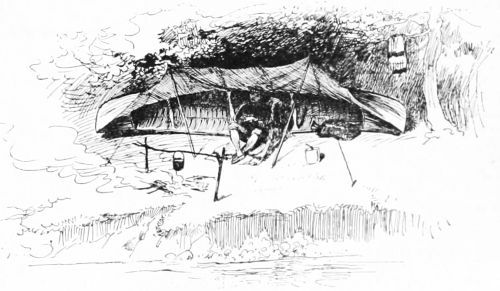
It is always advisable to select your camping-ground and be in camp before sunset. Pull the canoe up out of water, take your duffle out, and turn the boat upside down over it. Then make your fire; see that there is no danger of its spreading, and that the breeze is blowing the sparks away from your camp or your canoe. The fire well started, take a pail and a glass jar and go to the nearest farm-house for milk and eggs. When you get back, you will find that the fire has made a nice bed of coals on which you can do your cooking. Never attempt to cook over a blaze. It sometimes happens, however, that the ground is wet, or that a storm will interfere with your fire. For such emergencies it is well to have an alcohol lamp in your outfit, for on this you can boil enough water to cook eggs and make a cup of coffee, and if you are an expert with a chafing dish you can rival the best of city restaurants. But it is not probable that you will have such a luxury as a chafing dish among your equipments. You will probably have a saucepan instead—in fact it is necessary that you should have a saucepan. And with a little practice you can cook almost anything in the latter that you can in a chafing dish. The other necessary cooking utensil is a coffee-pot. With that and the saucepan and a small kettle you can live very comfortably. There are a number of small books of convenient pocket size that will tell you all you want to know about camp cooking. This is a good subject to study up before starting on a cruise.
The supplies that a canoeist takes with him in his boat should consist of a few pounds of sugar, a box of salt, three or four pounds of ground coffee in a tin box with a close-fitting screw top, some bacon, a pound of tea, a couple of jars of marmalade or jam, a tin of deviled ham, and a pound or two of pilot-bread or hardtack. There will be lots of places along the course of your cruise where you will be able to replenish these stores should they run short, and at the villages you pass you can secure fresh meat if you care for it or are skilful enough cook to prepare it. Always have a line and some fish-hooks with you, for a canoeist should be a good fisherman.
A mess-chest is a good thing to have if you are travelling in a "Peterborough." This is a tin box three feet long, one foot high, and about eighteen inches wide. Its top should have a cover of painted canvas, with flaps that will come down over the edges. In this box your provisions and a change of under-clothes may be kept perfectly dry. Carry plenty of matches and a good lantern.
Your matches should be kept in a glass jar with a screw top—an old preserve jar is just the thing. Then they cannot get damp.
CRUISING CANOE UNDER PADDLE.
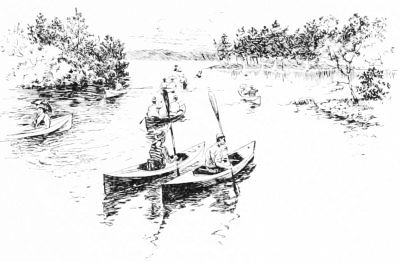
As to the cruise itself, it should be carefully planned beforehand. Never start off with only a general idea of where you want to go. It is a bad thing to trust to luck in canoeing. Plan your trip so that you will start at the head of some river, or as near the head as you can find good water, and cruise down. Don't attempt to cover too great a distance in one day. Twenty-five miles a day is enough, and is more than you will care to make if most of it has to be paddled. Further—never hurry. Take plenty of time to fish, bathe, land, visit the country, and eat your meals regularly. If you have only a certain number of days to devote to your cruise, lay out the distance you must cover each day, and try to stick to your schedule as closely as camping-grounds will allow. Keep a record of your adventures in a log-book; this will prove not only interesting but valuable in the future.
No one should ever think of taking a canoe cruise unless he can swim. The canoeist gets too many upsets to risk venturing into deep water unless he can take care of himself. It is a good thing to practise upsetting in shallow water, so as to learn how to climb back into your boat again. Having fallen into the stream or the lake, whichever it may be, swim back to your canoe and seize the side nearest to you at the middle with your left hand. Then reach across the cockpit to the opposite gunwale with your right, and extend your body horizontally on the surface of the water. By a quick motion you can easily draw yourself across the cockpit and into the canoe again. It is well to keep your paddle tied to a thwart with a stout string long enough not to interfere with your work. Then it cannot float away when you upset.
A RACING CANOE.
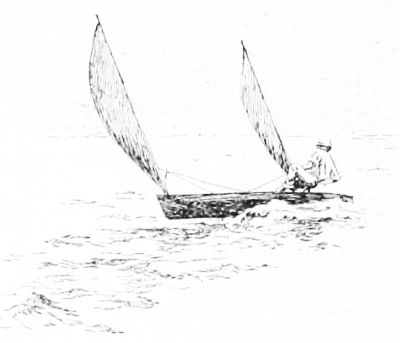
LEG-OF-MUTTON.
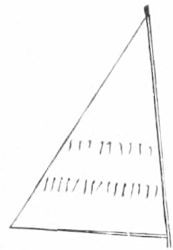
The sails most commonly used on canoes are the leg-of-mutton sail and the standing lug. On racing canoes you usually see the bat sails—but racing canoes are mere machines that are not good things to have or to imitate, and the better element among canoeing sportsmen to-day are frowning them down. A leg-of-mutton sail requires a tall mast, which some canoeists regard as a serious objection. The sail, however, runs to such a small point aloft that there is really very little surface exposed to the wind, and very little weight up there. It is the most simple form of sail, too, and can be easily raised and lowered, or reefed, and is, I believe, the safest kind of a sail for a canoe. It can be used to very good advantage on a boat of the "Nautilus" type.
STANDING LUG.
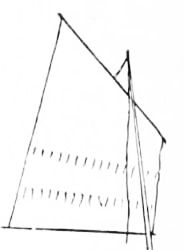
For a canoe of the "Peterborough" type the best kind of a sail is the standing lug. It is very nearly square (and if you want to manufacture one yourself you can make it square), and very good for running before the wind. It is easily managed, and serves admirably as a tent or awning when you are camping with your canoe turned up for shelter.
One of the greatest pleasures of canoeing is that the impressions you get are so vivid and real. All the world seems so big and strong. Your craft is so tiny that everything else appears to be very large. A breeze that would be welcome to a yacht is a gale to a canoe, and what are moderate waves to a sail-boat of ordinary size are heavy seas to a "Peterborough." And then, in a canoe, you are your own captain and your own crew. You can go as close in-shore as you wish, and the panorama that passes by you is so near that you almost feel you can touch the fields and hills, or pick up the cows from the pastures and put them down again. And then the expense of canoeing is so moderate. You can live on your voyages at the rate of about fifty cents a day. You carry your house along with you; your only expenses are for provisions. I should be glad to give more space to the subject, but while I believe that a great many of the readers of these columns are interested in canoes—or would be if they had ever tried one—I realize, too, that there are others who are just as eager for bicycling and cat-boat sailing and mountain climbing and hunting and fishing. And to them I shall talk later. But if there is anything about canoes that any reader of the Round Table desires to know, I shall be glad to reply to his questions.
Football practice has begun in California. The school term opens in August on the Coast, and the football men of the Academic Athletic League are already on the gridiron. The Oakland High-School eleven promises to be a strong one again this year in spite of losses by graduation. Lynch will probably fill McConnell's place at tackle, and Walton will no doubt play half-back. Russ, the clever half-miler, is trying for quarter. He is not particularly apt at the game, and is too good a track athlete to risk his legs in a scrimmage. If the O.H.-S. Captain can find another man for the position, it will be best for the general welfare of the school's sport to keep Russ on the cinder track. Chickering will be on the end again, and Guppy is pretty sure to hold the other flank.
Captain Anderson will keep his old position at full-back. He has speed, endurance, and pluck; he runs low, uses good judgment, and plays hard all the time.
His principal fault is that he runs too far out in circling the ends. It is better football to make for a hole and to depend on your end rush to hold the opposite end off. A down inside the end is better than a hard run away around with the risk of being forced beyond the line. A two-inch gain is better than a run across the field. What the team needs most is a good punter and place kicker, and the ends ought to learn to get down the field quicker on punts, and to follow the ball better than they do now.
A great many letters come to this Department every week asking questions and making suggestions. Most of them are signed by the writers, just as any gentleman signs a business letter when writing to another, and these can be answered in due time. Others come signed with initials merely, or with noms de plume, and without addresses. Most of these writers expect me to answer them through the columns of the Department. This is not always possible or advisable. The subjects spoken of in the letters may not be of sufficient general interest to deserve space here, yet they may be of sufficient importance to warrant a personal reply. I always endeavor to acknowledge in some way all the letters that come to the Department, but I cannot promise to answer anonymous communications.
The Graduate.
This Department is conducted in the interest of stamp and coin collectors. And the Editor will be pleased to answer any question on these subjects so far as possible. Correspondents should address Editor Stamp Department.
SMALL.
MEDIUM.
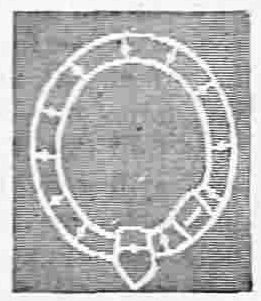
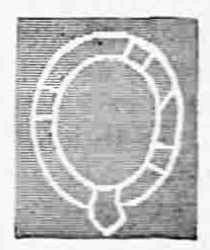
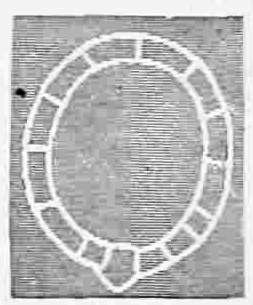
The high prices for the Great Britain 4d., red or blue paper, garter water-mark, quoted in the Round Table, No. 821, has stimulated the readers of this Department to look over their collections, and several think they have the rare varieties, but are not certain that they know the difference between the three garter water-marks. Therefore, I give fac-similes of all three—small, medium, and large garters. There is not only a difference in size between the medium and the large, but also a slight difference in the design. There must be many copies of these stamps, as they were quite common for many years, and prices did not advance much until about 1888. They are frequently found in old Collections.
LARGE.
The newest development in the collection of U.S. stamps is that of plate numbers and stamps showing all or part of the imprint. Many English stamps bear the plate numbers on the stamps themselves, but the U.S. has never followed this example. Collectors who have a chance to look over the stamps on sale at their post-office, should buy all the different stamps they can find with the marginal imprint and plate numbers, and lay them aside for future exchange. This is especially true of all the stamps issued previous to 1890. Many of the smaller offices have stamps of previous issues. Only the other day a collector bought of a local postmaster complete sheets of several 1870 issues, and about a year ago a sheet of 1868, 24c., was bought at face, and sold immediately for $200.
S.S.S.S. These four initials stand for the "Society for the Suppression of Speculative Stamps," which has just condemned the following issues as not worthy of collection: Portugal "San Antonio" Centennial Stamps, the 4, 10, 20, 30, and 40c. surcharged on the one dollar stamp of North Borneo and Labuan, and the various Chinese locals.
The annual meet of the American Philatelic Association is about to hold its convention at Clayton, N.Y. It seems probable that Mr. Tiffany, of St. Louis, will retire from the presidency, and Mr. Alvah Davison be elected in his place. The society now numbers about 1200 members, but lately has not occupied the commanding position it formerly held.
J. O. P.—No premiums on the coins mentioned.
Constant Reader.—It is the St. Anthony Jubilee issued by Portugal. It has little value, as these stamps were made for the purpose of selling to collectors primarily, and for postal use secondarily. I do not think Portugal will find it very profitable, as collectors are growing shy of philatelic trash.
A. B. Stern, Asbury Park.—It is a medal or token, not a coin, and it has no money value.
J. V. D.—Priest's Paid Despatch stamp is worth from $5 to $20, according to variety and condition. The 1818 half-dollar is sold by dealers for 75c.
F. M. L.—Dealers quote the 1859 1c. at 5 to 10c.
Interested Reader.—Your coin is either Austrian or Russian, probably the first. The value is about 10c.
N. P. P.—There are four varieties of the 1807 and five varieties of the 1802 1c. worth from 20 to 75c. The "Army and Navy" is not a coin, but simply a medal or token. There are tens of thousands of varieties of these tokens issued from 1861 to 1865 during our civil war.
Philatus.