Part 1 — LIFE-BLOOD OF A GREAT CITY.
Reading edition
HOW NEW YORK GETS ITS WATER.
BY JULIAN RALPH.
AQUEDUCT TUNNEL UNDER THE HARLEM.
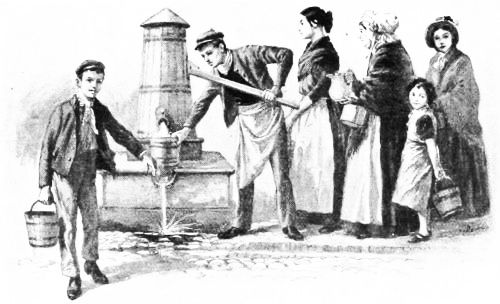
The furnishing of water to millions of human beings in a city, and the arrangements for giving it to them as they want it, whether merely by the glassful or in the profusion with which it is used in a brewery, are among the most wonderful achievements of civilization. Imagine the way men live when they break their way into a new country; that is the only manner in which we can measure the convenience of a modern water supply. I have seen the settlers on the Canadian plains walking a quarter of a mile—perhaps half a mile—to the Bow River to fill a bucket with water with which to cook and with which to supply drink to a household. Bathing, as we understand the term, was only to be done by going to the same river and plunging in—daring the few months when the river water was warm. Thus it must have been with the first Hollanders who settled Manhattan Island. In time they dug wells in the ground, and then came that more lavish use of the splendid fluid, attended by such economy as used to lead the Dutch mothers to scold the children with that admonition we still may hear in the country, "Do you think the servant-girl has nothing to do but to carry water up stairs for you to waste it as you do?"
Did the reader ever see a medical or anatomical chart of the human body, showing the arteries and veins that carry the blood from our hearts to every main and every minute part of our bodies? How like a tree it looks, with its main stem or trunk, with its great branches, with its delicate boughs and switches and twigs. Well, a Croton-water chart of the system by which a river is brought to our bedrooms, instead of our having to go to the river with our buckets, would be just such another complicated, marvellous, treelike object, only I really think it would be more astonishing in one sense, because it is so wholly the hard brain-work of man instead of the mysterious divine creation of the Almighty, whose works are so profound that their wonders do not surprise us so much as when man produces something a tenth part or a thousandth part as extraordinary.
MAP OF CROTON AQUEDUCT.
If we could cut away all the earth of the island, leaving the water-mains bare, and if we could tear down all the buildings of the city so as to allow the water-pipes to stand up, bare and naked, just as they now stand up in their covers of brick and plaster, I suppose the sight of that wonderful forest of big and little pipes would be as surprising as anything that any human being ever saw. Just try to fancy Manhattan Island all under a tangle of towering pipes and crisscrossed tubes, and then, while we are about it, just fancy a lot of savages landing here and tampering with those pipes until one of them should touch some cock and turn on the water. What a rain there would be, in big streams and middling streams and tiny little streams, out of millions of fixtures! No shower bath that was ever conceived or heard of would compare with it. And yet—see how small and weak man is, after all—it would not begin to equal an ordinary rain-storm.
Of water mains—or big pipes sunk in the streets to distribute the Croton water from the reservoirs—there are no less than 715 miles, but when the reader thinks how at every twenty-five feet smaller pipes branch out of the mains to carry the water to every floor of every building and sometimes to every office or room, he will see that of smaller pipes there must be tens of thousands of miles, making up that grand tree which is as much the "tree of life" of a great city as the arterial system is the tree of life of each of our bodies. To carry off the water that courses through all these thousands of miles of pipes we have 456 miles of sewers—or much bigger pipes; some of which men can walk through or even paddle a boat in.
One hundred and fifty years ago, when New York was considered rather an ancient town, the people got their water for drinking from the "collect," where the Tombs prison stands, and from the little springs and streams that ran into that pond. A very few had wells, public or private, near their houses. It was not until 1750 that pumps were set up to make the getting of water easier. It will surprise the reader to know that hundreds of these old wells still remain upon the island. Two or three still have pumps affixed to them, and are used for giving drink to horses, but the rest are covered over and, in most cases, their existence is forgotten. It is not possible, even in case of war, when our water supply might be cut off, that we will ever revert to the use of these wells, for they yield a polluted water that is as bad to drink as poison. Just before the Revolutionary War a man named Colles built a little reservoir above the City Hall, but it yielded such bad water that the people who could afford to do so bought water that was hawked in the streets from carts. It was not until 1842, when we had a population of 350,000 souls, that New York got its water systematically and in such plenty that mothers did not scold their children and Mayors did not remonstrate with the people for wasting it.
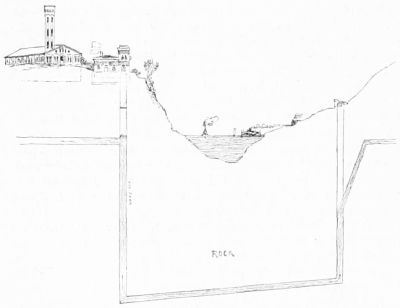
New York has never been a boastful city. It never has filled the world with the noise of its greatness or the parade of its wonderful achievements. Its Broadway is the longest thoroughfare in Christendom, I believe; its suspension-bridge is only excelled by one bridge of another kind; its actual size and population are second to those of but one city; but such facts one must glean from the encyclopædias and the letters of travellers. The New-Yorkers say nothing about them. Therefore it is but little known that the aqueduct which carries our water to us is the greatest—many times the greatest—tunnel in the whole world. It is more than thirty-three miles in length, and far from being a mere trench, averages a depth of 170 feet below the surface, and is in places 380 feet underground. It is from ten to thirteen feet high, and averages nearly as great a width. Its way is hewn through solid rock in places, and it is everywhere built of brick and granite. It passes under several rivers, and at the Harlem River, the northern boundary of this island, it is in the shape of a siphon upside down, sloping for 1300 feet under the river, and then rising 400 feet straight up through the Manhattan Island bank of the stream. It cost nearly $27,000,000, and it brings, without pumping, by the incline of the tunnel, nearly 100 gallons of water a day for each of the 1,900,000 persons in the city, or about 171,000,000 gallons of water a day for all of us. It is a solid cube of water running at the rate of two miles an hour, eight or ten feet thick, and ten or a dozen feet high.
RESERVOIR IN CENTRAL PARK.
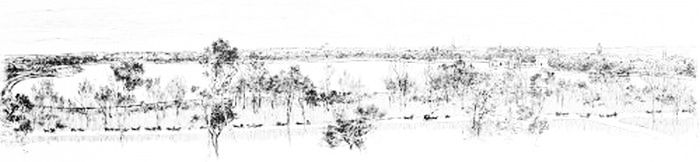
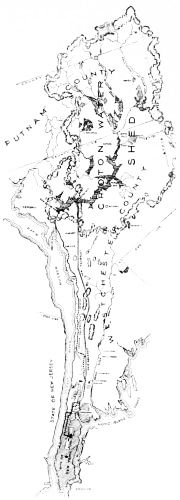
We are in the habit of saying that the water we drink comes from Croton Lake, thirty miles north of the city in Westchester County, but that is only a part of the truth. The fact is, that Croton Lake was made by damming the Croton River when our system was begun in 1835-42. We now take that water, and the water of several other lakes, ponds, and rivers that are in a great valley or depression in the earth called the Croton watershed. We keep stored up and ready for use about 17,000,000,000 gallons of water in the following natural and artificial reservoirs: Croton Lake, Lake Mahopac, Lake Gilead, and Kirk Lake, Middle Branch, East Branch, Bog Brook, and Barrett Pond. Their names sufficiently describe the character of these great goblets of crystal water which nature and man have arranged for the needs of the great city. But these are so insufficient that, although it is believed we could draw 250,000,000 gallons a day even in dry weather, we are going to take into our system three more reservoirs, which will allow us to store 13,000,000,000 gallons more than we can store at present. And as even these will not long supply our growing needs, we are about to build the greatest dam the world ever saw. It is already called the Quaker Bridge dam. It is to be built five miles south of Croton Lake, back of the town of Sing Sing, where the great State-prison is. It will be a great pyramidal-shaped wall of solid masonry 264 feet high, and 1500 feet long, and will cost, the officials think, at least $6,000,000. When it is finished, a magnificent rich farming country will be flooded and turned into one immense glass of water for old Father Knickerbocker (as we call our patron saint) and his children. The water that will bank up against that dam will rise up over many, many farms and houses and barns and villages for a distance of no less than sixteen miles, and the present dam at Croton Lake will be thirty-five feet under the surface of the water. Now we store 17,000,000,000 gallons of water, but then we will have a liquid treasure of 84,600,000,000 gallons.
THE OLD WAY.
We are apt to think about water as free because Nature evidently intended that it should cost no more than fresh air. And so it is free, so long as we are satisfied to use very little, and to go and dip up that very little out of a stream and carry it to our homes. But when we demand the full fruits of modern civilization, when we insist upon the building of huge dams and vast reservoirs and tunnels and pumping-stations, we must buy the water they bring in order to pay for the cost of the convenience. What we pay in New York amounts to about $1.75 a head for every man, woman, and child in the city, or more than $3,000,000 a year. This great tax, called the "water rents," is used to pay the interest on the debt we owe for our aqueduct, to keep the system in repair, and to swell a sinking fund which we have established. The water rents are not paid according to the amount of water each person uses, but for the quantity that passes into each house, office building, factory, brewery, and stable. The house-owners each pay between four dollars and eighteen dollars a year, and the men who use great quantities—such as brewers, makers of mineral water, sugar refiners, and the like—in the course of their business all pay special rates, which seem very large indeed when we read the sums in print.
This department is conducted in the interest of Amateur Photographers, and the editor will be pleased to answer any question on the subject so far as possible. Correspondents should address Editor Camera Club Department.
MEMORY ALBUMS
What a wonderful thing the memory is! Grandmamma, who counts, perhaps, her threescore years and ten, sees a piece of faded calico, and her mind goes back to the time when, a little girl of eight, she was dressed in a new gown, of which this faded scrap is a remnant, and taken to town for "general training." She sees again the soldiers and the officers in their uniforms, she almost smells the cards of gingerbread, and hears the bustle and stir in the streets. She may not have thought of this special day for long, long years, but this bit of calico has brought it all back to her memory.
Since the advent of cameras into nearly every family one has the opportunity of making actual pictures of festal occasions which occur, such as the birthday parties, the family picnics, John's new bicycle and his first unsuccessful attempt to ride it, the Hallowe'en frolic, the Christmas tree—any special day or event can be preserved in gelatine, and in a few years these pictures will have for one more interest and value than many made from much finer negatives. Now we want to suggest to our young amateurs that they start memory albums at once.
Begin the album by looking over your collection of plates, and select such as have been made on special occasions. From these make prints, and be sure and look up the exact date on which the picture was taken. Do not reject a "memory picture" because it is not as clear a plate or the grouping as artistic as one could desire. For the album itself, buy the album leaves which are almost as cheap as card mounts, and they can be added to from time to time as one makes new pictures. Arrange your pictures in chronological order—that is, the earliest date first, etc., marking under each picture its proper date.
A person who has used a camera for two or three years will find he has quite a number of "memory pictures," and one who starts a memory album should make it a rule to add the pictures to his collection as soon as they are made. One can use blue prints for such albums, for a good blue print seldom fades or discolors, while aristo or albumen prints, unless very carefully finished, are apt to grow yellow or discolor. In after-years our memory albums will be considered of as much value as any of our possessions.
Sir Knight Alfred C. Baker asks "If he can become a member of the Camera Club, and what are the duties of a member?" We shall be very glad to enroll Sir Alfred a member of our Camera Club, and as he says he owns two or three cameras, and finishes his own pictures, he will doubtless be a great addition to our club. The duties of a member have never been exactly defined, but we expect our members to take an active interest in the work, and they are requested to send to the club any new or improved way of doing anything in photography. We also want each one of our members to become a specialist along some special line of photographic work. We hope soon to organize a correspondence and exchange club. Sir Alfred would like to correspond on photography with some of the members of the club. He has also a Kombi camera which he would like to sell or exchange.