Part 1 — A MESSENGER-BOY'S ADVENTURE.[1]
Reading edition
A MESSENGER-BOY'S ADVENTURE.[1]
BY EDWARD W. TOWNSEND.
Danny Cahill had been a district messenger for a year, and it seemed to him that he had been on every street and across every park in the great city of New York. Mr. Kean, who had helped him to become a newsboy, had secured him a position in a down-town messenger office, where he could easily learn his duties, and gradually became acquainted with the city, for most of his "calls" there were from offices which wanted messengers for short errands, and he was only occasionally sent far up town. But after six months he was transferred to an office in the fashionable part of the city, near Fifth Avenue, and then he began to go on long journeys which gave him rides on the elevated roads from one end of the city to the other; "from the Battery to the Harlem River," as the saying is.
The work was hard, though, and more so for Danny, because, after or before his long hours on duty, he went every day or night to the school in the Newsboys' Lodging-house where he lived. If he had been on night duty, no matter how late he had been up, nor how many miles he had walked, he was at school the next morning, and if on day duty, he did not go to bed until he had attended the night class. I cannot say that Danny liked this, for he would much rather have gone with the other boys on their pleasure excursions about the city, but Mr. Kean had urged Danny to put in all the time he could spare in school. He promised him that if he did so he would find him a better position when he was far enough advanced to take one.
One evening, when it was nearly time for Danny to go off duty, a messenger call came in the office, and as he was "next" he had to answer it. It took him to a big fashionable house where he had often been before, and he expected as usual to have a short errand with a note to some neighboring house or shop. But when a servant let him into the big hall he was soon joined by a maid who gave him a bundle to carry, and told him he was to take it, and pilot her to the Tenement Mission, "wherever that may be," said the maid, crossly.
Danny knew well enough where it was, for it was situated only a few blocks from the place he once called "home," where he had lived with his uncle who had made him beg, and whom he had never seen since the day he escaped, by Mr. Kean's aid, from the policeman who had arrested both him and his uncle.
What he could not understand was what so grand a house as he was then in could have to do with the Tenement Mission, and he said so to the maid when they were on the street walking toward the Third Avenue elevated station.
"I don't wonder at your surprise," said the maid. "The lady in charge of that nasty mission is the young lady of our house, and I'm her maid. What she wants to go down among those trash for I'm sure I don't know."
"Say," exclaimed Danny, in amazement, "de yer mean dat Barstow lives where we's just come from?"
"Sure, Miss Barstow," answered the maid, "but how do you know?"
"Everybody down dare where I useter live knows her, and calls her 'a tenement angel,'" Danny replied. "But she don't dress grand—not so grand as you."
The maid laughed at this, and then said: "Well, she has a right to dress as she pleases, and go where she pleases, I suppose; but I don't know what right she has to telegraph me to come down there with jelly and wine and broth that you have in that bundle. I'll just tell her that I ain't going to nurse any of her poor sick she's so fond of, if I have to give up my place."
"Say, I guess she isn't tinkin' dat you won't nurse nobody," Danny said, "because she'd get fooled, for I don't believe you'd know how."
"And I don't want to know how," snapped the maid.
When the Tenement Mission was reached Miss Barstow was not there, but a note had been left for the maid directing her to come, with the messenger, to an address which was given.
"Where is the place?" asked the maid, showing Danny the note.
"Oh, dat's a back tenement-house in Roosevelt Street," Danny answered. "Dare is Italians dare," he added, for he knew the place well, his old home with his uncle having been in the same block.
"Is it any worse than this?" the maid asked, in a voice which showed she was getting frightened.
"Dis is Fift' Avenue compared to dat," Danny said.
The girl began to whimper, and said at last, "I won't go. I'm scared to death already. I won't go to her nasty sick poor, and get the small-pox and everything else."
At first Danny did not know what to do. He tried to persuade the maid to go, but she was thoroughly frightened now, and half hysterical. Finally Danny took up the bundle, saying: "Well, I'm going, anyway. If Miss Barstow wants dese things she is goin' to have dem, and you can do what you like. I don't tink you are much good except for show, anyhow."
"I'll stay here until some one comes and takes me home," cried the girl, as Danny went out of the mission.
It was dark by this time, but Danny knew the way perfectly. He found the low narrow entrance to the front tenement, went through that to a little stone-paved court where there was one gas-lamp, and was crossing that when a couple of men stopped him, and demanded roughly to know what he had in the bundle.
"Never you mind," he answered. "It's for Miss Barstow, not for mugs like you."
The men slunk away without any more threats. They were none too good, but they, like nearly all the people in that neighborhood, had been won to respect Miss Barstow, and anything which belonged to her was almost sacred in their eyes.
Danny continued on across the dimly lit court into the dark entrance of the rear tenement. At the door of the room which Miss Barstow's note had described Danny knocked softly, and was admitted by her, a tall, plainly dressed, handsome young woman, whose kindly face was at that moment clouded by anxiety. She seemed surprised to see the messenger alone, and after taking the bundle from him and placing it in a chair, she stepped out in the hall, closing the door so that their voices would not disturb the sick people inside, and heard Danny's story of the maid's fright and desertion.
Miss Barstow was silent for some time before she said, and there was no anger in her voice:
"Perhaps I was wrong to send for her. I would not have done so, but all my assistants are busy. But," she added, after a pause, "I must have some assistance until the doctor comes again."
"Say, what's de matter wid me helpin' you, lady?" asked Danny, promptly.
Miss Barstow looked at him in the half-light the hall lamp gave, and then said, quickly, "Yes. Go and put my maid on a car that will take her home, and then come back here."
Danny did so, and was pretty soon back in the sick-room with Miss Barstow and her two patients. The room was poor, very poor, but better than the one he had lived in with his uncle. There were a bed and a cot, some chairs, a rough table, a cook stove, and a few cooking and table dishes.
In the bed was an Italian woman, and in the cot her daughter, a girl about twelve years old. Both were sick with a fever only too common in the tenement district. The husband and father was a fruit peddler, who had what is called an "all-night" stand on the Bowery. The man and his wife alternated with each other in attending the stand, and it was exposure to the cold wet nights that had brought on the woman's fever. The girl had been a scholar in the day-school for tenement children in Miss Barstow's Mission, but she had attempted to take her mother's place at the stand when the woman was taken sick, and she, too, soon came down with the fever.
It was while making inquiries about her absent scholar that Miss Barstow had found the patients both in bed, and having only the rough care the man could give them during the few hours he could leave his stand. Danny was soon at work under Miss Barstow's orders, and both the patients had some dainty food and wine, and every attention to make them comfortable. Before the Doctor arrived both mother and daughter were sleeping quietly, and Danny found himself whispering the story of his life to Miss Barstow, who, it seemed to him, had the kindest way of asking questions and understanding what he told her of any person in the world. The Doctor smiled when he came in at midnight and saw them, and Danny blushed proudly when the lady told the Doctor that her messenger had proved to be a good nurse and a very interesting companion.
The Doctor ordered Miss Barstow to go home, saying he would wait there until the husband came. When Miss Barstow had paid Danny, she asked him which way he was going. "I'm goin' to see you home, sure," Danny answered, gallantly.
They had left the tenements, and were walking up Roosevelt Street, when a man standing by a lamp-post stared at Danny, and then exclaimed:
"Oh, you little rascal! I've caught you at last! Come along home with me," and he grabbed the boy roughly by the shoulder.
It was Danny's uncle. "You've got fine clothes, and are with a fine lady, while your poor old uncle who had always given you a good honest home is starving," he exclaimed.
Some men who had been lounging about the corner ran up, and Cahill declared over and over to them that his boy had run away from an honest home, and should be taken back and help to support his old uncle, who was sick.
Danny, who had a notion that his uncle really had some sort of right over him, was sick and disheartened at the prospect of going back to his old life, but he had had his liberty too long to be willing to give it up without a struggle. He was a stout youngster; his constant exercise as a messenger-boy kept him in good physical condition, and he made a good resistance to his uncle's efforts to drag him away.
As he was struggling, Miss Barstow ran to him and asked, "Is this the man you told me of—your uncle?"
"Sure; dis is de mug, and he's no good," Danny answered, as he fought.
"Let that boy go," she said to Cahill, sternly.
"Not for you," responded Cahill, surlily.
Miss Barstow stepped to where the light fell on her face, and turning to the crowd of men, said: "Some of you must know me. I want you to make that man let this boy go."
"It's Miss Barstow," one of the men exclaimed. Then he added, "What you say goes down here, lady, mostly, but not in this case. Cahill has a right to the boy's wages. He's a good man, and the kid ain't going to get no harm by going along with him."
DANNY DISCOMFITS THE ASSAILANT.
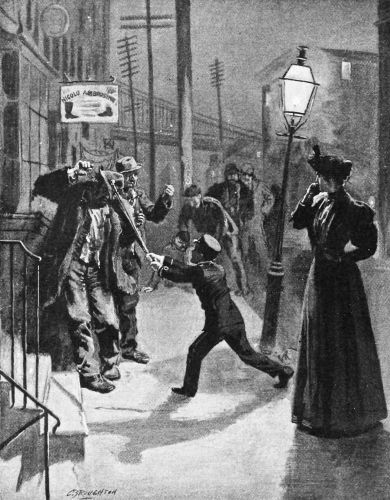
Miss Barstow's knowledge of this class taught her that the men had all been drinking, and she knew that the situation was serious. She had often been warned that she was in danger of just such experiences as this, but until now had been saved from danger by the respect that the tenement people felt for her. But these were not even tenement people of the lowest kind. They belonged to the class of idlers who skulked about the saloons in that neighborhood at night, and begged during the day. As she was debating what she should do, Danny managed to trip his uncle hard and break away from him. He ran to Miss Barstow, snatched her umbrella from her hand, jumped between her and the man, and told her to run. One of the half-drunken men lurched toward Danny, but suddenly halted when Danny brought the silver head of the umbrella down on the fellow's head with a whack. That was more than he expected, and while they stood irresolute Danny and Miss Barstow hurried away, Danny keeping between her and the enemy, swinging the umbrella threateningly. They reached the elevated-road station without further molestation, and Danny then found to his surprise that the woman who had been so brave while there was any danger was now white and trembling, and nigh to fainting.
"It was not that I was afraid," she said, "but it shows me that there is danger for me down there, and that I must give up my night work there."
"Why, lady," said Danny, "I taut it was a picnic; anyway it was good fun when I cracked dat mug's nut wid dis umbrella. He'll know he was in a fight to-morrow."
Danny went to Miss Barstow's door with her, and thought that would be the last he would hear of the adventure. Three days later, while he was sitting in the messenger office, a man called on him, who explained that he was the lawyer for Miss Barstow's society which supported the Tenement Mission. He had had Cahill and the men who had been with him that night arrested, and Danny was wanted as a witness against them in the Police Court.
"And now," said the lawyer, when he had explained about the arrest, "tell me all you can about yourself, and your relations with Cahill. Miss Barstow tells me that Cahill may have some legal right to your wages, and if he has we want to give you another guardian. What would you think of me as your guardian?"
Danny did not know what sort of a thing a guardian might be, and the lawyer explained. It was Miss Barstow's wish, he added, that Danny should have a proper legal guardian, and he would look into the matter, and do all that was necessary to protect Danny's rights.
So it came about, after Danny had signed a lot of legal papers, and there had been a lot of petitions and motions, that one day Danny was told that the law had taken notice of such an unimportant little chap as he was, and Miss Barstow's agent had become his guardian, and Uncle Cahill had no claim on Danny's liberty or his modest little account in the Bowery Savings-bank. Danny's comment was:
"I never taut I'd get to be such a swell mug as to have a guardeen all by me lonely. De first ting you know I'll be runnin' for President."

The action of the Interscholastic Athletic Association in passing the law prohibiting bicycle-races at all future in-door meetings held under the rules of the I. S. A. A. cannot be too highly commended. It was, of course, the logical outcome of the occurrences of the past four months, but nevertheless the promptness with which the evil was abolished is praiseworthy. Bicycle-races as an in-door sport should be universally done away with. What games in the past season have not been marred by accidents and collisions in that event? The culmination was the carrying away of W. G. Dann in an ambulance after he had broken his collar-bone at the Brooklyn Poly. Prep. games last March. It is to be hoped, now that the good work has been begun, that in the near future some of the other peculiar features of in-door meetings will receive proper attention at the hands of the legislators. I do not believe that Olympian Zeus—or whatever enlightened heathen god it was who invented and fostered track athletics—ever intended that sprints and shot-putting should be held under a roof. He surely would have drawn the line at bicycles, had he known anything about them. He wisely preferred the less-murderous four-horse chariot. But, to my mind, track athletics were never intended as an in-door sport. The gymnasium is not a hippodrome. But more of that later. Let us be thankful for one thing at a time.
I am not opposed to what some timid people call "rough and dangerous" sport. Football should be encouraged, by all means, although it may justly be termed "rough and dangerous" for young men who do not know how to play. It is not dangerous for those who do know the game and have been trained to take part in it. Yet under no circumstances is it a sport adaptable to evening clothes and kid gloves. If it were, we should not care for it as we do. But bicycle-racing—and I am speaking now essentially of in-door racing on a flat floor—is just as dangerous for experts as it is for the ignorant and the novice. More so, perhaps; for a novice's timidity will protect him from any attempt at riding through an iron girder. The dim light of an armory makes it difficult for a rider to judge angles and distances, especially when the track he is circling is marked solely by a chalk line on a slippery floor. In an open field, on a cinder track well rolled and well fenced, it is a very different matter. Should a rider fall there, his injuries are limited to a few scratches at the worst, and surgical assistance is unnecessary in such a case. As to sprinting and putting the shot on a board floor, these events are more incongruous than harmful. And if custom has made them popular as in-door sports, I am willing to defer to the dictum of Custom, until Experience shall step in and pronounce her verdict.
Another good rule adopted at this same meeting of the I. S. A. A. was that proposed by Syme of Barnard, to prevent, when possible, two boys from the same school starting in the same trial heat. It is, unfortunately, not uncommon for two boys from the same school to deliberately pocket a rival runner, especially in events like the 220, the half-mile, and the mile. Such practices are beneath the dignity of amateurs, and it is somewhat of a disgrace that any rule should be required to prevent it. But if the managers were forced to recognize this unsportsmanlike tendency on the part of even a few contestants, it is to their credit that they adopted measures to put a stop to it. Nothing in sport to-day is more important than to maintain a broad and honest spirit of fair play, for without such a spirit interscholastic athletics, and every other kind of athletics, are bound to deteriorate.
While speaking of this, I am reminded of rumors current in Brooklyn to the effect that one of the schools in the Long Island Interscholastic League has secured track athletes and baseball players by offering them half tuition, and in one case free tuition, as an inducement to attend that particular institution. This is a very ugly story, and should not be credited unless very positive proof of its veracity can be adduced. The only ground for the rumors, that I have been able to discover so far, is that the individuals in question attended other schools last year. But that fact is by no means sufficient to warrant the assertion, or even the insinuation, that the change they made was influenced by a financial consideration. If the report is unfounded, it is almost as reprehensible an offence against honest sportsmanship to circulate it as to be guilty of the dishonest practices alleged. As the matter stands now, there is no doubt that somebody—either the school in question or the other members of the league—is suffering under an injustice.
THE NEW YORK INTERSCHOLASTIC CUP.
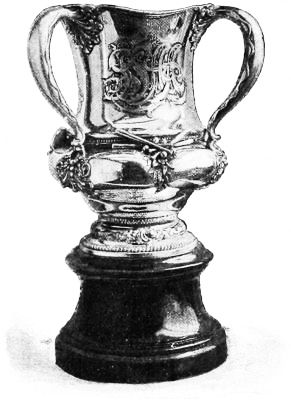
There are just ten days for practice left before the Interscholastics. The many school games of the past two weeks have shown that there is much new material in the field, and that it will not be so easy to pick the winner of the championship as might have been supposed earlier in the season. The struggle for supremacy promises to be more interesting this spring than ever, and I have little doubt that several records will be considerably bettered. Barnard, of course, will make a desperate endeavor to carry off the honors of the day, and thus secure a full title to the Interscholastic Cup. This school will be represented by a strong team, which gives good promise of equalling the record of last year's champions, although three of those 1894 point-winners are not back this year. Of the 38 points which won the day for Barnard last May, Rogers made 16; Simpson, 6; and Feigenspan, 1—in all 23, or almost two-thirds of the total victorious score. Thus, if victory perches on the Harlem banners next week, it will be due in a large measure to the development and acquisition of new material.
At the semiannual field day of the Academic Athletic League of the Pacific Coast, held at the Olympic Club Grounds, San Francisco, on March 16th last, the Oakland High-School and the Berkeley High-School, with 52 points each to its credit, tied for first place, and the championship was consequently awarded to the former for having been the winner the previous year. The struggle, as may well be imagined, was a close and exciting one throughout, there being no event, except perhaps the shot, hammer, and mile run, that was not hotly contested to the end. The O.H.-S. has been the Coast champion for sixteen years past, and if Cheek, the captain of the team, had entered this year, no doubt the score would have been very different. Cheek is a promising all-round athlete. In addition to vaulting and jumping he puts the shot 33 feet, throws the hammer over 100 feet, runs the 100 in 11 seconds, gets over the high hurdles in 17½ seconds, and the low hurdles in 28 seconds. The reason given for his non-entry into these sports is that his team was so much stronger than that of any of the other schools in the league, that the O.H.-S. preferred to contest the games without his aid, and so decide the day by a few points only. This experiment proved a most risky one. If the B.H.-S. had won the Relay race, they would have taken the championship by the score of 55 to 48. Such a self-sacrificing and eminently sporting spirit as Cheek's is something I have not yet observed in the East. The rules governing the contests of the A.A.L. are somewhat different from those of other leagues. The team of each school is limited to seven boys, and six more are allowed to enter for the Relay race, which counts as an extra event, and gives 10 points to the winner, 6 points to second, and 2 to third. There is some advantage in this limitation, but I should think that in many cases it would operate unjustly. Nevertheless, it is a great preventer of that worst feature of our Eastern track-athletic games—countless trial heats necessitated by unlimited and unrestricted entries.
The high hurdles were the occasion for a hot struggle between Dawson, O.H.-S., and Hoppin, B.H.-S. Dawson had never run the full course before, and this was only his fifth attempt at clearing the sticks, but he ran well and breasted the tape in 19½ seconds, with Hoppin at his heels. In the first heat of the low hurdles Hoppin won in 31½ seconds. Dawson fell at the seventh, but picked himself up quickly and finished, thus qualifying for the finals, which he won in 31½ seconds, with Hoppin third. Dawson will no doubt improve greatly within the next year, and I confidently look forward to see him smash some Coast records. He takes the hurdles without the suggestion of an effort, and although only 5 feet 5 inches tall, he gets in the seven steps without any trouble. He trained for the half-mile earlier in the spring, and so attained good endurance. Another boy with this quality strongly developed is Hanford, the O.H.-S. sprinter. He is slow at starting, but his endurance is such that he has been known to do 50 yards in 6-1/5 seconds on a dirt track, then walk back to the start, get on his mark and repeat the performance; and do this again a third and fourth time. He took the 220 in 25-1/5 seconds, without being pushed, but came in a foot behind Lippmann, B.H.-S., in the 100 on account of his slowness in getting away from the mark. In the field events the B.H.-S. walked away with everything, taking all the points in the hammer and shot events. They got first in the broad jump and pole vault, and tied for the high jump. In the hammer, Lynch, B.H.-S. threw 104 feet and won, and was going to try for a record, when the attention of the judges, for some reason, was distracted by the exciting Relay race, and so Lynch lost his chances and his rights. He is said to have done 125 feet in practice. On the whole the day was a notable success, and the scholars of California showed themselves sportsmen of the true stripe in the enthusiasm and energy which characterized the occasion.
COMPARATIVE TABLE OF NEW YORK AND SAN FRANCISCO INTERSCHOLASTIC MEETINGS.
I. S. A. A. Games at the Berkeley Oval,
New York, May 5, 1894.
Event.Winner.Performance.
100-yard dashRogers10-2/5 s.
220-yard dashSimpson23-3/5 s.
120-yard hurdlesBeers16-2/5 s.
220-yard hurdlesSyme27-1/5 s.
Half-mile runIrwin-Martin 2 m.10-1/5 s.
Mile runVeiller 5 m. 1-1/5 s.
Running high jump{Rogers} 5 ft. 9 in.
{Baltazzi}
Running broad jumpBeers 19 " 5 "
Pole vaultWhitney 10 "
Putting 16-pound shot
Putting 12-pound shotBall 39 " 1 "
Throwing 12-pound hammerBall110 " 3-1/2 "
A. A. L. Games at Olympic Club Grounds,
San Francisco, March 16, 1895.
Event.Winner.Performance.
100-yard dashLippmann10-4/5 s.
220-yard dashHanford25-1/5 s.
120-yard hurdlesDawson19-1/4 s.
220-yard hurdlesDawson31-1/2 s.
Half-mile runRuss 2 m.20-2/5 s.
Mile runJackson 5 m. 5-1/2 s.
Running high jumpMcConnell 5 ft. 3 in.
Running broad jumpLloyd 18 " 6 "
Pole vaultWoolsey 9 " 2 "
Putting 16-pound shotLloyd 32 " 8 "
Putting 12-pound shot
Throwing 12-pound hammerLloyd104 " 5 "
It is interesting to note the records made on this occasion, and to place them alongside of the performances of our Eastern scholars. The accompanying table will show that, even with almost a year's advantage in the comparison, the Californians are behind the New-Yorkers in every event. In many events, of course, the records of both leagues are better than the performances made on these two specific occasions; but the comparison goes only to show that in a contest between Eastern and Western schools, could such a one be arranged, there would be but little doubt this year as to the probable winners. Perhaps some day such a meeting may be brought about. What might be called the first step in that direction has already been taken by the California State University team, which is coming East next month to take part in the Intercollegiate games at Mott Haven. In a year or so the Pacific coast schools may get up enthusiasm and enterprise enough to follow the example of the college men and seek new laurels in the East.
It is possible that the universal interest in track and field sports, which has so rapidly developed in the last two years, will prove harmful to baseball and tennis. Already I have heard several complaints from captains of nines that it is difficult to get candidates to come out and try for positions on the team, because almost every boy who has any ambition for athletic honors is running or jumping, or otherwise training his muscles that he may take part in contests which offer material reward for success. In other words, gold, silver, and bronze medals are more tempting than a proprietary interest in a champion pennant. If it is true that an appreciable number of boys go into track athletics not for the sport, but for the medals, the sooner medals are done away with the better. But it does not seem possible that this can be so. It is more probable that baseball and tennis have been superseded, to a certain extent, by track and field sports because of the nature of the latter. A boy can go out and run or jump or put the shot all by himself at almost any time of the day. But he cannot go into an open field and play baseball with himself, nor can he go to a tennis-court and play tennis with himself. In one case he must secure one opponent at least, and in the other he must gather a dozen or more companions. To be sure, these objections are not very valid in New York, but I have no doubt the charm of individuality has tempted a good many boys to indulge in track sports. If baseball and tennis have suffered thereby it is all the more reason why baseball and tennis enthusiasts should strive by every means in their power to organize good nines and train good tennis-players—for it is an unhealthy tree that puts all its vitality into one branch.
There is talk of changing the constitution of the New England I.S.A.A. in order to allow scholars over twenty-one years of age to compete in games held under the rules of that association. The subject will be brought up for discussion and probably decided at the meeting to be held in Boston day after to-morrow, May 2d. The motion should be unconditionally defeated, and the constitution left unaltered. Except for very unusual reasons, a man twenty-one years old has no business being in school. He ought to be at work or in college. If, however, he still lingers about the school-room, there is no reason why special laws should be enacted for his benefit. He deserves to be discriminated against. Besides, there are probably not more than half a dozen men of that age in all the schools of the New England League, and these can certainly spend their time to better advantage in studying than at foot-racing and jumping. It is unfair to allow grown men to enter into competition with younger men, and I earnestly hope that those who control the policy of the N.E.I.S.A.A. will realize this, and unceremoniously shut the men out.
At the annual in-door meeting of the New England I.S.A.A., held in Boston last month, there were 342 entries, representing thirty preparatory schools. This would seem to show that there is even more interest in track athletics in Boston than there is in New York. The result of the meeting was most satisfactory, inasmuch as five records were broken, one was equalled, and a new record was established. The team races were a new feature, and as rival schools were purposely matched against one another the contests proved most interesting and exciting. The Worcester High-School managed to retain the championship of the Association by scoring 19 points; the Worcester Academy took second place with 14½ points. This prowess was not relished or appreciated by the boys of the Boston schools, who are not by any means anxious to see the pennant float over any city but the Hub; yet it has been evident for some time that any one who wants to defeat these Worcester school-boys will have to get up very early in the morning and travel remarkably fast.
The Graduate.
This Department is conducted in the interest of stamp collectors, and the Editor will be pleased to answer any question on the subject so far as possible. Correspondents should address Editor Stamp Department.
Since the discovery of the variety of the twelve-cent United States stamp illustrated last week, many collectors have sought to find other varieties in the same issue, thinking that if a new plate was made for the twelve cents it was likely that other new ones were engraved for different values. Thus far no further discoveries have been made.
The one, two, five, and ten cent values of the new United States newspaper stamps have thus far been issued.
In the three-cent stamp of the 1857 issue, the "Outer Line" variety consists of a fine line running all around the stamp. Each of the stamps has a line on the side, but in the variety an additional fine line appears at both the top and bottom, the perforation sometimes destroying one of them. The outer-line variety is not as scarce as the price given would indicate.
The high values of United States envelopes are now a thing of the past, the department no longer printing any value higher than five cents on the envelopes.
Many stamp papers say that only the one, two, and three cent values of the new postage-stamps have been issued and printed, but the ten has also been sent out.
It would not be surprising to many collectors if the current issue of United States stamps, which were first printed by the Bureau of Engraving, should be catalogued as a separate issue before many years, there being many points of difference between those first put out and what the bureau is now printing. The colors, perforation, and gum are now much superior to the first printings, and smaller things than these have caused stamps to be separately catalogued.
Another question that puzzles many collectors is the difference between wood-engraved and typographed stamps. Typographed means set and printed from type, so the United States officially sealed stamps of this variety are printed with regular type, while the lithographed are printed from stones, the designs being engraved, and thus fancy and very different from the type-set stamp.
A new stamp paper will shortly be issued from Boston. It will have a good financial backing, and it is expected to be one of the leading publications in the philatelic line.
Since the last catalogue added the varieties of United States stamps on ribbed paper, it has caused collectors to hunt for them, but probably with little success, as they are very scarce. Ribbed paper is a variety of wove, having lines running up or down or across, and showing on the back of stamp.