PRACTICAL GOLF.
Reading edition
BY W. G. van TASSEL SUTPHEN.
(In Five Papers.)
I.—THE GAME.
Given a bat and a ball, and the combinations that may be evolved are practically infinite in their variety. Every generation or thereabouts a new game or some modification of an old one suddenly rises into favor, and all the world plays croquet or tennis or golf. To-day it is golf, and yet the game divides with polo the honor of being the oldest of which we have any records. It has been played in Scotland for hundreds of years, but it is only within the last ten that it has become generally known and taken up. In this country the game is hardly two years old, but already there are over a hundred courses or grounds, a national association, and championship meetings for nearly every class of players. There must be something of good in a sport which has been taken up with such enthusiasm, and although "Young America" is very properly opposed to anything that harbors a suspicion of slowness, it is only fair to look into a case before deciding upon it.
A TEEING-GROUND.
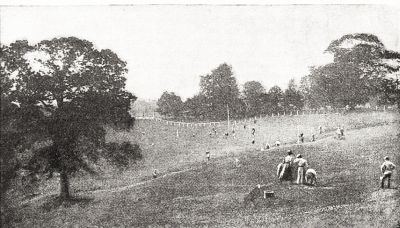
Of course the first thing is to inquire into the object and nature of the game. A golf course is generally laid out over rolling ground for the sake of variety, and standing at the first tee, or striking-off place, we see before us a stretch of turf that has been cleared of long grass and bushes, and in the distance (say 150 or 200 yards away) a square patch of smooth, hard lawn, in the centre of which a flag is fluttering. The square patch is the putting-green, and the flag marks the location of a small hole four inches in diameter and six inches deep, and generally lined with tin. Each player is provided with an assortment of curious-looking clubs and a small white hard-rubber ball, and the object is to finally knock the ball into the hole in the fewest possible number of strokes. Each player has his own ball, and the play begins from a particular spot, called the teeing-ground, and marked by whitewash or pins driven into the turf. This first stroke is called the tee-shot, and the player is allowed to tee his ball, or place it upon a little mound of sand, so that he may have the best possible chance of hitting it. But once the tee-shot is played, the ball cannot be touched again, except by a club, and no matter how short a distance it may go, or even if the ball is missed altogether, it still counts a stroke. The player who is farthest away from the hole always plays first, and he must keep on playing until he has passed the place where his adversary's ball is lying. When both balls have finally been played into the hole, the player who has accomplished the task in the fewest number of strokes or actual hits at the ball is said to have won the hole, and counts one scoring-point.
A short distance from this first hole is the second teeing-ground, and the players take up their balls and, walking over to the new point of departure, tee their balls, and strike off in the direction of the second hole. We will suppose that A, the first player, holes his ball this time in six strokes, and B does the same. The hole is then said to be halved, and is counted for neither side. But A, having won the first hole, is still ahead by one point, and this is called "one up." If he had won this second hole, he would have been "two up." Or again, if he had lost it, the game would have been "even all."
The full course is eighteen holes, but very good golf may be played on a course of twelve, nine, six, or even five holes. The game is won by the player who wins the greater number of holes, and this is the original game, now called match-play. Nowadays medal-play is more common, the only practical difference being in the scoring. In medal-play the total score for all the holes made by each player is added up, and the lowest number wins. For instance, if A goes around a six-hole course in 40, and B in 39, B is the winner.
One of the great advantages of the game is that you can play and have good sport even if there is no one to go around with you. You can try to beat your own best previous record, and, if possible, to lower the best score ever made by anybody over the course. If you succeed in this last, you will have gained the proud distinction of holding the "record for the course." Another good modification of the game is the "foursome," where there are two partners on each side, striking alternately at the same ball. But the ordinary match is against one adversary, and there is no reason why a girl may not play an interesting game against her brother. She may not be able to hit the ball quite so far, but once near the hole, where accuracy and not strength is required, she should be able to hold her own, and it is an old saying that many a game is won on the putting-green. Or again, she may be handicapped by an allowance of so many strokes, for in golf, as in billiards, handicapping does not detract from the interest as it does in tennis. There is no fun playing tennis against a very much weaker opponent, for you win rather on your adversary's mistakes than by your own skill, and this is fatal to true sport.
MODERN GOLF CLUBS. 1. Cleek. 2. Mashie. 3. Brassy. 4. Putter. 5. Driver. 6. Lofter. 7. Iron.
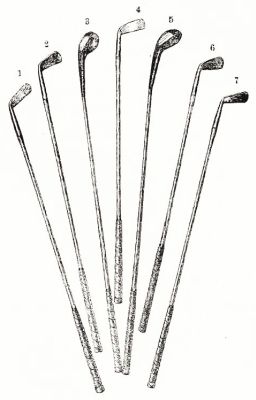
Now that we know what we have to do, let us take a look at the instruments with which the work is done. In the illustration seven clubs are pictured, and there is, at first glance, but very little difference between them. Of course, to see and handle the clubs themselves is far more satisfactory than any description, but the following hints may enable you to recognize them when you do see them. And first as to the different parts of the clubs and their name.
The striking surface is called the face, and the bottom, or the place where it rests on the ground, is the sole. The part nearest the angle made by the handle is the heel, and the extreme end is the nose. Both the wooden and the iron clubs are made in two pieces, the striking part being called the head, the long handle the shaft, and the place where they are joined together the neck or (in the case of the iron clubs) the hose. Some of these names may strike you oddly, but remember that the game is very old, and these terms have grown on to it somewhat as barnacles upon a ship's bottom.
The driver (No. 5) is a wooden club; it has generally the longest shaft of all the clubs, and is supposed to be the most powerful. It is always used for the first, or tee, shot, and in a good player's hands it will drive the ball from 150 to 200 yards. A boy's driving, especially at first, will be about 50 yards shorter, and a girl should be able to cover from 70 to 100 yards.
After the tee-shot the driver may be used again if the ball is lying clean—that is, in a good position—but most players prefer the brassy (No. 3), which is so called because its sole is shod with a brass plate. Generally, too, its face is spooned, or slanting slightly backwards, so as to raise the ball in the air, and its range is but little short of the regular driver.
Should the ball be lying in a hollow of the ground (called a cup), the cleek (No. 1) is the proper club to use. This is the straightest faced of all the iron clubs, and usually has a slightly longer shaft than the others. The cleek is also a powerful club, and its use is generally confined to free hitting when the object is to send the ball the longest possible distance.
But with the ball deeply imbedded in a cup, or with a sand bunker or other difficulty to surmount, it is necessary that the ball should be lofted, or raised higher in the air than the cleek can do it, and in such a case use the lofter, or lofting iron (No. 6), whose face is still further laid back. Or in the bunker itself you may take the mashie (No. 2) with its short head and very much laid back face. Its shape fits it to enter cart ruts and other places where the longer head of the cleek or lofter would stick fast. The iron (No. 7) is simply a modification between the cleek and lofter, and its carrying or driving power varies in about the same ratio. The beginner need not include it in his set, nor bother about it at all until he has played for some time.
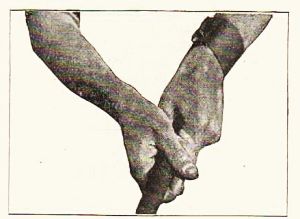
POSITION OF THE HANDS IN HOLDING THE CLUB.
Last of all comes the putter (No. 4), with a perfectly straight face and springless shaft. Its great essential is good balance, and it is used for the final act of holing out or putting proper.
These six—driver, brassy, cleek, lofter, mashie, and putter—are all that are actually needed for the game, and quite enough for the beginner to experiment with. They cost at the shops from $1.25 to $1.50 apiece, and they are made in lighter weights for girls and young boys.
The best way to start is to play a round at once, standing up square to the ball and hitting naturally at it. Grip the club as though it were a hammer, and you were about to strike a blow straight down upon the anvil. Then, without altering the position of your hands, place the club flat on the ground close behind the ball, and hit. By the time next week comes around you will have shaken yourself down into some kind of position, and will be ready for more detailed instruction.
Keep your eye on the ball.