FROM CHUM TO CHUM.
Reading edition
BY GASTON V. DRAKE.
XIII.—FROM BOB TO JACK.
Paris.
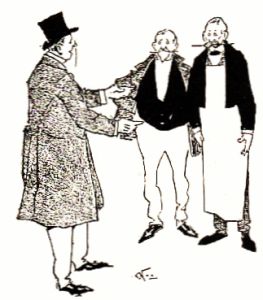
MY DEAR JACKY,—Did I say London was a circus? If I did, this place is two of 'em. And I tell you what, one of the queerest things in the world is to get into a country where people speak another language, even the children. Pop says there's even such a thing as French baby talk. It seems awful queer to ask a fellow what time it is in just the simplest way you know how, and have him look as if you'd asked him a question in algebra that he hadn't ever studied about. And yet that's happening all the time. They don't even understand the word Hullo; and Pop says some of 'em don't know French very well either, because he'd tried some of his on them, and they've just stood still and looked blank at him. I don't know what I'd do if Pop hadn't hired a courier to look after things. Ma said she didn't think a courier was necessary, but Pop said he thought he was. "You can talk French well enough to make yourself understood," Ma said. "I know that," said Pop, "but these French can't. If I want to go to the Luxemburg in a hurry I can ask a John Darm the way, but when he tells me, I have to sit down on the curb-stone for an hour or two and get out my pocket dictionary to translate what he says into English so that I can make use of his information." "But a courier is expensive," said Ma. "Three dollars a day," said Pa, "and I waste fifteen dollars' worth of nerves every hour going on as we do now." So we took him. His name is Jules and he's a dandy. He can speak all languages except Chinese and a few others, and he's a native of France and Germany. He was born in Alsace when it was French, which made him French, and now Alsace is German, which makes him German. That gave him two tongues to start with and he's picked up all the others since that time. His English is splendid, but as Pop says a little unexpected sometimes because he's got some of his words out of a slang dictionary, like corker for instance. When Pop asked him if there were any fine pictures to be seen anywhere he said the Luxemburg was full of "shay doovers—or as ze English say it has in it the very best corkers of modern times."
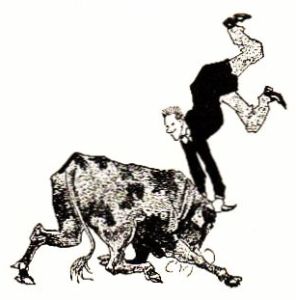
He's a fine fellow, Jules is, and for exciting times he can beat Sandboys and Chesterfield. He's seen a bull-fight in Spain and if he hadn't learned how to play leap-frog when he was a boy he'd have been killed at it, because the bull got loose and came straight for him, being angered by Jules's red necktie. His first impulse was to run, but when he saw how fast the bull was coming he knew he wouldn't have any chance in a running match, so he just stood still and the minute the bellering beast came within reach he grabbed hold of his horns and leap-frogged right over his back. The bull stopped short and kept gazing round the sky after him, thinking he'd tossed him and intending to catch him on his way down, and while this was going on Jules pulled the sword out of his cane, crept around in front and stabbed him to the heart. So you see leap-frog isn't such a waste of time after all, though I don't know what we could use it for at home unless it was to escape from a cable car, and that would be pretty hard work unless you were ten feet high.
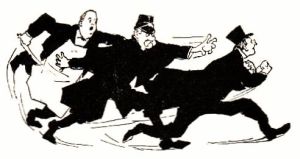
We first met Jules at the railway station. The proprietor of the hotel sent him to see that we got through the French custom-house all right. I guess maybe he knew that we weren't quite used to the French language and that Jules would help us out and it was a good thing he did because I never saw Pop so excited as he was when we got here. He wasn't feeling well anyhow. We'd all been so awfully seasick crossing the British Channel that Pop hadn't time on board to be seasick himself, so he'd saved up a headache for the land. Then he was pretty mad at a French waiter at Calais who was such an idiot he didn't know what eggs were even in his own language. Pop asked him for uffs eight times and the fellow couldn't understand until finally Pop got mad and grabbed up a half a dozen buns and made a rush for the train forgetting to pay, with the waiter and a John Darm after him. We got the row all straightened out after a little while, but Pop couldn't get over it all the afternoon, and finally when he reached Paris he was ready to fight the whole French nation, and I heard Ma tell Aunt Sarah she was glad he didn't know enough French to insult anybody with it because she didn't want to have any trouble. And then Jules turned up and took charge of us all, even Pop. Pop didn't know who he was at first, but Jules told him, and then Pop got calm again and didn't want to fight anybody.
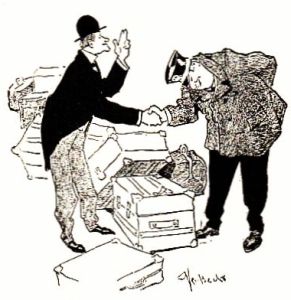
I have a sort of an idea that Jules is really a duke in disguise, because everybody sort of gives up to him. The custom-house people as soon as they saw Jules with our trunks never said a word but past 'em right through, and all he did was to shake hands with 'em for their trouble. Then we got in a fakir and rode to the hotel. Ma and Aunt Sarah and the children had gone ahead in an omnibus. Fakir is French for hack. They generally have only one horse and are open like a phaeton, with a little seat for boys just behind the driver. The drivers all have red faces and wear beaver hats made of patent leather some of 'em white but mostly black, and even when they cheat you they're awful cheap.
Pop tried some of his French on our driver on the way and you'd ought to have seen Jules try to keep his face straight. The driver looked amused too but Pop said he understood his French better than any other man he'd found yet in France.
"Yes, sir," said Jules. "I haf no doubt. Ze coshay he is vat you call a Irrishman."
The Paris streets are fine. They're so clean you could fall down and get up cleaner than you were when you fell and everybody's as polite as a dancing master. The hotel keeper acted as if we were some long lost relatives that he knew by the strawberry marks on our arms, he was so glad to see us, and when we went up to our rooms where the rest of the party already were, we found Ma and Aunt Sarah in a gorgeous parlor with fresh flowers on the centre table, but they still had their things on.
"We don't want this do we?" said Ma.
"Why not?" said Pop. "I think it's very nice."
"But it must be a million a day," said Ma.
"Oh no," said Pop. "I fixed that. It isn't any more expensive than back rooms on the top floor of a Yonkers hotel."
"All right," said Ma, taking off her coat and hat. "If that's so, I think we'll need two more rooms."
That shows you how very cheap everything is here.
To-morrow Jules is going to take us to see Napoleon's tomb, and I'll tell you about that and other things when I write again. I'm going out now with Pop to take a bicycle ride in the Boys de Bologna which is French for Central Park.
Good bye then for the present.
Bob.
The only artificial event now remaining on the Inter-collegiate card, and on the cards of the more important interscholastic associations, is the mile walk; and there is good reason to believe that within a year or two this will be relegated, with the standing-high-jump and the high-kick and the tug-of-war, to those regions whence acrobatic performances never return. Nothing in this life is worth doing or working at unless it is for some useful purpose, or unless there is an advantage to be gained by some one in its successful accomplishment. If the man who labors at becoming proficient in the mile walk does so because he believes he can afford amusement to the crowd in the grand stand by his acrobatics, very well. It is commendable to desire to add to the gayety of nations. But if he trains at walking—I am speaking now strictly of the heel-and-toe method—because he thinks he is doing athletic work, he is deluding himself.
Nothing, however, that is said here derogatory to artificial walking, as practised by the athlete, should be construed as reflecting in any way upon natural walking. There are few exercises for the general run of men any better than walking—walking across country at a natural gait, head up, chest out, toes turned out, and arms swinging easily at the sides. Such walking is natural and healthful. "Athletic" or "heel-and-toe" walking—exaggerated stride, heel pounding, toeing in, and all that—is artificial, and of no particular benefit. It is not harmful, of course, because it is exercise, and all normal exercise is beneficial.
The true test of the value of any field or track event is that of common-sense. For instance, it is well to learn to run 100 or 220 yards at great speed, because there are frequent occasions when it is necessary to cover those distances in quick time. It is well to train for quarter-mile and half-mile running, because if one wants to go to any place distant a half a mile of so, the quickest way to get there unaided is to run. It is the same way with the mile or the three-mile run. If you come to a brook, you use your knowledge of the running broad jump to get over it—not the standing broad jump. If you want to clear a fence (to escape a bull, for instance) you try the running high jump—not the standing high jump. If it is a high wall, and you have any knowledge of the pole vault, you likewise have an advantage. Hurdle-racing teaches you to get across country fields and fences, and both the hammer and the shot events on the card give good training for emergencies that may arise.
But there is no emergency that I can think of where proficiency in the mile walk would be of the slightest service. When it becomes necessary to travel a mile, running is by far the easier and the faster gait. There is no good word of any kind, so far as I know, to be said, for the mile walk. Yes, I will make one exception: it is a great thing for the digestion. I recommend it to dyspeptics! The rolling motion of the hips keeps the digestive organs in such constant exercise that they cannot become stagnant, and so perhaps for the American nation a little heel-and-toe now and then may be of value. But still, there are less acrobatic methods of helping the digestion than mile-walking.
THE ONE-MILE WALK.
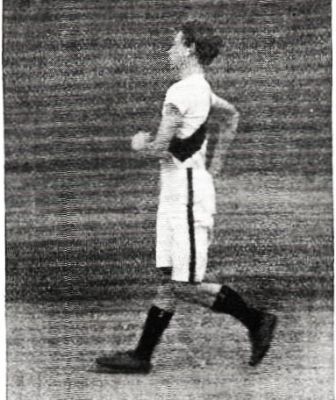
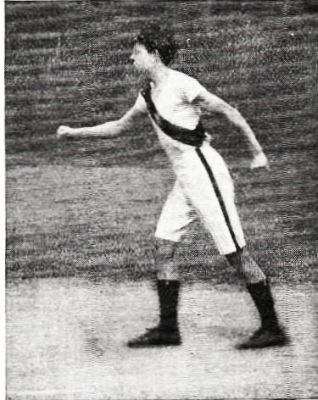
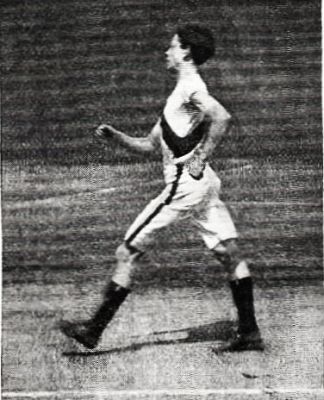
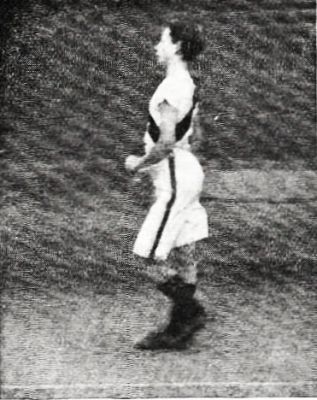
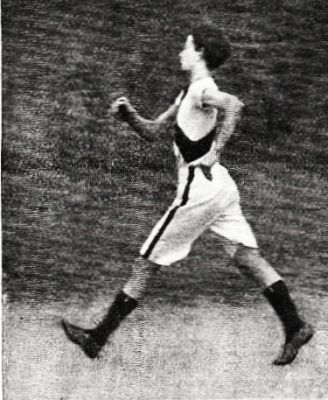
From Instantaneous Photographs of Phillips, the Harvard University Walker.
2.
1.
4.
3.
6.
5.
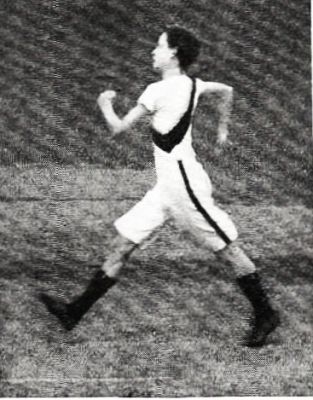
However, so long as mile-walking is an acknowledged feature of athletic meetings, we must recognize it—with a protest—and set down here a few hints as to how to go to work to cover the ground in the most approved fashion. The muscles that require the greatest development for walking are the abdominal and the fore-thigh muscles. Training should be begun, as soon as the snow is off the ground, by taking walks across country. Begin, of course, by taking short walks, in order to inaugurate a general hardening process, and each day, when you come to a good stretch of road, try two or three hundred yards of strict heel-and-toe walking, giving especial attention to acquiring the free and rolling motion of the hips. This motion is very clearly shown in illustration No. 3. To become a successful walker it is absolutely necessary to be loose and supple about the hips. The novice will notice pains about the abdomen at first, but he need not feel in any way alarmed. He has not caught cold. He has merely set some muscles to work that are not usually called upon to exert themselves under ordinary circumstances, and for a week or two they will feel sore and lame.
After a week of general unlimbering, the walks should be extended, and distances between five and ten miles should be covered. In all this walking the athlete must train himself to set his foot down straight, for walkers may not toe out. At the end of two or three weeks begin the alternate work as has been told of in the previous papers about the running events—that is, one day take a ten-mile walk at an easy gait, and the next day take a three-mile walk as fast as you can travel, and keep this up until you are ready to go on the track. But always rest on Sunday. One day's rest out of seven is imperative.
When work on the track begins, form is the principal thing to devote your attention to. Take long, slow walks around the cinder-path, putting the feet down straight and firmly, and devote all your energy to acquiring an easy stride, and, as far as possible, a long, swinging one. Work at the hip motion until you are master of it, and train yourself in the swinging of the arms until these become a means of assistance rather than an annoyance.
The only way to acquire speed in walking is to "sprint" (not a running sprint, but a walking sprint) from 100 to 200 yards. Here again alternate work should be done, that is, walk half or three-quarters of a mile and rest; then walk half a mile one day, and on the alternate days do short sprints several times, with rests in between. Don't try to go a mile at speed until you have been at work several months. After the first couple of weeks it may be well to take a trial half or quarter on time, but this should never be done oftener than once in a week or ten days. When you have gotten into condition at the end of four or five months, try a mile on time; but thereafter never attempt to go the full distance at speed more frequently than once in ten days or two weeks.
The costume for walking is the same as for running, except that the shoes have no spikes. The heels, too, are somewhat different, being built with a slight projection of the sole at the back, so as to make the constant pounding on the heels less severe. It seems almost needless to say here that walking differs from running in that one of the athlete's feet must be constantly on the ground; he must not lift the rear toe until the forward heel has struck, and the rear knee must lock. The illustrations show the rear knee locked in every instance. By speaking of the knee as "locked," is meant that the joint is closed.
In a race it is always well to take the lead, if possible, and walk your own mile. Before going into a contest the athlete ought to know pretty well how fast he can cover his distances, and he should disregard his competitors as much as circumstances will allow. Walking has fallen somewhat into disrepute of late, because unscrupulous athletes, proficient in the heel-and-toe method, can frequently run without apparently altering their form, and when the Judge of Walking is not at their very heels they travel rapidly but unfairly over the course. But this is not sport.
In the next issue of the Round Table will appear the last descriptive paper on track athletics of the series which has been running from time to time in this Department during the past winter. The subject will be the pole vault, and the illustrations have been made from instantaneous photographs of C. T. Buchholz, the inter-collegiate champion. All the articles and illustrations of this series, with many additional pictures, have been collected, and will be published early next month in a book to be called Track Athletics in Detail. This volume will be the first of a collection of books on all branches of amateur athletic sport, to be known as "Harper's Round Table Library of Sports."
The Pittsburg I.S.A.A. has done a very wise thing in limiting the entries for its games on June 6th to two representatives from each school. But even with such a restricted field I fear it will take the officials well into the night before they can get through, for the schedule includes fifteen events. Among these we have one circus feature—the hop, step, and jump. Four of the numbers on the card are to be bicycle-races. Through some process of reasoning, which I should be interested in having explained, the Pennsylvanians have adopted a scoring system of 3 points for first place, 1 for second, and 0 for third. I refer the Pittsburg I.S.A.A. officials to this Department in the issue of March 31st, where they will find a few paragraphs on the subject of scoring by points. I think they must acknowledge the arguments offered there to be just.
The notable feature of the Trinity School games, a week ago Friday, was Hipple's performance in the mile run. His time was 4 min. 48-2/5 sec. This breaks the scholastic record of 4 min. 55-4/5 sec., made by Tappin at the Poly. Prep. games last year, and is also better than Southwick's interscholastic record of 4 min. 52 sec.
The next few weeks will be crowded with interesting events to all lovers of interscholastic sport, and we may count on hearing of smashed records from every quarter. In a little over two weeks the New York and Long Island I.S.A.A.'s will be holding their field meetings, and then will come the Inter-City games; and then, before we know it, it will be time for the National meet. Before that, however, all the interscholastic associations in the East will have held their games, and perhaps we shall be able to form some kind of opinion as to where the national championship will go. It looks now as if it would go to Boston, but this is only a very rough guess, and I do not offer it in any way as a prophecy—but merely as a suspicion.
No trophy has been provided yet for this National championship. It is very important that there should be one, and the graduates of the schools ought to bestir themselves to collect a sufficient sum of money for the purchase of a suitable cup. I am very much afraid, however, that there is no single graduate with enough enthusiasm for the welfare of school sport to devote his time and energy toward persuading others to subscribe for a trophy, and even if there were he would have such a limited time in which to exercise his efforts that he would doubtless not be able to obtain a large enough subscription for his purpose. The cup which shall represent the National Interscholastic Championship ought to be as good as any of its kind, and ought to be put up for a number of years—say ten—and each year the name of the winning league should be inscribed upon it, the trophy to finally go to that association having its name upon it the greatest number of times. Further, I think that if such a cup were offered by the graduates, the National Association ought to award each year to the winning league a miniature cup of the same pattern, as a special evidence of that year's victory.
It would be far more to the interest of sport to have a valuable trophy of this kind to be contested for by the leagues, with small tokens only for individual prizes. Let the contest be among the league teams rather than among the individuals of the associations.
The tennis season is likewise upon us. Next Saturday will see the Harvard, Yale, Princeton, and Columbia interscholastic tournaments in full swing. There will also be an interscholastic tournament in Chicago, and it is possible that the winner may go to Newport for the championships.
The baseball season of the New England League began last Friday, and although it is too early yet to tell much about the various teams, it looks as if there would be some pretty good ball put up this season. Both C. H. & L. and Hopkinson's, who tied last year for first place, have strong nines. Lochman, who was the best catcher in the league last year, will take first base this season, and let Columbus go behind the bat. John Clarkson is to pitch, and his brother will play third. Both are brothers of the well-known professional pitcher, and ought to have baseball blood in their veins. Saul, captain of last year's victorious football eleven, is going into the field, and is counted on to do some batting.
For Hopkinson's, Captain Dickson will hold his old position of short-stop. Stillman is to pitch, and Carlton, who played half-back on the eleven, will catch him. Hallowell, also a member of last year's eleven, will look after left field. New men mostly will be tried for the other positions.
It seems necessary to repeat that no answers can be given in these columns to anonymous correspondents.
J. E. Downing, Locust Valley, N. Y.—In training for any kind of athletic event it is best not to eat sweets or pastry of any kind; but the most important thing is to take your meals at regular hours, and not to eat between meals.
The Graduate.
This Department is conducted in the interest of stamp and coin collectors, and the Editor will be pleased to answer any question on these subjects so far as possible. Correspondents should address Editor Stamp Department.
About six months ago a 10c. Baltimore stamp on bluish paper was shown in Boston. This unique copy was badly damaged, and when offered at auction a short time ago failed to realize the reserve price of $1500 which was placed on it. The great find of St. Louis stamps in Louisville, Ky., last winter, stimulated every owner of old correspondence in that city to overhauling the same. Some good stamps were found, among them a 10c. Baltimore on white paper. This stamp has been sold to a New York collector for $4500, the largest price ever paid for a single stamp. The New Haven envelope sold for $2000, and one of the largest dealers in New York has since offered $3000 for it, or for a duplicate equally as good, but without success.
The Canadian 15c. now current has been withdrawn, and probably will not be reprinted. Collectors here, looking over their duplicates, find that they have very few copies. It will probably be scarce and advance rapidly in value.
England is about to issue stamps surcharged O. W. for the use of the officials in the "Office Works" department. As but few copies will be used, these stamps will be much sought after.
Z.—The 1872 U.S. 12c. is worth 60c.; the 24c. is worth $2; the 40 centavos Costa Rica official, $1.
C. Broodstone.—There is no duty on stamps imported into the U.S. I cannot give names of societies, officers, etc.
Normal, Ill.—Your coin is a Spanish half-dollar. They were largely used in this country before the war, and hence are quite common.
H. M. C.—The Continental note is a curiosity, but has very little monetary value. Most of the notes can be bought of dealers at 10c. to 25c. each.
Philatus.