Three Leaves From Punch.
Reading edition
LECTURES ON LETTERS.
We find in a recent number of that well-known and reliable newspaper, the London Punch, an interesting sketch of a new and improved system of teaching the elementary branches of education. It proceeds upon principles somewhat different from those which have generally obtained in the popular methods of instruction. It was prepared by the Editor of the journal referred to, for the Council of Education established a few years since by the English Government, for the express purpose of discussing and promoting improved methods of public teaching. In a note accompanying the work, the author states that, as soon as it was completed, he forwarded it, by
the parcels conveyance company,
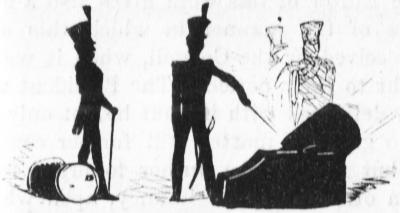
with a polite note to the Secretary of the Council.
We regret that our limits will not permit us to present to the readers of the New Monthly Magazine a full description of this novel work. We can only give a slight sketch of the manner in which it proposes to teach the Alphabet. The author thinks that, in the systems in general use hitherto, advantage has not been sufficiently taken of the pictorial form, as capable of connecting with the alphabet, not only agreeable associations, but many useful branches of knowledge.
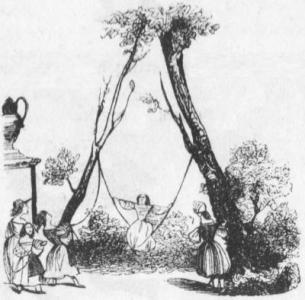
He would begin with the letter A, by rendering it attractive to children as a swing, and the opportunity might then be taken of leading the conversation to the swing of the pendulum, the laws which govern its oscillations, and the experiments of Maupertius, Clairault, and Lemmonier, upon its variations in different latitudes.
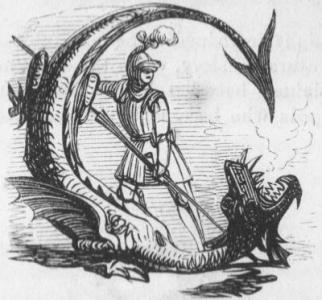
G, the child might be told, stands for George, and the pictorial illustrations of St. George and the dragon (the latter about to swallow its own tail) would enable the teacher to enter upon a disquisition relative to the probable Eastern origin of the legendary stories of the middle ages.
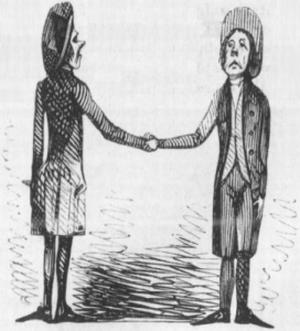
H would naturally suggest reminiscences of modern English history. The teacher would give some account of George Fox, the first Quaker, and of the singular customs and opinions of the sect he founded. Thence the child might be led to perceive the evils of schism, and the legitimate, and mischievous consequences of that right of private judgment still claimed by a small, but happily now an uninfluential minority in the established church.
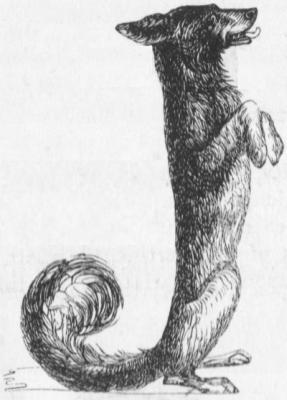
J might introduce some profitable remarks upon Natural History, when the difference could be explained between bipeds by nature, and quadrupeds who become bipeds only for selfish ends.
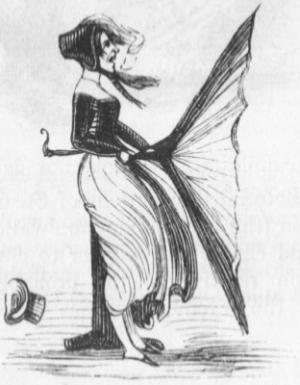
Advantage might be taken of the pictorial illustration of K to lay the foundation of an acquaintance both with the science of Pneumatics, and with Captain Reid's theory of the laws affecting the course of storms.
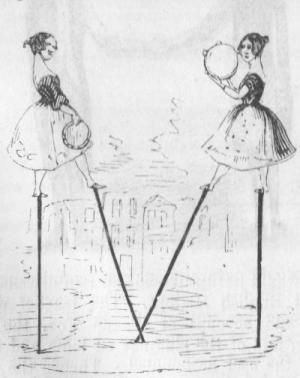
With the letter M the child might learn the meaning of what is termed the centre of gravity, so important to be maintained by ladies walking on stilts.
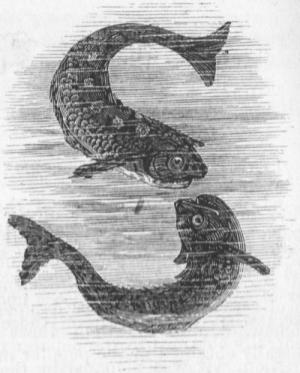
The letter S, reminding the teacher of Pisces—fishes—one of the signs of the Zodiac, would furnish him with a suitable opportunity for discoursing upon Astronomy. Afterward he might take up the subject of Ichthyology, and speak of the five orders, the apodal, the jugular, the abdominal, the thoracic, and cartilaginous species, into which the great family of fishes is divided.
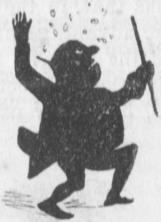
The Editor of this work gives also a general outline of the manner in which this system was received by the Council, when it was first brought to their notice. The President was so highly delighted with it, that he not only promised to give the matter still further consideration, but invited the author to bring forward certain other works for infancy, upon which, it was generally understood, he had been engaged. To this polite invitation the Editor replied that he had been able as yet to complete only two works of this description, namely, the delightful Poem,
how doth the little busy bee,
and the equally interesting and still more tragic history of
cock robin.
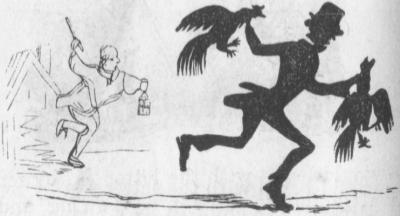
He thought the teacher could not better follow out Dr. Watts's idea of "improving the shining hour," than by rendering the same lesson of industry available for a full account of the genus apis, taking care not to confound in the child's mind the apis of entomology with apis the bull, worshiped by the ancient Egyptians. With regard to the historical work referred to, it was high time that the juvenile mind should be disabused of a popular error. The facts were, that a man of the name of Sparrow had robbed a farm-yard of its poultry, for which offense, after being taken and made to confess his guilt, he was transported. The crime and punishment were suggestive of many useful reflections upon the importance of honesty; but the facts were ludicrously distorted and deprived of all their moral force in the spurious account published by certain booksellers in St. Paul's Church-yard of the same transaction. A question is asked, "Who kill'd Cock Robin?" and the following answer is given:
"I says the Sparrow, With my bow and arrow, I killed Cock Robin!!!"
In continuing his account of this interview, the Editor introduces the new system of musical notation, which he also brought to the notice of the Council, and which they all agreed would be found exceedingly useful in
assisting a pupil up the gamut.
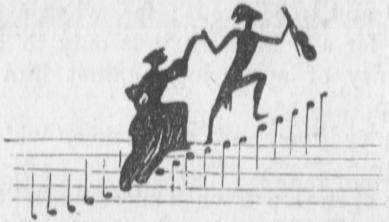
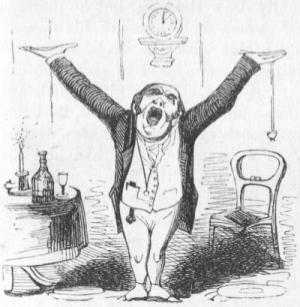
But into this branch of the subject we can not follow him. In fact, the Editor states that, at this point of his exposition, he was constrained to desist by noticing that several members of the Council had become so deeply impressed with the merits of his pictorial system, that they were illustrating it in their own persons, by throwing themselves into the form of
the letter Y.
PUNCH ON SPECIAL PLEADING.
INTRODUCTION.
Before administering law between litigating parties, there are two things to be done—in addition to the parties themselves—namely, first to ascertain the subject for decision, and, secondly, to complicate it so as to make it difficult to decide. This is effected by letting the lawyers state in complicated terms the simple cases of their clients, and thus raising from these opposition statements a mass of entanglement which the clients themselves might call nasty crotchets, but which the lawyers term "nice points." In every subject of dispute with two sides to it, there is a right and a wrong, but in the style of putting the contending statements, so as to confuse the right and the wrong together, the science of special pleading consists. This system is of such remote antiquity, that nobody knows the beginning of it, and this accounts for no one being able to appreciate its end. The accumulated chicanery and blundering of several generations, called in forensic language the "wisdom of successive ages," gradually brought special pleading into its present shape, or, rather, into its present endless forms. Its extensive drain on the pockets of the suitors has rendered it always an important branch of legal study, while, when properly understood, it appears an instrument so beautifully calculated for distributive justice, that, when brought to bear upon property, it will often distribute the whole of it among the lawyers, and leave nothing for the litigants themselves.