Chapter II · OF THE DECLARATION.
Reading edition
The writ being now served, it is next to be returned, and this is sometimes done by giving it back at once to the bailiff or throwing it in his face. Such quick returns as these would bring such very small profit to a plaintiff that they are not allowable, and the writ can only be returned by the sheriff bringing it back, on a certain day, into the superior court. He then gives a short account, in writing, of the manner in which the writ has been executed; but, if the bailiff has been pumped upon—as we find reported in Shower—or pelted with oysters, as in Shelley's case, or kicked down stairs, as he was in Foot against the Sheriff, it does not seem that the particulars need be set forth.
If the defendant does not appear within eight days after the writ has come "greeting," as if it would say, "my service to you," the plaintiff may, in most cases, appear for him; and this shows how true it is that appearances are often deceitful and treacherous; for, when a plaintiff appears for a defendant, it is only to have an opportunity of appearing against him at the next step.
The pleadings now commence, which were originally delivered orally by the parties themselves in open Court, when success might depend on length of tongue; but the parties themselves being got rid of, in the modern practice, and the lawyers coming in to represent them, success usually depends on length of purse. The object of pleading, whether oral or written, is to bring the parties to an issue; which means, literally, a way out; but, in practice, the effect of getting plaintiff and defendant to an issue is to let them both regularly in.
Almost all pleas, except those of the simplest kind, must be signed by a barrister; who does not usually draw the plea, but he merely draws the half guinea for the use of his name. The pleading begins with the declaration, in which the plaintiff is supposed to state the cause of action; but in which he gives such an exaggerated account of his grievances, that not more than one-tenth of what he states, is to be believed. For example, if A has had his nose slightly pulled by B, the former proceeds to say that "the defendant, with force and arms, and with great force and violence, seized, laid hold of, pulled, plucked, and tore, and with his fists, gave and struck a great many violent blows, and strokes, on and about, diverse parts of the plaintiff's nose." If Jones has been given into custody by Smith, without sufficient reason; and Jones brings an action for false imprisonment; instead of saying, "he was compelled to go to a station-house," he declares that the defendant, "with force, and arms, seized, laid hold of, and with great violence pulled, and dragged, and gave, and struck a great many violent blows and strokes, and forced, and compelled him—the plaintiff—to go in and along divers public streets and highways, to a police office; whereby the plaintiff was not only greatly hurt, bruised, and wounded, but was also kept."
If Snooks's dog bites Thomson's pet lamb, Snooks declares, "That defendant did willfully and injuriously keep a certain dog, he, the defendant, well knowing that the said dog was and continued to be fierce and mad, and accustomed to attack, bite, injure, hurt, chase, worry, harass, tear, agitate, wound, lacerate, snap at, and kill sheep and lambs, and that the said dog afterward to wit, on the — day of ——, and divers other days, did attack (&c., &c., down to) and kill one hundred sheep and one hundred lambs of the plaintiff; whereby the said sheep and the said lambs (it will be remembered there was only one lamb), were greatly terrified, damaged, injured, hurt, deteriorated, frightened, depreciated, floored, flustered, and flabbergasted, to the damage of the plaintiff of £—, and therefore he brings his suit."
The various forms of declaration are so numerous, that they fill a volume of 700 large pages of Chitty, who is quite chatty on this dry subject, so much does he find to say with regard to it. To this able and amusing writer we refer those who are curious to know how a schoolmaster may declare for "work and labor, care, diligence, and attendance of himself, his ushers and teachers, there performed and bestowed in and about the teaching, instructing, boarding, educating, lodging, flogging, enlightening, thrashing, washing, whipping, and otherwise soundly improving divers infants and persons." These, and almost all other conceivable causes of action, are dealt with fully in the pages to which we allude, and all therefore who wish the treat of going to law, are referred to the treatise alluded to.
SMITHFIELD CLUB CATTLE SHOW.
(FROM OUR OWN PROTECTIONIST.)
This melancholy event came off last week, when prizes were distributed to the breeders of the very leanest stock—a brass band, the horns and ophicleides draperied with black crape, playing funeral airs at intervals. The results of free trade were never more shockingly conspicuous than in the shadowy forms of steers and oxen; while there was a pen of a dozen pigs, scarcely one of which was visible to the naked eye. We observed more than one benevolent lady weeping pearls over indefinite things that had vainly struggled to become porkers. There were sheep that were nothing but the merest bladebones, here and there covered with threads of worsted. The Queen and Prince Albert, with two of the little Princes, visited the spectacle, contemplating it with becoming gravity. The Prince carried away the prize for a bull that was only visible when placed under a glass of forty Opera power. Occasionally, an acute ear might detect sounds that a liberal mind might interpret as ghost-like bellowings—spectral bleatings—with now and then an asthmatic attempt at a grunt. The Duke of Wellington's battering-ram is not to be seen when looked at in front; but only from either side. It is said to have been fed upon old drum-heads, with occasionally the ribbons of a recruiting sergeant chopped and made into a warm mash. We ought, by the way, to have remarked that the Duke of Richmond attended, as President, in deep mourning; and bore in his face and manner the profoundest traces of unutterable woe. However, let us proceed to give the list of prizes, all of them so many triumphant proofs of the withering influence of Free-Trade.
OXEN OR STEERS.
The Duke of Rutland carried away the £30 prize for the thinnest steer. It had been fed on waste copies of Protectionist pamphlets with the tune of "The Roast Beef of Old England," played in A flat on a tin trumpet. Some idea may be entertained of the nicety with which the animal had been brought to the lowest point of life, when we state that five minutes after the noble Duke received the prize, the thing died; all the brass band braying "The Roast Beef of Old England" for half-an-hour, in the vain hope of reviving it. The beast was distributed among the Marylebone poor; all of them ordered to appear in spectacles to see, if possible, their proper quantities.
LONG-WOOLED SHEEP.
The Duke of Atholl bore off the first prize of £20, for an extraordinary specimen of Highland sheep, that both puzzled and delighted the judges. The sheep had been reared upon Highland thistles, according to the Duke's well-known hospitality; and these thistles so judiciously served, that they had taken the place of the wool, growing through the animal's sides, and coating them all over with their brushy points. The Rev. Mr. Bennett was present, and was much delighted with his wool of thistles; he is to be presented with a comforter—the thing will be very popular by Christmas, to be called the Atholl Bosom Friend—woven from the fleece. The web, in place of the vulgar linen shirt, is expected to become very general with the ladies and gentlemen who feed upon the honey hived at St. Barnabas.
PIGS.
Colonel Sibthorp took the prize for the Pig of Lead; so small a pig, that it might creep down the tube of a Mordan's pencil. Mr. Disraeli sent the shadow of a sow; one of his practical epigrams, showing he had ceased to have even a real squeak for Protection; he also sent a porker that, from its largeness of size—where smallness was the object—was deemed hopeless of any reward. However, Mr. Disraeli carefully removing a muzzle from the pig's snout, the animal collapsed flat as a crush-hat. The fact is, Mr. Disraeli had, as he afterward averred, seemingly fattened the hog upon a pair of bellows. There are, we have heard, pigs that see the wind; whether Mr. Disraeli's pig is of that sort, the eloquent Protectionist said not. He, however, took a second prize; and next year promises to exhibit a whole litter of the smallest pigs in the world, suckled upon vials of aquafortis.
COWS.
The leap of the Cow that jumped over the Moon was exhibited by the Duke of Richmond. This Cow had been fed on the printer's ink from the Standard newspaper, which sufficiently accounts for the daring altitude of its flight. The Duke was proffered the gold medal, but resolutely refused any such vanity.
In conclusion, we are happy to say that the Exhibition was well attended. The thousands of our countrymen who witnessed the wretched condition of the cattle must have carried away with them the profound conviction, that the days of Free Trade are numbered; and that a speedy return to Protection is called for by the interests of man and brute—from Dukes to steers, from Parliament men to pigs.
OUR GOLDEN OPPORTUNITIES.
There is so much precious ore being brought from California, that people are beginning to fear gold may become a drug as well as a metal. Already gold fish are quoted at Hungerford market lower than silver, the recent importations having acted even upon the finny tribe, and those with silver scales have had the balance turned in their favor. In Europe, we go to great expense in watering the road to lay the dust; but the gold dust of California is so valuable, that no watering carts are employed, and when a man comes home from a dusty walk he has only to shake his coat, to shake a good round sum into his pocket. In California the housemaids stipulate for the dust as a perquisite, and the "regular dustman" of the place pays an enormous sum for the privilege of acting as "dust-contractor for the district."
UNIVERSAL CONTEMPT OF COURT.
It seems that any person is liable to be committed to prison for his lifetime by the Court of Chancery, as guilty of contempt of Court, for not paying that which he has not to pay, and for not doing other impossibilities. What a number of people might be committed for contempt of the Court of Chancery, if we all expressed our feelings!
STARTLING FACT!
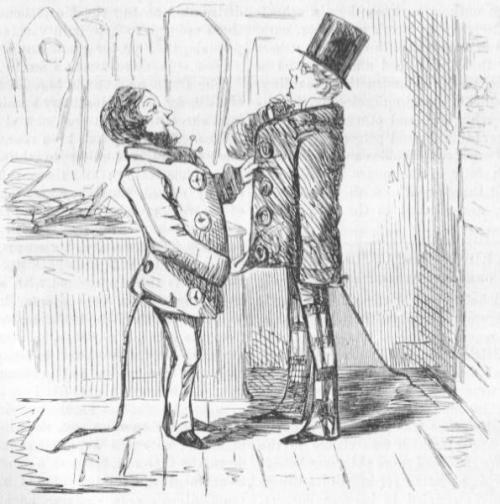
Oxford Swell. "Do you make many of these Monkey-Jackets now?"
Snip. "Oh dear yes, Sir. There are more Monkeys in Oxford this Term than ever, Sir."