THE STORY OF REYNARD THE FOX.
Reading edition
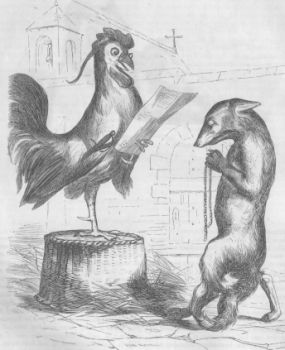
[The Story of Reynard the Fox, in prose and in rhyme, has for centuries been the favorite popular tale in Europe. We can not go back to the time when it was not told in every dialect spoken by the Teutonic race. "Among the people," says Carlyle, "it was long a house-book, and universal best-companion; it has been lectured on in universities, quoted in imperial council-halls; it lay on the toilets of princesses, and was thumbed to pieces on the work-bench of the artisan; we hear of grave men ranking it next to the Bible.... It comes before us with a character such as can belong only to a very few; that of being a true world's book, which through centuries was every where at home, and the spirit of which diffused itself through all languages and all minds." The translation which we present is from the old Low-German version, which, by superseding all previous ones, has come to be considered the recognized form of the tale. Goethe has expanded it into a long poem, for which Kaulbach designed some forty illustrations, forming the finest series of pictures ever produced for the illustration of a single book. Hermann Plouquet of Stuttgart, has contributed to the Great Exhibition in London a display of animals stuffed in the most comic attitudes. A portion of these are in illustration of Reynard the Fox, the designs of Kaulbach serving as models. The illustrations which we furnish are taken from daguerreotype pictures of these animals, and afford a striking example of the expression which the animal face and figure are capable of conveying.]
About the feast of Whitsuntide, when the woods were in their lustyhood and gallantry, when every tree was clothed in the green and white livery of glorious leaves and sweet-smelling blossoms, when the earth was covered with her fairest mantle of flowers, and the sweet birds entertained the groves with the delight of their harmonious songs, the Lion, the Royal King of Beasts, made solemn proclamation that all quadrupeds whatsoever should attend his court, and celebrate this great festival.
Now when the King had assembled all his subjects together, there was no one absent save Reynard the Fox, against whom many grievous accusations were laid. First came Isegrim the Wolf, with all his family and kindred, who, standing before the King, complained loudly how that Reynard had ill-treated his wife and children. Then there came a little hound named Curtsie, who accused the fox of having stolen his pudding in the extreme cold winter-time, when he was nigh dying of starvation. But scarcely had the hound finished his tale, when, with a fiery countenance, in sprang Tibert the Cat, and accused Curtsie of having stolen this pudding from himself, and declared that Reynard had righteously taken it away.
Then rose the Panther: "Do you imagine, Tibert," quoth he, "that Reynard ought not to be complained of? The whole world knows that he is a murderer, a vagabond, and a thief."
Then quoth Grimbard the Badger, Reynard's nephew: "It is a common proverb, Malice never spake well: what can you say against my kinsman the fox? All these complaints seem to me to be either absurd or false. Mine uncle is a gentleman, and can not endure falsehood. I affirm that he liveth as a recluse; he chastiseth his body, and weareth a shirt of hair-cloth. It is above a year since he hath eaten any flesh; he hath forsaken his castle Malepardus, and abandoned all his wealth; he lives only upon alms and good men's charities, doing infinite penance for his sins; so that he has become pale and lean with praying and fasting."
While Grimbard was still speaking, there came down the hill Chanticleer the Cock, and with him two hens, who brought with them on a bier their dead sister Copple, who had just been murdered by Reynard. Chanticleer smote piteously his feathers, and, kneeling before the King, spake in this manner:
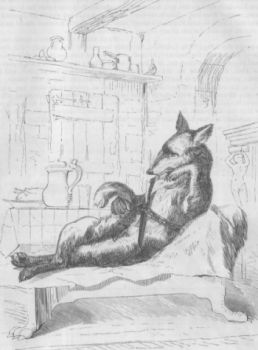
REYNARD AT HOME
"Most merciful and my great Lord the King, vouchsafe, I beseech you, to hear our complaint, and redress the injuries which Reynard the Fox has done to me and my children. Not longer ago than last April, when the weather was fair, and I was in the height of my pride and glory, because of my eight valiant sons and seven fair daughters, who were strong and fat, and who walked in safety in a yard well-fenced round, wherein also were several large dogs for their protection, Reynard, that false and dissembling traitor, came to me in the likeness of a hermit, and brought me a letter to read, sealed with your Majesty's seal, in which I found written, that your Highness had made peace throughout all your realm, and that no manner of beast or fowl should do injury one to another; affirming unto me, that, for his own part, he was become a monk, vowing to perform a daily penance for his sins; showing unto me his beads, his books, and the hair shirt next to his skin; saying, in humble wise, unto me, 'Sir Chanticleer, never henceforth be afraid of me, for I have vowed never more to eat flesh. I am now waxed old, and would only remember my soul; therefore I take my leave, for I have yet my noon and my evensong to say.' Which spake, he departed, saying his Credo as he went, and laid him down under a hawthorn. At this I was exceeding glad, that I took no heed, but went and clucked my children together, and walked without the wall, which I shall ever rue; for false Reynard, lying under a bush, came creeping betwixt us and the gate, and suddenly surprised one of my children, which he trussed up and bore away, to my great sorrow; for, having tasted the sweetness of our flesh, neither hunter nor hound can protect or keep him from us. Night and day he waits upon us, with that greediness, that of fifteen of my children, he hath left me but four unslaughtered; and yesterday, Copple, my daughter, which here lieth dead on this bier, was, after her murder, rescued from him. This is my complaint, and this I leave to your Highness's mercy to take pity on me, and the loss of my fair children."
Then spake the King; "Sir Grimbard, hear you this of your uncle the recluse? he hath fasted and prayed well: believe me, if I live a year, he shall dearly abide it. As for you, Chanticleer, your complaint is heard, and shall be cured; to your daughter that is dead we will give the rites of burial, and with solemn dirges bring her to the earth, with worship."
After this the King sent for his lords and wisest counselors, to consult how this foul murder of Reynard's might be punished. And in the end, it was concluded that Reynard should be sent for, and without all excuse, he should be commanded to appear before the King, to answer whatever trespasses should be objected against him; and that this message should be delivered by Bruin the Bear.
To all this the King gave consent, and calling the bear before him, he said, "Sir Bruin, it is our pleasure that you deliver this message, yet in the delivery thereof have great regard to yourself; for Reynard is full of policy, and knoweth how to dissemble, flatter, and betray; he hath a world of snares to entangle you withal, and without great exercise of judgment, will make a scorn and mock of the best wisdom breathing."
"My Lord," answered Sir Bruin, "let me alone with Reynard; I am not such a truant in discretion to become a mock to his knavery;" and thus, full of jollity, the bear departed.
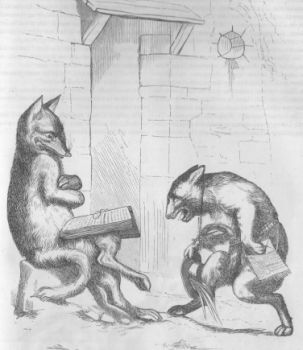
SIR TIBERT DELIVERING THE KING'S MESSAGE.
The next morning Bruin set out in quest of the fox; and after passing through a dark forest and over a high mountain, he came to Malepartus, Reynard's chiefest and most ancient castle. Reynard was at home, and pretended to be ill with eating too much honey. When the bear heard this, he was extremely desirous of knowing where such excellent food could be obtained; and Reynard promised to take him to a garden where he should find more honey-combs than ten bears could eat at a meal. But the treacherous rascal took him to a carpenter's yard, where lay the trunk of a huge oak-tree, half-riven asunder, with two great wedges in it, so that the cleft stood a great way open. "Behold now, dear uncle," said the fox, "within this tree is so much honey that it is unmeasurable." The bear, in great haste, thrust his nose and fore-paws into the tree; and immediately Reynard pulled out the two great wedges, and caught Bruin in so sharp a trap, that the poor beast howled with pain. This noise quickly brought out the carpenter, who, perceiving how matters stood, alarmed the whole village, who came and belabored the bear's sides with sticks and hoes and pitchforks, until, mad with rage, he tore his bleeding face and paws from the tree, and rushed blindly into a river that ran close by, knocking into the water with him many of the villagers, and among them, Dame Julock, the parson's wife, for whose sake every one bestirred himself; and so poor Bruin got safe away. After some delay, the bear returned to the court, where, in dismal accents, he recounted the sad trick that Reynard had played him.
Then said the King, "Now, by my crown, I will take such revenge as shall make that traitor tremble;" and sending for his counselors, they decided that Reynard should be again summoned to court, and that Tibert the Cat should be the bearer of the message. "It is your wisdom, Sir Tibert, I employ," said the great King, "and not your strength: many prevail with art, when violence returns with lost labor."
So Tibert made ready, and set out with the King's letter to Malepardus, where he found the fox standing before his castle-gates; to whom Tibert said, "Health to my fair cousin Reynard; the King, by me, summons you to the court, in which if you fail, there is nothing more assured unto you than a cruel and a sudden death."
The fox answered, "Welcome, dear cousin Tibert; I obey your command, and wish my Lord the King infinite days of happiness; only let me entreat you to rest with me to-night, and take such cheer as my simple house affordeth, and to-morrow, as early as you will, we will go toward the court, for I have no kinsman I trust so dearly as yourself."
Tibert replied, "You speak like a noble gentleman; and methinks it is best now to go forward, for the moon shines as bright as day."
"Nay, dear cousin," said the fox, "let us take the day before us, so may we encounter with our friends; the night is full of danger."
"Well," said the cat, "if it be your pleasure, I am content; what shall we eat?"
Reynard said, "Truly my store is small; the best I have is a honey-comb, pleasant and sweet; what think you of it?"
To which Tibert replieth, "It is meat I little respect, and seldom eat; I had rather have one mouse than all the honey in Europe."
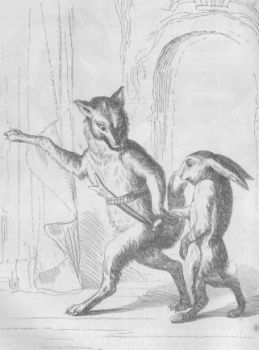
REYNARD BRINGS FORWARD THE HARE AS HIS WITNESS.
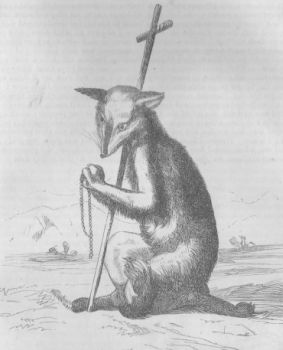
REYNARD ON HIS PILGRIMAGE TO ROME.
"A mouse!" said Reynard; "why, my dear cousin, here dwelleth a priest hard by, who hath a barn by his house so full of mice, that I think half the wagons in the parish are not able to bear them."
"Oh, dear Reynard," quoth the cat, "do but lead me thither, and make me your servant forever."
"Why," said the fox, "love you mice so exceedingly?"
"Beyond expression," quoth the cat.
Then away they went with all speed to the priest's barn, which was well walled about with a mud wall, where, but the night before, the fox had broken in and stolen an exceeding fat hen, at which the priest was so angry, that he had set a snare before the hole to catch him at his next coming, which the false fox knew of; and therefore said to the cat, "Sir Tibert, creep in at this hole, and believe it, you shall not tarry a minute's space but you shall have more mice than you are able to devour; hark, you may hear how they peep. When you have eaten your fill, come again, and I will stay and await for you here at this hole, that to-morrow we may go together to the court; but, good cousin, stay not too long, for I know my wife will hourly expect us."
Then Tibert sprang quickly in at the hole, but was presently caught fast by the neck in the snare, which as soon as the cat felt, he quickly leaped back again; and the snare running close together, he was half-strangled, so that he began to struggle and cry out and exclaim most piteously.
Then the priest, hearing the outcry, alarmed all his servants, crying out, "The Fox is taken!" and away they all ran to where poor Tibert was caught in the snare, and, without finding out their mistake, they beat him most unmercifully, and cruelly wounded one of his eyes. The cat, mad with pain, suddenly gnawed the cord, and seizing the priest by the legs, bit him and tore him in such a way that he fell down in a swoon, and then, as every one ran to help his master, Tibert leaped out of the hole, and limped as fast as his wounded legs would carry him to the court where the King was infinitely angry at the treatment he had received.
Then Grimbard the Badger, Reynard's nephew fearing it was likely to go hard with his uncle, offered to go to Malepardus and take the King's message to his most subtle kinsman; to which his Majesty graciously consented. So Grimbard set forth; and when he came to Malepardus, he found Reynard with Dame Ermelin his wife, sporting with their children. When Grimbard had delivered the King's letter, Reynard found that it would be better for him to show himself at court at once; so bidding an affectionate farewell to his dear wife and children, he immediately set out with the badger to go with him before the King. On his way, Reynard, remembering the heavy crimes he had committed, and fearing that his end was at hand, desired of the holy Grimbard, who had always led a hermit's life, that he would hear him confess, and set him a penance for his sins. Grimbard bade him proceed. And the fox confessed how shamefully he had ill-used the bear, and the cat, and the wolf, and Chanticleer's children, and many other ill-doings during his life; and when he had finished, he knelt before Grimbard, and said, "Thus have I told you my wickedness; now order my penance, as shall seem fit in your discretion."
Grimbard was both learned and wise; and therefore brake a rod from a tree, and said, "Uncle, you shall three times strike your body with this rod, and then lay it down upon the ground, and spring three times over it without bowing your legs or stumbling; then shall you take it up and kiss it gently, in sign of meekness and obedience to your penance; which done, you are absolved of your sins committed up to this day, for I pronounce unto you clear remission."
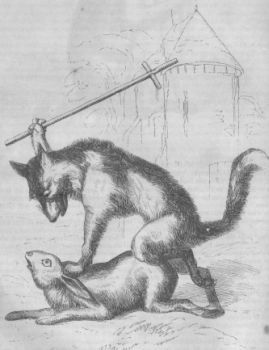
REYNARD ATTACKETH LAPRELL THE RABBIT.
At this the fox was exceeding glad; and immediately he performed the penance to Grimbard's satisfaction. But as they went journeying on, it happened that they passed by the poultry-yard of a convent; and as one young cock strayed far from the rest, Reynard leaped at him, and caught him by the feathers, but the cock escaped.
"Villain that you are," said Grimbard, "will you, for a silly pullet, fall again into your sins?"
To which Reynard answered, "Pardon me, dear nephew, I had forgotten myself; but I will ask forgiveness, and mine eye shall no more wander."
However, Grimbard noted that he turned many times to look at the poultry. But soon afterward they arrived at the court.
As soon as it was bruited in the court that Reynard the Fox and Grimbard his kinsman were arrived there, every one, from the highest to the lowest, prepared himself to complain of the fox; at which Reynard's heart quaked, but his countenance kept the old look, and he went as proudly as ever he was wont with his nephew through the high street, and came as gallantly into the court as if he had been the King's son, and as clear from trespass as the most innocent whosoever; and when he came before the chair of state in which the King sat, he said, "Heaven give your Majesty glory and renown above all the princes of the earth."
But the King cut him short at these words, and said, "Peace, traitorous Reynard; think you I can be caught with the music of your words? no, it hath too oft deceived me; the peace which I commanded and swore unto, that have you broken."
Then Bellin the Ram, and Oleway his wife, and Bruin the Bear, and Tibert the Cat, and Isegrim the Wolf, and Kyward the Hare, and Bruel the Goose, and Baldwin the Ass, and Bortle the Bull, and Hamel the Ox, and Chanticleer the Cock, and Partlett the Hen, and many others, came forward; and all these with one entire noise cried out against the fox, and so moved the King with their complaints, that the fox was taken and arrested.
Upon this arrest a parliament was called; and notwithstanding that he answered every objection severally, and with great art, Reynard was condemned, and judgment was given that he should be hanged till his body was dead; at which sentence the fox cast down his head, for all his jollity was lost, and no flattery nor no words now prevailed.
Then Isegrim on the one side and Bruin on the other led the poor fox to the gallows, Tibert running before with the halter. And when they were come to the place of execution, the King and the Queen, and all the rest of the nobility, took their places to see the fox die.
When all things were prepared, the fox said, "Now my heart is heavy, for death stands in all his horror before me, and I can not escape. My dread Lord the King, and you my sovereign Lady the Queen, and you my lords that stand to behold me die, I beseech you grant me this charitable boon, that I may unlock my heart before you, and clear my soul of her burdens, so that hereafter no man may be blamed for me; which done, my death will be easy."
Every creature now took compassion on the fox, and said his request was small, beseeching the King to grant it, which was done; and then the fox thus spake, "Help me, Heaven, for I see no man here whom I have not offended; yet was this evil no natural inclination in me, for in my youth I was accounted as virtuous as any breathing. This know, I have played with the lambs all the day long, and taken delight in their pretty bleating; yet at last in my play I bit one, and the taste of its blood was so sweet unto me, that I approved the flesh, and both were so good, that since I could never forbear it. This liquorish humor drew me into the woods among the goats, where hearing the bleating of the little kids, I slew one of them, and afterward two more, which slaughter made me so hardy, that then I fell to murder hens, geese, and other poultry. And thus my crimes increased by custom, and fury so possessed me, that all was fish which came to my net. After this, in the winter season, I met with Isegrim, where, as he lay hid under a hollow tree, he unfolded unto me how he was my uncle, and laid the pedigree down so plain, that from that day forth we became fellows and companions; which knot of friendship I may ever curse, for then began the flood of our thefts and slaughters. He stole the great things, I the small; he murdered nobles, I the mean subjects; and in all our actions his share was still ever the greatest: when he got a ram or a calf, his fury would hardly afford me the horns to pick on; nay, when he had an ox or a cow, after himself, his wife, and his seven children were served, nothing remained to me but the bare bones to pick. This I speak not in that I wanted (for it is well known I have more plate, jewels, and coin than twenty carts are able to carry), but only to show his ingratitude."
When the King heard him speak of this infinite treasure and riches, his heart grew inflamed with a desire thereof; and he said, "Reynard, where is that treasure you speak of?"
The fox answered: "My Lord, I shall willingly tell you, for it is true the wealth was stolen; and had it not been stolen in that manner which it was, it had cost your Highness your life (which Heaven, I beseech, keep ever in protection)."
When the Queen heard that dangerous speech, she started, and said: "What dangers are these you speak of, Reynard? I do command you, upon your soul's health, to unfold these doubtful speeches, and to keep nothing concealed which concerns the life of my dread Lord."
Then the fox in these words unfolded to the King and Queen this most foul treason: "Know, then, my dread sovereign Lord the King, that my father, by a strange accident, digging in the ground, found out King Ermerick's great treasure—a mass of jewels infinite and innumerable; of which being possessed, he grew so proud and haughty, that he held in scorn all the beasts of the wilderness, which before had been his kinsmen and companions. At last he caused Tibert the Cat to go into the vast forest of Arden to Bruin the Bear, and to tender to him his homage and fealty; and to say that if it would please him to be king, he should come into Flanders, where he would show him means how to set the crown upon his head. Bruin was glad of this embassage (for he was exceeding ambitious, and had long thirsted for sovereignty), and thereupon came into Flanders, where my father received him nobly. Then presently he sent for the wise Grimbard, my nephew, and for Isegrim the Wolf, and for Tibert the Cat; then these five coming between Gaunt and the village called Elfe, they held a solemn council for the space of a whole night, in which, by the assistance of the evil one, and the strong confidence of my father's riches, it was there concluded that your Majesty should be forthwith murdered; which to effect, they took a solemn oath in this manner: the bear, my father, the badger, and the cat, laying their hands on Isegrim's crown, swore, first to make Bruin their king, and to place him in the chair of estate at Aeon, and to set the imperial diadem on his head; and if by any of your Majesty's blood and alliance they should be gainsaid, that then my father with his treasure should hire those which should utterly chase and root them out of the forest. Now after this determination held and finished, it happened that my nephew Grimbard being on a time high flown with wine, he discovered this dread plot to Dame Slopecade, his wife, commanding her upon her life to keep secret the same; but she, forgetful of her charge, disclosed it in confession to my wife, as they went a pilgrimage over an heath, with like conjuration of secrecy. But she, woman-like, contained it no longer than till she met with me, and gave me a full knowledge of all that had passed, yet so as by all means that I must keep it secret too, for she had sworn by the Three Kings of Cologne never to disclose it: and withal she gave me such assurance by certain tokens, that I right well found all was true which she had spoken; insomuch that the very affright thereof made my hair stand upright, and my heart become like lead, cold and heavy in my bosom.
"But to proceed from this sorrow, I began to meditate how I might undo my father's false and wicked conspiracies, who sought to bring a base traitor and a slave into the throne imperial; for I well perceived as long as he held the treasure, there was a possibility of deposing your Majesty. And this troubled my thought exceedingly, so that I labored how I might find out where my father's treasure was hid; and to that end I watched and attended night and day in the woods, in the bushes, and in the open fields; nay in all places wheresoever my father laid his eyes, there was I ever watching and attending. Now it happened on a time, as I was laid down flat on the ground, I saw my father come running out of a hole, and as soon as he was come out, he gazed round about him, to see if any discovered him; then seeing the coast clear, he stopped the hole with sand, and made it so even, smooth, and plain, that no curious eye could discern a difference betwixt it and the other earth; and where the print of his foot remained, that with his tail he stroked over, and with his mouth so smoothed, that no man might perceive it: and indeed that and many other subtleties I learned of him there at that instant. When he had thus finished, away he went toward the village about his private affairs. Then I went presently toward the hole, and notwithstanding all his subtlety, I quickly found it; then I entered the cave, where I found that innumerable quantity of treasure, which can not be expressed; which found, I took Ermelin my wife to help me; and we ceased not, day nor night, with infinite great toil and labor, to carry and convey away this treasure to another place, much more convenient for us, where we laid it safe from the search of any creature.
"Thus by my art only was the treason of Bruin defeated, for which I now suffer. From hence sprang all my misfortune, as thus: these foul traitors, Bruin and Isegrim, being of the King's privatest council, and sitting in high and great authority, tread upon me, poor Reynard, and work my disgrace; notwithstanding, for your Majesty's sake, I have lost my natural father. O my dread Lord, what is he, or who can tender you a better affection, thus to lose himself to save you?"
Then the King and Queen, having great hope to get this inestimable treasure from Reynard, took him from the gibbet; and the King, taking a straw from the ground, pardoned the fox of all his trespasses which either he or his father had ever committed. If the fox now began to smile, it was no wonder; the sweetness of life required it: yet he fell down before the King and Queen, and humbly thanked them for mercy, protesting that for that favor he would make them the richest princes in the world.
Then the King began to inquire where all these treasures were hid, and Reynard told that he had hid them in a wood called Hustreloe, near a river named Crekinpit. But when the King said that he had never heard of such a place, Reynard called forth Kyward the Hare from among the rest of the beasts, and commanded him to come before the King, charging him, upon his faith and allegiance which he bore to the King and Queen, to answer truly to such questions as he should ask him.
The hare answered, "I will speak truth in all things, though I were sure to die for the same."
Then the fox said, "Know you not where Crekinpit floweth?"
"Yes," said the hare, "I have known it any time these dozen years; it runneth in a wood called Hustreloe, upon a vast and wide wilderness."
"Well," said the fox, "you have spoken sufficiently; go to your place again;" so away went the hare.
Then said the fox, "My sovereign Lord the King, what say you now to my relation; am I worthy your belief or no?"
The King said, "Yes, Reynard, and I beseech thee excuse my jealousies; it was my ignorance which did the evil; therefore forthwith make preparation that we may go to this pit where the treasure lieth."
But the fox answered that he could not go with his Majesty without dishonor; for that at present he was under excommunication, and that it was necessary that he should go to Rome to be absolved, and that from thence he intended to travel in the Holy Land. "The course you propose is good," said the King; "go on and prosper in your intent."
Then the King mounted on a rock, and addressing his subjects, told them how that, for divers reasons best known to himself, he had freely given pardon to Reynard, who had cast his wickedness behind him, and would no more be guilty of wrong-doing; and furthermore, he commanded them all to reverence and honor not only Reynard, but also his wife and children. At this, Isegrim the Wolf and Bruin the Bear inveighed against the fox in such an unseemly way, that his Majesty caused them both to be arrested for high treason. Now when the fox saw this, he begged of the Queen that he might have so much of the bear's skin as would make him a large scrip for his journey; and also the skin of the wolf's feet for a pair of shoes, because of the stony ways he would have to pass over. To this the Queen consented, and Reynard saw his orders executed.
The next morning Reynard caused his new shoes to be well oiled, and made them fit his feet as tightly as they had fitted the wolf's. And the King commanded Bellin the Ram to say mass before the fox; and when he had sung mass and used many ceremonies over the fox, he hung about Reynard's neck his rosary of beads, and gave him into his hands a palmer's staff.
Then the King took leave of him, and commanded all that were about him, except the bear and the wolf, to attend Reynard some part of his journey. Oh! he that had seen how gallant and personable Reynard was, and how well his staff and his mail became him, as also how fit his shoes were for his feet, it could not have chosen but have stirred in him very much laughter. But when they had got onward on their way, the fox entreated all the beasts to return and pray for him, and only begged of Bellin the Ram and Kyward the Hare that they would accompany him as far as Malepardus.
Thus marched these three together; and when Reynard was come to the gates of his own house, he said to Bellin, "Cousin, I will entreat you to stay here without a little, while I and Kyward go in." Bellin was well content; and so the fox and the hare went into Malepardus, where they found Dame Ermelin lying on the ground with her younglings about her, who had sorrowed exceedingly for the loss and danger of her husband; but when she saw his return, her joy was ten times doubled. But beholding his mail, his staff, and his shoes, she grew into great admiration, and said, "Dear husband, how have you fared?" so he told all that had passed with him at the King's court, as well his danger as his release, and that now he was to go a pilgrimage. As for Kyward, he said the King had bestowed him upon them, to do with him what they pleased, affirming that Kyward was the first that had complained of him, for which, questionless, he vowed to be sharply revenged.
When Kyward heard these words, he was much appalled, and would fain have fled away, but he could not, for the fox had got between him and the gate; who presently seized the hare by the neck, at which the hare cried unto Bellin for help, but could not be heard, for the fox in a trice had torn out his throat; which done, he, his wife, and young ones feasted therewith merrily, eating the flesh, and drinking to the King's health.
All this while stood Bellin the Ram at the gate, and grew exceedingly angry both against the fox and the hare, that they made him wait so long; and therefore called out aloud for Reynard to come away, which when Reynard heard, he went forth, and said softly to the ram, "Good Bellin, be not offended, for Kyward is in earnest conference with his dearest aunt, and entreated me to say unto you, that if you would please to walk before he would speedily overtake you, for he is light of foot and speedier than you: nor will his aunt part with him thus suddenly, for she and her children are much perplexed at my departure."
"Ay, but," quoth Bellin, "methought I heard Kyward cry for help."
"How! cry for help! can you imagine he shall receive hurt in my house? far be such a thought from you; but I will tell you the reason. As soon as we were come into my house, and that Ermelin my wife understood of my pilgrimage, presently she fell down in a swoon, which, when Kyward saw, he cried aloud, 'O Bellin, come, help my aunt, she dies, she dies!'"
Then said the ram: "In sadness, I mistook the cry, and thought the hare had been in danger."
"It was your too much care of him," said the fox. "But, letting this discourse pass, you remember, Bellin, that yesterday the King and his council commanded me that, before I departed from the land, I should send unto him two letters, which I have made ready, and will entreat you, my dearest cousin, to bear them to his Majesty."
The ram answered: "I would willingly do you the service if there be nothing but honorable matter contained in your letters; but I am unprovided of any thing to carry them in."
The fox said: "That is provided for you already, for you shall have my mail, which you may conveniently hang about your neck; I know they will be thankfully received of his Majesty, for they contain matter of great importance."
Then Bellin promised to carry them. So the fox returned into his house, and took the mail, and put therein the head of Kyward, and brought it to the ram, and gave him a great charge not to look therein till it was presented to the King, as he did expect the King's favor; and that he might further endear himself with his Majesty, he bade the ram take upon him the inditing of the letters, "which will be so pleasing to the King, that questionless he will pour upon you many favors."
This said, Bellin took leave of the fox and went toward the court, in which journey he made such speed, that he came thither before noon, where he found the King in his palace sitting among the nobility.
The king wondered when he saw the ram come in with the mail, which was made of the bear's skin, and said: "Whence comest thou, Bellin, and where is the fox, that you have that mail about you?"
Bellin answered: "My dread Lord, I attended the noble fox to his house, where, after some repose, he desired me to bear certain letters to your Majesty of infinite great importance, to which I easily consented. Wherefore he delivered me the letters inclosed in this mail, which letters I myself indited, and I doubt not but they are such as will give your highness both contentment and satisfaction." Presently the King commanded the letters to be delivered to Bocart, his secretary, who was an excellent linguist and understood all languages, that he might read them publicly; so that he and Tibert the Cat took the mail from Bellin's neck, and opening the same instead of letters they drew out the head of Kyward the Hare, at which being amazed, they said: "Wo and alas, what letters call you these? Believe it, my dread Lord, here is nothing but the head of poor murdered Kyward."
Which the King seeing, he said, "Alas, how unfortunate was I to believe the traitorous fox!" And with that, being oppressed with anger, grief, and shame, he held down his head for a good space, and so did the Queen also. But in the end, shaking his curled locks, he groaned out such a dreadful noise, that all the beasts of the forest did tremble to hear it.
Then the King, full of wrath, commanded the bear and the wolf to be released from prison, and gave to them and to their heirs forever Bellin and all his generation.
Thus was peace made between the King and these nobles, and Bellin the Ram was forthwith slain by them; and all these privileges doth the wolf hold to this hour, nor could ever any reconcilement be made between the wolf's and the ram's kindred. When this peace was thus finished, the King, for joy thereof, proclaimed a feast to be held for twelve days after, which was done with all solemnity.
To this feast came all manner of wild beasts, for it was known through the whole kingdom, nor was there wanting any pleasure that could be imagined. Also to this feast resorted abundance of feathered fowl, and all other creatures that held peace with his Majesty, and no one missing but the fox only.
Now after this feast had thus continued in all pomp the space of eight days, about high noon came Laprell the Rabbit before the King and Queen, as they sat at dinner, and with a heavy and lamentable voice said, "My gracious and great Lord, have pity upon my misery and attend to my complaint, which is of great violence which Reynard the Fox would yesterday have committed against me. As I passed by the castle of Malepardus, supposing to go peaceably toward my nest, I saw the fox, standing without his gates, attired like a pilgrim and telling his beads so devoutly, that I saluted him; but he, returning no answer, stretched forth his right foot, and with his pilgrim's staff gave me such a blow on the neck between the head and shoulders, that I imagined my head had been stricken from my body; but yet so much memory was left me that I leaped from his claws, though most grievously hurt and wounded. At this he was wrathful extremely, because I escaped; only of one of my ears he utterly deprived me, which I beseech your Majesty in your royal nature to pity, and that this bloody murderer may not live thus to afflict your poor subjects."
The royal King was much moved with anger when he heard this complaint, so that his eyes darted out fire among the beams of majesty; his countenance was dreadful and cruel to look on, and the whole court trembled to behold him. In the end he said, "By my crown, I will so revenge these outrages committed against my dignity, that goodness shall adore me, and the wicked shall die with the remembrance; his falsehood and flattery shall no more get belief in me. Is this his journey to Rome and to the Holy Land? are these the fruits of his mail, his staff, and other ornaments becoming a devout pilgrim? Well, he shall find the reward of his treason. I will besiege Malepardus instantly, and destroy Reynard and his generation from the earth forever."
When Grimbard heard this, he grew exceedingly sorry, and stealing from the rest, he made all haste to Malepardus, and told to his uncle all that had happened. Reynard received him with great courtesy, and the next morning accompanied him back to court, confessing on his way many heinous sins, and obtaining absolution from the badger. The King received him with a severe and stately countenance, and immediately asked him touching the complaint of Laprell the Rabbit.
To which Reynard made answer, "Indeed, sire, what Laprell received he most richly deserved. I gave him a cake when he was hungry; and when my little son Rossel wanted to share a bit, the rabbit struck him on the mouth and made his teeth bleed; whereupon my eldest son Reynardine forthwith leaped upon him, and would have slain him had I not gone to the rescue." Then the rabbit, fearing Reynard, stole away out of court.
"But," quoth the King, "I must charge you with another foul treason. When I had pardoned all your great transgressions, and you had promised me to go a pilgrimage to the Holy Land; when I had furnished you with mail, scrip, and all things fitting that holy order; then, in the greatest despite, you sent me back in the mail, by Bellin the Ram, the head of Kyward the Hare; a thing so notoriously to my disgrace and dishonor, that no treason can be fouler."
Then spake Reynard to the King, and said, "Alas, my sovereign Lord, what is that you have said? Is good Kyward the Hare dead? Oh, where is then Bellin the Ram, or what did he bring to your Majesty at his return? For it is certain I delivered him three rich and inestimable jewels, I would not for the wealth of India they should be detained from you; the chief of them I determined for you my Lord the King, and the other two for my sovereign Lady the Queen."
"But," said the King, "I received nothing but the head of poor murdered Kyward, for which I executed the ram, he having confessed the deed to be done by his advice and counsel."
"Is this true?" said the fox; "then woe is me that ever I was born, for there are lost the goodliest jewels that ever were in the possession of any prince living; would I had died when you were thus defrauded, for I know it will be the death of my wife, nor will she ever henceforth esteem me."
Then Reynard told the King and Queen of the great value of these inestimable jewels. One was a gold ring, another a comb polished like unto fine silver, and the third was a glass mirror; and so great were the virtues of this rare glass that Reynard shed tears to think of the loss of it. When the fox had told all this, he thus concluded, "If any one can charge me with crime and prove it by witness, here I stand to endure the uttermost the law can inflict upon me; but if malice only slander me without witness, I crave the combat, according to the law and instance of the court."
Then said the King, "Reynard, you say well, nor know I any thing more of Kyward's death than the bringing of his head unto me by Bellin the Ram; therefore of it I here acquit you."
"My dear Lord," said the fox, "I humbly thank you; yet is his death grievous unto me."
But Isegrim the Wolf was not content with this conclusion, and defied the fox to mortal combat. This challenge the fox accepted; and the next day was appointed for the meeting.
When all the ceremonies were done, and none but the combatants were in the lists, the wolf went toward the fox with infinite rage and fury, thinking to take him in his fore-feet; but the fox leaped nimbly from him, and the wolf pursued him, so that there began a tedious chase between them, on which their friends gazed. The wolf taking larger strides than the fox, often overtook him, and lifted up his feet to strike him; but the fox avoided the blow, and smote him on the face with his tail, so that the wolf was stricken almost blind, and was forced to rest while he cleared his eyes; which advantage when Reynard saw, he scratched up the dust with his feet, and threw it in the eyes of the wolf. This grieved him worse than the former, so that he durst follow him no longer, for the dust and sand sticking in his eyes smarted so sore, that of force he must rub and wash it away; which Reynard seeing, with all the fury he had he ran upon him, and with his teeth gave him three sore wounds on his head.
Then the wolf being enraged, said, "I will make an end of this combat, for I know my very weight is able to crush him to pieces; and I lose much of my reputation to suffer him thus long to contend against me." And this said, he struck the fox again so sore a blow on the head with his foot, that he fell down to the ground; and ere he could recover himself and arise, the wolf caught him in his feet and threw him under him, lying upon him in such wise, as if he would have pressed him to death.
Then the fox bethought himself how he might best get free: and thrusting his hand down, he caught the wolf fast by the belly, and he wrung him so extremely hard thereby, that he made him shriek and howl out with the anguish, and in the end the wolf fell over and over in a swoon; then presently Reynard leaped upon him, and drew him about the lists and dragged him by the legs, and struck, wounded, and bit him in many places, so that the whole field might take notice thereof.
Then a great shout was raised, the trumpets were sounded, and every one cried, "Honor to the fox for this glorious conquest." Reynard thanked them all kindly, and received their congratulations with great joy and gladness. And, the marshals going before, they went all to the King, guarding the fox on every side, all the trumpets, pipes, and minstrelsy sounding before him.
When Reynard came before the King he fell on his knees, but the King bade him stand up, and said to him, "Reynard, you may well rejoice, for you have won much honor this day; therefore here I discharge you, and set you free to go whither your own will leads you." So the court broke up, and every beast returned to his own home.
With Reynard, all his friends and kinsfolk, to the number of forty, took their leave also of the King, and went away with the fox, who was no little glad that he had sped so well, and stood so far in the King's favor; for now he had power enough to advance whom he pleased, and pull down any that envied his fortune.
After some travel the fox and his friends came to his borough or castle of Malepardus, where they all, in noble and courteous manner, took leave of each other, and Reynard did to every one of them great reverence, and thanked them for the love and honor he had received from them, protesting evermore to remain their faithful servant, and to send them in all things wherein his life or goods might be available unto them; and so they shook hands and departed.
Then the fox went to Dame Ermelin his wife, who welcomed him with great tenderness; and to her and her children he related at large all the wonders which had befallen him at court, and missed no tittle or circumstance therein. Then grew they proud that his fortune was so excellent; and the fox spent his days from thenceforth, with his wife and children, in great joy and content.