Fashions for November.
Reading edition
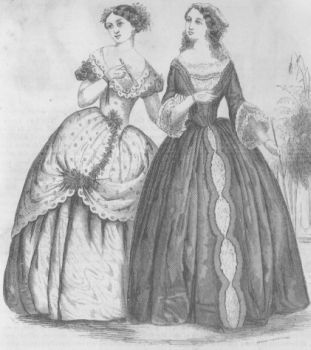
Fig. 1.—Ball and Dinner Costumes.
This is the commencement season for social parties and public amusements. We present seasonable illustrations of fashionable costumes for dinner parties, balls, and the opera. The first figure in the above engraving represents an elegant
Ball Dress.—Hair in short bandeaux, tied behind à la Grecque, with a wreath of bluebells; the flowers are small and arranged on a cord along the forehead; they increase in size and form tufts at the sides. The cord is continued behind and a second cord of flowers passes over the head, and blends with the flowers at the sides. The dress of white watered silk with a body and upper skirt of white silk net, festooned and embroidered in spots with silk. The spots are small. The opening of the body is heart-shape. The waist is pointed behind and before. The sleeves are silk net, puffed, and held up by a few bluebells. The body is trimmed with a double berthe, of silk net; a bouquet of bluebells is placed on the left, goes down from the waist en cordon, and forms another bouquet to hold up the left side of the skirt. On the right side it is held up by an isolated bouquet. This upper skirt is very full, and much longer behind than before. In the opening of the body and that formed by turning up the sleeves, a chemisette plaited very small, and edged with lace, is visible.
Dinner Toilet.—The second, or right hand figure, represents a graceful dinner toilet. Fanchonnette cap made of English lace, which is disposed in two rows. The upper one is about four inches wide sewed on silk net, which forms the middle, the joining being covered by a narrow band of terry velvet, No. 1. The bottom is composed of the same elements, exactly in the shape of a fanchon, straight in front, pointed behind, with small barbes at the side. Under the row that covers the top of the head are loops of silk ribbon. The sides are trimmed with more of the same kind, that hang down the cheeks. Plain silk dress. The body is low and opens down to the point. The skirt, in front, is open the whole length. The edges of the body, sleeves, and front of the skirt are undulated, and the undulations are trimmed with a silk ruché, the sides of which are the same stuff as the dress, while the middle is of a different-colored silk. The sleeves, turned up at the bend of the arm, show under-sleeves composed of three waves of lace; the body and under-skirt are muslin, embroidered so as to show the embroidery at the openings. The skirt has five graduated openings. The bottom edge of the body is composed of a deep lace, arranged square.
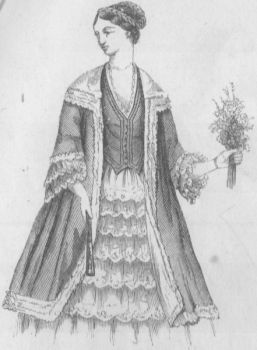
Fig. 2.—Opera Dress.
Opera Dress.—Costumes for the opera are diversified and quite fanciful. Our illustration exhibits one of the most elegant and admired. Hair in short puffed bandeaux. The knot behind is composed of two plaits, and a third is brought round on the top of the head in front. Waistcoat of watered silk, opening heart-shape in front, sitting well to the shape of the breast and waist, ending in an open point at bottom, and hollowed over the hip about an inch and a half. The back of the waistcoat is tight. It buttons straight down in front, the left side lapping over a little on the right, like a gentleman's waistcoat; it has one row of small buttons. The edge of the waistcoat has a narrow silk binding lapped over the edge, and all round run five rows of braid, one-tenth of an inch wide, at intervals of about one-fifth of an inch. Jaconet skirt, ornamented in front with six English bands one above the other; the first 3 inches long, the second 5, the third 6½, the fourth 8, the fifth 9½, and the sixth 12 inches. Each of these bands falls over the gathering of the other, the last covering the top of the flounce which runs round the skirt. The flounce is 16 inches deep, and the width of the bands, beginning with the top one is 2, 2¾, 3½, 4¼, 5, and 5¾ inches. The white sleeves which come below those of the soutanelle (cassock) have two rows of embroidery. The soutanelle is made of silk, and lined with a different color; it has a hood, the inside of which is like the lining; it forms a pelerine, and ends square in front. The soutanelle is cut without arm-holes; that is, the sleeve is taken out of the stuff and the seams of the body are taken in the cut under the arm. Sitting close on the shoulders and the upper part of the body, it forms round plaits from the waist. This fullness is owing to its being cut in a style like the paletot. The back is not tight. The edges of the hood, the soutanelle, and the sleeves are trimmed with three ruchés, very full, and indented like a saw. The one in the middle is the same color as the lining, the two others like the outside.
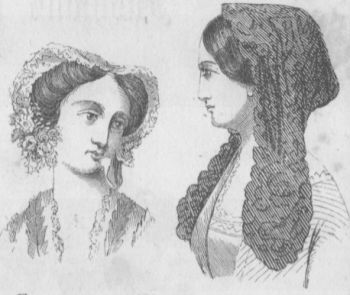
Figs. 3 and 4.—Head-Dresses and Caps.
Head Toilet.—Much attention continues to be bestowed upon caps and other arrangements for the head. Figure 3 represents one of the newest styles, called the chambord head-dress. The hair forms a point over the forehead: a very small cap à la Marie Stuart, formed of several small quillings of white silk net, set close together, with a bouquet of flowers upon one side and a small bow of ribbon upon the other. Figure 4 represents a simple cap of black lace, with broad appendages of the same, instead of ribbons, on each side, and covering the ears. This is a neat head toilet for the morning costume of matrons. Head-dresses for the young are principally composed of the same flowers as those which decorate the dress, and are formed so as to suit the countenance of the wearer, either as a cordon around the head, from which droop long sprays of twining herbs, or bouquets of flowers, placed very far back, and tied with bows of black ribbon or velvet, with long ends.
The rage for lace is undiminished. It is adapted to so many purposes—vails, falls, flounces, shawl-berthes, collars, ruffles, habit-shirts, &c., that every variety of costume has lace as an important material in trimming. It forms a part of the head-dress, accompanies the gown, surrounds the waist, falls from the shoulders; light as feathers, rich as velvet, it is at once an article of luxury and ornament—a garment and a jewel.
Embroidery, following the example of lace, is coming more and more into favor; sleeves, collars, petticoats, and handkerchiefs are literally loaded with it, abroad; even stockings are beginning to participate in this kind of luxury.
There is no essential change in the make of dresses. Sleeves à la Duchesse are beginning to be more fashionable than the pagoda sleeves. The waistcoat is still greatly admired, and is more seasonable now than in midsummer.
A new style of mantelet has appeared, called the Valdivia. It is a light gray cloth, lined with blue sarcenet. It is made without seams, very full, falling very low behind, where it is rounded in the form of the half circle. The two lappets before are also very long and wide, rounded like the back. No sleeves; the place for the hand is indicated by the sloped part. Another, called the Espera mantelet, is of black watered silk, trimmed with a wide velvet, and bordered by a chenille fringe. It fits to the waist and falls as low as the calf behind. The fronts fall straight and square, a little lower than behind.
The Bloomer costume has appeared in England and Ireland, and attracted attention and approbation. Although comparatively few in this country have yet adopted it to its full extent (or, rather, curtailment), the agitation of the question has been of essential benefit in modifying the long and untidy skirts. They are now made some inches shorter than they were six months ago.