CONCERNING THE ECLIPSES IN THE MONTH OF JULY, 1851.
Reading edition
BY CHARLES COLBY.
IN the month of July, 1851, there will occur two eclipses; one of the moon and one of the sun.
The former will occur after midnight, Sunday morning, July 13th; and the latter on the morning of Monday, July 28th.
Unless clouds prevent, both will be visible throughout the United States; and if visible will (the solar eclipse especially) attract general observation.

As here represented, there are formed complete shadows, called umbras; and partial shadows, called penumbras.
When an eclipse of the sun occurs, it appears totally eclipsed to those persons who are within the moon's umbra, and partially eclipsed, to those situated within the penumbra.
When an eclipse of the moon occurs, it appears totally eclipsed, if entirely within the earth's umbra, and partially eclipsed, if partially within it.
The length of the moon's umbra is usually greater than the distance of the moon from the earth.

The moon, therefore, crosses the sun's path twice in each revolution.
If, at new moon, it always crossed exactly in that part where the sun is, there would evidently be an eclipse of the sun; and it would recross in the opposite part and pass through the earth's umbra.
But the moon does not always cross the ecliptic where the sun is, nor uniformly in the same part.
Its crossing-place is different at each succeeding revolution.

Since the limits of this article will not allow an extended explanation of the manner of mathematically predicting eclipses, we will apply the foregoing statements in showing that there will occur an eclipse of the sun in July, 1851.
The first diagram on page 240 represents the relative positions of the sun and moon at the time of new moon in June, July, and August, 1851, calculated for Greenwich.
It is probable that there will be but few among the millions who may thus behold these wonderful phenomena who will not understand their causes.
However, an article explaining the manner of predicting these eclipses with diagrams illustrating the path of the moon's shadow in the solar eclipse across the United States and upon the whole earth, may not be acceptable.
Since the earth and moon are solid opaque bodies, they intercept the light passing from the sun through the heavens; or, in other words, they cause the existence of shadows.
Hence, if the moon, in its revolution pass directly between the sun and the earth its umbra will fall upon the earth, and cause a total eclipse of the sun.
If the moon passed through the heavens in exactly the same path as the sun, there would result eclipses of both sun and moon at each revolution; for it would pass directly over the disc of the sun, and through the centre of the earth's umbra.
But it was long since discovered that the path of the moon is inclined to the sun's path, or the ecliptic, about 5° (5° 8' 48").
This results from the fact that these crossing-places (which for convenience and according to astronomical usage we shall call the nodes), are in motion upon the ecliptic, from east to west.
Therefore, the moon may cross the ecliptic at such a distance from the sun, that when it passes between the sun and the earth, it will appear to pass above or below the disc of the sun; also, in the opposite part of its orbit, it may cross at so great distance from the earth's umbra, that it will pass above or below the umbra, as represented in the following diagram.
In June, the moon is seen below the sun, passing upward to the ascending node, and beyond the limits within which eclipses can occur.
While the moon is completing another revolution around the earth, the sun continues to move eastward, and when it again comes to A the sun is near B. The moon, moving much faster than the sun, passes upward in its orbit, and is in conjunction with the sun at B, within the limits of eclipses.
At this time the moon's umbra will fall upon the earth, and cause an eclipse, which will be total at all places over which the umbra will move; and partial at those places over which the penumbra will move.
In this, as in all solar eclipses, only a part of the earth is covered by the shadows.
Limits within which Eclipses of the Sun can occur.
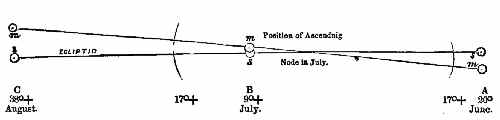
In August, at new moon, the sun has passed eastward to C, and the moon is seen above the sun, beyond the limit of eclipses.
The following engraving is a projection of the shadows of the moon upon the earth, exhibiting that portion where a total eclipse will be visible; and those portions where a partial eclipse will be visible.
West. East.
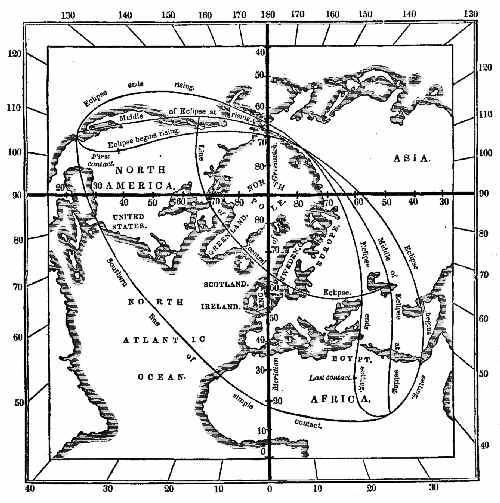
As shown in the first cut, the shadows of the moon are of a conical form, and, if the total eclipse existed but an instant, its projection upon the earth would be of a circular form.
But, since the earth revolves upon its axis, different parts are brought into the shadows; and this chart, to represent all that portion of the earth where any eclipse will be visible, has an oblong form.
Also, since the sun appears to rise in one portion of the earth at the same instant when in another portion of the earth it appears to set, this projection exhibits those parts of the earth where the eclipse commences at the instant of sunrise and sunset.
The next engraving is an enlarged representation of a part of the preceding; embracing a large portion of the United States, where a partial eclipse will be visible.
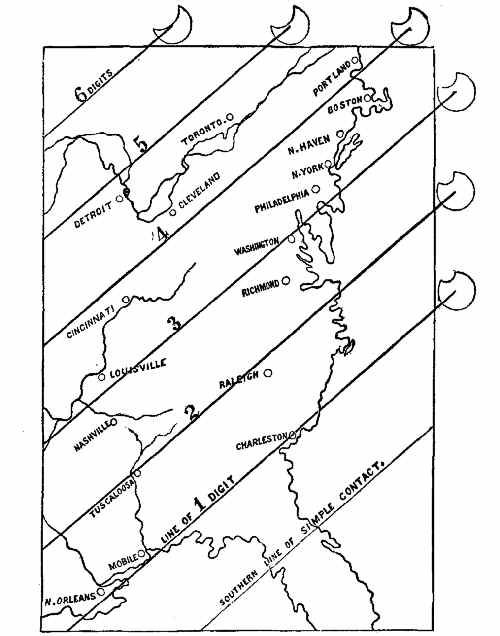
As exhibited in both charts, the southern line of simple contact of the disks of the sun and moon, passes through Florida.
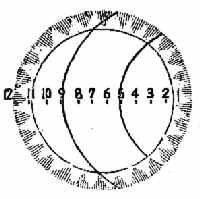
To express the extent of a partial eclipse of either sun or moon, the diameters of each are divided into twelve equal parts, called digits; and the extent of an eclipse at any place upon the earth is said to be a certain number of these digits.