BORED WELLS IN EASTERN MISSISSIPPI.
Reading edition
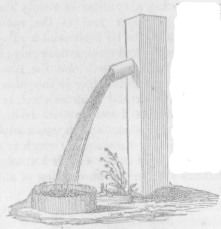
Who would not prefer something like this, to the "sweep and pole," however delightful the "old oaken bucket may seem as a reminiscence?" That the running fountain, "hard by the homestead gate" is attainable, has been demonstrated, of late years, in numerous instances; necessity called, science demonstrated, and experiment has proved. The Artesian well, in many localities, is but the work of a few days or a week. The implements required are simple and cheap, the supply of water afforded copious and continuous, conducing to health and comfort.
They are described as "those which are made by boring into the earth till the instrument reaches water, which spontaneously, from internal pressure, flows like a fountain." Not to quarrel with this definition, let us look at the instrument and its appurtenances, and also the processes or application, which cause the water to flow.

The Instrument.—Split the barrel of a common goose-quill, lengthwise, into equal parts, and we have in either half something that closely resembles in shape the auger; the lower end looking like the old "pod," in use formerly by house builders. One side, the cutting side or edge, of the said lower end being an adjustable steel "bit," readily removed for sharpening, hardening, and the like; its entire length is about eight feet; its diameter (or half diameter) is three and a half or four inches; its upper end terminating in a shank, with a screw-thread, cut perhaps two inches.
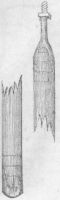
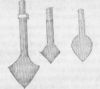
The Appurtenances are Wooden Rods or poles, Iron Rods, Pump, Picks, Windlass, Shears, Pulley-blocks, Yokes, or couters, &c. The first of these, the wooden rods or poles, are made of cypress or yellow-pine, twenty-five feet long, two and a half to three inches in diameter, planed round and smooth, armed at each end with iron, the upper a screw-shank, the lower a screw-socket. For convenience, there should be, belonging to the set, poles of half and quarter length, also an iron rod or two, of full or half length; these last being required after some depth is attained, to prevent the wooden ones from floating or being pushed up, as the water fills the bore. The Pump is constructed of sheet-iron or copper, being a cylinder of nearly the size of the auger, and of the same length, having in its lower end a valve playing freely, and closing tight enough to retain borings, sand, and the like; the upper end terminating as the poles; The valve is usually made of steel, being a band riveted into its place having its lower edge sharp, and its upper edge square, seating the clapper, which is a disk of wrought iron.This is a strong, effective tool in the prosecution of the work. The Picks or Drills are pointed with steel, and take such shapes as shall best forward the boring through a strata which the auger will not cut. The Windlass, Shears, Pulley-blocks, etc., constitute the apparatus for lowering and raising the auger, pump, or picks, as needed. The poles forming the shank of the auger, are elongated by screwing one upon another, as it descends into the earth.

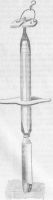
The Process, or Application.—The Shears and Windlass being erected, a short pole is suspended in the couter (A); a movable handle affixed to the pole at a convenient height from the ground, a short auger screwed into the lower end of the pole, which is then lowered till the point of the auger rests upon the ground, at the precise point where the prospective fountain is to flow. One man attends to the windlass, and one labors at the handle of the auger, walking round, with the sun, and after marking the spot by an insertion of six inches, pours in, if the nature of the soil requires, a bucket of water to render the borings adhesive, so that they will turn with the auger and come up in it when it is withdrawn. The first few feet is usually done with an extra-sized auger, or the smaller hole reamed out to a size sufficiently large to insert a bored log (like a pump-log), the calibre of which will admit the passage of the common auger, and other instruments used in boring the well; this log is forced down by driving till its lower end is secure in the rock, or such strata as will not crumble or cave. As the auger becomes full, it is withdrawn, cleaned, and again inserted. After such depth is reached, that the water lying upon the first impermeable strata flows into the bore, the auger will not always bring up its "chips," the pump is then put down alternately with the auger, and by being forced to the bottom of the bore brings out the residuum. As the hole deepens, other poles are added; the joints being thus rendered necessary, another of the uses of the hollow log becomes apparent. Two iron spikes projecting from its squared end, serve to keep the "yoke," or couter, from turning round; and the shank, below the screw and nut, of the sunken pole, being square and fitting the slot in the yoke, the whole is retained stationary, while the succeeding pole is screwed on, in descending, or unscrewed in ascending, so that in "putting down" or in "taking out" there is a pause at every joint, a pole added, or set aside, and a new hold taken by the yoke (of which there are necessarily two).
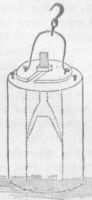
In this manner pole after pole is added, until the auger or drill is forced through some strata which confines, or holds down the fluid, and a fountain of "Adam's ale" is opened, which flows on and on, neither diminished by the droughts of summer nor swollen by the rains of winter. These delightful wells are becoming common in the eastern parts of this State, as also in our sister State, Alabama. Without doubt, the same thing may be done advantageously in many parts of the United States, hitherto badly supplied with water, either for useful or ornamental purposes.
The borings in this region vary from 180 to 580 feet, but generally the greater depth is attainable with proportionally less labor and expense, being unattended with some of the difficulties which are incident to those of less depth, such as quicksands, gravel, rotten limestone, and the like. The methods of overcoming some of these difficulties are next, and last, in order.
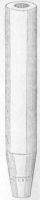
In some places, the soil or earth covering the first layer of rock is of such a character that it is next to impossible to sink the log through to the rock; still, patient contriving will do much in obviating this; for instance, after going as deep as the gravel or quicksand in which the first vein of water is found, will permit, and reaming out the hole, the log is inserted, having its lower end sharpened, and defended by a tapering iron band well secured. This may be driven down without much trouble through the bed of quicksand, and a passage is thus secured to the rock. It is sometimes necessary to insert the pump into, and through the log, and by agitating and withdrawing a portion of the obstructing mass, to cause the log to settle to its place. In some instances the distance to the rock, or consistent strata is so great, that the log requires "piecing." This is done neatly and effectively by banding the top of the sunken log, enlarging with a tapering instrument the mouth of the bore, and fitting another piece with a taper and shoulder.
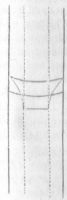
Again, at the depth of some two or three hundred feet, a vein of rotten soap-stone, or limestone will crumble and cave into the opening, and though by continual pumping and boring it is sometimes mastered, yet the only certain remedy seems to be the reaming from the top of the well (including the logs) with a larger instrument, down to the cave, and perhaps a little past it—so that a shoulder will be left at the place where the reamer ceases cutting. A sheet iron tube is then forced down, of such a length, that its lower end rests upon this shoulder, and the upper extends up past the defect, to the solid walls above; the calibre of this tube being such as to admit freely the tools when the boring is resumed. Should a second defect of this kind occur, another tube can be inserted of the same size (outwardly) as the well, but after it is placed, the auger and other implements must, of course, be diminished till they will pass through the smaller cylinder.
At times a layer of flint rock obstructs the downward progress. This, fortunately, is thin, and although but a few inches in a day can be drilled, yet the operator works with cheerfulness, for he expects that this is but the lid of the great strong box which holds the sought-for treasure.
Well-boring has become a regular business here with many ingenious and persevering men, and they each resort to many contrivances to obviate the various difficulties which occur; differing from each other, as individual experience, or the special occasion may seem to demand.
Those who bore deep wells usually train a horse to work the windlass, or, in that case, capstan; and it is truly interesting to observe with what precision this effective assistant per forms his work at the words of execution, "Walk! Trot! Slow! Whoa! Turn! Back!" &c., &c.
Knowing that in some parts of our country, thousands have been thrown away in fruitless attempts to find water convenient for man and beast, and thinking possibly some description of the way we manage this matter here, would be acceptable, "I have written what I have written."
N.E.G.
Columbus, Miss., July 4th, 1851.