Volume 2 — LI.
Reading edition
Saladin. Bravo, Ibrahim! you are indeed the messenger of good fortune; I thank you for your joyful tidings.
The Mameluke. Well, is that all?
Saladin. What did you expect?
The Mameluke. Nothing more for the messenger of good fortune.
Lessing: Nathan the Wise.
PALE and worn, Count d’Ahlefeld strode up and down his apartment; in his hand he crushed a bundle of letters which he had just read, while he stamped his foot on the smooth marble floor and the gold-fringed rugs.
At the other end of the room, in an attitude of deep respect, stood Nychol Orugix in his infamous scarlet dress, felt hat in hand.
“You have done me good service, Musdœmon,” hissed the chancellor.
The hangman looked up timidly: “Is your Grace pleased?”
“What do you want here?” said the chancellor, turning upon him suddenly.
The hangman, proud that he had won a glance from the chancellor, smiled hopefully.
“What do I want, your Grace? The post of executioner at Copenhagen, if your Grace will deign to bestow so great a favor on me in return for the good news I have brought you.”
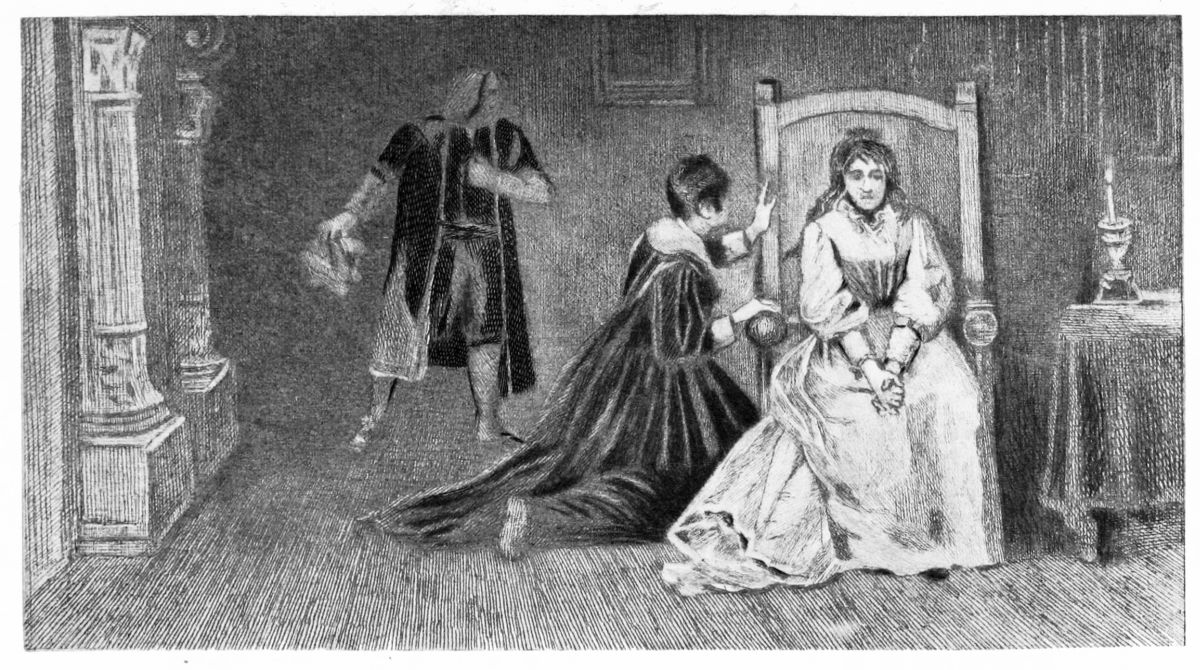
“The poor mother was insane.”
Photo-Etching.—From drawing by Démarest.
The chancellor called to the two halberdiers on guard at his door: “Seize this rascal; he annoys me by his impudence.”
The guards led away the amazed and confounded Nychol, who ventured one word more: “My lord—”
“You are no longer hangman for the province of Throndhjem; I deprive you of your office!” cried the chancellor, slamming the door.
The chancellor returned to his letters, angrily read and re-read them, maddened by his dishonor; for these were the letters which once passed between the countess and Musdœmon. This was Elphega’s handwriting. He found that Ulrica was not his daughter; that, it might be, the Frederic whom he mourned was not his son. The unhappy count was punished through that same pride which had caused all his crimes. He cared not now if vengeance evaded him; all his ambitious dreams vanished,—his past was blasted, his future dead. He had striven to destroy his enemies; he had only succeeded in losing his own reputation, his adviser, and even his marital and paternal rights.
But he must see once more the wretched woman who had betrayed him. He hastily crossed the spacious apartment, shaking the letters in his hand as if they were a thunderbolt. He threw open the door of Elphega’s room; he entered—
The guilty wife had just unexpectedly learned from Colonel Vœthaün of her son Frederic’s fearful death. The poor mother was insane.