Volume 2 — XLVIII.
Reading edition
Keep me, O Lord, from the hands of the wicked, Preserve me from the violent man; Who have purposed to thrust aside my step. The proud have hid a snare for me, and cords; They have spread a net by the wayside; They have set gins for me. Psalms cxl. 4.
THE fatal hour had come; the sun showed but half his disk above the horizon. The guards were doubled throughout Munkholm castle; before each door paced fierce, silent sentinels. The noises of the town seemed louder and more confused than usual as they ascended to the dark towers of the fortress, itself a prey to strange excitement. The mournful sound of muffled drums was heard in every courtyard; now and again cannon growled; the heavy bell in the donjon tolled slowly, with sullen, measured strokes; and from every direction boats loaded with people hastened toward the fearful rock.
A scaffold hung with black, around which an impatient mob swarmed in ever-increasing numbers, rose from the castle parade-ground in the centre of a hollow square of troops. Upon the scaffold a man clad in red serge walked up and down, now leaning upon the axe in his hand, and now fingering a billet and block upon the funeral platform. Close at hand a stake was prepared, before which several pitch torches burned. Between the scaffold and the stake was planted a post, from which hung the inscription: “ORDENER GULDENLEW, TRAITOR.” A black flag floated from the top of the Schleswig tower.
At this moment Ordener appeared before the judges, still assembled in the court-room. The bishop alone was absent; his office as counsel for the defence had ended.
The son of the viceroy was dressed in black, and wore upon his neck the collar of the Dannebrog. His face was pale but proud. He was alone; for he had been led forth to torture before Chaplain Athanasius Munder returned to his cell.
Ordener’s sacrifice was already inwardly accomplished. And yet Ethel’s husband still clung to life, and might perhaps have chosen another night than that of the tomb for his wedding night. He had prayed and dreamed many dreams in his dreary cell. Now he was beyond all prayers and all dreams. He was strong in the strength imparted by religion and by love.
The crowd, more deeply moved than the prisoner, eagerly gazed at him. His illustrious rank, his horrible fate, awakened universal envy and pity. Every spectator watched his punishment, without comprehending his crime. In every human heart lurks a strange feeling which urges its owner to behold the tortures of others as well as their pleasures. Men seek with awful avidity to read destruction upon the distorted features of one who is about to die, as if some revelation from heaven or from hell must appear at that awful moment in the poor wretch’s eyes; as if they would learn what sort of shadow is cast by the death angel’s wing as he hovers over a human head; as if they would search and know what is left to a man when hope is gone. That being, full of health and strength, moving, breathing, living, and which in another instant must cease to move, breathe, and live, surrounded by beings like himself, whom he never harmed, all of whom pity him, and none of whom can help him; that wretched being, dying, though not dead, bending alike beneath an earthly power and an invisible might; this life, which society could not give, but which it takes with all the pomp and ceremony of legal murder,—profoundly stir the popular imagination. Condemned, as all of us are, to death, with an indefinite reprieve, the unfortunate man who knows the exact hour when his reprieve expires is an object of strange and painful curiosity.
The reader may remember that before he mounted the scaffold, Ordener was to be taken before the court, there to be stripped of his titles and honors. Hardly had the stir excited in the assembly by his arrival given place to quiet, when the president ordered the book of heraldry of both kingdoms, and the statutes of the order of the Dannebrog, to be brought.
Then directing the prisoner to kneel upon one knee, he commanded the spectators to pay respectful heed, opened the book of the knights of the Dannebrog, and began to read in a loud, stern voice: “We, Christian, by the grace and mercy of Almighty God, king of Denmark and Norway, of Goths and Vandals, Duke of Schleswig, Holstein, Stormaria, and Dytmarsen, Count of Oldenburg and Delmenhurst, do declare:—
“That having re-established, at the suggestion of the lord chancellor, Count Griffenfeld [the president passed over this name so rapidly that it was scarcely audible], the royal order of the Dannebrog, founded by our illustrious ancestor, Saint Waldemar,
“Whereas we hold that inasmuch as the said venerable order was created in memory of the flag Dannebrog sent down from heaven to our blessed kingdom,
“It would belie the divine origin of the order should any knight forfeit his honor, or break the holy laws of Church and State with impunity,
“We therefore decree, kneeling before God, that whosoever of the knights of the order shall deliver his soul to the demon by any felony or treason, after a public reprimand from the court, shall be forever degraded from his rank as a knight of this our royal order of the Dannebrog.”
The president closed the book. “Ordener Guldenlew, Baron Thorwick, Knight of the Dannebrog, you have been found guilty of high treason, for which crime your head shall be cut off, your body burned, and your ashes flung to the winds. Ordener Guldenlew, traitor, you have shown yourself unworthy to hold rank with the knights of the Dannebrog. I request you to humble yourself, for I am about to degrade you publicly in the name of the king.”
The president stretched his hand over the book of the
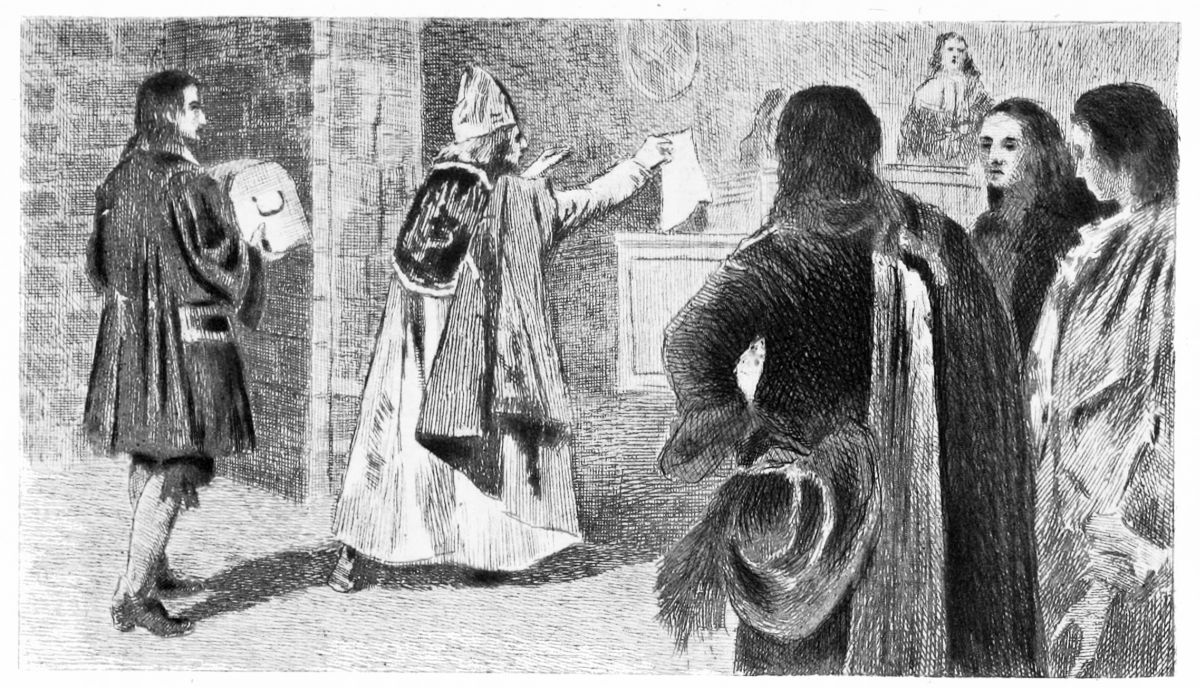
“Forbear,” said the Bishop.
Photo-Etching.—From drawing by Démarest.
order and prepared to pronounce the fatal formula against Ordener, who remained calm and motionless, when a side door opened to the right of the bench.
An officer of the Church entered and announced his reverence, the bishop of Throndhjem. He entered hurriedly, accompanied by another ecclesiastic, on whose arm he leaned.
“Stop, Mr. President!” he exclaimed with a strength of which a man of his age seemed hardly capable. “Stop! Heaven be praised! I am in time.”
The audience listened with renewed interest, foreseeing some fresh development. The president turned angrily to the bishop: “Allow me to inform your reverence that your presence here is wholly unnecessary. The court is about to degrade from his rank the prisoner, who will suffer the penalty of his crime directly.”
“Forbear,” said the bishop, “to lay hands on one who is pure in the sight of God. The prisoner is innocent.”
The cry of astonishment which burst from the spectators was only matched by the cry of terror uttered by the president and private secretary.
“Yes, tremble, judges!” resumed the bishop, before the president could recover his usual presence of mind; “tremble! for you are about to shed innocent blood.”
As the president’s agitation died away, Ordener arose in consternation. The noble youth feared lest his generous ruse had been discovered, and proofs of Schumacker’s guilt had been found.
“Bishop,” said the president, “in this affair crime seems to evade us, being transferred from one to another. Do not trust to any mere appearance. If Ordener Guldenlew be innocent, who, then, is guilty?”
“Your grace shall know,” replied the bishop. Then showing the court an iron casket which a servant had brought in behind him: “Noble lords, you have judged in darkness; within this casket is the miraculous light which shall dissipate that darkness.”
The president, private secretary, and Ordener, all seemed amazed at the sight of the mysterious casket.
The bishop added: “Noble judges, hear me. To-day, as I returned to my palace, to rest from the fatigues of the night and to pray for the prisoners, I received this sealed iron box. The keeper of the Spladgest, I was told, brought it to the palace this morning to be given to me, declaring that it undoubtedly contained some Satanic charm, as he had found it on the body of the sacrilegious Benignus Spiagudry, which had just been fished out of Lake Sparbo.”
Ordener listened more eagerly than ever. All the spectators were as still as death. The president and private secretary hung their heads guiltily. They seemed to have lost all their cunning and audacity. There is a moment in the life of every sinner when his power vanishes.
“After blessing this casket,” continued the bishop, “we broke the seal, which, as you can still see, bears the ancient and now extinct arms of Griffenfeld. We did indeed find a devilish secret within. You shall judge for yourselves, venerable sirs. Lend me your most earnest attention, for human blood is at stake, and the Lord will hold you accountable for every drop that you may shed.”
Then opening the terrible casket, he drew forth a slip of parchment, upon which was written the following testimony:—
I, Blaxtham Cumbysulsum, doctor, being about to die, do declare that of my own free will and pleasure I have placed in the hands of Captain Dispolsen, the agent, at Copenhagen, of the former Count Griffenfeld, the enclosed document, drawn up wholly by the hand of Turiaf Musdœmon, servant of the chancellor, Count d’Ahlefeld, to the end that the said captain may make such use of it as shall seem to him best; and I pray God to pardon my crimes.
Given under my hand and seal at Copenhagen, this eleventh day of January, 1699.
Cumbysulsum.
The private secretary shook like a leaf. He tried to speak, but could not. The bishop handed the parchment to the pale and agitated president.
“What do I see?” exclaimed the latter, as he unfolded the parchment. “A note to the noble Count d’Ahlefeld, upon the means of legally ridding himself of Schumacker! I—I swear, reverend Bishop—”
The paper dropped from his trembling fingers.
“Read it, read it, sir,” said the bishop. “I doubt not that your unworthy servant has abused your name as he has that of the unfortunate Schumacker. Only see the result of your uncharitable aversion to your fallen predecessor. One of your followers has plotted his ruin in your name, doubtless hoping to make a merit of it to your Grace.”
These words revived the president, as showing him that the suspicions of the bishop, who was acquainted with the entire contents of the casket, had not fallen upon him. Ordener also breathed more freely. He began to see that the innocence of Ethel’s father might be made manifest at the same time with his own. He felt a deep surprise at the singular fate which had led him to pursue a fearful brigand to recover this casket, which his old guide, Benignus Spiagudry, bore about him all the time; that it was actually following him while he was seeking for it. He also reflected on the solemn lesson of the events which, after ruining him by means of this same fatal casket, now proved the instrument of his salvation.
The president, recovering himself, read with much show of indignation, in which the entire audience shared, a lengthy memorandum, in which Musdœmon set forth all the details of the abominable scheme which we have seen him execute in the course of this story. Several times the private secretary attempted to rise and defend himself, but each time he was frowned down. At last the odious reading came to an end amid a murmur of universal horror.
“Halberdiers, seize that man!” said the president, pointing to the private secretary.
The wretch, speechless and almost lifeless, stepped from his place, and was cast into the criminal dock, followed by the hoots of the populace.
“Judges,” said the bishop, “shudder and rejoice. The truth, which has just been brought home to your consciences, will now be even more strongly confirmed by the testimony of our honored brother, Athanasius Munder, chaplain to the prisons of this royal town.”
It was indeed Athanasius Munder who accompanied the bishop. He bowed to his superior in the Church and to the court, then at a sign from the president, proceeded as follows: “What I am about to state is the truth. May Heaven punish me if I utter a word with any other object than to do my duty! From what I saw this morning in the cell of the viceroy’s son, I was led to think that the young man was not guilty, although your lordships had condemned him upon his own confession. Now, I was called, a few hours since, to give the last spiritual consolations to the unfortunate mountaineer so cruelly murdered before your very eyes, and whom you condemned, worthy sirs, as being Hans of Iceland. The dying man said to me: ‘I am not Hans of Iceland; I am justly punished for having assumed his name. I was paid to play the part by the chancellor’s private secretary; he is called Musdœmon; and it was he who managed the whole revolt under the name of Hacket! I believe him to be the only guilty man in this whole matter.’ Then he asked me to give him my blessing, and advised me to make haste and repeat his last words to the court. God is my witness. May I save the shedding of innocent blood, and not cause that of the guilty to flow!”
He ceased, again bowing to his bishop and the judges.
“Your Grace sees,” said the bishop to the president, “that one of my clients was not mistaken when he found so much resemblance between Hacket and your private secretary.”
“Turiaf Musdœmon,” said the president to the prisoner, “what have you to say in your defence?”
Musdœmon looked at his master with an expression which alarmed him. He had recovered his usual impudence, and after a brief pause, answered: “Nothing, sir.”
The president resumed in a weak and faltering voice: “Then you acknowledge yourself guilty of the crime with which you are charged? You confess yourself to be the author of a conspiracy alike against the State and against one John Schumacker?”
“I do, my lord,” replied Musdœmon.
The bishop rose. “Mr. President, that there may be no shadow of doubt in this affair, will your grace ask the prisoner if he had any accomplices?”
“Accomplices?” repeated Musdœmon.
He hesitated a moment. The president wore a look of awful anxiety.
“No, my lord Bishop,” he said at last.
The president’s look of relief fell full upon him.
“No, I had no accomplices,” repeated Musdœmon, still more emphatically. “I concocted this plot through affection for my master, who knew nothing of it, to destroy his enemy, Schumacker.”
The eyes of prisoner and president met once more.
“Your Grace,” said the bishop, “must see that as Musdœmon had no accomplices, Baron Ordener Guldenlew must be innocent.”
“Then why, worthy Bishop, did he confess his guilt?”
“Mr. President, why did that mountaineer persist that he was Hans of Iceland at the risk of his life? God alone knows our secret motives.”
Ordener took up the word: “Judges, I can tell you my motive, now that the real criminal has been discovered. I accused myself falsely to save the former chancellor, Schumacker, whose death would have left his daughter without a protector.”
The president bit his lip.
“We request the court,” said the bishop, “to proclaim the innocence of our client, Ordener Guldenlew.”
The president responded with a nod; and at the request of the lord mayor, they finished their examination of the terrible casket, which contained nothing more except Schumacker’s titles of nobility, and a few letters from the Munkholm prisoner to Captain Dispolsen,—bitter, but not criminal letters, which alarmed no one but Chancellor d’Ahlefeld.
The court then withdrew; and after a brief deliberation, while the curious crowd, gathered on the parade, waited with stubborn impatience to see the viceroy’s son led forth to die, and the executioner nonchalantly paced the scaffold, the president pronounced in a scarcely audible voice the death sentence of Turiaf Musdœmon, the acquittal of Ordener Guldenlew, and the restoration of all his honors, titles, and privileges.