HIS LIFE (continued 2)
A. Eaglefield (Arthur Eaglefield) Hull translation
Once again Handel returned to Italian Opera. The public hatred pursued him here also. The royal family of Hanover was detested. It added to its own discredit by the scandalous disputes which took place between the King and his son. The Prince of Wales, in a spirit of petty spite against his father, who showed his affection for Handel, amused himself by attempting to ruin the composer. Encouraged by the opposition, and enchanted by the idea of making sport against the King, he founded a rival opera house, and as he could no longer set Bononcini up against Handel, as the former had been discredited by a case of flagrant plagiarism, which had an European circulation,[215] he approached Porpora, with a view to directing his theatre. “Then,” says Lord Hervey, “the struggle became as serious as that of the Greens against the Blues at Constantinople under Justinian. An anti-Handelian was regarded as an anti-Royalist, and in Parliament, to vote against the Court was hardly more dangerous than to speak against Handel.” On the other hand, the immense unpopularity of the King redounded on Handel, and the aristocracy combined to secure his downfall.
He accepted the challenge, and after a third tour in Italy during the summer of 1733, again to recruit more singers, he bravely took up the fight with Porpora, to whom was added Hasse in 1734. They were the greatest rivals against which he had yet measured himself. But Hasse and Porpora had strong dramatic feeling, and especially were they the most perfect masters of the beautiful art of Italian melody and singing.[216] Nicolo Porpora, who came from Naples, was forty-seven years old. He had a cold but vigorous spirit, intelligent and possessing more than anyone else, except Hasse, all the resources of the Italian singing. His style was very beautiful, and it was not less broad than that of Handel. No other Italian musician of his time had such ample breadth of phrasing.[217] His writings seem of a later age than Handel’s, and approximate to the time of Gluck and Mozart. Whilst Handel, despite his marvellous feeling for plastic beauty, often treated the voices as an instrument, and in his development the beautiful Italian lines occasionally became weighed down by German complexity, Porpora’s music always kept within the bounds of classic purity, though the form was a little uninteresting in design. History has never done him sufficient justice.[218] He was quite worthy of measuring himself against Handel, and the comparison between Handel’s Arianna and that of Porpora, played at an interval of a few weeks,[219] did not prove to the advantage of the former. Handel’s music is elegant, but one does not find the breadth of certain airs in Porpora’s Arianna à Naxos. The form of these airs is perhaps of too classic a correctness, but the right Grecian breezes blow across his Roman temples.[220] He has been claimed as an Italian disciple of Gluck—a curious criticism which is bestowed occasionally on precursors. It was so with Jacopo della Quercia, who inspired Michael Angelo, and to whom the latter seems to owe something.
Hasse was even superior to Porpora in the charm of his melody, which Mozart alone has equalled, and in his symphonic gifts, which showed themselves in his rich instrumental accompaniments no less melodious than his songs.[221] Handel was not slow to discover the folly of striving with Hasse on Italian ground. His superiority was with the choruses; he sought to introduce them into the Opera after the French model. The situation was even less promising for him on the departure of his best protectrix, the Princess Anne, sister of the Prince of Wales.[222] After having compromised Handel by the strong feeling which she had shown in defending him, she left him to the tender cares of the enemies which she had made for him. She left England in April, 1734, to join her husband the Prince of Orange[223] in Holland.
Handel came to be abandoned by his old friends. His associate, Heidegger, the proprietor of the Haymarket Theatre, took the hall for a rival opera, and Handel, driven from the house in which he had worked for fourteen years, had to emigrate with his troupe to John Rich’s place at Covent Garden[224]—a sort of music-hall where Opera took its turn with all kinds of other spectacles: ballets, pantomimes, and harlequinades. In Rich’s troupe some French dancers were to be found, amongst whom was “la Salle,”[225] who was shortly to arouse great enthusiasm amongst the English public with two tragic dances: Pygmalion and Bacchus and Ariadne.[226] Handel, who had known the French art[227] for a long time, saw how far he could draw on these new resources, and he opened the season of 1734 at Covent Garden with a first attempt in the field of the French ballet opera: Terpsichore (November 9, 1734), in which “la Salle” took the principal rôle. A month later a Pasticcio followed, Orestes, where Handel gave a similar important part to “la Salle,” and to her expressive dances. Finally, he intermingled the dance and the choruses closely with the dramatic action in two masterpieces of poetry and beautiful musical construction—Ariodante (January 8, 1735), and especially Alcina (April 16, 1735).
Bad luck still pursued him. Some gross national manifestations compelled “la Salle” and her French dancers to leave London.[228] Handel gave up the ballet opera. To leave at this moment, if he was to continue the struggle with the theatre, went badly against the grain, and was tantamount to declaring himself vanquished. At the opening of his theatrical enterprise he had saved, so it is said, £10,000. All this was absorbed, and already he was £10,000 more to the bad. His friends did not understand his obstinacy, which seemed about to involve him in complete ruin. “But,” says Hawkins, “he was a man of intrepid spirit, and in no ways a slave to mere interest. He raised himself again for the battle rather than bow down to those whom he regarded as infinitely beneath him.” If he could no longer be conqueror, still less would he hand the reins to his adversaries. He overcame them—but a little more would have vanquished himself in the same stroke.
He persisted then in writing his operas,[229] of which the series spread out until 1741, marking work after work with a growing tendency towards the opéra-comique and the style of romances[230] so dear to the people at the second half of the eighteenth century. But since 1735 he felt more than ever that the true musical drama for him was the oratorio. He returned victoriously with Alexander’s Feast, which was composed on the Ode to St. Cecilia, by Dryden,[231] and given for the first time on February 19, 1736, at the Covent Garden Theatre.
Who would have believed that this work, robust and sane throughout, was written in twenty days, that it was performed in the midst of his business worries, within an ace of ruin, and when he was threatened with that grave malady which was to throw the mind of Handel for evermore into gloom?
. . . . . . . . . . . . . . . . . . . . . . . . .
For several years trouble pursued him. Work and excessive worry had undermined an iron constitution. He tried the baths at Tunbridge Wells during the summer of 1735, and probably also in 1736, but with no success. He could not sleep. His theatre was always on his mind. He made superhuman efforts to keep it going. From January, 1736, to April, 1737, he directed two seasons of Opera, two seasons of oratorio, and composed a song, an oratorio, a Psalm, and four operas.[232] On April 12, or 13, 1737, the machine broke down. He was smitten with paralysis, his right side was attacked, his hand refused all service, and even his mind was affected. In his absence his theatre closed its doors, bankrupt.[233] During the whole of the summer Handel remained in a pitiful state of depression. He refused to care for anything; all hope was lost. Finally, his friends succeeded in inducing him, towards the end of August, to try the baths at Aix-la-Chapelle. The cure had a miraculous effect. In a few days he was restored. In October he returned to London, and immediately the refreshed giant resumed the struggle, writing in three months two operas, and the magnificent Funeral Anthem on the death of the Queen.[234]
Sad days were in store, however. His creditors seized him, and he was threatened with imprisonment. Happily a sympathetic movement was inaugurated in favour of the artist so harassed by his kind. A benefit concert, to which his pride reluctantly submitted,[235] at the end of March, 1738, had an unexpected success. It freed him from the most pressing of his debts. In the following month a token of public admiration was given him. His statue was erected in the Vauxhall Gardens.[236] In the springtime of 1738 he began to feel, with returning strength, confidence in the future. The horizon cleared. He was encouraged by such faithful sympathy. He returned to life, and made his presence felt again.
On July 23 he commenced Saul; on August 8 he had written two acts of it; by September 27 the work was finished. On October 7 he began Israel in Egypt; by October 28 the work was achieved. Still pushing strenuously forward, on October 4 he launched the first volume of his organ concertos with the publisher Walsh, and on the 7th he took to him his Seven Trios or Sonatas in two parts, with bass, Opus 5. For those who know these joyful works, which dominate like two Colossi the two oratorios of victory, this superhuman effort had the effect of a force of Nature, like a field which breaks into flower in a single night of springtime.
Saul is a great epic drama, flowing and powerful, where the humorous and the tragic intermingle. Israel is one immense chorale, the most gigantic effort which has ever been made in oratorio, not only with a single but with combined choirs.[237] The audacious originality of the conception and its austere grandeur almost stunned the public of his day. The living Handel breathes throughout the work.
The hopes which Handel had founded on England caused him fresh uneasiness. Times were hard. Since the winter of 1739, theatrical performances, and even concerts, were suspended for several months on account of the war, and the extreme cold. Handel, to keep himself warm, wrote in eight days the little Ode to St. Cecilia (November 29, 1739); in sixteen days L’Allegro, Il Penseroso, ed Il Moderato of Milton (January-February, 1740); in a month the Concerti Grossi, Opus 6.[238] But the success of these charming works, graven out with loving care, into which Handel had perhaps put more than into any other his own personal feelings, his poetic and humorous reproductions of nature,[239] was hardly sufficient yet to establish his affairs, at one time so embarrassed. Once more, as in the time of Deborah and Arianna, he was attacked by a coalition of fashionable people. One does not know how Handel had wounded them,[240] but they were resolved on his downfall. They avoided his concerts. They even paid men to pull down his placards in the streets. Handel, tired and disheartened, suddenly threw up the combat.[241] He decided to leave England, where he had lived for nearly thirty years, and where he had increased his fame so much. He announced his last concert for April 8, 1741.[242]
. . . . . . . . . . . . . . . . . . . . . . . . .
It is a remarkable thing that often in the lives of the great men, just at the moment when all seems lost, or things are at their lowest ebb, they are nearest to the fulfilment of their destiny. Handel appeared vanquished. Just at that very hour he wrote a work which was destined to establish permanently his immortality.
He left London.[243] The Lord-Lieutenant of Ireland invited him to Dublin to direct some concerts. Thus it was, so he said, “in order to offer this generous and polished nation something new” that he composed The Messiah on a poem by his friend Jennens.[244] They had already given many of his religious works in Dublin for charitable concerts.[245] Handel was received enthusiastically. The letter which he wrote on December 29 to Jennens bubbles over with joy. The time which he passed in Dublin was, together with his early years in Italy, the happiest in his life. From December 23, 1741, to April 7, 1742, he gave two series of six concerts, and always with the same success. Finally, on April 12, the first hearing of The Messiah took place in Dublin. The proceeds of the concert were devoted to charitable objects, and the success was very considerable.[246]
Eight days after having finished The Messiah (that is to say, before he had yet arrived in Ireland) Handel had commenced Samson, which was finished in five weeks, from the end of September to the end of October, 1741. However, he did not give it in Dublin. Doubtless he could not find the interpreters which he desired for this colossal drama, rich in choral scenes and in difficult rôles.[247] Perhaps also he reserved the work for the following season in Dublin, when he hoped to return, but the expected invitation which he awaited in London did not come, and it was in London that Samson reached its first hearing on February 18, 1743.
To this heroic oratorio, based on the sublime Samson Agonistes of Milton,[248] succeeded a light opera, which bore, nevertheless, the name of oratorio, the libretto of which was based on a poem by Congreve: Semele (June 3 to July 4, 1743). It afforded a relief for him between these two Herculean works. In the same month in which he finished Semele, Handel wrote his monumental Dettingen Te Deum, to celebrate the victory of the Duke of Cumberland over the French.[249] Joseph, written in August and September of the same year, on a very touching poem by James Miller, reveals a sweet yet melancholy fancy, a little insipid, on which, however, the strong portrait of Simeon projects itself forcibly.
1744 was one of Handel’s most glorious years from the creative point of view, but one of the most miserable in outward success. He wrote nearly simultaneously his two most tragic oratorios, the great Shakespearian drama of Belshazzar (July-October, 1744), the rich poem of which was furnished for him by his friend Jennens;[250] and the sublime tragedy of the ancient Hercules, a musical drama,[251] which marks the culmination of the Handelian musical drama, and indeed one might say of the whole musical theatre before Gluck.
Never was the hostility of the English public more roused against him. The same hateful cabal which had already thrice threatened to bring about his downfall again rose against him. They invited the fashionable world in London to their fêtes, specially organised on the days when the performances of his oratorios were to have taken place, with the object of robbing him of his audience. Bolingbroke and Smollett both speak of the plots of certain ladies to ruin Handel. Horace Walpole says that it was the fashion to go to the Italian Opera when Handel directed his oratorio concerts. Handel, whose force of energy and genius had weakened since his first failure of 1735, was involved afresh in bankruptcy at the beginning of 1745. His griefs and troubles, and the prodigious expenditure of force which he made, seemed again on the point of turning his brain. He fell into extreme bodily prostration and lowness of spirit, similar to that of 1737, and this lasted for the space of eight months, from March to October, 1745.[252] By a miracle he was able to rise out of this abyss, and by unforeseen events, where music was his only aid, he became more popular than he ever was before.
The Pretender, Charles Edward, landed in Scotland; the country rose up. An army of Highlanders marched on London. The city was in consternation. A great national movement arose in England, Handel associated himself with it. On November 14, 1745, he brought to light at Drury Lane his Song made for the Gentlemen Volunteers of the City of London,[253] and he wrote two oratorios, which were, so to speak, immense national hymns: the Occasional Oratorio,[254] where Handel called the English to rise up against invasion, and Judas Maccabæus[255] (July 9 to August 11, 1746), the Hymn of Victory, written after the rout of the rebels at Culloden Moor, and for the fête on the return of the conqueror, the ferocious Duke of Cumberland, to whom the poem was dedicated.
These two patriotic oratorios, where Handel’s heart beat with that of England, and of which the second, Judas Maccabæus, has retained even to our own day its great popularity, thanks to its broad style and the spirit which animates it,[256] brought more fortune to Handel than all the rest of his works together. After thirty-five years of continuous struggle, plot and counterplot, he had at last obtained a decisive victory. He became by the force of events the national musician of England.
. . . . . . . . . . . . . . . . . . . . . . . . .
Freed from material cares, which had embittered his life,[257] Handel took up the work of his composition again, with more tranquillity, and in the following years came many of his happiest works. Alexander Balus (June 1 to July 4, 1747)[258] is, like Semele, a concert opera, well developed; the orchestration being exceptionally rich and subtle. Joshua (July 30 to August 18, 1747)[259] is a somewhat pale replica of Judas Maccabæus. A gentle love idyll blossoms amidst the pompous choruses. Solomon (June, 1748)[260] is a musical festival, radiating poetry and gladness. Susanna (July 11, 1724, to August, 1748), grave and gay by turns, realistic yet lyric, is a hybrid kind of work, but very original.
Finally, in the spring of 1749, which marks, so it seems, the end of Handel’s good fortune, he wrote his brilliant Firework Music—a model for popular open-air fêtes—produced on April 27, 1749, by a monster orchestra of trumpets, horns, oboes, and bassoons, without stringed instruments, on the occasion of the Firework display given in Green Park to celebrate the Peace of Aix la Chapelle.[261]
More solemn works followed these gay pieces. At this moment of his life the spirit of melancholy raised its grey head before the robust old man, who seemed to be obsessed by the presentiment of some coming ill fortune.
On May 27, 1749, he conducted at the Foundling Hospital[262] for the benefit of waifs and strays, his beautiful Anthem for the Foundling Hospital,[263] which was inspired by his great pity for these little unfortunates. From June 28 to July 31 he wrote a pure masterpiece, Theodora, his most intimate musical tragedy, his only Christian tragedy besides The Messiah[264]. From the end of that same year dates also his music for a scene from Tobias Smollett’s Alceste, which was never played, and from which Handel took the essential parts for his Choice of Hercules.[265] A little time after he made his last voyage to Halle. He arrived on German soil at the moment when Bach died, July 28, 1750. Indeed he nearly ended his life there himself in the same week by a carriage accident.[266]
He recovered quickly, and on January 21, 1751, when he commenced the score of Jephtha, he appeared to be in robust health, despite his sixty-six years. He wrote the first act at a stretch in thirteen days. In eleven days more he had arrived at the last scene but one of Act II. Here he had to break off. Already in the preceding pages he only progressed with difficulty; his writing, so clear and firm at the commencement, became sticky, confused, and trembling.[267] He had started on the final chorus of Act II: “How dark, O Lord, are Thy Ways.” Hardly had he written the opening Largo than he had to stop working. He wrote:
“I reached here on Wednesday, February 13, had to discontinue on account of the sight of my left eye.”[268]
The work was broken off for ten days. On February 23 (which was his birthday) he wrote in:
“Feel a little better. Resumed work”;
and he wrote the music to those foreboding words:
“Grief follows joy as night the day.”
He took hardly five days to finish this chorus, which is really sublime. He stopped then for four months.[269] On June 18 he resumed the third act. He was again interrupted in the middle.[270] The last four airs and the final chorus took more time than a whole oratorio usually occupied. He did not finish it until August 30, 1751. His sight was then gone.
. . . . . . . . . . . . . . . . . . . . . . . . .
After that, all was ended. Handel’s eyes were closed for ever.[271] The sun was blotted out, “Total eclipse....” The world was effaced.
He had never suffered so much as in the first year of his illness, when he was not yet completely blind. In 1752 he was unable to play the organ at the productions of his oratorios, and the public, moved by sympathy, saw him tremble and blanch in listening to the admirable complaint of his blind Samson. But in 1753, when the evil was incurable, Handel regained his self-possession. He played the organ again at the twelve performances of oratorios which he gave each year in Lent, and he kept up this custom until his death.
But with his vanished sight he had lost the best source of his inspiration. This man, who was neither an intellectual nor a mystic, one who loved above all things light and nature, beautiful pictures, and the spectacular view of things, who lived more through his eyes than most of the German musicians, was engulfed in deepest night. From 1752 to 1759 he was overtaken by the semi-consciousness which precedes death. He only wrote in 1758 a duet and chorus for Judas Maccabæus, “Zion now her head shall raise,” and reviving in that the happy times of other days he took up a work of his youth, the Trionfo del Tempo,[272] which he now gave in a new version in March, 1757: The Triumph of Time and Truth.[273]
HANDEL’S MONUMENT IN WESTMINSTER ABBEY. (In the “Poets’ Corner.”)
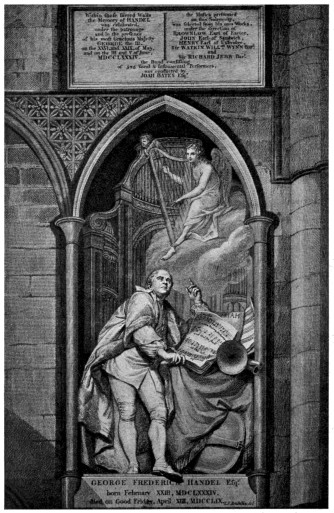
On April 6, 1759, he again took the organ at a production of The Messiah. His powers failed him in the middle of a movement. He soon recovered himself and improvised (it is said) with his habitual grandeur. Returned home he took to bed. On April 11 he added a last codicil to his will,[274] bequeathing munificently £1000 sterling to the Society for the Maintenance of Poor Musicians, and expressing, with tranquillity, his desire of being buried in Westminster Abbey. He said: “I want to die on Good Friday in the hope of rejoining the good God, my sweet Lord and Saviour, on the day of his Resurrection.” His wish was accomplished. On Holy Saturday, April 14, at eight in the morning, the sweet singer of The Messiah slept with his Lord.
. . . . . . . . . . . . . . . . . . . . . . . . .
His glory spread after his death. On April 20 he was interred in Westminster Abbey, as he had requested.[275] The annual performances of his oratorios continued in Lent under the direction of his friend, Christopher Smith. Popular performances of them were soon given. The great festival of his Commemoration celebrated at Westminster Abbey and in the Pantheon, from May 26 to June 5, 1784, for the centenary of his birth,[276] was observed all over Europe. New festivals took place in London in 1785, 1786, 1787, 1790, and 1791. On the last occasion more than a thousand executants[277] took part. Haydn was present, and he said, through his tears, “He is master of us all.”
The English performances attracted the attention of Germany. Two years after the Commemoration, Johann Adam Hiller produced The Messiah in the Cathedral Church at Berlin, then at Leipzig, and then at Breslau. Three years later, in 1789, Mozart made his arrangements of The Messiah, of Acis and Galatea, of the Ode to St. Cecilia, and of Alexander’s Feast.[278] The first complete edition of Handel was commenced in 1786. A strong feeling of emulation made itself felt in Germany to imitate the English festivals, and to restore choral singing, and to found the Singakademien for the preservation of the national glories.[279] The rendering of Handel’s oratorios inspired Haydn to write The Creation. Beethoven at the end of his life said of Handel: “See there is the truth.”[280] Poets also vied equally in rendering him homage. Goethe admired him, and Herder devoted a chapter to him in his Adrastea of 1802. The wars of Independence gave an access of favour to the oratorio of freedom, to Judas Maccabæus.
With romanticism the feeling for the genius of Handel was lost. Berlioz, who, if he had but known him truly, and had found a model for that grand popular style which he sought, never understood him. Of all other musicians, those who approached to the spirit of Handel nearest were Schumann and Liszt,[281] but they were exceptional in the lucidity of their perception, and their generous sympathies. It might be said that Handel’s art, distorted by the editions and false renderings—quite as much those in Germany as the ridiculously colossal representations in England—would have been completely lost except for the foundation in 1856 of the Handel Society, which devoted itself to the object of publishing an exact and complete edition of the works of the master. Gervinus was the promoter and Friedrich Chrysander alone accomplished the task. It did not aim at being a critical edition of his works. His ardent apostle sought simply to revive them in their pristine force.[282] He was seconded by the choral societies of north Germany, particularly by the Berlin Singakademien, which from 1830 to 1860 never ceased to perform all the oratorios of Handel. On the contrary, Austria remained a long way behind. In 1873, Brahms conducted the first production of Saul in Vienna, but the veritable awakening of Handel’s art in Germany only dates back about half a score years. One recognized his grandeur, and did not doubt that he had lived. It was chiefly (so it seems) at the first Handel Festival of Mayence in 1895, where Hercules and Deborah were given, that his astounding dramatic genius was first truly felt there.
To us in France we still await the full revelation of the living scenes of this great and luminous tragic art, so akin to the aims of Ancient Greece.[283]