TABLE OF HEADINGS. (continued 3)
Reading edition
The floor of the Rotunda is a kind of mosaic, known as terrazzo, ornamented with great concentric bands of Tennessee marble. Terrazzo, sometimes called “chip mosaic” or “granito,” is made by sprinkling a layer of small pieces of marble upon a bed of Portland cement, rolling it all down so that the pieces are thoroughly embedded, and, after it is dry, rubbing it down smooth with sandstone. When carefully prepared, it makes an especially durable floor.
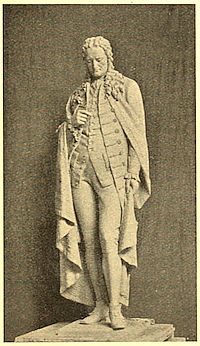
NEWTON. BY C. E. DALLIN.
Provision for Readers.—The reading desks are arranged in three circles, surrounding the Distributing Desk as a centre. Each row contains eight desks, leaving room between for aisles radiating from the central desk. They are constructed of dark, heavy mahogany, and are supported on iron standards with gratings admitting warm or fresh air, for heating and ventilation. The inmost row is a combination of reading-tables, settees, and standing writing-desks, with shelves for reference books,—encyclopædias, dictionaries, directories, atlases, etc.,—of which there is a very full selection. The outer rows are double-faced, and arranged exclusively for persons reading and studying. Allowing each a space of four feet, the desks are capable of seating altogether two hundred and forty-six readers. Including the alcoves, which, on account of the number of separate spaces they contain, are well adapted to the use of special students, particularly those desiring to turn over a large number of books at one time, the total number of readers that can be accommodated in the Rotunda is two hundred and eighty-nine.
The Distributing Desk is surrounded by a circular counter for attendants, and for delivering and receiving books, and cases containing a card catalogue of the Library, arranged alphabetically in shallow drawers according to the subject, author, and title. It has been the policy of the Library from the beginning, moreover, to issue its catalogue in printed volumes, new editions being prepared as the old ones became obsolete on account of fresh accessions. Of late years, however, the Library has grown so enormously that the annual appropriations of Congress have not been sufficient to warrant this undertaking. The latest volumes were published in 1881, and carried the catalogue only through the letter “C.”
Within the enclosures formed by these various desks and cabinets is a small elevator for bringing books by the truck-load from the basement story. The Distributing Desk itself is built of mahogany, ornamented with panelling and carving. On the east side it consists of a high station for the use of the Superintendent—the officer in charge in the Rotunda—who is thus able to keep in touch with everything doing in the room. On the other side is a cabinet containing the terminus of the system of book-carrying apparatus connecting the Reading Room and Stacks, and in the centre is a stairway leading to the basement. Along the front of the desk, also, is a row of twenty-four pneumatic tubes for the transmission of messages, either in cylindrical pouches, as in the case of the written applications which those desiring to draw books are required to make out, or verbally, by means of a mouth-piece with which each tube is equipped. Nine tubes go to the North Stack and nine to the South Stack, or one for every floor. Four go to the East Stack, or one to every other floor. An attendant for any portion of the stack system can thus be reached at a moment’s notice. Of the other two tubes, one goes to the Librarian’s Room and the other connects with the Capitol.
Each tube is numbered, and is operated by pressing a button, the action of which indicates, also, when the pouch is delivered at the other end. Each tube terminates in a separate bronze case or box, which is heavily cushioned, and closed by self-shutting glass doors in order to prevent noise. The tube enters at the bottom, and the pouch is thrown against a curved “hood,” so called, which guides it to one side so that it may not fall back into the mouth of the tube.
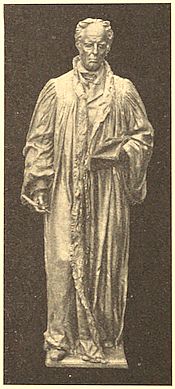
KENT. BY GEORGE E. BISSELL.
The Book-Carrying Apparatus.—The main features of the book-carrying apparatus were suggested by Mr. Green, although worked out with the assistance of ingenious mechanics. The apparatus is in two parts, each separately operated, the first of which connects with the North Stack and the second with the South Stack. The East Stack is so much less extensive than the other two that it was thought more economical to rely solely upon the services of the attendants for the delivery and return of the books it contained. Each section of the apparatus (north or south) consists of a pair of endless chains kept continuously in motion, at the rate of about one hundred feet a minute, by means of power furnished by an electric dynamo. These two chains run from the terminal cabinet to the basement; thence on a level to the stacks; and from there directly up a small well to the top floor, where they turn and descend.
The cable carries eighteen trays, distributed at regular intervals. Each tray is capable of carrying a volume the size of the ordinary quarto, (say eleven inches by ten, and four inches thick), or its equivalent in smaller volumes. Larger books must be carried by hand down the elevator with which each stack is provided. The tray is of brass, made in the form of a hooked comb, the ends of the teeth being left free. The terminal cabinet and all the stack stories are provided with toothed slides, the teeth of which engage with those of the trays, and rake off or deliver the books, as the case may be. If one bends and slightly opens the fingers of both hands, and then draws the fingers of one through those of the other, the general principle of the arrangement will immediately be seen. The tray, however, can receive books only when going up, and can deliver them only when coming down. When a book is received by a slide it falls into a padded basket, ready to be taken to its place on the shelves or delivered to the reader. When the attendant desires to deliver a book to the Rotunda, he places it on the slide, and sets the latter so that it will be ready to meet the first tray which arrives. In returning books, the officer at the Distributing Desk must set a little lever on a dial at the number of the stack for which the book is intended. When the tray approaches the proper floor, the slide is automatically pushed out to receive the load.
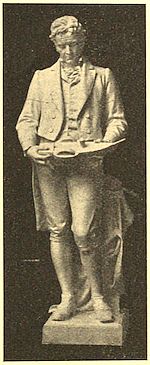
FULTON. BY EDWARD C. POTTER.
Connection with the Capitol.—It is calculated that, by means of the pneumatic tubes and the book-carrying apparatus, it will require no more than six or seven minutes to bring a book from the stacks, from the time it is first called for. Valuable, however, as is the use of machinery in connecting widely distant portions of the Library, it is even more important as a factor in bringing together the Library itself and the Capitol, where hardly an hour passes, during a session of Congress, but some member desires to draw books for immediate use in debate or committee work. The distance between the two buildings is about a quarter of a mile (twelve hundred and seventy-five feet). This is covered by a tunnel having at one end a terminus in the basement almost immediately beneath the Distributing Desk, and at the other end in a room in the Capitol about midway between the Senate and House of Representatives. The tunnel is built of brick, is perfectly dry, and about six feet high and four feet wide, or just large enough for a man to enter and make any needed repairs. An endless cable, kept moving by a similar force to that which supplies the apparatus connecting with the stacks, carries two trays back and forth between the terminals, receiving and delivering books by the same arrangement of teeth as has just been described. The trays are much larger, however, than the others, and are capable of containing the largest volumes, such as bound volumes of newspapers. The speed at which the cable runs is about six hundred feet a minute, delivering a book at the Capitol within three minutes after it has left the Library. In addition to the book-carrier, the tunnel contains the pneumatic tube already spoken of, and the wires of private telephones connecting the two Houses of Congress with the Distributing Desk. So quickly can a message be sent and a book returned, that it is said that a Congressman can get the volumes he desires in less time than it would have taken him when the Library occupied its old quarters in the Capitol itself.
THE BOOK-STACKS.
From the point of view of library equipment and management, however, the three great book-stacks radiating from the Rotunda are the most interesting and remarkable feature of the building. They were entirely planned by Mr. Bernard R. Green, the engineer in charge of the construction of the Library. The word “planned,” indeed, is hardly adequate; “invented” would be nearer the exact fact. The idea of a book-stack, as distinguished from a mere arrangement of bookcases, is so new that such examples as were in existence when Mr. Green entered upon the work were imperfect in many very important points.
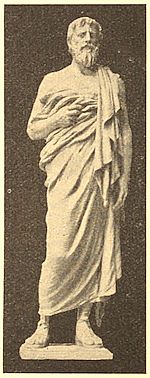
PLATO. BY JOHN J. BOYLE.
The root purpose of a book-stack, of course, is to make it capable of holding the greatest number of volumes in the smallest possible space—always, however, bearing in mind that every book must be perfectly accessible and so placed that it can be easily and quickly handled. The space being limited and the number of volumes large, the old way of arranging cases along the walls, even when the wall space is materially increased by dividing a room into alcoves, has to be abandoned in favor of a more compact system. The modern substitute is to erect the cases in stories, or tiers, with corridors and passages only large enough to give convenient access to the books. Throughout, the aim of the builder is to dispose of every inch of space as economically as possible. Of the three stacks in the Library of Congress, those to the north and south are, as the visitor has seen, the largest, each having a length of one hundred and twelve feet against thirty for the East Stack. All three are of the same width, however—forty-five feet—and the same height—sixty-three feet. The method of construction is the same throughout, and each is absolutely fireproof, the only materials used being steel, iron, brick, glass, and marble. Few things which can be destroyed by fire at all are more difficult to burn than books, and a fire in the stacks, even if carefully nursed by an incendiary, could hardly do more than a trifling injury.
Arrangement and Construction.—The stacks are divided into nine tiers, each tier being seven feet high, and into an equal number of stories the same distance apart. This distance was adopted in order that the books on the highest shelf of a tier might not be beyond the convenient reach of a man of average height, or so far away that he could not easily read their titles. By the present arrangement every book can be handled or its title read without effort.
The stacks begin at the basement story, which is fourteen feet below the level of the floor of the Rotunda. They are sixty-three feet in height—the sum, that is, of the nine seven-foot stories—and are topped by an iron covering, so that any water which might by accident come through the roof would be shed without harming the books. The construction of the shelving is entirely of steel and iron. The unit of construction, as it may be technically called, is a steel column erected on a firm foundation and extending the height of the stack. There are over three hundred of them in each of the two large stacks. At the bottom of every tier above the basement is a horizontal framework of steel bars, running between the columns, the length and width of the stack, and securely anchored to the walls. These cross-pieces perform a double service: they brace the upright columns and prevent them from bending under the weight they bear, and they are supports on which to lay the decks. The cases, that is, do not rest on the flooring, but the flooring on the general system of the cases. It may be added that with the strong and simple framing that is used the stacks might very well have been carried a dozen stories higher without materially increasing the size of the columns.
The ranges—by which is meant the cases for books—are of iron, divided into six compartments by partitions bolted to the columns. They are double-faced, each side being a foot deep, and have no backs. On the front edge of each partition are blunt teeth, and near the back edge is a vertical row of horns, both serving to hold the shelves in place. The ranges are at right angles with the wall, so that there is no opportunity for the occurrence of what are called “dead angles”—waste spaces in which it is impossible to put books.
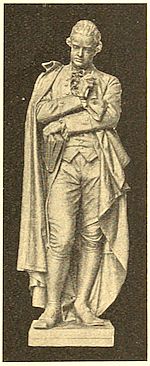
GIBBON. BY CHARLES H. NIEHAUS.
The ranges are nineteen and a quarter feet long, and in both of the larger stacks are forty-two in number, twenty-one on each side of the stack, leaving a corridor between every story the length of the gallery. Between them are aisles three feet four inches wide. Near the middle of the stack a couple of ranges are omitted to give room for staircases up and down, an elevator well, large enough to carry an attendant and a truck-load of books; and the shaft or well for the book-carriage service.
The decks themselves are of white marble, two and a half feet wide in the aisles and five and a half in the corridors, set in an iron frame. This leaves a five-inch slit on either side, between it and the range. The space is too narrow and too close to the range for anyone to step through, and in order that any small article may not roll off, the deck is protected by a raised edge. It would, of course, be possible, though difficult, to drop a book down the slit, in which case, however, it would be very sure to lodge long before it struck the basement floor. If found necessary, any such accident could be prevented by protecting the opening with a wire netting. The advantages of an open space are many, however: attendants may speak to one another from deck to deck without the trouble of going to the stairways; light is diffused through it; and it keeps the books on the lower shelves from damage, either by being carelessly struck by the foot or one of the wheeled trucks used to carry books from the shelves to the elevator well.
Ventilation and Heating.—Especially, by allowing a free circulation of air, these desk-slits help to heat and ventilate the stacks. Ventilation is especially important. Books require pure air almost as much as human beings do; if they do not get it they grow “musty,” and gradually decay. As will have been seen, the whole structure of the stack is open; nothing is closed, even the partitions in the ranges being made in the form of gratings. The system of ventilation and heating is one and the same, and both require the freest circulation of air. Air is taken into the cellar through the windows looking out into the court-yards, first, however, passing through filters of cotton cloth to exclude all dust; after being warmed it ascends through gratings to the roof, where it passes out through ventilating flues. In this way the temperature is everywhere kept very nearly even. Electric fans are ready for use in case of any sluggishness in the circulation, and in summer are also used for sending cooled air into the stack.
The Shelving.—The shelves themselves are open, being composed of parallel strips of steel with a narrow space between. The total number of shelves in the three stacks is sixty-nine thousand two hundred. Each is one foot wide and thirty-eight inches long, with a total length of forty and a half miles. They are capable of sustaining a weight of forty pounds a square foot—more than will ever be required of them—with practically no deflection. Nevertheless, though so much stiffer, they are as light as the ordinary board shelf of the same size. They can be easily and quickly adjusted at any height, without the need of pegs or loose screws. Once in place they cannot slip or tip, and being made in a uniform size (with some small exceptions for certain irregular spaces around stairways, etc.), every shelf is available for use anywhere. There are no rough edges or projections on which a book can wear, and the parallel strips of steel are rounded and highly polished by means of the Bower-Barff process of coating with magnetic oxide of iron, so that the surface is as smooth as glass—which not only helps to preserve the books, but can offer no lodgement for dust or insects. The open spaces, also, afford an opportunity for using a workable book-brace, specially devised by Mr. Green.
Furthermore, the shelves can be removed from any compartment as desired, and space thus made for a table, a cabinet, or a desk, as needed; or an extra corridor can be at once opened for any distance. Then again, in case of the extra large books, sufficient space may be made by placing the shelves of both sides of the range on a level.
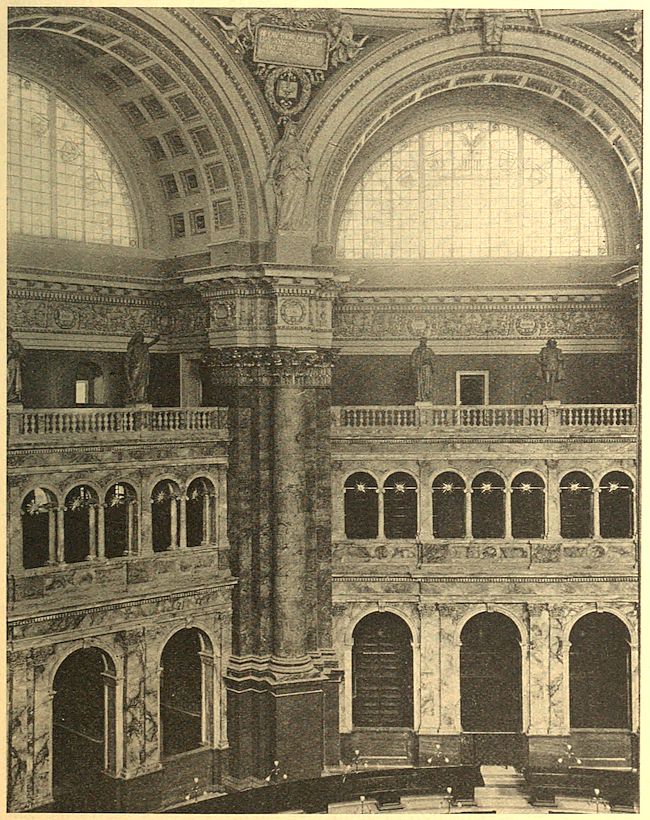
THE ROTUNDA, LOOKING EAST.
Lighting.—No point was more carefully studied in the construction of the stacks than the lighting. Preliminary plans requiring an immense amount of labor were made, showing the amount of direct sunlight which any portion of the three arms would receive at any hour of the day, any month in the year. Skylights along the line of the corridors help light the upper tiers. The walls are honeycombed with windows from top to bottom. In the north and south stacks there are no less than three hundred and sixty. They occur at the ends of the passageways between the ranges, being placed at the intersections of the decks, so that each may diffuse direct light into two tiers at once. In this way there can be no perceptible difference in the amount of light cast into the upper and lower portions of the tiers. At the end of each passageway the window is fitted with a seat for the use of the readers admitted to the stacks, or attendants. Ground glass is employed for the windows on the east side of the south stack, where the sunlight is so abundant and continuous that it would be inconvenient if admitted, besides being likely to cause the bindings of the books to fade; everywhere else the clear open plates invite the entrance of all the illumination which can be obtained. Each window consists of a single piece of polished plate glass three feet wide, and permanently sealed, so that no dust or moisture can ever penetrate it. In order to wash the glass from the outside the wall is fitted at convenient intervals with skeleton galleries. The courts themselves give an abundance of full, bright light; and that none of it may be wasted, and in order that it may be evenly distributed through the tiers, both at the bottom and top of the stacks, the walls of the courts are constructed of yellow enamelled brick, which makes an admirable reflector, on rainy as well as on sunny days. Inside, the marble decks are highly polished, so that they, too, serve as efficient reflectors, casting the light which they receive into every nook and cranny of the stack. Evenings, the light is furnished by incandescent lamps, with which the passages and corridors are abundantly equipped, and here again the polished decks serve a most useful purpose in diffusing the brilliant illumination throughout the whole system of shelving. Altogether, it may be very confidently stated that no great collection of books was ever before so thoroughly and conveniently lighted, whether in the day or at night.
THE LANTERN.
Before leaving the Rotunda it should be added that it is possible to ascend into the Lantern by taking either of the winding iron staircases in the piers on the left and right of the west gallery. The staircases in all the piers carry one up into the space between the two shells of the dome, where it will be necessary from time to time for workmen to go in order to paint the iron framing and thus preserve it from rust and decay, but only these two are open to the public. On the way up one has a chance to observe the interesting construction of the dome; and in the Lantern, which is left unfinished except in the portions seen from below, one may look over the parapet and down into the Rotunda.
By taking the staircase to the right, moreover—to the right as one originally enters the gallery from the Entrance Hall, that is—one reaches a door through which one may pass out to a little gallery encircling the Rotunda in the open air and affording a beautiful view of Washington and the surrounding country.
Or, if one chooses to defer this little expedition, it is possible to make the trip without retracing one’s steps by taking the elevator on the first story of the Entrance Hall and getting out on the attic floor, from which one may enter either of the two stairways just described.
THE RECTANGLE.
In going through the various galleries and pavilions of the Rectangle it is perhaps more logical to begin on the library floor, but supposing the visitor to be about to leave the Rotunda by the way in which he has come, it will save a little time to take the second story first. Both are alike, so far as the arrangement of rooms is concerned, except that on the first story one leaves the Entrance Hall by a narrow corridor, while above one enters the galleries directly. The arrangement is very simple, as will be seen by looking at the plan of the building. The pavilions are connected by long galleries, two on the west and east sides, where the Rectangle is interrupted by the centre pavilions, and one each on the north and south sides. The corner pavilions of both floors contain octagonal-shaped rooms, which, in the second story, have domed ceilings and mosaic floors, and are richly embellished with paintings and sculpture and relief decoration in stucco. The East Pavilion contains a small staircase and a good sized but plainly finished room on both stories.
The rooms on the second story are intended for the most part as exhibition halls for the display of works of art which have come into the possession of the Library through the operation of the copyright law, or of books and manuscripts of special interest on account of their rarity and curiosity. One room, for example, is intended to contain a collection of early printed books and, in general, such volumes as best illustrate the history of printing; another room is for books relating to the early history of America. The North Gallery is the Map Room; the South Gallery is the Print Room, for engravings, lithographs, etchings, photographs, etc., illustrating the progress and development of the reproductive arts.
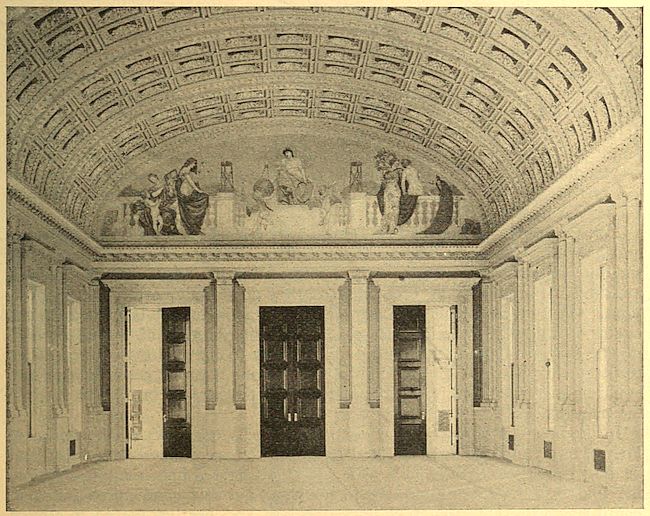
SOUTHWEST GALLERY.—THE SCIENCES.—BY KENYON COX.
There is space here to speak only of the more richly decorated of these rooms—the corner pavilions and the two galleries on the west side. The others, as the visitor will see in walking through them, require no special description. The walls are decorated in broad masses of plain color, with deep friezes of simple but interesting patterns. The decoration varies from room to room, but all are united in a single intelligent harmony of color. Each contains a long skylight surrounded by a stucco border left plain in most of the galleries, but in the Print Room enriched by coffering decorated with gilt “cherubs’ wings.” The skylights are ornamented with a simple design of stained glass. The chief colors employed are purple and pale green and yellow, and the design includes the names of men distinguished in American history and in art, letters, and science.[11]
SOUTHWEST GALLERY.
The chief decorations of the gallery into which one goes from the South Corridor of the Entrance Hall are two large tympanums by Mr. Kenyon Cox, one at each end of the room over the triple doors by which one enters or leaves. For the rest, the room is lighted, like the other galleries, on both sides, so that one may look out toward the Capitol, or, on the east, into one of the interior courts. The ceiling is an elliptical barrel vault, rising to a height of twenty-nine feet. It is set with square coffers in blue and gold, and divided by double ribs which spring from the paired pilasters. Between the pilasters a bright-colored arabesque is introduced, in which blue is the prevailing color. It is continued in the ceiling by an arabesque in relief, the most conspicuous features of which are seated cherubs, and medallions with the letters “C. L.”—standing for “Congressional Library.” The floor is Vermont, Italian, and Georgia marble, laid in square panels, so as to reflect, in a way, the pattern of the coffers in the ceiling above.
Mr. Cox’s Paintings.—Mr. Cox’s tympanums are thirty-four feet long and nine and a half feet high. At the south end of the room the subject of the decoration is The Sciences, and at the north end, The Arts. The panels are similar in composition, occupying as they do exactly corresponding positions. On each the design is drawn together by a low marble balustrade, at the centre of which is a semicircular recess enclosing a kind of throne or high marble seat. At either end of the recess, so as to come directly over a pilaster occurring between the doors, is a post bearing a tripod on which incense is burning. The effect is to carry the lines of the architecture below up into the painting.
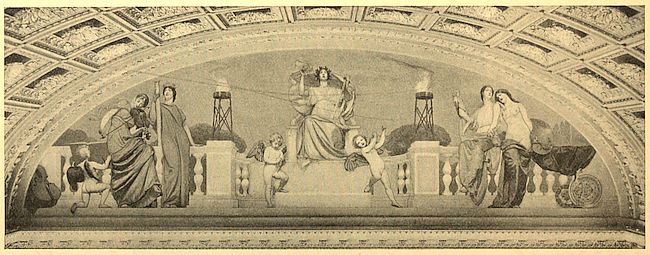
THE ARTS.—BY KENYON COX.
In the panel of The Arts, the central throne is occupied by the figure of Poetry, represented as a young and beautiful woman crowned with laurel and bearing an antique lyre. She is seated in an attitude of immediate inspiration, the fold of her garment blowing in the wind, her left hand raised from the chord which she has just struck upon the lyre, and her lips parted in a burst of song. On the steps of her throne are two little geniuses, one writing down her words on a tablet, and the other raising his arms in sympathy as he joins in the rhythmical swing of her song. The first may be taken as personifying the more strictly literary and reflective side of poetry, and the other as standing for its feeling for harmony and music, or, in general, the lyrical element in poetry. In the left-hand portion of the decoration are Architecture and Music, and to the right, Sculpture and Painting—all typified by female figures bearing some appropriate object identifying the art which they represent. Architecture is conceived as the sternest and most dignified of the arts, as shown by her expression of proud abstraction and the severe lines of her drapery. She holds a miniature marble column, and her head is crowned with a circlet of battlements. Music is playing upon a violin, and looking the while upon the pages of a great music-book which a kneeling genius holds open before her. Beside her is a violoncello. Sculpture holds a statuette of a nude female figure, and talks with Painting, who has a palette and brushes. The latter, as representing the gentler and more luxurious art, is shown partly nude, and leaning her head affectionately upon the shoulder of her companion. In the corner of the picture are a vase and two large plates in different styles of decorated pottery—standing for the minor decorative arts.
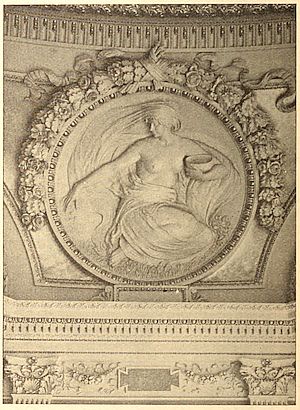
SPRING.—BY BELA L. PRATT.
In the tympanum of The Sciences the central figure is Astronomy. She holds a pair of compasses, and leans forward on her throne to make measurements upon the celestial globe which a genius holds up before her. Another genius to the right looks through a telescope. To the left of the panel are Physics and Mathematics. Physics holds an instrument designed to show the law of the balance of different weights at different distances from the point of support. Mathematics has an abacus, or counting-frame, with which she is instructing a little genius in the elements of figures. The beads of the abacus are so placed that they give the date, “1896”—the year the picture was painted. Beside her, in the extreme left-hand corner, are various figures illustrating plane and solid geometry. The former kind are so arranged, as the visitor will see by looking carefully, that they form all the letters of the artist’s name—KENYON COX. On the other side of the throne are Botany, bearing a young oak tree, and wearing a green and white figured gown; and Zoölogy, a nude figure holding out her hand to caress a magnificent peacock perched on the coping of the balustrade. In the corner are a shell and various kinds of minerals, for Conchology, Mineralogy, Geology, and so forth.
On tablets over the doors and windows are the names of men distinguished in Science and Art. Those representing Art are Wagner, Mozart, Homer, Milton, Raphael, Rubens, Vitruvius, Mansard, Phidias, and Michael Angelo. The Scientists are Leibnitz, Galileo, Aristotle, Ptolemy, Dalton, Hipparchus, Herschel, Kepler, La Marck, and Helmholtz.
THE PAVILION OF THE DISCOVERERS.
The Southwest Pavilion—or the Pavilion of the Discoverers, as it may better be called, from the subject of the paintings with which it is ornamented—opens immediately from the Southwest Gallery. The domed ceiling is richly coffered and profusely ornamented with gilding, except for a large central space in the form of a disc, which contains a painted decoration. Below the dome are four tympanums, also occupied by paintings. The walls are ornamented with paired pilasters, bearing a narrow frieze decorated with lions’ heads and festoons of garlands.
Mr. Pratt’s Bas-Reliefs.—In the pendentives is a series of four large circular plaques in relief, representing The Seasons. The series, which is repeated in each of the other three pavilions, is the work of Mr. Bela L. Pratt. Spring is the figure of a girl sowing the seed, her garment blown into graceful swirls by the early winds of March. Summer is a maturer figure, sitting, quiet and thoughtful, in a field of poppies. Autumn is a mother nursing a baby. An older child—a little boy—stands beside her, and the abundance and fruitfulness of the season are still further typified in the ripe bunches of grapes which hang from the vine. Winter is an old woman gathering faggots for the hearth. Behind her is a leafless tree, on which is perched an owl. A garland appropriate to the season hangs over each of the four plaques—fruits for Spring and Summer, grains for Autumn, and oak leaves and acorns for Winter.
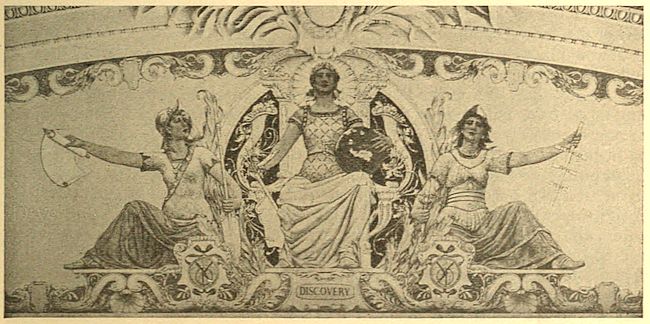
CENTRAL GROUP OF DISCOVERY.—GEORGE W. MAYNARD.
Mr. Maynard’s Paintings.—The paintings in the tympanums and the disc are the work of Mr. George W. Maynard, whose panels in the Main Entrance Hall have already been described. In the tympanums the sequence of Mr. Maynard’s subjects begins on the east side and continues to the right, as follows: Adventure, Discovery, Conquest, Civilization—the bold roving spirit of Adventure leading to Discovery, which in turn results in Conquest, bringing at last a settled occupation of the land and final Civilization. In the disc of the ceiling, Mr. Maynard has depicted the four qualities most appropriate to these four stages of a country’s development—Courage, Valor, Fortitude, and Achievement.
Since the tympanums are the same in shape and of the same size, measuring each thirty-one feet by six, and since all stand in the same relation toward the whole room, Mr. Maynard has followed throughout a single method of arrangement. Each tympanum is over three doors or three windows, as the case may be. In accordance, therefore, with this exactly balanced architectural scheme, a pyramidal group of three female figures—pyramidal because any other form would have looked top-heavy—is placed above the central opening. Balancing or, so to say, subsidiary figures, which, if only from their position at the diminishing ends of the tympanum, are necessarily of less importance, are placed over the doors or windows to the side. Thus the decoration is poised in complete accordance with the disposition of the wall which it crowns. The figures at the ends, it will be noticed, are of two sorts, mermaids and emblazoned shields; but since they alternate in pairs from tympanum to tympanum, the shields occurring in the east and west and the mermaids in the north and south, this variety serves very well to accentuate the unity of the composition of the four paintings. The ornament, also, is the same in its more important features: the throne in the centre, flanked by cornucopias; the arabesque border with its dolphins, suggestive of seafaring; and the lists of names of discoverers and colonizers which occupy the spaces to the right and left of the central group, and serve to draw together the whole composition.
It would be well if the visitor were to hold in mind these points, for in the two following pavilions on this floor, where the conditions governing the painter are exactly the same as in the present room, it will be seen that the artists employed have followed in their work the same orderly and logical plan of arrangement which Mr. Maynard has here adopted.
In the first tympanum, Adventure, seated on her throne, holds in her right hand a drawn sword, in instant readiness for the combat; her left hand rests upon an upright caduceus, the emblem of Mercury, the god of the traveller, merchant, and thief, and fit, therefore, to be the patron of the restless adventurers who sailed westward in the sixteenth century, impelled as well by a desire for booty as for legitimate trade. To the right and left are seated female figures, representing respectively Spanish and English adventure—the two countries which furnished America with the largest part of its early buccaneers and adventurers. Like the central figure, the two are clad in rich and elaborate armor, accurately copied, as is that in the other tympanums, from authentic sixteenth-century models. The figure to the left, typifying England, holds a cutlass in her right hand, while her left hand buries itself in a heap of pieces-of-eight, the pirate and buccaneering coin par excellence. The companion figure to the right holds a battle-axe in her right hand, and in her left one of the little figurines, or miniature idols of gold, which the Spaniards in Peru sought so eagerly, and with so much cruelty, to secure from the natives. At either side of the throne is a shield, on which an old Norse Viking ship, propelled by oars and sail, is depicted. At either end of the tympanum is a shield, that to the right bearing the arms of Spain, and that to the left those of England. On the Spanish side of the decoration is the following list of names of Spanish adventurers: Diaz, Narvaez, Coello, Cabeza, Verrazano, Bastidas. On the other side is the English list: Drake, Cavendish, Raleigh, Smith, Frobisher, Gilbert. Each group of names is surmounted by the heraldic form of the naval crown, ornamented with alternate sterns and squaresails of ships, which was given by the Romans to a successful naval commander, or to the sailor who first boarded an enemy’s ship. In either corner of the tympanum still another emblem of sea-power, the trident, is introduced.
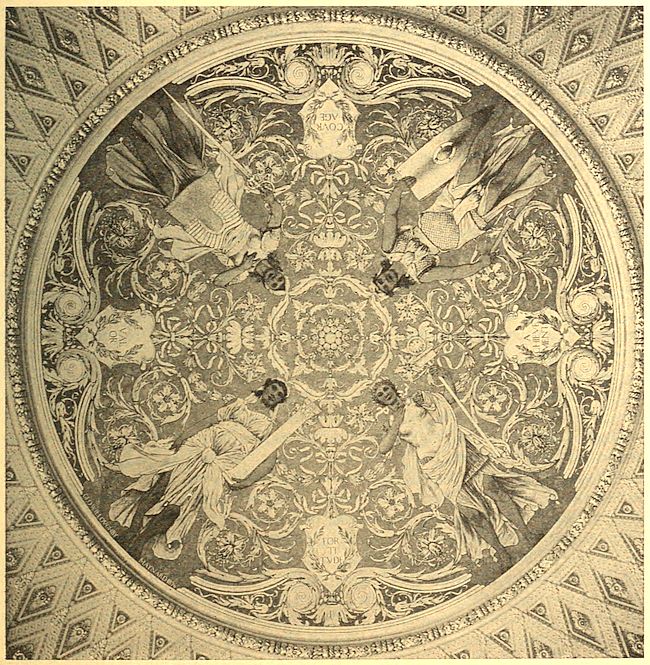
CEILING DISC.—GEORGE W. MAYNARD.
In the second tympanum, Discovery, crowned with a laurel wreath of gold and wearing a leather jerkin, sits on her throne, holding a ship’s rudder in her right hand, and with her left upon a globe of the earth, which is supported on her knee. The rude map of America, which appears on it, is copied from a portion of a mappemonde, or chart of the world, which was discovered a few years ago in England, and which has been ascribed to Leonardo da Vinci. It dates from the second decade of the sixteenth century.[12] The two seated figures to the right and left are clad in armor; the first holds a sword and “Jacob’s staff,” or cross staff, a device used by the early navigators instead of a quadrant or sextant to determine the altitude of the sun and stars. The figure to the left, with paddle and chart, points towards the distance with outstretched arm, and turns to her companions to beckon them onwards. The two shields at the foot of the throne bear an astrolabe, an obsolete instrument used for the same purpose as the cross staff. At either end of the tympanum, a mermaid, with a seashell for cap, and with seaweed twined about her body, invites the voyagers with strings of pearls and coral. Lists of names occur at the left and right, surmounted, as before, with the naval crown. The first list is: Solis, Orellana, Van Horn, Oieda, Columbus, Pinzon; the second, Cabot, Magellan, Hudson, Behring, Vespucius, Balboa.
In the third tympanum, that of Conquest, the idea expressed in the central group is that of the proud tranquillity which follows triumph in battle. The figures carry the insignia of victory. The one seated upon the throne has pushed back her casque and lets her left hand hang idly over the crosspiece of the sword. But there is still danger of a renewal of the struggle; the right hand rests clenched upon an arm of the throne, the armor has not yet been laid aside, and the sword not yet sheathed. The figures to the left and right are in a like attitude of readiness, though they carry in addition to their swords the emblems of peace—the first, representing Southern Conquests, a sheaf of palms; and the second, representing Northern Conquests, chaplets of oak-leaves, which wreathe her casque and sword. The two shields bear a heraldic representation of the Pillars of Hercules, with the motto Ne plus ultra twined about them, and between them, in the distance, the setting sun—perhaps an ironical allusion to the ancient idea which set the limits of the earth at the Straits of Gibraltar, or perhaps simply an adaptation and extension of it to the new conditions of knowledge. At the ends of the tympanum the arms of England and Spain are again introduced, as significant of the general division of North and South America into English and Spanish territory. The names to the left are: Pizarro, Alvarado, Almagro, Hutten, Frontenac, De Soto; to the right, Cortes, Standish, Winslow, Phipps, Velasquez, De Leon. Over each group is the battlemented mural crown given by the Romans to the soldier who first succeeded in planting a standard upon the wall of a besieged city.
The fourth tympanum, Civilization, is the flowering of the other three. The armor has been laid aside, and the three figures in the centre are clad simply in classic garments. Civilization, crowned with laurel and seated on her throne, holds up the torch of learning, or enlightenment, and displays the opened page of a book—an idea which is repeated in the lamp and book which compose the device on the two shields below. To the left is Agriculture, crowned with wheat, and holding a scythe and a sheaf of wheat. To the right is Manufactures with distaff and spindle, twisting the thread. The mermaids at the ends of the decoration hold up, one an ear of corn, and the other a branch of the cotton-plant bearing both the flower and the boll—the two chief products respectively of the northern and the southern portions of our country. The names are: to the left, Eliot, Calvert, Marquette, Joliet, Ogelthorpe, Las Casas; and to the right, Penn, Winthrop, Motolinia, Yeardley, La Salle. Over each list is a wreath of laurel.
Mr. Maynard has represented in the ceiling the four qualities most pertinent to the character of his four tympanums. All four are shown as female figures, displayed against a background of arabesque. The first, Courage—a brute, animal courage—is clad in a coat of coarse scale-armor, over which a lion’s skin is drawn, the head of the beast serving her for a cap. She is armed with a war-club and a shield. The next, Valor, is a nobler figure, more beautiful and wearing more beautiful armor. Her right hand holds a sword, and her left is pressed to her breast. The third, Fortitude, is unarmed. In her left arm she carries an architectural column, the emblem of stability. Achievement, the last, is clad in armor, but is without offensive weapon. She wears a laurel crown, and in her left hand she carries the Roman standard, surmounted by its eagle and laurel wreath, the symbol of a strong and just government. In the order named, therefore, it will readily be seen how these figures may be said to typify the successive tympanums of Adventure, Discovery, Conquest, and Civilization.
THE PAVILION OF THE ELEMENTS.
In the same way that the room decorated by Mr. Maynard has been called the Pavilion of the Discoverers, so the Southeast Pavilion may be called the Pavilion of the Elements, from the subject of the paintings ornamenting the tympanums and the disc. The tympanums are by Mr. Robert L. Dodge, and the disc by Mr. Garnsey and Mr. Dodge working in conjunction, the former making the ornamental design and the latter designing and carrying out the figure-work.
Mr. R. L. Dodge’s Paintings.—Each of the four tympanums is devoted to a single Element: the east tympanum to Earth, the north to Air, the west to Fire, and the south to Water. The composition, which is very simple, is uniform throughout. In the middle of the tympanum is a group of three figures typifying the subject of the decoration—the central figure standing and the other two seated. The latter are of women, but to prevent monotony, the standing figures are alternately male and female—male in the tympanums of Earth and Fire, and female in those of Air and Water. The central figure holds up in either hand an end of a heavy garland of flowers, which, stretching in a single festoon to the extremity of the tympanum, is there caught up by a little boy or genius. In the middle of each half of the picture, and in each tympanum the same on both sides, is an ornamental bronze column flanked on either hand by a bronze standard or tripod, all three united by floating streamers or ribands into a single group, and each serving as a pedestal on which to place some emblems of the Element represented.
In the tympanum of Earth the idea is the fertility and bounteousness of the soil. In the central group the figure to the right leans her arm upon an amphora or ancient wine-jar, and holds in her hand a rose. The figure to the left is that of a reaper, with a wreath of grains on her head and a bundle of wheat by her side, and holding in her hand a sickle. The geniuses at the ends of the decoration are dancing for jollity. The background is a smiling and luxuriant summer landscape, the fruits of which, the peach, the plum, the pear, the grape and the rest, are displayed in the great garlands which the central figure holds up with outstretched arms. The bronze columns support baskets of fruit, and on the accompanying standards are perched magnificent peacocks. The border of the decoration includes masks, urns and lions, the last emblematic of the subject of the decoration.
The central figure in the decoration typifying Air stands upon a bank of clouds; she is winged, and a large star blazes on her forehead. Of the figures to her right and left, the first is winged and the second carries the caduceus. The festoons are of morning glories, upheld at the further ends by flying geniuses. The background is sky and clouds. The central standards carry astrolabes, as being the typical astronomical instrument of a few centuries ago, and eagles are perched on those to the side. In the border, winged griffins are substituted for lions.
The background of the third tympanum, Fire, is a mountainous and volcanic region, its peaks touched with lurid light from constant eruptions. The festoons are composed of sunflowers, and the seated figures in the centre carry each a flaming torch. The columns to the right and left bear flaming globes, while the flanking standards support the fiery nest of the phœnix—the bird which was fabled by the ancients to live, sole of its species, five hundred years, at the end of which time it repaired to the desert and built a funeral pyre, in the flames of which it was consumed. From its ashes as a nest a new phœnix arose, as here depicted. In the border of the decoration are salamanders, which, according to the old superstition, lived in the midst of fire.
In the last tympanum, Water, the central figure, clad in green, holds festoons of seaweed and water-lilies—flowers, buds and pads. On either side is a mermaid, one of them with a seashell. The background is the open sea. The standards are in the form of rostral columns (such as the Romans erected in honor of their victorious admirals) ornamented with garlands of laurel and the beaks and sterns of captured ships. On top is set a galley, with oars and sails. Over each of the standards to the side hovers a sea gull. The geniuses at the end of the picture have tails like mermaids, and in the border are dolphins.
The disc of the ceiling repeats in another form the general idea of the decorations of the tympanums. In the centre is the sun, across which the sun-god, Apollo, drives his four-horse chariot. The sun, however, is still the sun, and not a yellow background; the dusky picture outlined against it is to be taken as a vision, so to say, of its attributes.
Around the sun as a centre, is painted a chain of alternate medallions and cartouches—four of each, or eight in all—which typify the Four Elements represented in the tympanums below. A medallion and a cartouche are devoted to each. The former sort are painted so as to suggest a cameo design. The first of them, which occurs, like the other three, on the side nearest the tympanum of the corresponding subject, typifies Earth, a female figure reclined amidst a summer landscape. In her hand is a scythe, and behind her is a plow, standing in the midst of a wheat field. Water is a mermaid riding off a rocky shore on the back of a dolphin. In her hand she holds an oar. Fire is a woman watching the smoke which floats away from the flame of a little brazier at her side. Behind her is a tripod on which incense is burning. In the distance is Mt. Vesuvius, sending out a steady cloud of smoke, and in the plain beneath are the ruins of Pompeii. Air is a female figure clad in flowing drapery, and floating among the clouds on the outstretched wings of an eagle.
The cartouches are more simply designed. That of Earth contains a tortoise, on the back of which, according to the Hindoo mythology, the earth is ultimately supported. Air is typified by a swan; Fire, by a lamp; and Water by two intertwined dolphins. Finally the whole decoration is surrounded by a broad band of arabesque ornament, in which are placed the signs of the Zodiac.
THE PAVILION OF THE SEALS.
The third of the second-story pavilions is the Pavilion of the Seals, at the northeast corner of the building. The walls in this room, it may be noted, are treated differently from those of the other three pavilions. Instead of the frieze and the paired pilasters, one has wall-surfaces covered with gilding and ornamented with painted laurel-bands arranged in regular patterns recalling the designs of the parterres of an old-fashioned garden.
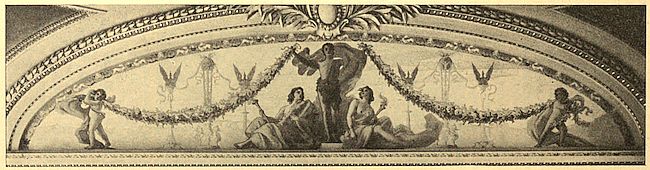
FIRE.—BY R. L. DODGE.
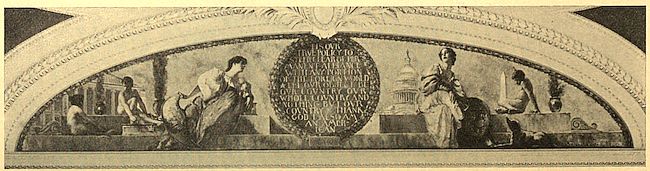
STATE AND TREASURY.—BY W. B. VAN INGEN.
The paintings in the tympanums are by Mr. W. B. Van Ingen, and illustrate the seals of the various Executive Departments of the United States Government. The disc of the domed ceiling was designed by Mr. Garnsey, and shows the Great Seal of the United States surrounded by allegorical emblems.
Mr. Van Ingen’s Paintings.—As in the previous pavilions on this floor, the general arrangement of the decoration is the same in all four tympanums. In each the artist has introduced a low terrace or wall of masonry running from end to end, thus serving both to ballast the picture, as it were, and to bind its parts more strongly together. A recess in the centre of the terrace allows space for a circular tablet, painted to represent wood, about six feet in diameter, or nearly the height of the tympanum. On this are inscribed, as if in raised letters, one or more quotations from the writings or speeches of great American statesmen. These were selected by the Librarian, Mr. Spofford, mainly for their general patriotic application, but, of course, as far as possible with some special reference to the subject of the decoration. The border of each tablet, as of the decoration itself, is a band of laurel-leaves, suggested by the laurel-roll which outlines the disc of the ceiling.
On either side of the tablet is a female figure, seated against the terrace, personifying a Department of the Government, in token of which she supports a shield or cartouche on which the seal of that Department is conspicuously displayed. The visitor will notice that these figures (in this respect like Mr. Reid’s in the Entrance Hall) illustrate the American type of woman, and wear modern gowns and not conventional Greek or Roman drapery.
The two figures and the tablet between form the necessary central pyramidal composition. For a limit and balance to the decoration the artist has painted, at either end, a cypress-tree and, in all but one of the tympanums, one or two nude children or geniuses, usually engaged in some action which shall be useful in explaining the purport of the picture, the meaning of which is still further brought out, in most cases, by introducing into the background a well known monument or building, or some conventional object, suggestive of the functions of the Department represented.
The west tympanum is devoted to the Department of the Treasury and the Department of State; the north tympanum to the Department of Justice and the Post-Office Department; the east tympanum to the Departments of Agriculture and the Interior; and the south tympanum to the War and Navy Departments.
Half a tympanum is devoted to each. The Department of the Treasury—to begin with the one first named in the above list—is sufficiently indicated by the introduction of the Treasury Building in the background. Two children are playing on the parapet, one of them with his foot on a strong-box. The background of the other portion of the tympanum—illustrating the Department of State—exhibits the dome and west front of the Capitol and, to the right, the Washington Monument. The vital thing about a nation—that which it is the first business of a Department of State to help preserve—is its independence. The Monument may be taken, therefore, as standing for the establishment of that independence, and the Capitol for its maintenance. A dog, typical of fidelity, lies in the foreground. The cypress trees, it may be noted before passing to the next tympanum, are introduced purely for their decorative effect, and are without any symbolical meaning. In all the decorations they are set in jars copied from Zuñi originals in the National Museum.
In the north tympanum, the figure of Justice is clad in ermine. On the terrace is a high bronze standard, carrying a pair of evenly balanced scales. The genius at the left holds a measuring rod, for exact justice. In the other half of the painting, devoted to the Post-Office Department, the genius is represented with a pair of compasses marking out mail routes on a globe. Mercury was the Messenger of the Gods, according to classic mythology, and a bronze statue of him with his winged sandals, staff, and cap, is appropriately set upon the stone terrace to typify the dispatch and celerity of the Department.
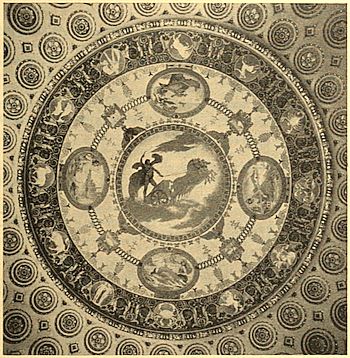
CEILING DISC.—BY ELMER E. GARNSEY.
Agriculture, in the next tympanum, is symbolized solely in the fertile and well cultivated landscape which forms the background of her portion of the decoration. The chief duty of the Department of the Interior—to protect and control the Indians—is indicated in the background of the other half of the picture by a representation of the curious method of burial, if one may use the word, which prevails among certain of the western tribes—the body, lashed to a few poles for a bier, being laid away in the branches of a tree.
In the last tympanum, that of War and the Navy, the terrace is nicked and shattered by the bullets of the enemy. The figure to the left, representing the Department of War, holds a regulation army sword, and the figure to the right a naval sword. To the left the two children are engaged in combat; one is falling, stained with blood, while the other presses upon him with a falchion, or Roman sword. The corresponding composition to the right is much the same; the chief difference being the trident which the victor aims at his opponent’s breast. War is accompanied by a Roman standard adapted to an American use by altering the old initials “S.P.Q.R.”—“The Senate and People of Rome”—to “U.S.A.” In the background is Bunker Hill Monument in Boston. On the other side are the masts of the recently constructed battleship Indiana, and a rostral column of the same sort as those used in the tympanum representing Water in the Pavilion of the Elements, but in this case copied exactly from the one erected in honor of Commodore Decatur and afterwards removed to Annapolis, where it is now. The inscriptions on the tablets in the four tympanums may most conveniently be inserted here. In the west tympanum, that of the State and Treasury Departments, the quotations are as follows:—
’Tis our true policy to steer clear of permanent alliance with any portion of the foreign world.—Washington.
Let our object be our country, our whole country, and nothing but our country.—Webster.
Thank God I also am an American.—Webster.
In the north tympanum:—
Equal and exact justice to all men, of whatever state or persuasion, religious or political: peace, commerce and honest friendship with all nations—entangling alliance with none.—Thomas Jefferson.
In the west tympanum:—
The agricultural interest of the country is connected with every other, and superior in importance to them all.—Andrew Jackson.
Let us have peace.—U. S. Grant.
In the south tympanum:—
The aggregate happiness of society is, or ought to be, the end of all government.—Washington.
To be prepared for war is one of the most effective means of preserving peace.—Washington.
Mr. Garnsey’s Ceiling Painting.—The disc of the dome contains one of the most interesting and ingeniously arranged of the purely conventional decorations which ornament the Library. In the centre is the great seal of the United States, which puts the final touch of significance upon the series of paintings in the tympanums. Surrounding it is a circular band containing forty-eight stars, one for each State and Territory. On the diagonal axes of the room are four medallions containing heads symbolizing the Four Winds—North, South, East and West—each blowing a gale from his mouth, as in the classical representations. They stand, of course, for the four great natural divisions of the country. Below each medallion is a garland of fruits or grains, festooned from bunches of eagles’ feathers which spring from the central panel of the decoration, and indicating the nature of the products of each section. The garland under the medallion of the North Wind, for example, is composed of apples, pears, peaches, and similar fruits; that under the East Wind, of various vegetables and berries; under the West Wind, grains, as wheat, oats, and maize; and under the South Wind, bananas, pomegranates, oranges, lemons, and so forth.
Other emblematic objects introduced into the decoration are lyres, each flanked on either side by a horn of plenty filled with fruits; and flaming torches, set between a pair of dolphins. There are thus two sorts of groups, each of which occurs four times in the decoration in accordance with the standard fixed by the four medallions of the Winds. The four different objects depicted signify four of the great interests of the country—the lyre, the Fine Arts; the cornucopia, Agriculture; the torch, Learning and Education; and the dolphin, Maritime Commerce. Finally the composition is united by American flags festooned from the lyres to the garlands of fruit which underhang the medallions of the Winds. And around the whole is a narrow border, on which are inscribed the following words from Lincoln’s Gettysburg address, used also, in part, by Mr. Vedder in his decorations in the Entrance Hall:—
That this nation, under God, shall have a new birth of freedom; that government of the people, by the people, for the people, shall not perish from the earth.
THE PAVILION OF ART AND SCIENCE.
The entablature and paired pilasters which decorate the walls of the two pavilions to the south, are resumed in the Northwest Pavilion, or Pavilion of Art and Science, if one choose to name it, as the three corresponding rooms on this floor were named, from the subject of the paintings which it contains.
Mr. W. de L. Dodge’s Paintings.—These paintings, both in the tympanums and in the ceiling disc, are the work of Mr. William de Leftwich Dodge. The subjects are as follows: in the west tympanum, Literature; north tympanum, Music; east tympanum, Science; south tympanum, Art; and in the ceiling disc, Ambition, considered as the incentive of all human effort, whether in art, science, or affairs. Comparing them with the other decorations in the Library, the visitor will be struck with the unusually large number of figures which Mr. Dodge has introduced into his canvases, all, of course, helping to illustrate some phase of the subject under which they are grouped. Throughout, however, the meaning is unusually clear, the special significance of every figure being indicated either by some expressive attitude or action, or by the introduction of some appropriate and typical object.
Literature shows a varied group of male and female figures sitting or standing. The scene is along the steps of an old Greek temple. The God of Letters—or Apollo, if one wishes—sits in the foreground holding an open book. Behind him is a company of maidens reading in an ancient scroll, which they unroll from hand to hand. To the right, a woman is instructing two children in the rudiments of learning. Comedy, a nude and easy figure, is looking at the ludicrous features of a comic mask, and Tragedy stands in an attitude of recitation, lifting her arms in an emphasizing gesture. In the corner is a little boy working over an ancient hand-press. To the left a poet sits with his head bowed in thought, perhaps in despair that his verses have not received their due meed of applause; but Fame stands behind him holding out the wreath of laurel with which, after many years, she means to crown him. Further on is another poet, who, as he reclines half dreaming on the ground, is suddenly inspired with the rapture of the Muse. In the corner is a bust of Homer, with a pile of books for pedestal.
In Music, Apollo, as the God of Song and Harmony, is seated in the centre of a long marble bench playing upon a lyre. Other figures, variously disposed throughout the panel, play upon a number of different musical instruments, illustrating at once the development and present scope of the art. One plays a violin, two others are blowing trumpets, a fourth has the double pipes, another a mandolin—and so on.
The central figure of Science—the background of which is again the columns and marble steps of a temple—is a winged female figure descending through the air to crown the inventor of the phonograph, who kneels on the steps before her with a simple electrical instrument beside him. More broadly considered, the group typifies the triumphs of modern electrical science, summed up indeed, in the invention of the phonograph, but including as well the electric telegraph and the telephone. To the right is a man holding the model of a propeller steamship, and further on a husbandman with his team of horses, gathering the fruits of Agriculture. To the left is a table, on which are set two alembics for Physics, and around which is gathered a group of scientists, one holding a human skull, which forms the subject of their discussion. The group may be taken to represent the various medical and surgical sciences, such as Physiology, Anatomy, and so forth. Further to the left is a figure looking at a kite lying on the ground—a reminder of Benjamin Franklin’s famous electrical experiment with the kite and the key. In the background is a little camp-fire over which a tea-kettle is suspended, for Watt’s celebrated discovery of the power of steam.
Art shows a student sketching a nude model. Behind him is his instructor criticizing his work. Sculpture is symbolized to the left, and, to the right, a young woman is painting a design upon a great Greek vase. Behind her are the capitals of a number of the more familiar orders of Architecture, as the Egyptian and the Doric.
In the painting of Ambition in the ceiling, the scene is supposed to be the top of a high mountain, but only the marble terrace which marks the summit is actually visible in the painting. Here is gathered a group which has toiled along a weary path up the mountain side to comparative success; but none is satisfied. Above them, the Unattainable Ideal, a figure holding aloft in mockery the palm branch of complete achievement, rides through the air on a great winged horse. In front is Fame, grasping the horse’s bridle with one hand, and turning to those below to sound a derisive note on her trumpet. The figures on the mountain top are involved in a scene of mad confusion; some for the moment are distracted by crime or lust, or cynical contempt, but most reach out their arms in ineffectual eagerness to attain the glorious vision above them. They have leapt to the top of the terrace in their fierce desire to gain the slightest advantage. To the left, a murderer shrinks back in horror from the body of the miser whom he has just slain; as he starts away, aghast at his crime, he topples over a flaming tripod which had been set on a post of the terrace. Conspicuous figures in the mad struggle for success are a warrior, with sword, greaves, and helmet, and a sculptor, bearing a statuette of the Venus of Milo. In front of them is the seated figure of a poet, with a bandage over his eyes to indicate the abstraction and ideality of his thought. Further on, a man flings out both arms in a mad appeal, and on the moment is grasped in the arms of a woman, who drags him back to the level of her own baseness. A jester, one of Shakespeare’s fools, in his cap and parti-colored coat, stands near by, holding a bauble surmounted by a skull in one hand, and a statuette of Victory in the other. That fame comes only after death, and that the promptings of personal ambition are but a hollow mockery, is the moral that he preaches.
NORTHWEST GALLERY.
From Mr. Dodge’s Pavilion, one goes into the Northwest Gallery, which leads directly into the Main Entrance Hall once more. In dimensions, arrangement, and general architectural scheme it corresponds to the Southwest Gallery, with which the visitor began his tour through the Rectangle. The prevailing color, however, is red, and not blue, both in the walls and in the coffers of the vaulted ceiling.
Mr. Melchers’s Paintings.—At either end, occupying the same position as Mr. Cox’s decorations, and of the same size and shape, is a painting by Mr. Gari Melchers, illustrating, at the north, War, and at the south, Peace. The same subjects, it is interesting to note, and as many readers will remember, were chosen by Mr. Melchers for his decorations at the World’s Fair in Chicago. The present paintings may be taken, therefore, as representing the development and completion of a favorite idea of the artist.
In the panel of War, the scene represented is that of a chieftain of some primitive tribe returning home with his clansmen across a desolate tract of open country from a successful battle. He is crowned with a wreath of laurel, and sits proudly astride a magnificent white horse. A second horseman rides beside him, and another a little behind. Three men carry a roughly constructed bier on which they are bringing home the dead body of a warrior for burial in his native soil. In the right-hand corner a woman kneels to care for a wounded man who has just sunk exhausted to the ground. Behind, a trumpeter sounds his horn, exulting in this dearly bought victory. To the left two foot-soldiers carry shields emblazoned with devices of primitive heraldry. One of them holds in a leash two straining bloodhounds, eager for their kennels, and leading the way toward home.
Mr. Melchers’s other painting, Peace, represents an early religious procession. The inhabitants of some little village, perhaps in prehistoric Greece, have come to the border of a grove bearing the image of their tutelar goddess, a small seated figure set on a little platform covered with an embroidered cloth. The procession has halted, and the priest is reading from a paper which he holds in his hand, containing, very likely, a blessing in the name of the goddess upon the fields and orchards of the villagers. Various objects, one of them the model of a ship, are carried in the procession to be offered up as memorials in the temple of the goddess, and in the rear a boy leads to the sacrifice a bull wreathed with garlands.
The following names—forming a list of the world’s most famous generals and admirals—are inscribed in tablets above the doors and windows of the gallery: Cyrus, Alexander, Hannibal, Cæsar, Charles Martel, William the Conqueror, Frederick the Great, Charlemagne, Eugene, Marlborough, Napoleon, Wellington, Nelson, Washington, Jackson, Scott, Grant, Farragut, Sherman, and Sheridan.
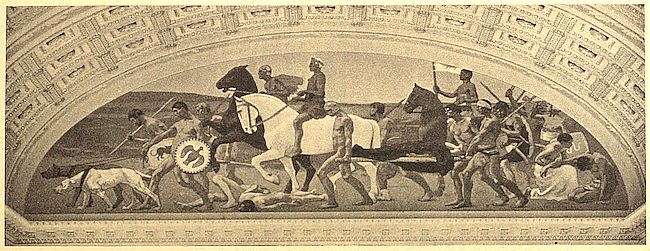
WAR.—BY GARI MELCHERS.
THE RECTANGLE: FIRST FLOOR CORRIDORS.
The only rooms on the first story of the Rectangle which require a special description are the galleries and pavilions stretching from the Main Entrance Hall along the west front of the building. As has been said before, entrance to these is through two corridors, leading to the north and south. The corridors look out upon the interior courts; the floors are of mosaic, and the walls are painted in simple tones of color with pilasters of Vermont marble polished to a peculiarly soft and waxy surface. The ceiling is a succession of small domes in white and gold. In the centre of each is a large gilt rosette. Around it are hexagonal coffers, or panels ornamented with painted figures. The broad arches between are decorated with coffers and panels in relief, and, finally, the tympanums beneath the domes (one at either end of the corridor, and seven along the west wall) are occupied with panels representing, in the corridor to the south, which the visitor is now supposed to have entered, The Greek Heroes.
Mr. McEwen’s Paintings.—The series is the work of Mr. Walter McEwen. The special subjects are incidents, as related in Greek mythology, in the lives of the following heroes, taking the paintings in order from north to south: Paris, Jason, Bellerophon, Orpheus, Perseus, Prometheus, Theseus, Achilles, and Hercules.
Paris, son of Priam, King of Troy, was brought up as a shepherd on Mt. Ida. When a dispute arose among the three goddesses, Juno, Minerva and Venus, as to who should possess a golden apple inscribed “To the Fairest,” which Eris (Strife) had flung in the midst of an assembly of the deities, Paris was selected by Jupiter to decide their quarrel. He awarded the apple to Venus, who promised him the most beautiful woman in the world to be his bride. Hearing of the charms of Helen, wife of Menelaus, King of Sparta, Paris sailed to Greece, and by the aid of Venus carried her away to Troy—thus provoking the expedition of the Grecian chiefs, and the ten years’ siege of Troy. Mr. McEwen’s painting shows Paris at the court of Sparta, conversing with Menelaus, while Helen sits listening beside her husband.
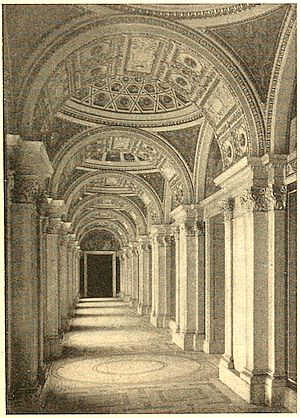
CORRIDOR OF THE SPECIAL READING ROOMS.
Pelias, King of Iolchos in Thessaly, was warned by the oracle to beware of his nephew Jason. He therefore sent him in search of the Golden Fleece. This had belonged to a ram which had miraculously carried Phryxus and Helle, a brother and sister in danger of their lives through the cruelty of a stepmother, across the sea to Colchis. Here, when the ram died, Phryxus hung up its fleece in the grove of Mars, where it was guarded by a sleepless dragon. Jason accepted the quest, and is here shown inviting the Grecian heroes to join in the voyage which he is to make to Colchis in the ship Argo—to enroll themselves in the famous band of the “Argonauts.”
The third painting shows Bellerophon receiving from Minerva a golden bridle with which he may guide the winged horse, Pegasus. The hero had incurred the dislike of his kinsman, Proteus, King of Argos, who sent him with a sealed message to Iobates, King of Lycia. The message desired Iobates to cause Bellerophon to be slain. Being unwilling to do this directly, Iobates sent him to encounter the Chimæra, a horrible monster, part lion, part goat, and part serpent, which was devastating his domains, and which had overpowered all who had ventured to attack it. By the help of Minerva and the winged horse, Bellerophon was successful.
Orpheus, who charmed with his song the rocks, the trees, the wild beasts, and even the infernal powers, incurred the wrath of Bacchus, whose divinity he refused to worship. Bacchus therefore inflamed his priestesses, the Mœnads, or Bacchantes, against the poet, who was slain, as here represented by Mr. McEwen, in one of their orgies.
Perseus was the son of Jupiter and Danaë. Danaë’s father had heard that his daughter’s son would be the cause of his death. He therefore set the mother and child afloat in the sea in a chest, which was safely cast upon the island of Seriphos, the ruler of which was Polydectes. By the time Perseus had grown to manhood, Polydectes had fallen madly in love with Danaë, and, fearing lest Perseus should be a bar to his passion, he ordered him to cut off the head of the Gorgon Medusa, whose face turned to stone everyone who looked upon it. Assisted by Minerva, Perseus succeeded in his adventure. Returning to Seriphos he found Danaë persecuted by Polydectes, and, appearing at the palace of the king while he and his court were sitting at dinner, he drew the head of Medusa from his wallet and turned the whole company into stone.
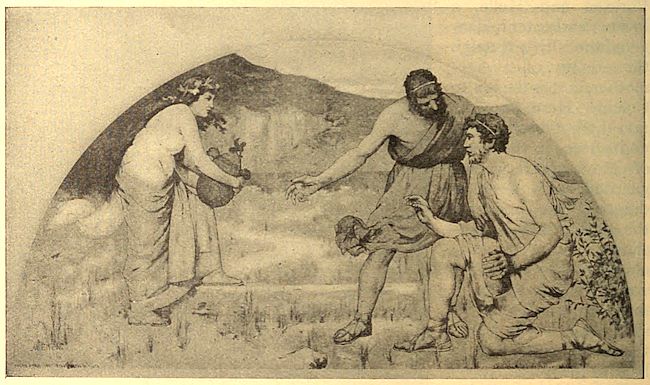
PROMETHEUS AND PANDORA.—BY WALTER McEWEN.
Prometheus is represented as warning his brother Epimetheus not to accept Pandora from the gods. Prometheus, who, with his brother, was the first of mankind, had outwitted Jupiter in the matter of offering sacrifices; Jupiter, in return, had withheld fire from earth. Prometheus, however, secured it by stealth from heaven, and Jupiter in revenge formed Pandora, the first woman, and sent her to become the bride of Epimetheus. Epimetheus disregarded his brother’s advice and took Pandora and with her the fatal box, which, when opened, let loose a cloud of evils to torment, with only delusive Hope to console, mankind.
Theseus is directed by Minerva to leave Ariadne, who sleeps beside him, and proceed to Athens alone. Athens had been compelled for years to send an annual tribute of youths and maidens to Minos, king of Crete, to be devoured by the Minotaur, a savage monster, half bull, half man, who was confined in a Labyrinth. Theseus voluntarily sailed on the tribute-ship, and reaching Crete gained the love of the daughter of Minos, Ariadne, by whose aid he was enabled, after slaying the Minotaur, to find his way out of the Labyrinth. Returning, he bore Ariadne away with him, but deserted her at the island of Naxos, as here depicted, at the command of Minerva. There she was found by Bacchus, who made her his bride.
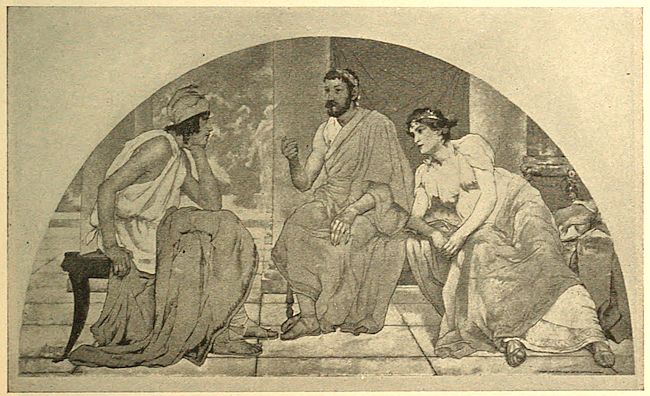
PARIS AND HELEN.—BY WALTER McEWEN.
Achilles, disguised as a maiden, and living among the women of the court of Lycomedes, king of Scyros, is discovered by Ulysses. Thetis, the mother of Achilles, had been forewarned that her son would die an early death, as it turned out afterwards that he did, being slain by Paris before the walls of Troy. She therefore dipped him, while still an infant, in the River Styx. He was thus made invulnerable in every part of his body except his heel, by which his mother had held him, and which therefore remained unaffected by the sacred water. To make assurance doubly sure, Thetis sent him to Lycomedes to be reared as a maiden, far from the dangers of war. When the Greeks were arming for the siege of Troy, the oracle informed them that without Achilles the city could never be taken. The crafty Ulysses was therefore sent in search of him. He arrived at the court of Lycomedes disguised as a pedler, bearing in his basket weapons of war and feminine trinkets. Showing these among the women, all were eager to examine the ornaments; Achilles clutched at the sword and shield, thus discovering himself immediately to the keen eye of Ulysses.
Hercules was sold as a slave by Mercury to Omphale, Queen of Lydia. They became enamored of each other, and Hercules, to please her, wore female garments, and spun among the female slaves. The artist here exhibits him aiding the queen in her task.
THE HOUSE READING ROOM.
Mr. McEwen’s corridor opens directly into a richly decorated gallery, serving as a special reading room for members of the House of Representatives. No apartment in the Library is more lavishly and sumptuously ornamented. The floor is dark quartered oak; the walls have a dado of heavy oak panelling about eleven feet high; and the deep window-arches are finished entirely in the same material. Above the dado the walls are hung with olive green silk. The ceiling is beamed and panelled, and is finished in gold and colors, with painted decorations in the panels, and encrusted conventional ornament in cream white along the beams. Over the three doors are carved oak tympanums, by Mr. Charles H. Niehaus, comprising two different designs—the first a central cartouche bearing an owl, and supported on either side by the figure of a seated youth; the other, the American eagle flanked by two cherubs. At either end of the room is a magnificent mantel of Sienna marble. Over the fireplace is a large mosaic panel by Mr. Frederick Dielman, representing, at one end of the room, Law, and at the other, History. Above is a heavy cornice, supported on beautiful columns of Pavannazzo marble, the general color of which is gray instead of yellow, but with a system of veining which agrees very well with that of the Sienna. In the centre of the cornice is a small cartouche, of green onyx in the mantel to the south, and of labradorite, or Labrador spar, in the other, the latter stone being remarkable for its exquisite gradations of deep peacock-blue, continually changing with the light and the point from which it is seen.
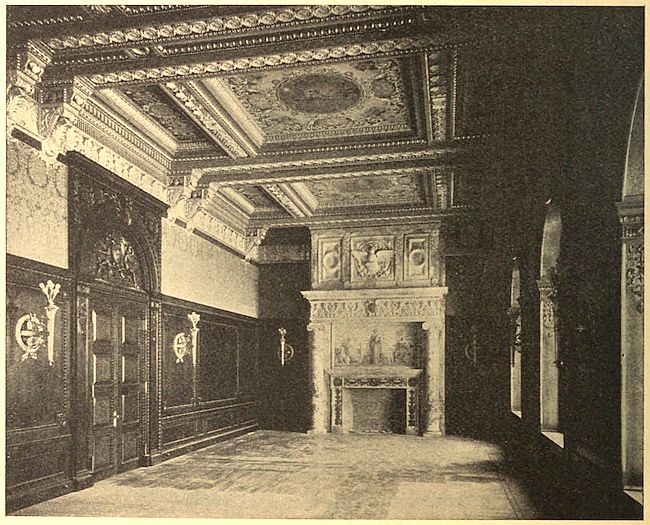
THE HOUSE READING ROOM.
Mr. Dielman’s Mosaics.—Mr. Dielman’s mosaic panels are of the same size and shape, each being seven and a half feet wide and three feet seven inches high. They were executed in Venice, which for generations has been celebrated for the delicacy, accurate coloring, and nicety of fitting, of its mosaics. The process and methods used in this work are much the same as in the ordinary sorts of mosaic—such as would be required for a ceiling, for example—although, of course, the pieces, or tesseræ, must be fitted with much greater care and patience, so that every piece may take its place in a perfect gradation of color. The work of the painter consisted in making full size cartoons in the exact colors desired in the mosaic; from these the Italian workmen prepared the finished panels, and sent them to this country ready to be put in place. The cartoons, however, were necessarily painted as much as possible in simple outlines and shades of color, for, although the Italian shops are said to have at their command enamels of no less than twenty-five thousand different tints, it would be obviously impossible with such a material to reproduce exactly every variation of tone and line of which the brush is capable. Certain refinements of technique, therefore, and more especially the vagueness of color which is often so desirable in the painted canvas, must be avoided in a cartoon made for such a purpose as Mr. Dielman’s.
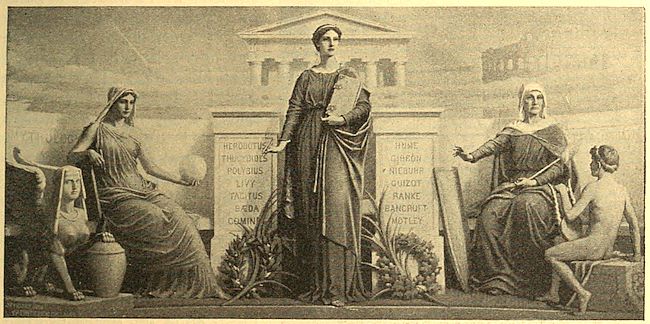
HISTORY.—BY FREDERICK DIELMAN.
The mosaic at the north end of the room represents Law, typified by a young and beautiful woman seated on a massive marble throne and holding in one hand a sword with which to chastise the guilty, and in the other a palm branch with which to reward the meritorious. Her head is surrounded by a glory, and she wears on her breast the Ægis of Minerva to signify that she is clad in the armor of righteousness and wisdom. On the steps of her throne are the scales of Justice and the book of Law, and a pair of white doves emblematic of mercy. The visitor will notice that Mr. Dielman’s conception of Law includes the conventional typification of Justice, but at the same time slightly differs from it. The reason is that he has wished to indicate not only the judicial but the legislative side of Law; hence the freer air of command, and, in particular, the outdoor landscape of woods and hills, signifying a less restricted authority than that of the courtroom. Such a typical symbol of Justice as the scales is less conspicuously introduced, and the usual globe is entirely omitted.
To the left of the central throne are three figures representing, as one may see by the names in the streamer above them, respectively Industry, Peace, and Truth, the friends and supporters of Law; while to the left Mr. Dielman introduces three other figures typifying Fraud, Discord and Violence, the enemies of Law. Industry and Violence are represented as male figures; the other four as female. Very appropriately, the first group seems to be advancing unafraid toward the throne of the Goddess; while the figures to the right shrink terrified from her presence. The emblems which distinguish the various figures are easily understood: Industry with a wheel and hammer; Peace with an olive-branch and crown of olive; Truth with the lilies; Fraud, represented as a withered hag; Discord, with disordered hair and garment, and holding a pair of knotted serpents; and Violence, in a steel cap with the blazing torch lying on the ground before him.
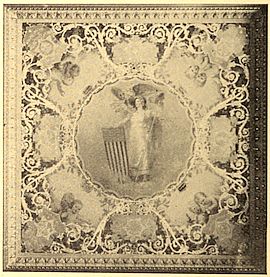
GOVERNMENT.—BY CARL GUTHERZ.
Mr. Dielman’s second panel represents History. The titular figure, that of a woman of great charm and beauty, stands in the centre holding a pen and a book. On either side are marble tablets bearing the names of great historians—Herodotus, Thucydides, Polybius, Livy, Tacitus, Baeda, Comines, Hume, Gibbon, Niebuhr, Guizot, Ranke, Bancroft, Motley. At the foot of one tablet is a laurel wreath, for peace, and on the other side an oak wreath, for war—the twin topics of history—each accompanied by a palm branch, the general reward of success. On either side of the panel extends a marble bench on which are seated two female figures representing Mythology and Tradition, the predecessors of history. Mythology, the expounder of the ancient tales of the gods and heroes, stands for theories of the system of the universe, in token of which she holds in her right hand a globe of the earth. Beside her is a sphinx—the female sphinx of the Greeks, not the male sphinx of Egypt—suggesting the eternally insoluble Riddle of the World. At the other end of the panel, Tradition, an aged granddame, relates her oldwives’ tales to the boy who sits listening before her. The figure represents the whole body of mediæval legend and folk-tale. Reminders of a past age are brought out in the distaff she holds in her lap, the Romanesque capital on which the boy sits, the harp he holds in his hand—with its reference to the wandering minstrel of the Middle Ages and his store of tales—and in the shield, very likely the text of the story which is being told, which leans against the tablet.
In the background of the panel, seeming to float amidst the clouds, are three ancient buildings, an Egyptian pyramid, a Greek temple, and a Roman amphitheatre—signifying the three nations of antiquity in which History was most highly developed.
Mr. Gutherz’s Paintings.—Along the centre of the ceiling are seven panels containing decorations by Mr. Carl Gutherz, representing The Spectrum of Light. Each of the seven colors shown in the spectrum is typified by a central figure standing for some phase of achievement, human or divine. Other features of the panel are two cherubs in each corner, representing arts or sciences, and a series of eight escutcheons, one with the title of the decoration, and the other containing the seals of the various States, the whole being combined in a single arabesque pattern by an elaborate design of scroll ornamentation.
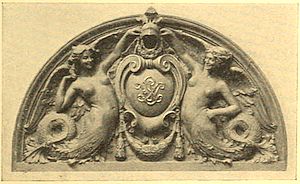
OAK DOORHEAD.—SENATE READING ROOM. BY HERBERT ADAMS.
The order of the subjects begins in the centre and goes first north and then south from that point. The color of the centre panel is Yellow, and the subject The Creation of Light. The Divine Intelligence, sitting enthroned in the midst of Space, and enveloped in mist and clouds, utters the words, “Let there be Light.” The corner figures represent Physics, Metaphysics, Psychology, and Theology.
The second color is Orange, and the subject The Light of Excellence, suggested to the artist by Longfellow’s poem, Excelsior. A spirit stands midway on a pyramid of steps (signifying Progress), which is lost in the unknown distance. She beckons to man to join her on the heights where she is standing, and holds in one hand the wreath which crowns every effort for Excellence. In the corner, the cherubs typify Architecture and Sculpture; Transportation; the Phonograph and Telephone; and Invention and Design.
The third panel is Red, representing The Light of Poetry. Poetry, mounted upon Pegasus, holds a torch in one hand and with the other reaches toward that light of the ideal for which he must always strive, but which he can never attain. In the background half-seen figures represent the afterglow of Tradition and Mythology. The corner groups stand for Tragedy and Comedy; Lyric Poetry; Pastoral Poetry; and Fable.
Violet, the fourth color, is symbolized as The Light of State. The United States being regarded as the highest form of government yet achieved, its emblems are selected as the best expression of the ideal State. This being the case, Violet was the color under which, according to the conception of the artist, the United States might best be represented, since violet results from the union of the American colors, Red, White, and Blue. The figure is that of Columbia, with a shield emblazoned with the United States flag, and carrying a staff surmounted by a liberty-cap, while the American eagle hovers above her shoulder. The cherubs in the corners represent the Suffrage, Justice, Liberty, and Equality.
The next subject is Green, or The Light of Research. The central figure is the Spirit of the Lens, which in the telescope and the microscope reveals to the scientist the secrets of the universe. She is surrounded by the sea, with its myriad forms of life furnishing her with the material for her investigations. The cherubs in one corner have a microscope. In another, they represent Chemistry; in the third Archæology (Egyptology deciphering the hieroglyphics); and in the fourth, Mineralogy—all selected as being especially concerned with original investigation and research.
Blue is The Light of Truth. The Spirit of Truth crushes the dragon of Ignorance and Falsehood under foot, and reaches to heaven for a ray of light with which to inflict the final wound. The blue of the background is the blue of daylight,—light from darkness. The cherubs hold the level, the plumb, and the Bible, each considered as an agent in indicating the presence of a universal law.
The last panel represents Indigo as The Light of Science. The figure represents Astronomy, who is guided by the soul (figured as a butterfly fluttering above her head) to explore the movement of the stars. The cherubs represent various phases of astronomical study. One of the figures, for example, explains the theory of mathematics, showing on the fingers of the hand that one is the unit of everything; a second looks through a telescope; and others are studying books and making calculations.
SENATE READING ROOM.
At the end of the corridor leading to the House Reading Room, is a little lobby, from which one enters the Southwest Pavilion, or Senate Reading Room, reserved for the use of members of the Senate. The little lobby itself is one of the most beautiful examples of pure architectural design to be found in the Library. The walls are of Vermont marble—the same as in the corridor—panelled with Sienna marble. The moulded ceiling is finished entirely in gold, with a central rosette, surrounded by coffers and conventional Greek mouldings, one of which, a rather elaborate fret, is laid upon a ground of deep red. The whole effect of the decoration, taken in connection with the low light which prevails, is remarkably fine—a combination of great richness with soberness and refinement.
The Senate Reading Room is finished in much the same style as the House Reading Room, but with less elaboration of ornament. On the whole, the effect, though quieter, is perhaps more restful and satisfying. A toilet room, leading from the lobby just spoken of, cuts off a portion of the pavilion, but allows space above for a low gallery enclosed by a delicately carved balustrade of Sienna marble. Below, the oak dado is ornamented with delicate inlaid arabesques of white mahogany. Above the dado the walls are covered with figured red silk. In the southwest corner is a fireplace of Sienna marble, with a sculptured panel of the same material by Mr. Herbert Adams. The design shows an eagle with arrows in his claws, and an American shield supported by flying cherubs. The doorhead tympanum is of oak, like those in the House Reading Room, and contains a carved panel, also by Mr. Adams, with a heraldic shield bearing the monogram, “U. S. A.,” and supported by mermaids. The gold ceiling contains six square panels, each containing four graceful female figures holding garlands in their hands—the work of Mr. William A. Mackay.
THE NORTH CORRIDOR.
The corridor leading to the north from the Main Entrance Hall is, as has been said, similar in design to that opening into the Congressional Reading Rooms. The design of the floor and ornament upon the arches is somewhat different, however. The tympanums which it contains are ornamented by a series of paintings, by Mr. Edward Simmons, representing the nine Muses.
Mr. Simmons’s Paintings.—The Muses, according to the Greek mythology, were the goddesses of the various departments of Art, Poetry, and Science. Apollo, the God of Song, was their father, and Mnemosyne (Memory) their mother. Their names, given in the order in which they occur in Mr. Simmons’s series, beginning at the south end of the corridor, were as follows: Melpomene, Clio, Thalia, Enterpe, Terpsichore, Erato, Polyhymnia, Urania, and Calliope. Melpomene was the Muse of Tragedy; Clio, of History; Thalia, of Comedy and Bucolic Poetry; Enterpe, of Lyric Song; Terpsichon, of Dancing; Erato, of Erotic Poetry; Polyhymnia, of Sacred Song; Urania, of Astronomy; and Calliope, of Epic Poetry.
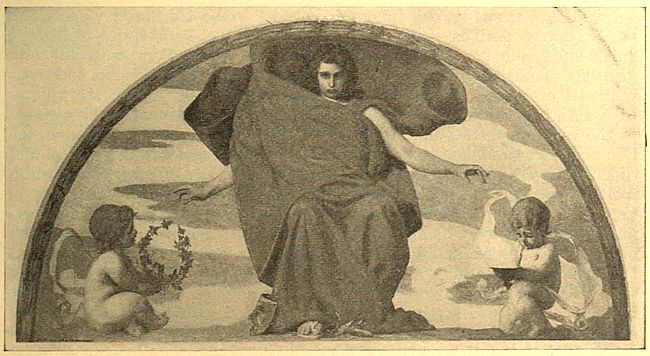
MELPOMENE.—BY EDWARD SIMMONS.
In Mr. Simmons’s panels, each of the Muses is shown as a seated figure. On either side a laurel wreath is displayed, as the general symbol of intellectual pursuits, and the background is diversified by curving lines of smoke proceeding from the flame of a torch or a censer—thus signifying the inspiration of Art and Poetry. In several of the tympanums the Muse is accompanied by little geniuses who serve to bring out the special character of the central figure. In the panel devoted to Thalia the genius is a satyr, with goat’s legs, and carrying a pair of Pan’s pipes. The Muse playfully catches him in a fold of her garment—the whole suggesting the rustic sportiveness of the early Greek Comedy. Certain of the panels, also, contain various distinguishing objects. Melpomene, for example, is accompanied by a tragic mask; Clio by a helmet, for the warlike exploits recorded by History; Thalia, by a comic mask; Urania by a celestial globe. Terpsichore is represented as if swaying to the music of the dance, and is striking a pair of cymbals. Erato is nude, and bears a rose—the flower of love—in her hand. Polyhymnia holds an open book in her lap. One of the geniuses in the tympanum of Calliope holds a scroll, and the other some peacock’s feathers—the latter symbolical, perhaps, of the dignity and beauty of the Epic.
SPECIAL ROOMS.
Of the two rooms leading from this corridor—the Northwest Gallery and the Northwest Pavilion—the first is decorated in a cheerful spring-like green ornamented with garlands, and the Pavilion in a deep Pompeiian red with medallions containing figures of dancing girls, by Mr. R. L. Dodge, and conventional ornaments adapted from Pompeiian designs. In the six window bays, also, is the series of the signs of the zodiac, designed by Mr. Thompson.
The various galleries and pavilions on this floor, excepting, of course, the Congressional Reading Rooms, are designed to accommodate the clerical and cataloguing work of the Library and the Copyright Department, or to furnish room for special collections of books. There is every reason to hope that in time many valuable private libraries throughout the country will find their permanent home in some one of these apartments, given or bequeathed by their owners to the Nation, and preserved for all time in convenient, well lighted and fireproof rooms as a memorial to the liberality of their donors. Already one such collection has been received, presented several years ago to the Library by the late Dr. J. M. Toner of Washington. It is kept by itself in the Northeast Pavilion. The most remarkable feature is its Washington letters, gathered either in the original or in copies, during a period of many years.
THE BASEMENT.
The basement of the Library, which may be reached through the doors under the staircases in the Main Entrance Hall, is arranged in the same way as the first and second stories, except that the whole floor is connected by a series of corridors which extend entirely round the building.
The walls of the West Pavilion are sheathed in a dado of white Italian marble about ten feet high, above which is a vaulted ceiling ornamented with a bright, open arabesque in green, blue, and yellow on a cream-colored ground. The corridors have dados of American marbles, usually dark in color, as Lake Champlain or Tennessee. For the walls and vaults, plain colors harmonizing with the marble and set off with simple arabesques and borders, have been used. The effect is well worth the attention of the visitor—the rich tones of the marble and the brighter coloring of the walls and vaults framing a long vista seen through a succession of low, narrow arches.
THE
ARCHITECTURE
SCULPTURE AND PAINTING
BY CHARLES CAFFIN
THE ARCHITECTURE SCULPTURE AND PAINTING BY CHARLES CAFFIN
It is interesting to note that the ground plan of the new Library of Congress was suggested by that of the British Museum. There, however, the central reading room was placed inside the quadrangle as an afterthought. Building on this, as well as on the architectural experience of other libraries, our own Library has had the advantage of organic growth. Every part is related to the whole, and practical and æsthetic requirements are logically and naturally fulfilled.
These requirements were: an imposing edifice, with plenty of well-lighted rooms; facilities for the storing of books; and ample space for the reading and general public. With one exception the exterior of the building indicates the character and relative importance of the interior divisions. That exception is the book-stacks, radiating from the sides of the Rotunda or central reading room. But their position is in completely natural relation to the rest, and by being hidden from the outside, they could be made just what they pretend to be, viz. huge book-shelves of iron, bricks, and marble, well lighted and ventilated. Their construction is æsthetically perfect, and yet without injury to the façades.
The latter, albeit severe and lacking the indefinable artistic spirit of the Capitol, are grand and imposing. The ground floor, resting on a continuous plinth, is constructed of huge blocks, quarry or rock-faced, with bold joints and square lights. The masonry of the first story is fine pointed with vermicular or coral-like quoins at the angles of the pavilions. In the second story, the bel étage, the face of the granite is smooth; the windows are framed with pilasters and surmounted with pediments; the pavilions are emphasized by porticoes resting on Corinthian columns. The horizontal mouldings are boldly accentuated and carefully graduated, terminating in a modillioned cornice surmounted by a balustrade. The shadow effects are strong and tender, and the set-back of each floor well marked.
While the exterior of the building represents a single thought and one engrossing individuality, the interior reveals a complexity of thought and a variety of distinct personal influences, due to the parts played by the sculptors and painters. Yet there is no lack of homogeneousness. The architect has balanced the individual notes by the breadth and force with which he has treated the purely decorative parts of his scheme. His effects are massed. Sumptuous expanses of mosaic, or painted surfaces, or stuccoed vaults, compel our attention and divide our interest with the special objects of beauty. The spectator’s mind is not bewildered by a jumble of elaboration, but passes quietly from one impression to another. On entering the Entrance Hall, for instance, marble is beneath our feet and on all sides of us. The impression is instantaneous, irresistible, and entirely undistracted. In the adjoining halls, the prevailing theme is varied by the colors of the marble mosaic vaults, which assert their own beauty at the same time that they modestly bring the painted compositions of the tympanums into color-relation with the grey-white marble walls.