TABLE OF HEADINGS. (continued 2)
Reading edition
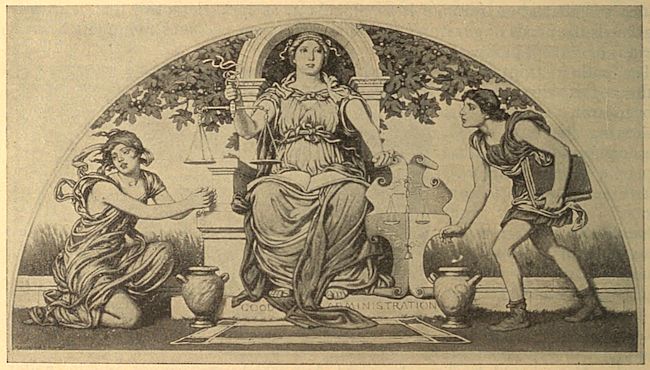
GOOD ADMINISTRATION.—BY ELIHU VEDDER.
On the other side of the central tympanum, Good Administration sits holding in her right hand a pair of scales evenly poised, and with her left laid upon a shield, quartered to represent the even balance of parties and classes which should obtain in a well ordered democracy; on this shield are emblazoned, as emblems of a just government, the weight, scales, and rule. The frame of her chair is an arch, a form of construction in which every stone performs an equal service—in which no shirking can exist—and therefore peculiarly appropriate to typify the equal part which all should take in a democratic form of government. On the right is a youth who casts his ballot into an urn. He carries some books under his arm, showing that education should be the basis of the suffrage. To the left is another voting-urn, into which a young girl is winnowing wheat, so that the good grains fall into its mouth while the chaff is scattered by the wind—an action symbolical of the care with which a people should choose its public servants. In the background is a field of wheat, a last touch in this picture of intelligence and virtue, and, in itself, symbolical of prosperous and careful toil.
In the last panel, that of Peace and Prosperity, the central figure is crowned with olive, the emblem of peace, and holds in her hands olive-wreaths to be bestowed as the reward of excellence. On either side is a youth, the one to her right typifying the Arts, and the other, Agriculture. The former sits upon an amphora or jar, and is engaged in decorating a piece of pottery; behind him is a lyre, for Music, and in the distance a little Grecian temple, for Architecture. The other is planting a sapling,—an act suggestive of a tranquil, just, and permanent government, under which alone one could plant with any hope of enjoying the shade and fruit of after years. The background of the picture is a well-wooded and fertile landscape, introduced for much the same purpose as the wheat-field in the preceding tympanum.
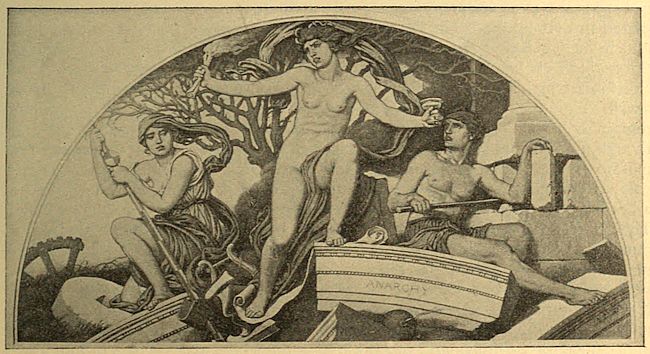
ANARCHY.—BY ELIHU VEDDER.
Still another piece of symbolism is expressed in this interesting series of pictures by the trees, their foliage forming the background against which the central figure is placed. The oak in the central panel has been spoken of. In the design representing Peace and Prosperity, an olive-tree typifies not only Peace but Spring; in the next panel, that of Good Administration, the tree is the fig, and the season summer; in that of Corrupt Legislation, the autumnal vine, hinting at a too abundant luxury, and with its falling leaves presaging decay; and in that of Anarchy, bare branches and Winter.
The Second Floor Corridors.—Returning again to the Entrance Hall proper, the visitor may most conveniently continue his tour of the Library by ascending the Grand Staircase to the beautifully decorated corridors of the second-story arcade, on his way to the public galleries of the Main Reading Room. The corridors are arranged like those which the visitor has already passed through on the first floor, but their greater height and the brighter tone of the decoration give an effect of considerably greater spaciousness.
The Decoration of the Vaults.—The floors of the corridors are laid in mosaic of varying patterns. The ceilings are uniformly a barrel vault, with pendentives—the same, that is, as those of the North, East, and South Corridors below. The vaults are covered with a painted decoration of Renaissance ornament which for variety and interest is hardly surpassed anywhere else in the building. The decorative scheme which has been adopted was planned throughout by Mr. Casey, and elaborated, especially in the matter of color, and carried into effect, by Mr. Garnsey, working under Mr. Casey’s direction. In addition, each corridor contains, as a distinctive accent of color and design, a series of paintings by a specially commissioned artist—in the West Corridor by Mr. Walter Shirlaw, in the North Corridor by Mr. Robert Reid, in the East Corridor by Mr. George R. Barse, Jr., and in the South Corridor by Mr. Frank W. Benson. In the side corridors, also, at the west end, the arch of the vault is spanned by a broad band of stucco ornament containing a series of octagonal coffers, ornamented in relief by Mr. Hinton Perry.
The decoration is varied, of course, from corridor to corridor, in order to prevent any monotony of impression, but the main principles on which it is based are everywhere the same. Thus the color scheme—which was suggested in part by the beautiful Library in Sienna—comprises in every corridor blue in the pendentives, golden yellow in the penetrations, and a grayish white in the body of the vault. The only exception to this rule is in the West and East Corridors, which are terminated by double arches instead of ending directly upon a wall. Here the end penetrations are red and the pendentive yellow. The others remain as before. The delineation of the spaces is at bottom very simple, and though more elaborate, a good deal like that already noted in describing the mosaic in the lower corridors. The penetrations are outlined by a bright colored border, on which, where the lines converge to a point at the top, rests a border of greater width, enclosing the entire vault in a single great rectangle. This, in turn, is divided into compartments by bands of ornament, varying in number according to the requirements of the decoration, but always occurring immediately over the columns of the arcade. These bands, coming where they do, perform a vital service for the decoration in continually reminding the visitor, if only by a painted arabesque, of the importance of the arch in such a piece of construction as a vault. In the spaces between them are garlands and wreaths, and panels for paintings and inscriptions—the whole making part of one great arabesque, which is as easily intelligible and coherent as it is various, but which would have been bewildering in its wealth of ornament and color if it had not been for the fundamental service performed by these various bands and borders and broad masses of color.
The penetrations and pendentives are richly embellished with a great variety of ornament, both conventional and otherwise. The treatment differs in different corridors, however, on account of the varying relative position of the paired columns which support the arcade—from which results first a series of wide and then a series of narrow pendentives. Where the former occur—in the West and East Corridors—they are ornamented with the decorations of Mr. Shirlaw and Mr. Barse; while the narrower pendentives on the north and south carry simple medallions and tablets, and Mr. Reid’s and Mr. Benson’s paintings find place in the arabesque of the ceiling vault and in circular frames along the wall beneath. The balance is restored, however, by introducing a series of medallions, corresponding to Mr. Benson’s and Mr. Reid’s, though smaller and of less importance, in the vaults east and west, and by ornamenting the penetrations in the side corridors with greater richness and elaboration.
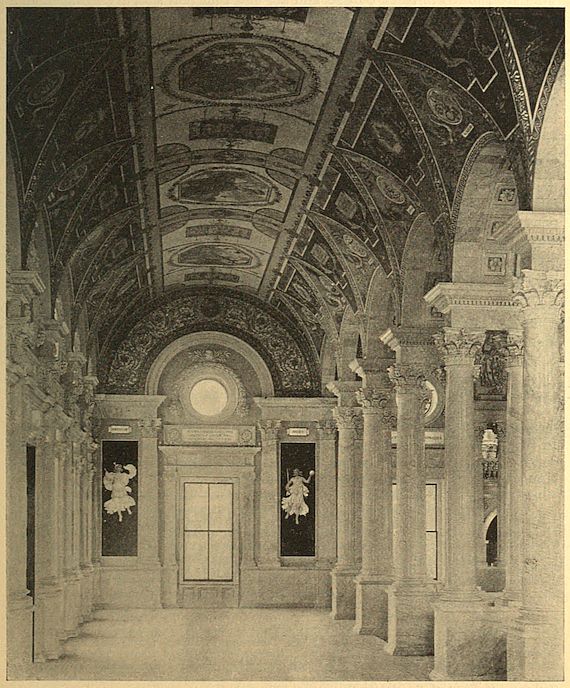
THE NORTH CORRIDOR, SECOND STORY, MAIN ENTRANCE HALL. SHOWING DECORATIONS BY GEORGE W. MAYNARD AND ROBERT REID.
The Printers’ Marks.—The most interesting decoration of the penetrations, however, is a series of “Printers’ Marks” which is continued through all four corridors. Altogether there are fifty-six of them—sixteen in each of the side corridors, ten in the West Corridor, and fourteen in the East Corridor. They are painted in black outline, and are of a sufficient size, averaging about a foot and a half in height, to be easily made out from the floor. By a printer’s mark, it should be explained, is meant the engraved device which the old printers used in the title-page or colophon of their books, partly as a kind of informal trade-mark guarding against counterfeited editions, and partly as a personal emblem, such as a publisher of good standing would like to see on a long list of worthy books. For this latter reason, and in order to be able to add an interesting piece of ornament to the title-page, the mark has been revived of late years by a considerable number of modern publishing and printing houses.
Very often, as the visitor will see, the printer’s mark is, in its way, a really beautiful piece of design; many have an interest as being associated with the reputation of a famous printer like Caxton, or Aldus, or Elzevir; while others depend mainly for their point upon some special symbolical meaning, very frequently taking the form of an illustrated pun. Thus, in the West Corridor, the mark of Lotter—which means “vagrant” in German—is a mendicant supplicating alms. In the South Corridor, the mark of Geoffroy Tory commemorates the death of his little daughter—the broken vase, with a book symbolizing the literary studies of which she had been fond.
There is no necessity, however, of describing the marks in detail, for, with the exception of two or three American examples, they were all taken from Mr. William Roberts’s Printers’ Marks (London, 1893), in which they are illustrated and explained. Those thought best adapted for decorative effect were chosen throughout, although the marks of as many of the better known printers as possible were included. Occasionally a border or a motto was omitted, but in the main Mr. Roberts’s engravings were pretty exactly copied. In the West Corridor the marks are mostly those of German printers; in the South Corridor, French; in the East Corridor, Italian and Spanish; in the North Corridor, English and Scottish and American.[7]
Mr. Hinton Perry’s Bas-Reliefs.—Mr. Perry’s bas-reliefs, at the west end of the north and south vaults, have already been referred to. They are four in number, and measure three feet eight inches from one side to another. Taken as a series they represent what may be called, for lack of a better title, Ancient Prophetic Inspiration. The chief figure in each is a sibyl or priestess—Greek, Roman, Persian, Scandinavian—in the act of delivering the prophetic warnings which have been revealed to her in the rapture of a divine frenzy. She is regarded as the mouthpiece of the god, and therefore as the fountain of religion, wisdom, literature, art, and success in war—all of which are typified, in one panel or another, in the figures of her auditors.
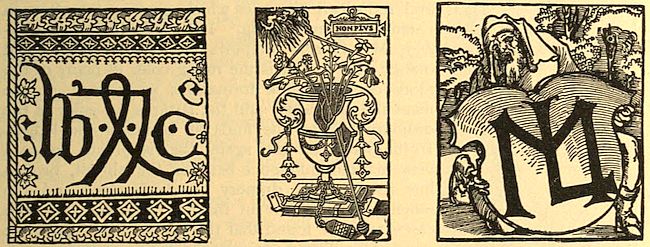
PRINTERS’ MARKS.—CAXTON, TORY, LOTTER.
Beginning in the South Corridor, the first panel shows the Cumæan or Roman Sibyl. She is represented, in accordance with the ancient histories, as an old and withered hag, whose inspiration comes from an infernal, rather than a celestial source. Two figures, as in all the panels, complete Mr. Perry’s group, one male and the other female. The first is clad in the splendid armor of a Roman general; the woman is nude, and stands for Roman Art and Literature. At her feet is a box of manuscripts, and she takes in one hand an end of the long scroll (representing one of the Sibylline Books, so famous in Roman history) which the Priestess holds in her lap. The panel on the other side of the arch represents a Scandinavian Vala or Wise Woman, with streaming hair and a wolf-skin over her head and shoulders. She typifies, in her bold gesture and excited gaze, the barbaric inspiration of the Northern nations. To the left is the figure of a Norse warrior, and to the right a naked woman lies stretched upon the ground, personifying the vigorous life and fecundity of genius of the North.
In the North Corridor, the subjects of Mr. Perry’s two decorations are Greek and Persian Inspiration. The former is represented by the Priestess of the world-renowned Oracle of Apollo at Delphi. She is seated upon a tripod, placed above a mysterious opening in the earth, from which the sacred fumes rise to intoxicate the Priestess, and fill her with the spirit of prophecy. On one side of the panel, an old man, standing for Greek science and philosophy, takes down her words on a tablet; on the other is a nude female figure, personifying Greek art and literature. In the second panel, that of Persia, the face of the Sibyl is veiled, to signify the occult wisdom of the East. A man prostrates himself at her feet in a fervor of religious devotion, and a woman, nearly nude, stands listening in the background. With her voluptuous figure and her ornaments of pearl and gold—a fillet, anklets, armlets, and necklace—she represents the luxuriance and sensuousness of Eastern art and poetry.
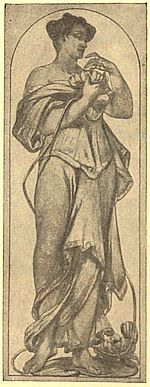
BOTANY. BY WALTER SHIRLAW.
Mr. Shirlaw’s Paintings.—The subjects of Mr. Shirlaw’s figures in the vault of the West Corridor are, on the west, beginning at the left: Zoölogy, Physics, Mathematics, and Geology; and on the east, again beginning at the left: Archæology, Botany, Astronomy, and Chemistry. Each science is represented by a female figure about seven and a half feet in height. The figures are especially interesting, aside from their artistic merit, for the variety of symbolism by which every science is distinguished from the others, and for the subtlety with which much of this symbolism is expressed. Not only is each accompanied by various appropriate objects, but the lines of the drapery, the expression of the face and body, and the color itself are, wherever practicable, made to subserve the idea of the science represented. Thus the predominant colors used in the figure of Chemistry—purple, blue, and red—are the ones which occur most often in chemical experimenting. In the pendentive of Geology, Mr. Shirlaw employs principally purple and orange; the former is the ruling color in many of the more common rock formations when seen in the mass and naturally; and the latter is the color of the ordinary lichens one finds on boulders and ledges. In the matter of line, again, the visitor will notice a very marked difference between the abrupt, broken line used in the drapery of Archæology, and the moving, flowing line in that of Physics. In both cases it will be found that the line is in very complete sympathy with the character of the science depicted. The method of archæology is largely excavation carried on among sculptural and architectural fragments. The swirling drapery of Physics is suggestive of flame and heat.
Zoölogy is represented with a lion seated beside her, her hands clasping his mane. She is the huntress and student of wild life, and her body is powerfully developed, like an Amazon’s. She is clad in the pelt of an animal, the head forming her cap, and in buskins of skin. She stands on a rocky piece of ground, like a desert. The chief colors employed in the pendentive are the typical animal colors, browns and yellows.
Physics stands on an electric globe, from which emanate rays of light. She carries a torch in her left hand, and she holds up an end of her drapery in her right in such a way that it seems to start from the flame and flow in sympathy with it over her whole body, so that it conveys the idea of the unceasing motion of fire. The same colors as those used in the pendentive of Geology, purple and orange, are used here also, but in this case standing, of course, for the colors of flame.
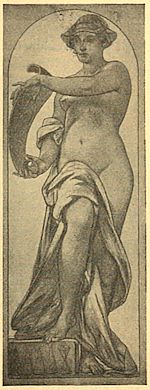
MATHEMATICS. BY WALTER SHIRLAW
Mathematics, the exact science, is represented as almost entirely nude,—like “the Naked Truth” of Mr. Walker’s tympanum on the floor below. Her right foot is on a stone block inscribed with the conic sections, and on a shield which she holds are various geometrical figures. Her scanty drapery is appropriately disposed in the severest lines.
Geology, a sculpturesque figure, stands squarely and firmly upon a mountain top, beyond which is seen the setting sun. A fold of her drapery forms a receptacle for the specimens she has gathered. In her left hand is a globe, and in her right a fossil shell. Her hair is confined by a head-dress of bars of silver and gold. The embroidered pattern of her garment has a suggestion of fossil forms and of the little lizards which are found among the rocks.
Archæology is clad in the Roman costume, and wears the helmet of Minerva; the helmet is wreathed with olive, the emblem of peace, which was sacred to Minerva, and is here used with special reference to the peaceful character of the science, which can pursue its labors only in an orderly society. The figure stands on a block of stone, the surface of which is carved to represent a scroll, the ancient form of book. A vase, copied from the manufacture of the Zuñi Indians of New Mexico, stands beside her. In her right hand she holds a large book, the pages of which she examines with the aid of a magnifying glass in order to spell out its half obliterated text. Around her neck is coiled a chameleon, whose changing hues are intended to symbolize the varying nature of the theories she propounds.
The countenance of Botany is expressive of a joyous sympathy with nature. She stands on the pad of a water-lily, engaged in analyzing its flower, the long stem of which coils gracefully about her body to the water. Her drapery flows and breaks as a half-opened flower might arrange itself.
Astronomy holds a lens, such as is used in a telescope, in her right hand, and in her left the globe of Saturn surrounded by its rings—selected as being perhaps the best known and most easily distinguished of all the planets. She stands on the sphere of the earth, beyond which, to the left, is the quarter moon. The lines of her drapery with their slow curves are suggestive, in a way, of the orbits of the heavenly bodies. They flow in long lines, enveloping her figure in the strength which proceeds from complete harmony.
Chemistry is shown with her left foot placed upon a piece of chemical apparatus and holding in her right hand a glass retort, in which she is distilling a liquid. The necessary heat, manifested by the ascending vapor which curls about the vessel, is from the mouth of the serpent—the emblem of fecundity and life, breathing the element of life, fire. The serpent is coiled about an hour-glass, which is significant of the exact measurement of time necessary in chemical experiments. The face of the figure is more worn, on account of the anxious nature of her employment, than would comport with the character of an out-of-door science like Botany or Zoölogy. She is draped somewhat in the eastern manner, like a sibyl, thus recalling the occult character ascribed to the science during the Middle Ages—when it was called alchemy—and, for that matter, the marvellousness of its results in the laboratories of to-day. A snake wound as a fillet about her hair still further emphasizes this mystic quality.
At either end of the corridor is a tablet bearing a list of names of men distinguished in the sciences which Mr. Shirlaw has depicted; at the north end: Cuvier, the Zoölogist; Linnæus, the Botanist; Schliemann, the Archæologist; and Copernicus, the Astronomer; at the south end: La Grange, the Mathematician; Lavoisier, the Chemist; Rumford, the Physicist; and Lyell, the Geologist. In the penetrations on either side of these two lists of names are the following appropriate inscriptions:—
The first creature of God was the light of sense; the last was the light of reason. Bacon.
The Light shineth in darkness, and the darkness comprehendeth not. John 1, 5.
All are but parts of one stupendous whole, Whose body Nature is, and God the soul. Pope.
In nature all is useful, all is beautiful. Emerson.
Along the centre of the vault, three medallions by Mr. William B. Van Ingen represent respectively Sculpture, Architecture, and Painting. In each the art is represented by a female figure engaged either in chiselling the features of a bust (that of Washington), drawing the plan of a building, or painting at an easel.
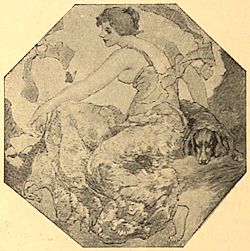
TOUCH.—BY ROBERT REID.
Mr. Reid’s Paintings.—Passing to the North Corridor, the attention is at once attracted to the brilliant coloring of Mr. Reid’s decorations in the vault and along the north wall. The former are five in number, and represent the Five Senses. They are octagonal in form, measuring within an inch of six feet and a half across. The order of the subjects, beginning at the westerly end, is Taste, Sight, Smell, Hearing, Touch. In each the sense suggested is represented by a beautiful young woman, more of the modern than the antique type of beauty, and clad in drapery which recalls contemporary fashions rather than the classic conventions which are usually followed by artists in their treatment of ideal subjects. Being painted upon a ceiling, so that the visitor is required to look directly upward in order to study them, the figures, though, in a sense, represented as seated, are rather to be imagined as poised in the air, without any special reference to the law of gravitation. They are shown as supported upon cloud-banks, and the backgrounds of the panels are sky and clouds.
The suggestion of the subject is as simply as it is ingeniously and unconventionally conveyed. A large portion of this suggestion must be looked for, of course, in the expression of the face and the attitude as well as in the action of the figures. Taste is shown drinking from a shell. She is surrounded by foliage, and a vine grows beside her laden with bunches of ripe grapes. She wears flowers in her hair, and the idea throughout may perhaps be taken as that of the autumnal feast of the wine-press. Sight is looking at her reflection in a handglass, and smiling with pleasure at the evidence of her beauty. A splendid peacock, the emblem of beauty and pride in beauty, is introduced beside her. Smell is represented seated beside a bank of lilies and roses. From this mass of flowers she has selected a great white rose, which she presses to her nose. Hearing holds a large sea-shell to her ear, and dreamily listens to its roaring. Touch is delightedly observing a butterfly which has alighted on her bare outstretched arm—the touch of its tiny feet as it walks over her flesh imparting an unaccustomed sensation to her nerves. A setter dog, which she has just ceased from caressing, lies asleep behind her.
Mr. Reid’s subjects in the four circular panels along the wall are entitled, in order from left to right: Wisdom, Understanding, Knowledge, and Philosophy. Each is represented by a half-length seated female figure—more solidly painted, but of much the same type as the figures representing The Senses—holding a scroll, book, or tablet. In the panel of Philosophy, a Greek temple is seen in the background, emblematic of the Greek origin of philosophy.
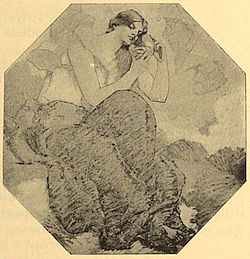
HEARING.—BY ROBERT REID.
Alternating with Mr. Reid’s ceiling paintings, is a series of rectangular panels, in which are depicted, in low tones of color and in a style somewhat suggestive of a classic bas-relief, a number of ancient out-door athletic contests. Beginning at the west end of the vault, the first of these represents a group of young men throwing the discus. Then come Wrestling and Running. In the fourth panel, the athletes are being rubbed down by attendants, to clear them of the sweat and heat of the conflict; and in the fifth, the successful contestants are kneeling to receive the crown of victory at the hands of a woman seated on a dais. The last picture represents the return home, a tripping company of youths and maidens crowned with garlands.
The visitor will remember what was said concerning the special enrichment of the penetrations in the side corridors for the sake of compensating in a way for the absence of such decorations as Mr. Shirlaw’s in the pendentives. In the present instance, this enrichment takes the form of dragons and swans, which serve as “supporters” of the panels containing the printers’ marks.
In the pendentives, tablets for inscriptions alternate with medallions containing trophies of various trades and sciences. The list of the latter, beginning at the left over the north wall, is as follows: Geometry, represented by a compass, a protractor, and a scroll, cone, and cylinder; Meteorology, the barometer, thermometer, and anemometer; Forestry, a growing tree, and an axe and pruning-knife; Navigation, the chronometer, log, rope, rudder, and compass; Mechanics, the lever, wedge, and pulley-block; and Transportation, with a piston, propeller, driving-wheel, and locomotive head-light.
The inscriptions are from Adelaide A. Procter’s poem, Unexpressed, and are as follows:—
Dwells within the soul of every Artist More than all his effort can express. No great Thinker ever lived and taught you All the wonder that his soul received. No true painter ever set on canvas All the glorious vision he conceived. No musician.... But be sure he heard, and strove to render, Feeble echoes of celestial strains. Love and Art united Are twin mysteries, different yet the same. Love may strive, but vain is the endeavor All its boundless riches to unfold. Art and Love speak; and their words must be Like sighings of illimitable forests.
The only other decoration which there is space to mention is the broad, semicircular border which follows the line of the vault on the wall at either end of the corridor. At the east end, this border is ornamented with a bright-colored arabesque, mainly in violet and greens, with a medallion in the centre bearing a map of the Western Hemisphere. At the west end, the border is plainer, with five semicircular or circular tablets, two of which are ornamented with the obverse and reverse respectively of the Great Seal of the United States. The other three carry the following inscriptions:—
Order is Heaven’s first law. Pope.
Memory is the treasurer and guardian of all things. Cicero.
Beauty is the creator of the universe. Emerson.
Mr. Barse’s Paintings.—In the East Corridor, the pendentive figures of Mr. Barse represent, beginning on the east side, at the north end: Lyric Poetry (entitled by the artist, Lyrica), Tragedy, Comedy, and History; and on the west, again beginning at the north, Love Poetry (Erotica), Tradition, Fancy, and Romance. The subject of the entire series, therefore, may be called simply Literature. The figures, as the visitor will perceive, need but little explanation. All are those of women clad in graceful, classic robes, represented throughout as seated, and depicted with little attempt at dramatic expression or action. Lyric Poetry is playing on the lyre. Tragedy and Comedy have a tragic and comic mask respectively, and Comedy a tambourine. History has a scroll and palm-branch, and an ancient book-box for scrolls, such as was used by the Romans, is set at her feet. Romance has a pen and a scroll. Fancy clasps her hands, and gazes upward with a rapt expression on her face. Tradition wears the Ægis, and holds a statue of the winged goddess of Victory in her hand—both introduced as symbols of antiquity. Erotica is writing on a tablet.
Along the centre of the vault, occupying a similar position to the medallions in the opposite corridor, is another series of three paintings, executed by Mr. William A. Mackay, which represent The Life of Man. One will best understand the meaning of the paintings by first reading the inscriptions which are placed immediately above and below each medallion. On one side they refer to the ancient allegory of the Three Fates, Clotho, Lachesis, and Atropos—the first of whom spun, the second wove, and the third cut, the Thread of Life—and are as follows:—
For a web begun God sends thread. Old Proverb.
The web of life ... is of a mingled yarn, good and ill together. All’s Well that Ends Well.
Comes the blind Fury with th’ abhorred shears And slits the thin-spun life. Milton.
On the other side the inscriptions, which compare the life of a man to the life of a tree, are taken from Cardinal Wolsey’s speech in Henry VIII:—
This is the state of man: to-day he puts forth The tender leaves of hopes. To-morrow blossoms. And bears his blushing honors thick upon him. The third day comes a frost, ... And ... nips his root, And then he falls.
Accordingly, in the present series, the first medallion shows a woman (Clotho) with her distaff and a baby lying in her lap. The sun is rising above the horizon, a sapling begins to put out its branches, and near by is a little spring. In the next picture, Lachesis has a loom and shuttle. The spring has grown into a river, and the mature man bears in his hand a basket of fruit gathered from the abundance of the full-grown tree, while the sun in the heavens marks the high noon of life. In the last medallion the sun is setting, the tree has fallen in ruin on the ground, and the stream has dried up. The man, grown old and crippled, faints by the roadside, and Atropos opens her fatal shears to sever the thread of his existence.
At each end of the corridor is a tablet containing the names of eminent American printers, and men who have contributed to the improvement of American printing machinery. At the north these names are: Green, Daye, Franklin, Thomas, Bradford; and at the south, Clymer, Adams, Gordon, Hoe, Bruce.
Mr. Benson’s Paintings.—Mr. Benson’s decorations in the vault of the South Corridor and along the wall below are of the same size and shape as those of Mr. Reid in the North Corridor. The arabesque ornament of the ceiling is so arranged, however, as to allow space for only three instead of five of these hexagonal panels. The subject of the paintings they contain is The Graces—Aglaia (at the east), Thalia (in the centre) and Euphrosyne (at the north).
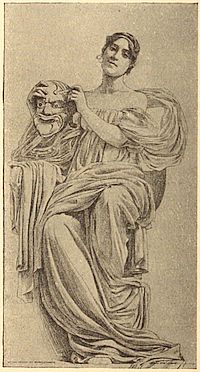
COMEDY. BY GEORGE R. BARSH, JR.
The three figures are almost invariably represented in a group, in both ancient and modern art. Taken together, they stand, of course, for beauty and graciousness, and typify, also, the agreeable arts and occupations. In separating them, Mr. Benson has considered Aglaia as the patroness of Husbandry; Thalia as representing Music; and Euphrosyne, Beauty. The first, therefore, has a shepherd’s crook, the second a lyre, and the last is looking at her reflection in a hand-mirror. All are shown sitting in the midst of a pleasant summer landscape, with trees and water and fertile meadows.
For the four circular panels Mr. Benson has chosen as his subject The Seasons. Each is represented by a beautiful half-length figure of a young woman, with no attempt, however, at any elaborate symbolism to distinguish the season which she typifies. Such distinction as the painter has chosen to indicate is to be sought rather in the character of the faces, or in the warmer or colder coloring of the whole panel—in a word, in the general artistic treatment.
At either end of the vault is a rectangular panel painted in the same style as those depicting the ancient games in the North Corridor, but in this case representing the modern sports of Football and Baseball. The former, occurring at the east end of the vault, is a more or less realistic picture of a “scrimmage.” The latter is more conventionalized, showing single figures, like the pitcher and catcher, in the attitude of play, and others with bats, masks, and gloves.
Instead of the swans and dragons of the North Corridor, the printers’ marks in the penetrations of the present corridor are supported between the figures of mermen and fauns, and mermaids and nymphs, the male figures, with their suggestion of greater decorative strength, occurring at the ends of the corridor, and the nymphs and mermaids alternating between. Altogether there are thirty-two figures, each painted by Mr. Frederick C. Martin.
On the pendentives, the series of trophies begun in the North Corridor is continued, giving place, as before, in every other pendentive, to a tablet bearing an inscription. Beginning on the south side, at the east end, the trophies are as follows: Printing, with a stick, inking-ball, and type-case; Pottery, three jugs of different kinds of clay; Glass-making, three glass vases of different shapes; Carpentry, a saw, bit, hammer, and right angle; Smithery, the anvil, pincers, hammer, bolt, and nut; Masonry, a trowel, square, plumb, and mortar-board.
The following are the eight inscriptions:—
Studies perfect nature and are perfected by experience. Bacon. Dreams, books, are each a world; and books, we know, Are a substantial world, both pure and good. Wordsworth. Learning is but an adjunct to ourself. Love’s Labor’s Lost. A little learning is a dangerous thing; Drink deep, or taste not the Pierian spring. Pope. The universal cause Acts to one end, but acts by various laws. Pope. Vain, very vain, [the] weary search to find That bliss which only centres in the mind. Goldsmith. Creation’s heir, the world, the world is mine! Goldsmith. The fault ... is not in our stars, But in ourselves, that we are underlings. Shakespeare (Julius Cæsar).
The semicircular borders at either end are practically the same in color and design as in the North Corridor. At the east end, the Eastern is substituted for the Western Hemisphere, and at the west end, a caduceus and a lictor’s axe for the United States Seal. The accompanying inscriptions are as follows:
Man raises but time weighs. Modern Greek Proverb. Beneath the rule of men entirely great, The pen is mightier than the sword. Bulwer Lytton. The noblest motive is the public good. Virgil.
The Decoration of the Walls.—The decoration of the vaults of the four corridors is distinctly Renaissance in character; the walls beneath, however, are colored and decorated in accordance with a Pompeiian motive. It may seem at first thought illogical thus to join two styles so remote from each other in point of time, but it must be remembered that, in both art and literature, the Renaissance was literally, as has been pointed out, the new birth of Greek and Roman forms, in the course of which the Italian painters adapted to their use and subdued to their style the sort of wall decoration which we know as Pompeiian, from the discovery of so many examples of it in the excavations at Pompeii. The two styles, as used in conjunction in the Library of Congress, not only in these corridors but throughout the building, are perfectly harmonious in color and design; from the explanation just given the visitor will see that they have long ago been brought into a historical unity as well, through the conventions established by the great and authoritative school of the Renaissance artists.
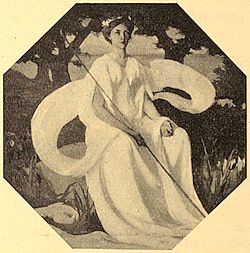
AGLAIA.—BY F. W. BENSON.
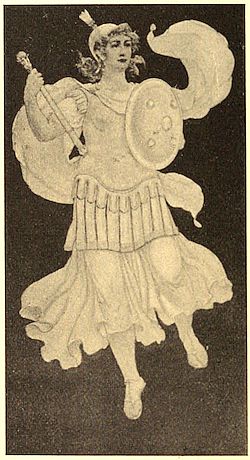
Mr. Maynard’s Pompeiian Panels.—The frequent occurrence of windows, doors, and pilasters cuts the wall into narrow spaces, which, at the north and south, are colored a plain olive, and at the east and west the familiar rich Pompeiian red, ornamented with simple arabesques and, at the ends, with female figures representing The Virtues, by Mr. George Willoughby Maynard. There are eight of these figures in all, two in each corner of the hall. Each figure is about five and a half feet high, clad in floating classic drapery, and represented to the spectator as appearing before him in the air, without a support or background other than the deep red of the wall. The style of the paintings is Pompeiian; the general tone is somewhat like that of marble, although touched with color so as to remove any comparison with the marble framing.
Beginning at the left in each case, the names and order of the Virtues are as follows: At the northeast corner, Fortitude and Justice; at the southeast corner, Patriotism and Courage; at the southwest corner, Temperance and Prudence; at the northwest corner, Industry and Concord. The number of virtues to be represented was determined beforehand, of course, by the number of spaces at the disposal of the painter. The selection, therefore, was necessarily somewhat arbitrary.
Each figure is shown with certain characteristic attributes. In the case of Industry, Courage, and Patriotism, Mr. Maynard has himself selected these attributes; in the other five figures he has followed the usual conventions.
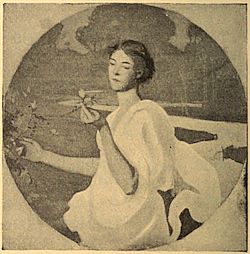
SPRING.—BY F. W. BENSON.
Fortitude is shown fully armed—the mace in her right hand and the buckler on her arm, and protected by cuirass, casque, and greaves. She is thus represented as ready for any emergency—living in continual expectation of danger, and constantly prepared to meet it. Justice holds the globe in her right hand, signifying the extent of her sway. She holds a naked sword upright, signifying the terribleness of her punishment. Patriotism is feeding an eagle, the emblem of America, from a golden bowl—an action which symbolizes the high nourishment with which the Virtue sustains the spirit of the country. Courage is represented as armed hastily with the buckler, casque, and sword—not, like Fortitude, continually on guard, but snatching up her arms in the presence of an unforeseen danger. Temperance—figured as the classic rather than the modern virtue—holds an antique pitcher in her right hand, from which a stream of some liquor, whether wine or water, descends into the bowl she holds in her left. Her buoyancy and air of health betoken her moderation of living. Prudence looks in a hand-glass to discover any danger which may assail her from behind. In her right hand she holds a serpent—the emblem of wisdom. Industry draws the flax from a distaff, the end of which is stuck in her girdle, and twists it into thread, to be wound upon the spindle which hangs at her side. Concord—the Roman goddess Concordia—illustrates the blessings of peace. In her right hand she bears an olive-branch, and in her left she carries a cornucopia filled with wheat.
The Inscriptions along the Walls.—Before taking leave of the corridors of the Entrance Hall, one more feature of the decoration requires notice, namely the twenty-nine inscriptions occupying the gilt tablets below the stucco frames which surround the circular windows and the wall-paintings of Mr. Benson and Mr. Reid. They are as follows:—
Too low they build who build beneath the stars. Young.
There is but one temple in the Universe and that is the Body of Man. Novalis.
Beholding the bright countenance of Truth in the quiet and still air of delightful studies. Milton.
The true university of these days is a collection of books. Carlyle.
Nature is the art of God. Sir Thomas Browne.
There is no work of genius which has not been the delight of mankind. Lowell.
It is the mind that makes the man, and our vigor is in our immortal soul. Ovid.
They are never alone that are accompanied by noble thoughts. Sidney.
Man is one world and has Another to attend him. Herbert.
Tongues in trees, books in the running brooks, Sermons in stones, and good in everything. As You Like It.
The true Shekinah is man. Chrysostom.
Only the actions of the just Smell sweet and blossom in the dust. Shirley.
Art is long, and Time is fleeting. Longfellow.
The history of the world is the biography of great men. Carlyle.
Books will speak plain when counsellors blanch. Bacon.
Glory is acquired by virtue but preserved by letters. Petrarch.
The foundation of every state is the education of its youth. Dionysius.
The chief glory of every people arises from its authors. Dr. Johnson.
There is only one good, namely knowledge, and one only evil, namely ignorance. Diogenes Laertius.
Knowledge comes, but wisdom lingers. Tennyson.
Wisdom is the principal thing; therefore get wisdom: and with all thy getting get understanding. Proverbs iv, 7.
Ignorance is the curse of God, Knowledge the wing wherewith we fly to heaven. 2 Henry IV.
How charming is divine Philosophy! Milton.
Books must follow sciences and not sciences books. Bacon.
In books lies the Soul of the whole past time. Carlyle.
Words are also actions and actions are a kind of words. Emerson.
Reading maketh a full man, conference a ready man, and writing an exact man. Bacon.
Science is organized knowledge. Herbert Spencer.
Beauty is truth, truth beauty. Keats.
THE ENTRANCE TO THE ROTUNDA.
The vaulting of the broad passageway leading to the Reading Room consists of a series of six small domes, the ornamentation of which is similar, in its more modest way, to that of the vaulted corridors which the visitor has just left. The colors are light and bright, and the three different patterns employed consist mainly of garlands and ribbons, and of simple bands of color radiating from a central medallion. Swans, eagles, or owls are introduced both in the domes and as the ornament of the pendentives, and eagles occur between the double consoles which receive the weight of the domes upon the east wall. In the medallions just referred to are various objects symbolizing the Fine Arts—tragic and comic masks, for Acting; a lyre, for Music; a block of marble, half shaped into a bust, and sculptors’ tools, for Sculpture; a lamp, scrolls, and an open book, for Literature; and the capital of an Ionic column, a triangle, and some sheets of parchment, for Architecture.
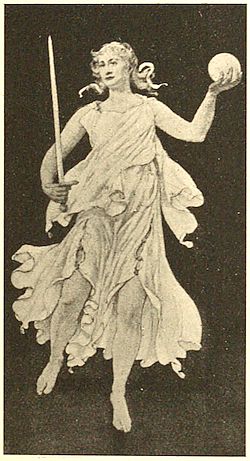
JUSTICE. BY GEORGE W. MAYNARD.
The trophies of Sculpture and Architecture, it should be added, are accompanied by appropriate names—comprising those of cities, statues, and buildings—inscribed both in the arabesques and in the pendentives of certain of the domes. For Architecture, the buildings commemorated are the Colosseum, the Taj Mahal, the Parthenon, and the Pyramids; while the cities are those with whose fame these four great monuments are connected—Rome, Agra, Athens, and Gizeh. The sculptures are the Farnese Bull, the Laocoön, the Niobe, and the Parthenon Pediment, and in the bordering arabesques are the names of the four divinities often taken as the subject of ancient statuary—Venus, Apollo, Hercules, and Zeus.
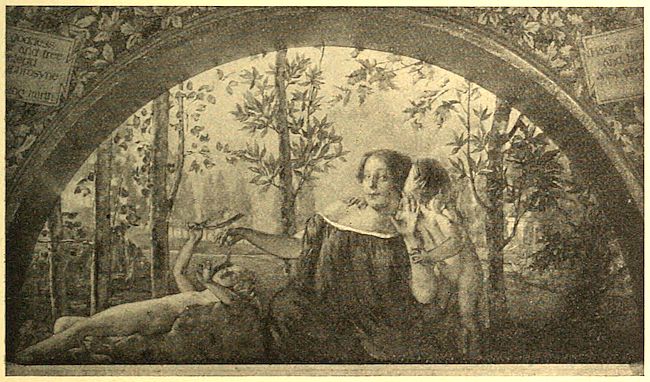
Mr. Van Ingen’s Paintings.—In the centre of the passage a marble staircase, dividing to the right and left at a landing halfway up, leads to the gallery of the Reading Room. Beneath, on either side, is a little bay, giving access to the elevators. In the decoration of the ceiling the effect aimed at is that of an arbor, with a vine, climbing over a trellis, painted against a sunny yellow background. Each contains a small tympanum, in which Mr. Van Ingen has suggested the subjects of Milton’s well-known companion poems, L’Allegro and Il Penseroso—Mirth, and Melancholy or Thoughtfulness. The decorations are not illustrations, as the word is usually understood, like some of Mr. Walker’s panels, already described; they have no reference to any particular scene or incident in the poems, but are intended as an interpretation of their general spirit and meaning. In the first, Il Penseroso, the time of year is autumn; in the other it is spring. Similarly, in L’Allegro the landscape is shown in morning light, while in Il Penseroso the time is evening. The latter panel is in the bay to the north of the staircase. A single figure, that of a beautiful woman with dark hair and soft, pensive eyes, is shown at half length, leaning her head upon her hand in an attitude and with an expression of deep contemplation. L’Allegro is represented by a young woman, light-haired and sparkling with laughter, who is playing under the trees with two little children.
In the pendentives of the bays are inscribed portions of the two poems illustrated. The lines from L’Allegro are as follows:—
... Come, thou Goddess fair and free, In heaven yclept Euphrosyne, And by men heart-easing Mirth; Haste thee, Nymph, and bring with thee Jest, and youthful Jollity, Quips and cranks and wanton wiles, Nods and becks and wreathèd smiles, Such as hang on Hebe’s cheek, And love to live in dimple sleek.
The lines from Il Penseroso are:—
Hail! thou Goddess, sage and holy! Hail, divinest Melancholy! Come; but keep thy wonted state, With even step, and musing gait, And looks commercing with the skies, Thy rapt soul sitting in thine eyes: There, held in holy passion still, Forget thyself to marble....
FORTITUDE. BY GEORGE W. MAYNARD.
Mr. Vedder’s Mosaic Decoration.—The wall of the landing of the staircase is occupied by an arched panel, fifteen and a half feet high and nine feet wide, containing a marble mosaic by Mr. Elihu Vedder.[8] The artist has chosen for his subject Minerva, her armor partly laid aside, appearing as the guardian of civilization. She is the Minerva of Peace, but Mr. Vedder indicates that the prosperity which she now cherishes has been attained only through just and righteous war, whether waged against a foreign enemy or against the forces of disorder and corruption within. Beside her is a little statue of Victory, such as the Greeks were accustomed to erect in commemoration of their success in battle. The figure is that of a winged woman standing on a globe, and holding out the laurel-wreath and palm-branch to the victors. In the sky the clouds of disaster and discouragement are rolled away and about to disappear, while the sun of reappearing prosperity sends its rays into every quarter of the land. Although her shield and helmet have been laid upon the ground, the Goddess still retains the Ægis, and holds, in one hand, like a staff, her long, two-headed spear, showing that she never relaxes her vigilance against the enemies of the country which she protects. For the present, however, her attention is all directed to an unfolded scroll which she holds in her left hand. On this is written a list of various departments of learning, science, and art, such as Law, Statistics, Sociology, Botany, Bibliography, Mechanics, Philosophy, Zoölogy, etc. To the left of Minerva is the owl, perched upon the post of a low parapet. Olive trees, symbolizing peace, grow in the field beyond. The armor of the Goddess is carefully studied from ancient sculptures. The character of the Ægis can here be more easily made out than in any of the other representations of Minerva to be found in the building. Traditionally a cape of goat-skin, the Greek artists finally came to overlay it with metal scales, like scale-armor. The border is composed of twisting serpents. The head of the Gorgon Medusa, which forms the central ornament, is used also as the decoration of the large shield lying in the foreground of the picture. The helmet is decorated with a pair of rams’ heads. Mr. Vedder’s whole design is surrounded by a border containing, on either side, a conventionalized laurel-tree displayed like a vine.
L’ALLEGRO.—BY W. B. VAN INGEN.
THE ROTUNDA.
Entering by either of the doors at the head of the staircase, the visitor at once steps out upon an embayed gallery, affording a spacious and uninterrupted view of the great domed Reading Room, or Rotunda, which, in every sense, is the central and most important portion of the Library. As such, it is marked by a magnificence of architecture and decoration nowhere else to be found in the building. Outside, from whatever direction one approaches, the gilded dome which forms its outer shell is the first thing to catch the eye; and the golden flame of the torch which surmounts the lantern indicates to the passer-by at once the central and the highest point of the whole structure. Within, richer materials have been used, and decoration has been more freely employed than in any other part of the Library. Sculpture and paintings, rare marbles, and a broad scheme of color and of ornamentation in stucco relief unite with a lofty architectural design to form what is one of the most notable interiors in the country.
The Importance of the Rotunda.—The detailed description of the Rotunda may be deferred a little, however, in order to explain its relation to the rest of the building, and, especially, the reason for its central position. Besides accumulating books and providing the student with proper accommodations for his work—such as good light and convenient chairs and tables—it is the business of every well managed library to supply its readers with the books they desire in the shortest possible time and with the least possible amount of friction. A well digested catalogue is the first requisite; the second is that the books should be stored in a place as closely accessible to the reading room as may be. In a small library this is a simple matter; the same room will be sufficient for both books and readers. When the number of volumes increases it is necessary to shelve them in a compact system of bookcases called a “stack”—or, as in the Library of Congress, in a series of stacks—which must occupy a portion of the building by itself. The reading room and the stacks being thus separated, it is still the aim of the architect to place them in such a way as to retain as far as possible the practical convenience of the smaller library, where every reader is almost within reaching distance of every book. This end is most easily attained by adopting what is called the “central system” of library construction, which is the system followed in the Library of Congress. It has already been seen that the building is in the form of a cross enclosed within a rectangle, thus allowing space for four courts for light and air. At the intersections of the arms of the cross is the Rotunda, the main entrance to which is through the west arm of the cross. The other three arms are occupied by the stacks; the East Stack, directly opposite, is the second short arm; the North and South Stacks, each the same length, are the two long arms. It is obvious that by this arrangement the books can be more easily reached than in any other way. The axes of the stacks are continued radii of the Rotunda, and, so far as the ground plan is concerned, the shortest way from any part of the cross to the Distributing Desk which the visitor sees below in the centre of the room is always along a straight line. This Distributing Desk, of course, being in the exact centre of everything, is the vital point, the kernel, of the whole arrangement. No part of the stack, it will be noted, is far enough away from it to delay the transmission of a book unreasonably, as might very well be the case if the three stacks were in one. Moreover, by the use of a mechanical contrivance, which will be explained later, even this distance is in effect very greatly reduced.
THE GALLERY OF THE ROTUNDA. SHOWING THE STATUES OF HERODOTUS AND BEETHOVEN.
Another thing may well be noted in this connection although it has already been referred to in the preliminary description of the building—and that is, the comparative unimportance, from the standpoint of the real requirements of the Library, of the great Rectangle which encloses the stacks and the Rotunda, and necessarily appears from the street to be the main portion of the building. It contains rooms which, at present, are very convenient for clerical work or as art galleries and special reading rooms, and which may in time be necessary to accommodate an overflow of books; but it must steadily be borne in mind that the Rotunda and the stacks contain the real life of the institution. They are the only really essential and vital portion of the building; without them, there could hardly be a library; and by themselves they would be sufficient for almost every present need.
The General Arrangement.—The character of the Rotunda is warm and rich in ornament as befits a room where people remain to read. It is naturally not so formal as the Rotunda of the Capitol. The height of the room from the floor to the top of the dome, where it converges upon the lantern, is one hundred and twenty-five feet, and from the floor to the crown of the domed ceiling of the lantern itself, one hundred and sixty feet. This latter point, however, is quite shut off from the view of a person standing in the gallery and can be seen only from a position near the centre of the room. The ground plan of the room is octagonal in shape, measuring one hundred feet from one side to another. Eight massive clustered piers, each set some ten feet forward from a corner of the octagon, support a series of heavy arches running entirely round the room. These piers serve, as it were, to stake out the limit of the Reading Room proper; between them are marble screens arcaded in two stories, and behind they are connected with the outer wall by partitions which divide the octagon into eight bays or alcoves, each fourteen feet deep and thirty wide. In each alcove, at the height of the screen, is a gallery like that which the visitor has already entered, one connecting with another, through doors pierced in the partition walls, so as to form a continuous promenade—as it may be called, considering its purpose—in which the sightseer may walk without fear of disturbing the readers below.
LAW. BY PAUL W. BARTLETT.
The alcoves are arched and enclose great semi-circular windows filled with stained glass, which furnish the greater part of the light needed for the room. The arches springing from the piers support a heavy circular entablature, immediately above which is the dome, arched in the line of an exact circle and supported upon eight ribs dividing it into eight sections or compartments. The ribs are the essential feature of the dome construction, and continue naturally the line of support of the great piers which are the ultimate support of the whole interior—a fact which is more clearly brought out to the eye by paired consoles or brackets introduced in the entablature between the two and seeming to carry the weight from one to the other.
The surface of the dome is of stucco, attached to a framework of iron and steel filled in with terra cotta, and richly ornamented with coffers and with a very elaborate arabesque of figures in relief. At the top, where the dome prepares to join the lantern, the ribs terminate against a broad circular “collar,” so called, containing a painted decoration by Mr. Edwin Howland Blashfield. Finally comes the lantern, thirty-five feet in height, and pierced by eight windows, recalling the octagonal arrangement with which the construction began. The shallow dome which covers the lantern is ornamented with a second painting by Mr. Blashfield, summing up the idea of his decoration in the collar.
At the risk of some tediousness, perhaps, but thinking that afterwards the connection between the decoration and the architecture would be more clearly understood, the writer has given this general description of the Rotunda, in order that the visitor might immediately see what portion of the whole was essential and what not essential; what was “structural” and vital, in other words, and what not. It will have been observed that we have, on the outside, an octagon supporting a shallow dome, on which rests the lantern. Well within this is an octagonal arrangement of piers carrying a much steeper dome. Alcoves occupy the space between the inner and outer octagons. Between the two domes—the inner shell and the outer—is vacancy. The whole exterior—walls, dome, and lantern—the partitions back of the piers, and the connecting screens: all could be torn away and the inner dome still remain secure on its eight massive piers.
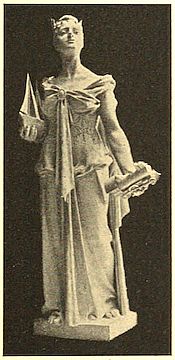
COMMERCE. BY JOHN FLANAGAN.
The piers are constructed of brick, veneered with marble from Numidia in Africa, curiously mottled and in color a sort of dusky red. The high base on which the pier rests is sheathed with a chocolate brown variety of the familiar close-grained Tennessee marble. The height of the piers, including base and capital, is forty-four feet.
The screens are built solidly of marble from Sienna, Italy, which encloses in its rich black veining almost every variety of yellow, from cream color to dark topaz. Like the piers, the screens are erected upon a Tennessee marble base, in this case, however, very much lower—four feet to the other’s eleven. The arcading of the screens is in two stories, the first of three and the second of seven arches. At the top of each screen the gallery is railed in by a heavy balustrade—still of the same Sienna marble—connected with which are two marble pedestals which bear bronze statues of illustrious men. The screens are alike on every side of the octagon but two, the west and the east—the former the entrance from the Staircase Hall, and the latter affording a way through to the east side of the building. In both instances, therefore, the central arch is accentuated by free standing columns. In the second story of the west screen, also, still another modification has been made in order to allow space for a large clock—the three middle arches giving place to a rich architectural setting ornamented with bronze statuary.
The Alcoves.—The alcoves behind the screens are in two stories, like the arcading, and are intended to contain a collection of the most necessary standard books on all important topics. The entrance from the floor of the Reading Room is through the central arch of the screen. One may pass through doors in the partitions from one alcove to another, on either floor; and by means of a winding staircase inside each of the piers one may go up or down, not only from story to story, but, on the one hand, into the basement below, and, on the other, to the space between the inner and the outer dome above.
Altogether, the alcoves have a capacity, with their present shelving, of 130,000 volumes. The cases are of iron, and similar in a general way to those in the large stacks, to be described later; but they are built against the walls, according to the older method of library arrangement, and with very little attempt to combine them in a real stack system, properly so called. The upper shelves in the lower story are reached from a small iron gallery; in the second story a step-ladder must be used—the only instance in the whole building where a book-shelf cannot be reached by a person standing on the floor.
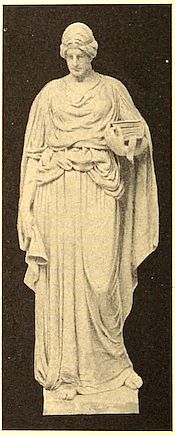
PHILOSOPHY. BY BELA L. PRATT.
In front of each of the great piers of the Rotunda is an engaged column, so called because it is not quite clear of the mass behind it, which serves as the ultimate support of a statue placed between the arches upholding the dome. In height, base, and capital, it is the same as the pier with which it is connected, and, like it, is sheathed in Numidian marble, but not so dark in tone, since the burden resting on the column includes no part of the dome, and is therefore much lighter than that borne by the pier.
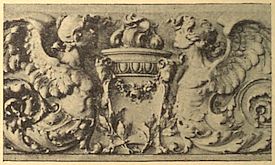
The engaged columns, however, join with the piers to carry an elaborate entablature some seven feet in height, which, finding its way in and out of the alcoves from pier to pier, completely encompasses the room. The color of the entablature, which is entirely of stucco, is a cream or ivory white, like the dome, touched sparingly with gold. The mouldings, which are of the usual Greek patterns employed in Renaissance architecture, are very rich and heavy. The topmost member of the cornice is boldly projected upon a series of modillions, the soffits between being ornamented with rosetted coffers—gilt on a blue ground. The frieze is enriched with an arabesque of Renaissance ornament in relief, including antique urns and lamps; garlands enclosing tablets; and winged half-figures. The general design of the frieze, as of all such work in the Library, is by Mr. Casey as architect; the individual figures, however, were modelled by Mr. Weinert.
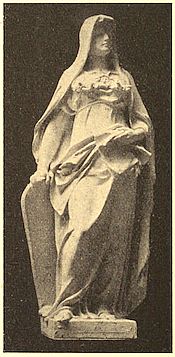
The Symbolical Statues.—The eight statues set upon the entablature over the engaged columns represent eight characteristic features of civilized life and thought. From the floor to the plinth or base on which they stand is a distance of fifty-eight feet; each is ten and a half feet, or, including the plinth, eleven feet high. All are of plaster, toned an ivory white to match the general tone of the stucco decoration throughout the room, and are effectively placed against the plain red pendentives of the dome as a background. The title of each is inscribed in gilt letters in a tablet in the frieze below. Beginning with the figure directly to the right as one enters the west gallery of the Rotunda, the order is as follows: Religion, modelled by Mr. Theodore Baur; Commerce, by Mr. John Flanagan; History, by Mr. Daniel C. French; Art, by a French artist, Mr. Dozzi, after sketches by Mr. Augustus St. Gaudens; Philosophy, by Mr. Bela L. Pratt, who modelled the granite spandrels of the Main Entrance; Poetry, by Mr. J. Q. A. Ward; Law, by Mr. Paul W. Bartlett; and Science, by Mr. John Donoghue.
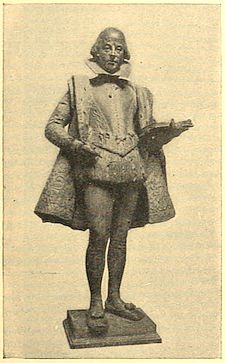
SHAKESPEARE. BY FREDERICK MACMONNIES.
Nearly all bear some appropriate and distinguishing object. Religion holds a flower in her hand, seeming to draw from it the lesson of a God revealed in Nature. Commerce, crowned with a wreath of the peaceful olive, holds in her right hand a model of a Yankee schooner, and in her left a miniature locomotive. History has a book in her hand, and with an obvious symbolism holds up a hand-glass so that it will reflect things behind her. Art is unlike the other figures in being represented as nearly nude. She is crowned with laurel, and bears a model of the Parthenon. Beside her is a low tree, in the branches of which are hung a sculptor’s mallet and the palette and brush of the painter. Philosophy is a grave figure with downcast eyes, carrying a book in her hand. The garment of Poetry falls in severe lines, which suggest the epic and the more serious forms of the drama, rather than the lighter aspects of the Muse. Law has a scroll in her hand; a fold of her robe is drawn over her head to signify the solemnity of her mission; and beside her is the stone Tablet of the Law. Science holds in her left hand a globe of the earth, surmounted by a triangle. In her right hand is a mirror, not, like History’s, turned backward, but held forward so that all may perceive the image of Truth.
Above each statue the pendentive of the dome is occupied by a group in plaster, sculptured by Mr. Martiny, consisting of two winged geniuses, modelled as if half flying, half supported on the curve of the arches, and holding between them a large tablet carrying an inscription in gilt letters. Above the tablet is a pair of crossed palm-branches (meaning peace), and below are the lamp and open book symbolical of learning, these last being surrounded by an oak-wreath, typifying strength—the whole group thus signifying the power and beneficence of wisdom.
The inscriptions were selected by President Eliot of Harvard University, who several years before had furnished the memorable sentences carved upon the Water Gate at the World’s Fair in Chicago. Each is appropriate to the subject of the statue below it.
Thus, above the figure of Religion are the words:—
What doth the Lord require of thee, but to do justly, and to love mercy, and to walk humbly with thy God? Micah vi, 8.
Above the figure of Commerce:—
We taste the spices of Arabia yet never feel the scorching sun which brings them forth. Anonymous.[9]
Above the figure of History:—
One God, one law, one element, And one far-off divine event, To which the whole creation moves. Tennyson.
Above the figure of Art:—
As one lamp lights another, nor grows less, So nobleness enkindleth nobleness. Lowell.
Above the figure of Philosophy:—
The inquiry, knowledge, and belief of truth is the sovereign good of human nature. Bacon.
Above the figure of Poetry:—
Hither, as to their fountain, other stars Repairing, in their golden urns draw light. Milton.
Above the figure of Law:—
Of law there can be no less acknowledged than that her voice is the harmony of the world. Hooker.
Above the figure of Science:—
The heavens declare the glory of God; and the firmament sheweth his handiwork. Psalms xix, 1.
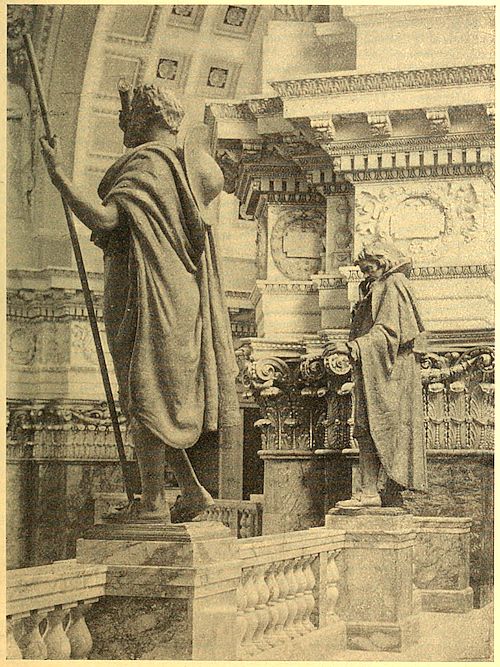
The Portrait Statues.—The sixteen bronze statues set along the balustrade of the galleries represent men illustrious in the various forms of thought and activity typified in the figures just described. The arrangement of the statues is in pairs, each pair flanking one of the eight great piers of the Rotunda. The list of those who have been thus selected to stand as typical representatives of human development and civilization is as follows: Under Religion, Moses and St. Paul; Commerce, Columbus and Robert Fulton; History, Herodotus and Gibbon; Art, Michael Angelo (a single figure, but standing at once for Architecture, Sculpture, and Painting) and Beethoven; Philosophy, Plato and Lord Bacon; Poetry, Homer and Shakespeare; Law, Solon and Chancellor Kent (the author of the well-known Commentaries); Science, Newton and Professor Joseph Henry. The sculptors were: of the Moses and Gibbon, Mr. Charles H. Niehaus; St. Paul, Mr. John Donoghue (the sculptor of the figure of Science); Columbus and Michael Angelo, Mr. Paul W. Bartlett (who modelled the figure of Law); Fulton, Mr. Edward C. Potter; Herodotus, Mr. Daniel C. French (History); Beethoven, Mr. Theodore Baur (Religion); Plato and Bacon, Mr. John J. Boyle; Homer, Mr. Louis St. Gaudens; Shakespeare, Mr. Frederick Macmonnies (who did the central doors at the Main Entrance); Solon, Mr. F. Wellington Ruckstuhl (the sculptor of the busts of Goethe, Macaulay, and Franklin, in the Entrance Portico); Kent, Mr. George Bissell; Newton, Mr. C. E. Dallin; and Henry, Mr. Herbert Adams, whom the visitor already knows for his work in connection with Mr. Warner on the bronze entrance doors, as well as for his little figures of Minerva in the Main Vestibule.
Of these figures, two, the Moses and St. Paul, are ideal, though modelled, in a general way, according to conventions long established in Christian art. The Solon is an original study, although, of course, aiming to be entirely Greek in spirit and costume. The Homer follows an ancient ideal bust. The Herodotus and Plato are studied from original Greek sculptures. The features of the other ten are taken from portraits from life, and the costumes are accurately copied from contemporary fashions.
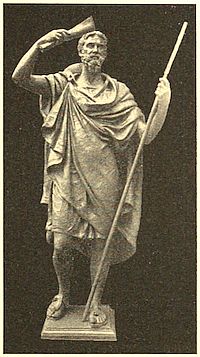
HERODOTUS. BY DANIEL C. FRENCH.
The Moses of Mr. Niehaus holds the Table of the Law, and, like Michael Angelo’s famous figure, is horned—a curious convention which crept into art from an ancient mistranslation of a passage in Exodus. The St. Paul is a bearded figure, one hand on the hilt of a great two-edged sword, and the other holding a scroll. Mr. Ruckstuhl has conceived his Solon as the typical law-giver of the ancient world. He is represented as stepping forward, clothed in all the power of the state, to announce at a solemn gathering of the people the supremacy of Law over Force. A fold of his garment is drawn over his head with a certain priestly suggestion, as if the laws he proclaimed were of divine origin. He holds aloft, in his left hand, a scroll bearing the Greek words OI NOMOI, which, though meaning simply “The Law,” were understood as referring especially to Solon’s enactments. His right hand rests upon a sheathed and inverted sword, which is wreathed with laurel. The idea is that law has supplanted force, but that force is always ready to carry out the mandates of the law. Homer is represented with a staff in his hand and a wreath of laurel crowning his head. Mr. French represents Herodotus as a traveller, searching the known world for the materials of his histories. His garments are girt up, he bears a long staff in one hand, and shades his eyes with a scroll as he gazes into the distance to discover his destination. The Fulton carries a model of a steamboat, and the Henry an electro-magnet, for discoveries in electrical science. The Beethoven shows the composer with his hand uplifted as if to beat the measure of the harmony which has suddenly come into his mind—so suddenly that in the eagerness of his movement he has pulled the pocket of his greatcoat inside out. Mr. Macmonnies’s Shakespeare is a somewhat novel study, so far as the head is concerned; it is a composite of the portrait in the first collected edition of the Plays and of the Stratford bust. The figure of Kent wears the judicial ermine; he carries in one hand the manuscript of his Commentaries, and holds a pen in the other. Of the other figures, some, like the Gibbon, carry a book or pen; but in most instances the sculptor has sought merely to give his subject an appropriately noble and contemplative attitude and expression, without trying to introduce any special symbol of his work.
Mr. Flanagan’s Clock. [10]—Still another piece of sculpture—the group ornamenting the great clock over the entrance to the Rotunda—remains to be spoken of before passing on to a description of the dome and Mr. Blashfield’s decorations. It is the work of Mr. John Flanagan, the sculptor of the figure of Commerce, and, taken altogether, is one of the most sumptuous and magnificent pieces of decoration in the Library. The clock itself is constructed of various brilliantly colored precious marbles, and is set against a background of mosaic, on which are displayed, encircling the clock, the signs of the zodiac, in bronze. Above is a life-size figure, executed in high relief in bronze, of Father Time, striding forward scythe in hand. To the left and right are the figures of maidens with children, also in bronze, representing the Seasons. The dial of the clock is about four feet in diameter; in the centre is a gilt glory, or “sunburst.” The hands, which are also gilded, are jewelled with semi-precious stones.
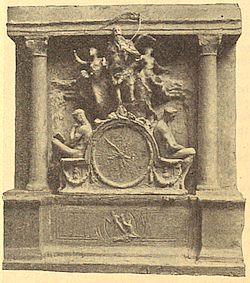
THE ROTUNDA CLOCK. BY JOHN FLANAGAN.
Including, of course, Mr. Weinert’s and Mr. Martiny’s work, it will be seen that no less than nineteen American sculptors have contributed to the decoration of the Rotunda. Considering the room—just for the moment, and for the sake of the special point of view—merely as a Gallery of Statuary, it will be seen how important and representative a collection of American sculpture has been brought together. The choosing of the sculptors to be commissioned, and of the work to be assigned to each—not only here but throughout the Library—were necessarily matters of very careful consideration. To aid in this work, General Casey secured the advice of the President of the National Sculpture Society (the authoritative organization in such matters), then as now Mr. J. Q. A. Ward, who associated with him as a committee two others of the most prominent members of the Society. This committee went into the question very thoroughly, and as a result recommended the sculptors for the Entrance Portico, the bronze entrance doors, the Commemorative Arch in the Staircase Hall, and the Rotunda. Their advice was accepted in toto, with the result, barring a few changes made necessary by subsequent circumstances, that the visitor has now seen.
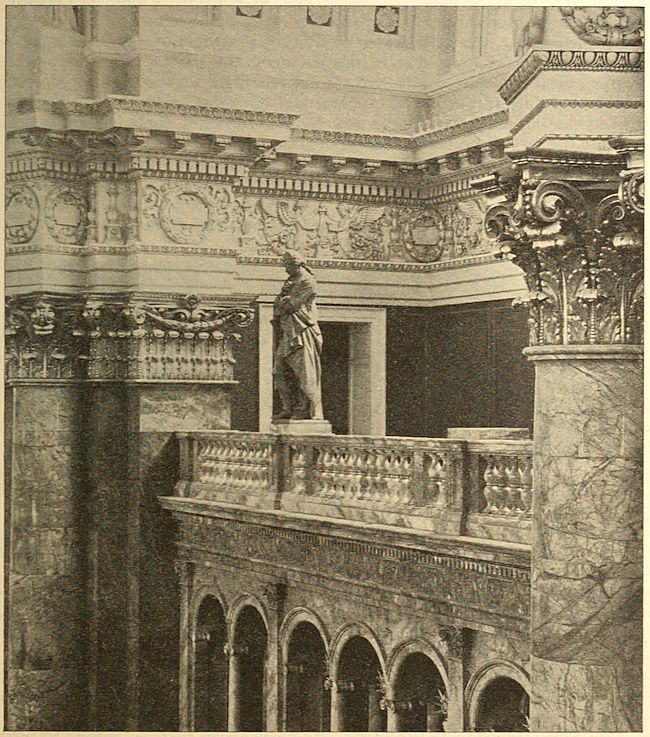
DETAIL OF THE ROTUNDA. SHOWING THE STATUE OF GIBBON.
The Lighting of the Rotunda.—The soffits of the arches upholding the dome are ornamented with a row of plain coffers; the larger arches which roof the alcoves within, carry a triple row of more elaborate coffers, each with a gilt rosette. The windows of stained glass, already spoken of as enclosed by these arches, are semicircular in form and measure thirty-two feet across at the base. They furnish the greater part of the light needed for the illumination of the room. No shadows are cast in any direction. Being so high above the floor, the light from them is much more effective than if they were nearer the level of the reader’s eye. They are better even than skylights, and with none of the disadvantages of skylights. Other sources of light are the various little windows pierced in the four walls of the Octagon which face the interior courts; and, above, the eight windows of the Lantern. It has been said that no reading room in the world is so well lighted—so steadily, abundantly and uniformly, whether on the brightest or the darkest day. Mr. Blashfield’s paintings in the dome, for example, can hardly be said to receive direct light from a single window in the room, but for all that, so perfectly is the light diffused, they are as easily made out as any decorations in the building.
In the evening, the light, which is furnished entirely by electric lamps, is quite as perfect in its way as in the daytime. In the second story of the arcading of the marble screens, a brass rod runs between the capitals of each arch, supporting in the centre a brass star of eight points, each point an electric lamp of thirty-two-candle power. With seven of these in each screen (except the west, where Mr. Flanagan’s clock leaves room for only four), and eight screens, one has a total of four hundred and twenty-four lamps thus used. Above the cornice of the second entablature is a great ring containing three hundred and eight more. Similarly, a line of fifty lamps occurs at the bottom of each of the semicircular windows, making four hundred in all; and in the eye of the lantern, so placed, however, that the lamps themselves are invisible, is a second ring numbering forty-six. On the floor, the reading desks are equipped, altogether, with sixty-eight bronze standards, each bearing three lamps, or two hundred and four in all. Add the number, seventy-six, which serve to light the Distributing Desk and the lower story of the alcoves, and the result is a grand total of fourteen hundred and fifty-eight, and a total candle-power of upwards of forty thousand. When the current is turned on and all these lamps are lit, the Rotunda presents a spectacle of light and shadow worth going far to see.
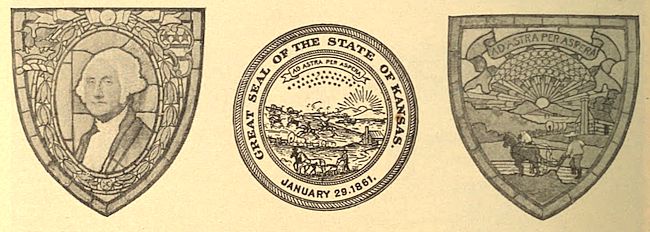
SEALS OF WASHINGTON AND KANSAS.—BY H. T. SCHLADERMUNDT. WITH AUTHORIZED SEAL OF KANSAS IN THE CENTRE.
The Semicircular Windows.—It is calculated that, by putting stained glass in the eight semicircular windows, the amount of light admitted has been diminished almost exactly one-eighth; in other words, the result is the same as if one of the eight had been quite closed up. The loss, of course, is hardly appreciated in a room sufficiently supplied with light from such a number of sources.
The windows are double, with about four inches between the two sashes. The glass used for the outside is plain, but of different degrees of translucency, according as it is necessary to prevent the entrance of direct sunshine, which, if admitted, would be disagreeable to the occupant of the room and would distort the desirable even effect of the stained glass within. Thus, in the east and west, ribbed skylight glass is used; in the southeast, south, and southwest, ribbed and ground glass; while on the other three sides, where the sun never comes, the glass is left perfectly clear.
The cartoons for the stained glass were made by Mr. Schladermundt, after designs prepared by the architect, Mr. Casey. The ground is a crackled white, leaded throughout into small, square panes. In order to give an effect of boldness and strength, the windows are divided vertically by heavy iron bars. The design is surrounded by a richly colored border of laurel, combined with rosettes and Roman fasces. At the top, in the middle of each window, is the great seal of the United States, four feet high, surmounted by the American eagle, whose outstretched wings measure eight feet from tip to tip. To the right and left, following the curve of the window, are the seals of the States and Territories, three on a side, or six in each window, so that forty-eight—excluding only Alaska and Indian Territory—are contained in the eight windows. Torches alternate with the seals, and the fasces are introduced at the bottom.
The name of the State or Territory is inscribed above each seal, with the date of the year in which it was admitted to the Union, or organized under a territorial form of government. The seals occur in the order of their dates, the series beginning with the Thirteen Original States—which start in the easterly window in the order in which they signed the Constitution—and continuing around the room to the three Territories of New Mexico, Arizona, and Oklahoma. Taken all in all they form one of the most interesting decorations in the Library, for the reason that the artist has succeeded in making a harmonious whole out of a very heterogeneous collection of designs. The originals, of course, were separately drawn, often by persons unacquainted with heraldry, and never with any particular thought of fitting them into a single series like the present. The result is that these originals show the greatest diversity of treatment. The key, so to speak, is continually changing. Sometimes, for example, a figure introduced in the foreground is dwarfed by an altogether disproportionate background, while in other cases the figure overpowers everything else; copied exactly, any heraldic or artistic unity of effect would be entirely lacking. Accordingly, after getting together a complete collection of the seals—in every instance an authentic impression of the original obtained from the State secretary—Mr. Schladermundt re-drew, and often almost redesigned his material to bring it into accordance with his decorative scheme. Just what it was that Mr. Schladermundt undertook to do may best be seen in the accompanying engravings of the Seal of Kansas, the first giving the seal as used on official papers, the second copied from Mr. Schladermundt’s cartoon. It will be seen that the spirit of the seal and its heraldic intention are the same in both. The only difference is that in Mr. Schladermundt’s design certain changes of proportion have been made to make the seal harmonize with the style to which the artist wished to have all his designs adhere. In many cases, particularly in the seals of the Thirteen Original States, the original has hardly been changed at all. In the seal of the State of Washington, indeed, which consists merely of a portrait of Washington himself, Mr. Schladermundt has unobtrusively added the Washington arms in the upper corner of the design, in order to suggest the desirable heraldic conventionality more fully; occasionally, too, it has been necessary to omit certain minor details as being unsuited to the breadth of treatment necessary in stained glass—but, as a rule, Mr. Schladermundt has followed very carefully the specifications contained in the authoritative legislative enactments.
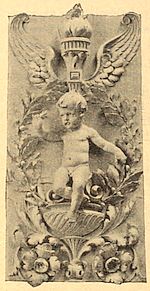
DOME ORNAMENT. BY ALBERT WEINERT.
The Dome.—A vertical section of the dome of the Rotunda would show an exact half circle, with a diameter of one hundred feet. As has been said before, the dome is of stucco, applied to a framework of iron and steel, filled in with terra cotta. Although, as previously described, it appears to rest upon the deep upper entablature, it really springs immediately from the eight arches resting upon the great piers. The entablature, as will be seen on a close inspection, bears no part in the construction. It is projected so far forward from the dome that one may easily walk between the two.
The entablature is about seven feet high, with a richly moulded architrave and a heavy projecting cornice. The ground of the frieze is gilt, with a relief ornament in white of eagles standing upon hemispheres and holding in their beaks a heavy garland of laurel. Over the north, south, east, and west arches, are two female figures—the work of Mr. Philip Martiny—represented as seated upon the architrave moulding and supporting a heavy cartouche—another instance of the emphasis which the architect has so often placed upon the four main axes of the building.
HALF FIGURES. BY ALBERT WEINERT.
The Stucco Ornamentation.—The dome is so simply planned that a description of its main features may be given in a very brief space. The surface is filled with a system of square coffers. The ornamentation of the body of the dome is in arabesque. The eight ribs which mark off the dome into compartments are each divided into two by a band of gilded ornament resembling a guilloche. The coffers diminish in size from four and a half feet square at the bottom to two and a half feet at the top. The total number of coffers is three hundred and twenty—or forty in each compartment, and also in each horizontal row, and eight in each vertical row. The ground of the coffers is blue, the sky-color, as if one were really looking out into the open air—and therefore the color traditionally used in coffering. To give sparkle and brilliancy, many shades and kinds of blue are used, the darker and heavier at the bottom, and the lighter and airier toward the top. The transition is so gradual and natural that the eye does not perceive any definite change, but only a generally increased vividness. The border mouldings of the coffers are cream-colored—old ivory is the usual term—strongly touched with gold, and in the centre of each is a great gold rosette.
Although the purpose of the dome arabesque is primarily to give an agreeable impression of light and shade, the individual figures of which it is composed are nearly as interesting a study as the general effect of the whole. The variety of the figures is almost bewildering—lions’ heads, sea-horses, dolphins, urns, cartouches, griffins, shells, storks, caryatides, tridents, eagles, cherubs, half-figures, geniuses—altogether something like forty-five principal type-designs, interwoven with very many smaller but no less beautiful pieces of ornament. All are adapted from Renaissance models of the best and purest period, and are combined with the utmost spirit and harmony in an arabesque whose every portion has equal artistic value. No single figure catches the eye; broad horizontal and vertical bands of decoration, gradually diminishing as they approach the top, encircle and ascend the dome, each with its particular “note” of arrangement and design, but all cunningly united to form an indisputable whole, everywhere balanced and restrained.
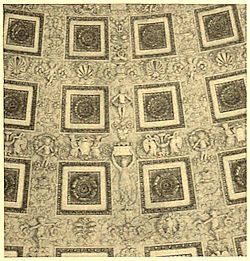
DETAIL OF THE DOME.
It may be of interest to the visitor to learn that one of the most novel and ingenious pieces of engineering connected with the construction of the Library was a so-called “travelling” or rotary scaffold, devised by Mr. Green for the use of the workmen employed on the stucco decorations of the dome. It may be likened to a huge pair of steps, ascending from the upper entablature to the lantern. Its upper end thrust against an iron pintle secured to beams laid across the eye of the lantern, and was steadied at the bottom by a pair of flanged wheels, which travelled on a track in the entablature, so that the whole apparatus could be traversed entirely round the room. The various stages or landings were adjusted to fit the concave of the dome, with the result that the accuracy of the curve could be tested with almost mathematical exactness. At one time two of these scaffolds were swung to the same pintle.
Mr. Blashfield’s Paintings.—The position of Mr. Blashfield’s decorations in the Collar and Lantern of the dome is the noblest and most inspiring in the Library. They are literally and obviously the crowning glory of the building, and put the final touch of completion on the whole decorative scheme of the interior. The visitor will see how, without them, not a painting in the building would seem to remain solidly and easily in its place, for they occupy not only the highest, but the exact central point of the Library, to which, in a sense, every other is merely relative.
As was hinted in the description of Mr. Vedder’s paintings, Mr. Blashfield was almost necessarily drawn to select some such subject as he has here chosen—the Evolution of Civilization, the records of which it is the function of a great library to gather and preserve.
The ceiling of the Lantern is sky and air, against which, as a background, floats the beautiful female figure representing the Human Understanding, lifting her veil and looking upward from Finite Intellectual Achievement (typified in the circle of figures in the collar) to that which is beyond; in a word, Intellectual Progress looking upward and forward. She is attended by two cherubs, or geniuses; one holds the book of wisdom and knowledge, the other seems, by his gesture, to be encouraging those beneath to persist in their struggle towards perfection.
The decoration of the collar consists of a ring of twelve seated figures, male and female, ranged against a wall of mosaic patterning. They are of colossal size, measuring, as they sit, about ten feet in height. They represent the twelve countries, or epochs, which have contributed most to the development of present-day civilization in this country. Beside each is a tablet, decorated with palms, on which is inscribed the name of the country typified, and below this, on a continuous banderole or streamer, is the name of some chief or typical contribution of that country to the sum of human excellence. The figures follow each other in chronological order, beginning, appropriately enough, at the East, the East being the cradle of civilization. The list is as follows: Egypt, typifying Written Records; Judea, Religion; Greece, Philosophy; Rome, Administration; Islam, Physics; The Middle Ages, Modern Languages; Italy, the Fine Arts; Germany, the Art of Printing; Spain, Discovery; England, Literature; France, Emancipation; and America, Science.
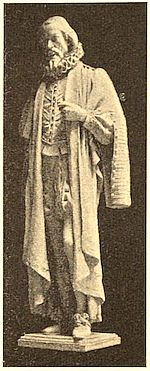
BACON. BY JOHN J. BOYLE.
Each figure is winged, as representing an ideal, but the wings, which overlap each other regularly throughout, serve mainly to unite the composition in a continuous whole, and in no case have been allowed to hamper the artist in his effort to make each figure the picture of a living, breathing man or woman. Four of the twelve figures, it will be observed, stand out more conspicuously than the rest on account of the lighter tone of their drapery—Egypt, Rome, Italy, and England. They occupy respectively the east, south, west, and north points in the decoration, and furnish another instance of the stress that has been laid, throughout the Library, upon the four cardinal points of the compass which govern the axial lines of the building, and which in turn have been enriched and dignified in the final decorative scheme of the interior. Each of these axial figures is painted in a more rigid attitude than those beside it, and forms, as will be noticed, the centre of a triad, or group of three, each of the flanking figures leaning more or less obviously toward it. It should be noted that there was no intention on the part of the painter to magnify the importance of the four figures thus represented over any of the others. The emphasis of color is solely for decorative purposes. The arrangement being chronological, Mr. Blashfield was unable to exercise much control over the order in which each figure should occur, and still retain his original selection of countries.
Egypt is represented by a male figure clad in the waistcloth and cap with lappets so familiar in the ancient monuments. The idea of Written Records is brought out by the tablet he supports with his left hand, on which is inscribed in hieroglyphics the cartouche or personal seal of Mena, the first recorded Egyptian king; and by the case of books at his feet, which is filled with manuscript rolls of papyrus, the Egyptian paper. Besides the idea of Writing and Recording, Mr. Blashfield brings out the fact that the Egyptians were among the first who held the doctrine of the immortality of the soul. The figure holds in the right hand the Tau, or cross with a ring head, the emblem of life both in this world and beyond it; and on the tablet behind his feet is the winged ball, the more familiar symbol of the same idea.
Judea is shown as a woman lifting her hands in an ecstatic prayer to Jehovah. The over-garment which she wears falls partly away, and discloses the ephod, which was a vestment worn by the high priests, ornamented with a jewelled breastplate and with onyx shoulder clasps set in gold, on which were engraved the names of the Twelve Tribes of Israel. On the face of a stone pillar set beside her is inscribed, in Hebrew characters, the injunction, as found in Leviticus, xix, 18: Thou shalt love thy neighbor as thyself—a sentence selected as being perhaps the noblest single text contributed by the Jewish race to the system of modern morality. In her lap is a scroll, containing, presumably, a portion of the Scriptures; and at her feet is a censer, typical of the Hebrew ritualism.
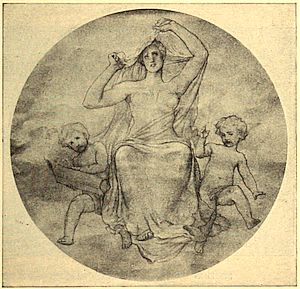
THE HUMAN UNDERSTANDING.—BY E. H. BLASHFIELD.
The figure of Greece is distinctly suggestive, so far as attitude and drapery are concerned, of one of the beautiful little Tanagra figures of terra-cotta—so called from the ancient Greek town in which they were first discovered—which are so familiar to students of Greek art. A bronze lamp is set beside her, and in her lap is a scroll—the emblems of wisdom. Her head is crowned with a diadem—possibly with a reference to the City of the Violet Crown, Athens, the Mother of Philosophy.
Rome, the second axial figure, wears the armor of a centurion, or captain in a legion. A lion’s skin, the mark of a standard-bearer, is thrown over him, the head covering the top of his casque. The whole conception is that of the just but inexorable administration of Rome founded upon the power of its arms. One foot is planted upon the lower drum of a marble column, signifying stability. His right arm rests upon the fasces, or bundle of rods, the typical emblem of the Roman power and rule. In his right hand he holds the baton of command.
Islam is an Arab, standing for the Moorish race which introduced into Europe not only an improved science of Physics, as here used by Mr. Blashfield in its older and less restricted sense—but of mathematics and astronomy also. His foots rests upon a glass retort, and he is turning over the leaves of a book of mathematical calculations.
By the term Middle Ages, represented by the female figure which comes next in the decoration, is usually understood the epoch beginning with the dissolution of the Western Roman Empire in 455 and ending with the discovery of America in 1492. No single country is here indicated, for Europe was throughout that period in a state of flux, so to say, in the movement of which the principal modern languages were finally evolved from the Latin and Teutonic tongues. But it was an epoch notable for many other things, also. The figure typifying the epoch is distinguished by an expression at once grave and passionate, and has a sword, casque and cuirass, emblematic of the great institution of Chivalry; a model of a cathedral, standing for Gothic Architecture, which was brought to its greatest perfection in these thousand years; and a papal tiara and the keys of St. Peter, signifying mediæval devotion and the power of the Church.
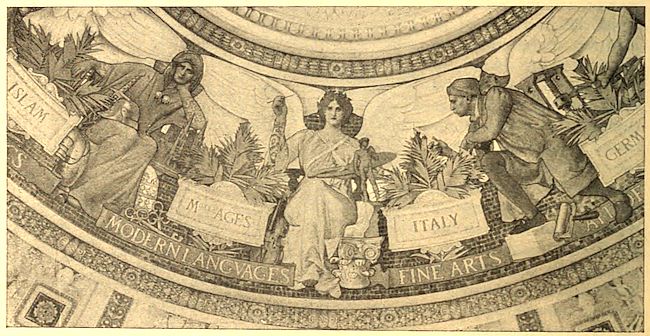
SECTION OF THE DOME DECORATION.—BY EDWIN H. BLASHFIELD.
The next figure, Italy—the Italy of the Renaissance—is shown with symbols of four of the Fine Arts which she represents—Painting, Sculpture, Architecture, and Music. She holds a palette in her left hand, and with the brush in her right seems about to lay another stroke of color on her canvas. To her left is a statuette after Michael Angelo’s celebrated David, in Florence. At her feet is a Renaissance capital; and leaning against the wall a violin, at once the typical musical instrument and that in the manufacture of which the Italians peculiarly excelled.
Germany is the printer, turning from his press—a hand-press, accurately copied from early models—to examine the proof-sheet he has just pulled. His right foot is placed upon a pile of sheets already corrected, and a roller for inking lies convenient to his hand.
Spain is the sixteenth century Spanish adventurer. He wears a steel morion on his head, and is clad in a leathern jerkin. Holding the tiller of a ship in his right hand, he seems to be watching for land to appear in the sea. Beside him is a globe of the earth, and at his feet a model of a caravel, the sort of ship in which Columbus sailed on his voyages, is introduced.
England wears the ruff and full sleeves of the time of Elizabeth—the era when English Literature, both poetry and prose, was at its highest. She is crowned with laurel—the reward of literature—and bears in her lap an open book of Shakespeare’s Plays—the right-hand page with a facsimile of the title-page of the first edition of A Midsummer Night’s Dream, dated 1600.
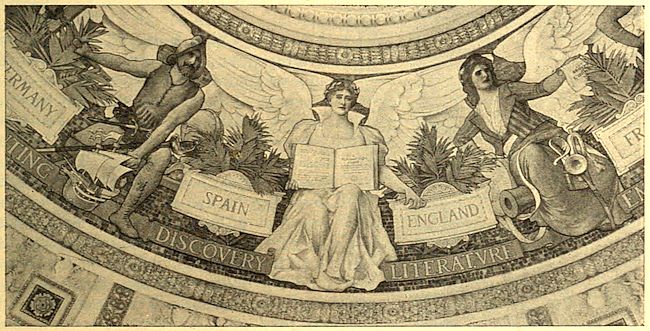
SECTION OF THE DOME DECORATION.—BY EDWIN H. BLASHFIELD.
France, standing for Emancipation and the great revolutionary upheaval of the eighteenth century, is dressed in a characteristic garb of the First Republic—a jacket with lapels, a tricolor scarf, and a liberty-cap with a tricolor cockade. She sits on a cannon and carries a drum, a bugle, and a sword—emblems of her military crusade in behalf of liberty. In her left hand she displays a scroll bearing the words “Les Droits de l’Homme,” the famous Declaration of the Rights of Man adopted by the French Assembly in 1789.
The twelfth and last figure, bringing us once more round to the east, is that of America—represented as an engineer, in the garb of the machine-shop, sitting lost in thought over a problem of mechanics he has encountered. He leans his chin upon the palm of one hand, while the other holds the scientific book which he has been consulting. In front of him is an electric dynamo—recalling the part which the United States has taken in the advancement of electrical science.
On the base of the dynamo, Mr. Blashfield has signed his work in an inscription which recalls also the name of the artist who assisted him in laying it upon the plaster: “These decorations were designed and executed by Edwin Howland Blashfield, assisted by Arthur Reginald Willett, A. D. MDCCCLXXXXVI.”
The visitor will perhaps have been a little perplexed by the familiar appearance of some of the faces in Mr. Blashfield’s decoration. It is an interesting fact that in several cases Mr. Blashfield has introduced a resemblance, more or less distinct, to the features of some real person in order to give greater variety, and, above all, greater vitality to his figures. The persons chosen were selected because the character of their features seemed to him peculiarly suited to the type which he wished to represent. In the case of Abraham Lincoln—the figure of America—and of General Casey—the Germany—the choice was fitting for other reasons. Among the female figures, The Middle Ages is Mrs. De Navarro (Mary Anderson), and England, Miss Ellen Terry. The faces of Italy and Spain are from sketches made from Miss Amy Rose, a young sculptor in New York, and Mr. William Bailey Faxon, the painter, respectively. France suggests the features of the artist’s wife. Throughout, however, it must be remembered that, to use Mr. Blashfield’s own words, “no portraiture has been attempted, but only characterization.”
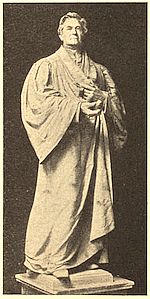
HENRY. BY HERBERT ADAMS.
The Rotunda Color Scheme.—One can hardly leave this description of the decoration of the Rotunda without a word respecting the general color scheme. Beginning with the brown, red, and yellow marbles at the base, one ends with the pure whites and bright greens and violets of Mr. Blashfield’s final decoration. The difference between these two extremes has been bridged over by the use of harmonizing colors on the walls and in the dome. The Pompeiian red of the alcove walls and the pendentives is suggested by the Numidian marble of the piers. A touch of brown on the wall below the semicircular windows echoes the brown Tennessee base, and the yellow predominant in the alcove arches above derives from the Sienna screens. These last, again, in their lightest portions, strike the key for the “old ivory”—the delicate gray yellow—which, either deeper or lighter, is always the ruling tone of the entablature, the dome, and the sculptural figures in plaster. The coffers of the dome, one will notice by looking closely, are defined by a narrow band of yellow or red—yellow throughout one whole compartment, and red in the next. The former carries up (more markedly than in the ivory-toned stucco) the color of the screens; the latter the color of the piers. The blue ground, moreover, and the yellow stripe create together, whether one will or not, an impression of green upon the eye, because green is compounded of blue and yellow; and the blue and the red, in turn, create an impression of violet, for a similar reason. Thus, the visitor, glancing up to the decorations of the collar, is already prepared for Mr. Blashfield’s two dominating tones. The white is expected as the natural result of a color scheme which has been steadily growing lighter from the beginning, and, after being used in Mr. Blashfield’s painting, it is at last appropriately employed almost solely in the lantern which crowns the whole Rotunda. Finally, considering the room as a whole, it will be noted that the profuse use of gold throughout the dome and lantern is not only legitimately suggested by the Sienna marble, but of itself helps to keep the various colors—in marble or stucco—in what may be called a more complete “state of solution” than would otherwise have been possible. By attracting attention to itself, it softens the contrasts between the other colors.