Part 1 — INDEX
Reading edition
Adena2
Adena Narrow Stemmed3
Afton4
Angostura5
Appalachian6
Autauga7
Bakers Creek8
Beacon Island9
Beaver Lake10
Benjamin11
Benton Broad Stemmed12
Benton Stemmed13
Big Sandy14
Big Sandy Auriculate15
Big Sandy Broad Base16
Big Sandy Contracted Base17
Big Slough18
Bradley Spike19
Brewerton, Eared-Notched20
Buzzard Roost Creek21
Camp Creek22
Candy Creek23
Cave Spring24
Clovis25
Clovis, Unfluted27
Conerly28
Coosa29
Coosa, Notched30
Copena31
Copena Triangular32
Cotaco Creek33
Crawford Creek35
Cumberland36
Dalton, Colbert37
Dalton, Greenbrier38
Damron40
Decatur41
Ebenezer42
Ecusta43
Elk River44
Elora46
Eva48
Evans49
Fairland50
Flint Creek51
Flint River Spike53
Fort Ancient54
Frazier55
Garth Slough56
Gary57
Greenbrier58
Greeneville59
Guilford60
Guilford Rounded Base61
Guntersville62
Halifax63
Hamilton64
Hamilton Stemmed65
Hardaway66
Harpeth River67
Jacks Reef Corner Notched68
Jacks Reef Pentagonal69
Jeff70
Jude71
Kays72
Kirk Corner Notched73
Kirk Serrated74
Knight Island76
LeCroy77
Ledbetter78
Lerma Pointed Base79
Lerma Rounded Base80
Limestone81
Little Bear Creek82
Lost Lake83
Madison84
Maples85
McIntire86
McKean87
Montgomery88
Morrow Mountain89
Morrow Mountain Rounded Base90
Morrow Mountain Straight Base91
Motley92
Mountain Fork93
Mud Creek94
Mulberry Creek95
New Market96
Nodena97
Nolichucky98
Osceola99
Paint Rock Valley100
Palmer101
Pedernalis102
Pickwick103
Pine Tree104
Pine Tree Corner Notched105
Plevna106
Quad107
Redstone108
Rheems Creek110
Russell Cave111
Sand Mountain112
Savage Cave113
Savannah River114
Smithsonia115
South Prong Creek116
Stanfield117
Stanley118
Sublet Ferry119
Swan Lake120
Turkey Tail121
Wade122
Washington123
Washita124
Wheeler Excurvate125
Wheeler Recurvate126
Wheeler Triangular127
White Springs128
Provisional Type 1—Stemmed129
Provisional Type 2—Expanded Stem130
Provisional Type 4—Stemmed Barbed130
Provisional Type 5—Stemmed and Serrated131
Provisional Type 6—Unfinished Base131
Provisional Type 8—Corner Notched132
Provisional Type 9—Side Notched132
Provisional Type 10—Eccentric Notched133
Provisional Type 11—Triangular133
Provisional Type 12—Rounded Base134
Provisional Type 13—Notched Convex Stem134
ABBEY, Hulse (This paper): A-122
GENERAL DESCRIPTION: This is a medium sized, stemmed point with incurvate blade edges that are beveled on each side of both faces.
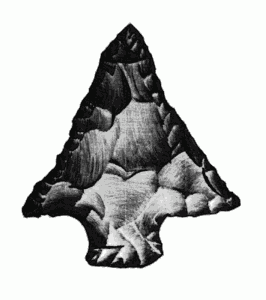
MEASUREMENTS: Measurements of 12 cotypes (including the illustrated example) from which features were taken ranged as follows: length—maximum, 51 mm.; minimum, 38 mm.; average, 42 mm.: width at shoulders—maximum, 49 mm.; minimum, 32 mm.; average, 41 mm.: stem width—maximum, 21 mm.; minimum, 14 mm.; average, 18 mm.: stem, length—maximum 12 mm.; minimum 7 mm.; average, 9 mm.: thickness—maximum, 9 mm.; minimum, 6 mm.; average, 7 mm.
FORM: The cross-section is flattened. The shoulders are expanded and are usually horizontal, but may be inversely tapered. The blade is incurvate, beveled on each side of both faces, and is in rare instances serrated. The distal end is acute. The stem is usually straight but may be expanded. The basal edge may be either slightly excurvate or straight and is usually thinned.
FLAKING: This type displays well controlled, broad, shallow, random flaking. The blade and stem edges were retouched by shallow, regular, pressure flaking. Good local materials were used. All examples are patinated.
COMMENTS: The type was named from sites near Abbey Creek in Henry and Houston counties, Alabama. They were associated with Elora and Maples points and probably were used during the Archaic period.
ADENA, Bell (Bell, 1958): A-1
GENERAL DESCRIPTION: This is a medium to large point with a long, very broad, sometimes rounded stem.
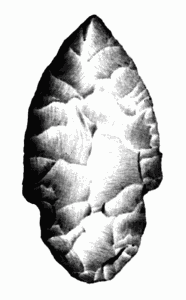
MEASUREMENTS: The measurements of seven homotypes from which traits and measurements were taken are: length—maximum, 65 mm.; minimum, 50 mm.; average, 56 mm.: shoulder width—maximum, 35 mm.; minimum, 32 mm.; average, 34 mm.: stem width—maximum, 27 mm.; minimum, 18 mm.; average, 24 mm.: stem length—maximum, 30 mm.; minimum, 15 mm.; average, 21 mm.: thickness—maximum, 9 mm.; minimum, 7 mm.; average, 8 mm.
FORM: The cross-section is biconvex with wide proportions. The shoulders may be horizontal or tapered, with an occasional weak barb. The blade shape is excurvate. The distal end is usually acute. The stem may be straight, contracted or slightly expanded. Some examples can be described as having a rounded stem. The stem base is either straight or excurvate. The basal edges may be lightly ground.
FLAKING: The blade and stem are shaped with strong random flaking, with some retouch along most edges.
COMMENTS: The name Adena is derived from the point's association with the Adena culture. The illustrated specimen is from Cambron Site 48, Lincoln County, Tennessee. The measured examples are from this site and Cambron Site 50, Limestone County, Alabama. Most examples are made from local materials. The type is associated with early Woodland in the eastern United States. Kneberg (1956) indicates an Archaic association in Tennessee. In Alabama, the Adena point seems to appear on both Archaic and Woodland sites. One example was found in Level 1, Zone A, and one example in Zone C at the Stanfield-Worley Bluff Shelter (DeJarnette, Kurjack and Cambron, 1962). One example was found in Stratum II (Archaic) at the Flint Creek Rock Shelter (Cambron and Waters, 1961). Scattered examples are known from most of North Alabama. The Alabama points closely resemble examples from Ohio, illustrated by Bell (1958) and Webb and Baby (1957), as well as some examples from an Adena mound at Natrium, West Virginia (Solecki, 1953). Examples from New York with unground bases are described by Ritchie (1961). Radiocarbon dates from Adena sites in Ohio and Kentucky (Webb and Baby, 1957) suggest an age of from 800 B. C. to 800 A. D.
ADENA NARROW STEMMED, Cambron (This Paper): A-1-a
GENERAL DESCRIPTION: This is a medium to large point with a long, rounded stem and a long, excurvate blade.
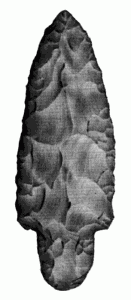
MEASUREMENTS: The illustrated example measures 92 mm. in length, 32 mm. in width, 19 mm. in stem width, 21 mm. in stem length, 9 mm. in thickness.
FORM: The cross-section is biconvex. The shoulders may be horizontal or slightly tapered. The blade shape is excurvate but may be almost straight with an acute distal end. The stem is long and is usually rounded, but it may have straight side edges with an excurvate basal edge. A slightly expanded stem occurs rarely.
FLAKING: The blade and stem were produced by broad percussion flaking, which results in rather uniform flake scars. The technique may be described as random flaking, but may approach collateral flaking on some examples. The blade edges are finished by secondary flaking with some fine retouching. The stem edges were treated in a manner similar to that of the blade.
COMMENTS: The type is described as a variant of the classic Adena point. The illustrated example is from Cambron Site 76 (Pine Tree). Some sites have produced only one of the two Adena variants, which may simply indicate a high degree of variation of the Adena point or may, upon further investigation, prove to be an indication that the two types are associated with somewhat different cultures. Several good examples from Natrium Mound in West Virginia are illustrated by Solecki (1953). Some of his points shown in Plate 28, Figures R, T, and U, were found arranged in association with a burial. Classic Adena points (Figures V and W, Plate 28) and other artifacts were also found with this burial. Closely associated with another burial and accompanying artifacts were points illustrated as Figures X and Y, Plate 28. At this site, the types were contemporaneous.
An Adena Narrow Stemmed point was recovered from a feature pit in Stratum I at the Danley Site (Cambron, Dowell and O'Mahoney, 1962) along with a Wheeler Punctate sherd, a Cotaco Creek point, one polished and three flaked flint celts, and other artifacts. The Flint Creek Rock Shelter (Cambron and Waters, 1961) and Stanfield-Worley Bluff Shelter (DeJarnette, Kurjack and Cambron, 1962) produced classic Adena but no Adena Narrow Stemmed points. The narrow, stemmed type is probably coeval with the classic Adena type on most Alabama sites.
AFTON, (Sub-Variety), Bell and Hall (Bell, 1958): A-2
GENERAL DESCRIPTION: The Afton point is a medium to large, stemmed point with an angular blade outline.
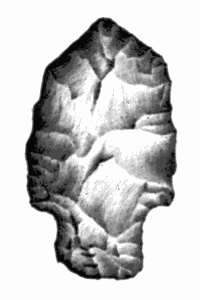
MEASUREMENTS: The illustrated example (plesiotype) measures 45 mm. in length, 25 mm. in shoulder width, 15 mm. in stem width, 12 mm. in stem length, 6 mm. in maximum thickness.
FORM: The cross-section is flattened. The shoulders are tapered. The blade is parallel angular; the distal end, apiculate. The stem is straight.
FLAKING: The faces of the blade and stem are shaped by broad percussion flaking with some fine retouch along the edges.
COMMENTS: The type was named from specimens found near Afton, Oklahoma. The illustrated example is from Cambron Site 43 in Madison County, Alabama. Another example of the same size and material and comparable characteristics was found on Cambron Site 48 across a small mountain pass in Lincoln County, Tennessee. To date (September, 1975) these are the only examples classified from Alabama and adjacent areas. Both of these examples fall into a category described by Bell (1958) as a sub-variety, since they have straight—rather than expanded—stems and no shoulder barbs.
Bell gives the general distribution as throughout northeastern Oklahoma and the adjacent regions of Arkansas, Kansas and Missouri, as well as various sections of the Ohio Valley, particularly Ohio. He also indicates a pre-pottery cultural association.
ANGOSTURA, Suhm and Krieger (Suhm, Krieger and Jelks, 1954): A-4
GENERAL DESCRIPTION: The Angostura point is a medium to large, auriculate point with an excurvate blade.
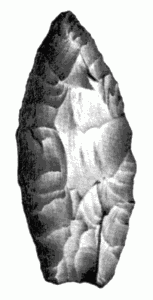
MEASUREMENTS: Twelve specimens from nine Tennessee Valley sites (Soday and Cambron, n. d.) average 76 mm. in length, 28 mm. in width, and 8 mm. in thickness. The longest point (Quad Site, Limestone County, Alabama) measures 101 mm. and the shortest point (Sweiger 1, Meigs County, Tennessee) measures 54 mm. The illustrated example measures 67 mm. long, 30 mm. wide, 9 mm. thick.
FORM: The cross-section is biconvex. Some examples have a faint shoulder at the terminal end of the hafting area. The blade shape is excurvate; the distal end, acute. Several local examples are beveled on one edge of each face. Most examples have auriculated bases with contracted, pointed, or rounded basal edges. Although an incurvate base is one of the distinguishing characteristics of the type, some bases may be straight or even slightly excurvate. The base is usually thinned and may be ground.
FLAKING: The blade may be shaped by broad random flaking, crude collateral flaking or, in some examples from the west, fine oblique transverse flaking. Random flaking is by far the predominant type. Most blades are finished by secondary flaking, which appears in some examples to have been done by the percussion method. As a final finishing step, fine retouch, carried out in order to remove irregularities from the blade edges, is present.
COMMENTS: The type was first described by Hughes (1949) as Long points from the Long Site in Angostura Reservoir, South Dakota. Hughes accepted all of Suhm's illustrated examples (Suhm, Krieger and Jelks, 1954) except the beveled ones. Several beveled examples were illustrated by Suhm, Krieger and Jelks, 1954. The example shown here is from Cambron Site 116, Limestone County, Alabama. Suhm, Krieger and Jelks (1954) estimate the age between 6000 B. C. and 4000 B. C. or later. An Angostura point was recovered from the lower levels at Stanfield-Worley Bluff Shelter (DeJarnette, Kurjack and Cambron, 1962), and what appears to be an Angostura point was associated, along with a pointed-base Lerma and a biface knife, with the second mammoth found at Santa Isabel Iztapan, Mexico (Wormington, 1957). This example resembles some Tennessee Valley specimens which may be late Paleo or early Archaic (Cambron and Hulse, 1960b).
APPALACHIAN, Kneberg (Kneberg, 1957): A-5
GENERAL DESCRIPTION: The Appalachian point is a medium to large, stemmed point with concave base, made of quartzite.
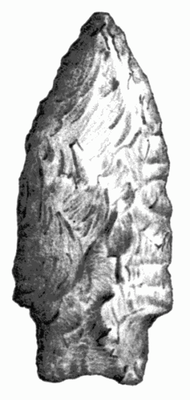
MEASUREMENTS: The illustrated example measures 85 mm. in length, 38 mm. in shoulder width, 27 mm. in stem width, 16 mm. in stem length, and 16 mm. in thickness. The length for the type ranges from 60 mm. to 110 mm. (Harwood, 1959).
FORM: The cross-section is usually flattened. The shoulders are usually tapered and narrow. The blade is usually excurvate, but may be straight with an acute distal end. The stem is broad and may be straight, slightly contracted, or expanded, with an incurvate basal edge that may be thinned. The hafting area is usually ground along the edges.
FLAKING: This point displays well-controlled percussion flaking with some retouch along the edges.
COMMENTS: The point is named for the Southern Appalachian region, where the type is widely distributed (Kneberg, 1957). Several examples were recovered at the Camp Creek Site, where they may be associated with Early Woodland (Kneberg, 1957). The illustrated example is from Harwood Site 6A on Hominy Creek in Buncombe County, North Carolina. The part of the site designated 6A by Harwood (1959) is pre-ceramic. Large, biface, quartzite tools are in association with the points, which are all made from quartzite. Examples from Cowee Creek, Macon County, North Carolina, were recovered below the ceramic zone. This type is associated with Savannah River points on several sites. It appears that the point is associated with the middle to late Archaic and early Woodland cultures.
AUTAUGA, Cambron (This paper): A-123
GENERAL DESCRIPTION: The Autauga is a small, corner-notched, serrated point with straight blade and base.
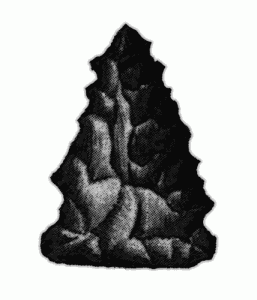
MEASUREMENTS: Twelve cotypes, including the illustrated example, from sites in Autauga County, Alabama, provided traits and the following measurements: length—maximum, 38 mm.; minimum, 23 mm.; average, 32 mm.: shoulder width—maximum, 21 mm.; minimum, 15 mm.; average, 19 mm.: stem width—maximum, 21 mm.; minimum, 16 mm.; average, 18 mm.: stem length—maximum, 7 mm.; minimum, 5 mm.; average, 6 mm.: thickness—maximum, 8 mm.; minimum, 6 mm.; average, 7 mm.
FORM: The cross-section may be either rhomboid or biconvex. The shoulders are usually either horizontal or inversely tapered. The blade is straight. Blade edges are usually serrated and are steeply beveled on half of the examples. The distal end is acute. The corner notches are usually ground and range in width from 2 mm. to 4 mm. and in depth from 5 mm. to 7 mm. The expanded stem has straight or incurvate side edges. The base is straight and thinned. It is lightly ground on nearly all examples.
FLAKING: Narrow, shallow, random flaking was used to form the blade and stem. Notching, to form the expanded stem, was accomplished by removal of fairly deep flakes and finished by light grinding.
COMMENTS: The type was named for Autauga County, Alabama, where the examples, used in this paper, were recovered. All of these points are made of vein quartz. This type is found in surface collections with Dalton, Big Sandy, Kirk Corner Notched, and Crawford Creek points. This association and the fact that the type has features similar to Decatur, Big Sandy, Palmer, and Crawford Creek points indicates an Early Archaic or Transitional Paleo-Indian provenience.
BAKERS CREEK, Cambron (DeJarnette, Kurjack and Cambron, 1962): A-6
GENERAL DESCRIPTION: This is a medium-sized, expanded-stem point.
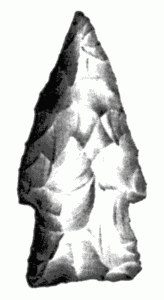
MEASUREMENTS: Eleven cotypes, including the illustrated example, provide traits and the following measurements: length—maximum, 78 mm.; minimum, 43 mm.; average, 55 mm.: shoulder width—maximum, 28 mm.; minimum, 23 mm.; average, 26 mm.: stem width—maximum, 27 mm.; minimum, 21 mm.; average, 23 mm.: stem length—maximum, 18 mm.; minimum, 12 mm.; average, 16 mm.: thickness—maximum, 10 mm.; minimum, 7 mm.; average, 8 mm.
FORM: The cross-section is biconvex. The shoulders are narrow and may be horizontal or tapered. The blade is usually straight but may be excurvate. The distal end is usually sharply acute, but may approach an acuminate type. The hafting area consists of an expanded stem formed by notching into the blade about one-third of the way from the base to the distal end. This diagonal notch tapers from the basal edge, which is usually unmodified in width. The basal edge is thinned and usually straight, but it may be excurvate and lightly ground. Many examples are patinated.
FLAKING: The blade and stem are shaped by broad, random, percussion flaking. Flake scars indicate a strong percussion method was used to notch the hafting area to form the expanded stem. All edges appear to have been retouched as a final step in shaping the point.
COMMENTS: The illustrated specimen is from Cambron Site 53, the type site, at the mouth of Bakers Creek in Morgan County, Alabama. This type is described by Cambron (1958a) as Stemmed Copena. It appears in surface collections along with Copena and triangular Copena points. Two examples were recovered from the lower two-thirds of Stratum I (Woodland) at Flint Creek Rock Shelter and were illustrated as Bakers Creek points (Cambron and Waters, 1961). One example was recovered from Level 7, Zone A, at the Stanfield-Worley Bluff Shelter (DeJarnette, Kurjack and Cambron, 1962). One example was recovered from the 2-foot level at Little Bear Creek, Ct 8 (Webb and DeJarnette, 1948b). At this site Copena points were also recovered from Zone C. This evidence indicates an early to middle Woodland cultural association and an estimated age of somewhere between 1500 B.C. and early centuries A.D.
BEACON ISLAND, Allen and Hulse (This Paper): A-131
GENERAL DESCRIPTION: This is a medium-sized point with expanded-rounded stem, straight blade edges and weak to strong shoulder barbs.
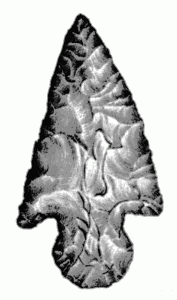
MEASUREMENTS: Seven cotypes, two from Franklin County, Alabama, three from Beacon Island and two from Bear Creek along the Tennessee River below Florence, Alabama, provided the following measurements: length—maximum, 73 mm.; minimum, 48 mm.; average, 61 mm.: shoulder width—maximum, 28 mm.; minimum, 22 mm.; average, 24 mm.: stem width at shoulder—maximum, 14 mm.; minimum, 12 mm.; average, 13 mm.: stem width at widest point—maximum, 19 mm.; minimum, 15 mm.; average, 17 mm.: stem length—maximum, 18 mm.; minimum, 12 mm.; average, 15 mm.: thickness—maximum, 7 mm.; minimum, 6 mm.; average, 7 mm.
FORM: The cross-section is biconvex. Shoulders may be barbed or inversely tapered. Blade edges are straight and may be finely serrated. The stem is expanded-rounded with diagonal notches at the shoulders. The distal end is acute.
FLAKING: Shallow random flaking was employed to shape the faces of the blade and stem. Careful pressure flaking was used to finish the blade edges and to thin the base.
COMMENTS: The type was named from Ralph Allen Site 41 on Beacon Island and was associated with Cotaco Creek, Flint Creek and Wade points on this site. Several examples are illustrated as Type 8, Plate 159 (Webb and DeJarnette, 1952). A suggested placement is in late Archaic and early Woodland times.
BEAVER LAKE, Cambron and Hulse (DeJarnette, Kurjack and Cambron, 1962): A-7
GENERAL DESCRIPTION: This is a medium-sized, auriculate point with recurvate blade edges.
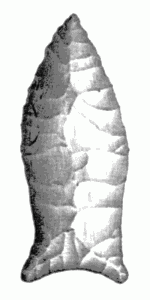
MEASUREMENTS: The lengths of 23 points from 23 sites in the Tennessee Valley range from a maximum of 86 mm. to a minimum of 47 mm. (average length, 64 mm.). The average width of these points is 24 mm. and the average thickness is 8 mm. (Soday and Cambron, n. d.). The measurements of the illustrated (autotype) specimen are: length, 61 mm.; width of blade, 26 mm.; width at base, 25 mm.; width of hafting constriction, 21 mm.; thickness, 9 mm.; basal concavity, 3 mm.
FORM: The cross-section is usually biconvex, but one or both faces may be median ridged. The blade is recurvate—constricted in the hafting area above the auricles. The distal end is usually acute. The auriculated hafting area is expanded-rounded. The basal edge is usually thinned and incurvate, but may be straight. The hafting constriction and basal edge are usually ground.
FLAKING: The shallow random flaking usually employed to shape the faces sometimes produces a median ridge. Secondary retouch flake scars are usually long, evenly spaced, and struck off on alternate faces, resulting in an irregular pattern along the blade edges. This retouch appears to have been accomplished with indirect percussion or pressure flaking.
COMMENTS: The type was named for the Beaver Lake area in Limestone County, Alabama, where many examples, including the illustrated specimen from Cambron (Pine Tree Site 76), were recovered. Most examples from this area are made from Ft. Payne chert, which is usually patinated to a chocolate brown color. The type has been called unfluted Cumberland in several papers, especially Soday and Cambron (n. d.). Beaver Lake points are found only on sites that produce early-man materials. An example was recovered from the bottom of Stratum III (pre-Archaic) at Flint Creek Rock Shelter (Cambron and Waters, 1961). Examples were recovered from the lowest culture-bearing stratum at Stanfield-Worley Bluff Shelter (DeJarnette, Kurjack and Cambron, 1962). All evidence indicates the type dates from 10,000 B.P. to an unknown earlier time. It is considered to be a transitional Paleo-Indian type.
BENJAMIN Cambron (This paper): A-118
GENERAL DESCRIPTION: The Benjamin is a large to medium sized lanceolate point with straight or excurvate base and excurvate blade.
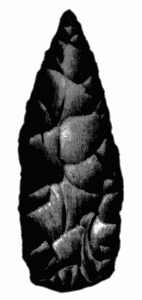
MEASUREMENTS: Nine cotypes, including the illustrated example, ranged in measurements as follows: length—maximum, 100 mm.; minimum, 54 mm.; average, 66 mm.: width—maximum, 32 mm.; minimum, 22 mm.; average, 26 mm.: thickness—maximum, 12 mm.; minimum, 9 mm.; average, 11 mm.
FORM: The cross-section is biconvex. The blade is excurvate. The widest point may be either at the base or somewhat below the midsection, making the hafting area difficult to define. The distal end is acute. The basal edge is usually excurvate, but may be straight, and is usually thinned.
FLAKING: Broad, deep, random flaking appears on the faces, with some fine secondary flaking along the blade edges and sides of the hafting area. Short random flaking was used to thin the basal edge. Local materials were used.
COMMENTS: The type was named after the Benjamin site (Cambron Site 333) in Lawrence County, Alabama, where it was first recognized and appears in association with Woodland artifacts. The illustrated example is from Cambron Site 19 in Morgan County, Alabama. At Cactus Rock Site Dk-101 in DeKalb County, Alabama, one example was recovered from Level 1 in association with Woodland point types and one example from Level 4 in association with Woodland and Archaic point types. At University of Alabama Site Dk-57 in DeKalb County, Alabama, the type was associated with Copena and Madison points. At University of Alabama Sites Lo-23 in Lowndes County, Alabama, and Lr-20 in Lamar County, Alabama, Benjamin points appear in Woodland strata. The association of Benjamin points at these sites seems to place the type within the Woodland period.
BENTON BROAD STEMMED, Cambron (This Paper): A-9-a
GENERAL DESCRIPTION: This is a medium to large, broad-stemmed point with steeply beveled stem edges.
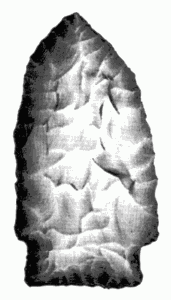
MEASUREMENTS: The measurements of the illustrated example are: length, 66 mm.; shoulder width, 32 mm.; stem width, 28 mm.; stem length, 11 mm.; thickness, 9 mm.
FORM: The cross-section may be flattened or biconvex. The shoulders are narrow and may be horizontal or tapered. The blade is usually excurvate, the distal end acute. The stem is usually slightly expanded, but may be straight. It is very broad and short. The stem side edges are usually incurvate or straight and beveled. The beveled basal edge is usually straight but may be slightly incurvate or excurvate.
FLAKING: The blade and stem display broad, shallow, random flaking. Some broad retouching was used to finish the blade and stem edges. The stem appears to have been formed by the removal of the corners of the original basal edge.
COMMENTS: The type name was derived from the Benton Stemmed point, to which it seems to be closely associated both typologically and culturally. The outstanding differences between the two are the exceptionally broad stem and broader, shorter blade of the Benton Broad Stem point. The type does not appear as frequently or in as great numbers as Benton Stemmed. The illustrated example is from Cambron Site 48, Lincoln County, Tennessee. Due to its association with Benton Stemmed and Buzzard Roost Creek points, it is considered to be an Archaic point and is probably coeval with these types, dating from about 4000 B.C. to 2000 B.C.
BENTON STEMMED, Kneberg (Kneberg, 1956): A-9
GENERAL DESCRIPTION: This is a medium to large, stemmed point with steeply beveled stem edges.
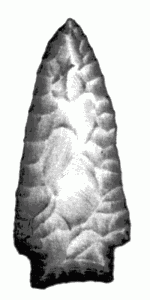
MEASUREMENTS: The measurements of five cotypes from which measurements and traits were taken are: length—maximum, 97 mm.; minimum, 45 mm.; average, 65 mm.: shoulder width—maximum, 30 mm.; minimum, 25 mm.; average, 29 mm.: stem width—maximum, 20 mm.; minimum, 16 mm.; average, 17 mm.: stem length—maximum, 11 mm.; minimum, 8 mm.; average, 9 mm.: thickness—maximum, 9 mm.; minimum, 5 mm.; average, 7 mm. Measurements of the illustrated example are: length, 53 mm.; shoulder width, 28 mm.; stem width, 19 mm.; stem length, 9 mm.; thickness, 8 mm.
FORM: The cross-section is biconvex to flattened. The shoulders are narrow and, rarely, barbed. They may be horizontal or slightly tapered. The blade is usually recurvate, but may be excurvate with an acute distal end. The stem is relatively broad and short with straight, beveled side edges. It may be tapered or expanded. The steeply beveled basal edge may be straight or incurvate.
FLAKING: The random, primary flaking used to shape the face of the blade and stem is broad and shallow. Some areas seem to be only slightly modified and exhibit some blade scars. The retouching along the blade edges is broad and shallow. Short, broad flakes are used to shape the stem and bevel the stem edges. These appear to be the result of indirect percussion.
COMMENTS: The type was named for Benton County, Tennessee. The illustrated example is from Hulse Site 17, Limestone County, Alabama. The type is found in the Tennessee River Valley and in western Tennessee along the Mississippi River (Bell, 1960). At the Eva Site, in Benton County, Tennessee, the cultural association is with the early Big Sandy component (Lewis and Lewis, 1961). Practically all the types recovered from Stanfield-Worley Bluff Shelter were from Zone A, where the first ten levels contained examples. The more frequent occurrence of the type in Levels 4 through 9, Zone A, is an indication of Archaic association (DeJarnette, Kurjack, Cambron, 1962). At Rock House Shelter, University of Alabama Site Ms 201, in Marshall County, Levels 5, 7, 8 and 11 produced one point each. This indicates an early Archaic association at this site. At Flint Creek Rock Shelter (Cambron and Waters, 1961), all examples were in middle- and upper-stratum II (Archaic). At Little Bear Creek, Ct 8 (Webb and DeJarnette, 1948b), examples were recovered from the two-foot level through the eight-foot level, most examples being from the lower three levels. The type appeared in Zones A, B, C and D at Flint River, Mound Ma 48 (Webb and DeJarnette, 1948a); it was most frequent in Zone C. A strict Archaic association dating from about 4000 B.C. to 2000 B.C. is suggested.
BIG SANDY, Lewis and Kneberg A-10 (Cambron and Hulse, 1960a): A-11
GENERAL DESCRIPTION: This is a small to medium, side-notched point. The basal edges and/or notches are usually ground. The blade edges may be serrated and/or beveled.
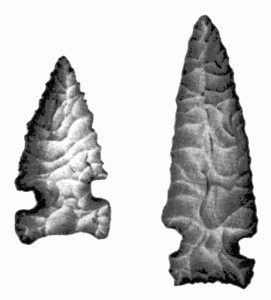
MEASUREMENTS: The range of measurements of 14 examples from an excavation on the Quad Site (Cambron and Hulse, 1960a) are: length, 35-56 mm.; width, 18-20 mm.; thickness, 6-8 mm. Measurements of the illustrated example are: length, 41 mm.; shoulder width, 20 mm.; width at base, 21 mm.; notch depth, 4 mm.; notch width, 6mm.; thickness, 6mm. Later unground examples from the Big Sandy Site in Henry County, Tennessee, range in length from 44 mm. to 89 mm. and average near 64 mm. (Bell, 1960).
FLAKING: The flaking is variable, but usually is good. Random flaking is usually employed to shape the faces of the blade and hafting area; retouch is evident along the edges. The side notches appear to have been made by broad percussion flaking. Rare examples show oblique flaking (Kneberg, 1956).
FORM: The cross-section is usually biconvex but may be rhomboid, plano-convex, or median ridged. The blade may be excurvate or straight. Of the 22 whole and broken examples recovered, 62% are beveled on one side of each blade face and 8% are serrated. The distal end is acute. The hafting area is side-notched. The notches average about 5 mm. deep and 7 mm. wide, and are nearly always ground. Of the 22 measured examples, 43% have incurvate bases, 32% have slightly excurvate bases, and 25% have straight bases. The bases are usually thinned, and 50% of the 22 examples have ground bases. The part of the hafting area between the notches and the base may be straight or auriculated. Rarely, the basal edge is parallel pointed.
COMMENTS: The point is named for the Big Sandy I phase of the Archaic period (Lewis and Kneberg, 1959). The illustrated example is from Hulse Site 38 (Pine Tree), Limestone County, Alabama. Examples were found in association with a fluted midsection, Wheeler, Dalton, and Quad points on the Quad Site (Cambron and Hulse, 1960a). Ritchie, in New York (1961), described the type as the Otter Creek point. The type was dated at Stanfield-Worley Bluff Shelter by radiocarbon method at near 10,000 B.P. (DeJarnette, Kurjack and Cambron, 1962). Similar examples from Danger Cave, Utah, were listed by Jennings (1957) as types W4, W25, and W26. Type W4 was recovered only from Level II, where the radiocarbon dates were 9789 ±630 B.P. and 8960 ±340 B.P. This type was described in earlier editions of this book as Big Sandy I. An unground variant, also described in earlier editions of this book as Big Sandy II, Code, No. A-11, were numerous in the Three Mile Phase at the Eva Site (Lewis and Lewis, 1961). Kneberg suggests a date of from 3500 B.C. to 1000 B.C. for this variant (1959).
BIG SANDY AURICULATE, Cambron (This Paper): A-133
GENERAL DESCRIPTION: This is a small to medium sized, side-notched point with auriculate, incurvate base and excurvate blade edges. The basal edges and/or notches are nearly always ground.
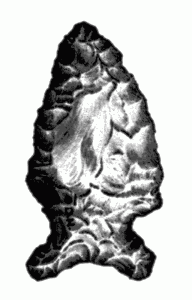
MEASUREMENTS: Eight examples from Cave Spring (Moebes, 1974) provided the following measurements: length, 30-45 mm.; average, 39 mm.; shoulder width, 16-26 mm.; average, 22 mm.: stem width, 18-23 mm.; average, 21 mm.: stem length, 10-13 mm.; average, 11 mm.: thickness, 6-9 mm.; average, 8 mm.: basal concavity, 1-3 mm.; average, 2 mm.: width in notches, 10-17 mm.; average, 14 mm.: notch width, 6-10 mm.; average, 8 mm.: notch depth, 3-7 mm.; average, 4 mm.: stem length below notches, 4-6 mm.; average, 5 mm.
FLAKING: Fifty percent show collateral flaking and 50% show random flaking.
FORM: Seventy-four percent of the cross-sections are biconvex, 13% are plano-convex and 13% are median ridged. All blade edges are excurvate. All bases are incurvate. All bases and notches are ground and 75% of the stem edges are ground. Fifty percent have shoulder barbs and all examples are patinated. Thirteen percent have acuminate distal ends and 87% have acute distal ends.
COMMENTS: The provenience of 9 examples, used to define this type of Big Sandy point is as follows: Stratum I; Level 3, 1 (probably out of context); Stratum II: Level 7, 2; Level 8, 2; Stratum III: Level 7, 1; Level 10, 1; Level 12, 2. Five examples of similar type (W4) from Level II at Danger Cave (Jennings, 1957) were dated by radiocarbon samples at 9789 ±630 B.P. and 8960 ±340 B.P. One example was recovered from Stratum II at Flint Creek Rock Shelter, Fig. 55 (Cambron and Waters, 1958).
BIG SANDY BROAD BASE, Cambron (This Paper): A-134
GENERAL DESCRIPTION: This is a medium sized, side-notched, trianguloid point with blade edges that are usually excurvate but may be straight or recurvate. Most examples are serrated. The basal edges and/or notches are usually ground.
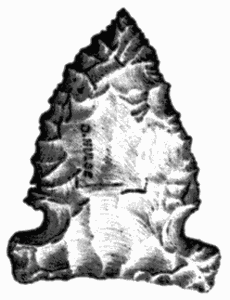
MEASUREMENTS: Eleven examples from DeKalb County, Tennessee, 1 example from Warren County, Tennessee, and 3 examples from Cave Spring (Moebes, 1974) provided the following features and measurements: length, 37-53 mm.; average, 44 mm.: shoulder width, 21-38 mm.; average, 25 mm.: stem width, 23-32 mm.; average, 29 mm.: stem length, 11-17 mm.; average, 15 mm.: thickness, 5-10 mm.; average, 7 mm.: basal concavity, 1-4 mm.; average, 2 mm.: width in notches, 17-23 mm.; average, 19 mm.: notch width, 6-9 mm.; average, 7 mm.: notch depth, 3-5 mm.; average, 4 mm.: stem length below notches, 6-10 mm.; average, 8 mm.
FLAKING: Random flaking was employed in shaping the blade and hafting area. The notches were formed by well controlled pressure flaking.
FORM: Thirty percent of the cross-sections are biconvex, 50% are flattened, 5% are plano-convex and 15% are rhomboid. Eighty percent of the blade edges are excurvate, 10% are straight, 10% are asymmetrical, 54% are serrated, 18% are beveled on one edge of each face, 41% have incurvate bases, 59% have straight bases. The basal edges and notches are usually ground and thinned. All examples are patinated. Eighty-four percent of the distal ends are acute and 16 are acuminate.
COMMENTS: The three examples from Cave Spring were randomly flaked, and rhomboid in cross-section. All three had blade edges that were serrated and beveled on one edge of each face. They were ground in the notches as well as on the base and stem edges. The distal ends were acute. Three other examples from Cave Spring were either broken or reworked and could be not meaningfully measured but the provenience of all six examples is: Stratum II; Level 5, 1; Stratum III; Level 7, 1; Level 8, 1; Level 9, 1; Level 10, 2. An early Archaic or Transitional Paleo placement is suggested.
BIG SANDY CONTRACTED BASE, Cambron (This Paper): A-132
GENERAL DESCRIPTION: This is a small to medium sized, side-notched point with a contracting stem and an incurvate base. Most examples show collateral flaking and shallow serrations along the blade edges.
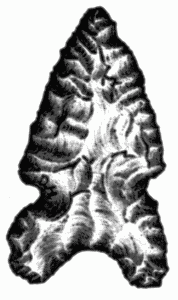
MEASUREMENTS: Seven cotypes supplied the following features: length, 35-60 mm.; average, 45 mm.; shoulder width, 20-26 mm.; average, 23 mm.: stem width, 20-25 mm.; average, 23 mm.: stem length, 12-16 mm.; average, 14 mm.: thickness, 5-8 mm.; average, 7 mm.: basal concavity, 3-6 mm.; average, 5 mm.: width in notches, 13-16 mm.; average, 15 mm.: notch width, 3-5 mm.; average, 4 mm.: notch depth, 3-5 mm.; average, 4 mm.: stem length below notches, 8-13 mm.: average, 11 mm.
FLAKING: Shallow pressure flaking was used to thin the basal edge. Well controlled pressure flaking was employed to shape the side notches. All blade surfaces exhibit collateral flaking.
FORM: Seventy percent of the cross-sections are median ridged; 15% are biconvex; and 15% are plano-convex. Fifty-seven percent of the blade edges are straight and 43% are excurvate. Eighty-four percent have shallow serrations along the blade edges. Bases are usually thinned and all of them are ground. Eighty-four percent of the stem edges and all notches are ground. All examples are patinated. Forty percent have acute distal ends and 60% of the distal ends are acuminate.
COMMENTS: The provenience of seven examples, from the Cave Spring Site, (Moebes, 1974) used to define this type of Big Sandy point is as follows: Level 5, 2; Level 7, 1; Level 8, 1; Stratum II. Level 7, 1; Level 8, 1; Level 9, 1; Level 10, 2; Level 11, 1; Stratum III. A similar type was described by Jennings (1957) from Danger Cave, Utah is listed as Type W 17 where dates of 9787 plus or minus 630 B.P. and 8960 plus or minus 340 B.P. were secured from levels containing this type. Two examples were classified from the collection of Steve Maloney Site DK 2 in DeKalb County, Tennessee.
BIG SLOUGH, Hulse (Cambron and Hulse, 1960b): A-12
GENERAL DESCRIPTION: This is a medium to large point with a broad expanded stem.
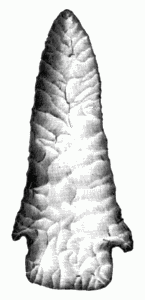
MEASUREMENTS: The range of measurements of 11 cotypes from Morgan and Limestone Counties near Decatur, Alabama are: length—maximum, 85 mm.; minimum, 49 mm.; average, 62 mm.: shoulder width—maximum, 42 mm.; minimum, 29 mm.; average, 34 mm.: stem width—maximum, 28 mm.; minimum, 20 mm.; average, 25 mm.: stem length—maximum, 17 mm.; minimum, 14 mm.; average, 15 mm.: thickness—maximum, 9 mm.; minimum, 7 mm.; average, 8 mm. Measurements of the illustrated example are: length, 85 mm.; shoulder width, 38 mm.; stem width, 28 mm.; stem length, 14 mm.; thickness, 9 mm.
FORM: The cross-section is biconvex. The shoulders are inversely tapered with narrow barbs that may be expanded, especially on examples with recurvate blade edges. The blade may be excurvate or recurvate; rarely, excurvate-recurvate. One example of the cotypes has one straight and one recurvate blade edge. About half the blade edges are asymmetrical. The distal end is usually acute but may be apiculate. The stem is broad and long and expanded by shallow diagonal notches. The stem side edges may be slightly incurvate, slightly excurvate, or straight. The basal edge is excurvate, thin, and usually ground.
FLAKING: Most examples are made by broad, shallow, random flaking, but a considerable number show collateral flaking. Several have random flaking on one face and collateral on the other. The blade edges usually show rather broad retouching with some fine flaking along the retouched edges that gives a somewhat crushed effect, as does the baton method of percussion flaking. The notches appear to have been formed by indirect percussion flaking with some retouch. The basal edge is thinned by removal of broad, shallow flakes. The stem is usually finely retouched on all edges.
COMMENTS: The point is named for the Big Slough area in Limestone County, Alabama, where many examples are found on the surface with early Archaic types. The illustrated example is from Hulse Site 18, Limestone County, Alabama. At Stanfield-Worley Bluff Shelter (DeJarnette, Kurjack and Cambron, 1962), one example each was recovered from Levels 1, 5, 6, 8 and 9 of Zone A. At University of Alabama Site Ms 201, Rock House Shelter, in Marshall County, Alabama, Levels 4 and 5 produced one example each. One example was recovered from Zone C (Archaic) at Ma 48, Flint River Mound (Webb and DeJarnette, 1948a). This evidence suggests a cultural association of from early Archaic to middle Archaic times, with a probable age range of about 5000 B.C. to 2000 B.C.
BRADLEY SPIKE, Kneberg (Kneberg, 1956): A-14
GENERAL DESCRIPTION: The Bradley Spike is a small to medium-sized, spike-shaped, stemmed point.
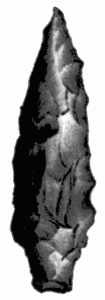
MEASUREMENTS: The measurements of the 13 plesiotypes upon which description of form was based (included is the illustrated specimen from Ma 48, Flint River Site, Webb and DeJarnette, 1948a) are: length—maximum, 65 mm.; minimum, 40 mm.; average, 51 mm.: shoulder width—maximum, 17 mm.; minimum, 10 mm.; average, 15 mm.: stem width—maximum, 12 mm.; minimum, 8 mm.; average, 11 mm.: stem length—maximum, 15 mm.; minimum, 7 mm.; average, 11 mm.: thickness—maximum, 14 mm.; minimum, 6 mm.; average, 10 mm.
FORM: The cross-section is usually median ridged but may, rarely, be plano-convex or biconvex. The shoulders are usually tapered and may be asymmetrical. The blade may be straight or slightly convex; the distal end is sharply acute. The hafting area is stemmed and the stem is usually straight but may be tapered. Stem side edges are straight; the basal edge of the stem is usually excurvate but may be straight and may exhibit some of the patinated rind of the parent material from which the point was made.
FLAKING: Some examples are almost as thick as they are broad. The steep, percussion, random flaking used to shape the point may be struck from alternate faces to produce an irregular blade edge outline. Occasional retouch, that appears to have been done by percussion flaking, is evident; but no regular pressure retouch is present.
COMMENTS: The type was named for Bradley County, Tennessee, where it was first recognized. The illustrated specimen is from Ma 48 (Webb and DeJarnette, 1948a). Ten examples were recovered from Zone A at the Stanfield-Worley Bluff Shelter (DeJarnette, Kurjack and Cambron, 1962), eight specimens from the upper four levels and one each from Levels 7 and 9. One example was recovered from Level 5 at University of Alabama Site Ms 201 (Rock House). Of the 34 examples from Flint River Mound Ma 48 (Webb and DeJarnette, 1948a), 18 were from Zone A and 16 from Zone B. The evidence supports Kneberg's (1956) analysis of early Woodland cultural association since examples are found in early Woodland association at these sites. However, most of the points were found in the upper Woodland stratum, indicating a later Woodland association in the North Alabama area, possibly dating from about 2000 B.C. to sometime A.D.
BREWERTON, EARED-NOTCHED, Ritchie (Ritchie, 1961): A-127
GENERAL DESCRIPTION: This is a small trianguloid point with shallow side notches.
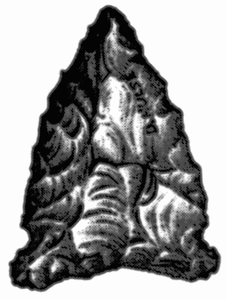
MEASUREMENTS: The measurements of four plesiotypes (including the illustrated example) from which descriptions were taken are: maximum, 40 mm.; minimum, 27 mm.; average, 33 mm.: shoulder width—maximum, 18 mm.; minimum, 14 mm.; average, 16 mm.: stem length—maximum, 9 mm.; minimum, 6 mm.; average, 7 mm.: stem width—maximum, 20 mm.; minimum, 16 mm.; average, 18 mm.: thickness—maximum, 6 mm.; minimum, 5 mm.; average 6 mm.
FORM: The blade edges may be straight or excurvate. The cross-section is biconvex. The base may be straight or excurvate. The hafting area is shallowly side notched forming weak auricles.
FLAKING: The blade and hafting area display broad, shallow random flaking. Some broad retouching was used to finish the blade and hafting area edges. The notches were formed by shallow pressure flaking after the blade was finished, thus forming the auricles.
COMMENTS: Brewerton Eared-Notched is one of four Brewerton types described by Ritchie (Ritchie, 1961). The other three types were listed as Brewerton Eared-Triangular, Brewerton Corner-Notched and Brewerton Side-Notched. Ritchie (Ritchie, 1961) considers the Brewerton complex to be a part of the upper middle and late Archaic horizons in New York and New England. The examples that provided the type description, including the illustrated example, are from the Etowah River Site, Bartow County, Georgia. They were excavated by James Chapman and others and were associated with ceramics at this site. One example was recovered from Level 6, Stratum I at Cave Spring in Morgan County, Alabama (Moebes, 1974).
BUZZARD ROOST CREEK, Cambron (Cambron, 1958a): A-89
GENERAL DESCRIPTION: This is a medium to large, bifurcated-stemmed point.
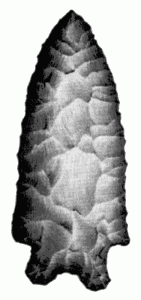
MEASUREMENTS: The measurements of nine cotypes (including the illustrated example) from which features were taken are: length—maximum, 104 mm.; minimum, 61 mm.; average, 82 mm.: shoulder width—maximum, 36 mm.; minimum, 27 mm.; average, 30 mm.: stem width—maximum, 23 mm.; minimum, 17 mm.; average, 19 mm.: stem length—maximum, 12 mm.; minimum, 10 mm.; average, 11 mm.: thickness—eight examples measured 8 mm. and one example measured 7 mm.
FORM: The cross-section is biconvex. The shoulders are usually inversely tapered and the barbs usually expanded. The blade is recurvate with an acute distal end. The stem is usually straight but may be expanded, with straight or incurvate side edges. The basal edge of the stem is usually bifurcated but may be auriculate. Usually all of the stem edges are beveled. Points made of adaptable material are usually patinated.
FLAKING: The flaking used to shape the blade and stem is usually random, broad, and thin; rarely, it is collateral. The secondary flaking along the edges of the blade is long and shallow. The short deep scars left by flaking used to bevel the stem edges may be the result of indirect percussion, possibly with some pressure flaking. The flaking used to bifurcate the stem appears to be of the same type as that used to bevel the stem edges.
COMMENTS: The type was named for Buzzard Roost Creek Site (Cambron Site 158), in Colbert County, Alabama, where the illustrated example was recovered. The original description has been revised to exclude those examples with straight or slightly incurvate stem bases, since these examples are classified as Benton Stemmed—to which Buzzard Roost Creek is culturally and typologically related. Examples at Stanfield-Worley Bluff Shelter (DeJarnette, Kurjack and Cambron, 1962) appeared in Zone A, Levels 2 through 8, with concentrations in Levels 6 and 7. Three examples were recovered from the middle and upper parts of Stratum II at Flint Creek Rock Shelter (Cambron and Waters, 1961). At Little Bear Creek (Webb and DeJarnette, 1948b) examples were recovered from four-foot through eight-foot levels, with most examples from the six-foot level. This appears to be an early to middle Archaic type found in northern Alabama and southern Tennessee.
CAMP CREEK, Kneberg (Kneberg, 1956): A-16
GENERAL DESCRIPTION: This is a small to medium, triangular point with incurvate base.
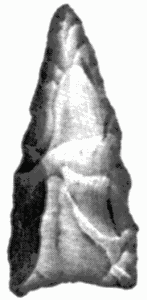
MEASUREMENTS: The measurements of the illustrated example are: length, 35 mm.; width at base, 16 mm.; thickness, 7 mm.; depth of basal concavity, 2 mm.
FORM: The cross-section is usually biconvex. The blade is usually straight; rarely, incurvate or excurvate. The distal end is acute. The base is incurvate and usually thinned with some fine retouch.
FLAKING: The flaking used to shape the blade and hafting area is random and fairly well executed. Some fine retouch is in evidence along the blade edges. Much of the flint and quartzite used at the Camp Creek Site has poor flaking qualities, resulting in a poorly manufactured point.
COMMENTS: The type was named from the Camp Creek Site (Cambron Site 284) on the Nolichucky River in Greene County, Tennessee. The illustrated specimen is from Zone A of the Camp Creek Site (Lewis and Kneberg, 1957). This example was selected by Cambron from his collection from Camp Creek (Site 284) as typical of the type. Although a minority type in all levels at this site, it is found with burials more frequently than are other types. It comprises about 15% of the stemless points in Level D, but in other levels does not exceed 6% (Lewis and Kneberg, 1957). The type appears to be a part of the Greeneville complex, found along the western edge of the Appalachians southwest from the Greeneville, Tennessee, area into south-central Alabama. It is usually associated with the early to middle Woodland period. Some other points that appear in this complex are Greeneville, Nolichucky, Triangular Copena, Coosa, and possibly Ebenezer. At the Stanfield-Worley Bluff Shelter (DeJarnette, Kurjack and Cambron, 1962) Zone A, four examples were found in Level 1, five in Level 2, one in Level 3 and three in Level 4. This indicates a Woodland association at this site. Most of the examples recovered from Flint Creek Rock Shelter (Cambron and Waters, 1961) were in the lower three-quarters of Stratum I (Woodland). One example was recovered from Level 1 and one from Level 2 at Rock House Shelter in Marshall County, Alabama (University of Alabama Site Ms 201). Ten examples were recovered from Zones A and B (Woodland) and two from Zone D (Archaic) at Flint River Mound (Webb and DeJarnette, 1948a). Kneberg suggests a date of from about 1000 B.C. to 500 A.D.
CANDY CREEK, Kneberg (Kneberg, 1956): A-17
GENERAL DESCRIPTION: This is a medium-sized, auriculate point with recurvate edges and incurvate base.
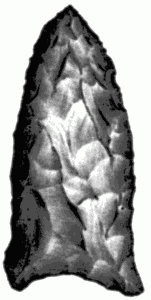
MEASUREMENTS: The illustrated example measures 50 mm. long, 22 mm. wide at widest point of blade, 25 mm. wide at base, 21 mm. wide across hafting constriction, 9 mm. thick, 3 mm. deep at basal concavity.
FORM: The cross-section is biconvex. The blade is recurvate; the distal end, acute. The auriculated hafting area is usually expanded-rounded with an incurvate basal edge. The base is occasionally fluted or thinned. The hafting area edges may be lightly ground, as are most Copena and Copena Triangular points, with which they are frequently associated.
FLAKING: The flaking used to shape the blade and hafting area is usually shallow and random. Fine retouching employed to finish the blade and hafting area edges is usually evident. Although there appears to be no connection between this type and Paleo fluted types, the hafting method must have been very similar. The flutes, when present, appear to be nothing more than results of attempts to thin the base, as they are usually broad and shallow. Copena and Copena Triangular types were probably hafted in about the same manner as Candy Creek points.
COMMENTS: The name is derived from Candy Creek Site in Bradley County, Tennessee. The illustrated specimen is a plesiotype from Cambron 53, Morgan County, Alabama. Of 1552 points at Camp Creek, 9 were classified as Candy Creek (Lewis and Kneberg, 1957). One example was recovered from Zone A, Level 1 at the Stanfield-Worley Bluff Shelter (DeJarnette, Kurjack and Cambron, 1962). Two examples, one from Level 2 and one from Level 3, were recovered from Rock House Shelter in Marshall County, Alabama (University of Alabama Site Ms 201). Twenty-three examples from Cambron Site 53 at Bakers Creek in Morgan County, Alabama, were associated with other Woodland types. Kneberg (1956) suggests an age of from 1000 B.C. to 500 A.D.
CAVE SPRING, Cambron (This Paper): A-126
GENERAL DESCRIPTION: The Cave Spring is a small to medium sized, bifurcated point with an expanded stem.
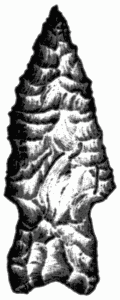
MEASUREMENTS: Seven cotypes from Strata II and III of the Cave Spring type site (Moebes, 1974) provided the following traits and measurements: length, 50-32 mm.; average, 40 mm.: shoulder width, 25-17 mm.; average, 20 mm.: stem width, 17-11 mm.; average, 15 mm.: stem length, 17-10 mm.; average, 13 mm.: thickness, 6-5 mm.; average 6 mm. The illustrated example, from Stratum III, measures 50 mm. in length, 20 mm. in shoulder width, 14 mm. in stem width, 16 mm. in stem length and 6 mm. in thickness. Stratum III points averaged longer and slightly narrower than points from Stratum II.
FORM: The cross-section is usually biconvex but may be plano-convex or rarely median ridged. Shoulders are usually tapered but may be barbed or rarely horizontal. Blade edges are nearly always straight, rarely excurvate. The distal end is usually acute; rarely broad. The hafting area consists of an expanded stem that is shallowly bifurcated. Stem width usually exceeds the stem length.
FLAKING: Broad, shallow, random flaking is in evidence on the stem and blade. Collateral flaking was used to finish the blades of most examples. Fine retouch is present along most blade edges. Long shallow flakes were removed to thin the base in the basal concavity. One example from Level 5, Stratum II, had diagonal flakes struck from the base in the same tradition as Decatur points. One large flake was struck from each side of each face of the stem forming a shallow notch where the stem joins the blade. These notches and all other stem edges are usually ground. All examples were made of local material and all were patinated.
COMMENTS: The type was named after the Cave Spring Site in Morgan County, Alabama, where examples were recognized during excavation. The illustrated example is from Level 8, Stratum III. Except for the bifurcated stem some examples are similar to some of the Jude points recovered in this excavation. Some of the blades of Cave Spring points are similar to blades of some Big Sandy points recovered at this site. The provenience and associations at this site strongly suggest a late Transitional Paleo-Indian affiliation as well as early Archaic. One example from the Big Sandy Site in Tennessee is shown in Fig. E, Plate 4 (Bell, 1960). One example is illustrated from the Packard Site, Mays County, Oklahoma, Plate VIII, Fig. 3 (Wyckoff, 1964).
CLOVIS, (Suhm, Krieger and Jelks, 1954): A-19
GENERAL DESCRIPTION: This is a medium to large, auriculate, fluted point with incurvate base.
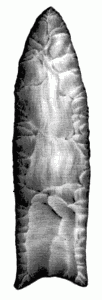
MEASUREMENTS: The maximum measurements, in mm., of 59 examples from 44 sites in the Tennessee River valley (Soday and Cambron, n. d.) average: length, 66; width, 27; thickness, 7. The length of the longest example is 154; of the shortest, 35. The weight of the largest is 60 grams; of the shortest, 5 grams. Maximum measurements of fourteen examples of "Fine Clovis" from 13 sites average 59 mm. long, 25 mm. wide, 6 mm. thick. The length of the longest is 109 mm.; of the shortest, 29 mm. The weight of the longest is 27 grams, of the shortest, 3 grams. Texas examples (Suhm, Krieger and Jelks, 1954) range from 69 mm. to 140 mm. in length and 20 mm. to 40 mm. in width. The range of 66 examples from New York State (Ritchie, 1961) is: length, about 25 mm. to about 127 mm.; thickness, 3 mm. to 10 mm. The illustrated example measures 110 mm. long, 31 mm. wide at widest point, 28 mm. wide at base, 27 mm. wide across basal constriction, 9 mm. thick. The longest flute measures 29 mm.; the shortest flute, 28. Flute width is 19 mm.
FORM: The cross-section in the fluted area of the blade is fluted; in the unfluted area, biconvex. The blade is usually excurvate but may be slightly recurvate; the distal end is usually acute but may be broad. The hafting area is auriculate and may be pointed or rounded. It is usually parallel, but on a few examples may be expanded or contracted. The basal edge is incurvate. The hafting area is usually fluted on both faces; rarely, on one. Either single or multiple flutes may be present. Most examples are fluted about one-third of the total length, but some may be fluted to near the distal end. Most examples have ground basal edges, which may determine the hafting area.
FLAKING: The flaking is usually random but may be somewhat collateral, leaving a low median ridge. All examples are retouched along the edges; many are very finely pressure flaked. Flutes appear to have been struck by indirect percussion after preparation of a "striking platform" at the base. On the multiple fluted examples, two or more primary flutes appear to have been removed leaving a striking area near the center of the base from which the main flute was struck. After one face was fluted the base was beveled to facilitate striking flutes from the opposite face. This resulted in a basal concavity (Cambron and Hulse, 1961a).
COMMENTS: The point is named for the Clovis, New Mexico, area, where examples were found in association with mammoth remains. The illustrated example from Hulse Site 54, in Limestone County, Alabama, was selected for its similarity to the type specimens from New Mexico. A date of over 37,000 B. P. was taken from a hearth containing a Clovis point at Lewisville, Texas (Crook and Harris, 1958), but the association has been questioned. The date from the Naco mammoth find in Arizona is 9250 ±300 B. P. Many early-man authorities suggest a date of about 15,000 years ago. This range of dates may indicate long use of the type. The type is distributed over most of North America. Alabama examples are found on early sites with blade tools.
CLOVIS, UNFLUTED, Soday and Cambron (This Paper): A-19-a
GENERAL DESCRIPTION: The Unfluted Clovis point is a medium to large, auriculate point with incurvate base.
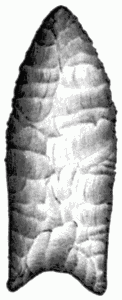
MEASUREMENTS: The average measurements of samples from seven sites (Soday and Cambron, n. d.) in the Tennessee River Valley are: length, 61 mm.; width, 25 mm.; thickness, 6 mm. Length and weight range as follows: longest, 179 mm.; weight 18 grams: shortest, 46 mm.; weight 4 grams. The detailed measurements of the illustrated example (one of the cotypes) are: length, 59 mm.; width at widest point, 24 mm.; width at base, 21 mm.; maximum thickness, 6 mm.; depth of basal concavity, 4 mm.; length of ground hafting area, 29 mm.
FORM: The cross-section is biconvex. The blade is excurvate and terminates in an acute, or, sometimes, broad distal end. The auriculate hafting area is usually either parallel-pointed or parallel-rounded; rarely, it is expanded with an incurvate basal edge which is usually well thinned. All basal edges are usually ground—sometimes for almost half the length of the point. The shape is similar to, but usually thinner than, that of the Clovis point.
FLAKING: The flaking used to shape the blade and hafting area may be transverse-oblique, random, or collateral with fine retouch along the blade edges. Usually several broad, shallow flakes were removed to thin the basal edge of the hafting area.
COMMENTS: The type was named Unfluted Clovis because of its similarity to the fluted Clovis type. The illustrated example was found weathered out of an early stratum along with a fluted Quad point on Cambron Site 20 in Morgan County, Alabama. Suhm, Krieger and Jelks (1954) suggest the possibility that some Clovis points have no flutes, and that it would be difficult to distinguish these examples from Plainview points. Concerning the fluting on some of the Clovis points at the Naco, Arizona Site, Wormington (1957) says, "In some instances the grooves had been formed by the removal of several smaller flakes." At least one illustrated example appears to be only basally thinned. The Naco find dates between 10,000 and 11,000 years ago. At the Silver Springs Site in Florida, fluted and unfluted Clovis-like points (Neill, 1958) were recovered together from the lowest levels of the site. Alabama examples usually are recovered from fluted point sites. It is suggested that this type may be contemporaneous with Clovis or may have appeared later.
CONERLY, Lively (This Paper): A-135
GENERAL DESCRIPTION: The Conerly is a medium to large point with an incurvate base that is thinned. The stem is contracted.
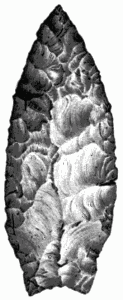
MEASUREMENTS: Nine cotypes from Lively Sites 1, 2, and 4 in the Sardis area of Burke County, Georgia, provided the following measurements and traits: length—maximum, 105 mm.; minimum, 57 mm.; average, 77 mm.: shoulder width—maximum, 31 mm.; minimum. 21 mm.; average, 27 mm.: stem width—maximum, 21 mm.; minimum, 16 mm.; average, 18 mm.: stem length—maximum 20 mm.; minimum, 17 mm.; average, 18 mm.: thickness—maximum, 12 mm.; minimum, 9 mm.; average, 11 mm.: basal concavity—maximum, 4 mm.; minimum, 2 mm.; average, 3 mm.
FORM: The cross-section is biconvex, rarely flattened. The shoulders are narrow or lacking. Blade edges may be excurvate or straight and most examples exhibit shallow serrations. The distal end is acute. The stems are contracted with an incurvate and thinned basal edge.
FLAKING: Mostly broad, shallow, random flaking was employed to shape the blade and stem. Two examples exhibited oblique transverse flaking on the blades. Short, deep random flaking used to finish the blade edges often resulted in fine serrations. A minimum of flaking was used to finish the sides of the stem. The basal edge of the stem was flaked to form a concavity and then thinned. Local materials were used and all points were patinated.
COMMENTS: The type was named from the Conerly Site near Sardis in Burke County, Georgia. The examples used are from the collection of Matthew Lively of Birmingham, Alabama. Associated artifacts seem to place the type somewhere in the Archaic period. Physical appearance of the Conerly points indicate a similarity to Savannah River points (Bullen, 1968) as well as Guilford points (Coe, 1959) and Arredondo points (Bullen, 1968). A suggested date is somewhere between 7000 and 4000 years B. P.
COOSA, DeJarnette (DeJarnette, Kurjack and Keel, 1973): A-22
GENERAL DESCRIPTION: This is a small to medium-sized, usually thick, point with a short stem.
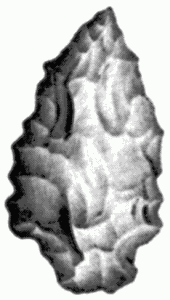
MEASUREMENTS: The measurements of ten plesiotypes, including the illustrated example, follow (these plesiotypes also served as a basis for description of features): length—maximum, 43 mm.; minimum, 31 mm.; average, 37 mm.: width at shoulder—maximum, 23 mm.; minimum, 18 mm.; average, 20 mm.: stem width—maximum, 13 mm.; minimum, 10 mm.; average, 12 mm.: stem length—maximum, 7 mm.; minimum, 4 mm.; average, 6 mm.: thickness—maximum, 8 mm.; minimum, 5 mm.; average, 7 mm.
FLAKING: Flaking used to shape the blade and stem is usually of a random nature; rarely, it is transverse oblique. On most examples some or all blade edges may be crudely beveled for about one-fourth the width of the blade. The retouch that produces the beveling also produces fine serrations on some examples. Points are usually made of a poor grade local flint in the Coosa River area.
FORM: The cross-section is usually biconvex but may be plano-convex or flattened. The shoulders are usually horizontal or inversely tapered. The blade is excurvate and very finely serrated by secondary flaking; the distal end is acute. The two examples with plano-convex cross-sections were unmodified on the plano face except for retouch along the edges. The stem is straight or displays straight side edges and excurvate stem base edge. The stem base edge is usually crudely thinned.
COMMENTS: The type was named for the Coosa River area, where sites produced the first examples to be recognized as a type. The illustrated and measured examples came from University of Alabama Site Ce 200 (Coker Ford Site), Cherokee County, Alabama. The main association at this excavated site was with fabric-marked, limestone-tempered sherds and simple-stamped, sand-tempered sherds (DeJarnette, Kurjack and Keel, 1973). Two occurrences of association in a stone mound with plain or brushed limestone-tempered sherds were also noted. One example was recovered from B Zone (Woodland) at Ma 48, Flint River Mound (Webb and DeJarnette, 1948a). Nine examples recovered from the Camp Creek Site in Greene County, Tennessee, were listed as "straight short stemmed" (Lewis and Kneberg, 1957). A date at this homogeneous site of 2050 ±250 years B. P. was obtained. This evidence suggests a middle Woodland association in Alabama; the type may be a part of the Greeneville complex. This type was associated with Coosa Notched points at the Coosa River sites.
COOSA NOTCHED, DeJarnette (DeJarnette, Kurjack and Keel, 1973): A-23
GENERAL DESCRIPTION: This is a small to medium-sized point, usually thick, with a shallow side notch.
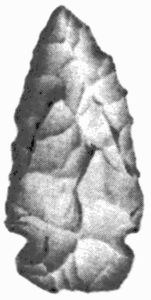
MEASUREMENTS: The four plesiotypes from which this description was drawn range in measurements as follows: length—maximum, 41 mm.; minimum, 36 mm.; average, 39 mm.: shoulder width—maximum, 23 mm.; minimum, 20 mm.; average, 22 mm.: stem width—maximum, 15 mm.; minimum, 11 mm.; average, 13 mm.: stem length—maximum, 9 mm.; minimum, 6 mm.; average, 7 mm.: thickness—maximum, 8 mm.; minimum, 7 mm.; average, 7 mm. The illustrated examples average 35 mm. in length, 17 mm. in shoulder width, 14 mm. in stem width, 7 mm. in stem length and 7 mm. in thickness.
FORM: The cross-section is usually plano-convex but may be biconvex. In most plano-convex examples, the plane face is unmodified except for retouch. The shoulders are inversely tapered. The blade may be excurvate or straight; the blade edges are usually finely serrated. The distal end is acute. Expanded stems are present as a result of shallow side notching on the hafting area. The basal edge is usually excurvate but may be incurvate; it is usually thinned.
FLAKING: Flaking used to shape the blade and hafting area is usually random. Blade edges may be beveled on one or both sides of each face for about one-fourth the width of the blade. This retouch often results in fine serrations along the blade edges. Notches appear to have been formed by removal of short flakes. The points are made of a poor grade flint in the Coosa River area.
COMMENTS: The type was named as a variant of the Coosa point, which was named for the Coosa River in Alabama, where many examples are found. The measured and illustrated examples are from University of Alabama Coker Ford Site, Ce 200, Cherokee County, Alabama. The type is associated mostly with fabric-marked, limestone-tempered sherds at this site but also with simple-stamped, sand-tempered ware (DeJarnette, Kurjack and Keel, 1973). The type appears to be coeval with Coosa, nine examples of which were recovered from the homogeneous Camp Creek Site and listed by Lewis and Kneberg (1957) as straight short stemmed. A radiocarbon date of 2050 ±250 B. P. was obtained from this site. Scattered finds are made on Woodland sites in the Tennessee Valley. This evidence suggests a middle Woodland association in Alabama.
COPENA, Webb and DeJarnette (Kneberg, 1956): A-20
GENERAL DESCRIPTION: This is a medium to large, trianguloid point with recurvate edges.
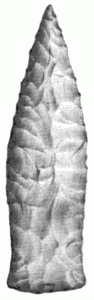
MEASUREMENTS: The illustrated example is, perhaps, slightly shorter than average. It measures 80 mm. long, 22 mm. wide at the widest point of the blade, 22 mm. wide at the base, 21 mm. wide across hafting constriction and 7 mm. thick.
FORM: The cross-section is biconvex. The blade is recurvate as a result of the hafting constriction. The distal end is usually acute but may be acuminate. The hafting area is expanded at the base. The basal edge is usually straight but may be excurvate or occasionally incurvate. It is usually thinned. Light grinding is usually present on the hafting area edges.
FLAKING: The blade and hafting area are shaped by broad, shallow, random or collateral flaking. The removal of these flakes occasionally resulted in a low median ridge. The edges are finely retouched as from pressure flaking. Copena points are usually made of local flint.
COMMENTS: The type was named after the Copena burial mound culture of North Alabama. The term "Copena" is derived from the first three letters of copper and the last three of galena, since copper and galena artifacts are often associated with the burials. The illustrated example is from Hulse Site 17 in Limestone County, Alabama. This type was illustrated by Webb and DeJarnette (1942). Copena is often called Southern Hopewell. It is a Woodland point, usually found in burial mounds, but occasionally on late Archaic sites in the Tennessee area (Kneberg, 1956). Copena points appeared in the lower levels of the Woodland stratum at Flint Creek Rock Shelter (Cambron and Waters, 1961) and two examples were recovered from Level 3 (pottery) at University of Alabama Site Ms 201, Rock House Shelter, in Marshall County, Alabama, as well as in the Woodland zone at Ma 48, Flint River Mound, in Madison County, Alabama (Webb and DeJarnette, 1948a). One example was recovered from Level 1 at the Stanfield-Worley Bluff Shelter (DeJarnette, Kurjack and Cambron, 1962). The type is found eroding out of several predominately Woodland shell middens in the Wheeler Basin of the Tennessee River. A suggested age is from about 500 B. C. to A. D.
COPENA TRIANGULAR, Webb and DeJarnette (Cambron, 1958b): A-20-a
GENERAL DESCRIPTION: This is a medium to large, trianguloid point. The sides of the hafting area are usually parallel.
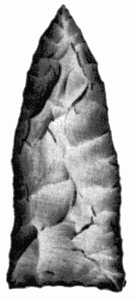
MEASUREMENTS: The 16 autotypes (including the illustrated example from the type site) which provided the features described below range in measurements as follows: length—maximum, 74 mm.; minimum, 43 mm.; average, 56 mm.: width at distal end of hafting area—maximum, 31 mm.; minimum, 20 mm.; average, 24 mm.: width at base—maximum, 31 mm.; minimum, 19 mm.; average, 25 mm.: thickness—maximum, 10 mm.; minimum, 7 mm.; average, 8 mm.
FORM: The cross-section is nearly always biconvex; rarely, it is plano-convex. Beyond the hafting area, the blade is usually excurvate but may be straight. Some examples may have one excurvate and one straight blade edge. The distal end is usually acute; rarely, acuminate. The sides of the hafting area are usually parallel but may taper from the base; rarely, they are slightly incurvate. The basal edge may be either straight or incurvate to a depth of about 2 mm. All bases are thinned. The hafting area edges of most examples with incurvate bases are lightly ground. Straight-based examples may be ground along the hafting area edges.
FLAKING: Faces display random flaking. Secondary flaking of short, broad nature appears, followed by fine retouch, as from pressure flaking, along the edges. The basal thinning is usually short, broad and shallow, but in rare examples it may extend approximately the length of the hafting area. Examples are usually made of local materials.
COMMENTS: The type site is Cambron 53 in Morgan County, Alabama, where examples were found eroding out of a shell midden along with Copena points. The illustrated example is from this site. Examples were first illustrated (Webb and DeJarnette, 1942) as Copena types. At the Stanfield-Worley Bluff Shelter (DeJarnette, Kurjack and Cambron, 1962) three examples were recovered from Level 1, one example from Level 2 and two examples from Level 6 in Zone A. This is an indication of Woodland and possibly Archaic association. Examples appeared in Woodland strata at Flint Creek Rock Shelter (Cambron and Waters, 1961). One example was recovered from Level 3 (Woodland) at University of Alabama Site Ms 201, Rock House Shelter, in Marshall County, Alabama. At Flint River Mound (Webb and DeJarnette, 1948a) examples were recovered from both Woodland and Archaic strata. These associations indicate that the type originated in Archaic times and continued into the Woodland period.
COTACO CREEK, Cambron (DeJarnette, Kurjack and Cambron, 1962): A-24
GENERAL DESCRIPTION: This is a medium to large, straight-stemmed point with rounded shoulders and straight blade edges.
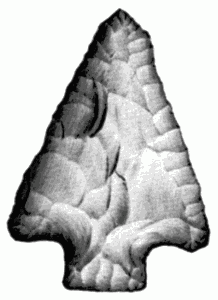
MEASUREMENTS: Measurements of nine cotypes (including the illustrated example) from which features were taken ranged as follows: length—maximum, 83 mm.; minimum, 47 mm.; average, 64 mm.: width at shoulders—maximum, 45 mm.; minimum, 33 mm.; average, 40 mm.: stem width—maximum, 19 mm.; minimum, 14 mm.; average, 16 mm.: stem length—maximum, 14 mm.; minimum, 6 mm.; average, 10 mm.: thickness—maximum, 10 mm.; minimum, 6 mm.; average, 7 mm.
FORM: The cross-section is usually flattened but may be rhomboid. Shoulders may be straight or inversely tapered with weak barbs and are usually rounded. The blade is usually straight, but may be excurvate, finely serrated and, sometimes, beveled on the right side (looking toward the distal end) of one or both faces. One example is smoothed, as from use, on the edges adjacent to the distal end. The distal end is usually apiculate or obtuse; rarely acute. The stem is usually straight; rarely, expanded with straight side edges. The basal edge may be straight or excurvate. Most basal edges are thinned. About half the examples are ground on the basal edge. Occasionally, the side edges of the stem are ground.
FLAKING: This type displays well-controlled, broad, shallow, random flaking. Edge retouch consisting of the removal of fine, short, regular flakes from alternate face edges appears as fine serrations. Sometimes longer, more even flakes were removed in beveling one edge of each face. Some examples were beveled and then serrated. Points were made from Ft. Payne chert, Bangor nodular flint, jasper or other local materials. Some examples made of Ft. Payne chert show considerable patination.
COMMENTS: The type was named for Cotaco Creek in Morgan County, Alabama, where many examples have been recovered. The illustrated example is from Cambron Site 156 (Stone Pipe) in Limestone County, Alabama. At the Stanfield-Worley Bluff Shelter (DeJarnette, Kurjack and Cambron, 1962) 10 examples were recovered from Level 2, 4 from Level 3, 2 from Level 4, 2 from Level 5, 4 from Level 6, 2 from Level 7, 1 from Level 9 and 1 from Level 10. These levels—all in Zone A—are Woodland and Archaic. At the University of Alabama Site Ms 201 in Marshall County, Alabama, one example was recovered from Level 3 (Woodland). Flint Creek Rock Shelter (Cambron and Waters, 1961) produced one example from Stratum I (Woodland) and five examples from middle and upper Stratum II (Archaic). Flint River Mound, University of Alabama Site Ma 48 (Webb and DeJarnette, 1948a) produced three examples from Zones A and B (Woodland) and 18 examples from the upper part of zones C and D (Archaic). This evidence suggests a strong late Archaic occurrence on the Tennessee River and continued use in Woodland times, especially at Stanfield-Worley Bluff Shelter. A variation of the type called Cotaco Creek Variant differs from Cotaco Creek in that it is usually smaller, cruder, often narrower and has an acute distal end. The blade of the variant is more apt to be excurvate.
CRAWFORD CREEK, Cambron and Hulse (DeJarnette, Kurjack and Cambron, 1962): A-25
GENERAL DESCRIPTION: This is a medium-sized, stemmed point with a blade that is usually straight. Blade edges are usually finely serrated.
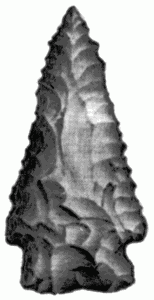
MEASUREMENTS: The 13 cotypes (including the illustrated example) from which features were obtained ranged in measurements as follows: length—maximum, 46 mm.; minimum, 27 mm.; average, 36 mm.: shoulder width—maximum, 30 mm.; minimum, 20 mm.; average, 25 mm.: stem width—maximum, 20 mm.; minimum, 13 mm.; average, 16 mm.: stem length—maximum, 9 mm.; minimum, 6 mm.; average, 8 mm.: thickness—maximum, 9 mm.; minimum, 5 mm.; average, 7 mm.
FORM: The cross-section is biconvex. Shoulders may be horizontal, slightly tapered or slightly inversely tapered. The blade is usually straight, but several examples have one excurvate edge. The blade edges of nearly all examples are finely serrated. Distal ends are usually acute. The stem is usually straight but several examples have expanded stems. Stem sides may be straight or incurvate. The basal edge of the stem, strongly thinned on most examples, is usually straight but may be excurvate; rarely, it is incurvate. At Flint Creek Rock Shelter (Cambron and Waters, 1961) expanded-stemmed examples appear to pre-date straight-stemmed examples.
FLAKING: Irregular, random flaking shapes the blade and hafting area. Some large flake or blade scars may be evident on one or both faces. Flakes removed to form the stem were usually fairly deep and broad while the flakes removed to thin the base were broad and shallow. Fine, often steep, retouch along the blade edges appears to have been accomplished by pressure flaking. Fine serrations were formed by the removal of small flakes, opposite each other, from each face. The point is usually made of local materials.
COMMENTS: The type was named for Crawford Creek in Morgan County, Alabama. This creek is near the Flint Creek Rock Shelter (Cambron and Waters, 1961) where the type was first found and called Provisional Type Three, small, stemmed, serrated. The illustrated example is from Flint Creek Rock Shelter, Cambron Site 287. The name Crawford Creek was used by Cambron and Hulse (1960b). One example (plate 13e) from the Eva Site is illustrated by Lewis and Lewis (1961) as a unique point. One example was found among other artifacts in association with a Morrow Mountain burial at the Stanfield-Worley Bluff Shelter (DeJarnette, Kurjack and Cambron, 1962). Zone A (Woodland and Archaic) at the Stanfield-Worley Bluff Shelter also yielded two examples from Level 6, two from Level 8 and one from Level 9. At University of Alabama Site Ms 201, in Marshall County, Alabama, one example was recovered from Level 5, one from Level 7 and one from Level 10. Of the 20 examples from Flint Creek Rock Shelter, two were recovered from Stratum I (Woodland) and the other 18 from Stratum II (Archaic), particularly from the lower half. Surface finds are usually made on early Archaic sites. All of the above evidence indicates an early Archaic association which lasted into later Archaic. A suggested date is sometime before 5000 B. C.
CUMBERLAND, Kneberg (Kneberg, 1956): A-26
GENERAL DESCRIPTION: This is a medium to large, auriculate, fluted point displaying hafting constriction.
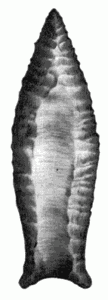
MEASUREMENTS: Thirty-one plesiotypes from 28 sites in the Tennessee River Valley (Soday and Cambron, n. d.) ranged in measurements as follows: longest example, 101 mm.; shortest; 37 mm.; average length, 69 mm.; average width, 23 mm.; average thickness, 8 mm. The illustrated example measures 77 mm. long, 24 mm. across the blade, 19 mm. wide at base, 16 mm. wide at hafting constriction, 7 mm. thick, 2 mm. deep at basal concavity. Length of flutes measured from basal concavity: 1st flute, after flaking of striking platform for 2nd flute, 47 mm.; 2nd flute, 53 mm.
FORM: Cross-section is usually fluted or median ridged on unfluted faces. The blade is recurvate; the distal ends, acute. The auriculate hafting area is usually expanded-rounded with an incurvate basal edge. There is no sharp break between the blade edges and the ground edges of the hafting area. The base may be multiple fluted or single fluted on one or both faces. The main flute or flutes may extend to near the distal end.
FLAKING: Collateral flaking was usually employed to shape the median ridges on the faces. The hafting constriction was sometimes partially worked out before fluting. For multiple fluting, two short primary flutes were removed down each side of the median ridge after the basal edge had been flaked to the proper degree of pitch to form a striking platform. This resulted in the formation of a striking nipple in the center of the basal edge from which the main flute was struck by indirect percussion. The basal edge was then reflaked to the desired pitch or level to facilitate repeating the fluting procedure on the other face. Flaking of the basal edge was sometimes accomplished after the second main flute had been struck. Fine retouch was occasionally carried out on all side edges. Finally, the hafting constriction was completed (Cambron and Hulse, 1961).
COMMENTS: The type was named for the Cumberland River Valley in Tennessee where many examples were collected on the surface. The illustrated example is from Holland Site 270 in Colbert County, Alabama. Three examples of Cumberland points were recovered from University of Alabama Site Ms 201, in Marshall County, Alabama, in the irregular, rocky, lower part of the lower levels with Big Sandy I, Dalton and other early types. They are found with Clovis points in many surface collections. A Paleo-Indian association, sometime before 10,000 years ago, is suggested.
DALTON, COLBERT, Kneberg (DeJarnette, Kurjack and Cambron, 1962): A-28
GENERAL DESCRIPTION: This is a medium-sized, auriculate point with a rectangular hafting area.
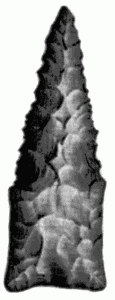
MEASUREMENTS: Eleven cotypes from 11 sites in the Tennessee River Valley (Soday and Cambron, n. d.) range in measurements as follows: longest, 54 mm.; shortest, 33 mm.; average length, 45 mm.; average width, 18 mm.; average thickness, 6 mm. The illustrated example measures 51 mm. long, 15 mm. wide across blade at junction of hafting area, 18 mm. wide at terminal end of hafting area, 19 mm. wide at base, 16 mm. wide across basal constriction, 6 mm. thick. The hafting area is 19 mm. long.
FORM: The cross-section is usually biconvex but may be somewhat rhomboid. Blade edges are usually straight but may be excurvate and may be beveled on one edge and/or serrated. The distal end is acute. The hafting area is more or less rectangular with slightly incurvate, heavily ground side and basal edges. The base is thinned.
FLAKING: The blade and hafting area are shaped by shallow, random flaking. Short, sharp, regular serrations on the blade edges are the result of the well-controlled removal, one at a time on alternate faces, of deep, short, flakes. Retouch was accomplished by the removal of broad, shallow flakes followed by very fine flaking which helped form smooth edges. Most examples are made of Ft. Payne chert but other local materials were also used.
COMMENTS: The type was named for Colbert County, Alabama, where examples were recovered from Stanfield-Worley Bluff Shelter (DeJarnette, Kurjack and Cambron, 1962). The illustrated example is from the Pine Tree Site, Cambron 76, Limestone County, Alabama. The type has been referred to locally as "Square Based Dalton" for some years (Soday and Cambron, n. d.) and was illustrated by Cambron and Hulse (1960a). In the survey of the Tennessee River Valley by Soday and Cambron only eleven examples were noted. Forty-three examples, excluding those from the 100-foot trench, were recovered from Stanfield-Worley Bluff Shelter. At this site, in the other trenches, examples appeared mostly from Level 7 through Level 14. In the blocks two examples were recovered from Zone B, three from Zone C and ten from Zone D. A radiocarbon date from Zone D (1960) gave an age of 9640 ±450 B. P. This appears to be a transitional Paleo-Indian type. Excavations in 1965 at the Tensaw Creek Site (1 Lo 9) in Lowndes County revealed Colbert Daltons and Greenbrier Daltons in a stratigraphic sequence (Chase, 1966).
DALTON, GREENBRIER, Kneberg (DeJarnette, Kurjack and Cambron, 1962): A-29
GENERAL DESCRIPTION: The Greenbrier Dalton is a medium-sized, auriculate point with expanded auricles and well-defined hafting area.
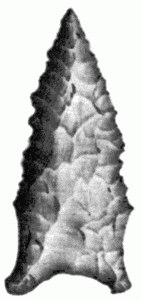
MEASUREMENTS: One hundred fifty-three plesiotypes which may include some Nuckolls Dalton points, since the types had not been separated when the survey was made (Soday and Cambron, n. d.), from 62 sites in the Tennessee River Valley ranged from maximum length of 69 mm. to a minimum length of 28 mm. The average length was 47 mm.; the average width, 21 mm.; average thickness, 6 mm. The illustrated example measured in length, 48 mm.; in width of blade at junction of hafting area, 18 mm.; in width at terminal end of hafting area, 19 mm.; in width at base, 21 mm.; in length of hafting area, 16 mm.; in width of basal constriction, 18 mm.; in thickness 6 mm.
FORM: The cross-section is usually biconvex but may be rhomboid. The blade is usually excurvate but may be straight. Blade edges may be beveled on one edge and/or serrated. The distal end is acute. The hafting area, usually well defined by a sharp change in the contour of the edge of the point at the junction of the blade, is auriculated with expanded-rounded, rarely expanded-pointed auricles. Side and basal edges of the hafting area are usually incurvate and ground. The basal edge is thinned, sometimes fluted.
FLAKING: The blade and hafting area are shaped by broad, shallow, random flaking. Retouch along the blade edges often resulted in serrations and/or beveling. Retouch along the hafting area edges was more limited, and usually finer, which helped to smooth the hafting area edges. Most examples are made of local materials.
COMMENTS: The type was named for the Greenbrier area of Kentucky Lake. The illustrated example is from the Quad Site, Cambron 84, Limestone County, Alabama. Forty-one examples were recovered from the Stanfield-Worley Bluff Shelter (DeJarnette, Kurjack and Cambron, 1962) excluding those found in the 100-foot trench. Most of the examples came from the trenches, and were present in Levels 7 through 15. Zone C produced two examples. One example was found in each of the following levels of Zone D: 1, 2, 5, 6, 12. At University of Alabama Site Ms 201, in Marshall County, Alabama, one example was recovered from Level 10 and two from Level 11. A radiocarbon date of 9640 ±450 years B. P. from Zone D material at the Stanfield-Worley Bluff Shelter suggests a Transitional Paleo-Indian association, as do associations of surface finds in Alabama with other early materials. An example was found in association with Quad, Wheeler, Big Sandy I and Stanfield Triangular points, a fluted midsection and uniface tools at the Quad Site (Cambron and Hulse, 1960a). A variant of the type called Nuckolls Dalton (by Kneberg, for the Nuckolls Site in Kentucky Lake, Tennessee) differs from Greenbrier Dalton in that it has either parallel-rounded or, rarely, parallel-pointed auricles. Forty-six examples of this variant were recovered from the Stanfield-Worley Bluff Shelter. No significant difference in distribution by levels was noted between any of the Dalton types at this site. Examples with straight hafting area sides are similar to Meserve points (Suhm, Krieger and Jelks, 1954).
DAMRON, Cambron (This Paper): A-83
GENERAL DESCRIPTION: The Damron point is a medium-sized point with shallow side notches.
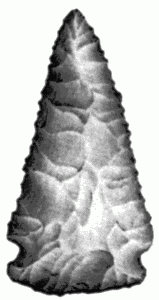
MEASUREMENTS: Eleven cotypes, including the illustrated example, provided traits and the following measurements: length—maximum, 72 mm.; minimum, 37 mm.; average, 49 mm.: shoulder width—maximum, 32 mm.; minimum, 24 mm.; average, 27 mm.: stem width—maximum, 29 mm.; minimum, 19 mm.; average, 24 mm.: stem length—maximum, 11 mm.; minimum, 7 mm.; average, 9 mm.: thickness—maximum, 10 mm.; minimum, 7 mm.; average, 8 mm.: notch width—maximum, 8 mm.; minimum, 7 mm.; average, 7 mm.: notch depth—maximum, 5 mm.; minimum, 2 mm.; average, 3 mm.
FORM: The cross-section is usually biconvex but may be flattened or, rarely, plano-convex. Shoulders are tapered. The blade may be excurvate or straight. Some examples have one excurvate and one straight blade edge. Blade edges may be finely serrated. The steepness of some blade edges gives a near-beveled appearance. The distal end is acute. The hafting area is notched with shallow, narrow, side notches situated near the basal edge. Sides of the expanded stem are incurvate. The basal edge is usually excurvate but may be straight. Rarely, it is ground; usually it is beveled on one or both faces.
FLAKING: Fairly deep random flaking shapes the faces of the blade and hafting area. Fine, regular retouch finishes the blade edges, often resulting in fine serrations. Notches, formed by the removal of one or more flakes, are found near the basal edge. Short, deep flakes were removed in order to bevel the basal edge. Unbeveled faces are thinned. Local materials were used and all examples are patinated.
COMMENTS: The type was named from the Damron Site (Cambron Site 47), Lincoln County, Tennessee, where many examples were recovered. The illustrated example is from the Quad Site (Cambron Site 84) in Limestone County, Alabama. The type has been previously classified locally as Upper Valley Side Notched. One example was recovered from Level 8 of Zone A (an Archaic level) at the Stanfield-Worley Bluff Shelter (DeJarnette, Kurjack and Cambron, 1962). At Flint Creek Rock Shelter (Cambron and Waters, 1961) three examples were recovered from the middle Archaic Stratum and one from the upper Woodland Stratum. One example was recovered from Zone B (a Woodland level) at the Flint River Mound (Webb and DeJarnette, 1948a). The appearance of the type in surface collections from pre-shellmound sites in the Wheeler Basin of the Tennessee River indicates an early Archaic association. An association with some part of the Archaic period is suggested.
DECATUR, Cambron (Cambron, 1957): A-31
GENERAL DESCRIPTION: This is a small to medium-sized point that is corner-notched and beveled with diagonal flakes struck from the base and basal sides of the stem forming an incurvate base.
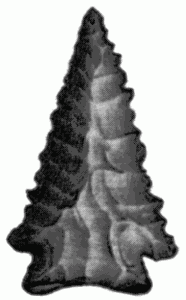
MEASUREMENTS: Sixteen autotypes from sites near Decatur, Alabama, provided both measurements and features. Measurements ranged as follows: length—maximum, 54 mm.; minimum, 29 mm.; average 42 mm.: shoulder width—maximum, 38 mm.; minimum, 22 mm.; average, 28 mm.: stem width—maximum, 25 mm.; minimum, 13 mm.; average, 19 mm.: stem length—maximum, 12 mm.; minimum, 4 mm.; average, 7 mm.: thickness—maximum, 7 mm.; minimum, 5 mm.; average, 6 mm. The illustrated example measures in length, 40 mm.; in shoulder width, 23 mm.; in stem width, 17 mm.; in stem length, 5 mm.; in thickness, 5 mm.
FORM: The cross-section is usually rhomboid; rarely, biconvex. The shoulders are usually tapered with expanded barbs but, rarely, may be straight, with or without expanded barbs. The blade may be straight or incurvate; rarely, recurvate. Blade edges are usually beveled on one edge and serrated. The distal end is acute. The corner notches range in width from about 3 mm. to 7 mm. and in depth from about 4 mm. to 7 mm. The expanded stem usually has straight side edges; the basal edge is usually incurvate but may be straight. Rarely, it is excurvate. It is usually thinned and nearly always ground.
FLAKING: Most examples exhibit broad, shallow flaking on the faces. Blade edges are serrated, either as a result of retouch accomplished by alternate removal of deeper flakes from opposite faces or as a result of beveling. The bevel angle varies from steep to a bevel that extends to near the center of the blade and may overlap from near halfway the blade length to the distal end. Most examples have one or more flakes struck from the basal corners of the stem to near the center of the basal edge. On many examples, the same type of flake may be struck from the basal corners of the stem up the sides of the stem towards the shoulders. This flaking tends to flatten the base and sides of the stem. Stem edges are finished by grinding.
COMMENTS: The type was named for the Decatur, Alabama, area where it was first recognized. The illustrated example is from Hulse Site 32 (Stone Pipe) Limestone County, Alabama. The type was described by Bell (1960). Two examples were recovered, one from upper half of Stratum II and one from the center third of Stratum II (Archaic) at Flint Creek Rock Shelter (Cambron and Waters, 1961). The type was not found in excavations in other early strata away from the Tennessee River. Local examples are found near the river on pre-shellmound sites. This evidence suggests an early Archaic association.
EBENEZER, Kneberg (This Paper): A-107
GENERAL DESCRIPTION: The Ebenezer is a small, short-stemmed, point with rounded stem and excurvate blade edges.
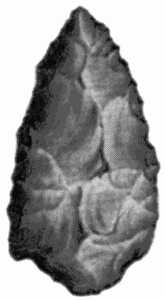
MEASUREMENTS: The illustrated example, which provided the features, is 38 mm. long, 19 mm. in shoulder width, 15 mm. in stem width, 6 mm. in stem length and 7 mm. thick.
FORM: The cross-section is biconvex. Shoulders are narrow and are usually tapered but may be straight. The blade is usually excurvate with an acute distal end. The stem is short and rounded.
FLAKING: The blade and stem are shaped by broad, shallow or deep, random flaking. Short, regular retouch finishes the blade edges. Use of a rather poor grade of local flint at the Camp Creek Site (Lewis and Kneberg, 1957) may account for the relatively crude flaking on examples from this site.
COMMENTS: The Ebenezer type was illustrated as Rudimentary Stemmed at Camp Creek in Greene County, Tennessee (Lewis and Kneberg, 1957) where the illustrated example was recovered (Cambron Site 284). Fifty-eight examples were recovered scattered through the midden. The type was described as being "associated with early Woodland artifacts on other upper eastern Tennessee sites". A radiocarbon date of 2050 ±250 B. P. was obtained from the homogeneous midden at Camp Creek. One example was recovered from the middle of Stratum I (Woodland) at Flint Creek Rock Shelter (Cambron and Waters, 1961). At Flint River Mound Ma 48 (Webb and DeJarnette, 1948a) in the Woodland zone, one example was recovered from Zone A and one from Zone B. The Ebenezer point was dominant at the Rankin Site on French Broad River (headwaters of Tennessee River) where most of the ceramics were sand-tempered. This evidence would place the type in early to late Woodland association with a suggested date of from about 2000 years ago to possibly 1500 years ago or some part thereof. The type is similar to some illustrated examples of Cliffton points from Texas (Suhm, Krieger and Jelks, 1954), which are estimated to be near the same age.
ECUSTA, Harwood and Osborne (Harwood, 1958): A-32
GENERAL DESCRIPTION: The Ecusta is a small, triangular, side-notched point with serrated and beveled blade edges.
MEASUREMENTS: The illustrated example measures 37 mm. long, 24 mm. wide at the base, and 7 mm. thick.
FORM: The cross-section is rhomboid. The shoulder barbs are weak, and are usually the result of beveling of the blade. The blade is straight, and beveled on one side of each face and, usually, serrated. The distal end is acute. The sides of the hafting area display shallow side notches. The base of the hafting area is usually broad and rounded but may be straight or incurvate. Striking of diagonal flakes from the basal edge on some examples results in flattening of the base.
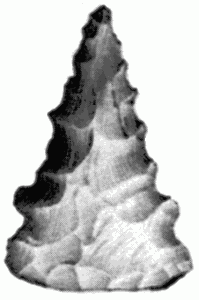
FLAKING: This is a well-made point, shaped by random, percussion flaking and retouched with serrations along the blade edges.
COMMENT: The point was named "Ecusta" since this is the Cherokee Indian name for Davidson River, where the type was first recognized at the Osborne Site in Transylvania County, North Carolina (Harwood, 1958). The illustrated homotype is from Kyle Hardin's Baker 1 Site in Blount County, Alabama, where it was recovered along with four other examples. One example (No. 1, p. 42) was illustrated by Lewis (1961) from Guntersville Basin in North Alabama. Other examples were found on the surface in North Alabama, Kentucky Lake in Tennessee, and Madison County, North Carolina. The Ecusta is similar to Decatur and Plevna points inasmuch as all of these types are notched, beveled and may have diagonal flakes struck from the base. Plevna and Decatur points from Kyle Hardin's Baker 1 Site were very similar in workmanship to Ecusta points from this site. All examples are found with early Archaic materials. An Alabama pre-shellmound association is suggested, with a probable date prior to 5000 years ago.
ELK RIVER, Cambron (DeJarnette, Kurjack and Cambron, 1962): A-33
GENERAL DESCRIPTION: This is a medium to large, stemmed point with oblique-horizontal flaking on the blade faces.
MEASUREMENTS: Measurements of the 15 paratypes (specimens of the original series including the holotype) range as follows: length—maximum, 92 mm.; minimum, 48 mm.; average, 72 mm.: shoulder width—maximum, 38 mm.; minimum, 30 mm.; average, 31 mm.: stem width—maximum, 19 mm.; minimum, 15 mm.; average, 17 mm.: stem length—maximum, 17 mm.; minimum, 11 mm.; average, 14 mm.: thickness—maximum, 11 mm.; minimum, 8 mm.; average, 9 mm. The illustrated example measures 128 mm. in length; 27 mm. in shoulder width; 20 mm. in stem width; 14 mm. in stem length; 9 mm. in thickness.
FORM: The cross-section is usually biconvex; rarely, plano-convex. The shoulders are usually tapered and may be expanded. The blade is excurvate; the distal end, acute. The hafting area is usually straight-stemmed but the stem may be expanded or contracted with a straight or, rarely, excurvate basal edge. One example could be described as having shallow side notches. About one-fourth of the original series have lightly ground bases.
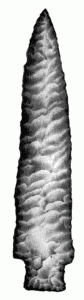
FLAKING: One or (usually) both faces are shaped by oblique-transverse flaking. Retouch is minimized since the oblique flaking, in most cases, carries from the blade edges to near the center of the face and occasionally almost forms a median ridge. The transverse-oblique flaking is similar to that seen on the faces of some Angostura, Scotts-bluff and Brown Valley points and Cape Denbigh artifacts illustrated by Wormington (1957). This flaking technique was also used on some late neolithic Danish daggers (Bordaz, 1959).
COMMENTS: The point was named for the Elk River Site on Elk River in Limestone County, Alabama. The illustrated example is from Hulse 38E (Quad Site), Limestone County, Alabama. The type was listed in the depth distribution charts at Flint Creek Rock Shelter (Cambron and Waters, 1961) in the middle-Archaic stratum (10 examples) and Woodland stratum (two examples). An illustration was listed as Provisional Type 2, expanded stem. Two examples of Elk River points from Perry Site, Lu 25, on Seven Mile Island in Lauderdale County, Alabama, were used to illustrate the high art of flint flaking (Webb and DeJarnette, 1942). Examples from Levels 8 and 9, Zone A, at Stanfield-Worley Bluff Shelter (DeJarnette, Kurjack and Cambron, 1962) indicate a late Archaic association. Examples were recovered from Zones A, B, C, and D at Flint River Mound, Ma 48 (Webb and DeJarnette, 1948a). At Little Bear Creek, Ct 8 (Webb and DeJarnette, 1948b) six examples were recovered from the five-foot level and one from the six-foot level. This again indicates a middle- to late-Archaic type. Since most of the associations in the North Alabama—South Tennessee area are within the shellmound period, this type very likely appeared before 5000 years ago. It is probably not associated with the western point types with similar flaking.
ELORA, Cambron (Cambron and Hulse, 1960b): A-34
GENERAL DESCRIPTION: The Elora is a medium to large, thick, broad, stemmed point with unfinished base.
MEASUREMENTS: The 12 cotypes (including the illustrated example) which provided the features range in measurements as follows: length—maximum, 71 mm.; minimum, 53 mm.; average, 61 mm.: shoulder width—maximum, 57 mm.; minimum, 35 mm.; average, 43 mm.: stem width—maximum, 22 mm.; minimum, 20 mm.; average, 20 mm.: stem length—maximum, 15 mm.; minimum, 8 mm.; average, 12 mm.: thickness—maximum, 12 mm.; minimum, 7 mm.; average, 10 mm.
FORM: The cross-section is biconvex. Shoulders are usually rounded and tapered but may be horizontal or, rarely, expanded. The blade is usually straight; rarely, excurvate or incurvate. Some examples are finely serrated as a result of retouching along the blade edges. The distal end is usually acute; rarely, broad. The hafting area consists of a thick, contracted stem with side edges that are straight or incurvate and a basal edge that is usually straight but may be excurvate. The crudely finished stem base found on most examples often has an intentionally broken appearance. Removal of one or more flakes usually results in a relatively broad, flattened basal edge.
FLAKING: The flaking used to form the blade and hafting area is broad, shallow or deep, and random. Fine, sometimes steep, regular retouching along the blade edges accomplished by removal of alternate flakes from each face sometimes results in fine serrations. The shoulder and side edges of the stem may show some secondary flaking. The basal edge is usually unfinished but may show a little retouch as broad flakes were struck off or perhaps intentionally broken off to form a more or less flat stem base edge.
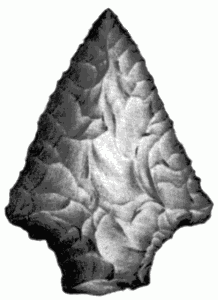
COMMENTS: The type was named from the Elora area of Lincoln County, Tennessee, where several sites have produced many examples of the type. The illustrated example as well as the cotypes are from Cambron Site 48 in this area. A variant classified locally as Elora Serrated is slightly larger than Elora and is strongly serrated by the alternate removal of flakes from opposite faces of the point. The Elora point was categorized Provisional Type 7, large, thick, stemmed, by Cambron and Waters (1961). In Zone A at the Stanfield-Worley Bluff Shelter (DeJarnette, Kurjack and Cambron, 1962) 2 examples were recovered from Level 1, 1 from Level 2, 2 from Level 3, 1 from Level 6, 1 from Level 9. One example of Elora Serrated was recovered from Level 1 in Zone A and one from Level 1 in Zone D at the Stanfield-Worley Bluff Shelter. A serrated example was also recovered from Level 8 at University of Alabama Site Ms 201 in Marshall County, Alabama. At Flint Creek Rock Shelter (Cambron and Waters, 1961) two examples of Elora were recovered from Stratum I (Woodland) and 3 examples from upper Stratum II (Archaic). At Little Bear Creek, Site Ct 8 (Webb and DeJarnette, 1948b) two examples were recovered from the 4-foot level, one from the 5-foot level and one from Zone B, about the 4-foot level (Archaic). At Flint River, Mound Ma 48 (Webb and DeJarnette, 1948a) two examples were recovered from Zone D (Archaic). This evidence suggests a middle-to-late, shellmound Archaic and possibly a very early Woodland association. Elora Serrated may be slightly older than Elora. A date of 5000 to 3000 years ago, or some part thereof, is suggested. Hulse suggests that Elora Serrated may be a type distinct from Elora.