Chapter VI · (continued 2)
Reading edition
BENDING LESSONS.
These lessons should be given to the horse each day so long as the snaffle-bit is used alone; but the exercise should be varied, so that the horse may not become fatigued or disgusted.
The balance of the horse's body and his lightness in hand depend on the proper carriage of his head and neck.
A young horse usually tries to resist the bit, either by bending his neck to one side, by setting his jaw against the bit, or by carrying his nose too high or too low.
The bending lessons serve to make a horse manageable by teaching him to conform to the movements of the reins and to yield to the pressure of the bit. During the lessons the horse must never be hurried.
To Bend the Horse's Neck to the Right.—Take a position on the near side of the horse, in front of his shoulder and facing toward his neck; take the off rein close up to the bit with the right hand, the near rein the same way with the left hand, the thumbs toward each other, the little fingers outward; bring the right hand toward the body, at the same time extend the left arm so as to turn the head to the horse's right.
The force employed must be gradual and proportioned to the resistance met with, and care must be taken not to bring the horse's nose too close to his chest. If the horse moves backward, continue the pressure until, finding it impossible to avoid the restraint imposed by the bit, he stands still and yields to it.
When the bend is complete, the horse holds his head there without any restraint and champs the bit; then make much of him and let him resume his natural position by degrees, without throwing his head around hurriedly. A horse, as a rule, champs the bit when he ceases to resist.
The horse's neck is bent to the left in a similar manner, the man standing on the off side.
To Rein in.—Cross the reins behind the horse's jaw, taking the near rein in the right hand and the off rein in the left, at about six inches from the rings; draw them across each other till the horse gives way to the pressure and brings his nose in. Prevent the horse from raising his head by lowering the hands. When the horse gives way to the cross-pressure of the reins, ease the hand and make much of him.
SADDLING.
This should be done at first on the longeing-ground. One man, facing the horse and taking the snaffle-reins in both hands near the bit, should hold him while another places the saddle on his back. If the horse shows no uneasiness or resistance, let down the cincha-strap and cincha; fasten the cincha-strap loosely at first, and tighten it afterwards by degrees. Care must be taken not to make the cincha so tight as to cause uneasiness to the horse. If the horse resists or is restless, remove the saddle and let him see and smell it; he will then generally allow it to be placed; if necessary, strap up a leg until the horse is saddled. The longeing is then continued with the horse saddled.
MOUNTING.
When the horse becomes accustomed to the saddle, he should be mounted. Two men should assist the man who is to mount. The man with the longe, facing the horse and taking the snaffle-reins in both hands near the bit, holds his head rather high and engages his attention; the second man bears down on the off stirrup at the proper moment to keep the saddle even when the third man mounts. The man who mounts proceeds with caution, stopping and caressing the horse if he shows any uneasiness; after being seated the man pats the horse a few moments, and without attempting to make him move, dismounts with the care and gentleness exercised in mounting. This is repeated several times, until the horse submits without fear. The rider then mounts, takes a snaffle-rein in each hand, and feels lightly the horse's mouth; the man with the longe leads the horse forward and afterwards longes him to the left, and then to the right, at a walk; if the horse shows any disposition to kick or plunge, the longe is shaken to engage his attention and to keep up his head. After a few turns the rider dismounts, the horse is fed from the hand, patted, and dismissed.
These lessons are continued until the horse can be mounted and dismounted without any difficulty; and when he can be made to go forward, to the right and left, to halt and rein back by gentle application of the aids, the longe is dispensed with.
The horse is now exercised in the riding-hall or open manège, the lessons for young horses not exceeding three quarters of an hour. The horse is ridden on the track first at a walk, then at a slow trot, and afterwards the trot and walk are alternated, care being taken to turn the corners squarely; the horse is next marched to the right and left, halted and reined back to accustom him to obey the bit and the pressure of the legs. When he is obedient to the snaffle, the horse is equipped with the curb-bit. The bit must have rings at the ends of the mouthpiece for snaffle-reins, or a bit-bridoon must be used in order that the horse may be accustomed by degrees to the action of the curb-bit. The first instruction given to the horse with the curb-bit is bending the neck and reining in, dismounted; he is then mounted and exercised in the riding-hall or open manège as before described, and receives the bending and reining lessons mounted.
BENDING LESSONS, MOUNTED.
The horse is now equipped with a curb-bridle.
To Bend the Horse's Neck to the Right.—Adjust the reins in the left hand; seize the right rein with the right hand well down; draw it gently to the right and rear until the horse's head is brought completely around to the right, in the same position as in the bend dismounted. When the horse champs the bit, make much of him, and allow him to resume his natural position. The horse's neck is bent to the left in a similar manner.
To Rein in.—Lower the bridle-hand as much as possible, turning the back uppermost; with the right hand, nails down, take hold of the curb-reins above and close to the left hand and shorten them by degrees, drawing them through the left hand, which closes on the reins each time they are shortened.
When the horse resists much and holds his nose up, keep the reins steady; do not shorten or lengthen them; close the legs to prevent the horse from backing; after remaining perhaps a minute or more with his nose up and his jaw set against the bit he will yield, bring his nose in, and champ the bit; make much of him, loosen the reins, and after a few seconds rein in again.
This exercise gives the horse confidence, and teaches him to arch his neck and bring his head in proper position whenever he feels the bit.
Most young horses are afraid of the bit, and they must never be frightened by sudden jerks on the reins, lest they should afterwards refuse to stand the requisite pressure of the bit. A certain amount of bearing is necessary to induce the horse to work boldly and well, as well as to apprise the rider of what the horse is going to do.
In reining in, some horses rest the lower jaw against the breast; to counteract this, press both legs equally and force the horse forward to the bit.
Some horses will not work up to the hand; that is, will not bear the bit at all. Such horses are unfit for the service.
Whenever, without an apparent cause, a horse resists or is restive, the bit, saddle, and equipment should be carefully examined to see if any part hurts or irritates him.
REARING.
Should the horse rear, the rider must yield the hand when the horse is up, and urge him vigorously forward when he is coming down; if the horse is punished while up, he may spring and fall backward.
Use the running-rein with a rearing horse.
KICKING.
This can be prevented by holding the horse's head well up and closing the legs; if necessary, they are closed so much as to force the horse forward.
SHYING.
This sometimes results from defect of sight and sometimes from fear. If from fear, the horse must be taken up to the object with great patience and gentleness, and be allowed to touch the object with his nose. In no case should a horse be punished for timidity. The dread of chastisement will increase his restiveness.
TO ACCUSTOM THE HORSES TO FIRING.
Station a few men at a little distance from and on both sides of the stable-door, and cause them to fire pistols as the horses are led into the stable to be fed; for the same object a gun may be fired during the hour of feeding. If a horse is nervous, he may be put on the longe and fed from the hand and petted each time the pistol is discharged; or he may be thrown, care being taken not to discharge the pistol so as to burn him or injure him in any way. The horses should be trained to be steady under the fire of the pieces, and also under pistol-firing by the cannoneers on the chests and by the drivers from their teams.
SWIMMING HORSES.
The horses are at first equipped with the watering-bridle, and are without saddles. The reins are on the horse's neck just in front of the withers, and knotted so that they will not hang low enough to entangle the horse's feet, care being taken to have them loose enough to permit the horse to push his nose well out, so as to have entire freedom of the head. The horse should be watered before putting him into the stream.
When the rider gets into deep water, he drops the reins, seizes a lock of the mane with the up-stream hand, allows his body to drift off quietly to the down-stream side of the horse, and floats or swims flat on the water, guiding the horse as much as possible by splashing water against his head, only using the reins when splashing fails. The horse is easily controlled when swimming; he is also easily confused, and it is therefore necessary that the rider should be gentle and deliberate. The rider must be cautioned that the horse is easily pulled over backward by the reins when swimming, and also that he may plunge when he touches bottom. When the horse touches the bottom at the landing, the rider pulls himself on the horse's back and takes the reins.
The rider may also be required to swim, holding the horse's tail, allowing the horse to tow him.
After the man and horse have gained confidence, the rider may be required to be seated on the horse while swimming. As the extra weight presses the horse down and impedes his movements, the rider should hold his knees well up to lessen the resistance, and steady his seat by holding on to the mane or pommel of the saddle.
The men are instructed, in crossing running water, to keep their eyes fixed on the opposite bank.
The practice of swimming gives horses confidence in deep water when in harness. Streams deep and wide enough to swim one and even two pairs of a team have been crossed by light artillery in our service.
BREAKING IN THE YOUNG HORSE TO HARNESS.
The harness should be put on the horse in the stable with caution, and at first without the traces, so that in the event of the horse jumping about they will not hang about his legs and frighten him. The horse should then be fed in his harness, and after standing for some hours be walked about in it.
When the horse has thus been fed and walked about, and has become reconciled to the harness, the traces should be attached, and a rope tied to the rear end of each; a man then takes the ends of the ropes, and the horse is walked about, the man holding the ropes, taking care that the traces do not rub against the sides of the horse in the beginning, but accustom him to them gradually.
When the horse has become accustomed to the pressure of the collar and traces, he may then be hitched in with a steady horse. At first the utmost caution should be observed and a foreleg held up, if necessary, while the traces are being fastened, and no noise or shouting should be permitted. After being hitched in, the horse should be permitted to stand still for some minutes before the carriage is started, and it should be put in motion by the other horses. The horse should be left to himself and not be required to draw at first; all that should be demanded of him is to move forward quietly.
MANAGEMENT OF VICIOUS HORSES.
A vicious or refractory horse may be thrown. He is thus made to submit to control without exciting his resentment, or suffering any other physical pain than that resulting from his own resistance. During the operation the man acts with deliberation, speaks with a kind voice, and never uses harsh treatment.
TO THROW THE HORSE.
The method explained is a modification of the one generally known as "Rarey's Method." The horse is equipped with a watering-bridle and surcingle. The surcingle is buckled securely but not tightly around the horse's body just back of the withers. The man is provided with two strong straps. No. 1 is about ten feet long and one inch wide, and has a loop or iron ring at one end. No. 2 is about three feet six inches long and from one and one half to two inches wide; one end has a strong buckle and two keepers (one on each side of the strap). In the absence of straps as specified, the halter-strap may be substituted for No. 1, and the stirrup-strap for No. 2.
The horse is taken to an open space, preferably covered with turf, free from stones, etc., to prevent injuring the horse's knees. Pass the free end of No. 1 through the ring and make a slip-loop; raise the horse's off forefoot, and place the loop around the pastern; see that the loop has no twist in it; let the foot down, draw the strap taut, and pass the free end over the horse's back from the off side and under the surcingle from front to rear, the free end hanging down on the near side. Pass the free end of No. 2 through the inside keeper and make a slip-loop; raise the near forefoot and place the loop around the pastern, with the buckle outside, and make it snug; raise the heel against the forearm, pass the free end of the strap, from the inside, over the forearm, and buckle the strap sufficiently tight to hold the leg in this position. Let the bridle-reins either hang down or place them on the neck; they may be caught hold of at any time after the first plunging is over. It is important that the off forefoot be kept from the ground after the horse first raises it, and this will be better accomplished if both hands are used at strap No. 1 during the first plunge.
The man takes his place behind the surcingle on the near side of and close to the horse, the left foot in advance, and grasps securely with the left hand the free end of No. 1, and, if the strap is long enough, makes a turn with it around the left hand, the right hand grasping it loosely, forefingers close to the surcingle, back of the hand against the horse's back. Quietly and gently urge the horse forward; the instant he raises his foot, pull the strap with the left hand, bring the off heel against the forearm, the strap slipping through the right hand, which should be kept in place, but which grasps the strap as soon as the foot is sufficiently raised, and holds it firmly; make a turn with the strap around the right hand, and take both reins in the left hand on the near side of the horse. The horse is now brought to his knees; bring the horse's nose well to the left and raised, placing the right shoulder and arm against the horse's side, thus indicating to him that he is to lie on his right side. A horse of a stubborn disposition may remain in this kneeling position for some time, and this he should be allowed to do until he is willing to lie down of his own volition. No force will be used to push the horse down. From this kneeling position the horse may rear and plunge, but as he moves so should the man, maintaining his relative position to the horse, and a firm hold of the long strap, in order to deprive the horse of the use of his right foreleg. In most cases, after remaining in this kneeling position for a short time, the horse will lie down. The man maintains his hold of the strap and reins until the horse is quiet and shows no immediate disposition to attempt to rise; or he has the strap and reins so placed that he can grasp them directly the horse attempts to get up.
To dispel his fears and reconcile him to his unexpectedly assumed position, he should now be petted, spoken to in a kindly tone of voice, and generally made much of. When he becomes quiet and ceases to struggle, the man should pass around him, handle his feet, and straighten out and rub his legs. If the horse shows no inclination to rise before being told to do so, the straps may be unfastened and removed, but so long as the eye shows a wild, startled expression the straps should not be removed. The eye is the true index of the horse's feelings and disposition, and if closely observed will always betray his intentions.
When he has remained in the lying position for a short time after the straps have been removed, and he no longer struggles or attempts to rise, or if he attempts to rise and cannot be prevented from doing so, the man should raise his horse's head a little with the reins and command: "Up!" When the horse gets up, he should be made much of and given to understand that he has done what was required of him. It will be advantageous to throw the horse three or four times at each lesson, but the throwings should not follow each other in rapid succession, in order to avoid the overfatigue and constraint which might incite the horse to insubordination and resistance.
It will be found that horses of a peculiarly wilful and stubborn disposition will not lie quiet after the straps have been removed. To overcome horses of this class, the long strap should be made fast to the left fore foot so that both knees will be secured in a bent position. The horse need be no longer held, but will be allowed to struggle. He may rear, or plunge, or assume a kneeling position, but whatever he may do no restraint should be put upon him. After finding that all his struggles are of no avail, and that the only result attained by them is suffering to himself, he will succumb and quietly lie down. When, from his ceasing to struggle when handled, and from the appearance of his eye, there is reason to believe that the horse has yielded, the straps may be gradually loosened and removed. Two or three lessons properly administered in this way will conquer the most stubborn horse.
After a stubborn horse has been thrown several times, it may happen that he will not permit his fore leg to be strapped up, and will resist by rearing, plunging, striking, or kicking. In such cases another strap, "No. 3," may be necessary. This is a strong leather surcingle about three inches wide in which two iron rings, about two feet six inches apart, are securely fastened. The leather girth is secured so that the rings will be about the middle of the horse's sides. Two long straps, "No. 1," are used. One is placed on each front pastern without raising the foot. The free ends of the straps are run through the rings on the surcingle so that they can be used as a pair of driving-reins. These straps are held by one man in rear of the horse, while another, approaching the horse on the near side, attempts to raise his left foot. The instant the horse rears, strikes, or plunges he is brought to his knees by the man holding the long reins; after this is repeated several times the horse will allow his foot to be strapped up. Should the horse stand, or refuse to move, the whip may be used.
These means may be used to break horses of rearing, plunging, or bucking under the saddle. In this case the surcingle is dispensed with; the rider holds the straps and exerts sufficient force when the horse is refractory to bring him to his knees. The same means may be used to discipline horses which refuse to carry double, the man in the rear holding the straps.
TO BREAK THE HORSE OF KICKING.
The horse is thrown and one end of each of the long straps is made fast to the bit-rings; the other ends are passed through the rings on the leather surcingle and secured to the hind pasterns. When thus secured, all means should be resorted to in order to make the horse kick, and this should be repeated until he no longer struggles or attempts to move his hind legs under any provocation whatever.
TREATMENT AND CARE OF HORSES.
Horses require gentle treatment. Docile, but bold, horses are apt to retaliate upon those who abuse them, while persistent kindness often reclaims vicious animals.
A horse must never be kicked in the belly, or struck about the head with the hands, reins, or any instrument whatever.
Never threaten, strike, or otherwise abuse a horse.
Before entering a stall speak to the horse gently, and then go in quietly.
Never take a rapid gait until the horse has been warmed up by gentle exercise.
Never put up a horse brought to the stable or line heated, but throw a blanket over him and rub his legs, or walk him until cool. If he is wet, put him under shelter and wisp him against the hair until dry.
Never feed grain to a horse, or allow him to stand uncovered, when heated. Hay will not hurt a horse no matter how warm he may be.
Never water a horse when heated, unless the exercise or march is to be immediately resumed. A few mouthfuls of water, however, will do no harm, and should ordinarily be given him.
Never throw water over a horse coming in hot, not even over his legs or feet.
Never allow a horse's back to be cooled suddenly by washing or even removing the blanket unnecessarily.
To cool the back gradually, the blanket may be removed and replaced with the dry side next the horse.
At least two hours' exercise daily is necessary to the health and good condition of horses; they should be marched a few miles when cold weather, muddy ground, etc., prevent drill.
Horses' legs will be often hand-rubbed, particularly after severe exercise, as this removes enlargement and relieves or prevents stiffness.
In mild weather the sheath will be washed out once a month with warm water and castile soap and then greased; during the cold season the intervals between washings should be longer.
Sore backs and galled shoulders are generally occasioned by neglect. The greatest pains will be taken in the fitting of the saddles and collars; the men must never be allowed to lounge or sit unevenly in their saddles. Every driver should keep a pair of soft leather pads, stuffed with hair, about six inches by four; the moment any tenderness is noticed in a horse's shoulder, the pressure is removed by placing these pads under the collar above and below the tender part.
DESTRUCTION OF HORSES.
Occasions arise rendering the destruction of horses necessary. The following instructions will enable one to arrive at a point directly over the summit of the brain, and which when fired upon will cause instantaneous death. Draw a line, A A, horizontally across the forehead from the upper margin of one zygomatic ridge to the other, and from its central point, B, measure vertically upward on the forehead 3½ to 4½ inches. The point, D, thus obtained is directly over the brain-cavity.
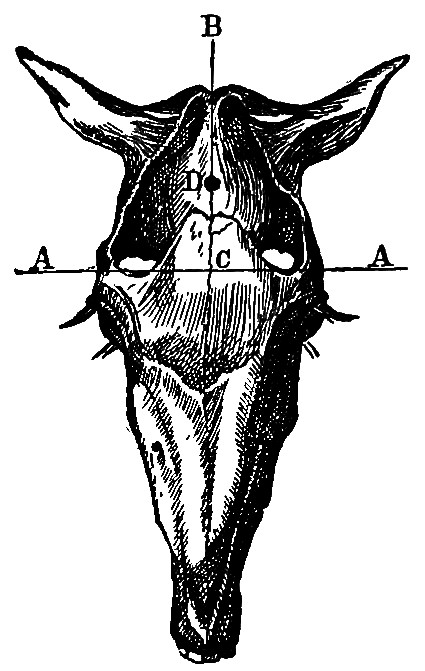
Fig. 76.
Before firing, the horse should be induced to lower his head, which is easily accomplished by placing a little food upon the ground, the muzzle of the weapon being brought directly over the spot indicated.
It is a mistake to suppose that the star, or curl, is over the brain-cavity, for it is generally below the cavity.