Chapter XIV
Reading edition
Battery Books and Records. Rolls, Reports, and Returns. The Ration. Salt and Vinegar for Public Animals. The Travel-ration. Present Organization of U. S. Light Field-battery. Cost of a Battery of Four 3.2-inch Guns, in Detail. Price-list of Artillery-harness. Price-list of Harness for 1.65-inch Mountain-gun. Price-list of Artillery Accoutrements, etc. Price-list of Horse Equipments. Price-list of Stencil and Marking Outfits. Supply Table of Ordnance Stores for a Battery of Light Artillery for Six Months. Allowance of Ammunition for Target Practice. Standard Supply Table of Veterinary Medicines. Tableware and Kitchen Utensils. Allowance of Clothing, Equipage, Fuel, Lights, etc. Weights of Certain Articles of Clothing and Equipage. Pay Table of Enlisted Men. Summary Court, and List of Punishments. U. S. Signal and Telegraph Code. Penetration of Projectiles. Cover for Field-artillery. Treatment of Sick Men. Tables of Weights, Measures, etc. Tables for Converting Customary and Metric Weights and Measures. Salutes. Camp Furniture and Mess Outfits for Officers.
BATTERY BOOKS AND RECORDS.
Sick report book; company clothing book; morning report book; guard report book; descriptive and deposit book—all obtained from adjutant-general. Order book; letters received book; index to letters received; letters sent book; index to letters sent; descriptive book of public animals—all obtained from quartermaster-general. Artillery practice report book—from chief of ordnance. Battery council book; roster book.
ROLLS, REPORTS, AND RETURNS.
Designation. To Whom Sent. When Made. When Sent. By Whom.
Muster roll[12] of battery. Adjt. Gen. Every month Within 3 days Mustering officer
Inventory of effects of deceased soldiers. " " Immediately Immediately Battery com'dr
Final statements of deceased soldiers. " " " " "
Certificates of disability (in duplicate). " " " " Post com'dr
Return of Ord. and Ord. stores. Chief of Ordnance End of month Within 20 days Battery com'dr
Return of battery Regtl. adjutant " Within 3 days "
Transcript of orders making temporary appointments of or reducing N. C. officers at posts not regtl. headqrs. " Immediately Immediately "
Abstract of battery fund. " End of quarter Next day "
Morning report Post adjt. Every morning Before 8 A.M. "
Monthly return of battery (to be returned for file). " " End of every month First of subsequent month
Return of battery fund (with council book). " " End of every quarter " " " "
Req. for fuel, forage, and straw. " " End of every month End of every month "
Req. for salt and vinegar. " " " " " " " " "
Ration return " " On days designated by C.O. "
Estimate of C. and E., 6 months' supply. " " Jan. 1, Apl. 1, July 1, Oct. 1.
Req. for stationery. " " End of every quarter First of subsequent month "
THE RATION.
Article. 1 Ration. 50 Rations. 100 Rations. 1000 Rations. Bulk of 1000 Rations.
Net. Gross.
oz. Lbs. Lbs. Lbs. Lbs. Barrels.
Fresh beef, or other fresh meat 20 62½ 125 1250

Or salt beef 22 68¾ 137½ 1375 6.875
Or salt pork 12 37½ 75 750 1219 3.75
Or bacon 12 37½ 75 750 903 4.9
Or dried fish[13] 14 43¾ 87½ 875
Pickled or fresh fish[13] 18 56¼ 112½ 1125
Potatoes 16 50 100 1000 4.66
Or potatoes 12.8 40 80 800
And onions 3.2 10 20 200
Or potatoes 11.2 35 70 700
And tomatoes 4.8 15 30 300
Or other fresh vegetable
Sugar 2.4 7½ 15 150 .62
Or molasses
Or syrup .64 gill 1 gal. 2 gals. 20 gals.
Salt .64 2 4 40 .16
Pepper .04 ⅛ ¼ 2½
Flour 18 56¼ 112½ 1125 1234 5.74
Or soft bread 18 56¼ 112½ 1125
Or hard bread 16 50 100 1000 1229 12
Or corn-meal 20 62½ 125 1250
Beans or peas 2.4 7½ 15 150 177 .7
Or rice or hominy 1.6 5 10 100 115 .46
Coffee, green 1.6 5 10 100 122 .58
Or coffee roasted 1.28 4 8 80 108 .83
Or tea .32 1 2 20 25 .16
Soap .648 2 4 40 47 .19
Candles (if no oil) .24 ¾ 1½ 15 16.5 .89
Yeast-powder (in the field) .64 2 4 40
Vinegar .04 qt. ½ gal. 1 gal. 10 gals. 107½ .09
SALT AND VINEGAR FOR PUBLIC ANIMALS.
No. of Animals. Salt. Vinegar.
Quantity per Week. Quantity per Month, When Necessary. Quantity per Week.
Lbs. Oz. Lbs. Oz. Gals. Qts. Pts. Gills.
1 2 12 .64
5 10 3 12 3.2
10 1 4 7 8 1 2.4
50 6 4 37 8 1 -- -- --
100 12 8 75 -- 2 -- -- --
THE "TRAVEL-RATION."
Articles. Per 100 Rations.
Soft bread pounds 112½
or hard bread pounds 100
Beef, canned pounds 75
Baked beans, 1-pound cans number 33
or baked beans, 3-pound cans number 15
Coffee, roasted pounds 8
Sugar pounds 8
Canned tomatoes (after 4 consecutive
days of above) pounds 100
Present Organization of Light Field-battery.—1 captain, 2 first lieutenants, 2 second lieutenants, 1 first sergeant, 6 sergeants, 4 corporals, 2 musicians, 2 artificers, 1 wagoner, 59 privates. Total commissioned 5. Total enlisted 75.
Special-duty Men Allowed in a Light Battery.—1 N. C. O. to take immediate charge of police, etc., of stable and picket-line, 1 clerk, 1 tailor, 1 cook, 1 assistant cook, when necessary (the head cook is allowed 25 cents per day from company fund); 1 N. C. O. (detailed from roster) to supervise rooms and gun-racks.
COST OF EQUIPMENT (EXCLUSIVE OF AMMUNITION) FOR A FOUR-GUN 3.2-INCH FIELD-BATTERY, WITH COMBINED BATTERY-WAGON AND FORGE.
(Total Cost as herein indicated $17595.71.)
Articles. Price. Amount.
Dolls. Cts. Dolls. Cts.
4 3.2-inch B. L. steel guns 1022 00 4088 00
4 3.2-inch carriages and limbers (cost of brake included) 1316 74 5266 96
4 3.2-inch caissons and limbers 721 50 2886 00
1 combined forge and battery wagon 816 00 816 00
9 sets artillery-harness for 2 wheel-horses 170 59 1535 31
9 sets artillery-harness for 2 lead-horses 138 81 1249 29
ON EACH CARRIAGE.
1 pair bow-spring recoil-brakes 62 50
1 sponge and rammer, jointed, for bore 6 00 6 00
2 short rammers and sponges, combined, for chamber 9 00 18 00
1 sponge-cover, bore-sponge 40 40
2 sponge-covers, chamber-sponge 45 90
1 prolonge (section of picket-rope) 8 60 8 60
1 combination screw-driver in trail-box 1 28 1 28
1 gunners' gimlet in trail-box 24 24
1 gunners' reamer in trail-box 50 50
1 priming-wire in trail-box 10 10
1 vent-punch in trail-box 50 50
1 front sight in trail-box 8 00 8 00
WITH EACH CARRIAGE-LIMBER.
1 breech-sight, bronze 36 00 36 00
1 breech-sight pouch 1 81 1 81
2 gunners' haversacks 2 20 4 40
2 primer-pouches 1 33 2 66
2 lanyards, new pattern 68 1 36
1 fuze-punch 50 50
1 front-sight cover 67 67
1 combined tompion and muzzle-cover 93 93
1 breech-cover 3 77 3 77
1 breech-strap 96 96
1 sperm-oiler, rectangular, brass 50 50
1 wheel-grease can 2 09 2 09
1 wheel-grease can knife 75 75
2 watering-buckets, canvas, folding 1 45 2 90
1 tool-box 1 36 1 36
1 screw-wrench, 12-inch 49 49
1 iron nut-wrench, 12 inches long 1 50 1 50
1 ¾-inch cold chisel, 8 inches long 25 25
1 8-inch hand bastard file 08 08
1 hand-hammer, 12¼-inch handle 70 70
1 small steel punch 18 18
1 neck-yoke 8 00 8 00
1 doubletree 7 55 7 55
2 singletrees 2 32 4 64
2 paulins, 12 × 12 feet, dyed duck 9 77 19 54
1 cushion, canvas and hair 7 48 7 48
1 padlock for ammunition-chest 60 60
ON EACH CAISSON-BODY.
1 manœuvring-handspike 1 10 1 10
2 shovels, long-handled 50 1 00
2 spades, short-handled 80 1 60
2 pickaxes, handled 75 1 50
2 axes, handled 75 1 50
2 lanterns, with Cranston attachment 59 1 18
1 prolonge (section of picket-rope) 8 60 8 60
1 spare pole 26 16 6 16
1 spare wheel[14] 2 00 22 00
2 paulins, 12 × 12 feet, dyed duck 9 77 19 54
2 padlocks for ammunition-chest 60 1 20
2 cushions, canvas and hair 7 48 14 96
WITH EACH CAISSON-LIMBER.
1 wheel-grease can 2 09 2 09
1 wheel-grease can knife 75 75
2 paulins, 12 × 12 feet, dyed duck 9 77 19 54
1 neck-yoke 8 00 8 00
1 doubletree 7 55 7 55
2 singletrees 2 32 4 64
2 watering-buckets, canvas, folding 1 45 2 90
1 cushion, canvas and hair. 7 48 7 48
1 padlock for ammunition-chest 60 60
ON LIMBER OF FORGE AND BATTERY-WAGON.
1 neck-yoke 8 00 8 00
1 doubletree 7 55 7 55
2 singletrees 2 32 4 64
2 paulins, 12 × 12 feet 9 77 9 77
2 watering-buckets, canvas, folding 1 45 1 45
1 wheel-grease can 2 09 2 09
1 wheel-grease can knife 75 75
1 canvas coal-bag (3 bushels) 40 2 40
200 pounds horseshoes 039/10 78 00
50 pounds horseshoe-nails 16 8 00
Blacksmith's tools (forge-chest):
1 forge, portable, Empire (modified for army use) 19 75 19 75
2 aprons, leather, smith's 1 29 2 58
1 hammer, hand, handled 70 70
1 hammer, riveting 30 30
1 hammer, shoeing 25 25
1 pair tongs for holding ¼-inch iron 75 75
1 pair tongs for holding ½-inch iron 75 75
1 pair tongs, smith's, 11-inch 84 84
1 chisel, handled, for cutting hot iron 50 50
1 chisel, handled, for cutting cold iron 50 50
1 fore-punch and creaser (on one handle) 22 22
1 chisel, hand, cold 25 25
1 pritchel 08½ 08½
ON LIMBER OF FORGE AND BATTERY-WAGON.
1 shoeing-rasp, 16-inch 42 42
1 flat bastard file, 12-inch 16 16
1 round punch, hand 07 07
1 hardie 09 09
1 screw-wrench, 12-inch 49 49
2 shoeing-knives 25 25
1 toe-knife 07 07
1 shoeing-pincers 42 42
1 clinching-iron 30 30
1 nail-punch 06 06
1 rule (2-foot), wood, 4-fold, No. 72, Stanley 15 15
1 square, steel 40 40
1 oiler, brass 07 07
1 shoeing-box, sole-leather 1 50 1 50
1 file-handle, iron, 6-inch 30 30
1 wrench, small, for forge 50 50
1 fire-rake 14 14
1 fire-shovel 28 28
2 small canvas bags for nails and small stores 62 62
1 padlock (and key) 60 60
ON BODY OF FORGE AND BATTERY-WAGON.
2 water-buckets, galvanized sheet-iron 1 10 2 20
1 prolonge (section of picket-rope) 8 60 8 60
2 lanterns, with Cranston attachment 59 1 18
1 oil-can, sperm (2¼ pints) 50 50
1 oil-can, coal (3 gallons) 3 20 3 20
1 grindstone, arbor, crank, and frame (iron), complete 16 25 16 25
1 lunette-prop 70 70
2 jackscrews 9 50 19 00
1 hammer, sledge, medium 90 90
1 anvil (100 pounds) 5 25 5 25
1 vise, forge 84 84
2 padlocks (and keys) 60 1 20
Saddler's tools (chest):
1 saddler's tool-chest (handled) 15 15 15 15
1 knife, round 90 90
1 knife, shoe 17 17
1 draw-gauge 1 10 1 10
6 awls, stitching, handled (assorted) 05½ 33
1 rivet-set (two holes) 25 25
1 revolving punch, four tubes, Nos. 4, 5, 6, and 7 55 55
1 claw-tool 12 12
1 compasses, 6-inch 12 12
1 creaser, wood 17 17
1 cutting-nippers, 10-inch 1 50 1 50
1 hammer, riveting 30 30
1 edge-tool, No. 2 12½ 12½
1 rule (2-foot), No. 18, 2-fold 15 15
1 oil-stone 2 70 2 70
1 pliers (large), 6-inch 25 25
1 driving-punch, No. 5 09 09
1 stitching-horse, complete 3 67 3 67
2 small canvas bags for small stores 62 1 24
Carpenter's and wheelwright's tools (chest):
1 carpenter's and wheelwright's tool-chest, handled 15 15 15 15
1 brace with 12 bits, assorted 1 55 1 55
1 drawing-knife, 12-inch 50 50
1 hand-saw, 20-inch 30 30
1 rip-saw, 26-inch 85 85
1 hand-axe, No. 7 84 84
1 hammer, claw 50 50
4 chisels, framing—¾-inch, 1-inch, 1½-inch, 2-inch 1 34
3 gouges, framing—½-inch, 1-inch, 1½-inch 1 35
1 screw-wrench, 12-inch 49 49
1 plane, jack 42 42
1 plane, smoothing 40 40
1 spoke-shave 18 18
1 rule (2-foot), No. 72, 4-fold, Stanley 15 15
10 brad-awls, assorted, with (and contained in) handle 42
1 square, trying, 9-inch 22 22
1 awl, scribing 08 08
12 files, saw, assorted—4-inch and 6-inch 66
1 rasp, wood, 10-inch 32 32
1 file, wood, 10-inch 12½ 12½
1 oiler, brass 12 12
1 oil-stone, 8-inch 2 70 2 70
1 gauge 06 06
1 compasses, 10-inch wing 25 25
1 table-vise 1 40 1 40
1 pincers, small 12½ 12½
1 mallet, wood 40 40
6 auger-bits—¼-inch, ½-inch, ¾-inch, 1-inch, 1¼-inch, 1½-inch 1 43
2 screw-driver bits—½-inch and ¾-inch 15
1 patent auger-handle 18 18
3 file-handles, iron—4-inch flat, 4-inch round, 5-inch 65
1 linen tape-line ("Chesterman" Sheffield), 100 feet 2 35 2 35
2 small canvas bags for small stores 62 1 24
SUPPLIES, CLEANING MATERIAL, SPARE PARTS, ETC., CARRIED IN BATTERY-WAGON BODY.
SUPPLIES.
2 sides leather, bridle (24 pounds)
1 side leather, harness (20 pounds)
2 pounds beeswax
3 pounds black wax
36 buckles
2 papers tacks, copper
3 papers tacks, iron
2 pounds rivets and burrs, copper
2 pounds thread, patent
5 pounds thread, shoe
5 needles, collar
50 needles, saddler's, assorted
4 thimbles.
10 pounds nails
1 gross wood screws
6 pieces sash-cord, braided (13½ pounds)
85 pounds bar iron, assorted,
40 pounds toe-steel
250 pounds coal, bituminous
3 gallons coal-oil
50 pounds wheel-grease
MATERIAL FOR CLEANING AND PRESERVATION.
4 gallons neat's-foot oil (2 cans)
2¼ pints sperm-oil
20 pounds harness-soap
10 pounds sponge
4 quires sand-paper
6 quires emery-cloth
2 pounds rotten stone
25 papers tripoli
SPARE PARTS—GUN.
4 carrier latch-pins
8 carrier latch-pin springs
2 gas-check pads
1 steel split ring
4 vent-bushings, copper
SPARE PARTS—CARRIAGE.
1 bow-spring brake
2 singletrees
1 doubletree
1 neck-yoke
4 pole-pads
12 linch-pins
8 linch-washers
4 ammunition-chest bolts and nuts
2 turnbuckles for ammunition-chests
2 breech-strap eye-washers
2 nuts for assembling-bolts for lazy-tongs
2 springs for pole-prop at end of pole
4 lid-props
4 lid-prop plate pivots
1 pintle-key and chain
SPARE PARTS—HARNESS.
6 breast-straps
6 bridles and bits, artillery, N. P
4 collars steel
9 girths, hair, artillery, N. P
6 halters, artillery, N. P
50 halter-straps
4 martingales
2 neck-yoke pads
10 surcingles
2 traces, lead, artillery, N. P
2 traces, wheel, artillery, N. P
STEEL COLLAR.
2 trace-plates
4 draft-springs
4 pad-hooks
2 pad bolts and nuts
2 nuts for pad-bolts
2 buckle-latches
6 buckle-springs
6 bolts and nuts for top connection
4 nuts for top-connection bolts
6 bolts and nuts for bottom of collar
4 nuts for bottom bolts
6 bolts and nuts for extension
4 nuts for extension-bolts
6 bolts and nuts for trace-plate
4 nuts for trace-plate bolts
12 back-straps
8 back-strap connections
6 collar-pads, canvas
TOOLS AND IMPLEMENTS.
3 gunners' gimlets
3 vent-punches
3 priming-wires
2 fuze-wrenches
4 fuze-punches
24 fuze-punch pins
1 obturator spindle and wrench
4 whips, artillery
2 pickaxe-handles
2 axe-helves
4 short rammers and sponges, combined
1 sponge and rammer, jointed
2 sponge-heads and sponges for short rammers and sponges, combined
1 rammer-head for short rammers and sponges, combined
2 sponge-heads and sponges for jointed sponge and rammer
1 rammer-head for jointed sponge and rammer
PRICE-LIST OF ARTILLERY-HARNESS.
New Pattern.
Components. Wheel. Lead.
Near Horse. Off Horse. Near Horse. Off Horse.
BREAST-STRAP. $ c. $ c. $ c. $ c.
Strap 85 85
Double hooks, 2 @ $3.50 each 7 00 7 00
Breast-strap complete 7 85 7 85
BREECHING.
Body 3 98 3 98
Side-straps, 2 @ 56c. each 1 12 1 12
Breeching complete 5 10 5 10
BRIDLE.
Curb-bit, Shoemaker 2 25 2 25 2 25 2 25
Curb-strap 34 34 34 34
Cheek-pieces, 2 @ 28c. each 56 56 56 56
Crownpiece 25 25 25 25
Reins 1 04 1 04 1 04 1 04
Throat-lash 15 15 15 15
Brow-band 28 28 28 28
Brow-band ornaments, 2 @ 8c. each 16 16 16 16
Coupling-strap 70 70
Bridle complete 5 03 5 73 5 08 5 78
HALTER.
Head-stall 1 90 1 90 1 90 1 90
Strap 50 50 50 50
Halter complete 2 40 2 40 2 40 2 40
Leg-guard 3 22
Loin-strap 55 55 55 55
Trace-loops, 2 @ 32c. each 64 64 64 64
Martingale 2 14 2 14
SADDLE.
Saddle-trees, leather-covered, spring bar attached 9 27 9 27 9 27 9 27
Back-straps, 2 @ 83c. each 1 66 1 66 1 66 1 66
Cincha-straps, 2 @ 50c. each 1 00 1 00 1 00 1 00
Stirrups, brass, 2 @ $1.20 each 2 40 2 40 2 40 2 40
Stirrup straps and sweat-leather attached, 2 @ $1.48 each 2 96 2 96 2 96 2 96
Rawhide thongs, 3 @ 5c. each 15 15 15 15
Lead rein roller and strap 35 35
Cantle-hook 2 70 2 70
Saddle complete 20 14 20 49 17 44 17 79
Saddle-cloth, hair 4 50 4 50 4 50 4 50
Saddle-cloth, duck 2 12 2 12 2 12 2 12
Saddle-bags 5 17 5 17 5 17 5 17
Hair girth 1 20 1 20 1 20 1 20
Traces, wheel, 2 @ $7.00 each 14 00 14 00
Traces, lead, 2 @ $8.95 each 17 90 17 90
Whip 1 14 1 14
Collar, steel locking 9 00 9 00 9 00 9 00
Crupper and hip-straps 2 23 2 23 1 72 1 72
Trace-loops, 2 @ 32c. each 64 64
Crupper and hip-straps complete 2 23 2 23 2 36 2 36
Total 87 00 83 59 69 45 69 36
Cost of one set of harness for 2 wheel-horses $170.59
Cost of one set of harness for 2 lead-horses 138.81
COST OF PACKING OUTFIT FOR HOTCHKISS MOUNTAIN-GUN (CAL. 1.65-INCH).
Pack-saddle for gun $44.16
Crupper 4.10
Belly-cincha 4.85
Saddle-cincha 3.89
Cargo-cincha 9.24
Wheel-straps .17
Hub-straps .40
Gun-pad 1.30
Lashing-rope .25
$68.36
Pack-saddle for carriage 41.44
Crupper 4.10
Belly-cincha 3.63
Saddle-cincha 3.89
Cargo-cincha 6.45
Trail-strap .14
Lashing-rope .25
59.90
Pack-saddle for ammunition 48.94
Crupper 4.10
Belly-cincha 3.63
Saddle-cincha 3.89
Cargo-cincha 3.92
Lashing-rope .25
64.73
HARNESS, ETC.
Bridles, 2 at $1.92 each 3.84
Breast-collars, 2 at $2.72 each 5.44
Martingales, 2 at 77 cents each 1.54
Breechings, 2 at $3.61 each 7.22
Traces, 2 pairs at $1.30 per pair 2.60
Pole-straps, 2 at 26 cents each .52
21.16
Harness-sack 1.26
Neck-yoke .75
Neck-yoke brace .40
Neck-yoke brace-billet and chapes .12
1.27
Pole $41.21
Splinter-bar $7.51
Trail-hooks for attachment of splinter-bar 1.60
9.11
Ammunition-boxes, 4 at $3.18 each 12.72
Cartridge-pack 2.54
Total 282.26
CLASS VI. OFFICERS' SABRES.
Sabre complete with scabbard $16.00
Scabbard 5.00
Chamois case .75
CLASS VI. SABRE AND KNIFE FOR ENLISTED MEN.
Sabre complete $5.00
Hunting-knife 1.10
CLASS VII. ARTILLERY ACCOUTREMENTS. ETC.
Components. Price.
Dolls. Cts.
Light-artillery sabre-belt, with slings, etc. $0.99

Light-artillery sabre-belt plate .18
Light-artillery sabre-belt complete 1 17
——————
Light-artillery knapsack 4 00
Pistol-cartridge pouch 60
Pistol-holster 79
Sabre-knot 55
Canteen 53
Canteen-strap with snap, short, for saddle 20
Canteen-strap for dismounted service 29
Haversack 88
Haversack-strap 56
Meat-can 28
Tin cup 15
Knife 07
Fork 05
Spoon 02½
——————
Snap-hook for canteen-strap 02
Snap-hook for sabre-sling 32
OFFICER'S BLACK LEATHER SWORD-BELT FOR FIELD SERVICE.
Components. Price.
Dolls. Cts.
Waist-belt 45
Sliding loops, leather, 2 at 2½ cents each 05
Belt-plate 35
Belt-plate hasp 08
Belt-slides, leather, with ovals, 2 at 9½ cents each 19
Long sling 15
Short sling 07
Belt-buckle 07
Sling-buttons, 2 at 9½ cents each 19
Short-sling button with hook 12
Snap-hooks for sword-slings, 2 at 55 cents each 1 10
Sword-belt complete 2 82
Note.—All the metallic parts of the officer's sword-belt are of brass, gold-plated.
CLASS VII. HORSE EQUIPMENTS.
(See also Artillery-harness.)
Saddle. (See Artillery-harness.)
Sabre-straps, 2 at 10½ cents each $0 21
Stirrups, wood (without hoods), 2 at 21 cents each 42
Stirrup-hoods, 2 at 57½ cents each 1 15
Stirrup-straps, 2 at 50 cents each 1 00
Curb-bridle. (See Artillery-harness.)
Watering-bridle.
Watering-bit complete $0 73
Reins 50
Watering-bridle complete $1 23
Curry-comb $0 23
Double spring snap for lariats 14
Harness-sack for artillery-harness 3 15
Horse-brush 90
Horse-cover, cotton duck, with surcingle of the same material attached 3 29
Lariat 86
Link, with snap 29
Mane-comb 08
Nose-bag 95
Picket-pin 34
Saddle-blanket, artillery 3 25
Saddle-cloth for officers of artillery 5 05
Brow-band, scarlet, officer's 49
Breast-straps, scarlet, officer's 2 55
Side-lines (or hopples) 1 20
Stirrup, with hood and socket for guidon attached 1 34
Sweat-leathers, each 55
Surcingle 91
Spurs, per pair 70
Spur-straps, per pair 20
Spurs for Officers.
2 spurs, 60 cents each $1 20
2 spur-chains, 40 cents each 80
2 spur-straps, 6½ cents each 13
2 spur-strap buckles, 15¾ cents each 31½
1 packing-box, pasteboard 05½
1 pair spurs $2 50
Stencil Outfit.
1 stencil-plate of sheet brass, with coat of arms of the service, number of regiment, and letter of company $0 75
10 metal stencil-plates, numbers O to 9 16½
1 stencil-brush 15
1 box of black marking-paste 08
1 packing-box 16½
Price of stencil outfit complete $1 31
Marking Outfit.
1 stamp $1 06
1 stamp-holder 55
2 thumb-screws, at 4 cents each 08
1 company letter 05¼
19 figures and 1 blank, at 3 cents each 60
1 brass mallet 49
1 ink-pad 05¼
1 glass bottle, ground-glass stopper 10½
4 ounces indelible ink 09
1 inking-stick 02
1 packing box 43
Price of marking outfit complete $3 53
In Class III. Artillery Implements and Equipments.
Lanterns, common $1 00
Lanterns, dark 1 25
Lanterns, globe 1 25
SUPPLY TABLE OF ORDNANCE STORES FOR SIX MONTHS OF A FOUR-GUN BATTERY OF LIGHT ARTILLERY—3.2-INCH RIFLES.
Expendible stores are marked with a star (thus *), and must not be dropped until actually used.
I. Battery Equipment.
4 short rammers and sponges combined
1 sponge and rammer, jointed
2 sponge-hds.—chamber-sponge*
1 sponge-head—bore-sponge.*
2 rammer-heads—chamber.*
1 rammer-head—bore.*
8 sponges, woollen, chamber.*
4 sponges, woollen, bore.*
2 sponge-covers—bore-sponge
3 sponge-covers—chamber-sponge
6 watering-buckets, canvas, folding
4 lanyards for friction-primers
2 vent-punches
2 gunner's reamers
4 priming-wires
1 fuze-wrench
2 paulins (12 feet by 12 feet)
1 spare pole.*
1 neck-yoke.*
1 doubletree *
2 singletrees.*
5 keys and chains.*
6 washers, linch.*
2 pole-pads.*
2 pickaxe-handles.*
3 axe-helves.*
2 gas-check pads
12 fuze-punch pins
2 axes, hand
2 shovels, long-handled
6 files, hand, saw, assorted
6 files, wood.
1 hammer, hand
1 knife, shoe and saddler's
2 rasps, wood, 10-inch
1 nipper
1 pair bow-spring recoil-brakes
II. Harness, etc.
6 bridles, artillery
6 bridles, watering, cavalry pattern
6 breast-straps
9 girths, hair
15 halters, N. P
50 halter-straps.*
15 nose-bags
20 saddle-blankets, red
10 saddle-cloths, red
10 surcingles
2 traces, lead.*
2 traces, wheel.*
III. Equipments, etc.
12 canteens and straps
10 haversacks and straps
6 spurs and straps
6 sabre-belts and plates
30 currycombs
50 horse-brushes
8 whips, artillery
EXPENDIBLE SUPPLIES FOR SIX MONTHS.
I. Materials for Cleaning and Preservation.
4 quires sand-paper
5 quires crocus-cloth
6 quires emery-cloth
12 pounds putz pomade
2 pounds rotten-stone
50 papers tripoli
20 pounds harness-soap
10 pounds Castile soap
5 pounds borax
6 pounds cosmoline
6 pounds harness-oil
25 pounds cotton waste
10 pounds sponge
4 gallons neat's-foot oil
2 gallons sperm-oil
3 gallons asphalt varnish
2 quarts blacking for leather
II. Paints, etc.
25 pounds paint, lead-colored
25 pounds paint, black
75 pounds paint, olive
1½ pounds paint, first coat for 3.2-inch rifle
1½ pounds paint, second coat for 3.2-inch rifle
2 pounds lampblack
2 pounds extract of logwood
50 pounds wheel-grease
4 gallons linseed-oil, boiled
3 gallons spirits of turpentine
3 pieces sash-cord
6 brushes, paint
4 sash-tools
III. Saddler's Materials.
150 pounds harness-leather
3 sides bridle-leather
2 sides rawhide
1 pound beeswax
2 pounds black wax
3 pounds thread, shoe
2½ pounds thread, linen, patent No. 35
2 ounces bristles
3 pounds rivets and burrs, copper
3000 tacks, iron
2000 tacks, copper (1000 of 12-ounce, 1000 of 20-ounce)
144 wood-screws, 1-inch, No. 8
60 buckles (20, ½-inch; 20, ¾-inch; 20, 1-inch)
40 buckles, 1½-inch, girth
15 buckles, iron, roller, l¼-inch
60 saddle-nails, japanned
20 awls, saddlers', assorted
6 awl-handles
50 needles, saddlers', assorted
4 needles, collar
ANNUAL ALLOWANCE OF AMMUNITION.
For each battery of artillery equipped as a battery of horse-artillery or a light battery, and serving as such:
Gun. Maximum Charge. No. of projectiles for each gun of the command.
3.2-inch rifle 3½ lbs. L. X. Q. powder 25 standard projectiles
Hotchkiss revolving cannon 100 standard projectiles.
3.6-inch mortar For each battery: (a) Fifteen shells without fuzes (shell ballasted); (b) five full charges, 16 ounces. Ten 8 ounce charges, comprising each one 5-ounce and one 3-ounce charge bound together; these can be used as 3-ounce, 5-ounce, 8-ounce, or 11-ounce charges.
Each battery equipped as a battery of horse-artillery or a light battery will be allowed for instruction, other than target practice, as many blank cartridges and friction-primers as may be deemed necessary by the battery commander and approved by the post commander.
For batteries armed with the Hotchkiss breech-loading mountain-gun there will be allowed for the annual target practice twenty-five standard projectiles for each gun of the command, or their equivalent in money value if reloaded.
For each machine-gun of small-arm calibre there will be allowed for the annual target practice two thousand ball cartridges, or their equivalent in money value if reloaded.
Blank cartridges for salutes and for firing the morning and evening gun:
3.2-inch rifle, 2½ lbs. I. K. powder.
3-inch rifle, 1 lb. of either mortar, cannon, or I. K. powder.
6-pdr. bronze gun, 1 lb. of either mortar, cannon, or I. K. powder.
Light 12-pdr. bronze gun, 1¾ lbs. of either mortar, cannon, or I. K. powder.
VETERINARY MEDICINES.
Veterinary medicines, instruments, and supplies for the treatment of all public animals, and the authorized private horses of mounted officers, are furnished by the Quartermaster's Department.
Requisitions and estimates for veterinary supplies will be made in conformity with the standard supply table. Only the articles and the quantities thereof that are actually needed will be placed on the requisition. The quantity prescribed in the table is not to be considered an allowance, but as a limit not to be exceeded without special authority.
The standard supplies of veterinary medicines and dressings are under charge of the quartermaster, to be issued by him to the different commands at the post upon approved requisitions in such quantities and of such articles as may be deemed requisite, in conformity with the standard supply table. Battery commanders must deduct from the allowance, in making requisition, the quantity of each article on hand and available for issue.
Veterinary instruments and books remain in the custody of the post quartermaster, and are loaned as needed.
The pannier, pocket-case, and saddle-bags are easily improvised, and are omitted from the table.
For a greater or less number of animals than are provided for in the table the proportions indicated will be observed in requisitions and issues.
This table is ample and sufficiently varied for ordinary practice; but in order to provide for the necessities of epidemics, and to indulge, as far as practicable, individual preference and training, a special requisition for articles not in the supply table, with an explanation of the nature of the emergency or case rendering it necessary, may be forwarded through the regular channels for the action of the quartermaster-general.
STANDARD SUPPLY TABLE.
Articles. Quantities.
Medicines for Three Months' Supply— For 100 Animals. For 200 Animals. For 300 Animals.
Acid, carbolic, crystallized oz. 16 18 24
Aconite, tincture of the root oz. 4 4 8
Alcohol gals. 1 2 3
Aloes, Barbadoes oz. 20 20 30
Ammonia, aromatic spirits of lbs. 2 3 4
Ammonia, carbonate of lbs. 1 1½ 2
Ammonia, solution of gals. 1 2 3
Belladonna, fluid extract of oz. 4 6 8
Camphor lbs. 1 1½ 2
Cantharides (Spanish flies), powdered oz. 2 3 4
Charcoal, powdered lbs. 1 1½ 2
Cosmoline, veterinary lbs. 4 8 12
Ether, spirits of nitrous (sweet spirits of nitre) lbs. 3 6 8
Ether, sulphuric lbs. 2 3 4
Flaxseed-meal lbs. 25 30 40
Ginger, powdered lbs. 2 3 4
Gentian, powdered lbs. 2 3 4
Glycerine oz. 8 12 16
Iron, sulphate of desiccated oz. 8 10 12
Lime, chloride of lbs. 25 50 75
Lunar, caustic oz. 1 1 2
Oil, linseed gals. 2 3 4
Opium, tincture of lbs. 3 4 6
Oil, olive gals. 1 2 3
Pepper, Cayenne, ground lbs. 1 1½ 2
Potassa, nitrate of (saltpetre) lbs. 3 4 6
Soap, Castile lbs. 10 15 20
Soda, bicarbonate of lbs. 4 8 12
Sulphur, washed lbs. 2 3 4
Turpentine, oil of gals. 2 3 4
Zinc, sulphate of oz. 8 10 12
Dressings for Six Months' Supply.
Bandages 2½ inches wide and 4 yards long, of heavy bed-ticking doz. 2 3 4
Bandages 4 inches wide and 4 yards long of heavy red flannel doz. 2 3 4
Oakum lbs. 10 15 20
Silk for ligatures oz. ¾ ¾ 1
Sponges, coarse lbs. 1 1½ 2
Instruments for Each Post— Of 100 Animals. Of 200 Animals. Of 300 Animals.
Ball forceps no. 1 2 3
Bistouries no. 1 2 3
Catheters, gum, with stylet no. 1 2 2
Corkscrews no. 1 2 2
Drenching-horns, tin no. 2 2 4
Fleams (3 blades) no. 2 4 6
Funnels, tin no. 1 2 3
Graduate glasses, 6-oz. no. 1 2 3
Hobbles, casting no. 1 2 3
Hones no. 1 2 3
Lancets no. 3 6 8
Measures, tin, sets no. 1 2 3
Mortars and pestles, wedgewood, large no. 1 2 3
Needles, surgeons' no. 8 10 12
Needles, Seaton no. 8 10 12
Probangs, celluloid, in two pieces no. 1 2 3
Scales and weights, shop no. 1 2 2
Scissors, curved no. 2 4 6
Slings, suspending no. 1 2 2
Spatulas no. 1 2 3
Speculums, mouth no. 1 2 3
Syringes, rubber, 2-oz. no. 1 2 2
Syringes, rubber, 24-oz. no. 1 2 2
Thermometers, clinical no. 1 2 2
Tooth-rasps no. 1 2 3
Books for Each Officer in Charge of— 100 Animals. 200 Animals. 300 Animals.
Blank books, 2-quire, for record of cases no. 1 2 2
Practical Horse-shoeing, Fleming no. 1 2 2
The Farmer's Veterinary Adviser, Laws no. 1 2 2
Or, Army Veterinary Manual, Holcombe no. 1 2 2
TABLEWARE AND KITCHEN UTENSILS ALLOWED A LIGHT BATTERY.
Dinner-plates 75 Articles of china and glassware upon which an allowance of 20 per cent per annum of total value is made.
Soup-plates 75
Meat-plates 7
Cups and saucers 75
Water-pitchers 7
Vegetable-dishes 38
Salt-cellars 14
Pepper-boxes 14
Syrup-pitchers 14
Bowls 75
Pickle-dishes 9
Sugar-bowls 14
Gravy-boats 14
Mustard-pots 14
Tumblers 75
Dippers 7 Meat-saws 2
Soup-ladles 7 Scales and weights 1
Skimmers 2 Frying-pans 4
Dishpans 4 Meat-forks 7
Basting-spoons 7 Meat-choppers or meat-cutters 2
Tea-spoons 75 Carving-sets 2
Table-spoons 75 Cleavers 1
Table-forks 75 Mustard-spoons 14
Table-knives 75 Flour-sieves 1
Bread-knives 4 Can-openers 7
Butcher-knives 4 Graters 2
Chopping-bowls 4
Coffee-mills 1
ALLOWANCE OF CLOTHING.
Articles. Year. Total for five years.
First. Second. Third. Fourth. Fifth.
1st 6 mos. 2nd 6 mos.
Helmets and trimmings complete No. 1 ... ... 1 ... ... 2
Forage-caps and trimmings No. 1 1 1 1 1 1 6
Campaign hats No. 1 ... 1 1 1 1 5
Uniform coats No. 1 ... ... 1 ... ... 2
Trousers pairs 2 1 2 2 2 1 10
Canvas fatigue coats No. 1 ... 1 1 1 1 5
Canvas fatigue trousers pairs 1 ... 1 1 1 1 5
Linen collars No. 4 2 6 6 6 6 30
Dark blue flannel shirts No. 2 1 2 2 2 2 11
Knit undershirts No. 2 1 3 3 3 3 15
Drawers pairs 2 1 3 3 3 3 15
Boots for mounted troops pairs 1 ... 1 ... 1 ... 3
Shoes for mounted troops pairs 1 1 1 2 1 1 7
Barrack shoes pairs 1 ... 1 1 1 1 5
Stockings, woollen pairs 3 1 4 4 4 4 20
Stockings, cotton pairs 3 3 6 6 6 6 30
Blouses No. 1 ... 1 1 1 1 5
Overcoats No. 1 ... ... ... ... ... 1
Chevrons, cloth pairs 2 ... 1 1 1 1 6
Chevrons, gold lace pairs 1 ... ... 1 ... ... 2
Stripes for trousers pairs 2 1 2 2 2 1 10
Stable frock for mounted troops No. 1 ... ... 1 ... ... 2
Overalls for mounted troops pairs 1 ... 1 1 1 1 5
Blankets woollen No. 1 ... ... 1 ... ... 2
Berlin gloves for mounted troops pairs 2 2 4 4 4 4 20
Leather gauntlets pairs 1 ... 1 ... 1 ... 3
Suspenders pairs 1 ... 1 1 1 1 5
Cork helmets in lieu of campaign hats[15] No. 1 ... ... 1 ... ... 2
Arctic overshoes[15] pairs 1 ... 1 ... ... ... 2
Woollen mittens[15] pairs 2 ... 2 2 2 2 10
Overcoats, fur or other suitable material[15] No. 1[16] ... ... ... ... ... ...
Fur caps[15] No. 1 ... 1 1 1 1 5
Fur gauntlets[15] pairs. 1 ... 1 1 1 1 5
ALLOWANCE OF EQUIPAGE.
IN CAMP OR GARRISON.
Tents. Axes. Hatchets. Spades. Pick- axes. Camp- kettles. Mess- pans.
Conical wall. Wall. Common.
A general officer ... 3 ... 1 1 ... ... ... ...
Field and staff officer above rank of captain ... 2 ... 1 1 ... ... ... ...
Other staff officers or captains ... 1 ... 1 1 ... ... ... ...
Subalterns of companies, to every two ... 1 ... 1 1 ... ... ... ...
To every 6 foot or 4 mounted men ... ... 1 ... ... ... ... ... ...
To every 15 foot or 13 mounted men ... ... ... 2 2 2 2 2 5
To every 20 foot or 17 mounted men 1 ... ... ... ... ... ... ... ...
TENTS FOR THE SICK, THEIR ATTENDANTS, AND HOSPITAL SUPPLIES.
Tents.
Hospital. Common.
For 1 company 1 1
" 2 companies 1 1
" 3 " 2 1
" 4 " 2 1
" 5 " 3 1
" 6 " 3 1
" 7 " 3 1
" 8 " 3 1
" 9 " 4 1
" 10 " 4 1
CORN BROOMS AND SCRUBBING-BRUSHES.
To each battery, without regard to its numerical strength, 3 corn brooms and 2 scrubbing-brushes per month.
BARRACK CHAIRS.
One for each non-commissioned officer.
One for every two enlisted men of all other grades.
ALLOWANCE OF STOVES, FUEL, LAMPS, OIL, OFFICE FURNITURE, AND STATIONERY FOR A LIGHT BATTERY.
Stoves.—3 large stoves in each dormitory, 1 large stove in each mess-room and day-room, 1 small stove for each of the two rooms for non-commissioned officers, 1 small stove for the reading-room, blacksmith-shop, carpenter-shop, saddle-shop, and guard-room each, and one cooking-stove or range for the kitchen.
Fuel (monthly).—For each enlisted man 1/12 cord of wood from May 1 to August 31, and 1 cord from Sept. 1 to April 30. Stations between 36 and 43 degs. N. lat. ¼[17] increase; stations further north ⅓ increase. For guards, not to exceed 3 cords from Sept. 1 to April 30, with ¾ cord increase for stations between 36 and 43 degs. N. lat.; and 1 cord for those further north.
Lamps.—One burner for every ten (10) men and every fraction thereof, when fraction is five or more, of maximum strength of organization, and lamps or lanterns, not exceeding 3 for each barracks, for lighting interior passage-ways. Office, guard-house and first sergeant each a lamp with single burner. Stables, number of lamps or lanterns required, approved by department commander.
Oil (monthly).—Four ounces per burner for 1½-in. wicks and 2 ounces for smaller wicks during each hour of authorized illumination. (1 gal. for 26 hours for large burner, or 52 hours for small burner.)
Office Furniture.—To each desk, 1 ink-stand, 1 paper-folder, 1 ruler, 1 steel eraser, 1 piece of india-rubber, and 4 lead-pencils.
Stationery (quarterly).—Battery commander: 6 qrs. writing-paper, ¼ qr. envelope-paper, 10 sheets blotting-paper, 20 pens, 2 pen-holders, 1 pint black ink, 1 oz. red ink, ½ pint mucilage, 3 oz. sealing-wax, 1 piece office tape, 80 envelopes.
TABLE OF WEIGHTS OF CERTAIN ARTICLES OF CLOTHING AND EQUIPAGE.
Article. Lbs. Oz. Article. Lbs. Oz.
Overcoat 6 8 Stockings, pair 4
Blouse 2 Gauntlets, pair 7
Stable frock 1 4 Boots, pair 4 8
Overalls 1 2 Shoes, pair 2 6
Drawers 14½ Leggins, pair 8
Trousers 2 6 Blankets 5
D. B. F. shirt 1 4 Poncho 2 8
Knit undershirt 1 Rubber blankets 2 8
Mess-pan 1 10 Spade 5
Camp-kettle 5 8 Shovel, long 4 10
Axe and helve 6 4 Shovel, short 5
Hatchet and helve 1 8 Pickaxe and helve 7 12
TABLE OF MONTHLY PAY OF ENLISTED MEN.
Year of enlistment First Year. Second Year Third Year. Fourth Year. Fifth Year.
Rank and Service.
Company.
Private—artillery, cavalry, and infantry $13 $13 $14 $15 $16
Private (2d class)—engineers and ordnance
Musician—engineers, artillery, and infantry
Trumpeter—cavalry
Wagoner—artillery, cavalry, and infantry 14 Not entitled to additional pay.[18]
Artificer—artillery and infantry 15
Private—hospital corps 18 18 19 20 21
Corporal--artillery, cavalry, and infantry 15 15 16 17 18
Blacksmith, farrier, and saddler—cavalry
Sergeant—artillery, cavalry, and infantry 18 18 19 20 21[19]
Private (1st class)—engineers and ordnance 17 17 18 19 20
Corporal—engineers and ordnance 20 20 21 22 23
First sergeant—artillery, cavalry, and infantry 25 25 26 27 28[19]
Sergeant—engineers, ordnance, and signal corps 34 34 35 36 37
1st class sergeant—signal corps 45 45 46 47 48
Regiment.
Chief trumpeter 22 22 23 24 25
Saddler sergeant—cavalry
Principal musician—artillery and infantry
Chief musician—artillery, cavalry, and infantry 60 Not entitled to additional pay.[18]
Sergeant-major—artillery, cavalry, and infantry 23 23 24 25 26
Q. M. sergeant—artillery, cavalry, and infantry
Sergeant-major and Q. M. sergeant—engineers 36 36 37 38 39
Veterinary surgeon (senior) 100 Not entitled to any additional pay.
Veterinary surgeon (junior) 75
Post.
Ordnance sergeant 34 34 35 36 37
Commissary sergeant
Post quartermaster-sergeant
Hospital steward 45 45 46 47 48
Acting hospital steward 25 25 26 27 28
On re-enlisting after 5 years' service, $2.00 per month in addition to pay received at time of discharge ($1.00 is retained), and for each 5 years' continuous service thereafter a further sum of $1.00 per month.
The pay of a man who has ever re-enlisted under the act of August 4, 1854, and comes into the service again, commences with pay for fifth year.
A certificate of merit entitles a soldier to $2.00 per month additional pay, commencing on the date of rendering "distinguished service," and continuing through all subsequent service as an enlisted man.
Enlisted men (retired) are entitled to three fourths of the monthly pay allowed by law to them in the grade they held when retired, with commutation of clothing and rations.
SUMMARY COURT.
When charges are preferred against an enlisted man for offences cognizable by inferior courts-martial, they will be laid before the post commander, who, if he thinks that the accused should be tried, will cause him to be brought before the summary court. Here he will be arraigned and allowed to plead, according to the practice of courts-martial. If an accused neither demands a removal of his case to a regimental or garrison court-martial; nor, being a non-commissioned officer above the rank of corporal, objects to trial by inferior court-martial; nor objects to be tried by the officer second in rank on the ground of his being the accuser; nor pleads guilty, witnesses will be sworn and evidence received, the accused being permitted to testify in his own behalf and make a statement; but the evidence and statement will not be recorded. When the summary court shall have arrived at a finding and judgment, the summary court record book, with the entries therein made in accordance with the headings of its columns, will be laid before the post commander for his action, which also will be entered in the record book, dated and signed. When a case is heard by the post commander, the proceedings will be recorded in the same book. No other record of the proceedings will be kept, and trials by summary court will not be published in orders.
When a post commander sits as a summary court, no approval of the sentence is required by law, but he should sign the sentence as post commander and date his signature.
Record of Summary Court at.......................
No. Name, rank, company, and regiment. Article of War Violated. Synopsis of specification. Finding. No. of previous convictions. Sentence, with signature of trial officer. Action of commanding officer, with date and signature.
LIST OF PRESCRIBED PUNISHMENTS FOR ENLISTED MEN.
Article I.
In all cases of desertion the sentence may include dishonorable discharge and forfeiture of pay and allowances.
Subject to the modifications authorized in Section 3 of this article the limit of the term of confinement (at hard labor) for desertion shall be as follows:
Section 1. In case of surrender—
(a) When the deserter surrenders himself after an absence of not more than thirty days, one year.
(b) When the surrender is made after an absence of more than thirty days, eighteen months.
Sec. 2. In case of apprehension—
(a) When at the time of desertion the deserter shall not have been more than six months in the service, eighteen months.
(b) When he shall have been more than six months in the service, two and one half years.
Sec. 3. The foregoing limitations are subject to modification under the following conditions:
(a) The punishment of a deserter may be increased by one year of confinement at hard labor in consideration of each previous conviction of desertion.
(b) The punishment for desertion when joined in by two or more soldiers in the execution of a conspiracy, or for desertion in the presence of an outbreak of Indians or of any unlawful assemblage which the troops may be opposing, shall not exceed dishonorable discharge, forfeiture of all pay and allowances, and confinement at hard labor for five years.
Article II.
Except as herein otherwise indicated punishment shall not exceed the limits prescribed in the following table:
Offences. Limits of punishment.
Under 17th Article of War.
Selling horse or arms, or both Dishonorable discharge, forfeiture of all pay and allowances, and confinement at hard labor for three years.
Selling accoutrements Four months' confinement at hard labor and forfeiture of $10 per month for the same period; for non-commissioned officer, reduction in addition thereto.
Selling clothing Two months' confinement at hard labor and forfeiture of $10 per month for the same period; for non-commissioned officer, reduction in addition thereto.
Losing or spoiling horse or arms through neglect. Four months' confinement at hard labor and forfeiture of $10 per month for the same period; for non-commissioned officer, reduction in addition thereto.
Losing or spoiling accoutrements or clothing through neglect. One month's confinement at hard labor and forfeiture of $10; for non-commissioned officer, reduction in addition thereto.
Under 20th Article of War.
Behaving himself with disrespect to his commanding officer. Six months' confinement at hard labor and forfeiture of $10 per month for the same period; for non-commissioned officer, reduction in addition thereto.
Under 24th Article of War.
Refusal to obey or using violence to officer or non-commissioned officer while quelling quarrels or disorders. Dishonorable discharge, with forfeiture of all pay and allowances and confinement at hard labor for two years.
Under 31st Article of War.
Lying out of quarters Forfeiture of $2; corporal, $3; sergeant, $4.
Under 32d Article of War.
Absence without leave--—[20]
Less than one hour Forfeiture of $1; corporal, $2; sergeant, $3; 1st sergeant or non-commissioned officer of higher grade, $4.
From one to six hours[21] Forfeiture of $2; corporal, $3; sergeant, $4; 1st sergeant or non-commissioned officer of higher grade, $5.
From six to twelve hours Forfeiture of $3; corporal, $4; sergeant, $6; 1st sergeant or non-commissioned officer of higher grade, $7.
From twelve to twenty-four hours. Forfeiture of $5; corporal, $6; sergeant, $7; 1st sergeant or non-commissioned officer of higher grade, $10.
From twenty-four to forty-eight Hours. Forfeiture of $6 and five days' confinement at hard labor. For corporal, forfeiture of $8; sergeant, $10; 1st sergeant or non-commissioned officer of higher grade, $12; or, for all non-commissioned officers, reduction.
From two to ten days Forfeiture of $10 and ten days' confinement at hard labor; for non-commissioned officer, reduction in addition thereto.
From ten to thirty days Forfeiture of $20 and one month's confinement at hard labor; for non-commissioned officer, reduction in addition thereto.
From thirty to ninety days Three months' confinement at hard labor and forfeiture of $10 per month for same period; for non-commissioned officer, reduction in addition thereto.
For ninety or more than ninety days Dishonorable discharge and forfeiture of all pay and allowances, and six months' confinement at hard labor.
Under 33d Article of War.
Failure to repair at the time fixed, etc., to the place of parade—
For reveille or retreat roll-call and 11 P.M. inspection Forfeiture of $1; corporal, $2; sergeant, $3; 1st sergeant, $4
For guard detail Forfeiture of $5; corporal, $8; sergeant, $10.
For fatigue detail
For dress parade
For the weekly inspection
For target practice Forfeiture of $2; corporal, $3; sergeant, $5.
For drill
For guard-mounting (by musician)
For stable duty
Under 38th Article of War.
Drunkenness on—
Guard Six months' confinement at hard labor and forfeiture of $10 per month for the same period; for non-commissioned officer, reduction in addition thereto.
Duty as company cook Forfeiture of $20.
Extra or special duty
At drill
At target practice Forfeiture of $12; for non-commissioned officer, reduction and forfeiture of $20.
At parade
At inspection
At inspection of company guard detail
At stable duty
Under 40th Article of War.
Quitting guard Six months' confinement at hard labor and forfeiture of $10 per month for the same period; for non-commissioned officer, reduction in addition thereto.
Under 51st Article of War.
Persuading soldiers to desert Dishonorable discharge, forfeiture of all pay and allowances, and one year's confinement at hard labor.
Under 60th Article of War. Dishonorable discharge, forfeiture of all pay and allowances, and four years' confinement at hard labor.
Under 62d Article of War.
Manslaughter Dishonorable discharge, forfeiture of all pay and allowances, and ten years' confinement at hard labor.
Assault, with intent to kill Dishonorable discharge, forfeiture of all pay and allowances, and ten years' confinement at hard labor.
Burglary Dishonorable discharge, forfeiture of all pay and allowances, and five years' confinement at hard labor.
Forgery Dishonorable discharge, forfeiture of all pay and allowances, and four years' confinement at hard labor.
Perjury Dishonorable discharge, forfeiture of all pay and allowances, and four years' confinement at hard labor.
False swearing Dishonorable discharge, forfeiture of all pay and allowances, and two years' confinement at hard labor.
Robbery Dishonorable discharge, forfeiture of all pay and allowances, and six years' confinement at hard labor.
Larceny or embezzlement of property—[22]
Of the value of more than $100 Dishonorable discharge, forfeiture of all pay and allowances, and four years' confinement at hard labor.
Of the value of $100 or less and more than $50 Dishonorable discharge, forfeiture of all pay and allowances, and three years' confinement at hard labor.
Of the value of $50 or less and more than $20 Dishonorable discharge, forfeiture of all pay and allowances, and two years' confinement at hard labor.
Of the value of $20 or less. Dishonorable discharge, forfeiture of all pay and allowances, and one year's confinement at hard labor.
Fraudulent enlistment, procured by false representation or concealment of a fact in regard to a prior enlistment or discharge, or in regard to conviction of a civil or military crime Dishonorable discharge, forfeiture of all pay and allowances, and confinement at hard labor for one year.
Fraudulent enlistment, other cases of Dishonorable discharge, forfeiture of all pay and allowances, and confinement at hard labor for six months.
Disobedience of orders, involving wilful defiance of the authority of a non-commissioned officer in the execution of his office Six months' confinement at hard Six months' confinement at hard labor and forfeiture of $10 per month for the same period; for non-commissioned officer, reduction in addition thereto.
Using threatening or insulting language or behaving in an manner to a non-commissioned officer while in the execution of his office One month's confinement at hard labor and forfeiture of $10; for non-commissioned officer, reduction in addition thereto.
Absence from fatigue duty Forfeiture of $4; corporal, $5; sergeant, $6.
Absence from extra or special duty Forfeiture of $4; corporal, $5; sergeant, $6.
Absence from duty as company or hospital cook. Forfeiture of $10.
Introducing liquor into post or camp in violation of standing orders. Forfeiture of $3; for non-commissioned officer, reduction and forfeiture of $5.
Drunkenness at post or in quarters Forfeiture of $3; for non-commissioned officer, reduction and forfeiture of $5.
Drunkenness and disorderly conduct, causing the offender's arrest and conviction by civil authorities at a place within ten miles of his station Forfeiture of $10 and seven days' confinement at hard labor; for non-commissioned officer, reduction and forfeiture of $12.
Noisy or disorderly conduct in quarters. Forfeiture of $4; corporal, $7; sergeant, $10.
Abuse by non-commissioned officer of his authority over an inferior. Reduction, three months' confinement at hard labor, and forfeiture of $10 per month for the same period.
Non-commissioned officer encouraging gambling. Reduction and forfeiture of $5.
Non-commissioned officer making false report. Reduction, forfeiture of $8, and ten days' confinement at hard labor.
Sentinel allowing a prisoner under his charge to escape through neglect. Six months' confinement at hard labor and forfeiture of $10 per month for the same period.
Sentinel wilfully suffering prisoner under his charge to escape. Dishonorable discharge, forfeiture of all pay and allowances, and one year's confinement at hard labor.
Sentinel allowing a prisoner under his charge to obtain liquor. Two months' confinement at hard labor and forfeiture of $10 per month for the same period.
Sentinel or member of guard drinking liquor with prisoners. Two months' confinement at hard labor and forfeiture of $10 per month for the same period.
Disrespect or affront to a sentinel. Two months' confinement at hard labor and forfeiture of $10 per month for the same period; for non-commissioned officer, reduction in addition thereto.
Resisting or disobeying sentinel in lawful execution of his duty. Six months' confinement at hard labor and forfeiture of $10 per month for the same period; for non-commissioned officer, reduction in addition thereto.
Lewd or indecent exposure of person. Three months' confinement at hard labor and forfeiture of $10 per month for the same period; for non-commissioned officer, reduction in addition thereto.
Article III.
Section 1. When a soldier shall be convicted of an offence the punishment for which, as authorized by Article II. of this order or the custom of the service, does not exceed that which an inferior court-martial may award, the punishment so authorized may be increased by one half for every previous conviction of one or more offences within eighteen months preceding the trial and during the current enlistment; provided that the increase of punishment for five or more previous convictions shall not exceed that thus authorized when there are four previous convictions, and that when one or more of such five or more previous convictions shall have been by general court-martial, or when such convictions shall have occurred within one year preceding the trial, the limit of punishment shall be dishonorable discharge, forfeiture of all pay and allowances, and confinement at hard labor for three months.
When the conviction is of an offence punishable under Article II. of this order or the custom of the service with a greater punishment than an inferior court-martial can award, but not punishable with dishonorable discharge, the sentence may, on proof of five or more previous convictions within eighteen months and during the current enlistment, impose dishonorable discharge and forfeiture of all pay and allowances in addition to the authorized confinement, and when this confinement is less than three months it may be increased to three months.
When a non-commissioned officer is convicted of an offence not punishable with reduction, he may, if he shall have been convicted of a military offence within a year and during the current enlistment, be sentenced to reduction, in addition to the punishment already authorized.
Sec. 2. In every case when an offence on trial before a court-martial is of a character admitting of the introduction of evidence of previous convictions, and the accused is convicted, the court, after determining its findings, will be opened for the purpose of ascertaining whether there is such evidence, and, if so, of hearing it. These convictions must be proved by the records of previous trials, or by duly authenticated orders promulgating the same, except in the cases of conviction by summary court, when a duly authenticated copy of the record of said court shall be deemed sufficient proof. Charges forwarded to the authority ordering a general court-martial, or submitted to a summary, garrison, or regimental court, must be accompanied by the proper evidence of such previous convictions as may have to be considered in determining upon a sentence.
Article IV.
When a soldier shall, on one arraignment, be convicted of two or more offences, none of which is punishable under Article II. of this order or the custom of the service with dishonorable discharge, but the aggregate term of confinement for which may exceed six months, dishonorable discharge with forfeiture of pay and allowances may be awarded in addition to the authorized confinement.
Article V.
This order prescribes the maximum limit of punishment for the offences named, and this limit is intended for those cases in which the severest punishment should be awarded. In other cases the punishment should be graded down according to the extenuating circumstances. Offences not herein provided for remain punishable as authorized by the Articles of War and the custom of the service.
Article VI.
Summary courts are subject to the restrictions named in the 83d Article of War. Soldiers against whom charges may be preferred for trial by summary court shall not be confined in the guard-house, but shall be placed in arrest in quarters, before and during trial and while awaiting sentence, except when in particular cases restraint may be necessary.
Article VII.
The following substitutions for punishments named in Article II. of this order are authorized at the discretion of the court:
Two days' confinement at hard labor for one dollar forfeiture; one day's solitary confinement on bread and water diet for two days' confinement at hard labor or for one dollar forfeiture; provided that a non-commissioned officer not sentenced to reduction shall not be subject to confinement; and provided that solitary confinement shall not exceed fourteen days at one time, nor be repeated until fourteen days have elapsed, and shall not exceed eighty-four days in one year. Whenever the limit herein prescribed for an offence or offences may be brought within the punishing power of inferior courts-martial, as defined by the 83d Article of War, by substitution of punishment under the provisions of this article, the said courts have jurisdiction of such offence or offences.
Article VIII.
Non-commissioned officers above the rank of corporal shall not, if they object thereto, be brought to trial before regimental, garrison, or summary courts-martial without the authority of the officer competent to order their trial by general court-martial; nor shall sergeants of the post non-commissioned staff or hospital stewards be reduced, but they may be dishonorably discharged whenever reduction is included in the limit of punishment.
U. S. SIGNAL AND TELEGRAPH CODE.
(Authorized by G. O. No. 59, A. G. O., June 28, 1889.)
ALPHABET.
A ·- F ·-· K -·- P ····· U ··-
B -··· G --· L ---- Q ··-· V ···-
C ·· · H ···· M -- R · ·· W ·- -
D -·· I ·· N -· S ··· X ·-··
E · J -·-· O · T - Y ·· ··
Z ··· · · ···
NUMERALS.
1 ·- -· 3 ···- -· 5 - - - 7 - -·· 9 -··-
2 ··-·· 4 ····- 6 ····· 8 -···· 0 ----
PUNCTUATION MARKS.
Comma ·-·- Interrogation -··-· Parenthesis Pn
Semicolon Si Quotation Qn Brackets Br
Colon Ko Paragraph - - - - Dollar mark Sx
Period ··- -·· Exclamation - - - · Dash Dx
Hyphen Hx Underline Ux
Note.—A fraction is made by inserting a dot between the numerator and denominator:
Example, ⅞ - -·· · -····
SIGNALS AND ABBREVIATIONS.
1. Wait a moment
4. Start me
5. Have you anything for me?
7. Are you ready?
8. Busy on other wires (or stations)
9. Train order (or important military message)—give way
13. Do you understand?
18. What is the matter?
27. Adjust your magnet (or flash)
30. Circuit closed (or close station)
44. Answer quick
73. Accept compliments
92. Deliver (ed)
134. Who is at the key (flag, or torch)?
Ahr. Another
Ans. Answer
Ck. Check
Col. Collect
D H. Dead head
G A. Go ahead
G E. Good-evening
G M. Good-morning
G N. Good-night
G R. Government rate
N M. No more
O B. Official business
O K. All right
Opr. Operator
Pd. Paid
Qk. Quick
Sig. Signature
TO SIGNAL WITH FLAG OR TORCH.
The flagman faces exactly toward the communicating station; staff is vertical in front of centre of body, butt at height of waist. The dot (·) is represented by a motion to the right, and the dash (-) by a motion to the left of the sender. The space, whether separating elements of spaced characters (C, O, R, Y, Z, and "&"), or separating words, will be represented by a "front" motion.
Thus the motions:
Right, right, front, right, represent C.
Right, front, right, represent O.
Right, front, right, right, represent R.
Each motion will embrace an arc of 90°, starting from and returning to the vertical.
The long dash (letter "L" and numeral "naught") is distinguished from the "T" dash by a slight pause at the lowest point of dip, and with this exception there will be no pause whatever between the motions required for any single letter.
A slight pause will be made between letters.
At the end of each word, abbreviation, or conventional signal the space signal, or "front" motion, is made, preceded and followed by a pause equivalent to that made between letters.
CONVENTIONAL SIGNALS FOR HELIOGRAPH OR FLASH LANTERN.
To Call a Station.—Turn a steady flash on the station and keep it there until answered by a steady flash. Both stations will then adjust, each on the other's flash. When adjustments are satisfactory, the station called will acknowledge and cut off its flash, and the calling station will proceed with the message.
Adjustment.—If the receiver sees that the sender's mirror needs adjusting, he will turn on a steady flash until answered by a steady flash. When adjustment is satisfactory, the receiver will acknowledge, and the sender will resume his message.
CONVENTIONAL SIGNS FOR FLAG OR TORCH.[23]
To Call a Station.—Signal the "call letter" of the station required, or, if the call letter be not known, signal "A" without pause until acknowledged. The calling station will then proceed with the message.
To Acknowledge a Call.—Signal "I" three times followed by "front" and the call letter of the acknowledging station.
To Break or Stop the Signals from the Sending Station.—Signal "A" without pause until acknowledged.
To Start the Sending Station after Breaking.—Signal "G A" followed by "front" and the last word correctly received; the sender will immediately resume his message, beginning with the word indicated by the receiver. If nothing has been received, signal "R R"; the sender will then repeat all.
Error in Sending.—Signal seven dots (·······) rapidly followed by "front," and resume the message, beginning with the last word correctly sent.
End of Address.—Signal the period (··--··) followed by "front."
Signature Follows.—Signal "Sig" followed by "front."
To Acknowledge Receipt of a Message.—Signal "O K" followed by "front" and personal signal or initial of receiver.
PENETRATION OF PROJECTILES.
Experiments at Lydd, in 1886, showed that earthen parapets of sandy loam 12 feet thick were but little affected by the fire from B. L. 12-pdr. and 20-pdr. with steel shells, and the following rough rules will probably suffice against field-guns:
For friable soil, such as sand, etc. 2 yards
For medium soil, such as ordinary earth 2½ yards
For tenacious soil, such as clay 3 yards
The following data, obtained from experiments by the Germans, may prove of service:
PENETRATION FROM ARTILLERY-FIRE.
Field-artillery. Garrison and Siege Artillery.
Shrapnel; (bullets or fragments) in earth, 16 to 39 in. In earth 39 in.
Shrapnel, wood, overhead cover 2 in. Wood, overhead cover 4 in.
Individual shot:
Striking fair, earth 39 to 79 in. Earth 10 to 13 ft.
Striking fair, brickwork 39 in.
Striking fair, snow about 27 ft.
PENETRATION FROM INFANTRY-FIRE.
Sand 29½ in.
Rammed snow 6 ft. 9 in.
Sheaves of grain 16 ft. 9 in.
Pine 39 in.
Steel plate 0.8 in.
Ordinary earth 39 in.
Swampy or wet ground 79 in.
Laid sods and turf 79 in.
Oak 24 in.
Brickwork 19½ in.
A double thickness of planks filled in with broken stone 7.8 in.
Penetration at all ranges has been increased with the new rifle (U.S.). At 200 to 300 yards protection is afforded by about 0.2 inch of steel plate and about 0.3 inch wrought iron; at same distances penetration in earth is 25 inches, in pine, 30 inches.
GUN-PITS FOR FIELD-ARTILLERY.
THE FRENCH GUN-PIT.
Description.—The French gun-pit consists of an epaulement, whose general direction is perpendicular to the line of fire, with wings or returns at the sides, along which trenches are dug on the inside for the protection of the cannoneers. The earth for the epaulement is taken from a rectangular pit one and a half feet deep, and from the ramps and trenches leading to it. If there is not sufficient earth, more is obtained by digging a ditch in front. The lateral trenches may be prolonged and deepened to any extent.
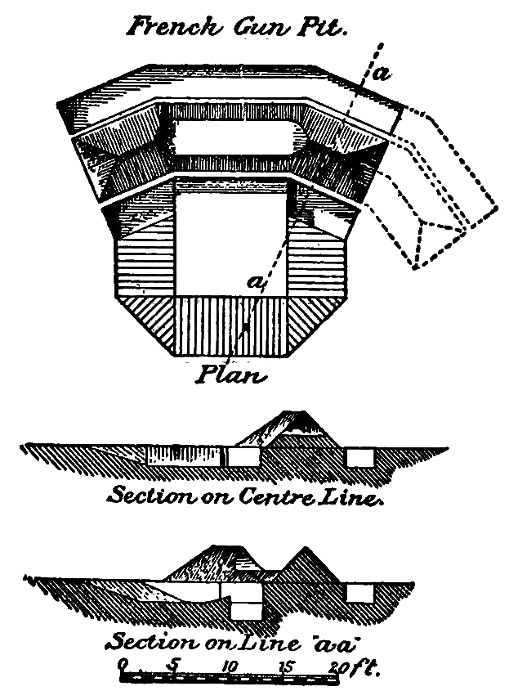
Fig. 136.
Construction.—To trace the pit:
1. Lay off a line about ten feet in length perpendicular to the line of fire, to mark the foot of the interior slope of the epaulement.
This line should be long enough to give the piece a field of fire of 90 degrees; mark the extremities and centre of the line with stakes or otherwise.
2. In the wings lay off two lines five to seven feet in length, making with the first line angles such that the trenches shall not restrict the field of fire or interfere with the recoil of the piece.
3. Complete the rectangle of the pit, and mark the points of intersection of the trenches and the ramps leading to it.
4. In soft ground it will be found to be more expeditious to use shovels; if the ground is hard, three picks and five shovels will be necessary for each detachment of eight men. The men should commence by breaking ground along the interior slope; having picked a breadth of about two feet, they face about and advance toward the rear of the pit.
As soon as there is room the shovels follow the picks.
In picking the men should be instructed to strike together to avoid accident.
Under pressure this pit can be constructed in one and a half hours.
THE GERMAN GUN-PIT.
The German gun-pit consists of a rectangular excavation one and a half feet deep, with a ramp leading to it from the rear. The epaulement is formed like an ordinary glacis, and surrounds all but the entrance.
This pit is easily and rapidly constructed, and, as seen from a distance, presents a very small target.
The parapet being the same height all round, the gun can fire in any direction by widening the pit, which would then take the form of a semicircle.
Construction.—1. Lay off a line four yards in length perpendicular to the direction of the line of fire. At each extremity erect a perpendicular of four yards.
2. From the vertices of the right angles thus formed lay off one yard on both the front and side lines, and mark the four points so determined, together with the rear extremities of the sides, with sabres or stakes.
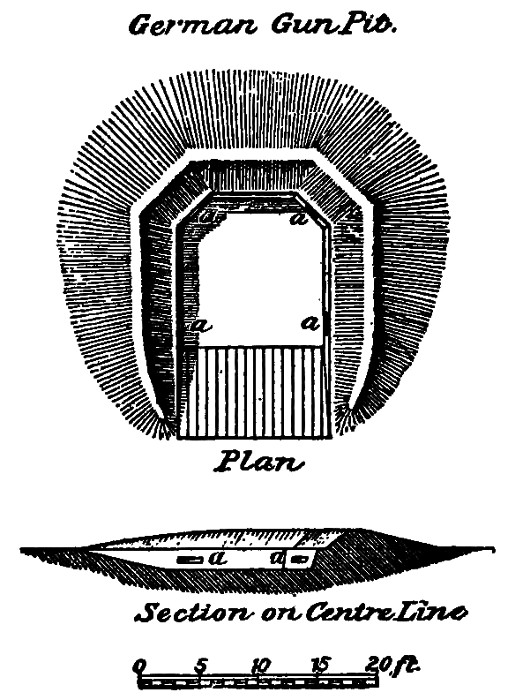
Fig. 137.
3. Commence and continue the digging as prescribed in the construction of the French gun-pit.
The pockets aa are for the reception of ammunition.
4. The ramp is laid out and completed after the pit is finished, or simultaneously with it, as may be most desirable.
An ordinary gun detachment can construct this pit in one hour.
THE AUSTRIAN GUN-PIT.
A simple rectangular pit one and a half feet deep, with front epaulement and ramp.
Construction.—Constructed similarly to the German, the earth from the pit being thrown to the front.
It can be made in less than half an hour, and while affording no special cover to the cannoneers, as do the German and English, it can be made in half that time, and does not present a conspicuous target.
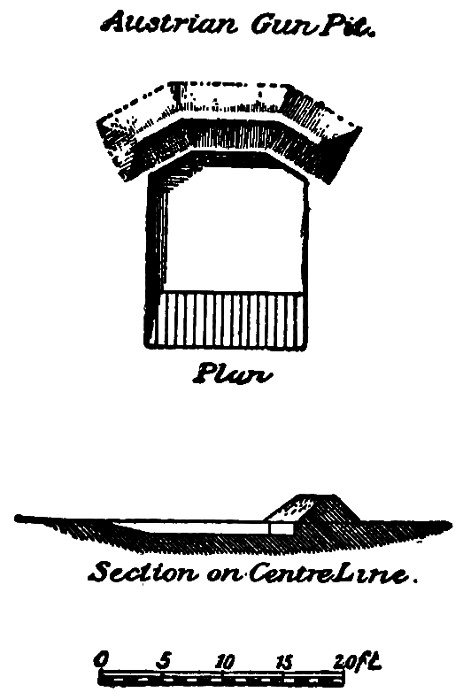
Fig. 138.
It has the further advantage of very rapid cover, and of being capable of transformation into any desirable pit if there be time.
THE ENGLISH GUN-PIT.
This type is a true "gun-pit," the bottom being below the natural surface of the ground, sloping up at back of pit toward the rear. It affords excellent cover for the piece and its detachment, can be readily marked out, and constructed in a comparatively short time.
The lateral trenches, if extended, would afford a covered way along the front of the battery.
The defects in this pit are a contracted field of fire, the conspicuous mark which the embrasure gives the enemy, the lack of ammunition-pockets, and want of drainage.
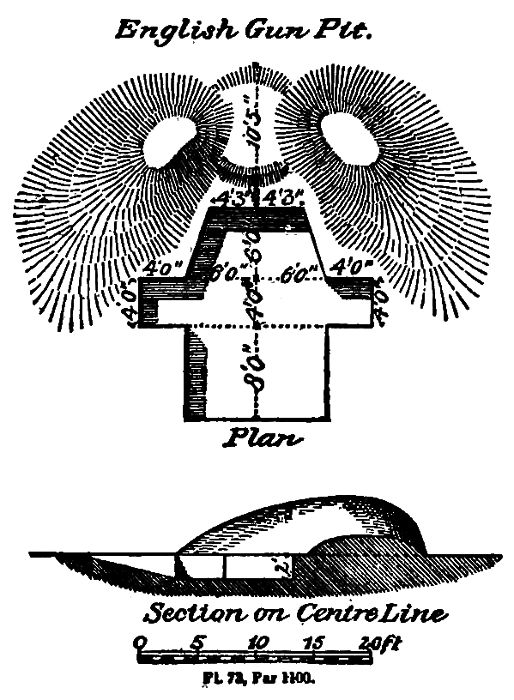
Fig. 139.
Construction.—1. Lay off 8 feet 6 inches on a line perpendicular to the probable direction of fire for the interior crest, and at the middle point of this line determine a perpendicular to it; on this perpendicular lay off from the interior crest distances of 6 feet, 10 feet, and 18 feet, and through their extremities determine lines parallel to the interior crest; on these lines find points that are 6 feet from the perpendicular on both sides of it, putting in a stake or sabre at each point so determined. Extend the parallels at 6 feet and 10 feet, 4 feet on each side, and mark the points thus established for the lateral trenches.
2. Commence excavating at the interior crest, throwing the earth to the front and sides (being careful to allow a berme of about one foot), thus forming an epaulement 1 foot 6 inches high and 10 feet 5 inches thick at bottom, extending round to the front corner of the lateral trenches. Then throw the earth out to the side front to form mounds about 4 feet high in front of the lateral trenches to still better protect the detachment, sufficient space being left in front for an embrasure. Dig down two feet throughout the pit back to the line 10 feet from the interior crest and level off the bottom. Slope up from the bottom of the pit at ten-foot line back to the eighteen-foot line. If desirable to connect adjoining pits of this class, extend the lateral trenches until they meet.
Time of construction of pit complete in all its details, with detachment of eight cannoneers, gunner, and chief of section, in stiff clay, without previous practice, one hour and twenty minutes.
ORDINARY RUSSIAN GUN-PIT.
This type differs from the gun-pit proper, in that the wheels rest on the natural surface of the ground, the side-pits being for the cannoneers. The only apparent advantages are good cover for the detachment under heavy fire, drainage as far as the piece is concerned, and facility for ingress and egress. The obvious disadvantages are contracted space for working party in digging, contracted field of fire, and the mark presented by the embrasure to hostile fire.
Construction.—Lay off on a line perpendicular to the probable direction of fire 10 feet, prolong the line 5 feet 3 inches in both directions, and mark the four points thus determined with stakes or sabres. At the middle point of the ten-foot line erect a perpendicular to it and lay off on this perpendicular to the rear 9 feet 2 inches; through this point determine a parallel to the ten-foot line and lay off on it, on both sides of the perpendicular, 9 feet and 14 feet 3 inches, marking the four points so determined with stakes or sabres.
The parallelograms whose vertices are thus established fix the surface-lines of the lateral trenches. Dig down to 4 feet 6 inches for the bottom of the trenches and throw the dirt to the front and side, giving the epaulement a height of 3 feet, and leaving space for the embrasure in front. When time permits, cut outside and rear steps for the trenches, as indicated, to admit of quick egress for the gun detachment.
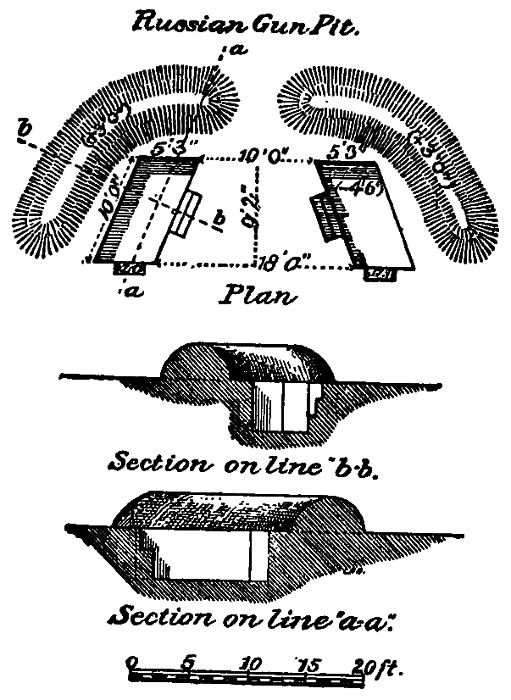
Fig. 140.
Time of construction complete, soil and detachment same as English pit, two hours.
GENERAL OBSERVATIONS ON GUN-PITS.
In forming the epaulement, leave a berme of at least a foot; and, when there is time, level and ram the earth, which, in front of the muzzle, should not be more than three and one half feet above the bottom of the pit. If there are side trenches, the earth in front of them should be high enough to afford complete protection to the men occupying them.
Pockets for the reception of the ammunition are very important in saving the ammunition from water which may accumulate, and from the fire of the enemy.
The field of fire should not be less than 90 degrees.
Avoid narrow embrasures as presenting an easy mark, and as likely to draw the fire of the enemy.
Cover should first be provided for the men and horses; then for the material.
If the position is occupied for some time, strengthen the parapet by earth from a ditch in front. Prolong the lateral trenches of the adjacent pits until they meet, forming a continuous parapet; if possible, plank or macadamize the bottom of the pit. Traverses between the guns will be found effective.
In order to conceal the parapets, cover the fresh earth with boughs, sod, or top-soil of the prevailing or surrounding color. If in winter, use snow for this purpose. A very effective plan is to dig a small trench or parapet from fifty to seventy-five yards in front of the real pits, thus deceiving an enemy as to where the real fire comes from.
If the ground does not afford natural cover for the limbers, limber-pits, similar to the Austrian gun-pits, can be easily constructed. They should be one foot deeper.
TREATMENT OF SICK MEN.
Bleeding.—Blood from the veins is dark and flows slowly; that from arteries is bright red and is thrown out in spurts.
To suppress bleeding from a vein, use cold water when slight; or place a moderately tight bandage below the wound.
If an artery, completely obstruct the artery by pressure at the bleeding point, or between it and the heart. Do this by means of the fingers, a pad and bandage, a plug, or a tourniquet. Make a knot in a handkerchief and place it at the proper spot over the course of the artery, then tie the handkerchief around the limb and by means of a stick twist it tight. In bleeding from hand, fore arm, or arm apply around arm near the shoulder; in bleeding of the foot, leg, or thigh apply around leg between knee and hip according to circumstances.
Chafing.—Chafing between the thighs may be alleviated by keeping the parts scrupulously clean, and powdered with fuller's earth, or a mixture of oxide of zinc and very finely powdered starch.
Colic.—Dose of castor-oil, hot applications to belly, and a teaspoonful of Squibb's mixture or ginger essence in water.
Cholera Morbus.—1 teaspoonful of paregoric, ¼ grain of morphine, or 1 teaspoonful of Squibb's mixture diluted may be given at once. Hot applications to belly. Stimulants in case of collapse.
Constipation.—A seidlitz powder, or a tablespoonful of Rochelle or Epsom Salts before breakfast; a teaspoonful of compound liquorice powder, or 2 or 3 compound cathartic pills, late at night.
Burns and Scalds.—Cover with vaseline or carron oil (equal parts of lime water and oil). If oil is not at hand, use flour or scraped potato. A tablespoonful of baking-soda to a teacupful of water soon relieves pain. Dress with lint or cotton-wool. Blisters should be carefully opened with a needle or scissors.
Diarrhœa.—Dose of castor-oil; if after oil has acted the diarrhœa persists, a teaspoonful of Squibb's mixture diluted; or a camphor and opium pill, to be repeated in an hour if necessary.
Drowning.—If the patient has stopped breathing, tight clothing is first loosened; the individual is then turned over on his face, a roll of clothing, a rolled blanket, etc., being placed under his stomach, his mouth and nose are cleared of sand, mud, or other substances collected therein, and pressure is made upon the spine and kept up until water ceases to flow from the mouth. The patient is then turned over on his back, and the roll placed under his shoulder-blades so as to raise the shoulders and extend the throat. The tongue, being drawn well forward, is either secured by a string or rubber band, passing around the base of the organ and the chin, fixed by thrusting a small stick or pencil across the top of it behind the molar teeth, or held by an assistant. Then, kneeling behind the patient's head, seize the arms above the elbows and draw them outwards and upwards until they are fully extended above the head. After a pause of about two seconds the arms are carried back to their original positions, the operator making firm pressure on the chest at the same time. This procedure is carried out at the rate of about fifteen times a minute. Whenever the arms are raised, the chest is expanded and air enters the lungs; when they are brought down and pressure is made upon the chest, the latter is compressed and the air is expelled. The natural movements of respiration are hence imitated. This should be kept up for hours if necessary, and until natural breathing returns, or the case has been given up as hopeless by competent authority. During this time warm and dry clothing should have been placed on the patient, a fire built, and warm articles of any kind used to restore the heat of the body. The body and limbs should be constantly rubbed towards the trunk. As soon as the patient is able to swallow a teaspoonful of hot liquor in a tablespoonful of water may be given every few minutes until the danger is over.
As soon as the patient begins to breathe of his own accord the artificial process should be timed to aid the natural respiration. Breathing may be stimulated by holding hartshorn to the nose, slapping the skin, or by dashing hot water on the chest.
After being restored the patient should be carefully carried in a recumbent position, put in a warm bed, and carefully watched for stoppage of breathing. If the patient has not stopped breathing when drawn out of the water, proceed as above, omitting artificial respiration except when the natural function begins to fail.
Emetics.—Gunpowder dissolved in water. One tablespoonful of mustard in a pint of water and then copious draughts of tepid water. Twenty grains of sulphate of zinc dissolved in water, to be followed by a cupful of tepid water, and repeated every three minutes until 3 or 4 doses have been given or vomiting has occurred.
Fainting.—Place patient on his back, head low, arms and feet may be elevated; loosen tight clothing; dash cold water in face; hold hartshorn to nostrils; a little whiskey and water when able to swallow.
Frost-bites.—Rub with snow or cold water.
Intoxication.—Pour water over head; give teaspoonful of ground mustard stirred up in a teacupful of lukewarm water; then, after vomiting has occurred, give a teaspoonful of aromatic spirits of ammonia in a teacupful of water, or a large draught of vinegar. If in danger of dying, general application of heat to body is imperative.
Heat Exhaustion resembles an ordinary fainting spell, and is similarly treated. Unlike sunstroke this condition presents a cool moist skin.
Sunstroke.—Its symptoms of warning are headache and oppression, followed after a time by loss of consciousness; breathing labored; skin intensely hot; perspiration absent; the bladder and bowels sometimes discharge involuntarily.
Convey immediately to a cool place; remove clothing; place in cold bath, or wrap with sheets soaked in cold water, and keep wet with ice-water if possible. If this cannot be done, sponge thoroughly and continually the head and body, lumps of ice being rubbed over the chest and placed over the large blood-vessels in the arm-pits and groins.
Discontinue application of cold when consciousness returns, to be renewed only in case temperature rises above normal (98.9° F.) or insensibility returns.
Sore Feet.—If the feet begin to chafe, rub the socks with common soap where they come in contact with sore places. By rubbing the feet with hard soap before the march you may escape having sore feet. The feet should be washed every night and thoroughly dried. Blisters should not be opened, but have a thread run through.
TABLES OF WEIGHT, CAPACITY, ETC.
NUMBER OF POUNDS IN A BUSHEL.
Oats 32
Beans 60
Onions 57
Castor beans 46
Barley 48
Peas 60
Timothy-seed 45
Flaxseed 56
Corn or rye 56
Clover-seed 60
Dried apples or peaches 28
Hemp-seed 44
Wheat 60
Potatoes 60
Salt 50
Bluegrass-seed 14
NUMBER OF POUNDS IN A BARREL.
Flour 196
Beef, pork, or fish 200
Salt 280
CYLINDERS FOR LIQUID MEASURES.
Diam. Height.
1 gill 1¾ in. 3 in.
½ pint 2¼ " 3⅝ "
1 pint 3½ " 3 "
1 quart 3½ " 6 "
1 gallon 7 " 6 "
2 gallons 7 " 12 "
8 " 14 " 12 "
10 " 14 " 15 "
CAPACITY OF BOXES.
A cubic yard contains 21.69 bushels.
1 barrel = 24 x 16 x 28 inches
½ " = 24 x 24 x 14 "
1 bushel = 16 x 16.8 x 8 "
1 " = a cylinder 14 in. diam. x 14 in. deep
½ " = 12 x 11.2 x 8 inches
1 peck = 8 x 8.4 x 8 "
1 gallon = 8 x 8 x 4.2 " (dry)
1 " = 6 x 6 x 6.42 " (liquid)
½ " = 7 x 4 x 4.5 "
1 quart = 4 x 4 x 4.1 " (dry)
1 " = 4 x 4 x 3.61 " (liquid)
In freighting ships 42 cubic feet are allowed to a ton.
ARMY WAGON (INSIDE MEASUREMENT).
Length 9½ ft. at bottom ; width, 3 ft. 4 in.; depth, 1 ft. 9 in.
10 ft. at top
TO DETERMINE THE QUANTITY OF GRAIN OR HAY.
Corn.—Two cubic feet of sound dry corn in the ear will make one bushel of shelled corn.
To determine the number of bushels of shelled corn in a crib of corn in the ear, multiply together the interior length, breadth, and height of the crib in feet, and divide by 2.
Oats.—A nose-bag will contain about 10 pounds of good oats.
A cubic foot of good oats weighs about 25¾ pounds.
To determine, approximately, the number of bushels of oats in a bin, multiply the length, breadth, and height in feet together, and multiply the result by O.8047.
To determine the number of bushels a wagon will contain, apply the same rule.
Hay.
Hay loose allow 5 pounds to a cubic foot
Hay in stack " 8 pounds to a cubic foot
Hay baled " 11 pounds to a cubic foot
Wagon-load of stack hay " 450 to 500 cubic feet to a ton
Wagon-load of new-mown hay 700 cubic feet to a ton
Straw.—Allow 10 to 12 pounds to a cubic foot.
MEASURES OF LENGTH.
LONG MEASURE.
12 inches make 1 foot ft.
3 feet " 1 yard yd.
5½ yards " 1 rod rd.
40 rods " 1 furlong fur.
8 furlongs, or 320 rods, " 1 mile mi.
3 miles " 1 league lea.
SURVEYOR'S MEASURE.
7.92 inches make 1 link li.
100 links " 1 chain ch.
80 chains " 1 mile mi.
SQUARE MEASURE.
144 square inches make 1 square foot sq. ft.
9 square feet " 1 square yard sq. yd.
30¼ square yards " 1 square rod sq. rd.
160 square rods " 1 acre A.
LAND MEASURE.
10,000 square links make 1 square chain
10 square chains " 1 acre
640 acres " 1 square mile
CUBIC MEASURE.
1728 cubic inches make 1 cubic foot cu. ft.
27 cubic feet " 1 cubic yard cu. yd.
128 cubic feet " 1 cord C.
LIQUID MEASURE.
The standard U. S. gallon equals 231 cubic inches, and contains 8.3311 pounds of pure water at 62° F.
A cubic foot of pure water at 62° F. weighs 62.32 pounds.
The liquid quart is about six sevenths of a quart of dry measure.
Name. Equivalent. Litres. Decalitres. Hectolitres.
1 gill .1183
1 pint 4 gills .4732
1 quart 2 pints .9463
1 gallon 4 quarts 3.7853
1 barrel 31½ gallons 11.9237 1.1924
1 hogshead 2 barrels 23.8474 2.3847
1 pipe 2 hogsheads 4.7694
1 tun 2 pipes 9.5389
1 litre = 8.4536 gills = 2.1134 pints = 1.0567 quarts.
DRY MEASURE.
The bushel (Winchester) contains nearly 2150.42 cubic inches, and is a cylinder measure 18½ inches across and 8 inches deep.
A bushel measure will contain 9.31 gallons of pure water at 62° F.
Name. Equivalent. Litres. Decalitre.
1 pint .5506
1 quart 2 pints 1.1012
1 peck 8 quarts 8.8096
1 bushel 4 pecks 35.2384 3.5238
1 litre = 1.816 pints = .908 quart.
APOTHECARIES' MEASURE.
60 minims (♏) 1 fluid drachm (f. ʒ)
8 drachms (water 1.732 cu. in., 437½ grains) 1 fluid oz. (f. ℥)
20 ounces 1 pint (O.)
8 pints (water 70,000 grains) 1 gallon (gall.)
1 drop 1 grain
60 drops 1 drachm
1 drachm 1 teaspoonful
4 drachms 1 tablespoonful
8 drachms (2 tablespoonfuls) 1 ounce
2 ounces (water 875 grains) 1 wineglassful
3 ounces 1 teacupful
MISCELLANEOUS TABLES.
COUNTING.
12 things make 1 dozen doz.
12 dozen " 1 gross gr.
12 gross " 1 great gross g. gr.
PAPER.
24 sheets make 1 quire qr.
20 quires " 1 ream ream
2 reams " 1 bundle bund.
2 bundles " 1 bale
BOOKS.
A book in which
Each sheet is folded into 2 leaves is a folio
" " " " 4 " " quarto, or 4to
" " " " 8 " " octavo, or 8vo
" " " " 12 " " duodecimo, or 12mo
" " " " 16 " " 16mo
" " " " 24 " " 24mo
" " " " 32 " " 32mo
MISCELLANEOUS VALUES.
4 inches make 1 hand, used in measuring horses
9 " " 1 span, " sacred history
18 feet " 1 cubit, " sacred history
6 " " 1 fathom, " measuring depths
MEASURES OF WEIGHT.
AVOIRDUPOIS = METRIC WEIGHTS.
Avoirdupois. Grammes. Decagrammes. Kilogrammes. Millier (Ton).
1 drachm 1.77184
1 ounce (16 drachms) 28.34954 2.83495
1 pound (16 ounces) 453.59256 45.35926 0.45359
1 hundredweight 45.3552
1 ton (20 cwt.) 907.1040 0.9071
Ton. Hundredweight. Pounds. Ounces. Drachms.
1 = 20 = 2000 = 32,000 = 522,000
1 = 100 = 1,600 = 25,600
1 = 16 = 256
1 = 16
TROY = METRIC WEIGHTS.
Troy Weights. Equivalents in Metric Denominations.
Milli- gramme. Gramme. Deca- gramme. Hecto- gramme. Kilo- gramme.
1 Troy grain 64.79895 0.06480
1 pennyweight 1.55517
1 ounce 31.10349 3.11035
1 pound 373.24195 37.32491 3.73249 0.37324
1 lb. = 12 oz. = 240 dwts. = 5760 grs.
1 " = 20 " = 480 "
1 " = 24 "
TABLES FOR CONVERTING U. S. WEIGHTS AND MEASURES.
CUSTOMARY TO METRIC.
LINEAR.
Inches to Millimetres. Feet to Metres. Yards to Metres. Miles to Kilometres.
1 = 25.4001 0.304801 0.914402 1.60935
2 = 50.8001 0.609601 1.828804 3.21869
3 = 76.2002 0.914402 2.743205 4.82804
4 = 101.6002 1.219202 3.657607 6.43739
5 = 127.0003 1.524003 4.572009 8.04674
6 = 152.4003 1.828804 5.486411 9.65608
7 = 177.8004 2.133604 6.400813 11.26543
8 = 203.2004 2.438405 7.315215 12.87478
9 = 228.6005 2.743205 8.229616 14.48412
SQUARE.
Square Inches to Square Centimetres. Square Feet to Square Decimetres. Square Yards to Square Metres. Acres to Hectares.
1 = 6.452 9.290 0.836 0.4047
2 = 12.903 18.581 1.672 0.8094
3 = 19.355 27.871 2.508 1.2141
4 = 25.807 37.161 3.344 1.6187
5 = 32.258 46.452 4.181 2.0234
6 = 38.710 55.742 5.017 2.4281
7 = 45.161 65.032 5.853 2.8328
8 = 51.613 74.323 6.689 3.2375
9 = 58.065 83.613 7.525 3.6422
CUBIC.
Cubic Inches to Cubic Centimetres. Cubic Feet to Cubic Metres. Cubic Yards to Cubic Metres. Bushels to Hectolitres.
1 = 16.387 0.02832 0.765 0.35239
2 = 32.774 0.05663 1.529 0.70479
3 = 49.161 0.08495 2.294 1.05718
4 = 65.549 0.11327 3.058 1.40957
5 = 81.936 0.14158 3.823 1.76196
6 = 98.323 0.16990 4.587 2.11436
7 = 114.710 0.19822 5.352 2.46675
8 = 131.097 0.22654 6.116 2.81914
9 = 147.484 0.25485 6.881 3.17154
CAPACITY.
Fluid Drachms to Millilitres or Cubic Centimetres. Fluid Ounces to to Millilitres. Quarts to Litres. Gallons to Litres.
1 = 3.70 29.57 0.94636 3.78543
2 = 7.39 59.15 1.89272 7.57087
3 = 11.09 88.72 2.83908 11.35630
4 = 14.79 118.29 3.78543 15.14174
5 = 18.48 147.87 4.73179 18.92717
6 = 22.18 177.44 5.67815 22.71261
7 = 25.88 207.02 6.62451 26.49804
8 = 29.57 236.59 7.57087 30.28348
9 = 33.27 266.16 8.51723 34.06891
WEIGHT.
Grains to Milligrammes. Avoirdupois Ounces to Grammes. Avoirdupois Pounds to Kilogrammes. Troy Ounces to Grammes.
1 = 64.7989 28.3495 0.45359 31.10348
2 = 129.5978 56.6991 0.90719 62.20696
3 = 194.3968 85.0486 1.36078 93.31044
4 = 259.1957 113.3981 1.81437 124.41392
5 = 323.9946 141.7476 2.26796 155.51740
6 = 388.7935 170.0972 2.72156 186.62088
7 = 453.5924 198.4467 3.17515 217.72437
8 = 518.3914 226.7962 3.62874 248.82785
9 = 583.1903 255.1457 4.08233 279.93133
1 Gunter's chain = 20.1168 metres
1 square statute mile = 259.000 hectares
1 fathom = 1.829 metres
1 nautical mile = 1853.25 metres
1 foot = 0.304801 metre, 9.4840158 log.
1 avoirdupois pound = 453.5924277 gramme
15432.35639 grains = 1 kilogramme
METRIC TO CUSTOMARY.
LINEAR.
Metres to Inches. Metres to Feet. Metres to Yards. Kilometres to Miles.
1 = 39.3700 3.28083 1.093611 0.62137
2 = 78.7400 6.56167 2.187222 1.24274
3 = 118.1100 9.84250 3.280833 1.86411
4 = 157.4800 13.12333 4.374444 2.48548
5 = 196.8500 16.40417 5.468056 3.10685
6 = 236.2200 19.68500 6.561667 3.72822
7 = 275.5900 22.96583 7.655278 4.34959
8 = 314.9600 26.24667 8.748889 4.97096
9 = 354.3300 29.52750 9.842500 5.59233
SQUARE.
Square Centimetres to Square Inches. Square Metres to Square Feet. Square Metres to Square Yards. Hectares to Acres.
1 = 0.1550 10.764 1.196 2.471
2 = 0.3100 21.528 2.392 4.942
3 = 0.4650 32.292 3.588 7.413
4 = 0.6200 43.055 4.784 9.884
5 = 0.7750 53.819 5.980 12.355
6 = 0.9300 64.583 7.176 14.826
7 = 1.0850 75.347 8.372 17.297
8 = 1.2400 86.111 9.568 19.768
9 = 1.3950 96.875 10.764 22.239
CUBIC.
Cubic Centimetres to Cubic Inches. Cubic Decimetres to Cubic Inches. Cubic Metres to Cubic Feet. Cubic Metres to Cubic Yards.
1 = 0.0610 61.023 35.314 1.308
2 = 0.1220 122.047 70.629 2.616
3 = 0.1831 183.070 105.943 3.924
4 = 0.2441 244.094 141.258 5.232
5 = 0.3051 305.117 176.572 6.540
6 = 0.3661 366.140 211.887 7.848
7 = 0.4272 427.164 247.201 9.156
8 = 0.4882 488.187 282.516 10.464
9 = 0.5492 549.210 317.830 11.771
CAPACITY.
Millimetres or Cubic Centimetres to Fluid Drachms. Centilitres to Fluid Ounces. Litres to Quarts. Decalitres to Gallons. Hectolitres to Bushels.
1 = 0.27 0.338 1.0567 2.6417 2.8377
2 = 0.54 0.676 2.1134 5.2834 5.6755
3 = 0.81 1.014 3.1700 7.9251 8.5132
4 = 1.08 1.353 4.2267 10.5668 11.3510
5 = 1.35 1.691 5.2834 13.2085 14.1887
6 = 1.62 2.029 6.3401 15.8502 17.0265
7 = 1.89 2.367 7.3968 18.4919 19.8642
8 = 2.16 2.705 8.4535 21.1336 22.7019
9 = 2.43 3.043 9.5101 23.7753 25.5397
WEIGHT.
Milligrammes to Grains. Kilogrammes to Grains. Hectogrammes to Ounces Avoirdupois. Kilogrammes to Pounds Avoirdupois.
1 = 0.01543 15432.36 3.5274 2.20462
2 = 0.03086 30864.71 7.0548 4.40924
3 = 0.04630 46297.07 10.5822 6.61387
4 = 0.06173 61729.43 14.1096 8.81849
5 = 0.07716 77161.78 17.6370 11.02311
6 = 0.09259 92594.14 21.1644 13.22773
7 = 0.10803 108026.49 24.6918 15.43236
8 = 0.12346 123458.85 28.2192 17.63698
9 = 0.13889 138891.21 31.7466 19.84160
Quintals to Pounds Avoirdupois. Milliers or tonnes to Pounds Avoirdupois. Kilogrammes to Ounces Troy.
1 = 220.46 2204.6 32.1507
2 = 440.92 4409.2 64.3015
3 = 661.39 6613.9 96.4522
4 = 881.85 8818.5 128.6030
5 = 1102.31 11023.1 160.7537
6 = 1322.77 13227.7 192.9044
7 = 1543.24 15432.4 225.0552
8 = 1763.70 17637.0 257.2059
9 = 1984.16 19841.6 289.3567
SALUTES.
Salutes are fired between sunrise and sunset, and, as a rule, never on Sunday. Salute to the Union, one gun for each state, fired at meridian, July 4th; the international salute, 21 guns.
The President, 21 guns, both on arriving at and departing from a military post.
On arriving at a military post:
The Vice-President and President of the Senate 19 guns
Members of the Cabinet, Chief Justice, Speaker of the House of Representatives, Governors in their respective states and territories, Committees of Congress visiting officially 17 "
Assistant Secretary of War 15 "
Sovereign or Chief Magistrate of a foreign state 21 "
Members of Royal Family 21 "
Viceroy, Governor-general, or Governors of provinces belonging to foreign states 17 "
Ambassadors Extraordinary and Plenipotentiary 17 "
Envoys Extraordinary and Ministers Plenipotentiary 15 "
Ministers Resident accredited to the United States 13 "
Chargés d'Affaires or subordinate diplomatic agent in charge of mission in the United States 11 "
Consuls-general accredited to the United States 9 "
To General-in-Chief, Field-marshal, or Admiral 17 "
To Lieutenant-General or Vice-Admiral 15 "
To Major-General or Rear-Admiral 13 "
To Brigadier-General or Commodore 11 "
An officer on duty, according to brevet rank, receives the salute of that rank.
Officers of volunteers or militia are saluted only when in service of United States.
Officers on retired list are not saluted.
Officers of foreign services are saluted according to their rank.
TABLE FOR CALCULATING CLOTHING ACCOUNTS.
Take the numbers from the columns A and B corresponding to the date immediately preceding the date of the man's enlistment.
January. February. March. April. May. June. July. August. September October. November. December.
Date. A B Date. A B Date. A B Date. A B Date. A B Date. A B Date. A B Date. A B Date. A B Date. A B Date. A B Date. A B
1 1 180 1 32 149 1 60 121 1 91 90 1 121 60 1 152 29 1 1 183 1 32 152 1 63 121 1 93 91 1 124 60 1 154 30
2 2 179 2 33 148 2 61 120 2 92 89 2 122 59 2 153 28 2 2 182 2 33 151 2 64 120 2 94 90 2 125 59 2 155 29
3 3 178 3 34 147 3 62 119 3 93 88 3 123 58 3 154 27 3 3 181 3 34 150 3 65 119 3 95 89 3 126 58 3 156 28
4 4 177 4 35 146 4 63 118 4 94 87 4 124 57 4 155 26 4 4 180 4 35 149 4 66 118 4 96 88 4 127 57 4 157 27
5 5 176 5 36 145 5 64 117 5 95 86 5 125 56 5 156 25 5 5 179 5 36 148 5 67 117 5 97 87 5 128 56 5 158 26
6 6 175 6 37 144 6 65 116 6 96 85 6 126 55 6 157 24 6 6 178 6 37 147 6 68 116 6 98 86 6 129 55 6 159 25
7 7 174 7 38 143 7 66 115 7 97 84 7 127 54 7 158 23 7 7 177 7 38 146 7 69 115 7 99 85 7 130 54 7 160 24
8 8 173 8 39 142 8 67 114 8 98 83 8 128 53 8 159 22 8 8 176 8 39 145 8 70 114 8 100 84 8 131 53 8 161 23
9 9 172 9 40 141 9 68 113 9 99 82 9 129 52 9 160 21 9 9 175 9 40 144 9 71 113 9 101 83 9 132 52 9 162 22
10 10 171 10 41 140 10 69 112 10 100 81 10 130 51 10 161 20 10 10 174 10 41 143 10 72 112 10 102 82 10 133 51 10 163 21
11 11 170 11 42 139 11 70 111 11 101 80 11 131 50 11 162 19 11 11 173 11 42 142 11 73 111 11 103 81 11 134 50 11 164 20
12 12 169 12 43 138 12 71 110 12 102 79 12 132 49 12 163 18 12 12 172 12 43 141 12 74 110 12 104 80 12 135 49 12 165 19
13 13 168 13 44 137 13 72 109 13 103 78 13 133 48 13 164 17 13 13 171 13 44 140 13 75 109 13 105 79 13 136 48 13 166 18
14 14 167 14 45 136 14 73 108 14 104 77 14 134 47 14 165 16 14 14 170 14 45 139 14 76 108 14 106 78 14 137 47 14 167 17
15 15 166 15 46 135 15 74 107 15 105 76 15 135 46 15 166 15 15 15 169 15 46 138 15 77 107 15 107 77 15 138 46 15 168 16
16 16 165 16 47 134 16 75 106 16 106 75 16 136 45 16 167 14 16 16 168 16 47 137 16 78 106 16 108 76 16 139 45 16 169 15
17 17 164 17 48 133 17 76 105 17 107 74 17 137 44 17 168 13 17 17 167 17 48 136 17 79 105 17 109 75 17 140 44 17 170 14
18 18 163 18 49 132 18 77 104 18 108 73 18 138 43 18 169 12 18 18 166 18 49 135 18 80 104 18 110 74 18 141 43 18 171 13
19 19 162 19 50 131 19 78 103 19 109 72 19 139 42 19 170 11 19 19 165 19 50 134 19 81 103 19 111 73 19 142 42 19 172 12