"Hair-Breadth Escapes" (continued 5)
Reading edition
“Did you make many converts among the Hottentots?” he asked one day. “I remember hearing you say your mission, as a whole, had not succeeded; but I suppose you made converts here and there?”
“I cannot say I ever made one.”
“Not one! And yet you were going back to them again!”
“Certainly. Why not?”
“Rather, ‘Why?’ I should have been inclined to ask.”
“Why? because God has commanded that the Gospel should be preached to all nations, and that command stands good, whether they will hear, or whether they forbear. It is our business to do His work, and His to look after the result.”
“And you would not consider that a man’s life was wasted, if he passed his whole life as a missionary, without making one convert?”
“No more wasted than if he had made ten thousand. Look here, Ernest. You have never seen a coral island, I suppose?”
“No,” said Warley; “I have read about them, but I have never seen one.”
“You have read about them? Then you know that the coral insects labour on, generation after generation, under the water, raising the reef always higher and higher, till it reaches the high-tide level at last.”
“Yes, that is what I have read, certainly.”
“For generations, then, upon generations, the work of the insect was wholly out of human sight. Ernest, was their work in vain? Did not they help to build up the island as much as those whose labours could be clearly discerned?”
“You are right,” said Warley. “One soweth, and another reapeth.”
“Yes, and both will rejoice hereafter together; claiming, under God, the work between them. The work of the missionary—of the early missionary—may seem to man’s eyes as nothing, but it is merely out of man’s sight. He is building up Christ’s kingdom, as the coral insect, far down below, builds up the reef; and will, unknown though he be now, have equal honour hereafter with those whom the world now accounts its greatest benefactors.”
Many such conversations as these were held between the two friends—as, notwithstanding the disparity of their years, De Walden and Ernest might be called—and every day the bond between them grew stronger. Together they visited the Kaffir huts, and held long talks with the occupants; who were never unwilling to discourse on the subject nearest to De Walden’s heart, little as they might be inclined to hearken to his teaching. He was, however, not without hope that he had succeeded in making some impression. More than one man resorted secretly to him to ask explanations of difficulties, which, it was plain, had been weighing on their minds; more than one woman attended the prayers, which were daily offered to the God of the Christians in the white man’s hut, in spite of Chuma’s interdict Maomo heard of it, and it roused still more fiercely his jealousy and alarm. He was, as has already been intimated, partly a deceiver, and partly a dupe. He knew that many of his pretensions were simply impostures; but he did believe in the existence of Evil Spirits, and their power to injure men. Such doctrines as those propounded by De Walden, must needs, he thought, be in the highest degree distasteful to them; and they would visit the land with the most terrible plagues, if the people fell away from the faith of their fathers.
He continually beset Chuma, therefore, with entreaties to put down the evil, before it reached any greater height. He reminded the chief that he had already forbidden De Walden, or the “White Lie-maker,” as he was wont to call him, to teach the people his new and dangerous creed. His commands had been openly disobeyed, and he must now enforce severe penalties against him, or suffer the most terrible consequences himself. Chuma listened, but made evasive replies. His own mind was in a state of doubt on the subject. He was incensed by the Englishman’s obstinate refusals to comply with his orders, and had begun to doubt whether he really did possess the presumed supernatural powers. If that should indeed be the case, he would make short work with him. At present, however, he was not convinced that this was the case, and he had resolved to defer any action until his mind was made up.
Meanwhile Frank and Nick went out almost every day with their guns, under the tutelage of Kobo, a middle-aged, strongly built Bechuana, into whose charge Chuma had consigned them. The missionary was jealously watched, not only by the chief’s servants, but by those of Maomo also. He was never allowed to leave his hut, unless accompanied by at least one man, and never to leave the village at all, except by the chief’s express permission, and under the escort of three armed men. But the boys were not so carefully looked after. Chuma contented himself with warning Kobo, that if at any time they were not forthcoming, he would have to pay the penalty with his own life. The boys knew this as well as Kobo, and promised him that they would make no attempt at escape, even if a favourable opportunity should offer; and the Bechuana, strange to say, seemed quite contented with their assurance. He went out with them into the bush, sometimes to a considerable distance, allowing them to take their firearms, and carrying no weapon himself, but a light hatchet, which would have been of no service to him at all, in event of any hostile movement on their part, nor did he ever seem to entertain a suspicion that could mean treachery towards him.
“He’s a good fellow, this blacky,” remarked Nick one day, as they halted under the shade of a large oomahaama, to rest an hour or two before returning home from one of their shooting excursions. “He’s a good fellow, not suspicious of every word one says, or of the meaning of every act one does. He really has some notion of honesty. More’s the wonder!”
“Yes,” answered Frank; “I should like to ask him where he got it from, only I suppose he wouldn’t understand one.”
“Oh yes, Kobo would—understand very well,” said Kobo, joining in the lads’ conversation, in broken, but very intelligible English.
“Hallo, hey, what!” exclaimed both the boys, half starting up with surprise. “What! you understand English, Kobo?” added Frank. “How in the world did you learn it?”
“And why in the world didn’t you tell us long ago that you understood it?” subjoined Gilbert.
“Kobo keep it secret—chief not know—prophet not know,” answered Kobo. “Kobo tell white boys, not black man.”
“Do tell us, then, Kobo,” said Nick, whose interest had been keenly awakened. “You may trust us to keep whatever we may hear to ourselves, if you desire it.”
Kobo assented readily enough. It was plain that he was anxious, for some reason of his own, that they should learn his history, and had been awaiting his opportunity of telling it. We shall not follow the broken English of his narrative, but relate it in our own words.
Kobo had been born and reared in the Bechuana village where he was still living; but when a lad of twelve or thirteen years old, had incurred the chief’s displeasure for some boyish offence, and to escape the punishment incurred by it, fled from the kraal and took refuge in a village lying at a considerable distance from his own people. He had not been there many months, when the village in which he was living was attacked by a commando, and with the usual consequences. All the males who had reached puberty and the elder women, were shot or cut down; the girls and children carried off into bondage.
Kobo’s fate had at first been very doubtful. He was just on the very verge of what was considered manhood, and the sword of more than one Dutchman was raised to cut him down. But he was, luckily for himself, rather short of stature, and it was ultimately resolved that he should be spared. He was taken to the southern part of the colony, and became the slave of a Dutch farmer residing near Oudtshoorn. Here he remained for several years, until he had quite grown to manhood. According to his own statement, which it would be reasonable to receive with some degree of caution, he was treated with the utmost injustice and cruelty by his masters—ill-fed, overworked, and kicked and cuffed without any reason, whenever his employers chanced to be out of temper.
But there was no remedy for his wrongs. It was in vain to appeal to the law, which would hardly entertain his complaint at all, and would have done nothing to protect him, even if he could have made out his case. To have offered resistance would have been the extremity of folly, as it would only have brought down increased suffering upon him; and to have attempted escape, would have been almost certain death. It was a long distance to the border of the Bechuana country; and the fierce bloodhounds kept by the whites would have overtaken and torn him to pieces, before he could have gone the twentieth part of the way. There was nothing for it but to bear it patiently.
It chanced that there was a man residing in Oudtshoorn, who was of European, but not Dutch, descent. He was believed to be an Englishman, who for some unknown reason had chosen to leave his own country. He took some notice of Kobo, whose appearance and manner pleased him; and gradually the Bechuana confided to him his history, the cruel hardships he endured, and the anxious longing which possessed him to regain his freedom. Andrews, as the Englishman was called, listened attentively to his story, and then advised him to wait patiently for a few weeks more, when an opportunity he desired might present itself. Andrews was a secret agent of the English Government, and knew that an army and fleet were soon going to be sent out to attempt the seizure of the Dutch colony. If this should prove successful, he would be able to help Kobo effectually. The Bechuana followed his advice; and one evening, towards the end of December, received an unexpected visit from his English friend, who was mounted on a strong Cape horse, and led another by the bridle.
“Mount, Kobo,” he said, “and ride with me. Your master is too much frightened by the news he has just received to think about you; and even if he did try to catch you, he couldn’t.”
Kobo obeyed willingly enough. They rode through the whole of that night, and next morning arrived at a place where fresh horses had been provided. Continuing their ride with hardly an hour’s delay, they reached Simon’s Bay, where an English fleet had just come to anchor. Andrew’s first step was to have Kobo regularly rated as his servant. When the campaign was ended by the cession of the colony, they returned to Oudtshoorn; where Kobo’s former master was still residing, but he stood too much in awe of Andrews to claim his fugitive slave again. Kobo, who had become greatly attached to his English master, continued for several years in his service, until in 1803 the colony was handed back to the Dutch. When it became certain that the English Government would take this step, Andrews advised Kobo to leave Oudtshoorn before the departure of the English troops. Van Ryk, his former master, had always looked upon him as his lawful property, of which he had been violently despoiled, and would inevitably claim him as soon as the Dutch power was again established. Kobo’s affection for Andrews would have induced him to remain and brave the hazard of this; but the Englishman pointed out that he would not have the power of protecting him against Van Ryk’s claim, or against any cruel usage to which he would probably subject him, and this would be worse pain to both than their separation. Kobo accordingly was conveyed by Andrews as far as the Gariep, where they took leave of one another, the Englishman returning to Oudtshoorn, and Kobo rejoining his tribe.
The latter, however, had kept the true history of his past life a profound secret from his countrymen, passing off a plausible tale of life among the Bushmen in its place. He was afraid that Van Ryk would offer the Bechuana chief a large sum for his tradition, and he knew Chuma’s avaricious spirit too well to believe that he would refuse it. When he heard from De Walden of the reoccupation of the Cape by the English, he was instantly seized with an anxious desire to return to Oudtshoorn, and would have offered himself to Lavie as his guide, if it had not been that he dared not betray his knowledge of the English language. He would, however, in all likelihood, soon have left the Bechuana village alone, if he had not conceived a liking for the English prisoners, and a desire to serve them in the danger which, as he could plainly see, was threatening them. He was well acquainted with Maomo’s cruel and vindictive nature. Several persons, towards whom the wizard had conceived a hatred, had suffered the most terrible tortures and death through his machinations, and towards no one had he ever felt such bitter enmity as towards De Walden.
This feeling had been increased by the failure of his schemes, thus far, to work the missionary’s ruin. He had been hoping that the drought, which often visited the country during the summer months, would give him the desired opportunity of either obliging De Walden to comply with Chuma’s entreaties to bring down rain by his incantations, or of provoking the chief’s wrath to the uttermost by his refusal. But the summer, to his infinite vexation, had been extraordinarily cool and genial, showers falling at short intervals of one another; and causing abundance of grass and water. What was worse, he could see that Chuma attributed this exceptional season to De Walden’s residence in the village. He was farther than ever therefore from accomplishing his object.
But he was not a man to be balked of his purpose; and Kobo, who had watched him narrowly, felt certain that he had some scheme on foot which would achieve the object on which his heart was set. He had been absent for two or three days in the previous week, and when he returned there was a look of triumphant malice in his face, which he tried in vain to hide. The only well-grounded hope they could have of escaping his malicious designs lay in immediate flight. Chuma, as yet, was favourably disposed, and had taken no steps which would render flight impossible. But this would not last long; and De Walden must take time by the forelock, or it would certainly be too late.
Such was the substance of what Kobo imparted to the boys, and which they made a point of laying before Mr De Walden immediately after his return to their village.
The missionary listened attentively, and asked several questions as to Kobo’s sources of information, and the details of the plan of escape he had suggested; but when these had been answered he refused to avail himself of the offer.
“I have little doubt,” he said, “that Kobo in the main is right, if not in every particular, but it is my duty to remain here, and remain I must, whatever may ensue. For the first time since my arrival in Africa, I have a real, well-grounded hope of gaining a considerable body of converts to our faith. What will these think of me? What hope can I have of their remaining true to the creed they have half adopted, if I myself am wanting to it? I am in God’s hands, and I trust all to Him. But you, my dear lads—it is not your duty to stay here, and encounter this danger. You, indeed, Ernest—”
“Do you think I could leave you?” interposed Warley reproachfully.
“I will not ask you to do so,” answered the missionary, clasping Ernest’s hands as he spoke; “but you two—”
“We too will not leave you,” broke in Frank. “I know I speak for Nick as well as myself. We will all stay and endure whatever may chance together. I will tell Kobo so forthwith.”
He sought out the Bechuana accordingly, and acquainted him with the resolution to which all the party had come, adding however, that they would all keep Kobo’s secret most inviolably, and if any occasion should arrive when his services might be required for an attempt of the kind suggested by him, they would at once apply to him to help them.
“Meanwhile,” he said, “Kobo, let us have plenty to employ our time and thoughts. It will never do for us to sit down and brood over our troubles; we should go mad, I expect. Look here, didn’t you tell us that the spoor of some elephants had been seen yesterday or this morning, at a short distance from this?”
“Great many elephant in bush,” said Kobo; “six, seven, big bulls, twenty cows, not three miles away. Not go away to-day, perhaps not to-morrow.”
“Do you hear that, Nick?” said Wilmore. “We had better set out the first thing in the morning, hadn’t we, and try to get a shot at one?”
“White boys see them to-night, if they like,” said Kobo. “See here. Kobo love white boys because they English. He wait here till they ready to run away. Then he run with them. Meanwhile they shoot, hunt, fish. Chuma not suspect they mean to run.”
“All right, Kobo,” said Nick. “You’re a brick, if you know what that means, though you have been baked pretty black in the kiln. Well, let us set off at once. Where do you propose that we should pass the night?”
“Bavian’s Pool, Master Nick; three miles from here—beautiful pool, sweet water, steep rock overhang it, too steep for beasts to climb, not too steep for us. There we sleep among bushes; animals come down to drink by moonlight; buffalo, gnu, zebra, giraffe, lion, rhinoceros, all sorts of beasts—elephant come too—”
“And we can shoot at them from the rock, hey?” interposed Nick.
“No, not shoot from rock. Elephant not come near enough, and light bad; but we track them when they leave waterside, and get good shot in morning.”
“All right, Kobo. How soon ought we to set out?”
“Three hours past noon, now. Get to pool at five. We start in an hour, say.”
“In an hour; very good. Let us go and say good-bye to Mr De Walden and Ernest, Frank, and get the guns.”
“Done with you,” said Frank. “Shall we ask Ernest to come with us? We have had very little of his company for a long time past, and I think he would enjoy this. You know how anxious he always was to come upon a herd of elephants, all the time when we were travelling through the country where they are said sometimes to be found. He is a good fellow, and I don’t like to lose sight of him so entirely.”
“I agree with you, that he is a good fellow,” said Nick,—“a deal better fellow, for the matter of that, than I am. But I am afraid there is not much chance of his making one of our party. There has been a change in him ever since that escape of his from the big snake; and since he has fallen in with Mr De Walden, he has been so taken up with him that he can think of nothing else. But we can ask him, certainly.”
But on reaching the hut they perceived at once that it would be no use to make any such suggestion—for the present, at all events. The two friends were on the point of repairing to the house of one of their converts, who had sent to them a message, entreating their immediate presence. One of the calamities, which the Bechuanas dreaded beyond all others, had just befallen him. It had been known for some time past, that a disease, nearly resembling that which has visited European countries of late years, was raging among the herds belonging to neighbouring tribes, and more particularly the Basutos. It was regarded with the utmost terror by all the races inhabiting Southern Africa, whom it deprived not only of all their wealth, but of their very means of subsistence. They were wholly unacquainted with any means of dealing effectually with it; indeed, for the most part, they attributed it entirely to the agency of malignant Spirits; and its appearance generally threw them entirely into the hands of the pretended prophets. In the present instance they had felt tolerably secure that it would not visit the Bechuana village, the summer having been exceptionally healthy. But that morning, two oxen had suddenly been seized with the symptoms which were only too well-known. The owner, who had unbounded faith in the missionary’s powers, had sent at once to him entreating his help; and he and Warley were just setting out to render what assistance it might be possible to give.
“Poor beggars!” exclaimed Nick. “It will be a bad job for them if they do lose their cattle, seeing that is pretty well all they have. Shall you be able to do anything for them, sir?”
“I am afraid very little,” said the elder man. “I have fallen in with the disease more than once during my residence in this country, and have hardly ever known a case of cure, when it has once fairly taken hold of an animal But we will do our best. Good night, lads I hope you may have a pleasant day’s sport. If it hadn’t been for this, I should have liked Ernest to have gone with you. As it is, I shall want his help.”
Chapter Eighteen.
Bavian’s Pool—Place aux Roi—Giant Bathers—An Elephant Hunt—The “Nick” of Time—Nick’s Ovation—De Walden arrested.
It took Kobo and the two lads a good hour to reach Bavian’s Pool. It lay in a different direction from any which they had yet pursued, through dense bush, in which they would soon have lost themselves, if it had not been for Kobo’s attendance. Occasionally they came on the spoor of the elephants, a large herd of which had evidently passed that way not many hours previously. The gigantic footprints were traced sharp and clear in the sandy soil; the young trees, that had been broken off or trodden down by their bulky frames, exhibited fresh white fractures; those which had only been bent by the weight of the animals in passing, seemed hardly yet to have regained their former positions. Kobo, who spoke under his breath in awe, as it seemed, of these forest kings, told them that the herd, in all likelihood, were reposing at the distance of not more than a quarter of a mile from the path they were now traversing. This intelligence appearing to excite the lads a good deal. He added, that they must not attempt to get a sight of them now, or they would certainly spoil their pleasure that evening, and probably prevent the elephant hunt, which was to take place the next day. The whole tribe, he said, was going out in the morning, and it was hoped that a good many animals would be killed; and as there were several very fine males among them, a large prize in the way of ivory was anticipated. But if the herd should be disturbed, and especially if it should be fired upon, they would probably retreat northwards towards the great lake, and the Bechuanas would see nothing of them but their spoor and dung.
The boys yielded to his representations; and, turning in a different direction from that followed by the elephants, they arrived in another quarter of an hour at Bavian’s Pool, which lay in the very heart of the bush, with a clear space overgrown with grass and short rushes of about twenty yards all round. On the west side appeared the rocks of which Kobo had told them, and which presented a most picturesque appearance. They rose abruptly from the bank of the tarn, to the height of perhaps twenty feet, and sank down with a sharp descent to the level ground everywhere, except in one place where a series of crags, piled one on another, presented a kind of rude and very steep staircase, by which the top might be attained. Up this the party climbed, and ensconced themselves snugly under a shelf of rock from which they could see the whole of the pool and the surrounding banks.
It was still broad daylight when they reached their place of ambush, and the spot was as vacant and still as though the whole landscape had been a part of the great Kalahari itself But they had not been there a quarter of an hour, when the sun disappeared behind the belt of woodland which bounded the sight, and the night of the tropics succeeded with its startling rapidity. The green waste of thorns and shrubs grew first dusky brown, and then deep black; the bright sparkling water a dull gleamy mirror, faintly rendering back the pale opal of the sky. But presently there came a further change. The moon rose higher in the heavens, and the stars came forth in all the unimaginable glories of a southern night—not mere specks of light as seen in the more cloudy skies of the north, but hung like cressets in the glowing air, the moon itself a bright globe of liquid fire. A clear soft radiancy diffused itself over the whole scene, tipping every tree top and distant eminence with silver, and causing the surface of the tarn, as it rippled lazily under the evening breeze, to flash in circlets of light. Presently there came a pattering of feet, as a crowd of small animals came down from different points of the compass to quench their thirst—antelopes with their slender legs and liquid eyes, glancing timidly round them; elands and koodoos tossing their stately heads; gnus and buffaloes in large herds consorting together for mutual protection; hyenas, jackals, and zebras, plunging to the mid-leg in the cool dancing waters, and bounding lightly away when their drought was satisfied. It was a beautiful sight to watch them come and go, like the scenes in a magic-lantern.
By and by, as the night deepened, the larger beasts of the forest made their appearance. The tall graceful heads of giraffes were seen over the tops of the bushes; tigers made their approach, singly or in pairs, with their stealthy and noiseless step; lions stalked proudly down, as though they felt that the sovereignty of the woods belonged by natural right to them; occasionally the ponderous bulk of the rhinoceros might be discerned, as he sucked in the refreshing water with his huge misshapen snout, and retreated with a grunt of satisfaction when his appetite had been appeased. Frank and Nick looked on with ever-increasing interest, though it needed Kobo’s oft-repeated remonstrances to keep them from discharging their rifles at some of the larger specimens, which came within tempting distance of their fire.
It was nearly midnight, and the shores of the pool were beset by a crowd of animals, consisting mostly of the larger beasts of prey, when a sudden sensation of alarm seemed to agitate the whole of the miscellaneous group. The giraffes lifted their stately heads, snuffed the air for a moment, and then bounded silently away; the panthers and nylghaus moved more slowly off; the lions uttered low growls, apparently of dissatisfaction, but nevertheless followed the retreat of the others. Even the sullen black rhinoceros, after bending his head awhile to listen, beat a leisurely retreat, viciously snorting as he retired. In a few minutes the shores of the pool were as still and vacant as they had been when the boys arrived, five or six hours before.
“What does this mean?” asked Nick in a whisper. “What have these brutes seen or heard, to alarm them so? Are your countrymen on their way to attack them?”
“No, it not that,” answered Kobo, in the same subdued accents. “Beasts hear elephant coming down to drink. All get out of elephant’s way. He king among them. Listen, you hear them.”
“Do you really mean it, Kobo?” asked Nick, astonished at this information. “The lions and rhinoceroses can’t really be so much afraid of the elephants as that comes to?”
“I believe it’s true,” said Frank; “I know I’ve been told so before. A lion or a rhinoceros wouldn’t mind a single elephant much, I dare say; but it’s the whole troop of ’em together that they’re afraid of. They’d run right over a lion, or a rhinoceros either, and trample the life out of them, before they knew where they were. Yes, Kobo’s right. Here they come over that low bit of hill there. What a lot! and what thundering big beasts!”
As he spoke, a dull heavy sound, like the roll of loaded waggons along a hard road was heard; and the figure of an enormous elephant emerged from the cover of the thicket, its broad flat head, huge misshapen ears, and white tusks glistening in the broad moonlight. It was followed by another, and another, each seeming to loom larger than the last, until ten of the monsters had reached the banks of the tarn, all of them males, and of the largest size.
“All bull,” whispered Kobo; “bull drink first, females wait till they done.”
While he was speaking, the elephants had advanced up to their mid-legs in the water, and dipping their trunks in, sucked up the cooling stream with a loud gurgling noise. Frank’s fingers insensibly stole to the lock of his rifle. One of the largest of the giants was now scarcely more than four or five yards from him, its figure as plainly visible in the clear cold light, as though it had been noonday. Kobo had again to lay his hand on the boy’s shoulder, and whisper in his ear, “No shoot, spoil hunt to-morrow,” or he might not have been able to resist the temptation.
Presently, however, the males had satisfied their thirst, and moving off slowly in a different direction from that by which they had approached the pond, re-entered the thicket. The cow elephants now took their places, some twenty or thirty in number, many of them with calves of various ages at their sides. There was scarcely room in the tarn for the whole herd, and before they retired, the bright and sparkling waters had become a turbid and discoloured flood. At length, however, they did retire, and before the moon had set, the last of the bulky figures had disappeared among the foliage.
“Now lie down and sleep;” said Kobo, “no more animals to-night.”
The boys complied, and lying down among the bushes which grew here and there between the masses of rocks, were soon buried in slumber. They were awakened by Kobo at daybreak; and having eaten their breakfast, and taken a dip in the tarn, which by this time had recovered its translucent clearness, announced to Kobo that they were ready to take the field.
They accompanied the Bechuana accordingly, as he proceeded cautiously to follow the track left by the herd on the previous evening, for half a mile or so through the bush. Then desiring them to climb two trees of some size, which stood on either side of the path in the heart of the woodland—an acacia and a motjeerie—he crept on alone through the shrubs, making his way as secretly and noiselessly as a snake, and soon vanished from their view.
Presently he reappeared, with the information that the herd were browsing at the distance of a few hundred yards only, and seemed to have no apprehension of danger. Chuma, however, and the other hunters would now soon make their appearance from the opposite side, and would doubtless attack the bull elephants with their assegais, their tusks being a valuable prize. Kobo told them that they could not do better than remain where they were. The elephants would almost certainly be driven past the tree in which they lodged, and so give them the opportunity they desired of trying their skill as marksmen. There were other trees, he said, at no great distance which were larger, and therefore safer, but the elephants might never come near them at all; whereas, in their present position, they were almost sure to see what passed.
“All right, Kobo,” said Frank, “we’ll stay here and take our chance. After all, it must be a jolly big elephant that would bowl this tree over.”
Kobo again vanished, and the boys sat on the tiptoe of expectation for the next hour or so, but without hearing any sound at all except the song of the birds and the buzzing of the insects. Suddenly, however, there broke forth a Babel of discordant sounds. The yells of the Kaffirs—as advancing at the same time from different quarters, they assailed the elephants with their assegais and arrows—were overpowered by the trumpeting of the huge brutes, and the crash of the thorn and seringa bushes, which gave way on every side before them, offering no more serious obstacle to their career, than long grass would to that of a man. Presently the whole herd broke from the cover of the jungle, hurrying on in a transport of mingled rage and terror—the solid earth seeming to tremble under their tread. The Bechuanas followed, darting their assegais from a distance, or thrusting them into the most vulnerable parts of the animals, according as opportunities presented themselves. They had broken up into two or three parties, each of which chose out one of the largest of the male elephants as the point of attack. Some of these were already so severely wounded, that it was with difficulty that they could continue their flight. It was a strange spectacle to witness. The great bulls, pierced with a perfect grove of spears, and dripping with the blood which poured from innumerable wounds, staggered along, screaming with pain and fury; while the Kaffirs continued to overwhelm them with more darts—mingling their blows with entreaties to the huge beasts not to gore or trample on them, but to have mercy and spare their lives, at the very moment when they were inflicting torture and death on the creatures, whose forbearance they implored!
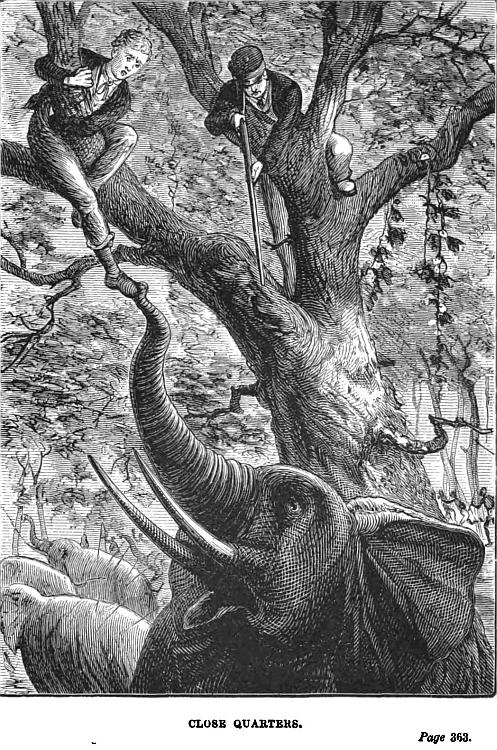
Several huge animals passed in this manner in front of the trees, where the two lads were seated; but none of them offered the desired opportunity of a fair shot. Sometimes a tree intervened; sometimes the animal’s head was hidden by a bush at the moment when they levelled their rifles; sometimes the Bechuanas engaged in the attack approached the line of their aim too nearly to render it safe for them to fire. At length, however, the opportunity did come. One of the largest of the males, fully twelve foot high, had escaped the notice of the assailants; and forcing his way through the haak-doorns and young motjikaaras as though they had been so much paper, bid fair to accomplish his escape without a wound. Both lads fired as he passed. Nick, who had levelled at the shoulder, missed his mark by several inches; and his bullet striking the creature’s side, inflicted only a slight wound, which the elephant hardly heeded. But Frank’s aim was more successful. The bullet struck the eye, though not precisely at the spot where it would have been instantly fatal; and the pain was so acute, as to arrest the monster in his panic-stricken flight. He stopped short and glared round him, seeking for the author of the outrage. Catching sight of the barrel of Frank’s rifle as it glanced in the morning sun, he charged directly at the tree in which he was seated. It was an acacia of tolerable size, and the branch which bore him was above the reach of the animal’s trunk. But so terrific was the force of his rush, that the trunk snapped like a rotten bough, and Frank, gun and all, was hurled to the ground. He sprang up, having been fortunately only bruised by the fall, and leaving his rifle to take care of itself, took to his heels as hard as he could.
“Come here, come here!” shouted Nick; “this tree will hold us both, and it’s too big for him to break. Besides, I’m ready for him again now.” Frank cast a rapid glance round him, and saw that Nick was right. The seringas and oomahaamas near him were thinly scattered, and afforded no cover at all; and the brute which had now recovered itself from the effect of the stunning blow it had received, was preparing to charge him again. Frank flew, rather than ran, to the tree, and springing lightly up, caught the lowest bough and swung himself on to it. From this he mounted to those above it with the agility of a squirrel. But the elephant was upon him, before he could reach the spot where his companion was seated. On it came, with its trunk stretched to the full length, and just caught Frank by the toe of the left foot, as he drew the other out of its reach. Frank thought it was all over with him. The tip of the trunk had caught firm hold of the shoe; and though it was only the tip, so that the animal could not exert its full strength, he felt himself drawn downwards with a force which he could not long resist. He had thrown both his arms and the other leg round the branch, so that the elephant had not merely the resistance of the boy’s muscles to encounter, but the solid and massive limb of the great motjeerie. Nevertheless, all would speedily have given way, if Nick, leaning forward and resting his rifle on the bough beneath him, had not fired directly into the monster’s eye, as it glared—not two feet below—upon him. Frank felt the deadly grip relax, as the elephant sank downwards and rolled over on its side, in its death agony, ploughing up the earth with its tusks, and presenting to the eye a vast quivering mass of dull grey hide, that gradually settled down into stillness.
Before Nick could fairly realise to himself his own success, the Bechuanas had surrounded the carcass, and were greeting the two boys with shouts of admiration and approval. They had not witnessed the manner in which the elephant had come by his death, a belt of shrubs having cut them off from the tree, in which Nick had been seated. They concluded that the animal had simply been brought down, as it was rushing by, by a successful shot from the lad’s rifle; which must indeed have been fired with extraordinary skill to be so instantaneously fatal. The elephant slain was the great leader of the herd, fully twelve feet in height, and with tusks that projected at least two feet beyond the lip. It was by far the most valuable prize of the day, and its ivory would fetch a considerable sum in the market. They overwhelmed the successful sportsman with applause; and mounting Nick on their shoulders, carried him back in triumph to the village, which lay at the distance of not more than a couple of miles. Nick, who did not particularly relish the honours bestowed upon him, nor the close contiguity to the persons of the natives into which he was brought, did his best to explain the occurrence to his bearers, and request them to desist from rendering compliments which were altogether unmerited.
“I say, darky,” he cried, “drop that, will you? I can walk home quite well without your help, thank you all the same. I’m not much of a shot with a rifle, and shouldn’t have killed the chap, I expect, if he hadn’t come and obligingly put his eye within half a yard of me! Bother it man, put me down. How their skins do stink—to be sure! Here, Kobo, Kobo”—he had just caught sight of his attendant, as he spoke—“just explain to these fellows, will you, that I prefer my own legs to their arms, if they have no objection; and the flavour of grease and red ochre isn’t agreeable to everybody. I prefer a different style of perfume myself!”
“Bechuanas carry white boy, ’cause he great hunter, kill big elephant, pay him great honour,” returned Kobo.
“I understand that plain enough,” said Nick, “but I wish they’d honour me according to my own notions, instead of theirs.”
“Take it easy, Nick,” said Frank, laughing. “We shall soon enter the kraal now. I hope that brute, Maomo, will be in the way to see our entry. It will do him good.”
As they ran on in this way, they approached the Bechuana kraal, where indeed, in accordance, as it seemed, with Wilmore’s wish, nearly the whole population, that had remained behind from the elephant hunt, were assembled. Maomo was in the middle of them, apparently engaged in making some address of a warning or threatening character to his hearers, which had the effect of exciting and terrifying them. As the lads approached nearer, they saw that the people were gathered round some object stretched on the ground; to which the prophet continually pointed during the pauses of his speech. Presently they perceived that the object was an ox, dying in great suffering from some malady. The poor brute’s limbs were swollen to a huge size, froth was issuing from its mouth and nostrils, the eyes rolled dim and bloodshot, and every now and then its whole frame was shaken by violent convulsions. As the chief, who was only a few paces behind the two boys, came on the scene, Maomo burst forth into a torrent of declamation, having reserved his energies, it appeared, for Chuma’s more especial hearing.
“See you here,” he exclaimed; “the pestilence has smitten the oxen, this poor beast will die, and no one can heal it; what has happened to one will happen to all. There will not be an ox left alive in the village in two or three days more. And who has caused it? The White Prophet. He prays to the wicked Spirits, and they hear him and send the pestilence! Every day, for many weeks past, he and the young prophet have been praying to the Spirits to punish the Bechuanas, because they will not worship his bad gods. Why does not Chuma forbid him? Why does he not punish him? Does not Chuma care that our cattle die? Chuma’s own cattle will die also.”
The Bechuana chief had halted, as he reached the spot where the ox was lying, and was now standing over it with a face of evident perplexity and dismay. There was no mistaking the symptoms of the malady, which, some years previously, had nearly caused a famine in the village, by the number of horned cattle which it had swept off. Nor was there any known remedy for the disease. Its appearance in the village might well cause the utmost alarm. It was almost impossible to account for the visitation. It had been generally attributed in former years to drought and deficient pasturage; but those causes could not be assigned now, as there had been abundance both of water and sweet grass for many weeks past. He did not suspect the truth—that Maomo had paid a secret visit to a distant tribe where the disease was raging, and brought back with him some of the virus, with which he had inoculated some two or three isolated cows. All Chuma’s former suspicions of De Walden rushed back upon the chief with accumulated force.
“How do you know that the White Prophet has caused this?” he asked, taking advantage of the first pause in Maomo’s oration.
“My Spirits have told me so,” replied Maomo. “They have sent good rains and healthy seasons to the Bechuanas, and now the White Falsehood-man has come among them and taught them to worship false and wicked Spirits, and many of the Bechuanas are beginning to pray to them, and the wicked Spirits hear them, and answer their evil prayers.”
“This is not true,” exclaimed Chuma, angrily. “I have forbidden the White Prophet to offer prayers to his Spirits. I have forbidden any of my people to hearken to his words. Who is there that would dare to disobey me.”
“The White Prophet treats your words as if they had been the idle winds,” returned the rainmaker, “and he has persuaded many of the people to disregard them too. He thinks his Spirits are strong enough to protect him against your anger; and so they would be if it were not that my Spirits are stronger still; but he does not know that, and presumes to set you at open defiance.”
“Is this true?” cried the chief, whose passion was now strongly excited. “Does this white man pray, as the rainmaker says? Do any presume to join in his prayers, if he so offers them?”
His eye was fixed sternly upon Kobo, whom he regarded in a general way as answerable for De Walden’s movements.
Frank and Nick glanced anxiously at their friend, hoping that he would say something which might allay Chuma’s anger; but to their surprise and dismay Kobo answered—
“It is true, chief I have not ventured to speak for fear that the White Prophet should do me some hurt; but Maomo will protect me. It is true. He prays every day in the big hut to his Spirits, and many of the Bechuanas pray with him, but not Kobo. It is not their fault. The White Prophet has bewitched them.”
“Let some one fetch him hither,” said Chuma. “If his prayers have done this harm, his prayers shall undo it, and that without delay, or it shall be the worse for him.”
“I will go to fetch him,” said Kobo. “I know where he is to be met with, and how to take him when he is off his guard. Let the rainmaker come with me, and we will bind and bring him hither.”
With a smile of gratified malice the wizard accepted the invitation, and hurried off to De Walden’s hut, accompanied by half a dozen stout Bechuanas. The chief stood in gloomy silence awaiting his return, while Frank and Nick looked on in an agony of doubt and apprehension.
Chapter Nineteen.
De Walden brought to Trial—His Defence—Imminent Danger—De Walden’s Doom—The Escape—A Rapid Journey—Koodoo’s Kloof.
Maomo and his myrmidons were not long in accomplishing their errand. De Walden and Warley had returned, about an hour previously, from their visit to the hut of old Dalili, whose oxen had been stricken with the pestilence early that morning. The missionary had from the first entertained little hope of saving any of the animals. He had several times encountered the disease during his residence in various parts of Kaffir land, and had very rarely known any treatment of it to have any effect. It was too late to try inoculation with the cattie already attacked, but he had helped the old man to apply the remedy in question, or rather the preventive in such of his oxen as were still healthy. In the others, though he had done all that was possible for their relief, he had warned him that he must not expect them to recover, and several of them had died before he left the village.
He was a good deal disturbed at the old Bechuana’s demeanour. He was one of the most satisfactory of his converts, and De Walden had resolved that in a few weeks more he might be admitted to baptism. But Dalili’s whole nature seemed changed. He did not, indeed, say anything to imply that a change in his religious opinions had taken place, but he seemed overwhelmed with terror, and to expect some terrible punishment to fall upon himself. The missionary and Ernest had done their best to quiet him, and had returned home to take some necessary food and rest before again seeking Dalili’s hut, when Chuma’s emissaries, headed by Maomo and Kobo, broke in upon them.
De Walden received them with the calmness of a man who had long carried his life in his hand, and knew that at any moment he might be required to surrender it. He quietly rose, and telling his captors there was no need to bind him, or use violence of any kind, as he was quite ready to go with them, took his hat and walked out of the hut. The others however insisted on tying his hands with strong leathern thongs, apprehensive that he might work some spell if they were left at liberty.
Escorted by Maomo on one side, and Kobo on the other, he advanced to the spot where Chuma was still standing with a large crowd of Bechuanas round him; the whole population of the village having by this time gathered together. It was a strange and striking scene. The chief, attired for the chase, carrying his weapons, occupied the central place—a large and martial figure. He was surrounded by a crowd of warriors armed and arrayed like himself, many of the party bearing in their dress and persons marks of the recent encounter with the elephants, which gave them a ghastly and bizarre appearance. The women and children filled up the background, looking with awful anticipation on what would probably ensue.
The missionary stepped calmly forward into the centre of the ring, meeting the stern glance of the Kaffir chief with a firm look, under which Chuma’s eye at length was compelled to falter. This, perhaps, rendered his first words more bitter than they might otherwise have been.
“Disease hath smitten the cattle of the Bechuanas,” he said; “whence comes this, and who has caused it?”
“It comes, like all visitations, from the hand of God; and the reason why He sends them is sometimes to teach mankind His power, and sometimes to punish their sins.”
“What is the reason why He has sent this?”
“It is impossible for any man to say. He only knows Himself His own purposes.”
“But you have yourself told me you have power with God. You have said that He always hears His servants?”
“I have, and I repeat it.”
“Then ask Him to take away this disease, and if He complies, then we will be His servants. Will you do this?”
“I will pray to God that He will be pleased to remove it. Whether He will do so or not, rests with Him.”
Chuma hesitated. His belief in De Walden was shaken by what had happened, but not wholly overthrown. Maomo saw his embarrassment, and hastened to interfere.
“Chief,” he said, “it is not by prayers, which are but words, that the White Falsehood—man has prevailed on the Evil Spirits to send this curse upon our people. Nor will it be by prayers that he can prevail on them to take it off again. There are sacrifices that he offers to his gods. I know that he was seen to pour water on Gaiké’s forehead, and utter some charm while he did so. I know that there are sacrifices which he renders, when he will suffer no one but his white companions to be present. Ask him, and he cannot deny this?”
“How is this?” said Chuma, turning again to De Walden; “you hear what the rainmaker says. Is it true?”
“It is true that we have rites at which none but believers are allowed to be present,” returned De Walden.
“Will you offer these to your gods, that the plague may be removed from the cattle of the Bechuanas?”
“It is not enough that you make him promise that,” interposed Maomo again, dreading that De Walden would comply with this request, and so avert, for the time at all events, the chief’s anger. “He must do so in public, so that you and all our people may be sure that he really sacrifices to his god.”
“You hear, white man,” said Chuma, sternly; “do you consent?”
“I cannot profane holy mysteries in such a manner,” was the answer. “I will pray, and offer what you call sacrifices in secret, but not before you.”
“You hear him, chief,” exclaimed the wizard. “He seeks to put you off with empty words. Now hear me; I will take away this woe. The cattle of the Bechuanas shall not die. But I cannot do this until the White Lie-man has been put to silence. The Spirits will not hearken to me while he lives. Choose, therefore, whether this impostor shall live to work his evil pleasure, and your cattle perish, or whether he shall receive his due punishment, and your cattle shall be saved.”
His words were drowned in a cry which burst simultaneously from a hundred lips, “Slay the White Wizard; preserve our cattie.”
“Once more, you hear,” exclaimed Chuma; “offer sacrifice or you die; which do you choose? Will you sacrifice?”
“My honoured friend and father,” said Ernest, addressing De Walden in a low voice apart, as he saw that he was about to offer a final refusal, “need this be? Wherefore not comply with their demand? Did not Elijah so challenge the priests of Baal, and God upheld him in the trial. And are you not as truly God’s servant as he was; and God is the same yesterday, to-day, and for ever? Why should he not answer you, by healing their diseased oxen, even as he answered Elijah, by consuming the sacrifice?”
“It had been revealed to Elijah that he was to act as he did,” returned the missionary in the same tone. “I have received no such intimations, and must not so take upon myself. Our God is indeed the same, and it may please Him to interpose and save me, or leave me to glorify Him by my death; but I must leave that in His hands.” He proceeded aloud, “No, chief, I will not offer the sacrifice you require. I cannot explain my reasons now, but I refuse.”
“Then you shall die, and that speedily. Take him to his hut, until the preparations are made; and be careful that he does not escape, or your own lives shall be the penalty. Take the other whites, and keep them in safe custody also. We will determine in the council what is to be done with them presently.”
The four Englishmen were dragged off under Kobo’s charge, the latter heaping every possible insult upon them during their conveyance to the hut, and ordering the men under his charge to bind them with rhinoceros thongs, which cut them so severely, that even the attendants seemed inclined to remonstrate at such needless severity. But Kobo silenced them by threatening to report their lukewarmness to the chief. Then desiring that the guns and everything belonging to them should be removed, and placed for security in his hut, he withdrew with a parting menace, to take his place at the council about to be held in the chief’s residence.
The lads were too deeply moved at the approaching execution of their friend, and the danger impending over themselves, to feel the disgust and indignation at Kobo’s double-faced treachery, which at another time it would have provoked. They listened reverently to the words addressed to them by De Walden; who warned them that their position was one of the greatest peril, and though he earnestly hoped that their lives might be spared, they would do wisely to be prepared for the worst. “God’s providential care for you,” he said, “has been shown so often and so signally of late, that I need not bid you to trust wholly in Him. But it would be no kindness in me not to warn you that your present peril is very great—as great perhaps as it was in the Hottentot village, though at first sight it might not seem to be so.”
“Not all of us are in imminent danger, I hope,” said Warley. “I know they are angry with me, almost as much as they are with you, but they have no grounds of quarrel with Frank or Gilbert.”
“I thought you might suppose so,” returned the missionary, “and that was the reason why I spoke. It is plain that they mean to put me to a speedy death—”
“Surely they dare not,” interposed Frank. “They know that Charles will be returning, before long, with messengers from the English governor at Cape Town. He is not likely to endure the murder of a British subject without a shadow of justice or reason. And when he hears—”
“Ay, Frank, that is just it,” said De Walden. “They will take care that he shall never hear it. They will probably say that I have died of some disease, or have taken my departure from their kraal of my own accord. But your evidence would disprove their story, and they will have no scruples in securing your silence by the surest of all methods—that is, by putting you to death.”
“Then they would have to account for all four of us,” observed Gilbert, “and some one in the kraal—Dalili or Gaiké, or Mololo perhaps—might tell Charles the truth, and then very signal punishment would probably be exacted.”
“You do not know these people,” said De Walden. “The influence of this pretended prophet would be greater than ever after his supposed victory over me. They will be too much terrified to venture even on a word. If Kobo had remained faithful to us indeed—”
“The treacherous wretch!” exclaimed Frank, passionately. “I feel more indignant with him than with Chuma, or even Maomo himself.”
“This is no time for anger, Frank,” said the elder man, gravely. “I should not speak of him at all, if it had not been necessary to explain to you your true position. If Kobo had remained faithful, I say, something might have been done. We might have sent him off from the village, and Chuma would have been afraid that he had gone to report what had happened to the English. But that hope does not exist, and there is nothing for it but for us all to prepare ourselves for the worst.”
“They may do what they will,” said Warley. “If they take your life, I have no wish to keep mine.”
“You must not say that, Ernest. God may have a great work for you to do; and if your life is preserved, I shall feel assured it is for that purpose. But we have probably but a short time to pass together; let us make the best use of that.”
They all knelt down while the missionary offered up a fervent prayer in behalf of each one of them, in which all heartily joined; and they were still engaged in their prayers, when Kobo re-entered, accompanied by his satellites, to announce to them their sentence, or rather that of De Walden.
This, he gave them to understand, with diabolical exultation, was to be the most painful form of death that imagination could conceive—one which was resorted to only in the instance of enemies captured in war, upon whom they wished to inflict the worst possible sufferings. De Walden was to be eaten alive by ants! He was to be pegged down on his back over one of the large ant-hills, some three feet in height—great numbers of which were to be found at the distance of a mile or two from the village—his neck, wrists, and ankles firmly secured by thongs of rhinoceros hide, so that it would be impossible to move even an inch to the right or left. He was to be left in this position half an hour or so after nightfall, about which time the ants, which had remained in a state of torpor all day, were wont to come out of their nests in such multitudes as to blacken the whole of the ground round one of their hills. They would be sure to fasten at once on any animal substance near them, and so great was their voracity, that in the course of three or four hours, the largest carcasses would be stripped of every particle of skin or flesh, and be left a bare and whitened skeleton.
This, Kobo informed them, was to be the form of death chosen for the missionary. Some of the councillors had suggested death by poison, or a blow from a heavy club; but Maomo, he gave them to understand—Maomo, supported by himself—had insisted that the Bad Spirits would not be appeased, unless the White Enemy died by a death of the greatest agony. As for the others, they would probably be pricked with a lance-head, steeped in the juice of the euphorbia, or the venom of the poison grub. But that would not be finally decided until the following day; only, anyhow, they were quite sure to undergo death in some painful and lingering shape.
The only drawback to these tidings, he further apprised them, was, that the execution of the missionary’s sentence would necessarily be deferred to the following day. A great feast was to take place at sundown on the flesh of the elephants killed that morning, and the chief could not be induced to put that off, even to gratify the anger he had conceived against the White Prophet. Maomo had made the attempt, but in vain. Nor would he leave the execution of the sentence to the rainmaker, so that the missionary’s death was to be put off till sunset on the following day: but, then, Kobo added, most probably the fate of the others would be determined, and all four would be executed together.
Having delivered himself of this outpouring of malice, and once more carefully examined the rhinoceros thongs, to make assurance doubly sure, Kobo relieved them of his presence; and soon afterwards the whole party, overcome by the intense weariness which anxiety and suffering of mind occasion, sank into a heavy and dreamless sleep.
It might have been four or five hours afterwards, when Frank was roused by a pricking feeling as though some one had stabbed him slightly with a knife. He started up. The hut was quite dark, though the stars outside were faintly glimmering. He was about to cry out when a hand was placed on his mouth, and a voice whispered in his ear.
“It me—Kobo. No make noise. I come help you get away.” At the same instant he again felt the prick of the knife, and the leather thong drop from his arm. In a moment the explanation of Kobo’s altered demeanour occurred to him. The man had affected the bitter hatred he had expressed, in order that they might be handed over to his custody instead of that of Maomo, as they would have been, had he been suspected of being their friend.
“All right, Kobo,” he said softly; “shall I strike a light?”
“No, no. That spoil all. If you have knife, cut the fastenings of your legs. I set prophet free.”
The others were roused with the same caution which Frank had received, and in a few minutes they were all at liberty. Then Kobo addressed them, still speaking under his breath.
“Chief and all much drunk. Only rainmaker sober. He suspect me. He watch me while feast go on. I see him, though he not guess it. I seem to drink twice as much as any, but throw it all away on ground. When feast half over, I tumble flat Rainmaker think Kobo drunk, but I creep away in dark. Now all follow me; creep like snake among hedge and bush; lucky no moon to-night.”
Following his direction, the whole party emerged one after another from the hut, and crawled on their hands and knees among the dwarf shrubs which lay scattered over the ground, until they had reached Kobo’s cottage, which was on the outskirts of the village. Here they found their guns, belts, and flasks, carefully hidden away under a heap of weeds. Having possessed themselves of these, they again hurried on, keeping within the cover of the wood, until they were at least half a mile from the Bechuana village; when the wooded covert gave place to an open plain overspread with large stones, and now and then patches of thorn.
“Get on as fast as we can,” was Kobo’s direction now. “Too far from kraal for Bechuanas to follow to-night.”
“And to-morrow they will none of them be in a condition to undertake any long journey, I expect,” observed Nick.
“Rainmaker not drunk. He keep sober,” said Kobo. “Very likely he gone to hut to see all safe, and find all gone!” added the savage with a chuckle. “But he no know which way to follow in dark. Not follow till to-morrow.”
“You have managed very cleverly, Kobo,” said Wilmore; “but I must say I wonder this wizard, or rainmaker, or whatever you call him, consented to leave us in your charge.”
“He not do that,” answered Kobo, “only he could not help it. I know how plague broke out among Dalili’s cows. I see rainmaker putting bad stuff into their sides with a little knife. He know that I saw him, and he ’fraid to speak against Kobo, for fear Kobo speak against him. Rainmaker bad man. Look, you see that big ant-hill there close by?”
“Yes, we see it plain enough,” answered Warley, with a shudder.
“That where rainmaker fasten Patoto ’bout six months ago. Patoto strong brave man, favourite with Chuma. Maomo jealous. He pretend Patoto bewitch people. Nyzée, Chuma’s young wife, very sick, Maomo say Patoto bewitched her, and Nyzée believe it and persuade Chuma. Patoto say it no true, but no one believe him. He sentenced to same death as White Prophet. Kobo saw him fastened to ant-hill. Six strong posts driven into ground. Patoto’s feet tied with rheims to two; his hands to two more; broad rhinoceros straps fastened to other two over Patoto’s belly. They strip him naked first, for why—no good to leave clothes on him, ants eat—”
“I understand, Kobo,” exclaimed Warley, interrupting the horrible narrative, which he could not endure to hear. “But why did not you set him at liberty, as you have set us?”
“Eh! Patoto only black man—not like White Prophet,” answered Kobo, coolly; “besides, chief set men to watch, for fear Patoto himself get away when ant begin to eat—”
“Be silent, for Heaven’s sake,” exclaimed De Walden, who had hitherto repressed his emotion, but could now bear no more. “Blessed be His holy name, who has delivered His servant from torments, which are unendurable even in thought. Let us speak no further of them. How far, and in what direction, do you propose that we should proceed to-night?”
“We fly towards Basuto country. Basutos and Bechuanas not friends, or Chuma send message for White Prophet to be given back to him.”
“The Basutos! Very good. I can speak their language, and they will very likely shelter us until we are rested sufficiently to travel to Cape Town. But the Basuto country lies at some distance, does it not?”
“Yes, several days’ journey. But when we have passed Koodoo’s kloof, all safe.”
“Koodoo’s kloof? What, on the Vaal river? The river is not passable there.”
“Ah, you not know. We pass all safe, so they not catch us.”
The missionary said no more. Kobo evidently knew what he was about, and there was very little chance of their escaping from their pursuers except through his help. By his skilful management they had probably secured several hours’ start, but that was all. The Bechuanas would be sure to be on their track on the following day, and their swiftness of foot was proverbial even among the Kaffir tribes. He resolved to attend implicitly to Kobo’s instructions, and a few words from him prevailed on the lads to do the same.
They hurried on till the forenoon of the next day, and then rested only a few hours during the meridian heat, resuming their journey with a speed which taxed the boys’ powers to the utmost, and against which they would have rebelled, if they had not been plainly told by their guide that their lives depended on the speed with which that and the following day’s travel could be accomplished. Kobo allowed another halt shortly before midnight, and the lads were further refreshed by a bathe in a deep cavity in the rock where the rain water had collected, before setting out on the following morning. The character of the country they were traversing now became more pleasing, and seemed to promise abundant shade and plenty as they advanced. The landscape was varied by groves of palms and sycamores; and not unfrequently date trees and figs offered to the travellers their ripe and tempting fruit. The dark-foliaged moshoma was relieved by the yellow of the mimosa, and the lilac of the plumbago. Herds of antelopes, and occasionally graceful koodoos and elands, bounded by them, and little rivulets, evidently on their way to mingle with some large river, covered the ground with a carpet of verdure.
“Vaal river near now,” remarked Kobo, when they paused a little before moonrise on the evening of the second day. “White boys travel fast—travel like men. Bechuanas not catch them.”
“That is good hearing at all events,” remarked Nick. “A fellow never knows what he can do till he’s tried. I didn’t believe I could have gone such a distance in three days, as I really have gone in less than two—no, not to save my life.”
“Well, it has been to save your life,” remarked Warley; “you forget that.”
“No, I don’t,” retorted the other. “It’s about the only thing I’m safe not to forget! Well, Kobo, when shall we get to this kloof of yours—to-night, or to-morrow morning?”
“To-morrow,” said the Bechuana, “’bout ten o’clock, if all well.”
They resumed their journey before daybreak, in no way abating their speed, though the stamina of the three younger travellers seemed now on the point of giving way. They struggled on, however, hour after hour, until the sun began to mount high in the heavens, and the heat to grow every moment more intolerable. Then, suddenly, Kobo pointed with his finger to a narrow ravine, richly wooded with trees of every variety of leaf, running between two lofty mountain ridges, and exclaimed—
“That Koodoo’s kloof. We safe now!”
Another quarter of an hour brought them within the shelter of the noble trees, which extended their network of delicious shade overhead. Kobo led them on by a path, which gradually sloped downwards for nearly half a mile, till the sound of running water broke upon their ears, and they found themselves on the margin of a broad and rapid river.
Chapter Twenty.
A Raft—Fate of Maomo—The Island—A Strange Apparition—A Hippopotamus Hunt—The Beautiful Stranger—Nick again—The Hippopotamus Trap.
“Well, we are here,” said Frank, an hour or so afterwards as they still lay on the grassy bank of the stream, enjoying alike the rest to their limbs, and the delicious coolness of the river breeze. “We are here, thanks to you, Kobo, for the same. But how we are to get across beats me altogether. This is not a narrow channel over which you could drop a tree; and if it had been, the cliffs opposite are two or three hundred feet high, and go down straight into the water. It is too deep to ford, and too rapid to swim, even if there was a landing-place on the other side, which there is not.”
“No want to cross river,” answered the Bechuana, briefly.
“Not want to cross it, Kobo?” asked Warley, “why I thought you said this was the point to which Chuma might pursue us, but he dare not go beyond it.”
“So I did. See now; give me the axe.”
He got up as he spoke, and began lopping off the boughs of a large willow, which grew at no great distance from the spot where they had been resting, choosing those which were about six inches in diameter. When he had collected a sufficient number of them, he reduced them all to an uniform length of some ten feet, and laid them on the ground side by side. He then tore down a number of parasitical creepers, which were almost as tough and pliant as so many cords, and began binding the logs together by their means.
“What are you making, Kobo?” inquired Nick, after contemplating his proceeding for some minutes with much interest. “Make raft, cover it with reeds, and launch it on river. It carry us to island yonder.” He pointed as he spoke to a group of trees, growing apparently in the middle of the river’s channel, at the distance of perhaps a mile. “There we rest, find plenty of food, fruit, and fish too. Then I go to look for Basuto people, and tell them ’bout white men.”
“Cover the raft with reeds? Hadn’t we better go and cut some, then?” suggested Warley; “or, rather, hadn’t. Nick and Frank better go and gather them, while I help you to tie the logs.”
“Very good. They two take axe, one cut reeds, other bring them in armfuls.”
Mr De Walden did not awake from the sleep into which he had fallen immediately on reaching the bank, until the raft was nearly completed. He understood at once the purpose for which it was constructed. “It will bear us safely enough, no doubt,” he said, “and we shall find abundance of food on the island; but will not the Bechuanas suspect the place of our retreat, and follow us?”
“Bechuanas not venture on Yellow River,” said Kobo; “besides, if they make raft, we shoot them from island, as easy as so many sheep. Kobo kill them all with bow and arrow—say nothing of guns.”
“That is true,” said De Walden; “and besides we could use our own raft to escape to the opposite shore before they came up. Well, we had better push the raft into the stream, hadn’t we? It seems to be finished; and there is no wisdom in staying here longer than can be helped.”
Kobo assented, and Frank coming up at that moment with his last heap of reeds, the four, by their united exertions, launched their handiwork, which was found to float very well. The guns, with the rest of the baggage, were then put on board; some long poles selected to serve as paddles, or puntpoles, as occasion might require; and the adventurers prepared to commence their voyage as soon as Nick joined them.
This he did almost immediately afterwards, but in breathless haste and alarm.
“Get on to the raft and push off,” he cried, as soon as he was able to command his voice. “The Bechuanas are after us, with that scoundrel Maomo at their head.”
He was obeyed with the utmost promptitude. In two minutes they had pushed from the shore and were beginning to catch the current, when the truth of Gilbert’s words was proved by a headlong rush of Bechuanas to the riverside, made in the hope of arresting the progress of the raft. They darted their assegais after the travellers, and cast long lassoes of leather; some of them even rushed into the water, trying to seize the logs with their hands.
“Stoop down!” shouted Kobo; “they shoot arrows.” All five threw themselves on their faces among the reeds, just in time to allow a flight of arrows to pass over them and bespatter the surface of the river beyond.
“Ah, you catch that,” cried Kobo, as he drew his bowstring in answer, and saw his arrow quivering in the neck of the rainmaker. “You no cure that, Maomo—you clever doctor, but no cure that! Him dead,” he continued, complacently addressing his companions, “him dead in half an hour. Poison quite fresh and good!”
“Unhappy wretch!” exclaimed the missionary, as he watched the Bechuanas gather in dismay round their fallen prophet. “I have no doubt you speak the truth, Kobo; and the impostor drew his fate upon himself. But it is a fearful ending! When will the light of God’s truth shine in this benighted land?”
“Yes, Kobo speak truth,” said the guide, answering the only part of De Walden’s speech which he understood. “Kobo speak truth—Maomo dead for certain—he suffer bad pain too. Ah, they carry him away. No trouble us more.”
The raft was by this time in the central channel of the river, sweeping rapidly down towards the island. In about half an hour this was reached; and Kobo steering it towards a spot where several willows stretched out into the stream, contrived to lodge it securely between two of them. The party then landed, and carried all their goods on shore; after which Kobo directed them to haul the raft also on to the bank, and hide it carefully among the long grass and rushes.
“People no come that way,” he said, pointing down the river; “large deep falls, and no come from that bank—rocks too steep and high. But may come from other bank, or same way as we, from further down. Sometimes Basutos hunt ‘’potmus,’ as white man call him.”
“Hippopotamuses!” exclaimed Frank. “Are there any of them hereabouts?”
“Plenty ’potmus. All along that bank—wonder we not see them. All among canes there—feed at night mostly—come out by and by.”
The raft was by this time hidden away, and the boys, under Kobo’s guidance, proceeded to explore the island, which was perhaps two hundred feet in length, by thirty in width. It was covered with a rich growth of mossy grass, interspersed with flowers of every variety of colour, and of the rarest fragrance. Wild geraniums, jessamines, arums, lilies scarlet and blue and purple, spread like a gorgeous carpet underfoot. Overhead pear trees, pomegranates, and wild plums, figs, quinces, and bananas, were intermingled with the foliage of the cypress, the gum, the willow, and a hundred others. Kobo might well say there was plenty of food to be obtained in the island, which seemed to them to be like an enchanted garden. They were delighted with the prospect of remaining there some days to rest and refresh themselves, while Kobo went on his errand. They soon chose the spot where they meant to fix their headquarters. Just about the middle of the islet, three large fig trees and a date grew so near to one another, that their interlacing boughs formed a roof impenetrable alike to sun or storm. The undergrowth of shrubs between the boles was soon cleared away by the help of the axe, and left a sort of bower about twelve feet square, open only on one side, and tapestried, as it were, with the loveliest flowers. Here they piled together the heaps of reed from the raft, which the sun had already dried, to make their beds, and here they sat down, an hour or two after their arrival, to enjoy the luxury of an abundant repast, and a long night of unbroken rest after it.
On the following morning, Kobo, having constructed for himself a much smaller raft, consisting simply of bundles of reed laid crosswise over one another, took himself off to the opposite bank, which, as he had told them, belonged to the Basutos. Here, having drawn the reeds ashore, he waved his hand to the English travellers, and then vanished among the shrubs. Left to their own devices, De Walden and Ernest withdrew to their arbour, to continue a conversation deeply interesting to them both, which they had begun on the previous evening; while Frank and Nick, having contrived to manufacture some extempore fishing-lines, betook themselves to a point where a shelf of stone, immediately on the water’s edge, offered them a pleasant seat, and began fishing.
They had better success than they had expected, considering the rudeness of their tackle, and their utter ignorance as to the proper bait to be used. Half a dozen tolerable-sized fish, mostly eels and barbel, soon lay lifeless on the turf at their side, and they were still pursuing their sport with unabated eagerness, when they were startled by a loud splashing and snorting at no great distance from them. They leaped up, for a moment apprehending that the Bechuanas were in pursuit of them, notwithstanding Kobo’s assurances that there was no fear of such a contretemps, and hurried to the southern extremity of the islet, where the noise was audible. Several dark shapeless objects, ten or twelve feet long, were to be seen floating apparently on the water; but whether they were fragments of wood, or the carcasses of drowned oxen, or living animals, it was impossible at first to determine. Presently, however, one of the floating masses disappeared beneath the waters, and anon rose again, with a loud grunting noise which could not be mistaken.
“They are the hippopotamuses Kobo told us of,” said Nick. “It is very odd, but I had forgotten all about them.”
“Hush!” answered Frank, “they are coming this way, I think; and if so, we shall get a clear view of them. I want to see one above all things. I’ve seen a picture of one, but that gives no real idea.”
“Yes, they are coming this way, certainly,” remarked Gilbert, a few minutes afterwards; “but how slowly and leisurely they move. I should think we might get a shot at one presently, if we keep quite quiet. Luckily, it is plain that they have not seen us, or they wouldn’t come this way.”
As he spoke, Frank laid his hand on his arm, and pointed silently towards a projecting point of the river bank, about two hundred yards off. The head of a canoe, formed out of the trunk of a tree apparently, and holding two persons, had just come in sight. It was followed closely by another of the same description, a good deal larger, and at some distance by several reed rafts, nearly as big as that which had conveyed them to the island on the previous day. The boys drew instantly back into the leafy covert, again fancying that the Bechuanas were on their track. A very short examination of the new-comers, however, satisfied them that this was not the case. Not only was their dress different in several particulars from that of the Kaffirs, but the weapons with which they were armed showed plainly that they had not come out for the purpose of apprehending runaways, but of hunting some animals—no doubt, indeed, the hippopotamus; for the weapons they carried were not used in the chase of any other animal But what rendered it absolutely certain that they could not belong to their late pursuers, was the presence, in the stern of the largest canoe, of a woman—evidently a personage of rank and importance. The boys looked at her, as the boats slowly approached the islet, with great surprise and curiosity. Her costume showed that she belonged to the same nation as the others, and her whole bearing and demeanour was that of a person familiarised by long habit with the scene and employment in which she was engaged But if it had not been for these circumstances, the boys would certainly have supposed that she was not a native of South Africa at all. Her complexion, though somewhat darker than that of an Englishwoman, was many shades lighter than that of her companions; her hair and eyes were totally unlike theirs. Her movements, easy and graceful as those of savages generally are, nevertheless exhibited an indefinable refinement, which was most perplexing to the spectators.
Their attention, however, was soon directed to other matters. All unconscious of the vicinity of strangers, the occupants of the boats and rafts glided noiselessly by the island, until they had reached the hippopotamuses, which were still lazily floating in the yellow waters; for the river, it may be observed in passing, well deserved its name. The huge animals scarcely seemed to notice the presence of the voyagers, whom they allowed to come close to them, without manifesting any symptoms of alarm.
By and by the canoe, in which the female already described was seated, had reached the spot where the largest of the bulky herd—fully twelve feet in length, and the same in girth—was reclining! She rose from her seat, lifting her figure to its full height, and then dexterously darted the barbed lance she carried into the body of the monster. The instant she had done so, she resumed her seat, and the rowers nimbly plying their oars, shot off from the vortex caused by the writhings of the wounded beast, and made for the shore. The girl bounded lightly on to the bank as the canoe approached it, holding in her hand the line, which was attached to the handle of the harpoon. She was followed instantly by the rest of the crew, who, seizing the cord, held it fast with their united strength to prevent the escape of the hippopotamus.
The latter had no sooner felt the wound than he dived, and commenced swimming under water, in the hope of ridding himself in that manner of his pursuers. But the barbed point held fast, and his struggles only increased the acuteness of his sufferings. He was soon obliged to rise again to the surface for air, and his reappearance was the signal of a recommencement of the attack. Fresh harpoons were continually lodged in the quivering flesh; the yellow waters grew every moment redder with the blood, which poured from countless wounds; until, at last, even his huge strength was exhausted, and the hunters were able to draw the lifeless carcass to the shore.
All this time the remainder of the herd had continued to paddle about, or lie basking in the sun within a short distance of the spot where the chase had been going on, wholly unconcerned, to all appearance, at what was passing. The rowers now resumed their places, and the woman her seat in the stern, and the same scene was enacted again; but this time not with the same success. The harpoon was thrown with equal skill, and firmly fixed in the animal’s side; but before the boat could reach the shore, which at this point of the river lay at a considerable distance, it was attacked by the infuriated beast, which seemed more inclined to revenge the wound he had received, than make his escape from further injury. He swam straight towards the canoe, which he overtook before it had gone many yards, and with a single blow from his formidable tusk, completely shattered its bottom. It sank instantly, leaving its five occupants to escape to the land as they best might. The monster glared round him as if seeking for the easiest victim, and perceiving that the female, who had been stationed in the bow, was the nearest to him, he made straight at her with his huge jaws expanded to their full width, and his deadly rows of teeth displayed. Observing his approach, she dived, reappearing at the distance of a few yards, and swam swiftly for the island, which was the nearest point of land. But the animal had been on the look out for her, and made a second rush, as soon as her head emerged from the water. She dived a second time, and rose nearer to the islet; but her strength was evidently failing her, and the weight of her clothes dragged her down. She struggled bravely, but could not get away from her pursuer. In another minute the horrid jaws would, in all likelihood, have cut her in twain, if a shot, fired opportunely at this moment from the central clump of the eyot, had not pierced the unwieldy brute behind the shoulder, and passed directly into the vitals. With a loud snort of agony he turned over on his side, vomiting a torrent of blood, which stained the dull yellow stream a still duller crimson, and then floated helplessly down the current.
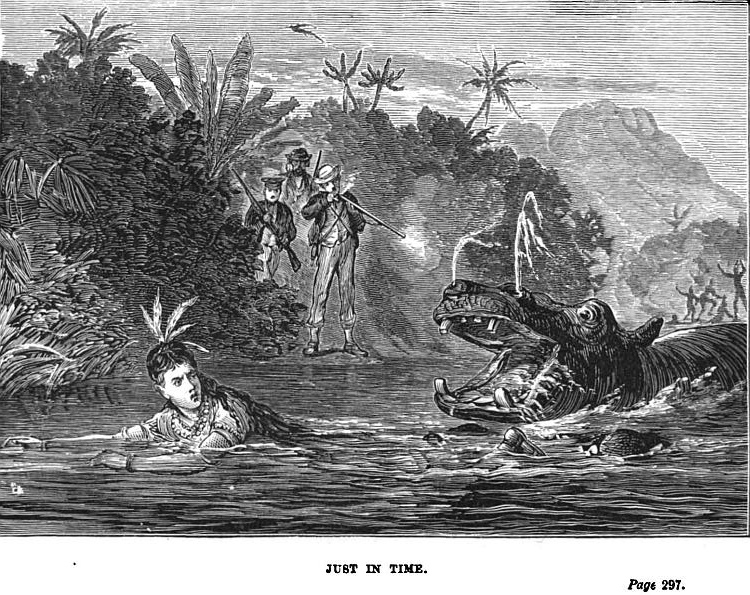
Warley, from whose rifle this unexpected deliverance had come, now hurried down the bank to complete her rescue. His attention, and that of De Walden, had been attracted to the noise on the river some time previously, and, catching his rifle, which he had taken the precaution of loading, Ernest hurried out to learn what was passing. When he first caught sight of the scene, he was indisposed to interfere, thinking the hunters able to effect their own escape, and unwilling to betray the place where he and his friends had taken refuge; but as soon as the peril of the female voyager became evident to him, he hesitated no longer. The other two lads now came hastening up, and between them they raised the woman, who was almost exhausted, from the water, and laid her on the bank. The natives, who were astonished beyond measure at the apparition of the white men, stood motionless on the further bank, or on their rafts, not knowing what was about to happen next.
The Englishmen on their sides were scarcely less astonished. The reader has already heard the surprise with which Frank and Gilbert had noticed their female visitor; but they had only beheld her from a distance, and had had a very cursory view of her face and figure. Now, however, they had leisure to take a closer survey. She was apparently about eighteen years old, tall and beautifully formed, and with a natural dignity of demeanour which would have become a princess. Her skin was somewhat darker than that of English ladies in ordinary, but, nevertheless, a very becoming colour mantled in her cheeks. Her features were formed after the finest type of Greek beauty—the shape of the face oval, the nose straight and slightly retroussé, the forehead broad and low, the eyebrows beautifully arched over orbs of the darkest hazel. Her hair, to complete the picture, bore no likeness at all to that of her attendants, but was glossy, long, and of a rich brown.
Her dress was almost as great an enigma as her face. It consisted of a kind of petticoat, or rather short gown, made of antelope skin, and edged with white fur, descending from her neck almost to her knees, and covering the arms about half-way to the wrist. Her feet were protected by sandals, the thongs of which were wound crosswise up her legs, and secured by a leathern garter at the knees. Round her waist she wore a girdle set with crimson beads and glittering stones. Her head had no ornament, with the exception of some eagle’s feathers fixed in the coronet of dark brown hair which surmounted her forehead. Her appearance, in fact, was neither that belonging to civilised nor to savage life, but rather that of some high-born European lady, who had assumed, for some masquerading purpose, the costume of the desert.
After resting for a few minutes on the sloping patch of turf where her rescuers had placed her, she appeared to recover her strength and self-possession, and to be anxious to bestow her thanks on the strangers who had come so opportunely to her rescue, but was at a loss how to express herself. Warley and the others felt equally embarrassed. At last, after a long pause, the former called to the missionary, who had remained behind in the arbour, too much occupied with the anxieties which were pressing on him to take heed of what was passing outside.
“Will you be so good as to come here, Mr De Walden?” he cried. “Here are some natives whom we cannot make understand us, but very likely they may understand you.”
A flash of intelligence passed over the girl’s face as he spoke.
“I understand you myself,” she said. “You are speaking English. Are you Englishmen?”
Her accent and words were those of an English lady. Still more bewildered, Warley answered—
“We are Englishmen, madam; and I need not say rejoiced to recognise a countrywoman, as we cannot doubt you are. By what strange chance you have been conveyed hither—”
“No,” she interposed, “I am not an Englishwoman. I was born in this land; but I am deeply interested in everything English. If it pleases you to accompany me to our village, which is not very far distant from this, my mother will be greatly pleased to welcome you as her guests.”
The boys glanced at De Walden, who was standing by, regarding her attentively. He now addressed her with much respect. “You are the daughter, I presume,” he said, “of the famous White Queen of the Basutos, of whom I have heard so much. But I thought her dwelling was considerably further to the east.”
“Yes, I am the daughter of Queen Laura, or Lau-au, as our people call her. My own name is Ella. You are right as to our ordinary place of residence; but the cattle disease, which is raging in the east, has obliged us for awhile to shift our dwelling. You, I conclude, are one of the white teachers whom my mother ever holds in honour. She would gladly have received you, even if I had not owed my life to your friend. We will set out at once, if you please, as the evening is now advancing.”
She summoned her attendants, who had been watching this interview with looks of much curiosity, and the party were soon conveyed to the opposite shore. Then desiring them to cut off as much of the flesh of the two slain hippopotamuses as could be conveniently carried with them, she set off, with two of her visitors walking on either hand, at a brisk pace, which an English lady would have found it difficult to maintain, but which did not appear at all to inconvenience their fair conductress.
But the day’s adventures were not yet concluded. After walking for a mile or two, still along the banks of the river, Nick’s restless spirit seemed to grow weary of the monotony of the journey. He began to linger by the wayside; now to pick a flower that attracted his fancy; now to gather some of the fruit, of which there was plenty to be seen—figs and bananas, and ripe dates—now to examine some brilliant insect, or to chase some gorgeous butterfly. On these occasions he allowed the party to get further and further in advance of him, until once or twice he was in danger of being left alone in the bush, to find, as best he might, the track pursued by his companions.
On one of these occasions, after he had succeeded with considerable difficulty in plucking a delicious watermelon, which grew in a deep hollow, surrounded on all sides by thorn bushes, he discovered to his chagrin and alarm, that the rest of the party were by this time fairly out of sight and hearing; and the dense mass of tangled shrubs and creepers in front of him rendered it impossible to distinguish anything at the distance of a hundred yards. He hurried on as fast as he could, in the direction which he supposed them to have taken, looking carefully round him for the marks of footsteps. But these were nowhere to be distinguished. Indeed all trace of a path seemed to have disappeared. A good deal alarmed, he stood still and shouted. Presently he heard a halloo in answer, but in a direction different from that which he had been pursuing. It evidently came from a considerable distance. Nick felt there was no time to be lost, and hurried along with all the speed he could command, though the long grass much impeded his progress. As he turned the corner of a thick mass of shrubs, he saw a figure which he recognised as that of De Walden advancing towards him, and holding up his hand, urging him, as he supposed, to rejoin the party as quickly as he could. He started accordingly at a run, but had not advanced many yards when his foot caught against some obstacle which threw him forward on his face. At the same moment there was a whirring noise, followed by a loud crash, and some heavy object struck the ground within a yard of him. Almost immediately afterwards he heard De Walden’s voice.