"Hair-Breadth Escapes" (continued 2)
Reading edition
Chapter Five.
Plans—The Boys set out—A Disappointment—The First Bok—Water! Water!—A Midnight Visitor.
The whole party slept soundly, and by six o’clock were sitting under their tent over the remains of their breakfast. Frank and Nick were on the point of issuing forth to collect some more fish for the mid-day meal, when the doctor called to them to stop.
“It is time,” he said, “that we hold a consultation, and come to some resolution respecting our future movements. Sit down here in the shade, and we’ll talk the matter over.”
The boys obeyed, and took their places; Lion, as usual, seating himself at Frank’s side, and occasionally bestowing a broad lick of affection on his face and hands.
“I have made a fresh examination of the boat this morning,” began Lavie, “and am quite satisfied that it is impossible for us to repair her. She is an old boat, and wouldn’t anyway have lasted much longer, and now she is so much hurt, that no one but a regular boat-builder could make her float again. It is impossible therefore to carry out our original intention of going on to Cape Town by sea. Well, then, we must hit on some other plan.”
“Wouldn’t it be the simplest way to travel along the line of coast the whole way?” suggested Ernest. “As far as I remember my geography, there are no bays running far inland, or very wide rivers to interfere with us.”
“You’re right, Ernest,” rejoined Lavie. “There are nothing but small bays all the way, and until we reached the mouth of the Gariep, there would be no rivers to interfere with us.”
“And when we did reach the Gariep, said Frank, we should be pretty safe to fall in with some settlers or, any way, natives, who, ‘for a consideration,’ would help us through the rest of our journey. I think Ernest’s advice very good.”
“I should think it so also, Frank,” said the surgeon, “if I didn’t happen to know something of the line of country proposed. I have never been along it myself, but I have met people who know it well. It is one long sandy waste the entire way—no trees, no grass, scarcely even a rock; and if there are any water-springs, they are so few and scanty, that it is almost the same thing as if there were none at all. There would be no food to be obtained, no shade from the sun, and no resting-place at night, as it would be impossible to carry our tent with us. And, to wind up, we should certainly not meet with a human being from the beginning of our journey to its end.”
“Well, that is pretty nearly enough, I think,” observed Nick, “I have no fancy to be broiled like a fish on a gridiron, or have a leg of nothing and no turnips for dinner, like the clown in a pantomime. Let us hear what you propose.”
“I advise that we should travel towards the east, until we come to the banks of one of the rivers which run southward into the Gariep. I know there are several at no very great distance from the coast: we can follow any one of these to its junction with the great river. When we have once got there, I have no doubt what Frank suggested is true enough. We shall come to the farmhouse of a Dutch boor, or a Hottentot village, or fall in with a hunting party, and so find the means of reaching Cape Town.”
“That sounds feasible,” said Frank. “We shall be sure of water, at all events, by going that way, and water’s the first thing to be thought of.”
“And there’ll be plenty of game, most likely,” added Lavie, “and, any way, fish.”
“And shade from the heat of the sun, and resting-places at night,” said Warley.
“But how about the wild beasts and the snakes?” struck in Nick. “Wouldn’t it be better to make a canoe, or a raft, and sail down the river itself?”
“That is not a bad idea, Nick,” said Frank. “What do you say to that, Charles?”
“That it would be a very good idea on some rivers, but not on these,” answered Lavie. “Nick has never seen one of these South African rivers, or he’d never suggest it. At times, the channels here are reduced to mere threads, along which no boat that was ever made could pass; at others, they are swollen to raging torrents, which would shatter them to fragments. A boat journey to the Gariep is out of the question.”
“Very well, then, we must make the journey along the banks,” said Warley. “Of course we must follow your advice, Charles. You know a good deal about the country between this and Table Bay, while we know absolutely nothing. I suppose you would recommend that we should set off, as soon as possible, for the nearest river that runs southward?”
“Yes,” said Lavie, “there is no kind of object in delaying here. There is neither food nor shelter to be had here, neither shade nor water; and the stench from the mud and the dead fish is very far from fragrant. I counsel that we move off with as little delay as possible.”
“Hear, hear,” said Frank; “I am quite of the same mind. Well, then, Charles, the next thing is, what are we to take with us? The boat would have held as much as we were likely to want; but our backs and pouches are different things.”
“Quite so, Frank—that was the next thing I was going to speak about. We must, of course, leave by far the greater part of our cargo behind. In fact, we must cumber ourselves with as little baggage as possible. But some things will be absolutely necessary. There are the guns and powder-flasks and bullets. We cannot do without them.”
“That is voted, nem. con.,” said Warley; “and there is the flint and steel and tinder-box. The doctor’s burning-glass will be no good when the sun doesn’t shine.”
“And we shall want the gridiron, and the knife and spoon and cup, and the iron pot for cooking and holding water,” struck in Nick.
“Each of us ought to carry a change of linen,” said Mr Lavie, “and a second pair of shoes; but no more, I think. I suppose one brush and comb must serve all four.”
“I hope you’ll take your lancets, Charles, and some physic, in case of any of us being taken ill,” suggested Warley.
“I am not likely to forget that, Ernest,” returned the surgeon. “Very well, then, that will be all. We had better each provide ourselves with the articles agreed on, make a hearty meal off some of the salt meat and biscuit, and then set off at once, leaving everything else in the boat, for the benefit of any one who may be thrown up, like ourselves, on these barren flats.”
No one urging farther objection, this programme was forthwith carried out. Belts and knapsacks were adjusted, the various articles required for the general use were divided between the four, a hasty meal was eaten, and then each man took his gun, and the party bade farewell to the old boat and low sandy shore, and set forth on their travels.
They soon surmounted the rocky shelf which they had visited on the previous day, and, passing through an opening in the barren hills, entered a valley, which seemed even more dreary than the scene they had just quitted. On either side were rocks of a dull grey colour, broken into all kinds of fantastic shapes, and full of holes and winding caverns, which suggested the possible neighbourhood of venomous snakes. Nick, in particular, cast many a suspicious glance at these orifices; which seemed to his imagination the lurking-places, whence at any moment the hideous head of a cobra or python might rear itself, preparatory to a deadly spring on its victim. He was greatly relieved when, after an hour or two of walking, the valley gradually opened into a wide plain, and patches of vegetation began to show themselves. The euphorbia was the first to appear, with its tall stiff bunches of foliage, each of which bore a curious resemblance to a chandelier with its cluster of candles. Then the kameel-doorn, the dwarf acacia, and the wild pomegranate began to vary the landscape with their contrast of colours; and presently there appeared the aloe and the mimosa, the bright yellow of the last-named reminding Ernest of the gorse and broom among which his walks had so often lain.
But though there was a great improvement in respect of the scenery, its most important accessory, water, was nowhere to be found. Lavie looked anxiously on all sides for some indication of the vicinity of the river; which, if his information was correct, lay only a few miles eastward of the spot where they had landed. They could hardly have mistaken the way, for no other opening in the rocks had been visible in any direction, except that which they had pursued; and the gradual downward slope of the glen could hardly end in anything but water. But they had now been travelling since mid-day, only sitting down to rest for a few minutes, at intervals of two hours or so; and now the sunset was near at hand. He was greatly rejoiced when, on turning the corner of a dense clump of euphorbias, they came in sight of what was evidently the course of the river, though the dense bushes on either side hid the stream from view.
“Hurrah! my lads,” shouted the doctor; “now for a good drink, and a cool bath too, if the water is only deep enough.”
He broke into a run as he spoke, and was joined by the other three, who forgot their weariness and anxiety in the excitement of the moment Lion bounded along at Frank’s side, as eager apparently as his master. They were the first to reach the fringe of shrubs, into which they plunged with headlong haste. But the next moment there came a loud cry of disappointment; the others hurried up, but only to catch sight of Frank and Lion standing over a dry bed of sand, which had evidently once been the channel of the river. There was now not the slightest trace of water to be seen. The sand was not even moist. Lavie now felt extremely anxious. There were rivers he knew lying to the eastward, and that at no very great distance, twenty or thirty miles at the outside, and probably they were not so far off as even twenty miles: and if so, the strength of the whole party might hold out until the nearest was attained. But then the lads were not used to roughing it in the desert; and they might miss the track and become too exhausted to travel further. He had fully reckoned on finding water at the spot which they had now reached, or he would have brought a supply with him from the water-cask in the boat, which had still contained several gallons. But it was too late now to think of returning that night to the seashore, and besides, such a step would naturally alarm and depress his companions. The best chance would be to proceed on their way as long as daylight lasted, and take the chance of falling in with some of the springs or pools, which are scattered about, though at rare intervals, in this inhospitable land.
“Well, that’s a nuisance,” he exclaimed aloud, as he gazed into the blank faces, and marked the dry parched lips of the boys. “That’s a nuisance, but it can’t be helped. Better luck next time. We had better step out as fast as we can while daylight lasts. We are safe to come to water, sooner or later, even in this country.”
“All right, Charles,” said Frank; “the sooner we reach it the better. We must step out, best pace.”
The other two made no remark, but they also quickened their walk. Emerging from the bushes, Mr Lavie pursued his route due eastward, though the path he followed did not seem very likely to fulfil his hopes. It lay along a bare hillside, over which huge boulders of rock were scattered; while the vegetation growing more and more scarce every mile of the way, at last ended in a waste as barren as that which they had traversed at the outset of their journey. It was, indeed, very much the same character of scenery as before, only that they were no longer shut in by a hollow defile in the hill. On either sides there rose high shelves of stone pierced by what seemed to be caverns running far inward. Between these masses of rock, long vistas of bare stony plains presented themselves, seeming to the belated travellers the very picture of desolation.
The sun was now fast setting; there remained scarcely an hour of daylight, and for all they could see, Lavie and his party would have to continue their journey by starlight, or bivouac on the sand. Suddenly at this moment, Lion, who had been tramping along for the last hour or two, as much depressed apparently as any of the party, stood still, sniffed the air for a moment or two, and then sprang forward with a joyous bark, turning round, when he had proceeded a few yards, as if inviting Frank to follow him.
“Don’t call him back, Frank,” said Mr Lavie as Wilmore shouted after him. “His instinct is much keener than ours. Either there is some animal near at hand, which you may shoot for supper; or, as I earnestly hope may be the case, he scents water. Cock your gun, and go after him.”
“I am afraid there is but little chance of his finding water here,” said Ernest, as Wilmore hastened forward. “There is nothing to be seen anywhere but hard crag-stone and dry sand. But he may put up some game among the rocks there which he is scrambling up. Ha! and so he has,” he added the moment after, as a steinbok came bounding down the cliff. “Now, then, to test Captain Renton’s rifle.”
He drew the trigger as he spoke, and the animal dropped on its knees, but rose the next minute and was making off, when a shot from Lavie again brought it down. They ran up and found that the steinbok was already dead. Ernest’s bullet had struck it in the side, and inflicted what would probably have proved a mortal wound, though it would, for the time, have succeeded in effecting its escape. But Lavie had aimed directly at the heart, and his shot having gone true, death was instantaneous.
“Hurrah!” shouted Frank, at this moment, waving his cap on the shelf of rock above. “Three cheers for old Lion. It is all right now.”
“All right as regards the meat, Frank,” said Nick, “but how about the drink? A fellow in this wicked world requires to drink as well as to eat—at all events, I do.”
“Meat,” repeated Frank, peering over the edge of the precipice, which might perhaps be a dozen feet in height. “Have you got any meat? Did you kill anything when you fired just now?”
“To be sure we did, Frank,” said Warley. “We’re not given to miss in our part of the world. We’ve brought down as nice a young steinbok as you’d wish to eat. If you’d only find us some water to match, we should be quite set up.”
“Water! why, that is just what we have found. Here has old Lion lighted on a well of water, the most delicious that any fellow ever drank of.”
“Water! what, up there? You don’t say so. Hurrah! here goes.” Laying down their guns, the three thirsty travellers speedily climbed the stony heights, and stood by their companion’s side, when their eyes were gratified by a very strange as well as a very welcome spectacle.
In the very middle of the plateau of rock surmounting the precipitous ascent appeared a circular hole, some three or four feet in diameter, and so deep, that its bottom could not be discerned. The cavity was evidently natural; nor indeed did either the Hottentots or the Bushmen—the only tribes by whom the spot was ever visited—possess either the tools or the patience necessary for so laborious a work. It was doubtless what is sometimes called, though most erroneously, a freak of nature—one of those beneficent provisions, more than one of which we shall have to notice in the course of this story, by which the providence of God supplies the wants of His creatures in the desolate wastes; without which help they must inevitably perish. The hole had retained the rain, with which it had been filled a week or two previously, and the water being sheltered by the surrounding rocks from the burning rays of the sun, was sweet, clear, and deliciously cool to the taste. The cup was passed round and round again, before the thirsty travellers were satisfied, and even then they were half disposed to envy Lion’s simpler mode of satisfying his drought, viz., by plunging head over ears into the well, and imbibing at every pore the refreshing moisture.
At length thirst was satisfied, and gave way to hunger. Descending from the rocky platform, they set themselves to prepare their supper. Nick collected the grey leafless shrubs, which grew in abundance among the rocks; and which, though anything but picturesque in appearance, made capital firewood. Frank cut up the carcass, broiling some parts of it on the gridiron, and boiling as much more as the pot would hold. It was dark long before their preparations were completed, and they had to eat their dinner by the light of their fire, assisted by the stars, for the moon had not yet risen. But the road to the mouth is very easy to find, especially when men are hungry. They all four soon finished a most excellent meal. Then the fragments of the repast were handed over to Lion—Frank declared he ought to have been called to the chair, and his health drunk with all the honours—and arrangements were made for the night. Some of the shrubs which Nick had collected, and which had not been used for the fire, made very comfortable beds. These were spread inside one of the largest caverns, though not before Nick had carefully examined its recesses by the help of a blazing log, to make sure that they contained no venomous reptiles. Lion stretched himself out to sleep at the entrance of the cave; and it was considered that his instinct might be trusted to warn them against the approach of danger, without additional precautions. In a few minutes they were all sound asleep.
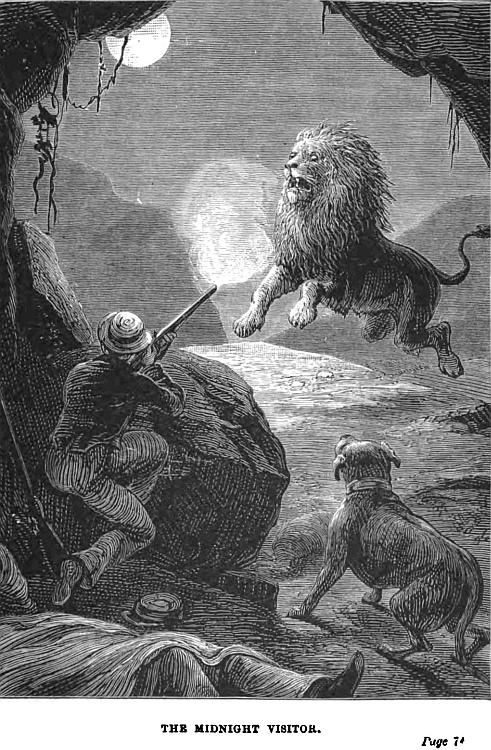
They might have slept for perhaps three hours, when Frank, whose slumbers were unusually light, was roused by a low growl close to him. Looking round, he saw Lion standing in the entrance of the cave over the remains of the steinbok, only a part of which had been eaten. Frank remembered that the carcass had been left at some little distance from their sleeping-place; and the dog, therefore, must have dragged it to its present place. Something unusual must have occurred to make him do this; and besides, the attitude of the animal, his hair bristling, his chest advanced, his muscles stretched to their full tension, and the fierce glare in his eye showed plainly enough that he beheld some formidable enemy.
“A hyena has scented the carcass, I have no doubt,” thought Frank, “but I can hardly afford to throw away a shot upon him. He must be driven away, though, or we shall get no rest.”
He stepped noiselessly up to the entrance, but recoiled instantly at the sight he beheld, and it was with difficulty that he stifled a cry of alarm. At a distance of about four yards, the outline of its magnificent figure clearly revealed in the bright moonlight, a lion of the largest size was crouching, evidently preparing itself to spring! Frank had never seen one of these animals, except in captivity. About a twelvemonth before, during his stay in London, Captain Wilmore had taken him to Exeter ’Change, where one or two lions were exhibited. But these were small of their kind, and enfeebled by age and long captivity. They bore no more resemblance to the glorious and terrible creature with which Frank was now confronted, than the trickling stream which glides lazily over the ledge of the rocks bears to the foaming cataract, swollen by snows and rains.
He perceived in a moment what had taken place. The lion had come to the water to drink; and the dog, scenting the approach of some beast of prey, had possessed itself of the remains of the steinbok, which would otherwise fall a prey to the marauder. The lion in its turn had discovered the vicinity of food, and had leaped down from the rock to seize it. All this passed through Frank’s mind in a moment. It could hardly be called thinking, but was rather like a sudden revelation. He felt, too, the necessity of killing the monster without a moment’s loss of time, or all their lives would be imperilled. He stooped noiselessly, and picked up the nearest gun, which chanced by good fortune to be Captain Renton’s rifle. Frank was a steady shot, as the reader has already been told; but he had never fired at a mark like this. He recalled, on the instant, what he had heard Mr Lavie say that the only spots in a wild animal’s body in which a bullet could be lodged with the certainty of causing instant death, were the ear, the eye, and immediately behind the shoulder, where there was a direct passage to the heart. It was impossible to aim at either ear or shoulder in the present instance, as the animal was standing directly facing him. The eye, therefore, which flashed large and yellow upon him in the broad glare of the moonlight—the eye must be his mark. He raised the rifle and brought it down to the level of his eye, drawing trigger the moment he had done so. It was well for him that his aim was true, and his hand steady. As the barrel dropped to its place, the metal flashed in the moonbeam, and its glitter seemed to rouse the creature from its momentary torpor. It rose into the air at the very moment at which the bullet struck it, and if the latter had not been aimed with the most perfect accuracy, there would have been an end of the mastiff, and probably of his master also. But the shot passed directly through the eyeball, and lodged in the brain, causing instantaneous death. The muscular power communicated to the limbs failed even before the leap was accomplished. A furious roar burst from the king of the forest as he felt the wound, but it died off abruptly, and the vast carcass fell, a lifeless mass, within two feet of the entrance of the cavern.
Chapter Six.
A Second Visitor—Nick’s Club—A Halt—A Mysterious Cry—A New Mode of Imprisonment.
The noise of the gun, and the dying roar of the lion, roused the whole party from their slumbers; and in another minute they were standing round the fallen monster, eagerly asking for information.
“You did that well, Frank,” said the surgeon, after carefully examining the wound; “just in the right place, and at the right moment. Half an inch either way, or ten seconds later, and there would have been a very different story to tell. You’ll be a mighty hunter one of these days, I expect. It’s very few who have made their début with a shot like this. But we must make sure that there are no more of them about. It’s strange that I should have forgotten the likelihood of beasts coming down at night to drink, or the risk there would be of an encounter between them and Lion. Get in, you old rogue,” he continued, giving the dog a playful kick in the ribs, and driving him inside the cave, where he secured him to a large fragment of rock. “You don’t know what an escape you’ve had. You are ready enough to fight, I don’t doubt, but ‘cave cui incurras,’ as the Latin grammar says, Master Lion; a single single blow of that brute’s paw would have been enough to break a horse’s back, let alone a dog’s. There, stand in the entrance with your gun, Nick, and keep a sharp look out, while we go to examine the well.”
The lads took their guns, and the three making a considerable détour to the left, cautiously ascended the rocks, until they gained a higher shelf than that in which the well was situated, and then looked over. The moon had by this time begun to set, and the steep summit of the crags behind them intercepted its light, throwing the shelf into deep shadow. A dark mass was indistinctly visible, lying immediately on the edge of the well, partly indeed protruding over it. “That’s the lioness drinking,” whispered Frank. “She has most likely followed her lord to the water, and has only just arrived here.”
“Most likely,” answered the doctor in the same cautious tone, “but don’t fire. You can’t see her plain enough to take a sure aim at her, and a mere wound would only enrage her. Leave her to me. As soon as she has done drinking, she’ll get up, and then we shall have a clear sight of her.”
They waited patiently for several minutes. It became evident that the animal was not, as they had supposed, drinking, but was either asleep or refreshing herself with the cool air, which the close proximity of the water produced. In either case it was impossible to conjecture how long she might retain her present attitude. “Let drop a stone upon her, Ernest,” whispered the doctor. “That will put her up. I have my rifle all ready.”
Warley looked round him. There was no stone near at hand, but he detached his shot-flask from his belt and threw it with a skilful aim, striking the lioness on the flank. She instantly sprang to her feet; but just as Ernest discharged his missile there came a dense cloud over the moon, and the figure of the animal was lost to sight. Before the cloud could quite pass away again, the lioness gave vent to a low savage roar. She had caught sight, notwithstanding the darkness, of the carcass below, and sprang down to examine it. “I wonder how Nick will get on with her?” exclaimed Frank. “He’s no great shot. I think we had better go down to the rescue. Just hold my gun, Ernest, while I slip down.”
Handing his rifle to his companion, he slid down the projecting face of the precipice, feet first, and then called to Warley to lower his weapon after him. Mr Lavie reached the shelf almost at the same moment, and both pressed forward with some anxiety to see what was passing below. The spectacle they beheld would have been extremely ludicrous, if it had not been still more alarming.
Forgetting or disregarding Lavie’s directions, Gilbert had laid aside his gun as soon as his companions left him, and had gone to make an examination of the lion—an animal which he had never before seen. He was greatly struck by the enormous size and vast strength of creature, and stood for a few moments considering whether he might not be able to carry away some souvenir of the adventure. A lock of his shaggy mane, or one of his huge teeth, were the first mementos which suggested themselves to him. It would be difficult, however, to obtain one of the last-named articles—that is without the help of certain tools which they had not in their possession. No, it must be a lock of the gentleman’s hair, which could be easily enough to procure, and equally easy to preserve, though the keepsake would be somewhat cumbrous. He picked up the knife, which Frank had left on a slab of stone near the entrance of the cave, and proceeded to choose the place whence the ringlet was to be cut. Suddenly it occurred to him that the tuft at the extremity of the tail would be extremely suitable for the purpose; or why, by the way, should he not retain the entire tail? Mr Lavie had been telling them, only that evening, of the practice adopted by the Bushmen of wearing a belt round the waist, by which the pangs of hunger were considerably mitigated. To judge by what happened yesterday, such a belt might be extremely serviceable, and the skin of the lion’s tail would make a famous belt. At all events there could be no harm in cutting the tail off; and this he effected easily enough by the aid of Mr Lavie’s hatchet. He was still engaged in examining his treasure by the imperfect light, when a whirling noise was heard over head, and a large object of some kind dropped within a few feet of him.
A good deal startled, Nick let fall the hatchet and grasping the upper end of the tail with both hands, whirled it, like a flail round his head. At the same moment the moon again broke out, and he perceived that his new companion was a large lioness, whose fierce growls were evidently the preliminary to a still fiercer assault. Nick gave himself up for dead; and if the attention of the animal had in the first instance been directed to him, there would indeed have been but small hope of escape for him. But the lioness had scented the dead body, and she proceeded to examine it all over, sniffing the tainted air, and uttering every now and then a low howl, like a mourning cry. Nick would have retreated to the cover of the cavern, but a feeling of fascination held him to the spot; and he continued to swing the tail right and left, apparently hardly conscious of what he was doing. Presently, the mood of the lioness seemed to change, and the notion to occur to her of taking vengeance for the ruthless slaughter of her mate. She glared fiercely at Nick, and gave vent to a low roar. She would, in fact, have instantly sprung upon him, but that the whirl of the tail immediately in front of her nose, dazed and bewildered her for the moment, and kept her at bay. This could not, however, have lasted, and Nick’s career would soon have been run, if rescue had not been at hand. But at this moment the crack of the doctor’s rifle was heard, and the brute, shot through the heart, rolled over in the death struggle.
“Bravo, Nick,” exclaimed Lavie, as he leaped down from the rock. “Hercules himself never wielded his club more valiantly, than you did the lion’s tail. I was sorry to keep you so long in suspense, but the beast persistently kept her back towards me, till just the moment when I fired. If I had only wounded her, she would have sprung on you all the same.”
“All right, doctor,” said Nick; “you couldn’t do more than bring me off with a whole skin. And it’s more than I deserve, too, for I didn’t obey orders.”
“Well, now I suppose we may go back to bed?” suggested Frank. “It’s not much past midnight, and I feel as if I wanted plenty more sleep before morning. I don’t fancy we shall have many more visitors to-night.”
“No,” said the doctor, “we may sleep soundly now. Animals don’t often go near a fountain where they have seen lions drinking. Indeed, the shots which have been fired would probably be enough to keep them away. Let us turn in again, by all means.”
His prognostications were fulfilled. There was no further disturbance that night, and when the travellers awoke on the following morning, they were in high health and spirits.
“Do you intend to take the same track which we were following up yesterday, Charles?” asked Warley, as they sat at breakfast, “or have you altered your mind about it?”
“I see no reason for changing it,” replied the surgeon. “I am sure the river, which Vangelt told me of, cannot be above fifteen miles off at the outside, and when we are once there, it is all, comparatively speaking, plain sailing. I don’t know how far this kind of country may last, but I feel sure it cannot be for any great distance. Notwithstanding yesterday’s experience, I don’t advise our taking water with us, or anything but a few slices of meat I am persuaded that we shall not suffer a second time, as we did yesterday; and carrying water always hampers travellers terribly.”
All readily gave their assent to his suggestions, and before six o’clock the travellers were again in motion. They journeyed on for several miles, the bare rocks and sand still continuing the main features of the landscape: but about twelve o’clock their eyes were relieved by the appearance of wooded slopes in the distance. Presently they came to a small pool, surrounded by a grove of oomahaamas and acacias, among the branches of which they noticed a quantity of grey-crested parrots, which kept up an incessant screaming, from the moment the travellers came in sight to that of their departure.
“Here’s a good place for a halt,” suggested Ernest. “This shade is most refreshing, and the water seems clear and cool.”
“I am quite of your mind, Ernest,” said Nick, flinging himself at full length on the grass at the edge of the pool. “Exhausted nature can’t go further without a respite. Now, if any one would be so good as to shoot two or three of those parrots, that are actually crying out to be shot, they would make a famous—What are you up to now, man?” he added sharply, as he felt a sudden blow on his shin. “You would do well to take care what you are doing.”
“You would do well to take care,” retorted Warley. “Do you see what was crawling up your leg?” He held up, as he spoke, a dead snake about eighteen inches long, with a curious-looking horn on either side of its head. “If I hadn’t hit him on the neck the moment I saw him, he’d have bitten your hand to a certainty. He was making straight for it.”
“A snake!” cried Nick, starting up in horror. “So there is, I declare. The nasty brute! I don’t know whether it is venomous or not, but I’m much obliged, even if it isn’t. They are not nice things up a fellow’s leg!”
“Hand him over here,” said Charles Lavie. “Oh ay, I know this fellow. He is called the cerastes, and is venomous, I believe, though not one of the worst kinds of poisonous snakes. You are well out of it, Nick, I can tell you, and must look more carefully about you in this country before you sit down in a place like this. Some of the reptiles are so nearly the colour of the ground, or the trees, that even an old stager may be taken in.”
“Are there any large pythons in these parts?” asked Warley. “I’ve heard two quite different accounts. One says that they are never found so far south as this; the other, that they are to be met with thirty or forty feet long, and as thick round as a stout man. What is the truth of the matter?”
“Well, the truth is something between the two, I believe, as is generally the case,” said the surgeon. “They are certainly not common in Southern Africa, since people who have lived here all their lives have never seen one. But now and then they are to be met with. I know persons who have seen serpents’ skins thirty feet long in the possession of natives; and one case I heard of, in which a skin was exhibited fully ten feet longer than that.”
“Are they difficult to kill?” asked Frank.
“Not if you bide your time,” said Lavie. “If you come upon them when they are hungry, they—the larger ones, that is—are more than a match for even the strongest men: and unless they are approached unawares, and wounded, so as to destroy their muscular power, a struggle with them would be most dangerous. But after they have gorged their prey, they are killed as easily as so many sheep—more easily in fact, for they are quite torpid.”
“What are the worst snakes found in these parts?” inquired Gilbert. “The cobra and the puff adder, I should say,” returned the surgeon. “The first will spring at you as if it was discharged out of some engine, and with such force, that if it fails to strike its mark it will overshoot the spot by several feet. The natives call it the hair-serpent, and are in great terror of it. If no sufficient remedy is applied, its bite will cause death in less than an hour.”
“Is there any sufficient remedy?” rejoined Nick. “I thought there was no cure.”
“It’s not so bad as that, Nick. There are remedies for most bites—the cobra’s for instance. There is a root which the mangoust always eats, when it feels itself bitten by a cobra, and which is, so far as is known, a complete cure. Eau de luce and sweet milk are generally given in this country for a snake’s bite, and the natives have beans and serpent stones, which, it is said, effect a cure. But the best thing to do—what I should have done in your case, Nick, if you had been bitten—is, first to fasten a ligature as tight as possible above the wounded part, and then cauterise or cut away the injured flesh. Snakes’ bites are nasty things in these hot countries, and one can’t be too careful. But come, it is time we move on again. We ought to reach the river banks early in the afternoon.”
They recommenced their march accordingly, and had proceeded half a mile or so further, when Frank suddenly called upon them to stop.
“What can that noise be?” he said. “I have heard it two or three times in the course of the last few minutes. It doesn’t sound like the cry of a bird, or beast either. And yet I suppose it must be.”
“I didn’t hear anything,” said Gilbert. “Nor I,” added Warley. “But my hearing is not nearly as good as Frank’s. I’ve often noticed that.”
“Let us stop and listen,” suggested Charles.
They all stood still, intently listening. Presently a faint sound was wafted to them, apparently from a great distance—from the edge of the sandy desert, they fancied, which was still visible beyond the wooded tracts.
“No,” said Charles, when the sound had been twice repeated, “that is not the cry of any animal, with which I am acquainted. It sounds more like a human voice than anything else. If it was at all likely that there was any other party of travellers in these parts, I should think they were hailing us. But nothing can be more improbable than that.”
“Still it is possible,” urged Warley, “and they may be in want of our help. Ought we not to go and find out the truth?”
“I think you are right, Ernest,” said Frank.
“Well, I don’t know,” urged Gilbert, nervously. “I’ve heard all sorts of stories of voices being heard in the deserts, enticing people to their destruction, and it may be some ruse of the savages about here, who want to get us into their hands, to possess themselves of our guns. What do you say, doctor?”
“Why, as for the voices, Nick, I’ve heard the stories you speak of, which have been told chiefly by persons who had lost their way and were nearly dead from cold and hunger. Under such circumstances, when people’s nerves and senses begin to fail them, they fancy all sorts of strange things. No doubt, too, there are all sorts of acoustic deceptions in these wild regions, as there are optical delusions; but I don’t think we four—all of us in sound health—are likely to be so deceived—”
“But how about the savages, doctor?” interposed Nick, anxiously.
“Well, if these were the backwoods of America, and we had the Red Indians to deal with, there would be a good deal in your suggestion. But neither the Hottentots nor the Bushmen are given to stratagems of this kind. However, we’ll move warily, and if any treachery is designed, we shall be pretty sure to baffle it.”
They turned off in the direction whence the cry had come, keeping to the open ground, and giving a wide berth to any clump of trees or underwood which might harbour an enemy. Every now and then they paused to listen for the sound, which was regularly repeated, at intervals apparently of two or three minutes, and grew more distinct as they advanced. It was now certain that the cry was human, and sounded like that of a full-grown man.
“We are getting a good deal nearer,” observed Warley, as they passed the last patch of trees, and entered once more the sandy wilderness. “I should say we must be almost close, only I don’t see any place where the person who is crying out in this manner can be hidden.”
“It comes from that heap of stones there,” exclaimed Frank, “that heap to the left, I mean—about two hundred yards further on.”
“I see the stones, Frank, plain enough,” said Mr Lavie, “but a man couldn’t be hidden among them. You call it a heap of stones, but there is no heap. There is not so much as one lying upon another.”
“Nevertheless the cry comes from there,” said Warley; “I heard it the last time quite plainly. Let us go up and see.”
They cautiously approached the spot in question, where there were about thirty or forty moderate-sized stones scattered on the plain. As they advanced the mysterious call was again heard.
“I see who it is that’s making it,” shouted Wilmore. “It’s a fellow whose head is just above ground. I took his head for a black stone, with a lot of moss growing on it. But now I can see that it is a head, though the features are turned away from us.”
They hurried up, and found that Frank was right. The stones were lying round what seemed to have been a dry well. In this a man had been buried up to his neck, the chin being just above the level of the ground. It did not appear that he was conscious of their approach; for at the interval of every two or three minutes he continued to give vent to the shrill monotonous cry, which had attracted their attention.
“What in the world can this mean!” exclaimed Nick. “The fellow can’t have tumbled into the well, and the stones have fallen in after him, I suppose?”
“Is it some penance, do you think, that he is undergoing?” suggested Warley.
“Or a punishment for a crime he has committed?” said Wilmore.
“It may be a punishment for some offence,” said Mr Lavie, “though I never heard of the Hottentots punishing their people in that way, and the man is plainly a Hottentot. As for anything else, of course it is quite impossible that he can have got jammed up in this way by accident; and the Hottentots know nothing of penances. Such a thing has never been heard of among them. But the first thing is to get the poor fellow out and give him something to restore him; for he is half dead with thirst and exposure to the sun, and does not seem conscious of what is passing.”
They fell to with a will, and had soon so far released the captive, that he was able to draw his breath freely and swallow a little brandy, which Mr Lavie poured on his tongue. He then opened his eyes for a moment, gazing with the utmost bewilderment and wonder on the dress and appearance of the figures round him; and then closed them again with a low groan.
“They meant this—the beggars that holed him in after this fashion,” observed Frank. “The stones are fitted round him as carefully as though they had been building a wall. And, look! the poor wretch’s arms are fastened by a thong to his sides. What brutes! Hand us the knife, Nick, and I’ll cut them. How tough they are!”
It needed a strong hand and a sharp blade to sever the stout thongs, which on subsequent examination were found to consist of rhinoceros hide. But when his arms were at length free, the man made no effort to use them. It was evident that they were so benumbed by the forced restraint in which they had so long been kept, that he had lost all power over them. They were obliged to continue to remove the stones, until his feet were completely released, before he could be extricated from the hole; and when this was effected, it was only by the joint strength of the four Englishmen, the Hottentot himself being unable to render any assistance.
He was now carried to the shade of the nearest trees; Nick ran back to their recent resting-place, and returned with the iron pot full of water, while Warley and Wilmore, under the surgeon’s direction, chafed his limbs. By the time of Gilbert’s return their efforts had been successful. The sufferer once more opened his eyes, and making signs that the water should be handed to him, drank a long and refreshing draught. “He’ll do now,” observed Nick, as he witnessed this feat. “There’s no more fear for his health after that. But I should like to know who he is, and how he came there. I say, blacky, what may your name happen to be, and how did you come to be boxed up after that fashion, like a chimney-sweep stuck in a narrow flue?”
To the astonishment of the whole party, Nick’s question was answered.
“Omatoko my name. Tank Englishman much for pull him out. Omatoko soon die, if they not come. Bushmen bury Omatoko one, two day ago. Good men, give Omatoko food, or he die now.”
Chapter Seven.
A Good Action Rewarded—A Raid on the Parrots—Omatoko’s Story—Proposed Change of Route—Bivouac for the Night.
Nick started back at the unexpected reply. “Who’d have thought that?” he exclaimed. “I should just as soon have expected to have heard Lion talk English.”
“Well, it wasn’t very good English,” remarked Warley, “but it was as much to the purpose as if he had been Lindley Murray himself. I suppose the first thing is to comply with his request. I have got a biscuit in my pocket, which I brought away from the boat I dare say he can eat that.”
“Not a doubt of it,” said Nick; “and I guess he’ll soon dispose of this slice of steinbok too. The worst of it is, that I had meant it for my own supper. But one can’t let the poor wretch starve.”
“We’ll all contribute something,” said the doctor, “and make him out a sufficient supper, I have no doubt. He mustn’t eat very much at a time. But the first thing is to carry him to some sheltered place, where we can make him up a comfortable bed. He must have a long rest before he will be good for anything.”
“Carry him, hey!” cried Nick doubtfully, as he contemplated the prostrate figure of the Hottentot; who, for one of his race, was unusually tall and large of frame. “How are we to do that, I wonder? He weighs twelve stone, I’ll go bail for it, if he weighs an ounce, and we don’t happen to have a horse and cart convenient.”
“We can manage it easily enough,” was the answer; “our guns and these thongs will make a very tolerable stretcher. Draw the charges first, though. It wouldn’t be safe to carry the guns loaded.”
Ernest complied, and then the doctor set about the construction of his litter. He first fastened a rifle and a gun together, reversing the direction of the barrels, so as to form a kind of staff out of them, about six feet long, with the stocks at the two ends. The other rifle and gun were then secured after the same manner, and thus the poles of the stretcher were formed. They were then tied together, about two feet apart from one another, by half a dozen thongs. The machine was now placed on the ground, and the Hottentot laid on the thongs. Then the stocks at one end were raised, and laid on the doctor’s shoulders, who bent on one knee and stooped as near to the ground as he could. The other two ends were next placed in like fashion on the shoulders of Ernest who had put himself into the like attitude. Frank and Nick now took their stations in the middle of the litter, each placing one shoulder under the pole. Then Lavie gave the word and they all rose together.
“Capitally managed!” exclaimed the doctor approvingly. “Now step all together, and we’ll have him under the shelter of the trees in less than a quarter of an hour.”
They moved off, walking quickly and steadily, and in less than the time named by Lavie, approached the friendly cover of the thicket. As they came near, a steinbok which had been feeding apparently under a tree, bounded out of the covert, passing within twenty yards of them.
“Alas! alas!” exclaimed Nick, “there goes our supper that should have been! That is the worst of doing a good action! One is sure to be punished for it!”
“Well, Nick, I don’t know about that,” said Warley. “If we hadn’t gone to look after the Hottentot, I don’t think we should have seen anything of the steinbok. He wouldn’t have come anywhere near us, I expect.”
“No, you may be sure of that,” observed the doctor, as they lowered their burden to the ground, and laid him on some soft grass under the shade of a large mimosa. “And what is more, I doubt whether our good action will not be rewarded in this instance. Look here, the steinbok was feeding on this melon, when we startled him. See the marks of his teeth, and here are the stalks of one or two others which he has eaten. I noticed these melons as I went by, but I was afraid to meddle with them, as I had never seen any exactly like them, and some melons in this country are more or less poisonous. But the steinbok wouldn’t have eaten them if they hadn’t been wholesome food, and so we may venture on them too. I have no doubt we shall find them very refreshing.”
Frank and Nick accordingly began pulling them up, while the surgeon applied himself to the restoration of his patient, who was still lying in a half-conscious state. But the cool air and soft bed, together with the restoratives, which from time to time were applied, presently brought him round, and he was able to eat as much food as was judged good for him. After partaking of this and another draught of cold water, he fell into a sound sleep, which seemed likely to last for several hours.
“It is still early in the afternoon,” remarked the doctor, as they sat down to their dinner of steinbok and melons, the latter of which proved most delicious; “it is still quite early, and I don’t suppose we can have gone more than a dozen miles since breakfast. Nevertheless, I think we must remain here. This poor fellow isn’t well enough to be left yet, though he may be to-morrow morning.”
“No, we can’t leave the poor wretch,” said Warley, “particularly after what he told us about the Bushmen. They may be lurking about somewhere in the neighbourhood, and may pounce upon him again, and he wouldn’t be able to escape them in his present weak state.”
“Eh, what!” exclaimed Gilbert, jumping up in great alarm at this suggestion. “The Bushmen lurking about! The bloodthirsty savages! They’ll be seizing us and burying us up to the chin perhaps, and then making a cockshy of our heads! Are the guns loaded again, Frank?”
“Long ago, Nick,” was the answer. “Ernest loaded them, while you and I were gathering melons. I saw him doing it, and I don’t think the Bushmen are very likely to trouble us. They have a most wholesome terror of European weapons, and more particularly of firearms, if all that I have heard is true. I think we had better try if we can’t kill one or two of these grey parrots, as you yourself, if I don’t mistake, were suggesting, just before the snake showed itself.”
“I have no objection, Frank,” returned Nick, somewhat reassured. “To be sure these Bushmen can’t very well be as bad as the snakes; and if one makes up one’s mind not to trouble one’s self about the one, one need not trouble one’s self about the other.”
“All right, Nick,” said Wilmore. “Now then, about these parrots. They’re very shy chaps, and will keep out of shot, if they can; and we mustn’t throw away powder by firing, unless with a pretty safe prospect of bringing one down. I think I’ll creep round, and hide behind that big trunk yonder. Then you shy a stone up into the tree in which they are sitting, and they’ll most probably fly out into the open, and give me a good shot.”
Wilmore and Gilbert conducted their joint manoeuvres with so much skill, that before supper-time, half a dozen good-sized parrots had been bagged, and their flesh when boiled was pronounced by all to be excellent. After supper the doctor informed the party that Omatoko, as he called himself, had now quite recovered his senses, and had held a long conversation with him; the particulars of which he was ready to communicate, if they wished to hear it. “Hear it? to be sure we do,” said Nick. “I’ve been longing to learn all about it, and if I had had any idea that he would have been able to talk, I shouldn’t have gone out parrot shooting.”
“You wouldn’t have understood what he said,” observed Lavie. “He told his story in Dutch. His knowledge of English was very small when he came to try it. He says he belonged to a tribe that formerly lived a good way to the south of this—not far from the mouth of the Gariep, I fancy, from his description. There were a good many farms belonging to Dutch owners in the neighbourhood; but Omatoko’s was a powerful tribe, and they seem for a good many years to have lived unmolested by their European neighbours. But about fourteen or fifteen years ago, some Englishmen—traders probably sent by some commercial house—landed near their village, and offered them more liberal terms for their skins and ivory than the Dutch had allowed. Finding the trade profitable, the English returned in the following year, and by-and-by ran up a few huts, where they carried on what promised to be a very lucrative business. It was from them that Omatoko picked up the few words of English which he knows, and he appears to have contracted a great liking for them.”
“Of course he did,” said Frank, “old England against the world!”
“With all my heart, Frank,” rejoined the doctor, “only the English are not always remarkable for making themselves popular. Well, the trade went on increasing, until it roused the jealousy of the Dutch. They didn’t fancy not being able to buy hides and tusks at the old prices, and besides, were jealous of the English attempting to settle in the country.”
“Ay, to be sure,” said Warley, “the time you speak of must have been a year or two before the conquest of the colony by our troops.”
“Just so, Ernest, and for some years previously to that there had been a feeling of uneasiness in the colony, that the English were meditating some attempt upon them. That is one of the things that induces me to believe the Hottentot’s story. Well, the Dutch in the fourth year after the appearance of the strangers, got together what they call a commando in these parts—”
“I know what that is,” interposed Wilmore. “I heard my uncle talking about it with some of the passengers. They get all the Dutchmen in the neighbourhood together, as well as some troops from the government, and make a raid on some unlucky Hottentot village—kill all the men, make slaves of the women and children, seize the cattle and goods of the natives, and burn the houses.”
“That’s what you call a clean sweep,” observed Nick.
“Yes, no doubt. But it’s shockingly cruel and wicked,” exclaimed Warley. “I should think you must be overstating the matter, Frank.”
“I am afraid he is not,” said Lavie. “That is very much what they were wont to do at commandos, as I had good grounds for knowing while I was living at Cape Town. They had a great deal of provocation, no doubt. The boors’ cattle was continually being stolen, and could very seldom be recovered. And it was next to impossible to prove the theft against any tribe in particular—”
“But that would not justify them in burning and shooting right and left, without any inquiry,” rejoined Warley. “I could not have believed that any Christian people—”
“Well, Ernest, I am inclined to go a long way with you on this subject, though I differ somewhat,” said the doctor, “but we have no time to discuss it now. Well, the Dutch commando attacked Omatoko’s village by night and burnt it, as Frank says, to the ground. Probably all the other results of which he spoke would have ensued, if the English had not heard the firing, and come up to the rescue.”
“I hope they peppered the Dutchmen properly,” cried Nick.
“Well, they seem to have made a good fight of it; but the Dutchmen were ten to one, and the Hottentots very little good. The upshot was that a large part of the tribe escaped, and the rest, together with the survivors of the English, surrendered themselves at discretion. Omatoko was one of those made prisoners, and he was for eight years in the service of a boor. He was pretty well treated; for the colony was all that time in the hands of the English, and they wouldn’t allow any cruelties to be exercised against the slaves. But two years ago the Cape was given back to the Dutch, and they began the old system again as soon as they were in possession. Omatoko and one or two others made their escape some twelve months ago; and he went back to his tribe, who are living, he says, at no great distance from this. The Dutch, he declares, have been trying to seize or kill him ever since—”
“Whew!” exclaimed Nick. “What, did those Dutch beggars bury him in the well after that fashion, then? Well, I always thought the Dutch to be brutes, but I never could have believed—”
“Stop that, Nick,” interposed Frank. “Have you forgotten that the Hottentot himself told us that it was the Bushmen who buried him?”
“Oh, ay, to be sure, I had forgotten that,” said Gilbert. “Go on, doctor. Did the Dutch send a commando after him?”
“Omatoko says that the Dutch had given up their system of commandos for several years, and could not easily organise them again, but they employed the Bushmen to seize any of the fugitives, and paid a large price for every one brought in.”
“But if that is true, what made the Bushmen bury Omatoko in that way, instead of carrying him to the Dutch to claim the reward?” asked Warley. “I must say, Charles, that sounds very suspicious.”
“So it did to me, Ernest,” said Charles; “but the Hottentot answered me, readily enough, that the Dutch would have paid the same sum for a runaway’s head, as they would if he had been brought to them alive. He declared that the Bushmen hated him, for having repeatedly escaped them, and for having several times requited their outrages in kind. He said they meant to have left him in the well, to die of cold and hunger; after which they would have cut off his head and carried it to the nearest Dutch village.”
“Well, that might be true, I suppose,” said Wilmore.
“Yes, I think so. The story hung well together. I could detect no flaw in it.”
“Did you ask him whether he would act as our guide to Cape Town?” inquired Ernest.
“Yes, and he said he would; but we could not go the way I had proposed, along the course of the Great Fish or Koanquip rivers. He knew them both perfectly, so he affirmed; but neither route would be safe. We must go still further eastward—into the Kalahari in fact—he told me.”
“What is the Kalahari?” asked Frank.
“A vast sea of sand,” said Lavie, “extending for more than four hundred miles, from the borders of Namaqua-land to the country of the Bechuanas. There is not, so far as I know, a single river, lake, or even fountain, to be found in the whole region.”
“What on earth are we to go there for?” cried Gilbert. “We should soon die of hunger or thirst, or heat!”
“Well no, not that,” said the surgeon. “A great part of the sand is covered with dense scrub, which affords something like shade, and though there is neither river nor pool, yet if you dig down a few feet you will generally find a supply of water. Life may be sustained there; indeed, tribes of Bushmen and Bechuanas are to be found in most parts of it. But I should think it was the most miserable dwelling-place to be found on the face of the earth.”
“Well, then, why are we to go there?” repeated Nick, irritably.
“Omatoko says it will not be safe, for the present at all events, to journey southward. It seems that the Dutch are expecting a new attempt of our countrymen to seize the colony, and their fear and anger are so greatly roused, that they would certainly imprison, and probably kill, any Englishman who at the present juncture fell into their hands. I really think he is likely to be right in what he says. When I left England two months ago, there was a good deal of talk about taking possession of the Cape Colony again.”
“But granting that we must not venture south, why need we bury ourselves in a sandy desert?” persisted Gilbert. “Omatoko proposes to take us some distance into Kalahari, because his tribe is at present living there. When they were driven by the Dutch from their own homes, they retired some few miles into the desert and built a new village, where they have been living ever since. He promises us a friendly welcome from his tribe, and advises us to remain with them until we can learn what is the precise state of things between the English and Dutch. If no attack is made by our government, the hostile feeling will gradually subside, and we may safely pursue our way as at first proposed. If an attack is made, and the colony again taken possession of by the British arms, we can travel to Cape Town, though it would be wise to follow a different route. That is the substance of what Omatoko advises.”
“And you are inclined to trust him, Charles?” said Warley, interrogatively.
“I am in two minds about it,” replied Charles. “Part of what he says I know to be true, and everything is consistent with truth. Still his anxiety to get back to his own tribe is suspicious. He has let fall, unconsciously, some hints of his burning desire to be avenged forthwith on the enemies who had so nearly put him to a cruel death; and if he were to conduct us to Cape Town, he would have to put off the gratification of his revenge for many months at the least; and perhaps before his return, the tribe he longs to punish will have moved hundreds of miles away.”
“And what do you advise that we should do?”
“I am inclined to follow his suggestions. If his tale is true, we should be running into the face of the most imminent peril by following the route I had marked out. And even if it is false, we shall probably not be delayed very long at the Hottentot village. His measures will be taken, I doubt not, promptly enough, and then he will be at liberty to attend to our affairs.”
“You think, in fact, that he really means friendly by us, though he may care more for his revenge than our convenience.”
“Just so, Ernest. His gratitude is, I believe, quite sincere.”
“Then I agree with you that we had better do as you advise. What do you two say?”
“I am of your opinion,” said Wilmore.
“And I don’t see what else is to be done,” added Gilbert.
“That’s agreed, then,” said Lavie. “And now, there is another thing. He says it won’t be safe for us to sleep under these trees, even though we light a fire, and keep it up all night. It seems that the neighbourhood abounds with beast of prey. Indeed, if Omatoko is to be believed there would be a considerable risk of our being devoured by a lion or tiger—”
“Tiger!” repeated Warley. “There are no tigers in this country surely.”
“Not the animal strictly called the tiger,” returned the surgeon; “that is not found in South Africa at all, or indeed anywhere, I believe, except in Bengal. The beast they name the tiger here, is the leopard; but he is quite fierce and savage enough. I should observe that the leopard is not the only animal miscalled in this country. They talk of the wild horse, the camel, and the wolf, as abounding here. But none of these are to be found. What they mean are properly the zebra, the giraffe, and the hyena. But to go on, Omatoko says we must either keep watch, all of us, with our guns all night—”
“I say, bother that,” broke in Nick; “a fellow can’t do without sleep.”
“Or else,” resumed Charles; “we must climb into trees and sleep there.”
“Well, we can do that,” said Frank; “that is, we four can. But how about this Hottentot? He is in no case to climb a tree, I judge, much less to stick in one all night.”
“And how about Lion?” added Gilbert. “He is a worse climber still, I expect.”
“Omatoko advised us to cut down a lot of young pines that are growing in a thicket close by, and lay them across two of the lower branches of the largest tree we can find. There are several acacias of immense size about here. A sort of floor will thus be formed, where we can all sleep safely. The branches would probably be not more than six feet from the ground, so that both the Hottentot and Lion might easily be handed up.”
“But these leopards can climb, can’t they?” suggested Frank. “We should be safe from lions or rhinoceroses no doubt, but not from leopards, or bears either, if there are any about here.”
“I don’t think any bears are to be found hereabouts. No doubt panthers and leopards can climb trees, but remember, they could only get at us by walking along the bough on the end of which our platform rests, or by dropping down from a higher limb. Lion would be sure to rouse us before they could accomplish either feat, and they would be easy victims to our rifles.”
“That’s true,” said Wilmore. “Well, then, do you three fall to work on the job, while I roast some parrots for to-morrow’s breakfast.”
They began the task accordingly. The doctor took his axe; and in half an hour had cut down a great number of stout firs about twenty feet long, and thicker round than his arm. These were brought up by Warley and laid across two of the lower branches of one of the giants of the forest, forming a tolerably flat stage some nine feet square. No fastening was required for the firs, their own weight and the shape of the branches, which bent slightly upwards at the ends, rendering them quite secure. Next, armfuls of dry grass and moss were handed up to form beds for the party; and then came the more difficult task of hoisting Omatoko to his place. This engaged the united strength of the doctor, Warley, and Wilmore below, while Nick, standing on the platform, received him from their hands. But the strength of the Hottentot was in some measure restored, and he was able to render some help himself, which greatly facilitated the job. As soon as Omatoko had been consigned to his bed, Lion was in like manner passed up; but he was by no means so conformable as his predecessor had been, and if anybody but Frank had had charge of his head and shoulders, they might have found their undertaking an unpleasant one.
However, in process of time he was got up, and secured by a thong to one of the poles in the centre of the platform. The guns came next, and lastly their owners. It was quite dark before their arrangements were completed, and before ten minutes had elapsed, the whole of the party were fast asleep.
Chapter Eight.
Dangerous Neighbours—Free and Easy Visitors—Proposed Departure—Journey Resumed—An African Storm—A Neck and Neck Struggle.
The sun was high in the heavens before any of the party were roused from their slumbers. Then the doctor was the first to wake up, and his thoughts were at once turned to his patient. He was pleased to find him in a most satisfactory condition. His skin was cool, and his pulse, though still low, was steadily recovering its tone. As for Frank and Ernest—they had no sooner opened their eyes, than they hurried off to the pool, which lay two or three hundred yards off, to enjoy a refreshing bath. They were followed shortly afterwards by Lavie and Omatoko, the latter having contrived to descend from his bedchamber by the help of the doctor’s arm, and to walk, though very slowly, as far as the waterside.
Having completed their ablutions, the lads set about preparing the breakfast; which, it was agreed, was to be eaten under the shade of the acacias.
“I think Omatoko must be mistaken about the wild animals,” observed Frank. “I slept as sound as a top, and so did Lion; and if there had been any of his namesakes about, or tigers either, he would have been pretty sure to give us notice.”
“You forget how tired we were, Frank; Lion as well as ourselves,” said the doctor. “Unless they made a very great uproar we should probably not hear them.”
“What does Omatoko say?” suggested Warley. “Does he think there were wild beasts about?”
The Hottentot nodded. “One, two lion,” he said, pointing to some footprints in the short grass round the pool. “One, two lion; many tigers; one rhinoceros.”
“Is that the spoor of a lion?” asked Warley with much interest, as he stooped down and examined the footprints. “How can you tell it from that of a large tiger?”
“You may always know the spoor of a lion by the marks of the toe-nails,” said Lavie; “they turn in, whereas those of other feline animals project. Yes, that is a lion’s spoor, sure enough, and those broad deep prints are as plainly those of a rhinoceros, and a pretty large one too. And there are plenty of others besides, which I am not sure of. Omatoko was certainly right. It was quite as well that we did not bivouac by this pool.”
Breakfast was now announced, and the party gathered round the eatables, when it was for the first time noticed that Nick was not present.
“I suppose he is still asleep,” said the surgeon. “I called to him to come and help me to get Omatoko down, but I got nothing but an intelligible growl at first, and then a sleepy assurance that he would be sure to be in time for breakfast.”
“No, he is not the fellow to miss that,” remarked Frank. “He must be very sleepy indeed, before he’ll go without his victuals. Depend upon it he will be here in a minute or two.”
Half an hour however passed away, and the meal was quite completed, and still no Nick made his appearance.
“Go, and look after him, Frank,” said the doctor, “while I consult with Omatoko as to what ought to be done next. We can’t afford to lose time, if it should be thought better for us to move.”
Wilmore took up his gun accordingly, and walked off towards the tree where they had slept. The dense foliage almost entirely concealed the staging from sight: but as he drew nearer he was sensible of loud chattering and gibbering sounds, intermixed occasionally with shrill screams, which seemed to come from a great number of throats. Wondering what this could mean, he made his approach as noiselessly as possible, and climbing up to the top of one of the roots, which projected a foot or two upwards, he peered cautiously over the edge of the platform. A most extraordinary sight greeted him, and it was with the greatest difficulty that he restrained himself from bursting into a loud laugh.
Nick was seated in the middle of the stage, bareheaded and without shoes, and was gazing upward with a look of mingled alarm and annoyance, which seemed to the spectator of the scene irresistibly ludicrous. On the boughs immediately over his head, as far up as Frank could descry, a great number of baboons were to be seen, leaping from one resting-place to another, with hideous grimaces, and keeping up incessant and most discordant screams. The grotesqueness of their appearance was much increased by their having taken possession of such of Nick’s property as they had been able to lay their paws on. One wore the blue cloth cap, with the leather peak and white edging, which was a souvenir of Dr Staines’s establishment. Two more had possessed themselves, each of one of his shoes, which he had laid aside when he went to sleep; and were turning them over with an air of grave curiosity, as if to discover what their use might be. Another party had seized the knapsack, which had been pulled from under Nick’s head before he was fully awake. The contents had been divided between several old baboons, who had turned the various articles to all sort of strange uses. One was scratching his ear with Gilbert’s pipe; another had thrust its head into a stocking, and appeared to have some difficulty in getting it out again; a third was enveloped from head to foot in a cotton shirt, his head showing itself just above the collar; while a fourth was examining the contents of the flask, which it had contrived partially to open, and was making hideous faces over the taste of the gunpowder, of which it had swallowed a good spoonful. Nick had fortunately awoke in time to prevent the baboons from seizing his knife or gun. He now held the latter with a strong grip in both hands, and seemed disposed to discharge its contents at one of his assailants, if he could only make up his mind which to single out for attack.
“Don’t fire, Nick,” exclaimed Wilmore, as he noticed Gilbert’s demeanour. “You’d enrage them greatly, if you were to wound or kill any of them. They have been known to tear a fellow to pieces, who shot one of their number. They’re terribly fierce and strong, if they are provoked.”
“What am I to do, then?” returned Gilbert. “They’ve not only carried off my knapsack and pipe, but my hat and shoes too; and I can’t venture to walk a step in these parts without them.”
“The best way will be to scare them away,” suggested Wilmore, “if we could think of any way of doing it.”
“I’ll tell you,” cried Nick, catching a sudden inspiration. “Do you climb up into the tree on the other side. The leaves are so thick that these brutes won’t see you, and the branches are easy enough to climb. When you’re well up over their heads, let fly with your gun. I’ll do the same the moment afterwards, and between the two reports they’ll be so scared, I expect, that they’ll cut for it straightway.”
“Very well,” said Frank, laughing, “I’ve no objection. We can but try, any way.” He carefully uncocked his gun, and began mounting the branches as quietly as possible, while Nick distracted the attention of the monkeys, by shaking his fist at them, and pelting them with fragments of bark. Presently there came the double explosion, which fully answered his expectations. Uttering a Babel of discordant screams, they dropped their recently acquired treasures, and made off at the top of their speed, bounding from tree to tree till they were lost in the distance. Nick set himself to collect the various articles thus restored, and had nearly repossessed himself of all of them, when Frank descended from his elevation and joined him on the platform.
“You get into scrapes, Nick, more than most,” he said, “but you’ve a wonderful knack of getting out of them again, that’s certain. Well, come along, if you’ve got everything. The doctor is anxious to start, if this Hottentot chap will let us, and you’ve still your breakfast to get.”
“The Hottentot let us start this morning!” repeated Gilbert. “Not if he’s to go with us himself, to be sure! To look at him last night, he wouldn’t be fit to walk again this side of Christmas. Perhaps he expects us to carry him, as we did yesterday—do you really think that, Frank?” continued Gilbert, stopping short, and eyeing his companion with an expression of much dismay.
“No, I don’t,” returned Wilmore, again bursting into a laugh; “and if he did expect it, he’d find his expectations deceive him considerably. That’s what I expect, at all events.”
“Well, here we are,” said Nick, a minute or two afterwards, as they reached the post. “Well, doctor, I’m sorry to be late, but Frank will tell you that I have been in the hands of the swell mob, and have only just contrived to escape them.”
The doctor looked puzzled, but he had no time for explanations. “Eat your breakfast, Gilbert,” he said, “while we settle what is to be done to-day. I suppose we are all agreed that it won’t do for us to stop here longer than we can help. Now Omatoko is not able to travel very far, but he could walk a few miles if he went very slowly and had a rest every now and then. He thinks so himself, and wishes to start at once.”
“We could give him an arm by turns, if that was all; but the question is, Charles, could we reach any good halting-place?” suggested Warley.
“That’s just it, Ernest,” returned Charles. “Omatoko says that about four or five miles from this there is a place where we could stay two or three days, if necessary, and find plenty of food and water. It is a ruined kraal— destroyed by the Dutch, he says, many years ago, but some of the cottages are still in sufficient repair to shelter us.”
“Why shouldn’t we stay here?” asked Nick, with his mouth full of parrot. “This is a jolly place enough—fresh water, lots of melons and parrots, and they’re both of them capital eating. And a comfortable sleeping-place. If we must make a halt anywhere, why not here? It’s a capital place, I think, except for the baboons,” he muttered in a lower tone, as the recollection of his recent adventure suddenly occurred to him.
“Why shouldn’t we stay here?” repeated Lavie. “Well, I’ll tell you, Gilbert. It isn’t so much the wild beasts—though a place which every night is full of lions, rhinoceroses, and leopards doesn’t exactly suit anybody but a professed hunter—but there is the fear of the Bushmen returning to cut off Omatoko’s head, whom they will expect to find dead. And if they find him alive, it is most probable that they will do both him and us some deadly mischief. And they may be looked for to-day, or to-morrow, certainly. Besides—”
“There’s no need to say any more, I am sure,” broke in Gilbert. “I didn’t think of the Bushmen. Let us be off at once, I say. I’d rather carry the Hottentot on my shoulders than stay here to be murdered, probably, by those savages!”
“Well, I own I think the return of the Bushmen quite enough by itself,” said the surgeon; “but I ought to add that Omatoko thinks the weather is going to change, and there is likely before long to be a violent storm. None of you have had much experience of what an African storm is like. But I have had quite as much as I desire, and do not wish to encounter it, without a roof of some kind over my head! Well, then, if we are all ready, let us set out at once.”
The grove and pool were soon left behind. Omatoko stepped out valiantly, sometimes leaning on Lavie’s or Warley’s shoulder, and sitting down to rest, whenever a thicket of trees afforded a sufficient close screen to hide the party from sight. They noticed that before leaving any of these coverts, he anxiously scrutinised the horizon towards the north, and once or twice requested the boys to climb the highest tree they could find, and report whether anything was visible in the distance.
His strength and confidence alike seemed to improve as the day advanced. About twelve o’clock they made what was to be their long halt, in a patch of scrub which sprung apparently out of the barren sand, though there was neither spring nor pond anywhere to be seen, nor even any appearance of moisture. They had progressed about four miles in something less than five hours, and were now, Omatoko told them, hardly a mile from their destination. He pointed it out indeed in the distance—a rocky eminence, with a patch of trees and grass lying close to it. But the party had not been seated for ten minutes, and were still engaged in devouring the melons they had brought with them, when their guide again rose and advised their immediately resuming their journey.
“What, go on at once?” exclaimed Gilbert. “Why, what is that for? I am just beginning to get cool—that is, as cool as ever I expect to be again. If we have only a mile to go, we had surely better walk it in the cool of the evening than under this broiling sun.”
“Must not wait,” said Omatoko. “Storm come soon—not able go at all.”
“The storm! Do you see any signs of one, doctor? I don’t.”
“Yes, I see signs; but I own I should not have thought it would break out for some hours. But the changes of the atmosphere are wonderfully rapid in this country, and I have no doubt the Hottentot is right. Will it be on us in another hour, Omatoko?”
“Perhaps half an hour, perhaps three-quarters,” was the answer.
“Half an hour! We must be off this minute, and move as fast as we can. Here, Frank, Ernest—hoist Omatoko on to my shoulders; I can carry him for a quarter of a mile, any way, and that will be ten minutes saved.”
“And I’ll take him as far as I can, when you’ve done with him,” added Warley, “and so, I doubt not, will the others. Lift him up. There, that’s right. Now step out as fast as we can.”
By the time that the doctor’s “quarter of a mile,” as it was called—though it was in reality nearly twice that distance—was completed, the signs of the approaching hurricane began to gather so fast, that even the most unobservant must have perceived them. The clouds came rapidly up, and gradually hid the rich blue of the sky. The light breeze which had stirred the foliage of the few trees which rose above the level of the scrub, gradually died away, and a dead, ominous calm succeeded. Warley, to whose back the sick man had now been transferred, hurried on with all the speed he could command, and rapid way was made. Every minute they expected the rain to burst forth. The black clouds which hid the horizon, every other minute seemed to be split open, and forked flashes of fire issued from them. Presently there came a furious rush of wind, almost icy cold—the immediate precursor of the outburst.
“We close by now,” exclaimed Omatoko, as he was transferred from Ernest’s shoulders to those of Frank. “Not hundred yards off. Turn round tall rock by pool there. Kraal little further on.”
They all ran as fast as their exhausted limbs would allow. The corner was attained, and there, sure enough, some forty or fifty yards further, were the ruins of a number of mud cottages thatched with reed. They were, for the most part, mere ruins. The walls had been broken down, the thatch scattered to the four winds. Some one or two, which had stood in the background, immediately under the shelter of a limestone precipice, had retained their walls, and some portions of the thatch unhurt. But one hut only, which stood in a corner under a sloping shelf, presented the spectacle of a roof still firm and whole. Frank hurried along the narrow defile leading to this cottage, putting out all strength to reach it. He was only a few yards from it, when the tempest at last broke forth in all its fury. The wind swept down with a force, which on the open plain no man or horse would have been able to stand against. The hail, or rather the large lumps of ice into which the rain was frozen, rattled against the rocks like cannon balls against the walls of a besieged fortress, and the sky grew so dark, that it was with difficulty that the travellers could discern each other’s features. But they had reached the friendly shelter of the cottage, and that was everything. For two hours the fury of the elements beggared all description. The rain, which after a quarter of an hour or so had succeeded the hail, seemed to descend in one great sheet of water, converting the path along which they had travelled not half an hour before, into a foaming torrent, bearing trees and stones before it. One flash of lightning succeeded another so rapidly that the light inside the cottage was almost continuous. Lavie looked several times anxiously at the thatch overhead, which could not have resisted the deluge incessantly poured upon it, if it had not been for the shelving rocks which nearly formed a second roof above it. As it was, not a drop penetrated, and when the raging of the wind and the deluge of rain at last subsided, not one of the party had sustained any injury.
The Hottentot had been laid on a heap of reeds which blocked up one corner of the hut, having been driven in there apparently at one time or another by the wind. He had been at first somewhat exhausted by the speed at which he had been carried for the last half mile or so, but he seemed quite restored before the storm had ceased. He now directed the boys to go out and gather some wild medlars, which he had noticed growing on a tree at no great distance from the rocky defile where they had turned aside from the main path, declaring them to be excellent eating. He also requested them to bring him a straight branch, about three feet long, from a particular tree which he described, and a dozen stout reeds from the edge of the pool. Out of these he intended, he said, to make a bow and arrows, by means of which he would soon provide the party with all the food they would require.
“Three feet long?” repeated Gilbert. “You mean six, I suppose.”
“No, he doesn’t,” said the doctor, who had overheard the request. “The bows of all these tribes are not more than three feet in length. I have seen several of them. It is wonderful to see with what force and accuracy they discharge their arrows, considering the material of which they are made. I had better go with you, I think. I know exactly the tree and the size of the bough required.”
Lavie, Wilmore, and Gilbert accordingly set out, leaving Warley to attend to Omatoko, and make the hut as comfortable as he could for a two days’ halt there. Lion also remained behind. As soon as his companions were gone Ernest set about his task.
“There are no chairs or tables to be had in these parts,” he thought. “We must sit on the ground when we do sit, and take our meals off the ground, when we take them. All that can be done is to strew the floor with rushes and grass, which will do also for beds at night I suppose everything outside is soaking wet, and won’t be dry enough for our purpose until it has had a good baking sun upon it for several hours. But the stuff we found in here was quite dry, and perhaps there may be some like it in the other huts. If not, I shall have to cut some from the edge of the pool, I suppose, and lay it out to dry.”
He took Lavie’s hatchet, and went into the nearest hut, the roof of which had been broken in in one or two places, but was still tolerably sound. He saw, as he stepped through the doorway, that he had not been mistaken about the reeds. A large heap had been lodged in one corner by the wind, and seemed to be quite dry. He stepped forward, and laying down his hatchet, gathered up a large armful. In so doing, he trod upon what appeared to be the end of a log: but his foot had no sooner touched it, than it was drawn away from under him, and a sharp hiss warned him that he had disturbed some enemy. At the same instant he felt a strong pressure round his legs and waist, and perceived that he was enveloped in the coils of a large serpent, which was rapidly winding itself round his chest. A moment afterwards, the flat diamond-shaped head came in sight, the eyes glaring fiercely at him, and the slaver dropping from the open jaws. Ernest’s arms were happily free, and he availed himself of the circumstance with the cool promptitude of his character. He glanced for a moment at the hatchet lying on the ground a few feet off; but he felt that it would be impossible for him to stoop to pick it up. It must be a struggle of muscle against muscle. Thrusting out his right hand, he grasped the snake by the neck, at the same time shouting aloud for help. The creature no sooner felt its antagonist’s grasp, than it turned its head, endeavouring to bite. Finding itself unable to seize Ernest’s hand, it drew in its folds, aiming at his face. The lad in an instant found that his muscular power was not nearly equal to that of his enemy. He seized hold of his right wrist with his other hand, throwing the whole power of his frame into the effort, but in vain. Slowly, inch by inch, his sinews were compelled to yield. Inch by inch the horrid fangs came nearer and nearer to his face. With the strength of despair he contrived to keep the reptile at bay for a few minutes longer; but his powers were fast failing him, and he expected every moment to feel the sharp teeth lacerating his flesh. Suddenly a shock seemed to be communicated to the monster’s frame. The terrible grip of the folds relaxed, and the threatening head drooped lax and powerless. Ernest cast his eyes downwards, and perceived that the mastiff had seized the tail in his strong jaws, and had almost bitten it in two. The muscular force of the serpent was paralysed by the wound, and Ernest had no difficulty in disengaging himself from the folds, and flinging them—a helpless and writhing mass—on the ground. Then, catching up the hatchet, he struck off the head, just as Omatoko hobbled up, leaning on a stick, from the adjoining hut.
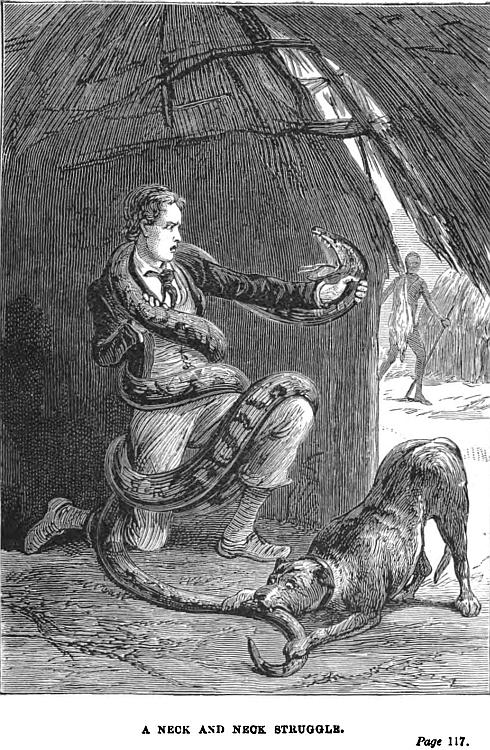
“Very big snake,” was his comment, “bad poison too. Lucky him no bite white boy, or him dead for certain. Lucky, too, big dog near at hand. Never see bigger snake than that. Him seventeen—eighteen foot long! Big dog just come in time, and that all!”
Meanwhile Warley, who had partially recovered his senses, after bathing his face and hands in the fresh water, was returning heartfelt thanks to Heaven for his narrow and wonderful deliverance from the most dreadful death which the imagination of man can picture.
Chapter Nine.
Measuring the Enemy—Poisoned Arrows—Substitutes for Water—Ostriches—A Sad Casualty—A New Mode of Deerstalking—Omatoko Triumphant.
Warley was still resting, half sitting, half kneeling, on a large stone by the side of the pool, when the sound of voices was heard, and Lavie came up, accompanied by the two boys. They were all evidently in high spirits. The doctor carried over his shoulder the carcass of a goat, which was large and heavy enough to give him plenty of trouble; and Wilmore and Nick each led a young kid by an extempore halter of rushes. The pockets of all three were distended by a goodly heap of wild medlars, which, in accordance with Omatoko’s suggestion, they had gathered, and which they had found extremely refreshing.
“Hallo, Omatoko!” shouted Gilbert as they approached the pool. “Just come here and take charge of this chap, will you? You are more used to this kind of thing than I am. He has done nothing but attempt to bolt the whole way home. I suppose we must eat up the old lady first, otherwise I should suggest that this fellow should be roasted for supper, if only to make sure that he won’t run away again.”
The Hottentot came out from the hut as he spoke. “One, two, three goat,” he said, “dat good, plenty food, all time we stay here.”