GREEK BIOLOGY
Reading edition
§ 1. Before Aristotle
What is science? It is a question that cannot be answered easily, nor perhaps answered at all. None of the definitions seem to cover the field exactly; they are either too wide or too narrow. But we can see science in its growth and we can say that being a process it can exist only as growth. Where does the science of biology begin? Again we cannot say, but we can watch its evolution and its progress. Among the Greeks the accurate observation of living forms, which is at least one of the essentials of biological science, goes back very far. The word Biology, used in our sense, would, it is true, have been an impossibility among them, for bios refers to the life of man and could not be applied, except in a strained or metaphorical sense, to that of other living things.[1] But the ideas we associate with the word are clearly developed in Greek philosophy and the foundations of biology are of great antiquity.
The Greek people had many roots, racial, cultural, and spiritual, and from them all they inherited various powers and qualities and derived various ideas and traditions. The most suggestive source for our purpose is that of the Minoan race whom they dispossessed and whose lands they occupied. That highly gifted people exhibited in all stages of its development a marvellous power of graphically representing animal forms, of which the famous Cretan friezes, Vaphio cups (Fig. 5), and Mycenean lions provide well-known examples. It is difficult not to believe that the Minoan element, entering into the mosaic of peoples that we call the Greeks, was in part at least responsible for the like graphic power developed in the Hellenic world, though little contact has yet been demonstrated between Minoan and archaic Greek Art.
For the earliest biological achievements of Greek peoples we have to rely largely on information gleaned from artistic remains. It is true that we have a few fragments of the works of both Ionian and Italo-Sicilian philosophers, and in them we read of theoretical speculation as to the nature of life and of the soul, and we can thus form some idea of the first attempts of such workers as Alcmaeon of Croton (c. 500 b. c.) to lay bare the structure of animals by dissection.[2] The pharmacopœia also of some of the earliest works of the Hippocratic collection betrays considerable knowledge of both native and foreign plants.[3] Moreover, scattered through the pages of Herodotus and other early writers is a good deal of casual information concerning animals and plants, though such material is second-hand and gives us little information concerning the habit of exact observation that is the necessary basis of science.
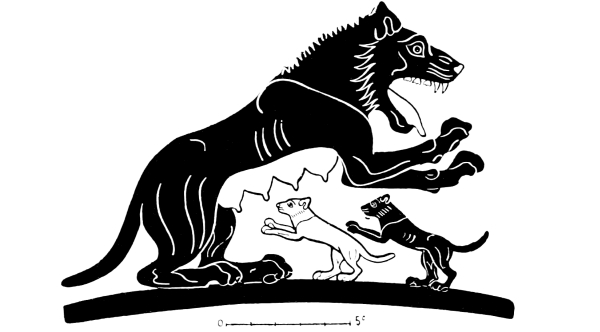
Fig. 1. Lioness and young from an Ionian vase of the sixth century b. c. found at Caere in Southern Etruria (Louvre, Salle E, No. 298), from Le Dessin des Animaux en Grèce d’après les vases peints, by J. Morin, Paris (Renouard), 1911. The animal is drawing itself up to attack its hunters. The scanty mane, the form of the paws, the udders, and the dentition are all heavily though accurately represented.
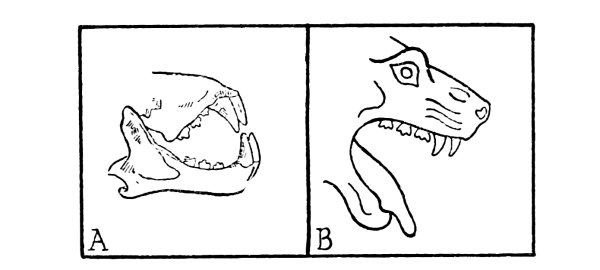
Fig. 2. A, Jaw bones of lion; B, head of lioness from Caere vase (Fig. 1), after Morin. Note the careful way in which the artist has distinguished the molar from the cutting teeth.
Something more is, however, revealed by early Greek Art. We are in possession of a series of vases of the seventh and sixth centuries before the Christian era showing a closeness of observation of animal forms that tells of a people awake to the study of nature. We have thus portrayed for us a number of animals—plants seldom or never appear—and among the best rendered are wild creatures; we see antelopes quietly feeding or startled at a sound, birds flying or picking worms from the ground, fallow deer forcing their way through thickets, browsing peacefully, or galloping away, boars facing the hounds and dogs chasing hares, wild cattle forming their defensive circle, hawks seizing their prey. Many of these exhibit minutely accurate observation. The very direction of the hairs on the animals’ coats has sometimes been closely studied, and often the muscles are well rendered. In some cases even the dentition has been found accurately portrayed, as in a sixth century representation on an Ionian vase of a lioness—an animal then very rare on the Eastern Mediterranean littoral, though still well known in Babylonia, Syria, and Asia Minor. The details of the work show that the artist must have examined the animal in captivity (Figs. 1 and 2).
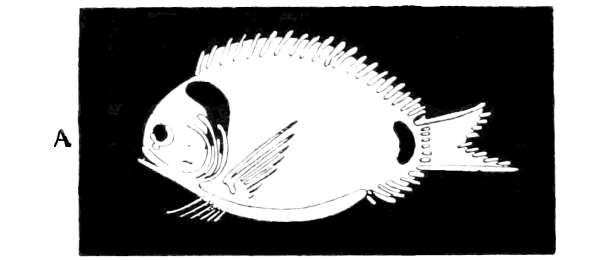
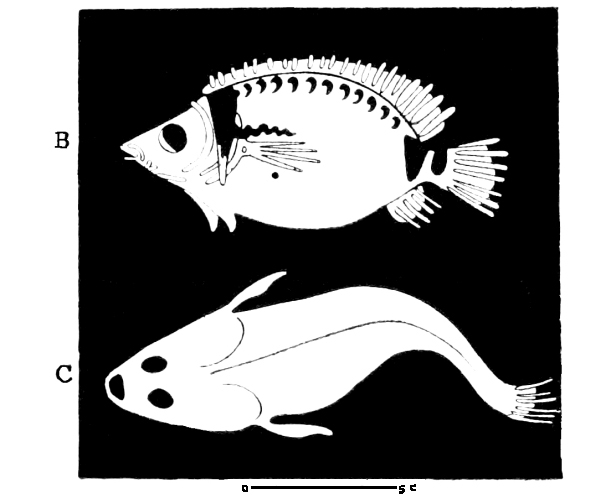
Fig. 3. Paintings of fish on plates. Italo-Greek work of the fourth century B. C. From Morin.
A. Sargus vulgaris.
B. Crenilabrus mediterraneus.
C. Uranoscopus scaber?
Animal paintings of this order are found scattered over the Greek world with special centres or schools in such places as Cyprus, Boeotia, or Chalcis. The very name for a painter in Greek, zoographos, recalls the attention paid to living forms. By the fifth century, in representing them as in other departments of Art, the supremacy of Attica had asserted itself, and there are many beautiful Attic vase-paintings of animals to place by the side of the magnificent horses’ heads of the Parthenon (Fig. 6). In Attica, too, was early developed a characteristic and closely accurate type of representation of marine forms, and this attained a wider vogue in Southern Italy in the fourth century. From the latter period a number of dishes and vases have come down to us bearing a large variety of fish forms, portrayed with an exactness that is interesting in view of the attention to marine creatures in the surviving literature of Aristotelian origin (Fig. 3).
These artistic products are more than a mere reflex of the daily life of the people. The habits and positions of animals are observed by the hunter, as are the forms and colours of fish by the fisherman; but the methods of huntsman and fisher do not account for the accurate portrayal of a lion’s dentition, the correct numbering of a fish’s scales or the close study of the lie of the feathers on the head, and the pads on the feet, of a bird of prey (Fig. 4). With observations such as these we are in the presence of something worthy of the name Biology. Though but little literature on that topic earlier than the writings of Aristotle has come down to us, yet both the character of his writings and such paintings and pictures as these, suggest the existence of a strong interest and a wide literature, biological in the modern sense, antecedent to the fourth century.
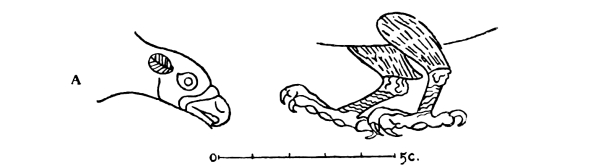

Fig. 4. Head and talons of the Sea-eagle, Haliaëtus albicilla:
A, From an Ionic vase of the sixth century b. c.
B, Drawn from the object.
From Morin.
Greek science, however, exhibits throughout its history a peculiar characteristic differentiating it from the modern scientific standpoint. Most of the work of the Greek scientist was done in relation to man. Nature interested him mainly in relation to himself. The Greek scientific and philosophic world was an anthropocentric world, and this comes out in the overwhelming mass of medical as distinct from biological writings that have come down to us. Such, too, is the sentiment expressed by the poets in their descriptions of the animal creation:
Many wonders there be, but naught more wondrous than man:
The light-witted birds of the air, the beasts of the weald and the wood He traps with his woven snare, and the brood of the briny flood. Master of cunning he: the savage bull, and the hart Who roams the mountain free, are tamed by his infinite art. And the shaggy rough-maned steed is broken to bear the bit. Sophocles, Antigone, verses 342 ff. (Translation of F. Storr.)
It is thus not surprising that our first systematic treatment of animals is in a practical medical work, the περὶ διαίτης, On regimen, of the Hippocratic Collection. This very peculiar treatise dates from the later part of the fifth century. It is strongly under the influence of Heracleitus (c. 540-475) and contains many points of view which reappear in later philosophy. All animals, according to it, are formed of fire and water, nothing is born and nothing dies, but there is a perpetual and eternal revolution of things, so that change itself is the only reality. Man’s nature is but a parallel to that of the universal nature, and the arts of man are but an imitation or reflex of the natural arts or, again, of the bodily functions. The soul, a mixture of water and fire, consumes itself in infancy and old age, and increases during adult life. Here, too, we meet with that singular doctrine, not without bearing on the course of later biological thought, that in the foetus all parts are formed simultaneously. On the proportion of fire and water in the body all depends, sex, temper, temperament, intellect. Such speculative ideas separate this book from the sober method of the more typical Hippocratic medical works with which indeed it has little in common.
After having discussed these theoretical matters the work turns to its own practical concerns, and in the course of setting out the natures of foods gives in effect a rough classification of animals. These are set forth in groups, and from among the larger groups only the reptiles and insects are missing. The list has been described, perhaps hardly with justification, as the Coan classificatory system. We have here, indeed, no system in the sense in which that word is now applied to the animal kingdom, but we have yet some sort of definite arrangement of animals according to their supposed natures. The passage opens with mammals, which are divided into domesticated and wild, the latter being mentioned in order according to size, next follow the land-birds, then the water-fowl, and then the fishes. These fish are divided into (1) the haunters of the shore, (2) the free-swimming forms, (3) the cartilaginous fishes or Selachii, which are not so named but are placed together, (4) the mud-loving forms, and (5) the fresh-water fish. Finally come invertebrates arranged in some sort of order according to their structure. The characteristic feature of the ‘classification’ is the separation of the fish from the remaining vertebrates and of the invertebrates from both. Of the fifty animals named no less than twenty are fish, about a fifth of the number studied by Aristotle, but we must remember that here only edible species are mentioned. The existence of the work shows at least that in the fifth century there was already a close and accurate study of animal forms, a study that may justly be called scientific. The predominance of fish and their classification in greater detail than the other groups is not an unexpected feature. The Mediterranean is especially rich in these forms, the Greeks were a maritime people, and Greek literature is full of imagery drawn from the fisher’s craft. From Minoan to Byzantine times the variety, beauty, and colour of fish made a deep impression on Greek minds as reflected in their art.
Much more important however for subsequent biological development, than such observations on the nature and habits of animals, is the service that the Hippocratic physicians rendered to Anatomy and to Physiology, departments in which the structure of man and of the domesticated animals stands apart from that of the rest of the animal kingdom. It is with the nature and constitution of man that most of the surviving early biological writings are concerned, and in these departments are unmistakable tendencies towards systematic arrangement of the material. Thus we have division and description of the body in sevens from the periphery to the centre and from the vertex to the sole of the foot,[4] or a division into four regions or zones.[5] The teaching concerning the four elements and four humours too became of great importance and some of it was later adopted by Aristotle. We also meet numerous mechanical explanations of bodily structures, comparisons between anatomical conditions encountered in related animals, experiments on living creatures,[6] systematic incubation of hen’s eggs for the study of their development, parallels drawn between the development of plants and of human and animal embryos, theories of generation, among which is that which was afterwards called ‘pangenesis’—discussion of the survival of the stronger over the weaker—almost our survival of the fittest—and a theory of inheritance of acquired characters.[7] All these things show not only extensive knowledge but also an attempt to apply such knowledge to human needs. When we consider how even in later centuries biology was linked with medicine, and how powerful and fundamental was the influence of the Hippocratic writings, not only on their immediate successors in antiquity, but also on the Middle Ages and right into the nineteenth century, we shall recognize the significance of these developments.
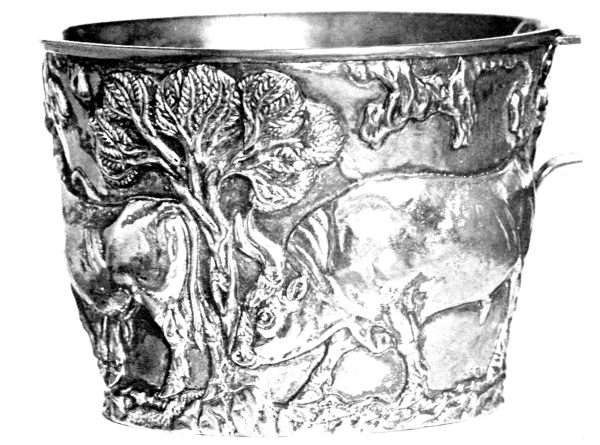
Fig. 5. MINOAN GOLD CUP. SIXTEENTH CENTURY b. c.
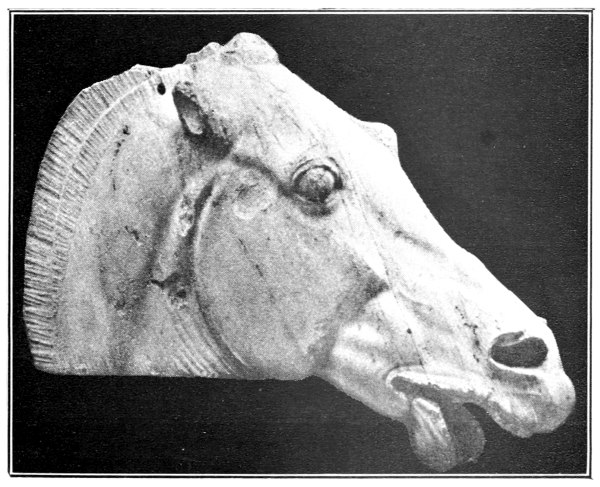
Fig. 6. HORSE’S HEAD. FROM PARTHENON. 440 b. c.
Such was the character of biological thought within the fifth century, and a generation inspired by this movement produced some noteworthy works in the period which immediately followed. In the treatise περὶ τροφῆς, On nourishment, which may perhaps be dated about 400 b. c., we learn of the pulse for the first time in Greek medical literature, and read of a physiological system which lasted until the time of Harvey, with the arteries arising from the heart and the veins from the liver. Of about the same date is a work περὶ καρδίης, On the heart, which describes the ventricles as well as the great vessels and their valves, and compares the heart of animals with that of man.
A little later, perhaps 390 b. c., is the treatise περὶ σαρκῶν, On muscles, which contains much more than its title suggests. It has the old system of sevens and, inspired perhaps by the philosophy of Heracleitus (c. 540-475), describes the heart as sending air, fire, and movement to the different parts of the body through the vessels which are themselves constantly in movement. The infant in its mother’s womb is believed to draw in air and fire through its mouth and to eat in utero. The action of air on the blood is compared to its action on fire. In contrast to some of the other Hippocratic treatises the central nervous system is in the background; much attention, however, is given to the special senses. The brain resounds during audition. The olfactory nerves are hollow, lead to the brain, and convey volatile substances to it which cause it to secrete mucus. The eyes also have been examined, and their coats and humours roughly described; an allusion, the first in literature, is perhaps made to the crystalline lens, and the eyes of animals are compared with those of man. There is evidence not only of dissection but of experiment, and in efforts to compare the resistance of various tissues to such processes as boiling, we may see the small beginning of chemical physiology.
An abler work than any of these, but exhibiting less power of observation is a treatise, περὶ γονῆς, On generation, that may perhaps be dated about 380 b. c.[8] It exhibits a writer of much philosophic power, very anxious for physiological explanations, but hampered by ignorance of physics. He has, in fact, the weaknesses and in a minor degree the strength of his successor Aristotle, of whose great work on generation he gives us a foretaste. He sets forth in considerable detail a doctrine of pangenesis, not wholly unlike that of Darwin. In order to explain the phenomena of inheritance he supposes that vessels reach the seed, carrying with them samples from all parts of the body. He believes that channels pass from all the organs to the brain and then to the spinal marrow (or to the marrow direct), thence to the kidneys and on to the genital organs; he believes, too, that he knows the actual location of one such channel, for he observes, wrongly, that incision behind the ears, by interrupting the passage, leads to impotence. As an outcome of this theory he is prepared to accept inheritance of acquired characters. The embryo develops and breathes by material transmitted from the mother through the umbilical cord. We encounter here also a very detailed description of a specimen of exfoliated membrana mucosa uteri which our author mistakes for an embryo, but his remarks at least exhibit the most eager curiosity.[9]
The author of this work on generation is thus a ‘biologist’ in the modern sense, and among the passages exhibiting him in this light is his comparison of the human embryo with the chick. ‘The embryo is in a membrane in the centre of which is the navel through which it draws and gives its breath, and the membranes arise from the umbilical cord.... The structure of the child you will find from first to last as I have already described.... If you wish, try this experiment: take twenty or more eggs and let them be incubated by two or more hens. Then each day from the second to that of hatching remove an egg, break it, and examine it. You will find exactly as I say, for the nature of the bird can be likened to that of man. The membranes [you will see] proceed from the umbilical cord, and all that I have said on the subject of the infant you will find in a bird’s egg, and one who has made these observations will be surprised to find an umbilical cord in a bird’s egg.’[10]
The same interest that he exhibits for the development of man and animals he shows also for plants.
‘A seed laid in the ground fills itself with the juices there contained, for the soil contains in itself juices of every nature for the nourishment of plants. Thus filled with juice the seed is distended and swells, and thereby the power (= faculty ἡ δὗύναμις) diffused in the seed is compressed by living principle (pneuma) and juice, and bursting the seed becomes the first leaves. But a time comes when these leaves can no longer get nourished from the juices in the seed. Then the seed and the leaves erupt, for urged by the leaves the seed sends down that part of its power which is yet concentrated within it and so the roots are produced as an extension of the leaves. When at last the plant is well rooted below and is drawing its nutriment from the earth, then the whole grain disappears, being absorbed, save for the husk, which is the most solid part; and even that, decomposing in the earth, ultimately becomes invisible. In time some of the leaves put forth branches. The plant being thus produced by humidity from the seed is still soft and moist. Growing actively both above and below, it cannot as yet bear fruit, for it has not the quality of force and reserve (δύναμις ὶσχυρὴ καὶ πιαρἀ) from which a seed can be precipitated. But when, with time, the plant becomes firmer and better rooted, it develops veins as passages both upwards and downwards, and it draws from the soil not only water but more abundantly also substances that are denser and fatter. Warmed, too, by the sun, these act as a ferment to the extremities and give rise to fruit after its kind. The fruit thus develops much from little, for every plant draws from the earth a power more abundant than that with which it started, and the fermentation takes place not at one place but at many.’[11]
Nor does our author hesitate to draw an analogy between the plant and the mammalian embryo. ‘In the same way the infant lives within its mother’s womb and in a state corresponding to the health of the mother ... and you will find a complete similitude between the products of the soil and the products of the womb.’
The early Greek literature is so scantily provided with illustrations drawn from botanical study, that it is worth considering the remarkable comparison of generation of plants from cuttings with that from seeds in the same work.
‘As regards plants generated from cuttings ... that part of a branch where it was cut from a tree is placed in the earth and there rootlets are sent out. This is how it happens: The part of the plant within the soil draws up juices, swells, and develops a pneuma (πνεῦμα ἴσχει), but not so the part without. The pneuma and the juice concentrate the power of the plant below so that it becomes denser. Then the lower end erupts and gives forth tender roots. Then the plant, taking from below, draws juices from the roots and transmits them to the part above the soil which thus also swells and develops pneuma; thus the power from being diffused in the plant becomes concentrated and budding, gives forth leaves.... Cuttings, then, differ from seeds. With a seed the leaves are borne first, then the roots are sent down; with a cutting the roots form first and then the leaves.’[12]
But with these works of the early part of the fourth century the first stage of Greek biology reaches its finest development. Later Hippocratic treatises which deal with physiological topics are on a lower plane, and we must seek some external cause for the failure. Nor have we far to seek. This period saw the rise of a movement that had the most profound influence on every department of thought. We see the advent into the Greek world of a great intellectual movement as a result of which the department of philosophy that dealt with nature receded before Ethics. Of that intellectual revolution—perhaps the greatest the world has seen—Athens was the site and Socrates (470-399) the protagonist. With the movement itself and its characteristic fruit we are not concerned. But the great successor and pupil of its founder gives us in the Timaeus a picture of the depth to which natural science can be degraded in the effort to give a specific teleological meaning to all parts of the visible Universe. The book and the picture which it draws, dark and repulsive to the mind trained in modern scientific method, enthralled the imagination of a large part of mankind for wellnigh two thousand years. Organic nature appears in this work of Plato (427-347) as the degeneration of man whom the Creator has made most perfect. The school that held this view ultimately decayed as a result of its failure to advance positive knowledge. As the centuries went by its views became further and further divorced from phenomena, and the bizarre developments of later Neoplatonism stand to this day as a warning against any system which shall neglect the investigation of nature. But in its decay Platonism dragged science down and destroyed by neglect nearly all earlier biological material. Mathematics, not being a phenomenal study, suited better the Neoplatonic mood and continued to advance, carrying astronomy with it for a while—astronomy that affected the life of man and that soon became the handmaid of astrology; medicine, too, that determined the conditions of man’s life, was also cherished, though often mistakenly, but pure science was doomed.
But though the ethical view of nature overwhelmed science in the end, the advent of the mighty figure of Aristotle (384-322) stayed the tide for a time. Yet the writer on Greek Biology remains at a disadvantage in contrast with the Historian of Greek Mathematics, of Greek Astronomy, or of Greek Medicine, in the scantiness of the materials for presenting an account of the development of his studies before Aristotle. The huge form of that magnificent naturalist completely overshadows Greek as it does much of later Biology.
§ 2. Aristotle
With Aristotle we come in sight of the first clearly defined personality in the course of the development of Greek biological thought—for the attribution of the authorship of the earlier Hippocratic writings is more than doubtful, while the personality of the great man by whose name they are called cannot be provided with those clear outlines that historical treatment demands.
Aristotle was born in 384 b. c. at Stagira, a Greek colony in the Chalcidice a few miles from the northern limit of the present monastic settlement of Mount Athos. His father, Nicomachus, was physician to Amyntas III of Macedonia and a member of the guild or family of the Asclepiadae. From Nicomachus he may have inherited his taste for biological investigation and acquired some of his methods. At seventeen Aristotle became a pupil of Plato at Athens. After Plato’s death in 347 Aristotle crossed the Aegean to reside at the court of Hermias, despot of Atarneus in Mysia, whose niece, Pythias, he married. It is not improbable that the first draft of Aristotle’s biological works and the mass of his own observations were made during his stay in this region, for in his biological writings much attention is concentrated on the natural history of the Island of Lesbos, or Mytilene, that lies close opposite to Atarneus. Investigation has shown that in the History of Animals there are frequent references to places on the northern and eastern littoral of the Aegean, and especially to localities in the Island of Lesbos; on the other hand places in Greece proper are but seldom mentioned.[13] Thus his biological investigations, in outline at least, are probably the earliest of his extant works and preceded the philosophical writings which almost certainly date from his second sojourn in Athens.
Fig. 7. ARISTOTLE
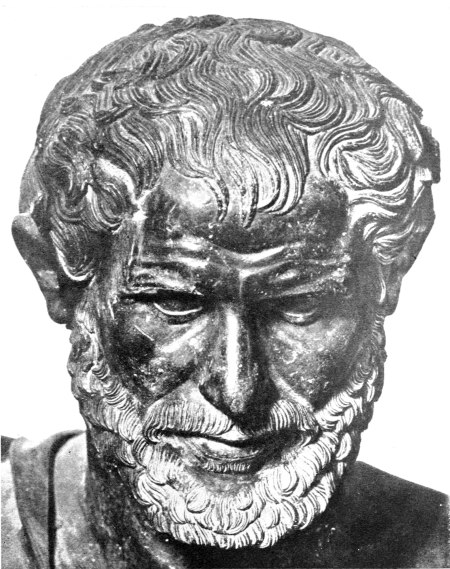
From HERCULANEUM Probably work of fourth century b. c.
In 342 b. c., at the request of Philip of Macedon, Aristotle became tutor to Philip’s son, Alexander. He remained in Macedonia for seven years and about 336, when Alexander departed for the invasion of Asia, returned to Athens where he taught at the Lyceum and established his famous school afterwards called the Peripatetic. Most of his works were produced during this the closing period of his life between 335 and 323 b. c. After Alexander’s death in 323 and the break up of his empire, Aristotle, who was regarded as friendly to the Macedonian power, was placed in a difficult position. Regarded with enmity by the anti-Macedonian party, he withdrew from Athens and died soon after in 322 b. c. at Chalcis in Euboea at about sixty-two years of age.
The scientific works to which Aristotle’s name is attached may be divided into three groups, physical, biological, and psychological. In size they vary from such a large treatise as the History of Animals to the tiny tracts which go to make up the Parva naturalia. So far as the scientific writings can be distinguished as separate works they may be set forth as follows:
Physics.
φυσικὴ ἀκρόασις Physics.
περὶ γενέσεως καὶ φθορᾱς On coming into being and passing away.
περὶ οὐρανοῡ. On the heavens.
μετεωρολογικά. Meteorology.
[περὶ κόσμου. On the universe.]
[μηχανικά. Mechanics.]
[περὶ ἀτόμων γραμμῶν. On indivisible lines.]
[ἀνέμων θέσεις καὶ προσηγορίαι. Positions and descriptions of winds.]
Biology in the restricted sense.
(a) Natural History.
περὶ τὰ ζῳα ἱστορίαι. Inquiry about animals = Historia animalium.
περὶ ζῴων μορίων. On parts of animals.
περὶ ζῴων γενέσεως. On generation of animals.
[περὶ φυτῶν. On plants.]
(b) Physiology.
περὶ ζῴων πορείας. On progressive motion of animals.
περὶ μακροβιότητος καὶ βραχυβιότητος. On length and shortness of life.
περὶ ἀναπνοῆς. On respiration.
περὶ νεότητος καὶ γήρως. On youth and age.
[περὶ ζῴων κινήσεως. On motion of animals.]
[φυσιογνωμονικά. On physiognomy.]
[περὶ πνεύματος. On innate spirit.]
Psychology and Philosophy with biological bearing.
περὶ ψυχῆς. On soul.
περὶ αἰσθήσεως καὶ αἰσθητῶν. On sense and objects of sense.
περὶ ζωῆς καὶ θανάτου. On life and death.
περὶ μνήμης καὶ ἀναμνήσεως. On memory and reminiscence.
περὶ ὓπνου καὶ ἐγρηγόρσεως. On sleep and waking.
περὶ ἐνυπνίων. On dreams.
[προβλήματα. Problems.]
[περὶ χρωμάτων. On colours.]
[περὶ ἀκουστῶν. On sounds.]
[περὶ τῆς καθ’ ὔπνον μαντικῆς. On prophecy in sleep.]
Of these works some, the names of which are placed here in brackets, are clearly spurious in that they were neither written by Aristotle nor are they in any form approaching that in which they were cast by him. Yet all are of very considerable antiquity and contain fragments of his tradition in a state of greater or less corruption. In addition to works here enumerated there are many others which are spurious in a yet further sense in that they are merely fathered on Aristotle and contain no trace of his spirit or method. Such, for example, is the famous mediaeval work of oriental origin known as the Epistle of Aristotle to Alexander.
In a general way it may be stated that the physical works, with which we are not here directly concerned, while they show ingenuity, learning, and philosophical power, yet betray very little direct and original observation. They have exerted enormous influence in the past and for at least two thousand years provided the usual physical conceptions of the civilized world both East and West. After the Galilean revolution in physics, however, they became less regarded and they are not now highly esteemed by men of science. The biological works of Aristotle, on the other hand, excited comparatively little interest during the Middle Ages, but from the sixteenth century on they have been very closely studied by naturalists. From the beginning of the nineteenth century, and especially as a result of the work of Cuvier, Richard Owen, and Johannes Müller, Aristotle’s reputation as a naturalist has risen steadily, and he is now universally admitted to have been one of the very greatest investigators of living nature.
The philosophical bases of Aristotle’s biology are mainly to be found in the treatise On soul and in that On the generation of animals. His actual observations are contained in this latter work—which is in many ways his finest scientific production—in the great collection on the History of animals, and in the remarkable treatise On parts of animals. Certain of his deductions concerning the nature and mechanism of life can be found in his two works which deal with the movements of animals (one of which is very doubtfully genuine) and in his tracts On respiration, On sleep, &c. The treatise On plants and the Problems in their present form are late and spurious, but they are based on works of members of his school. They were, however, perhaps originally prepared at the other end of the Greek world in Magna Graecia.
Aristotle was a most voluminous author and his biological writings form but a small fraction of those to which his name is attached. Yet these biological works contain a prodigious number of first-hand observations and it has always been difficult to understand how one investigator could collect all these facts, however rapid his work and skilful his methods. The explanations that have reached us from antiquity are, indeed, picturesque, but they are neither credible in themselves nor are they consistent with each other. Thus Pliny writing about a. d. 77 says ‘Alexander the Great, fired by desire to learn of the natures of animals, entrusted the prosecution of this design to Aristotle.... For this end he placed at his disposal some thousands of men in every part of Asia and Greece, and among them hunters, fowlers, fishers, park-keepers, herds-men, bee-wards, as well as keepers of fish-ponds and aviaries in order that no creature might escape his notice. Through the information thus collected he was able to compose some fifty volumes.’[14] Athenaeus, who lived in the early part of the third century a. d., assures us that ‘Aristotle the Stagirite received eight hundred talents [i.e. equal to about £200,000 of our money] from Alexander as his contribution towards perfecting his History of Animals’.[15] Aelian, on the other hand, who lived at a period a little anterior to Athenaeus, tells us that it was ‘Philip of Macedon who so esteemed learning that he supplied Aristotle with ample funds’ adding that he similarly honoured both Plato and Theophrastus.[16]
Now in all Aristotle’s works there is not a single sentence in praise of Alexander and there is some evidence that the two had become estranged. In support of this we may quote Plutarch (c. a. d. 100) who gives a detailed description of a conspiracy in 327 b. c. against Alexander by Callisthenes, a pupil of Aristotle who appears to have kept up a correspondence with his master.[17] Alexander himself wrote of Callisthenes, according to Plutarch: ‘I will punish this sophist, together with those who sent him to me and those who harbour in their cities men who conspire against my life’ and Plutarch adds that Alexander ‘directly reveals in these words a hostility to Aristotle in whose house Callisthenes ... had been reared, being a son of Hero who was a niece of Aristotle’.[18] Yet the Alexandrian conquests, bringing Greece into closer contact with a wider world and extending Greek knowledge of the Orient, must have had their influence in stimulating interest in rare and curious creatures and in a general extension of natural knowledge. That the interest in these topics extended beyond the circle of the Peripatetics is shown by the fact that Speusippus, the pupil of Plato and his successor as leader of his school, occupied himself with natural history and wrote works on biological topics and especially on fish.
Nevertheless, remarkable as is Aristotle’s acquaintance with animal forms, investigation shows that he is reliable only when treating of creatures native to the Aegean basin. As soon as he gets outside that area his statements are almost always founded on hearsay or even on fable.[19] Whatever assistance Aristotle may have received in the preparation of his biological works came, therefore, probably from no such picturesque and distant source as the gossip of Pliny or Aelian would suggest. We can conjecture that he received aid from the powerful relatives of his wife at Atarneus and in Lesbos, and we may most reasonably suppose that after his return to Athens much help would have been given him by his pupils within the Lyceum. To them may probably be ascribed many passages in the biological writings; for it seems hardly possible that Aristotle himself would have had time for detailed biological research after he had settled as a teacher in Athens. Of the work of these members of his school a fine monument has survived in two complete botanical treatises and fragments of others on zoological and psychological subjects by Theophrastus of Eresus, his pupil and successor in the leadership of the Lyceum and perhaps his literary legatee.
When we turn to the Aristotelian biological works themselves we naturally inquire first into the question of genuineness, and here a difficulty arises in that all his extant works have come down to us in a state that is not comparable to those of any other great writer. Among the ancients admiration was expressed for Aristotle’s eloquence and literary powers, but, in the material that we have here to consider, very little trace of these qualities can be detected by even the most lenient judge. The arrangement of the subject-matter is far from perfect even if we allow for the gaps and disturbances caused by their passage through many hands. Moreover, there is much repetition and often irrelevant digression, while the language is usually plain to baldness and very frequently obscure. We find sometimes the lightening touch of humour, but the style hardly ever rises to beauty. Furthermore, even in matters of fact, while many observations exhibit wonderful insight and, forestalling modern discovery, betray a most searching and careful application of scientific methods, yet elsewhere we find errors that are childish and could have been avoided by the merest tyro.
This curious state of the Aristotelian writings has given rise to much discussion among scholars and to explain it there has been developed what is known as the ‘notebook theory’. It is supposed that the bases of the material that we possess were notebooks put together by Aristotle himself for his own use, probably while lecturing. These passed, it is believed, into the hands of certain of his pupils and were perhaps in places incomprehensible as they stood. Such pupils, after the master’s death, filled out the notebooks either from the memory of his teaching or from their own knowledge—or ignorance. Thus modified, however, they were still not prepared for publication, even in the limited sense in which works may be said to have been published in those days, but they formed again the fuller bases of notes for lectures delivered by his successors. In this form they have finally survived to our time, suffering, however, from certain further losses and displacements on a larger scale. Some of the ‘Aristotelian’ works are undoubtedly more deeply spurious, but the works that are regarded as ‘genuine’ do not seem to have been seriously tampered with, except by mere scribal or bookbinders’ blunders, at any date later than a generation or two following Aristotle’s own time. These notebooks as they stand are in fact probably in much the state in which we should find them were we able to retrieve a copy dating from the first or second century b. c.[20]
In the opening chapter of one of his great biological works Aristotle sets forth in detail his motives for the study of living things. The passage is in itself noteworthy as one of the few instances in which he rises to real eloquence.
‘Of things constituted by nature some are ungenerated, imperishable, and eternal, while others are subject to generation and decay. The former are excellent beyond compare and divine, but less accessible to knowledge. The evidence that might throw light on them, and on the problems which we long to solve respecting them, is furnished but scantily by sensation; whereas respecting perishable plants and animals we have abundant information, living as we do in their midst, and ample data may be collected concerning all their various kinds, if only we are willing to take sufficient pains. Both departments, however, have their special charm. The scanty conceptions to which we can attain of celestial things give us, from their excellence, more pleasure than all our knowledge of the world in which we live; just as a half glimpse of persons we love is more delightful than a leisurely view of other things, whatever their number and dimensions. On the other hand, in certitude and in completeness our knowledge of terrestrial things has the advantage. Moreover, their greater nearness and affinity to us balances somewhat the loftier interest of the heavenly things that are the objects of the higher philosophy.... For if some [creatures] have no graces to charm the sense, yet even these, by disclosing to intellectual perception the artistic spirit that designed them, give immense pleasure to all who can trace links of causation, and are inclined to philosophy. We therefore must not recoil with childish aversion from the examination of the humbler animals. Every realm of nature is marvellous. It is told of Heraclitus that when strangers found him warming himself at the kitchen fire and hesitated to go in, he bade them enter since even in the kitchen divinities were present. So should we venture on the study of every kind of animal without distaste, for each and all will reveal to us something natural and something beautiful.[21] Absence of haphazard and conduciveness of everything to an end are to be found in Nature’s works in the highest degree, and the resultant end of her generations and combinations is a form of the beautiful.
‘If any person thinks the examination of the rest of the animal kingdom an unworthy task, he must hold in like disesteem the study of man. For no one can look at the primordia of the human frame—blood, flesh, bones, vessels, and the like—without much repugnance. Moreover, when any one of the parts or structures, be it which it may, is under discussion, it must not be supposed that it is its material composition to which attention is being directed or which is the object of the discussion, but the relation of such part to the total form....
‘As every instrument and every bodily member subserves some partial end, that is to say, some special action, so the whole body must be destined to minister to some plenary sphere of action. Thus the saw is made for sawing, since sawing is a function, and not sawing for the saw. Similarly, the body too must somehow or other be made for the soul, and each part of it for some subordinate function to which it is adapted.’[22]
Aristotle is, in the fullest sense a ‘vitalist’. He believes that the presence of a certain peculiar principle of a non-material character is essential for the exhibition of any of the phenomena of life. This principle we may call soul, translating his word ψυχή. Living things, like all else in nature, have, according to Aristotle, an end or object. ‘Everything that Nature makes,’ he says, ‘is means to an end. For just as human creations are the products of art, so living objects are manifestly the products of an analogous cause or principle.... And that the heaven, if it had an origin, was evolved and is maintained by such a cause, there is, therefore, even more reason to believe, than that mortal animals so originated. For order and definiteness are much more manifest in the celestial bodies than in our own frame.’[23] It was a misinterpretation of this view that especially endeared him to the mediaeval Church and made it possible to absorb Aristotelian philosophy into Christian theology. It must be remembered that the cause or principle that leads to the development of living things is in Aristotle’s view, not external but internal.
While putting his own view Aristotle does not fail to tell us of the standpoint of his opponents. ‘Why, however, it must be asked, should we look on the operations of Nature as dictated by a final cause, and intended to realize some desirable end? Why may they not be merely the results of necessity, just as the rain falls of necessity, and not that the corn may grow? For though the rain makes the corn grow, it no more occurs in order to cause that growth, than a shower which spoils the farmer’s crop at harvest-time occurs in order to do that mischief. Now, why may not this, which is true of the rain, be true also of the parts of the body? Why, for instance, may not the teeth grow to be such as they are merely of necessity, and the fitness of the front ones with their sharp edge for the comminution of the food, and of the hind ones with their flat surface for its mastication, be no more than an accidental coincidence, and not the cause that has determined their development?’[24]
The answers to these questions form a considerable part of Aristotle’s philosophy where we are unable to follow him. For the limited field of biology, however, the question is on somewhat narrower lines. ‘What,’ he asks, ‘are the forces by which the hand or the body was fashioned into shape? The wood carver will perhaps say, by the axe or the auger.... But it is not enough for him to say that by the stroke of his tool this part was formed into a concavity, that into a flat surface; but he must state the reasons why he struck his blow in such a way as to effect this and what his final object was ... [similarly] the true method [of biological science] is to state what the definite characters are that distinguish the animal as a whole; to explain what it is both in substance and in form, and to deal after the same fashion with its several organs.... If now this something, that constitutes the form of the living being, be the soul, or part of the soul, or something that, without the soul, cannot exist, (as would seem to be the case, seeing at any rate that when the soul departs, what is left is no longer a living animal, and that none of the parts remain what they were before, excepting in mere configuration, like the animals that in the fable are turned into stone;) ... then it will come within the province of the natural philosopher to inform himself concerning the soul, and to treat of it, either in its entirety, or, at any rate, of that part of it which constitutes the essential character of an animal; and it will be his duty to say what this soul or this part of a soul is.’[25] Thus in the Aristotelian writings the discussion of the nature and orders of ‘soul’ is almost inseparable from the subjects now included under the term Biology.
There can be no doubt that through much of the Aristotelian writings runs a belief in a kinetic as distinct from a static view of existence. It cannot be claimed that he regarded the different kinds of living things as actually passing one into another, but there can be no doubt that he fully realized that the different kinds can be arranged in a series in which the gradations are easy. His scheme would be something like that represented on p. 30 (Fig. 7 a).
‘Nature,’ he says, ‘proceeds little by little from things lifeless to animal life in such a way that it is impossible to determine the exact line of demarcation, nor on which side thereof an intermediate form should lie. Thus, next after lifeless things in the upward scale comes the plant, and of plants one will differ from another as to its amount of apparent vitality; and, in a word, the whole genus of plants, whilst it is devoid of life as compared with an animal, is endowed with life as compared with other corporeal entities. Indeed, there is observed in plants a continuous scale of ascent towards the animal. So, in the sea, there are certain objects concerning which one would be at a loss to determine whether they be animal or vegetable.’[26]
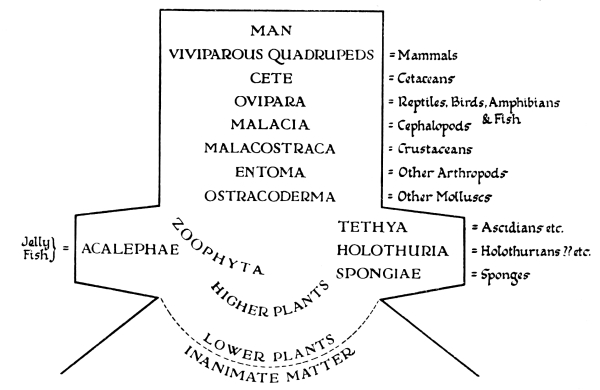
Fig. 7a. The Order of Living Things according to Aristotle.
‘A sponge, in these respects completely resembles a plant, in that ... it is attached to a rock, and that when separated from this it dies. Slightly different from the sponges are the so-called Holothurias ... as also sundry other sea-animals that resemble them. For these are free and unattached, yet they have no feeling, and their life is simply that of a plant separated from the ground. For even among land-plants there are some that are independent of the soil—or even entirely free. Such, for example, is the plant which is found on Parnassus, and which some call the Epipetrum [probably Sempervivum tectorum, the common houseleek]. This you may hang up on a peg and it will yet live for a considerable time. Sometimes it is a matter of doubt whether a given organism should be classed with plants or with animals. The Tethya, for instance, and the like, so far resemble plants as that they never live free and unattached, but, on the other hand, inasmuch as they have a certain flesh-like substance, they must be supposed to possess some degree of sensibility.’[27]
‘The Acalephae or Sea-nettles, ... lie outside the recognized groups. Their constitution, like that of the Tethya, approximates them on the one side to plants, on the other side to animals. For seeing that some of them can detach themselves and can fasten on their food, and that they are sensible of objects which come in contact with them, they must be considered to have an animal nature.... On the other hand, they are closely allied to plants, firstly by the imperfection of their structures, secondly by their being able to attach themselves to the rocks, which they do with great rapidity, and lastly by their having no visible residuum notwithstanding that they possess a mouth.’[28]
Thus ‘Nature passes from lifeless objects to animals in such unbroken sequence, interposing between them beings which live and yet are not animals, that scarcely any difference seems to exist between two neighbouring groups owing to their close proximity.’[29]
Some approach to evolutionary doctrine is also foreshadowed by Aristotle in his theories of the development of the individual. This is obscured, however, by his peculiar view of the nature of procreation. On this topic his general conclusion is that the material substance of the embryo is contributed by the female, but that this is mere passive formable material, almost as though it were the soil in which the embryo grows. The male by giving the principle of life, the soul, contributes the essential generative agency. But this soul is not material and it is, therefore, not theoretically necessary for anything material to pass from male to female. The material which does in fact so pass with the seed of the male is an accident, not an essential, for the essential contribution of the male is not matter but form and principle. The female provides the material, the male the soul, the form, the principle, that which makes life. Aristotle was thus prepared to accept instances of fertilization without material contact.
‘The female does not contribute semen to generation but does contribute something ... for there must needs be that which generates and that from which it generates.... If, then, the male stands for the effective and active, and the female, considered as female, for the passive, it follows that what the female would contribute to the semen of the male would not be semen but material for the semen to work upon....
‘How is it that the male contributes to generation, and how is it that the semen from the male is the cause of the offspring? Does [the semen] exist in the body of the embryo as a part of it from the first, mingling with the material which comes from the female? Or does the semen contribute nothing to the material body of the embryo but only to the power and movement in it?... The latter alternative appears to be the right one both a priori and in view of the facts.’[30]
This discussion leads to the question of the natural process of generation itself. It is a topic that we have seen discussed by an earlier writer who had set forth a sort of doctrine of pangenesis (see p. 14). His view Aristotle declines to share. ‘We must’, he says, ‘say the opposite of what the ancients said. For whereas they said that semen is that which comes from all the body, we shall say that it is that whose nature is to go to all of it, and what they thought a waste-product seems rather to be a secretion.’ According to Aristotle semen is derived from the same nutritive material in the blood vessels that is distributed to the rest of the body. The semen, however, is strained or secreted off from this nutritive material—as being its most essential and representative portion—before the distribution actually takes place.[31] But why, it may be asked, if the semen does not come from the various parts of the body, is it yet able to reproduce those various parts? The answer, on the Aristotelian view, seems to be that the semen contains special and peculiar fractions of the nutritive fluid which have been so modified and adapted that, if not secreted off as semen, they would be distributed to the different parts of the body to nourish each of these various parts. These substances have been elaborated by the soul or vital principle in a manner that is specifically suited for each organ, hand, liver, face, heart, &c., and from each of these specific substances a specific essence is separated off into the semen corresponding to hand, liver, face, heart, &c., of the offspring.
The next question that arises is the mechanism by which the offspring come to resemble their parents. The mechanism in the case of inheritance from the father is comprehensible when we consider the origin and nature of the semen, but the inheritance from the mother requires further explanation. The view of Aristotle is based upon the nature of the catamenia and their disappearance during gestation. ‘The catamenia’, in his view, ‘are a secretion as the semen is.’[32] The female contributes the material by which the embryo grows and she does this through the catamenia which are suspended during gestation for this very purpose. The matter is thus summed up by Aristotle.
‘The male does not emit semen at all in some animals, and where he does, this is no part of the resulting embryo; just so no material part comes from the carpenter to the material, i.e. to the wood in which he works, nor does any part of the carpenter’s art exist within what he makes, but the shape and the form are imparted from him to the material by means of the motion he sets up. It is his hands that move his tools, his tools that move the material; it is his knowledge of his art, and his soul, in which is the form, that move his hands or any other part of him with a motion of some definite kind, a motion varying with the varying nature of the object made. In like manner, in the male of those animals which emit semen, Nature uses the semen as a tool and as possessing motion in actuality, just as tools are used in the products of any art, for in them lies in a certain sense the motion of the art.’[33]
‘For the same reason the development of the embryo takes place in the female; neither the male himself nor the female emits semen into the female, but the female receives within herself the share contributed by both, because in the female is the material from which is made the resulting product. Not only must the mass of material from which the embryo is in the first instance formed exist there, but further material must constantly be added so that the embryo may increase in size. Therefore the birth must take place in the female. For the carpenter must keep in close connexion with his timber and the potter with his clay, and generally all workmanship and the ultimate movement imparted to matter must be connected with the material concerned, as, for instance, architecture is in the buildings it makes.’[34]
The problem of the nature of generation is one in which Aristotle never ceased to take an interest, and among the methods by which he sought to solve it was embryological investigation. In his ideas on the methods of reproduction we must seek also the main bases of such classification of animals as he exhibits. His most important embryological researches were made upon the chick. He asserts that the first signs of development are noticeable on the third day, the heart being visible as a palpitating blood-spot whence, as it develops, two meandering blood vessels extend to the surrounding tunics.
‘Generation from the egg’, he says, ‘proceeds in an identical manner with all birds.... With the common hen after three days and nights there is the first indication of the embryo.... The heart appears like a speck of blood in the white of the egg. This point beats and moves as though endowed with life, and from it two vessels with blood in them trend in a convoluted course ... and a membrane carrying bloody fibres now envelops the yolk, leading off from the vessels.’[35]
Aristotle lays considerable stress on the early appearance of the heart in the embryo. Corresponding to the general gradational view that he had formed of Nature, he held that the most primitive and fundamentally important organs make their appearance before the others. Among the organs all give place to the heart, which he considered ‘the first to live and the last to die’.[36]
A little later he observed that the body had become distinguishable, and was at first very small and white.
‘The head is clearly distinguished and in it the eyes, swollen out to a great extent.... At the outset the under portion of the body appears insignificant in comparison with the upper portion....
‘When an egg is ten days old the chick and all its parts are distinctly visible. The head still is larger than the rest of the body and the eyes larger than the head. At this time also the larger internal organs are visible, as also the stomach and the arrangement of the viscera; and the vessels that seem to proceed from the heart are now close to the navel. From the navel there stretch a pair of vessels, one [vitelline vein] towards the membrane that envelops the yolk, and the other [allantoic vein] towards that membrane which envelops collectively the membrane wherein the chick lies, the membrane of the yolk and the intervening liquid.... About the twentieth day, if you open the egg and touch the chick, it moves inside and chirps; and it is already coming to be covered with down when, after the twentieth day, the chick begins to break the shell.’[37]
Aristotle recognized a distinction in the mode of development of mammals from that of all other viviparous creatures. Having divided the apparently viviparous animals into two groups, one of which is truly and internally and the other only externally viviparous, he pointed out that in the mammalia, the group regarded by him as internally viviparous, the foetus is connected until birth with the wall of the mother’s womb by the navel-string. These animals, in his view, produce their young without the intervention of an ovum, the embryo being ‘living from the first’. Such non-mammals, on the other hand, as are viviparous are so in the external sense only, that is, the young which he considered to arise in this group from ova may indeed develop within the mother’s womb and be born alive, but they go through their development without organic connexion with the mother’s body, so that her womb acts but as a nursery or incubator for her eggs. It was indeed a sort of accident among the ovipara whether in any particular species the ovum went through its development inside or outside the mother’s body. ‘Some of the ovipara’, he says, ‘produce the egg in a perfect, others in an imperfect state, but it is perfected outside the body as has been stated of fish.’[38]
Yet though Aristotle regarded fish as an oviparous group, he knew also of kinds of fish that were externally viviparous. It is most interesting to observe, moreover, that he was acquainted with one particular instance among fish in which matters were less simple and in which the development bore an analogy to that of the mammalia, his true internal vivipara. ‘Some animals’, he says, ‘are viviparous, others oviparous, others vermiparous. Some are viviparous, such as man, the horse, the seal and all other animals that are hair-coated, and, of marine animals, the Cetaceans, as the dolphin, and the so-called Selachia.’[39]
Aristotle tells us elsewhere that a species of these Selachia which he calls galeos—a name still used for the dog-fish by Greek fishermen—‘has its eggs in betwixt the [two horns of the] womb; these eggs shift into each of the two horns of the womb and descend, and the young develop with the navel-string attached to the womb, so that, as the egg-substance gets used up, the embryo is sustained to all appearances just as in quadrupeds. The navel-string is ... attached as it were by a sucker, and also to the centre of the embryo in the place where the liver is situated.... Each embryo, as in the case of quadrupeds, is provided with a chorion and separate membranes.’[40]
The remarkable anatomical relationship of the embryo of Galeus (Mustelus) laevis to its mother’s womb was little noticed by naturalists until the whole matter was taken up by Johannes Müller about 1840.[41] That great observer demonstrated the complete accuracy of Aristotle’s description and the justice of his comparison to and contrast with the mammalian mode of development.[42] The work of Johannes Müller at once had the effect of drawing the attention of naturalists to the importance and value of the Aristotelian biological observations.
Aristotle attempts to explain the viviparous character of the Selachians. His explanation has perhaps little meaning for the modern biologist, just as many of our scientific explanations will seem meaningless to our successors. But such explanations are often worth consideration not only as stages in the historical development of scientific thought, but also as illustrating the fact that while the ultimate object of science is a description of nature, the immediate motive of the best scientific work is usually an explanation of nature. Yet it is usually the descriptive, not the explanatory element that bears the test of time.
‘Birds and scaly reptiles’, says Aristotle, ‘because of their heat produce a perfect egg, but because of their dryness it is only an egg. The cartilaginous fishes have less heat than these but more moisture, so that they are intermediate, for they are both oviparous and viviparous within themselves, the former because they are cold, the latter because of their moisture; for moisture is vivifying, whereas dryness is farthest removed from what has life. Since they have neither feathers nor scales such as either reptiles or other fishes have, all of which are signs rather of a dry and earthy nature, the egg they produce is soft; for the earthy matter does not come to the surface in their eggs any more than in themselves. That is why they lay eggs in themselves, for if the egg were laid externally it would be destroyed, having no protection.’[43]
This explanation is based on Aristotle’s fundamental doctrine of the opposite qualities, heat, cold, wetness, and dryness, that are found combined in pairs in the four elements, earth, air, fire, and water. The theory was of the utmost importance for the whole subsequent development of science and was not displaced until quite modern times. It was not an original conception of Aristotle, for something resembling it had been set forth long before his time in figurative language by Empedocles (c. 500-c. 430 b. c.), as Aristotle himself tells us.[44] The same view had been foreshadowed by Pythagoras (c. 580-c. 490 b. c.) at an even earlier date and was perhaps of much greater antiquity. But Aristotle developed the doctrine and was the main channel for its conveyance to later ages, so that his name will always be associated with it. Matter in general and living matter in particular was held by him to be composed of these four essential so-called elements (στοιχεῑ), each of which is in turn compounded from two of the primary qualities (δυνάμεις) which Aristotle brought into relation with the elements. Thus earth was cold and dry, water cold and wet, air hot and wet, and fire hot and dry (Fig. 7b).
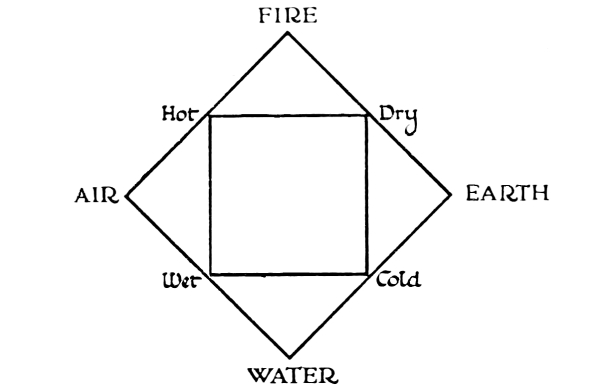
Fig. 7b. The Four Elements and the Four Qualities.
The theory of the elements and qualities is applicable to all matter and not specially to living things. The distinction between the living and not-living is to be sought not so much in its material constitution, but in the presence or absence of ‘soul’, and his teaching on that topic is to be found in his great work περὶ ψυχῆς, On Soul. He does not think of matter as organic or inorganic—that is a distinction of the seventeenth century physiologists—nor does he think of things as divided into animal, vegetable, and mineral—that is a distinction of the mediaeval alchemists,—but he thinks of things as either with soul or without soul (ἔμψυχα or ἄαψυχα).
His belief as to the relationship of this soul to material things is a difficult and complicated subject which would take us far beyond the topics included in biological writings to-day, but he tells us that ‘there is a class of existent things which we call substance, including under that term, firstly, matter, which in itself is not this nor that; secondly, shape or form, in virtue of which the term this or that is at once applied; thirdly, the whole made up of matter and form. Matter is identical with potentiality, form with actuality,’ the soul being, in living things, that which gives the form or actuality. ‘Of natural bodies’, he continues, ‘some possess life and some do not: where by life we mean the power of self-nourishment and of independent growth and decay’.[45] It should here be noted that in the Aristotelian sense the ovum is not at first a living thing, for in its earliest stage and before fertilization it does not possess soul even in its most elementary form.
‘The term life is used in various senses, and, if life is present in but a single one of these senses, we speak of a thing as living. Thus there is intellect, sensation, motion from place to place and rest, the motion concerned with nutrition, and, further, [there are the processes of] decay and growth,’ all various meanings or at least exhibitions of some form of life. Hence even ‘plants are supposed to have life, for they have within themselves a faculty and principle whereby they grow and decay.... They grow and continue to live so long as they are capable of absorbing nutriment. This form of life can be separated from the others ... and plants have no other faculty of soul at all,’ but only this lowest vegetative soul. ‘It is then in virtue of this principle that all living things live, whether animals or plants. But it is sensation which primarily constitutes the animal. For, provided they have sensation, even those creatures that are devoid of movement and do not change their place are called animals.... As the nutritive faculty may exist without touch or any form of sensation, so also touch may exist apart from other senses.’[46] Apart from these two lower forms of soul, the vegetative or nutritive and reproductive and the animal or sensitive, stands the rational or intellectual soul peculiar to man, a form of soul with which we shall here hardly concern ourselves.[47]
The possession of one or more of the three types of soul, vegetative, sensitive, and rational, provides in itself a basis for an elementary form of arrangement of living things in an ascending scale. We have already seen that Aristotle certainly describes something resembling a ‘Scala Naturae’ and that such a scheme can easily be drawn up from passages in his works. It may, however, be doubted whether his phraseology is capable of extension so as to include a true classification of animals in any modern sense. It is true that he repeatedly divides animals into classes, Sanguineous and Non-sanguineous, Oviparous and Viviparous, Terrestrial and Aquatic, &c., but his divisions are for the most part simply dichotomic. He certainly defines a few groups of animals as the Lophura (Equidae), the Cete (Cetacea), and the Selache (Elasmobranchiae together with the Lophiidae) in a way that fairly corresponds to similar groups in later systems. In most cases, however, his definitions are not exact enough for modern needs, for the same animal may fall into more than one of his classes and widely different animals into the same class. Thus he invents a category Carcharodonta for animals with sharp interlocking teeth and includes in it carnivores, reptiles, and fish; again, the horse kind must be included both among his Anepallacta or animals having flat crowned teeth as well as among the Amphodonta or animals with front teeth in both jaws. Such words as these are really terms of description, not of classification in the modern biological sense of that word.
There are, however, scattered through the biological works, certain terms which are applied to animal groups and organs and are defined in such a way as to suggest that they might ultimately have been developed for classificatory purposes. Thus his lowest group is the species. ‘The individuals comprised within a single species (εîδος) ... are the real existences; but inasmuch as these individuals possess one common specific form, it will suffice to state the universal attributes of the species, that is, the attributes common to all its individuals, once and for all.’[48] This is surely not very far removed from the modern biological conception of a species.
‘But as regards the larger groups—such as birds—which comprehend many species, there may be a question. For on the one hand it may be urged that as the ultimate species represent the real existences, it will be well, if practicable, to examine these ultimate species separately, just as we examine the species Man separately; to examine, that is, not the whole class Birds collectively, but the Ostrich, the Crane, and the other indivisible groups or species belonging to the class.
‘On the other hand, this course would involve repeated mention of the same attribute, as the same attribute is common to many species, and so far would be somewhat irrational and tedious. Perhaps, then, it will be best to treat generically the universal attributes of the groups that have a common nature and contain closely allied subordinate forms, whether they are groups recognized by a true instinct of mankind, such as Birds and Fishes, or groups not popularly known by a common appellation, but withal composed of closely allied subordinate groups; and only to deal individually with the attributes of a single species, when such species—man, for instance, and any other such, if such there be—stands apart from others, and does not constitute with them a larger natural group.
‘It is generally similarity in the shape of particular organs, or of the whole body, that has determined the formation of the larger groups. It is in virtue of such a similarity that Birds, Fishes, Cephalopoda, and Testacea have been made to form each a separate genus (γένος). For within the limits of each such genus, the parts do not differ in that they have no nearer resemblance than that of analogy—such as exists between the bone of man and the spine of fish—but they differ merely in respect of such corporeal conditions as largeness smallness, softness hardness, smoothness roughness, and other similar oppositions, or, in one word, in respect of degree.’[49]
The Aristotelian genus thus differs widely from the term as used in modern biology. In another passage he comes nearer to defining it and the analogy of parts which extends from genus to genus.
‘Groups that differ only in the degree, and in the more or less of an identical element that they possess are aggregated together under a single genus; groups whose attributes are not identical but analogous are separated. For instance, bird differs from bird by gradation, or by excess and defect; some birds have long feathers, others short ones, but all are feathered. Bird and Fish are more remote and only agree in having analogous organs; for what in the bird is feather, in the fish is scale. Such analogies can scarcely, however, serve universally as indications for the formation of groups, for almost all animals present analogies in their corresponding parts.’[50]
Aristotle nowhere gives to his term genus a rigid application that can be applied throughout the animal kingdom. He uses the word in fact much as we should use the conveniently flexible term group, now for a larger and less definite, now for a smaller and more definite collection of species. This varying use of a technical word makes it impossible to draw up a classification based on his genera or indeed with any consistent use of the terms which he actually employs.
The difficulty or impossibility of drawing up a satisfactory classificatory system from the Aristotelian writings has not, however, deterred numerous naturalists and scholars from making the attempt, and the subject has in itself a considerable history and literature[51] extending from the days of Edward Wotton (1492-1555) downward.[52] The more recent efforts at drawing up an Aristotelian classificatory system have been based on the methods of reproduction to which he certainly attached very great importance.[53] Provided that it be remembered that Aristotle does not himself detail any such system there can be no harm in constructing one from his works. At worst it will serve as a memoria technica for the extent and character of his knowledge of natural history, and at best it may represent a scheme to which he was tending.
ENAIMA (Sanguineous and either viviparous oroviparous)
= vertebrates.
Viviparous in the internal sense. 1. ἅνθρωπος. Man.
2. κήτη. Cetaceans.
3. ζῷα τετράποδα ζωοτόκα ὲν αὑτοῖς.
Viviparous quadrupeds.
(a) μὴ ἀμφώδοντα. Non-amphodonts
= Ruminants with incisor in lower
jaw only and with cloven hoofs.
(b) μώνυχα. Solid-hoofed animals.
i. λόφουρα. Equidae.
ii. μώνυχα ἔτερα. Other solid-hoofed animals.
4. ὄρνιθες. Birds.
(a) γαμψώνυχα. Birds of prey with talons.
(b) στεγανόποδες. Swimmers with webbed feet.
With (c) περιστεροειδῆ. Pigeons, doves, &c.
perfect (d) ἄποδες. Swifts, martins, &c.
Oviparous ovum. (e) ὄρνιθες ἕτεροι. Other birds.
though 5. ζὌῷα τετράποδα ῷοτόκα. Oviparous quadrupeds
sometimes = Amphibians and most reptiles.
externally 6. ὀφιώδη. Serpents.
viviparous. 7. ἰχθύες. Fishes.

With (a) σελάχη. Selachians. Cartilaginous fishes
imperfect and, doubtfully, the fishing-frog.
ovum. (b) ιχθύες ἕτεροι. Other fishes.
ANAIMA (Non-sanguineous and either viviparous, vermiparous or budding)
= Invertebrates
With perfect ovum. 8. μαλάκια. Cephalopods.

9. μαλακόστρακα. Crustaceans.
With ‘scolex’. 10. ἔντομα. Insects, spiders, scorpions, &c.
With generative 11. ὀστρακόδερμα.

slime, buds or Molluscs (except Cephalopods),
spontaneous generation. Echinoderms, &c.
With spontaneous 12. ζωόφυτα. Sponges, Coelenterates, &c.

generation only.
Some of the elements in this classification are fundamentally unsatisfactory in that they are based on negative characters. Such is the group of Anaima which is parallelled by our own equally convenient and negative though morphologically meaningless equivalent Invertebrata. Others, such as the subdivisions of the viviparous quadrupeds, can only be forcibly extracted out of Aristotle’s text. But there are yet others, such as the separation of the cartilaginous from the bony fishes, that exhibit true genius and betray a knowledge that can only have been reached by careful investigation. Remarkably brilliant too is his treatment of Molluscs. There can be no doubt that he dissected the bodies and carefully watched the habits of octopuses and squids, Malacia as he calls them. He separates them too far from the other Molluscs, grouped by him as Ostracoderma, but his actual descriptions of the structure and sexual process of the cephalopods are exceedingly remarkable, and after being long disregarded or misunderstood were verified and repeated in the course of the nineteenth century.[54]
Passing from his general ideas on the nature and division of living creatures we may turn to some of the most noteworthy of his actual observations. In the realm of comparative anatomy proper we may instance that of the stomach of ruminants. He must have dissected these animals, for he gives a clear and correct account of the four chambers. ‘Animals’, he says, ‘present diversities in the structure of their stomachs. Of the viviparous quadrupeds, such of the horned animals as are not equally furnished with teeth in both jaws are furnished with four such chambers. These animals are those that are said to chew the cud. In these animals the oesophagus extends from the mouth downwards along the lung, from the midriff to the big stomach [rumen, or paunch], and this stomach is rough inside and semi-partitional. And connected with it near to the entry of the oesophagus is what is called the kekryphalos [reticulum, or honeycomb bag]; for outside it is like the stomach, but inside it resembles a netted cap; and the kekryphalos is a good deal smaller than the big stomach.’ The term kekryphalos was applied to the net that women wore over their hair to keep it in order. ‘Connected with this kekryphalos,’ he continues, ‘is the echinos [psalterium, or manyplies], rough inside and laminated, and of about the same size as the kekryphalos. Next after this comes what is called the enystron [abomasum], larger and longer than the echinos, furnished inside with numerous folds or ridges, large and smooth. After all this comes the gut....’[55] ‘All animals that have horns, the sheep for instance, the ox, the goat, the deer and the like, have these several stomachs.... The several cavities receive the food one from the other in succession: the first taking the unreduced substances, the second the same when somewhat reduced, the third when reduction is complete, and the fourth when the whole has become a smooth pulp....’[56] ‘Such is the stomach of those quadrupeds that are horned and have an unsymmetrical dentition (μὴ ἀμφώδοντα); and these animals differ one from another in the shape and size of the parts, and in the fact of the oesophagus reaching the stomach central-wise in some cases and sideways in others. Animals that are furnished equally with teeth in both jaws (ἀμφώδοντα) have one stomach; as man, the pig, the dog, the bear, the lion, the wolf.’[57]
A very famous example in the Aristotelian works anticipating modern biological knowledge is afforded by his reference to the mode of reproduction of the cephalopods. ‘The Malacia such as the octopus, the sepia, and the calamary, have sexual intercourse all in the same way; that is to say, they unite at the mouth by an interlacing of their tentacles. When, then, the octopus rests its so-called head against the ground and spreads abroad its tentacles, the other sex fits into the outspreading of these tentacles, and the two sexes then bring their suckers into mutual connexion. Some assert that the male has a kind of penis in one of his tentacles, the one in which are the largest suckers; and they further assert that the organ is tendinous in character growing attached right up to the middle of the tentacle, and that the latter enables it to enter the nostril or funnel of the female.’[58]
The reproductive processes of the Cephalopods were unknown to modern naturalists until the middle of the nineteenth century. Before that time several observers had noted the occasional presence of a peculiar parasite in the mantle cavity of female cephalopods and had described its supposed structure without tracing any relationship to the process of generation. In 1851 it was first shown that this supposed parasite was the arm of the male animal specially modified for reproductive purposes and broken off on insertion into the mantle cavity of the female[59]. The actual process of reproduction does not seem to have been observed until 1894[60].
Aristotle is perhaps at his best and happiest when describing the habits of living animals that he has himself observed. Among his most pleasing accounts are those of the fishing-frog and torpedo. In these creatures he did not fail to notice the displacement of the fins associated with the depressed form of the body.
‘In marine creatures,’ he says, ‘one may observe many ingenious devices adapted to the circumstances of their lives. For the account commonly given of the frog-fish or angler is quite true; as is also that of the torpedo....
‘In the Torpedo and the Fishing-frog the breadth of the anterior part of the body is not so great as to render locomotion by fins impossible, but in consequence of it the upper pair [pectorals] are placed further back and the under pair [ventrals] are placed close to the head, while to compensate for this advancement they are reduced in size so as to be smaller than the upper ones.
‘In the Torpedo the two upper fins [pectorals] are placed in the tail, and the fish uses the broad expansion of its body to supply their place, each lateral half of its circumference serving the office of a fin.... The torpedo narcotizes the creatures that it wants to catch, overpowering them by the force of shock that is resident in its body, and feeds upon them; it also hides in the sand and mud, and catches all the creatures that swim in its way and come under its narcotizing influence. This phenomenon has been actually observed in operation.... The torpedo-fish is known to cause a numbness even in human beings.
‘The frog-fish has a set of filaments that project in front of its eyes; they are long and thin, like hairs, and are round at the tips; they lie on either side, and are used as baits.... The little creatures on which this fish feeds swim up to the filaments, taking them for bits of seaweed such as they feed upon. Accordingly, when the frog-fish stirs himself up a place where there is plenty of sand and mud and conceals himself therein, it raises the filaments, and when the little fish strike against them the frog-fish draws them in underneath into its mouth.... That the creatures get their living by this means is obvious from the fact that, whereas they are peculiarly inactive, they are often caught with mullets, the swiftest of fishes, in their interior. Furthermore, the frog-fish is usually thin when he is caught after losing the tips of his filaments.’[61]
The modification of the musculature of the torpedo-fish for electric purposes and the fishing habits of the fishing-frog or Lophius are now well known, but it was many centuries before naturalists had confirmed the observations of the father of biology.
When we turn from Aristotle’s observations in the department of natural history to his discussion of the actual mechanism of the living body, the subject now contained under the heading Experimental Physiology, we are in the presence of much less satisfactory material. Aristotle here exhibits his weakness in physics and not being endowed with any experimental knowledge of that subject his physiological development is very greatly handicapped. He seems often to accept fancies of his own in place of generalizations from collated observations. This tendency of his was conveyed to his successors and delayed physiological advance for many centuries. It forms a striking contrast to the method of certain of the Hippocratic works such as the Epidemics and the Aphorisms which exhibit an investigator intent on recording actual observations and on deducing general laws therefrom. Had the Hippocratic method been extended by Aristotle beyond the field of natural history, where he freely follows it, to that of physiology, the succeeding generations might have established medicine far more firmly as a science.
An important factor in Aristotle’s physical and physiological teaching is the doctrine that matter is continuous and not made up of indivisible parts. He thus rejected the atomic views of his predecessors Leucippus and Democritus which have been preserved for us by the poem of Lucretius. The different kinds of matter existing merely in their state of simple mixture formed various uniform or homogeneous substances, homoeomeria, of which the tissues of living bodies provided one type. We now consider tissues as having structure made up of living cells or their products, but to Aristotle their structure was an essential fact following on their particular elemental constitution. The structure of muscle or flesh was perhaps comparable to that of a crystalline substance, for, as we have seen, Aristotle made no fundamental distinction between organic and inorganic substances, which are in his view alike subject to the processes of generation and corruption. The difference between them lies not in their structure but in their potential relation to the various degrees of soul, the vegetative, the animal, and the rational.
‘There are’, says Aristotle, ‘three degrees of composition, and of these the first in order is composition out of what some call the elements, earth, air, water, and fire....
‘The second degree of composition is that by which the homogeneous parts of animals (ὁμοιομερῆ), such as bone, flesh, and the like, are constituted out of [these] primary substances.
‘The third and last stage is the composition which forms the heterogeneous parts (ἀνομοιομερῆ) such as face, hand, and the rest.’[62]
The distinctions are not altogether clear but may perhaps be explained along such lines as the following. The division into homogeneous and heterogeneous corresponds in a general way to the later division into Tissues and Organs, the former, however, including much that we should not call tissue. The homogeneous parts were again of two kinds: (a) simple tissues or stuffs without any notion of size or shape, that is, mere substance capable of endowment with life or soul, e.g. cartilaginous or osseous tissues; and (b) simple structure, that is actual structure made of such a single tissue but with definite form and size, matter to which form had been added and which either was actually or had been endowed with soul, e.g. a cartilage or a bone.
As a physiologist Aristotle is, in fact, in much the same position as he is as a physicist. He never dissected the human body, he had only the roughest idea of the course of the vessels, and his description of the vascular system is so difficult and confused that a considerable literature has been written on its interpretation. He regarded the heart as the central organ of the body and the seat of sensation and he probably believed that the arteries contained air as well as blood. He made no adequate distinction between veins and arteries. He tells us that two great vessels arise from the heart and that the heart is, as it were, a part of these vessels. The two vessels are apparently the aorta and the vena cava, and a very elementary and not very accurate description is given of the branches of these vessels. He believed that the heart had three chambers or cavities and that it took in air direct from the lung.
The brain was for him mainly an organ by which were secreted certain cold humours which prevented any overheating of the body by the furnace of the heart under the action of the bellows of the lung. He formally rejected the older views of Diogenes of Apollonia, of Alcmaeon of Croton, and of the Hippocratic writings, that placed the seat of sensation in the brain.[63] He failed to trace any adequate relation of sense organs and nerves to brain. He considered that the spinal marrow served to hold the vertebrae together.
In general we may say that his physiology is on a much lower plane than his natural history, since in dealing with physiological questions he always seems to have in mind the body as a whole and seldom pauses for any detailed investigation of a particular part. The physiological views of Aristotle were far from being fully accepted even by the generation which followed him. There was already growing up a school of physiologists whose work culminated five centuries later in that of Galen, where we find quite other views of the bodily functions. It is these views which we may take as more typical of the bases of Greek physiology (see p. 66).
In much of the Aristotelian material that we have discussed we have seen the development of a class of interests very foreign to those of the modern biologist, in whose work the general discussion of the ultimate nature and origin of life seldom plays a large part. The business of the modern biologist is mainly with vital phenomena as he encounters them and he is not concerned with the deeper philosophical problems. The man of science considers a part of the Universe where the philosopher makes it his business to regard the whole. With Aristotle this modern scientific process of taking a part of the sensible Universe, such as a particular group of animals or the particular action of a particular organ, and considering it in and by and for itself without reference to other things, had not yet fully emerged. Philosophy and science are still inextricably linked and there is no clear demarcation between them.
This is at least his theoretical view. But besides being a philosopher by choice he was a supreme naturalist by his natural endowments and he cannot suppress his love for nature and his capacity for observation. We see Aristotle the naturalist at his greatest as a direct observer or when reasoning directly about the observations that he has made. When he disregards his own observations and begins to erect theories on the observations or the views of others, he becomes weaker and less comprehensible.
§ 3. After Aristotle
All Aristotle’s surviving biological works refer primarily to the animal creation. His work on plants is lost or rather has survived as the merest corrupted fragment. We are fortunate, however, in the possession of a couple of complete works by his pupil and successor Theophrastus (372-287), which may not only be taken to represent the Aristotelian attitude towards the plant world, but also give us an inkling of the general state of biological science in the generation which succeeded the master.
These treatises of Theophrastus are in many respects the most complete and orderly of all ancient biological works that have reached our time. They give an idea of the kind of interest that the working scientist of that day could develop when inspired rather by the genius of a great teacher than by the power of his own thoughts. Theophrastus is a pedestrian where Aristotle is a creature of wings, he is in a relation to the master of the same order that the morphologists of the second half of the nineteenth century were to Darwin. For a couple of generations after the appearance of the Origin of Species in 1859 the industry and ability of naturalists all over the world were occupied in working out in detail the structure and mode of life of living things on the basis of the Evolutionary philosophy. Nearly all the work on morphology and much of that on physiology since his time might be treated as a commentary on the works of Darwin. These volumes of Theophrastus give the same impression. They represent the remains—alas, almost the only biological remains—of a school working under the impulse of a great idea and spurred by the memory of a great teacher. As such they afford a parallel to much scientific work of our own day, produced by men without genius save that provided by a vision and a hope and an ideal. Of such men it is impossible to write as of Aristotle. Their lives are summed up by their actual achievement, and since Theophrastus is an orderly writer whose works have descended to us in good state, he is a very suitable instance of the actual standard of achievement of ancient biology. ‘Without vision the people perish’ and the very breath of life of science is drawn, and can only be drawn, from that very small band of prophets who from time to time, during the ages, have provided the great generalizations and the great ideals. In this light let us examine the work of Theophrastus.
In the absence of any adequate system of classification, almost all botany until the seventeenth century consisted mainly of descriptions of species. To describe accurately a leaf or a root in the language in ordinary use would often take pages. Modern botanists have invented an elaborate terminology which, however hideous to eye and ear, has the crowning merit of helping to abbreviate scientific literature. Botanical writers previous to the seventeenth century were substantially without this special mode of expression. It is partly to this lack that we owe the persistent attempts throughout the centuries to represent plants pictorially in herbals, manuscript and printed, and thus the possibility of an adequate history of plant illustration.
Theophrastus seems to have felt acutely the need of botanical terms, and there are cases in which he seeks to give a special technical meaning to words in more or less current use. Among such words are carpos = fruit, pericarpion = seed vessel = pericarp, and metra, the word used by him for the central core of any stem whether formed of wood, pith, or other substance. It is from the usage of Theophrastus that the exact definition of fruit and pericarp has come down to us.[64] We may easily discern also the purpose for which he introduces into botany the term metra, a word meaning primarily the womb, and the vacancy in the Greek language which it was made to fill. ‘Metra,’ he says, ‘is that which is in the middle of the wood, being third in order from the bark and [thus] like to the marrow in bones. Some call it the heart (καρδίαν), others the inside (ἐντεριώνην), yet others call only the innermost part of the metra itself the heart, while others again call this marrow.’[65] He is thus inventing a word to cover all the different kinds of core and importing it from another study. This is the method of modern scientific nomenclature which hardly existed for botanists even as late as the sixteenth century of our era. The real foundations of our modern nomenclature were laid in the later sixteenth and in the seventeenth century by Cesalpino and Joachim Jung.
Theophrastus understood the value of developmental study, a conception derived from his master. ‘A plant’, he says, ‘has power of germination in all its parts, for it has life in them all, wherefore we should regard them not for what they are but for what they are becoming.’[66] The various modes of plant reproduction are correctly distinguished in a way that passes beyond the only surviving earlier treatise that deals in detail with the subject, the Hippocratic work On generation. ‘The manner of generation of trees and plants are these: spontaneous, from a seed, from a root, from a piece torn off, from a branch or twig, from the trunk itself, or from pieces of the wood cut up small.’[67] The marvel of generation must have awakened admiration from a very early date. We have already seen it occupying a more ancient author, and it had also been one of the chief pre-occupations of Aristotle. It is thus not remarkable that the process should impress Theophrastus, who has left on record his views on the formation of the plant from the seed.
‘Some germinate, root and leaves, from the same point, some separately from either end of the seed. Thus wheat, barley, spelt, and all such cereals [germinate] from either end, corresponding to the position [of the seed] in the ear, the root from the stout lower part, the shoot from the upper; but the two, root and stem, form a single continuous whole. The bean and other leguminous plants are not so, but in them root and stem are from the same point, namely, their place of attachment to the pod, where, it is plain, they have their origin. In some cases there is a process, as in beans, chick peas, and especially lupines, from which the root grows downward, the leaf and stem upward.... In certain trees the bud first germinates within the seed, and, as it increases in size, the seeds split—all such seeds are, as it were, in two halves; again, all those of leguminous plants have plainly two lobes and are double—and then the root is immediately thrust out. But in cereals, the seeds being in one piece, this does not happen, but the root grows a little before [the shoot].
‘Barley and wheat come up monophyllous, but peas, beans, and chick peas polyphyllous. All leguminous plants have a single woody root, from which grow slender side roots ... but wheat, barley, and the other cereals have numerous slender roots by which they are matted together.... There is a contrast between these two kinds; the leguminous plants have a single root and have many side-growths above from the [single] stem ... while the cereals have many roots and send up many shoots, but these have no side-shoots.’[68]