Volume 5 — WORKMEN AND HEROES (continued 6)
Reading edition
On both sides of the road which the retreating army had to traverse the Spaniards had placed in ambush a large force of arquebusiers. It was a weapon which Bayard held in detestation; for while skill and courage were required to wield a spear or sword, any skulking wretch could pull a trigger from behind a stone. From one of these hated weapons he received his death. As he was retreating slowly with his face toward the foe, a stone from a cross-arquebus struck him on the side. He instantly sank forward on his saddle-bow, exclaiming in a faint voice, "Great God! I am killed."
His squire helped him from his horse, and he was laid beneath a tree. His spine was broken in two places; and he felt within himself that he was dying. He took his sword, and kissed the cross-hilt, murmuring aloud the Latin prayer, "Miserere mei, Deus, secundum magnam misericordiam tuam."
The Spaniards were approaching. His friends made some attempt to raise him and to bear him from the field. But the least movement made him faint with agony; and he felt that all was vain. He charged his companions, as they loved him, to turn his face toward the enemy, and to retire into a place of safety; and he sent, with his last breath, his salutation to the king. With breaking hearts they did as he desired, and he was left alone.
When the Spaniards reached the spot, they found him still alive, but sinking fast. The conduct of Lord Pescara, the Spanish general, toward his dying foe, was worthy of a great and noble knight. He bade his own pavilion to be spread above him; cushions were placed beneath his head; and a friar was brought, to whom he breathed his last confession. As he was uttering the final words, his voice faltered, and his head fell. The friar looked upon his face—and saw that all was over.[Back to Contents]
GUSTAVUS VASA[11] By Charles F. Horne (1496-1560)
Three or four hundred years ago the little country of Denmark was of much greater importance than it is to-day. It had the mightiest navy in the world, and its rule over the seas was undisputed. Its appearance on the map was also very different then, for it not only extended over much of the German territory now surrounding it, but also held all Norway as a province. Sweden, too, though often rebelling, and being punished with terrible cruelty, was, up to the year 1523, a dependency of the Danish crown.
Naturally the Danes rather looked down on the conquered Swedes, and made them the subject of many rude jests and taunts. There was in the beginning of the sixteenth century at the great Danish university at Upsala a Swedish boy, who with the rest of his countrymen must have suffered many such insults. His proud, brave, little heart rebelled against this treatment; and one day, when his teacher had driven him beyond endurance with his severe punishments and bitter sneers, the boy snatched out his little sword and plunged it straight through the master's book. "I will teach you something, too," he cried; "teach you that the Swedes are no cowards, for some day I will gather them together and treat every Dane in Sweden as I do your book." Then he rushed out of the school, never to return.
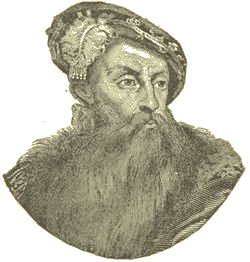
Many lads have, in some moment of passion made big boasts of what they would do "some day." Few ever made so tremendous a vaunt; fewer still ever so completely fulfilled their threats; and, perhaps, no one ever struggled so patiently, so nobly, nor against such tremendous obstacles before the goal was reached, as did this angry little Swede, known to history as Gustavus Vasa. He was born in 1496, and was the oldest son of Sir Eric Johansson, governor of a little group of islands in the Gulf of Bothnia. Returning home after his precipitate flight from school, Gustavus grew up under the eye of his stalwart father, who trained him to be not only a strong and a shrewd man, but also a good one.
Sent at the age of eighteen to the court of Svante Sture, the regent governing Sweden, he threw himself eagerly into the great war for freedom which his countrymen had begun under that mighty leader. This struggle was so far successful that four years later King Christian, of Denmark, utterly defeated on land and with his fleet in sore danger anchored off Stockholm, and proposed a peace. He asked that hostages be sent to remain on his ships, while he was on shore arranging the treaty. This was readily agreed to, and the hostages went on board without a thought of evil, the king having guaranteed their safe return. Young Vasa, although only twenty-two, had already gained such prominence among the patriots as to be one of those selected for this duty. Just as he and his companions reached the ships, the wind, which had hitherto blown from such a direction that King Christian was unable to leave the harbor, suddenly changed, and the king as promptly changing his plans, hoisted sail and fled from Stockholm, carrying with him, as prisoners, the hostages whom he was bound in honor to respect. But this grim and cruel old king never at any time let himself be checked by his promised word; and now he seriously considered slaying these men as rebels and traitors. Finally he concluded to hold them as prisoners.
Gustavus was placed for safe keeping in the castle of Eric Bauer, a Jutland noble, where he remained for two years. He lived on the very poorest food, and far worse, had to endure taunts a hundred times more bitter than those of his old school days, from the young nobles about him. Worse still, he learned from them that King Christian was gathering another and greater army with which to utterly crush the rebellious Swedes; and he could neither warn his countrymen nor raise a finger to give them help. But his courage and patience never failed him. Through all that weary time he was always planning and watching for a chance to escape. At last it came. Deceived by his apparent indifference his jailers permitted him to ride, and even to hunt with them, but always under a careful watch. One day, however, the hunt grew so exciting that everyone forgot Gustavus and rode hard and fast after the game. He saw his opportunity, and rode hardest and fastest of all. Soon he was first in the race; but he did not stop when he reached the captured deer. There was no one in sight and he hurried on faster than ever. When his horse gave out he pressed forward on foot, and nightfall found him forty miles from the castle. He astonished a countryman by trading clothes with him; and the next day, thus disguised, he hired himself to a drover to help him drive a herd of cattle to the great German city of Lubeck. Probably no cattle had ever been so driven before. Our hero knew well that the pursuit would be fast and furious, and he kept the herd almost on a steady run. The old drover was in a perpetual state of amazement; he did not know whether to regard his new assistant as a madman or as the most valuable hand he had ever hired. Gustavus never let the poor old fellow rest a moment; he had to eat his meals as he walked, and even to totter along half asleep. At last animals and men reached Lubeck, all badly worn out, but safe, for Lubeck was a free city and a powerful one, and when, an hour later, the enraged Eric Bauer galloped up to its great gates, he knew that his prisoner was beyond his reach, and that unless he could persuade the citizens to give him up there was no chance of recapturing him.
The citizens did not give Gustavus up. He and his jailer were brought face to face before the City Council to argue their case. When Eric said his prisoner had broken his word in escaping, Gustavus related how the king had broken his in the capture. When Eric threatened them all with his master's wrath, the shrewd old burghers laughed. They knew King Christian had other things to keep him busy enough, and that he would think twice before attacking their great league of cities. Besides, this young man had already shown that he could do great things, and, as one of the Council said, "Who knows what he may win if we send him home." So Eric was forced to leave without his captive; and after some delay, during which he was treated with high honor, Gustavus was sent home by the kind Lubeckers with the promise to help him, if need be, with both men and money.
Indeed Sweden needed all the help she could get just then; but it did not seem as though one man could do much for her. King Christian had carried out his threats, and landing with a great army, defeated the brave Sture and spread terror and destruction through all the land. The tale of his cruelty and treacheries belongs rather to the history of Sweden than of Gustavus. Enough to say that, having by promises of peace and pardon got all the leading Swedes into his power, he had them murdered, and then he and his soldiers went on slaying the common people right and left in mere wanton savagery. All the surviving nobles were in his pay; the least suspicion of an uprising was crushed with an iron hand, the least murmur of discontent brought death. Never had Sweden seemed more helpless in the power of the Danes.
To this unhappy country came Gustavus Vasa, and at once he was declared an outlaw, and a great price was offered for his head; for the king knew that here survived one man whom he could neither terrify nor bribe. One castle still held out against the besieging Danes, and for this Gustavus set out. But its defenders were disheartened by their hopeless position, and were almost on the point of surrender. They answered angrily to his brave words, and he left them to try and rouse the peasantry all over the land.
Now began for him such a period of danger, sorrow, and privation, as few men could have endured and lived. The land was filled with Danes eager for his capture. The peasants were timid and disheartened. To his passionate patriotic appeal they answered only, "We have salt and herring still. If we rebel we will lose them too." Often they drove him away with stones. Sometimes his own countrymen would have slain him for the promised reward. At length it was no longer possible for him to remain in Southern Sweden, and with a single servant he fled to the highlands of Dalecarlia, a province in the north. From this on his life reads like some wild romance of adventure. He had the grim courage and grit and perseverance of a bull-dog. Nothing could dishearten him in his seemingly hopeless and insane resolve to raise the Swedes once more against Christian.
He found as much devotion in some places, as he did treachery in others. Having crossed a ferry in advance of his servant, this latter rode off with their small stock of money. Gustavus plunged his horse into the river, and riding back after the faithless servitor, pursued him all day straight back into the enemy's country, until the terrified thief, abandoning horse and money and all, fled into the woods. Gustavus recovered his property and pursued his course. The Danes swarmed into Dalecarlia after him. He disguised himself as a woodcutter, and lived as such. One day he met in the woods a giant Dalesman named Liss Lars, and, as they were chatting together, a great bear attacked Gustavus. After a fierce battle Lars slew the brute with a blow of his axe. The two woodcutters became friends, and Lars got his companion a place under the same master as himself, where Gustavus remained a whole winter unsuspected. Often he himself was questioned by the Danish spies, hunting for the now famous Vasa.
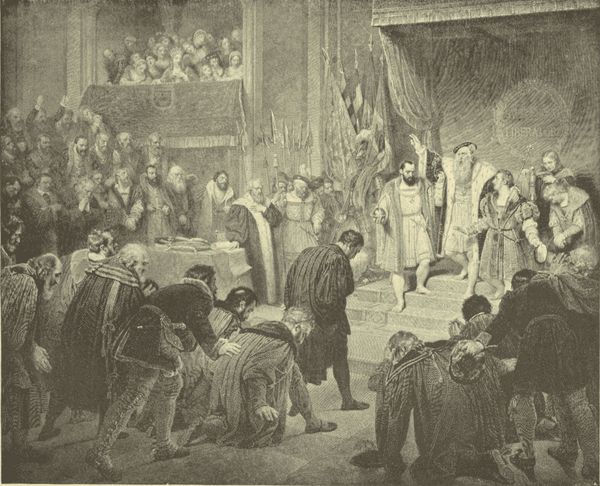
Abdication of Gustavus Vasa.
Once there was like to have been trouble between the two friends, for Lars loved a maiden at the farm, who out of coquetry often smiled at Gustavus, until the giant Dalesman became terribly jealous. One day when she brought them their noon-day ale, she handed it first to Gustavus, who, after drinking, returned it with a pleasant word and a pat on the cheek. With a roar like a mad bull, Lars rushed on his comrade and seized him in his giant arms. As he did so he saw around his neck the embroidered collar worn by the Swedish nobility. The astounded Dalesman staggered back, pointing to it. "Either thou art a thief, or the great Gustavus himself." "Ay, friend Lars, I am the outlaw Gustavus, son of Eric. Now, wilt thou hand me over to the Danes, or smash my head against the floor, as just now thou seemedest minded?" "I will swear eternal fealty to thee," cried Lars; "and if thou raisest the standard of revolt, I will be the first to join."
Soon, however, even this retired spot became too unsafe, and Gustavus fled farther north. Once an old schoolmate offered him shelter, and then, while Gustavus slept, rode away to get help to capture him. But the housewife, suspecting her husband's treachery, roused Gustavus, who climbed through a window twenty feet from the ground, and escaped on a horse the good woman had provided.
At another time, by burying himself in a load of hay he was carried past some Danish soldiers who were searching for him. They thrust their spears through the hay and then rode on. One of the spears wounded the hidden man, and, seeing the blood trickle down, the soldiers hurried back. But the driver had snatched out his knife and given a slight cut to one of his horses; and when he pointed to this, charging one of them with having done it, they rode away again laughing at their own suspicions. In a hundred other equally dangerous situations he escaped either by his own courage, or by the ready wit of the brave Dalecarlian peasants; and at last the Danish spies gave up the hunt for him, and returned to Stockholm.
Then he came forth again, and in ringing words urged the people to revolt. But though they loved Gustavus, and loved Sweden, yet they held back in doubt and fear from his daring plans; and so the hero left them, and went on through the surrounding provinces, telling everywhere of King Christian's cruelty, and sowing seed which was to ripen later on. Yet nowhere could he rouse the peasants to action, until word came that the cruel king had sworn to cut a hand and foot from every man in Sweden, that they might never revolt again. Now all felt that there was nothing left but fight. In great haste the Dalecarlians sent after Gustavus and brought him back. They held a great meeting, and to it came Gustavus' wood-cutter friend, Liss Lars. He made a great homely speech, saying, "This Gustavus, son of Eric, is a man. He has threshed with me, and I know him. We can trust him, and sense has he, more than all of us put together. He must be our leader."
All swore fealty to Gustavus; and he bade them make swords and spears and arrows on their own anvils, while he went on again to rouse the other provinces. King Christian had been called home by a rumor of rebellion there, but his lieutenants thought to crush this little uprising of the Dalecarlians as easily as they had a few others, and one of them marched promptly there with a large force. The brave peasants, led by Liss Lars and another, attacked him as he was crossing a river and defeated him with great slaughter. Gustavus heard rumors of the battle, and that his little army was destroyed. In wild haste he galloped back to Dalecarlia to find them celebrating their victory.
Now did the men he had roused in every quarter come pouring in; and he drilled them, and trained them, and encouraged them, became head and hand and heart for them all, till soon he had such an army that he might fairly hope to match any force the Danes could bring against him. Then he sent out a proclamation declaring Christian deposed for his cruel and bloody tyranny, and calling all true Swedes to join him in making war upon the oppressor.
Thus did this young man at twenty-five become the leader of a great rebellion, which he himself had created and controlled. He led his men against one fortress after another. There were long sieges and terrible battles; but Gustavus proved himself as great a general as he was a man; and two years later, in 1525, Stockholm, the last town remaining to the Danes in Sweden, surrendered to his army. Christian himself had been unable to leave Denmark, but he was in constant communication with his lieutenants, and wild was his rage at the continued success of his young opponent. Gustavus's mother and sister, with many other Swedish ladies, had fallen into the king's hands at the time of those wholesale murders; and he tried to frighten the hero with threats of what he would do to them; but poor Gustavus had learned only too surely that most of them were already dead from his cruel treatment. Finally this brute was deposed by his own subjects, and a new king chosen. This king made some faint attempts to recover Sweden, but he had small chance against such a man as Vasa.
The hero and his army entered Stockholm in triumph; and such of the old nobles as were left, gathered in a council and offered him the crown which he had wrested from Denmark. He refused it, saying he had labored for his country, not himself, and bade the nobles choose from among themselves some older man. But the whole country cried out that they would submit to no man but him; he had freed them, he should rule them. So there was, what seldom has been in history, a free choice of a king by a united people; and Gustavus, son of Eric, became Gustavus I., King of Sweden. Five years before he had been carried off a helpless, almost friendless prisoner, by a mighty king. Now they had, by sheer force of character, changed places; the king was in a dungeon, Gustavus on a throne.
Though the remainder of our hero's life was less adventurous, it was no less noble. He made, as all had foreseen, a great king, showing himself as wise and high-minded as he had already proven brave and patient. He found Sweden a petty province, he left it a mighty kingdom; he found it a wilderness, poor, thinly peopled, and semi-barbarous, he left it prosperous, populous, and civilized. He himself was the head and centre of all this, performing an amount of work which seems almost impossible for one man. His letters, some of which remain, are clear, minute in detail, and exact. He knew just how he wanted things done, and he had them done his way. His own life might be summed up in his advice to his two sons, given when, only a few months before his death, he resigned a crown grown too heavy for his failing strength. "Think carefully, execute promptly, never give up, never delay. Resolves not carried out are like clouds without rain in times of drought."[Back to Contents]
MARY, QUEEN OF SCOTS By Samuel L. Knapp (1542-1587)
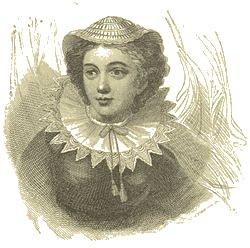
Mary Stuart, Queen of Scots, was the third child of James V. and his wife, Mary of Guise. That lady had borne him previously, two sons, both of whom died in infancy. Mary was born on December 7, 1542, in the palace of Linlithgow. She was only seven days old when she lost her father, who, at the time of her birth, lay sick at the palace of Falkland.
The young queen was crowned by Cardinal Beaton, at Stirling, on September 9, 1543. Soon after her birth, the Parliament nominated commissioners, to whom they intrusted the charge of the queen's person, leaving all her other interests to the care of her mother. The first two years of her life, Mary spent at Linlithgow, where it is said she had the small-pox, but the disease must have been of a particularly gentle kind, having left behind no visible traces. During the greater part of the years 1545, 1546, and 1547, she resided at Stirling Castle, in the keeping of Lords Erskine and Livingstone. She was afterward removed to Inchmahome, a sequestered island in the lake of Monteith; after remaining there upward of two years, it was thought expedient by those who had at the time the disposal of her future destiny, that she should be removed to France. She was accordingly, in the fifth year of her age, taken to Dunbarton, where she was delivered to the French admiral, whose vessels were waiting to receive her; and attended by Lords Erskine and Livingstone, her three natural brothers, and four young ladies as companions, she left Scotland.
The thirteen happiest years of Mary's life were spent in France. She was received at Brest, by order of Henry II., with all the honors due to her rank and royal destiny. She travelled by easy stages to the palace at St. Germain en Laye; and to mark the respect that was paid to her, the prison gates of every town she came to were thrown open, and the prisoners set free. Shortly after her arrival she was sent, along with the king's own daughters, to one of the first convents in France, where young ladies of distinction were instructed in the elementary branches of education.
Henry, to confirm the French authority in Scotland, was eager to marry Francis, his son, to Mary. Francis, the young dauphin, who was much about Mary's own age, was far inferior to her both in personal appearance and mental endowments. They had been playmates from infancy; they had prosecuted all their studies together; he loved her with the tenderest affection; it was not in Mary's nature to be indifferent to those who evinced affection for her; and if her fondness for Francis was mingled with pity, it has long been asserted that "pity is akin to love."
On April 24, 1558, the nuptials took place in the church of Notre Dame, with great splendor. Every eye was fixed on the youthful Mary; and, inspired by those feelings which beauty seldom fails to excite, every heart offered up prayers for her future welfare and happiness. She was now at that age when feminine loveliness is perhaps most attractive. It is not to be supposed, indeed, that her charms, in her sixteenth year, had ripened into that full-blown maturity which they afterward attained; but they were on this account only the more fascinating. Some have conjectured that Mary's beauty has been extolled far above its real merits; and it cannot be denied that many vague and erroneous notions exist regarding it. But that her countenance possessed, in a pre-eminent degree, the something which constitutes beauty, is sufficiently attested by the unanimous declaration of all contemporary writers. Her person was finely proportioned, and her carriage exceedingly graceful and dignified.
Shortly after the espousals, Mary and her husband retired to one of their princely summer residences, where she discharged the duties of a wife without ostentation. But the intriguing and restless ambition of her uncles could not allow her to remain long quiet. About this time Mary Tudor, who had succeeded Edward VI. on the English throne, died; and although the Parliament had declared that the succession rested in her sister Elizabeth, it was thought proper to claim for Mary Stuart a prior right. But it was destined that there was to be another and more unexpected death at the French court. Henry II. was killed at a tournament by Count Montgomery. Francis and Mary succeeded to the throne. Mary was now at the very height of European grandeur, for she was queen of two powerful countries, and heir presumptive of a third. She stood unluckily on too high a pinnacle to be able to retain her position long. Francis died after a short reign of seventeen months, and the heir to the throne Charles IX., being a minor, Catharine de Medicis became once more virtually queen of France; and from her Mary could expect no favors.
In August, 1561, Mary left France with tears, and was received in Scotland with every mark of respect. She came, alone and unprotected, to assume the government of a country which had long been distinguished for its rebellious turbulence. Contrasted, too, with her former situation, that which she was now about to fill appeared particularly formidable. By whatever counsel she acted, the blame of all unpopular measures would be sure to rest with her. If she favored the Protestants, the Catholics were sure to renounce her, and if she assisted the Catholics, the Protestants would be again found assembling at Perth, listening, with arms in their hands, to the sermons of John Knox, pulling down the remaining monasteries, and subscribing additional covenants. Is it surprising, then, that she found it difficult to steer her course between the rocks of Scylla and the whirlpools of Charybdis? If misfortunes ultimately overtook her, the wonder unquestionably ought to be, not that they ever arrived, but that they should have been guarded against so long.
To further their political views, Mary's hand was sought for by princes of the several European courts. The princes of the house of Austria, apprehensive of the ambition of France, wished a union between the Scottish queen and the Archduke Charles. Philip II., envying the Austrians so important a prize, used all his influence to procure her hand for his son Don Carlos, heir to the extensive domains of the Spanish monarchy. Catharine de Medicis, jealous of them both, offered the hand of the Duke of Anjou, brother to her former husband, and Elizabeth, the artful queen of England, recommended Lord Robert Dudley, afterward Earl of Leicester.
Mary shunned all their intrigues, and followed the bent of her own inclination in marrying Henry Stuart, Lord Darnley, eldest son of the Earl of Lennox. Darnley, at this time in the bloom of youth, was distinguished for the beauty and grace of his person, and accomplished in every elegant art; and he also professed the Catholic religion. Darnley's qualifications, however, were superficial, and abandoning himself to pleasure and the vices of youth, he became gradually careless and indifferent toward the queen, whose disappointments and mortifications were in proportion to the fervor of her former sentiments. Her French secretary was one David Rizzio, who was possessed of musical talents, and to whom she became much attached. Darnley became jealous of Rizzio, and he, with a number of conspirators, took possession of the palace on March 9, 1566, while the queen was at supper with the Countess of Argyle and Rizzio. The latter clung to the queen for protection, but he was torn from her and dragged to the next apartment, where the fury of his enemies put an end to his existence, by piercing his body with fifty-six wounds. The conspirators put Mary under guard, but she escaped, and by the aid of Bothwell and others, she was soon enabled to put her enemies at defiance. This event served to alienate Mary's affections from Darnley.
On June 19, 1566, the queen gave birth to a son; an event more fortunate to the nation than to his unhappy mother, whose evil destiny received aggravation from a circumstance which appeared so flattering to her hopes.
Darnley, neglected by the queen, and despised by the people, remained in solitude at Stirling, but alarmed by the rumor of a design to seize his person, he thought fit to retire to his father at Glasgow. On his way thither he was seized with a dangerous illness. Mary visited him, and it is said prevailed on him to be removed to the capital, where she would attend on him. Kirk of Field, a house belonging to the provost of a collegiate church, was prepared for his reception. The situation, on a rising ground and in an open field, was recommended for the salubrity of its air.
At two o'clock on the morning of February 10, 1567, the city was alarmed by a sudden explosion. The house in which Darnley resided was blown up with gunpowder. The dead body of Henry and a servant, who slept in his room, were found lying in an adjacent garden, without marks of violence, and untouched by fire. Thus perished Henry Stuart, Lord Darnley, in his twenty-first year, a youth whom the indulgence of nature and fortune had combined to betray to his ruin.
This execrable deed gave rise to various suspicions and conjectures, which, while they glanced at the queen from her new sentiments with regard to her husband, were, with a general consent, directed toward Bothwell. A proclamation was issued from the throne, offering a considerable reward for the murderer. Neither the power and greatness of Bothwell, nor his favor with the queen, secured him from the indignant sentiment of the nation. He had a mock trial, in which he was acquitted.
The queen, on a journey from Edinburgh to Stirling, to visit her son, was seized by a party of Bothwell's and conducted a prisoner to his castle at Dunbar. Here he prevailed on her to marry him, and on her subsequent appearance in public she was received with a sullen and disrespectful silence by the people.
The transactions which had passed during the last three months in Scotland were beheld by Europe with horror and detestation. The murder of the king, the impunity with which his assassins were suffered to escape, and the marriage of the queen with the man accused of being their chief, were a series of incidents, which, for their atrocity and rapid succession, were scarcely to be paralleled in the pages of history. A general infamy fell upon the Scotch nation, which was regarded, from these circumstances, as a people void of decency, humanity, and honor.
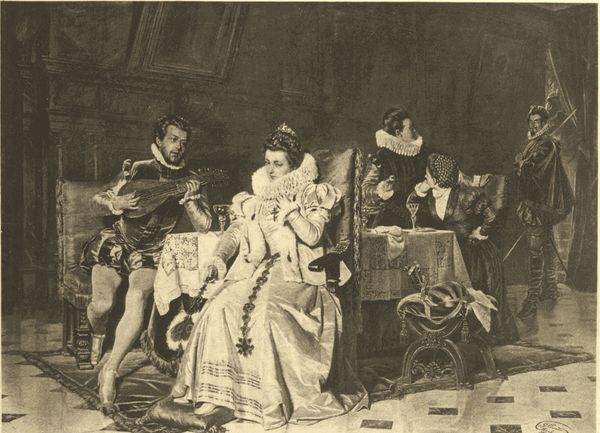
Mary Stuart and Rizzio.
The discontented nobles confederated together and flew to arms. Bothwell and Mary were unable to stem the opposition; she surrendered to her enemies, and was conducted a captive to the castle of Lochleven. Mary had for some weeks suffered the terrors of a prison; of her deliverance there seemed to be but little prospect; no one had appeared as her defender or advocate. Thus solitary, deserted, and distressed, her persecutors reckoned on her fears and on her sex. Lord Lindsay, the fiercest zealot of the party, was employed to communicate their plan to the queen, and to obtain from her a subscription to the papers with which he was charged. In the execution of his commission, he spared neither harshness nor brutality; certain death was offered to the unhappy victim, as the alternative of her refusal. Thus urged, she yielded to the pressure of circumstances, and put her signature to the papers presented to her by Lindsay. By one of these papers she resigned the crown, renounced all share in the government, and consented to the coronation of the young king. By another, she appointed Murray to the regency, and vested him with the powers and privileges of the office. Pierced with grief, and bathed in indignant tears, she signed the deed of her own humiliation, and furnished to her adversaries the instrument of her abasement.
The people were not generally satisfied with the conduct of Murray, the regent, and the scattered party of the queen began gradually to reunite. Such was the disposition of the nation when Mary, through the medium of George Douglas, a youth of eighteen, contrived to escape from prison. She flew on horseback, at full speed, to Hamilton, where, before a train of great and splendid nobles, and an army 6,000 strong, she declared that the deeds signed by her during her imprisonment, and the resignation of her crown, were extorted from her by fear. An engagement between her forces and those of Murray took place at Hamilton; her army was defeated. She stood on a hill and saw all that passed. In confusion and horror she began her flight, and so terrible was the trepidation of her spirits, that she stopped not till she reached the abbey of Dunrenan, in Galloway, fully sixty Scottish miles from the field of battle. In the space of eleven days she had beheld herself a prisoner, at the mercy of her greatest enemies; at the head of a powerful army, with a numerous train of nobles devoted to her service; and a fugitive, at the hazard of her life, driven, with a few attendants, to lurk in a corner of her kingdom. Still anxious and agitated in her retreat, she was impelled by her fears to an irretrievable step, fatal to all her future hopes. In vain her attendants, with the lords Herries and Heming, implored her on their knees not to confide in Elizabeth, her resolution was not to be shaken, and to England she fatally resolved to fly. No longer an object of jealousy, but compassion, Mary trusted in the generosity of a sister queen, that she would not take advantage of her calamitous situation. She got into a fisherman's boat, and with about twenty attendants, landed at Workington, in Cumberland, whence, with marks of respect, she was conducted to Carlisle.
She addressed, on her arrival in England, a letter to the queen, in which she painted in glowing colors the injuries she had sustained, and implored the sympathy and assistance which her present situation so pressingly required. Elizabeth and her council deliberated upon the course which, in this extraordinary event, it would be proper to pursue; and at last determined, in spite of justice and humanity, to avail herself of the advantages given her by the confidence of her rival. Mary demanded a personal interview with Elizabeth, but this honor she was told must be denied to her. She had no intention of acknowledging superiority in the queen of England, who, she expected, would, as a friend, herself receive and examine her defences. But Elizabeth chose to consider herself as umpire between the Scottish queen and her subjects; and she prepared to appoint commissioners to hear the pleadings of both parties, and wrote to the Regent of Scotland to empower proper persons to appear in his name, and produce what could be alleged in vindication of his proceedings.
Mary, who had hitherto relied on the professions of Elizabeth, was by this proposal at once undeceived, and she was, in despite of her remonstrances and complaints, conducted to Bolton, a castle of Lord Scroop, on the borders of Yorkshire. Commissioners met on both sides, and after protracted deliberations for four months, they left things just as they found them.
The last eighteen years of Mary's life were spent in imprisonment, and are comparatively a blank in her personal history. She was transported, at intervals, from castle to castle, and was intrusted sometimes to the charge of one nobleman, and sometimes to another; but for her the active scenes of life were past; the splendor and dignity of a throne were to be enjoyed no longer; the sceptre of her native country was never more to grace her hands; her will ceased to influence a nation; her voice did not travel beyond the walls that witnessed her confinement. She came into England at the age of twenty-five, in the prime of womanhood, the full vigor of health, and the rapidly ripening strength of her intellectual powers. She was there destined to feel, in all its bitterness, that "hope deferred maketh the heart sick." Year after year passed slowly on, and year after year her spirits became more exhausted, her health feebler, and her doubts and fears confirmed, till they at length settled in despair. Premature old age overtook her before she was past the meridian of life; and for some time before her death, her hair was white "with other snows than those of age." Yet, during the whole of this long period, amid sufferings which would have broken many a masculine spirit, and which, even in our own times, have been seen to conquer those who had conquered empires, Mary retained the innate grace and dignity of her character, never forgetting that she had been born a queen, or making her calamities an excuse for the commission of any petty meanness, which she would have scorned in the days of her prosperity. Full of incident as her previous life had been, brilliant in many of its achievements, it may be doubted whether the forbearance, fortitude, and magnanimity displayed in her latter years, do not redound more highly to her praise than all that preceded. Elizabeth wished for some plausible pretext to take away the life of the unhappy Mary, whom, though so defenceless, she regarded as a dangerous rival. The Duke of Norfolk made offers of marriage to Mary, to which she consented, in case she should be liberated. His scheme also was to favor the Catholic cause, and on its being discovered he was thrown into prison, where, after six months' confinement, he was liberated, on condition of his holding no further intercourse with the queen. He was, however, arrested the second time, and executed.
A conspiracy soon after took place, through the blind affection of the English Catholics for Mary, and their implacable hatred of Elizabeth; that, while it proved fatal to the life of one queen, has left on the memory of the other an indelible stain. It was a conspiracy of two zealous Catholics, to take the life of Elizabeth. The plot was revealed in confidence to Anthony Babington, a young gentleman of Derbyshire, possessing a large fortune and many amiable qualities, whom the Archbishop of Glasgow had recommended to the notice of Mary. The conspirators, through treachery, were arrested, and it is said two letters from Mary were found with Babington. This was a pretext to represent these fanatics as the instruments of the captive queen. Determined that no circumstance of solemnity suited to the dignity of the person arraigned might be wanting, Elizabeth appointed, by a commission under the great seal, forty persons, the most illustrious in the kingdom for their rank and birth, together with five judges, for the decision of the cause.
On October 11, 1586, the commissioners arrived at Fotheringay, where Mary was confined. She solemnly protested her innocence of the crime laid to her charge, and having never countenanced any attempt against the life of Elizabeth, she refused to acknowledge the jurisdiction of the commissioners. "I came," said she, "into the kingdom an independent sovereign, to implore the queen's assistance, not to subject myself to her authority. Nor is my spirit so broken by past misfortunes, or intimidated by present dangers, as to stoop to anything unbecoming the majesty of a crowned head, or that will disgrace the ancestors from whom I am descended, and the son to whom I shall leave my throne."
Mary made her own defence; and her conduct before her judges displayed the magnanimity of a heroine, tempered by the gentleness and modesty of a woman. The judges were predetermined to find her guilty: the trial was a mere pretence to give a sanction to their proceedings; they were unanimous in declaring Mary "to be accessory to the conspiracy of Babington, and to have imagined divers matters, tending to the hurt, death, and destruction of Elizabeth, contrary to the express words of the statute made for the security of the life of the queen."
On Tuesday, February 7, 1587, the Earls of Shrewsbury and Kent arrived at Fotheringay, and read in Mary's presence the warrant for her execution, which was appointed for the ensuing day. "That soul," said Mary, calmly crossing herself, "is unworthy the joys of heaven, which repines because the body must endure the stroke of the axe. I submit willingly to the lot which heaven has decreed for me; though I did not expect the Queen of England would set the first example of violating the sacred person of a sovereign prince." Then laying her hand on a Bible, which happened to be near her, she solemnly protested her innocence.
At the scaffold she prayed for the prosperity of her son, and for a long and peaceable reign to Elizabeth. She hoped for mercy, she declared, only through the death of Christ, at the foot of whose image she willingly shed her blood. With intrepid calmness she laid her neck on the block; her hands were held by one executioner, while the other, with two blows, dissevered her head from her body. "So perish all the enemies of Elizabeth!" exclaimed the dean, as he held up the streaming head. "Amen," answered the Earl of Kent alone; every other eye was drowned in tears; every other voice was stifled in commiseration. Thus, after a life of forty-four years and two months, nineteen years of which had been passed in captivity, perished the lovely and unfortunate Mary, Queen of Scots.[Back to Contents]
CAPTAIN JOHN SMITH[12] By Marion Harland (1579-1631)
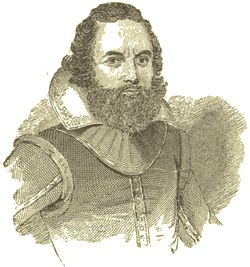
Of the antecedents of John Smith, Esquire, Captain and Knight, little is recorded beyond the facts that he was of gentle blood and honorable lineage, and that he was born in Lancashire, England, in 1579.
He was still under age when he enlisted as a private soldier and fought with "our army" in Flanders. Sigismund Bathor, Duke of Transylvania, was warring with the Turks, and young Smith, athirst for adventure, next took service under him. Before the Transylvanian town of Regall, he killed three Turkish officers in single combat, for which doughty deed he was knighted. The certificate of Sigismund's patent empowering the Englishman to quarter three Turks' heads upon the family coat-of-arms is in the Herald's Office in London.
The tables were turned by his subsequent capture by the Turks. He was sent to Tartary as a slave, not a prisoner of war, and compelled to perform the most ignoble tasks, until, escaping by killing his brutal master, he made his way by his wits to his native country in 1604. He was now twenty-five years of age, and emphatically a soldier of fortune. The tale of his prowess and adventures had preceded him, and he was eagerly welcomed in London by kindred spirits who were preparing to emigrate to America to form the colony of Virginia under the grant and direct patronage of James I. By the time the enterprise was ripe for execution, Smith had made himself so useful in counsel and preparation that the king named him as one of the councillors of the prospective colony.
The boundary lines of the royal grant were two hundred miles north, and the same distance south, of the mouth of the James River, and east and west "from sea to sea."
On December 19, 1606, the band of adventurers, 100 in number, embarked at Gravesend in three small vessels. Christopher Newport was in command, but Smith, and his close allies, Bartholomew Gosnold and George Percy, a younger brother of the Duke of Northumberland, were the ruling spirits of the voyagers. Carpenters and laborers were oddly jumbled upon the list of emigrants with jewellers, perfumers, and gold refiners, and "gentlemen" held prominence in numbers and influence. The officers outnumbered the privates. The little fleet was hardly out of the offing when the struggle for power began. The voyage was not half accomplished when John Smith was charged with complicity in a discovered mutiny. He had intended, it was alleged, to murder his superiors, seize the fleet, and make himself king of Virginia. The "General History of Virginia" tells how serious an aspect the affair wore:
"Such factions here we had, as commonly attend such voyages, that a paire of gallowes was made, but Captain Smith, for whom they were intended, could not be persuaded to use them."
He was still under suspicion and arrest when the fleet anchored (May 13, 1607) in the broad river, Powhatan, to which the English explorers gave the name of their king. Their first tents were pitched and first cabins built upon a low peninsula flanked by extensive marshes. The settlement received the name of Jamestown, in further demonstration of loyalty.
When the king's sealed orders were opened, the name of John Smith appeared second upon the roll of seven councillors appointed to govern the infant colony. Next to him Gosnold was fittest for the responsible position assigned to them. His death within three months after the landing, left Smith the object of the envious distrust of Wingfield, who had been elected president, and virtually alone in the honest desire to found a permanent settlement in Virginia for ends he thus sets forth:
"Erecting towns, peopling countries, informing the ignorant, reforming things unjust, teaching virtue and gain to our native Mother Country."
There is a prophetic ring in this remarkable utterance of one whom his contemporaries persisted in regarding as a reckless adventurer, ambitious and unscrupulous. His frank denunciation of the feeble measures of Wingfield and the selfish villainy of Ratcliffe, another colleague, had earned the ill-will of the president and the relentless hatred of Ratcliffe. Smith, being under arrest, was not allowed to take his place among the councillors. He bided the day of justice with patience learned from adversity. When the supreme opportunity came he grasped it. An attack from hostile Indians proved Wingfield's unfitness for the military command, and the alarmed colonists turned instinctively to the bravest of their number. Wingfield anticipated the uprising by reiterating his intention of sending Smith to England for trial, for the double crime of mutiny and treason.
"The restive soldier suddenly flamed out. He would be tried in Virginia as was his right—there was the charter! and the trial took place. The result was a ruinous commentary on the characters of Wingfield and the council. The testimony of their own witnesses convicted them of subornation of perjury to destroy Smith. He was acquitted by the jury of all the charges against him, and Kendall, who had conducted the prosecution, was condemned to pay him £200 damages. This sum was presented by Smith to the colony for the general use, and then the foes partook of the commission, and the soldier was admitted to his seat in the council." (Cooke's "History of Virginia.")
By autumn the settlement was fearfully reduced in numbers and spirits. Fever, engendered by marshland malaria and famine, threatened utter extinction.
"From May to September, those who escaped lived upon sturgeon and sea-crabs; 50 in this time were buried," writes one of the sufferers. "The rest, seeing the president's projects to escape these miseries in our pinnace by flight (who all this time had neither felt want or sickness), so moved our dead spirits as we deposed him and established Ratcliffe in his place."
It was an exchange of inefficiency for deliberate wickedness, and in the excess of continued misery the more reasonable of the victims arose as a man and put Smith at the head of affairs.
The "terrible summer" left hardly ten men who could wield axe or hoe. Smith himself was ill with malarial fever, yet nursed the sick, prayed with the dying, and kept up the hearts of all by brave words and braver action. He bought corn and meat of the Indians when they would sell, and when they refused, secured supplies by intimidation. Yet we find him, as soon as the immediate peril was over, again the subordinate of envious leaders, and volunteering to satisfy malcontents in America and in England, by heading a party in mid-December to attempt the discovery of the great "South Sea," for so long the ignis fatuus of Western adventurers.
The explorers sailed up the James, diverging here and there into the tortuous creeks of the Chickahominy. When stopped by shallows, Smith procured a canoe and Indian guides and pushed on with but two other white men (Robinson and Emry) into the unknown wilderness, teeming with spies jealous of the foreign intruders. Attempting to land at "Powhatan," one of "the emperor's" residences, he and his guide sank into the morass and were fired upon from the shore.
"The salvages ... followed him with 300 bowmen, led by the king of Pamunkee, who, searching the turnings of the river, found Robinson and Emry by the fire-side. These they shot full of arrowes and slew."
Smith bound the Indian guide to his arm and used him as a shield, thus saving his own life. He was, however, captured, lashed to a tree, and would have been killed, but for his address in presenting the King Opecancanough with "a round ivory double compass Dyall"—his own pocket compass—directing the attention of the "salvages" to the movement of the needle, and describing the uses of the instrument.
"A month those Babarians kept him prisoner; many strange triumphes and conjurations they made of him, yet he so demeaned himself among them as he not only diverted them from surprising the Fort, but procured his own libertie, and got himself and his company such estimation among them that these Salvages admired him as a demi-god."
From the pen of a contemporary we have the account of what led to his "libertie." He had killed two of the attacking party, and was condemned by Powhatan to die for the offence.
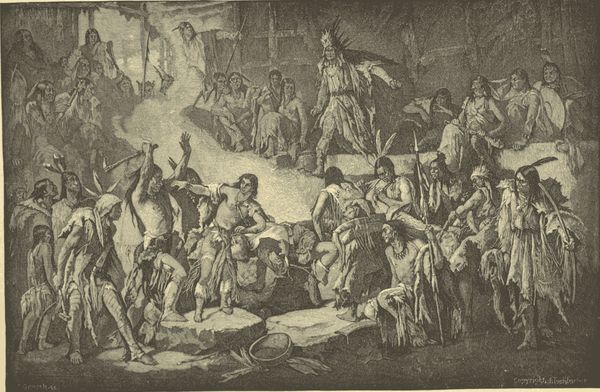
Captain Smith saved by Pocahontas.
"Having feasted him after their best barbarous manner they could, a long consultation was held; but the conclusion was, two great stones were brought before Powhatan, then, as many as could lay hands on him, dragged him to them, and thereon laid his head, and being ready with their clubs to beate out his brains, Pocahontas, the king's dearest daughter, when no entreaty could prevaile, got his head in her armes, and laid her owne upon his to save him from death; whereat the emperor was contented he should live to make him hatchets, and her bells, beads, and copper."
From other pages we get the stage-setting for this, the most dramatic incident in colonial history.
The emperor had heard the evidence with a "sour look," sitting in state upon a rude dais, covered with mats, his body wrapped in a cloak of raccoon skins. His dusky harem was grouped about him, watchful and interested. When the trial was over he bade one wife to bring water to wash the captive's hands, another a bunch of feathers to dry them upon. This was preliminary to the feast.
"So fat they fed Mee," says "A True Relation of Virginia," published by Smith in 1608, "that I much doubted they intended to have sacrificed mee to the Quioughquosiche, which is a superiour power they worship."
The appointment to the position of armorer in the royal household, and trinket-maker to the princess, was one of honor. Smith enjoyed it for a month only, but to his residence at Powhatan and intimacy with Pocahontas, he was indebted for the familiarity with Indian language and customs which was afterward of incalculable benefit to the Virginians. He describes Pocahontas in respectful admiration:
"For features, countenance, and expression she much exceeded the rest."
Her gala attire was a doeskin mantle lined with down from the breasts of wood-pigeons; bangles of coral bound her brown ankles and wrists, and in her hair was a white heron's feather in token of her royal blood. At the time of her rescue of Smith she was about thirteen years old.
In January, 1608, the emperor offered Smith a forest principality if he would remain with the tribe, but he petitioned to be allowed to return to Jamestown. The request was reluctantly granted, and an escort sent with him to the "Fort." This returned, bearing gifts for Powhatan and his wives, with marvellous stories of the cannon-shot fired into the sleety forest at Smith's command. We cannot but wonder what toy or ornament went to the petted child whom he had served in glad gratitude while a member of her father's household.
He had no time for sentimental musings. Upon the very day of his unlooked for return (January 8, 1608), Ratcliffe repeated Wingfield's attempt to escape to England in the only vessel left at Jamestown. The anchor was actually raised when Smith hastily collected a force and hurried to the landing. "With the hazzard of his life, with sakre, falcon, and musket shot, Smith forced" (them) "now the third time to stay or sinke."
In their sullen rage the foiled conspirators plotted and nearly executed a fiendish revenge. Once more we copy from the "General History," written by Smith and his friends.
"Some no better than they should be, had plotted with the president" (Ratcliffe) "the next day to have put him" (Smith) "to death by the Leviticall law for the lives of Robinson and Emry, pretending the fault was his that had led them to their ends; but he quickly took such order with such lawyers that he layd them by the heeles till he sent some of them prisoners to England."
The colony was almost destitute of food, and the memories of the famine of last year terrified the imaginations of those who had lived through it. "Gentlemen" having again predominated in reinforcements sent from England, the crops planted and gathered in Smith's absence had been meagre, while rats brought over in one of the vessels had wrought havoc with stored grain. Like an angel of mercy was the apparition of Pocahontas, at the head of a "wild train" of Indians laden with corn and game, approaching the fort. "Ever once in four or five days during the time of two or three years," the young princess, thus attended, visited the fort and succored the needy settlers. Smith declares that "next under God she preserved the colony from death, famine, and utter confusion." He might have subjoined that, but for himself, not even Pocahontas's bounty could have saved the settlement from the consequences of misconduct and misrule.
His was the only voice lifted to condemn the mad folly of loading a homeward-bound vessel with the glittering mud of a neighboring creek. That he was "not enamored of their dirty skill to freight such a drunken ship with so much gilded dirt"—was one of the mildest of his phrases, as, "breathing out these and many other passions," he harangued those who had "no thought, no discourse, no hope, and no work but to dig gold, wash gold, refine gold, and load gold."
Before the English assayers confirmed his judgment as to the value of this cargo, the intrepid adventurer had sailed, with fourteen others, up the Chesapeake into new and wonderful regions. Never losing heart, even when he believed himself to be dying from the sting of a poisonous fish, he discovered and entered the Potomac, the Rappahannock, and tributary creeks, fighting his way when not allowed to proceed peaceably. In July (1608) he led another party to the spot now occupied by the city of Baltimore, and made friends with a tribe called Susquehannocks, believed to be sun-worshippers. Returning from these voyages of three thousand miles in all, he drew in masterly style a chart of the countries explored, and sent it to England.
Jamestown was still in a state of what he calls "combustion," under the tyranny of Ratcliffe. Emboldened by Smith's return, the colonists deposed the hated governor, and formally elected Smith Governor of Virginia. The winter closed in upon an "affrighted" population. Storehouses were nearly empty, agriculture having been neglected in the gold fever. As Smith could not be "persuaded to use" the gallows, so he now announced that "no persuasion could persuade him to starve." In company with George Percy and fifty others, he visited his old ally Powhatan, and tried to buy food. A change had come to the emperor's heart. He addressed his quondam armorer as a "rash youth;" protested that he was afraid of him, and would not treat with the English unless they came to him unarmed. Warned by Pocahontas, who stole through the woods after dark to apprise Smith that treachery was intended, the party lay on their arms all night, and the force sent to surprise them retreated. Next day, Powhatan loaded the boats with corn, and Smith sailed up the York upon a similar errand to Opecancanough, Powhatan's brother. While in audience with him, the Englishmen were surrounded by a band of seven hundred armed savages. Seizing the wily chieftain by the scalp-lock, Smith held a pistol to his breast, and demanded a cargo of corn and safe-conduct for his party to Jamestown. The fifty men, without loss of a single life, took back enough food to victual the town.
Early in the spring of 1609, the president thus made known his policy to his constituents:
"Countrymen! You see now that power resteth wholly in myself. You must obey this now for a law—he that will not work shall not eat. And though you presume that authority here is but a shadow and that I dare not touch the lives of any, but my own must answer for it, yet he that offendeth, let him assuredly expect his due punishment.
"I protest by that God that made me, since necessity hath no power to force you to gather for yourselves, you shall not only gather for yourselves, but for those that are sick. They shall not starve."
Fields were tilled, the fort was repaired, wise Powhatan treated the pale-faces kindly for Smith's sake, and the emigrants felt for the first time firm ground beneath their feet. They had twenty-four pieces of ordnance, and three hundred stand of small-arms; three ships, seven boats, a store of more than two months' provisions, six hundred hogs, with goats, fowls, and sheep, and an established trading-station with the natives.
Like an aërolite from the summer sky came news from England that a fleet was to be sent out with a new colony, a new charter, and new officers; Smith's old enemy, Christopher Newport, was in command of the expedition. Smith had been complained of at home as "dealing harshly with the natives and not returning the ships full-freighted." His day was over. The king so willed it.
Smith's last official act was the establishment of a colony at Powhatan, renamed "Nonsuch," opposite where the city of Richmond was laid out over a century later. On his way back to Jamestown, he was cruelly wounded by the explosion of a bag of gunpowder. There was no good surgeon in the colony. To return forthwith to England was but anticipating by a few weeks what must be when the fleet arrived.
He returned to London at the age of thirty. "He had broke the ice and beat the path, but had not there" (in Virginia) "one foot of ground, nor the very house he builded, nor the ground he digged with his own hands."
In 1614 he returned to America, but now to the northern region assigned to the Plymouth Company. He gave name to Boston; explored and made a survey of the New England coast. On a second voyage he had a fight with a French squadron, was captured, and taken to Rochelle. While there he wrote a "Description of New England," for which service James I. appointed him "Admiral of New England." He died in London, in 1631, at the age of fifty-two, never having revisited Virginia. Upon his tomb, in the Church of St. Sepulchre's, London, may be still traced the outlines of the Three Turks' Heads and the inscription, beginning:
"Here lies one conquered that hath conquered kings."
Any sketch of his life, however brief, would be incomplete that contained no reference to the letter written by him to Queen Anne (the consort of James I.), in 1616, recommending the Lady Rebecca Rolfe to the royal favor.
He would "be guilty of the deadly poison of ingratitude," he wrote, if he failed to narrate what he and the colony at Jamestown owed to Pocahontas. He besought the queen's kindly consideration for the stranger just landed upon her shores, as due to Pocahontas's "great spirit, her desert, birth, want, and simplicity." His one call upon the wife of John Rolfe, Gentleman, was marked by profound respect on his part to one whom he accosted as "Lady Rebecca;" by profound emotion on hers.
John Smith's biography and epitaph are best summed up by one of his brothers-in-arms:
"What shall I saye, but thus we lost him that in all his proceedings made justice his first guide and experience his second, ever hating basenesse, sloth, pride, and indignitie more than any dangers; that never allowed more for himself than for his soldiers with him; that upon no danger would send them where he would not lead them himselfe; that would never see us want what he either had or could by any means get us; that would rather want than borrow, or starve than not pay; that loved action more than wordes, and hated falsehood and covetousnesse worse than death; whose adventures were our lives and whose losse our deaths."[Back to Contents]

WILLIAM HARVEY (1578-1657)
William Harvey was born on April 1, 1578, at Folkestone, on the southern coast of Kent. He was the eldest of nine children; of the rest little more is known, than that several of the brothers were among the most eminent merchants in the city of London during the reigns of the two first Stuarts. His father, Thomas Harvey, followed no profession. He married Joanna Falke, at the age of twenty, and lived upon his own estate at Folkestone. This property devolved by inheritance upon his eldest son; and the greater part of it was eventually bequeathed by him to the college at which he was educated.
At ten years of age he commenced his studies at the grammar school in Canterbury; and upon May 31, 1593, soon after the completion of his fifteenth year, was admitted as a pensioner at Caius College, Cambridge.
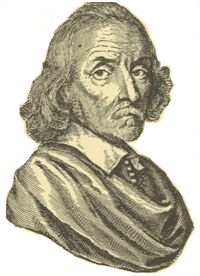
At that time a familiar acquaintance with logic and the learned languages was indispensable as a first step in the prosecution of all the branches of science, especially of medicine; and the skill with which Harvey avails himself of the scholastic form of reasoning in his great work on the Circulation, with the elegant Latin style of all his writings, particularly of his latest work on the Generation of Animals, affords a sufficient proof of his diligence in the prosecution of these preliminary studies during the next four years which he spent at Cambridge. The two next were occupied in visiting the principal cities and seminaries of the Continent. He then prepared to address himself to those investigations to which the rest of his life was devoted; and the scene of his introduction to them could not have been better chosen than at the University of Padua, where he became a student in his twenty-second year.
The ancient physicians gathered what they knew of anatomy from inaccurate dissections of the lower animals, and the slender knowledge thus acquired, however inadequate to unfold the complicated functions of the human frame, was abundantly sufficient as a basis for conjecture, of which they took full advantage. With them everything became easy to explain, precisely because nothing was understood; and the nature and treatment of disease, the great object of medicine, and its subsidiary sciences, was hardily abandoned to the conduct of the imagination, and sought for literally among the stars. Nevertheless, so firmly was their authority established, that even down to the close of the sixteenth century the naturalists of Europe still continued to derive all their physiology, and the greater part of their anatomy and medicine, from the works of Aristotle and Galen, read not in the original Greek, but re-translated into Latin from the interpolated versions of the Arabian physicians. The opinions entertained by these dictators in the republic of letters, and consequently by their submissive followers, with regard to the structure and functions of the organs concerned in the circulation, were particularly fanciful and confused; so much so that it would be no easy task to give an intelligible account of them that would not be tedious from its length. It will be enough to say, that a scarcely more oppressive mass of mischievous error was cleared away from the science of astronomy by the discovery of Newton, than that from which physiology was disencumbered by the discovery of Harvey.
But though the work was completed by an Englishman, it is to Italy that, in anatomy, as in most of the sciences, we owe the first attempts to cast off the thralldom of the ancients. Mundinus had published a work in the year 1315, which contained a few original observations of his own; and his essay was so well received that it remained the text-book of the Italian schools of anatomy for upward of two centuries. It was enriched from time to time by various annotators, among the chief of whom were Achillini, and Berengarius, the first person who published anatomical plates. But the great reformer of anatomy was Vesalius, who, born at Brussels in 1514, had attained such early celebrity during his studies at Paris and Louvain, that he was invited by the Republic of Venice, in his twenty-second year, to the chair of anatomy at Padua, which he filled for seven years with the highest reputation. He also taught at Bologna, and subsequently, by the invitation of Cosmo de' Medici, at Pisa. The first edition of his work, "De Corporis Humani Fabrica" was printed at Basle, in the year 1543; it is perhaps one of the most successful efforts of human industry and research, and from the date of its publication begins an entirely new era in the science of which it treats. The despotic sway hitherto maintained in the schools of medicine by the writings of Aristotle and Galen was now shaken to its foundation, and a new race of anatomists eagerly pressed forward in the path of discovery. Among these no one was more conspicuous than Fallopius, the disciple, successor, and in fame the rival, of Vesalius, at Padua. After him the anatomical professorship was filled by Fabricius ab Aquapendente, the last of the distinguished anatomists who flourished at Padua in the sixteenth century.
Harvey became his pupil in 1599, and from this time he appears to have applied himself seriously to the study of anatomy. The first germ of the discovery which has shed immortal honor on his name and country was conceived in the lecture-room of Fabricius.
He remained at Padua for two years; and having received the Degree of Doctor of Arts and Medicine, with unusual marks of distinction, returned to England early in the year 1602. Two years afterward he commenced practice in London and married the daughter of Dr. Launcelot Browne, by whom he had no children. He became a Fellow of the College of Physicians, when about thirty years of age, having in the meantime renewed his degree of Doctor in Medicine, at Cambridge; and was soon after elected Physician to St. Bartholomew's Hospital, which office he retained till a late period of his life.
On August 4, 1615, he was appointed Reader of Anatomy and Surgery to the College of Physicians. From some scattered hints in his writings it appears that his doctrine of the circulation was first advanced in his lectures at the college about four years afterward; and a note-book in his own hand-writing is still preserved at the British Museum, in which the principal arguments by which it is substantiated are briefly set down, as if for reference in the lecture-room. Yet with the characteristic caution and modesty of true genius, he continued for nine years longer to reason and experimentalize upon what is now considered one of the simplest, as it is undoubtedly the most important known law of animal nature; and it was not till the year 1628, the fifty-first of his life, that he consented to publish his discovery to the world.
In that year the "Exercitatio Anatomica de Motu Cordis et Sanguinis" was published at Frankfort. This masterly treatise begins with a short outline and refutation of the opinions of former anatomists on the movement of the animal fluids and the function of the heart; the author discriminating with care, and anxiously acknowledging the glimpses of the truth to be met with in their writings; as if he had not only kept in mind the justice due to previous discoveries, and the prudence of softening the novelty and veiling the extent of his own, but had foreseen the preposterous imputation of plagiarism, which, with other inconsistent charges, was afterward brought forward against him. This short sketch is followed by a plain exposition of the anatomy of the circulation, and a detail of the results of numerous experiments; and the new theory is finally maintained in a strain of close and powerful reasoning, and followed into some of its most important consequences. The whole argument is conducted in simple and unpretending language, with great perspicuity, and scrupulous attention to logical form.
The doctrine announced by Harvey may be briefly stated thus: The blood circulates through the body, thereby sustaining life. The heart is simply the pump which drives the blood through the arteries, from whence it returns impure, and is then forced through the lungs and repurified.
The pulmonary circulation had been surmised by Galen, and maintained by his successors; but no proof even of this insulated portion of the truth, more than amounted to strong probability, had been given till the time of Harvey, and no plausible claim to the discovery, still less to the demonstration, of the general circulation has ever been set up in opposition to his. Indeed, its truth was quite inconsistent with the ideas everywhere entertained in the schools on the functions of the heart and other viscera, and was destructive of many favorite theories. The new doctrine, therefore, as may well be supposed, was received by most of the anatomists of the period with distrust, and by all with surprise. Some of them undertook to refute it, but their objections turned principally on the silence of Galen, or consisted of the most frivolous cavils; the controversy, too, assumed the form of personal abuse even more speedily than is usually the case when authority is at issue with reason. To such opposition Harvey for some time did not think it necessary to reply; but some of his friends in England, and of the adherents to his doctrine on the Continent, warmly took up his defence. At length he was induced to take a personal share in the dispute in answer to Riolanus, a Parisian anatomist of some celebrity, whose objections were distinguished by some show of philosophy, and unusual abstinence from abuse. The answer was conciliatory and complete, but ineffectual to produce conviction; and in reply to Harvey's appeal to direct experiment, his opponent urged nothing but conjecture and assertion. Harvey once more rejoined at a considerable length; taking occasion to give a spirited rebuke to the unworthy reception he had met with, in which it seems that Riolanus had now permitted himself to join; adducing several new and conclusive experiments in support of his theory; and entering at large upon its value in simplifying physiology and the study of diseases, with other interesting collateral topics. Riolanus, however, still remained unconvinced; and his second rejoinder was treated by Harvey with contemptuous silence. He had already exhausted the subject in the two excellent controversial pieces just mentioned, the last of which is said to have been written at Oxford about 1645; and he never resumed the discussion in print. Time had now come to the assistance of argument, and his discovery began to be generally admitted. To this, indeed, his opponents contributed, by a still more singular discovery of their own, namely, that the facts had been observed, and the important inference drawn, long before. This was the mere allegation of envy, chafed at the achievements of another, which, from their apparent facility, might have been its own. It is indeed strange that the simple mechanism thus explained should have been unobserved or misunderstood so long; and nothing can account for it but the imperceptible lightness as well as the strength of the chains which authority imposes on the mind.
In the year 1623 Harvey became physician extraordinary to James I., and seven years later was appointed physician to Charles. He followed the fortunes of that monarch, who treated him with great distinction during the first years of the civil war, and he was present at the battle of Edgehill, in 1642. Having been incorporated doctor of physic by the University of Oxford, he was promoted by Charles to the wardenship of Merton College, in 1645; but he did not retain this office very long, his predecessor, Dr. Brent, being reinstated by the Parliament after the surrender of Oxford in the following year.
Harvey then returned to London, and resided with his brother Eliat at Cockaine house, in the Poultry. About the time of Charles's execution he gave up his practice, which had never been considerable, probably in consequence of his devotion to the scientific, rather than the practical, parts of his profession. He himself, however, attributed his want of success to the enmity excited by his discovery. After a second visit to the Continent, he secluded himself in the country, sometimes at his own house in Lambeth, and sometimes with his brother Eliat at Combe, in Surrey. Here he was visited by his friend, Dr. Ent, in 1651, by whom he was persuaded to allow the publication of his work on the "Generation of Animals." It was the fruit of many years of experiment and meditation; and, though the vehicle of no remarkable discovery, is replete with interest and research, and contains passages of brilliant and even poetical eloquence. The object of his work is to trace the germ through all its changes to the period of maturity; and the illustrations are principally drawn from the phenomena exhibited by eggs in the process of incubation, which he watched with great care, and has described with minuteness and fidelity. The microscope had not at that time the perfection it has since attained; and consequently Harvey's account of the first appearance of the chick is somewhat inaccurate, and has been superseded by the observations of Malpighi, Hunter, and others. The experiments upon which he chiefly relied in this department of natural history had been repeated in the presence of Charles I., who appears to have taken great interest in the studies of his physician.
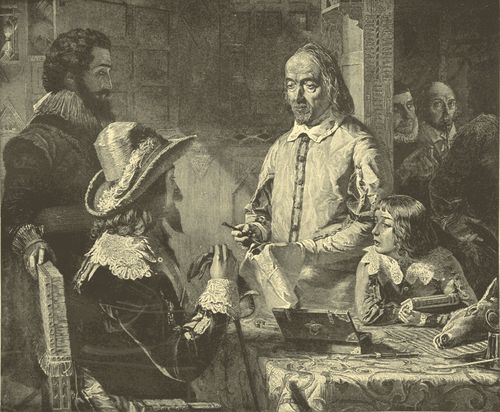
Harvey demonstrating the Circulation of the Blood.
In the year 1653, the seventy-fifth of his life, Harvey presented the College of Physicians with the title-deed of a building erected in their garden, and elegantly fitted up, at his expense, with a library and museum, and commodious apartments for their social meetings. Upon this occasion he resigned the professorship of anatomy, which he had held for nearly forty years, and was succeeded by Dr. Glisson.
In 1654 he was elected to the presidency of the college, which he declined on the plea of age; and the former president, Sir Francis Prujean, was re-elected at his request. Two years afterward he made a donation to the college of a part of his patrimonial estate, to the yearly value of £56, as a provision for the maintenance of the library, and the annual festival and oration in commemoration of benefactors.
At length his constitution, which had long been harassed by the gout, yielded to the increasing infirmities of age, and he died in his eightieth year, on June 3, 1657. He was buried at Hempstead, in Essex, in a vault belonging to his brother Eliat, who was his principal heir, and his remains were followed to the grave by a numerous procession of the body of which he had been so illustrious and munificent a member.
In person he was below the middle size, but well proportioned. He had a dark complexion, black hair, and small, lively eyes. In his youth his temper is said to have been very hasty. If so, he was cured of this defect as he grew older; for nothing can be more courteous and temperate than his controversial writings; and the genuine kindness and modesty which were conspicuous in all his dealings with others, with his instructive conversation, gained him many attached and excellent friends. He was fond of meditation and retirement; and there is much in his works to characterize him as a man of warm and unaffected piety.[Back to Contents]
PRINCE CHARLES STUART[13] By Andrew Lang, LL.D. (1720-1788)
Charles Edward Stuart, called the "Young Pretender" by his enemies, the "Young Chevalier" by neutrals, "Prince of Wales" and "Prince Regent" by his partisans, "Prince Edouard" by the French, "Ned" by his intimates, as we read in letters of Oliphant of Gask, and "Prince Charlie" by later generations, was born at Rome, December 31, 1720. His father was James VIII., of Scotland, and III. of England, according to the Legitimist theory; his foes called him "The Pretender," partly on the strength of the old fable about the warming-pan, so useful to the Whigs. No sane person now doubts the genuineness of James' descent from James II., but the nickname of Pretender still sticks, though Boswell tells us that George III. particularly disliked an appellation which "may be parliamentary, but is not gentlemanly." James III., or the Chevalier de St. George, was taken up by Louis XIV. on the death of James II., in France. He is said to have displayed courage in several battles in Flanders, but his attempt to assert his rights in 1715 was a melancholy failure. James showed melancholy and want of confidence; he soon left Scotland for the Continent, and the best that can be said for his conduct is that he endeavored to compensate the peasants whose houses were destroyed in the military operations of "the Fifteen." Unable to reside in France, he retired to Rome, a pensioner of the Pope, and entertained with royal honors. In 1719 he married Clementina Sobieski, a granddaughter of the famous John Sobieski, who delivered Europe from the Turks. Their eldest son, Prince Charles, appears to have inherited the spirit and daring of his Polish ancestors, which animated him throughout his youth, and were extinguished less by Culloden than by the treatment which he received from the French court, by his imprisonment in Vincennes in 1748, and by the unrelenting animosity of the English Government, which made him a homeless exile living mysteriously in hiding on the Continent. Heart-broken by these misfortunes and by other disappointments, Charles developed an unreasoning and sullen obstinacy, which alienated his adherents, while the habit of heavy drinking, learned in his Highland distresses, ruined his head and heart, and converted the most gallant, gay, and promising of princes into a brutal dipsomaniac.
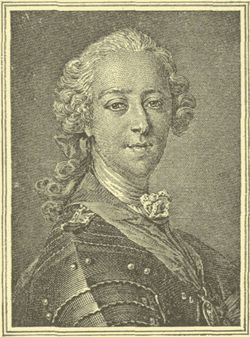
The education of Charles was casual and interrupted. Now he was in the hands of Protestants, now of Catholic governors and tutors, as the advice of English adherents, or the wishes of his devout mother, chanced to prevail. There were frequent quarrels between James and his wife, turning partly on the question of education, more on the jealousy which the queen conceived of the Countess of Inverness. The Pope sided with the queen in these melancholy broils, and James's private life (which was not faultless) was much more subject to criticism and interference than that of his at least equally lax rival on the English throne. A second son, Henry Benedict, Duke of York, was born in 1725, and, at one time, was regarded as of more martial disposition than Prince Charles. As the elder, Charles was first under fire, and at the siege of Gaeta, in 1734, while a mere boy, he displayed coolness, daring, and contempt of danger. Young Henry, aged nine, "was so much discontented at being refused the partnership of that glory and that danger, that he would not put on his sword till his father threatened to take away his garter too," says Murray of Broughton, in a letter dated 1742. In later life the Duke of York showed no military aptitude. A kind of progress which Charles made through the cities of Italy, aroused his desire to be a prince in more than name. The English Government quarrelled with the Republic of Venice about the royal honors paid to the prince, and his ambition was awakened. His education, we have said, was very imperfect. Murray of Broughton, indeed, credits him with Latin, Greek, history, and philosophy. But his spelling in both French and English was unusually bad, even in an age of free spelling; he wrote époles for epaules, "Gems" for "James," "sord" for "sword." He did not neglect physical exercise; was wont to make long marches without stockings, to harden his feet (as he told a follower during his Highland distresses). He was a good shot, fond of hunting, and, about 1742, was probably the first man who ever played golf in Italy. Murray describes him as "tall above the common stature, his limbs cast in the most exact mould, his complexion of an uncommon delicacy, all his features perfectly regular and well turned, and his eyes the finest I ever saw." Whether they were blue or hazel is undecided; they are hazel in at least one contemporary portrait. As a boy, engravings show him pretty, merry, and buoyant; an air of melancholy may be remarked as early as 1744. With bright nut-brown hair, golden in the sun, and worn long beneath his peruke, he certainly justified the endearing name of "Bonny Prince Charlie." The distinction of his air could be concealed by no disguise, as his followers loved fondly to declare. He certainly had the royal memory for faces. At the opera, in 1773, he noticed an English officer opposite, whom he sent for. The gentleman visited the royal box, accompanied by a Scotch servant. "I have seen you before," said Charles to this man. "You once brought me a message at Falkirk, in 1746."
Such was Prince Charles when, in 1742, Murray of Broughton became acquainted with the royal exile in Rome, and was appointed secretary for Scotland. With Lochiel and others, Murray formed a Jacobite association in his native country. Negotiations were begun with the French court, which hung off and on, as did the English Jacobites. They would rise, if France supplied men, money, and arms. France would do this if sufficiently assured of support in England. The king had no enthusiasm for the enterprise. He was weary of promises and of leaning on that broken reed, Louis XV. Murray intrigued in Scotland, Lord Elcho in England, Kelly at the French court. Lord Semple confused all by false hopes; Charles was much in the hands of Irishmen—Sheridan, Sullivan, O'Brien, and O'Neil; already a "forward," or Prince's party was growing, as opposed to the waiting policy and party of the disheartened and unambitious James. To what extent English Jacobites were pledged is uncertain. There was much discontent with the Hanoverian dynasty in England, but the dread of popery was strong among the middle classes. The butchers were advised that Catholics ate no meat on Sundays, the official clergy preached Protestant sermons, the Jacobite gentry feared for their lives and estates in case of failure, and the sagacity of the Government has never revealed the extent to which the Duke of Beaufort and others were committed to King James. The universities, the sporting squires, and the smugglers drank to "The king over the water," but there enthusiasm began and ended.
More was expected, and till assured of more, France held aloof, while making promises enough. Even the Highland chiefs said that without a French army nothing could be done. In 1744 Charles left Rome, under pretext of a hunting party, concealed his withdrawal with great skill, and reached Paris. He was obliged, however, to be incognito and was not received by the king. An invading force was crowded on board ship. The chance seemed excellent, England's forces being mainly abroad; but the old friends of England, the winds, drove the battered fleet back into harbor, and Charles in vain tried to persuade the Earl Marischal to accompany him to Scotland in a small fishing vessel.
One result followed the reception of Charles by France, niggardly as that reception was—war with England broke out, and the French army of invasion was moved from Dunkirk to Flanders. The prince, not permitted to serve in the French army, returned to Paris, where he had been falsely assured by Semple and Æneas Macdonald that England was ready to rise for him. Murray, who visited him in Paris, tried to dissuade him from a wild venture; in Scotland he found the chiefs of his own opinion, but the letter carrying the news never reached the prince. His Irish friends urged him on; "the expedition was entirely an Irish project." He borrowed money from his bankers, the Waters, he pawned his share of the Sobieski jewels, and, with a privateer man-of-war and a brig, La Doutelle, he left Belleisle on July 13, 1745. Neither the French court nor his father knew that, attended only by seven men, "The Seven Men of Moidart," he had set out to seek for a crown. The day before he embarked he wrote to James; he said that no man would buy a horse, nor trust a prince, that showed no spirit. "I never intend to come back," he added. So, dressed as a student of the Scots College, he started. He lost his convoy, the Elizabeth, on the way, after a drawn battle with the Lion (Captain Brett). Resisting all advice to turn back, as Æneas Macdonald, who accompanied him, narrates, he held on in La Doutelle, and reached Erisca, an islet between Barra and South Uist, on August 2, 1745. An eagle hovered over his ship, and Tullibardine hailed the royal bird as a happy omen. But he found himself unwelcome. Boisdale bade him go home; "I am at home," said the prince. He steered for Moidart, the most beautiful but the wildest shore of Scotland, a region of steep and serrated mountains, of long salt-water straits, winding beneath the bases of the hills, and of great fresh-water lochs. Loch Nahuagh was his port; here he received Clan Ranald, whose desolate keep, Castle Tirrim, stands yet in ruins, since "the Fifteen." Glenaladale (whose descendants yet hold their barren acres), Dalilea, and Kinlochmoidart (now, like Clan Ranald, landless men) met him with discouraging words. But, seeing a flash in the eyes of a young Macdonald, of Kinlochmoidart, Charles said, "You will not forsake me?" "I will follow you to death, were no other sword drawn in your cause."
The chiefs caught fire, Charles landed, with the seven men of Moidart—Æneas Macdonald, the Judas of the cause; the Duke of Athol (Tullibardine), who had been out in the fifteen; Sheridan, the prince's tutor; Sir John Macdonald; Kelley, a parson who had been in Atterbury's affair; Strickland, an Englishman; and Buchanan. Young Lochiel was disinclined to join, but yielded to the fascination of the prince. With his accession the rising was a certainty. But Duncan Forbes of Culloden, the lord president, had influence enough to hold back the Macleods of Skye, to paralyze the shifty Lovat, and to secure the Sutherland house for the Hanoverian cause. Charles left Boisdale for Kinlochmoidart, "the head of Loch Moidart," where an avenue of trees, the prince's walk, is still shown, though the old house was burned after Culloden. Keppoch cut off a small party of Scots Royal; this was first blood for the Jacobite cause. The wounded were hospitably treated by Lochiel; the English captain was released on parole. Charles now crossed the steep hills between Kinlochmoidart and the long narrow lake of Loch Sheil, there he took boat, and rowed past the lands of Glenaladale and Dalilea to Glenfinnan, where Tullibardine raised the standard, inscribed Tandem Triumphans. A statue of the prince, gazing southward, now marks the spot. The clans came in, and as Charles marched southeast, each glen sent down its warriors to join the stream. The clansmen, as a rule, had probably little knowledge of or interest in the cause. They followed their chiefs. The surviving Gaelic poetry speaks much of the chieftains; of Tearlach, righ nan Gael, but little is said. It was the middle of August before the rulers of England received the news of the landing. They at once set a reward of £30,000 on Charles's head, a proceeding "unusual among Christian princes," said Charles, who was compelled by his forces, and their threats of desertion, to follow the evil example. Sir John Cope was sent with an English army to stop the prince. It appeared likely that the armies would meet about Dalwhinnie, now the highest and bleakest part of the Highland Railway. The path then led over Corryarrack; Charles and his men raced for the summit, but Cope was not to be seen. He had marched east and north, to Inverness, and all the south of Scotland lay open to the prince. He passed by Killiecrankie and Blair Athol to Perth; Cluny came in, with the Duke of Perth, and Lord George Murray, Charles's most skilled general, who had been out at Glensheil, in 1719, and had learned the lesson of war in the Sardinian army. How easily he won Edinburgh, how he held court at Holyrood, how he routed Cope (who returned by sea) at Preston Pans or Gladsmuir, is familiar to all. His clemency was conspicuous; he wrote to James that he would give up Holyrood to the wounded, rather than see them homeless. Home, a Whig volunteer, and the author of a Whiggish history, acknowledges the nobility of his conduct, and his "foolish lenity" (he would not permit the execution of several persons who tried to assassinate him) is blamed by the fanatics who, in 1749, issued a wild Cameronian manifesto, "The Active Testimonies of Presbyterians." The contrast with the savage brutalities of Cumberland is very notable. In the battle the chiefs refused to let Charles lead the charge, but he was at the head of the second line, "a pistol shot behind" the first. Preston Pans was fought on September 21, 1745. That Charles dallied before Edinburgh Castle till October 21st was no fault of his. Some of his men had gone home with booty, others were to be waited for, many of the chiefs were in favor of holding Scotland under James as a separate kingdom, and it was only by constant personal appeals that the prince persuaded them to push south. Lord George's strategy deceived the English, who knew not where to look for the Highlanders. They met at Carlisle, took it, passed through Preston and Manchester, gave Cumberland the slip, and their advanced posts, six miles south of Derby, were within a hundred and twenty miles of London. The army of Finchley was unlikely to make a stand, the city was partly Jacobite, the mob were ready for anything, when Lord George and the chiefs insisted on retreat. Historians doubt which policy was the wiser; it is certain that success, if to be attained at all, could only be won by audacity. The chiefs, however, declared for a return and a junction with French forces then expected. Charles wept and prayed to no avail. His army, as disappointed as himself, found their faces set to the north, and the prince, who had ever walked among the first ranks, leaving his carriage to old Lord Pitsligo, now rode dejected and heart-broken. The retreat was rapid and able. At Clifton, Murray turned on the pursuing dragoons, headed a claymore charge, and drove them back. A hapless garrison of Lancashire volunteers was left to the tender mercies of Cumberland in Carlisle, and Charles went by way of Whiggish Dumfries (the house where he lodged is now an inn) to Glasgow. To all intents and purposes the end had come. Charles had lost faith in the advisers who dragged him back from the south, he listened to Murray of Broughton and to his Irishry; he suspected, unjustly but not unnaturally, the good faith of Lord George. He dallied at Stirling, besieging the castle without proper artillery, and Hawley was sent to attack him. On January 17, 1746, the armies met at Falkirk. A storm of wind and rain blew at the backs of the Highlanders, they charged, scattered the enemy, drove them in flight, and cut up the Glasgow volunteers. But, in the dark and the mist they scarcely knew their own advantage. The pipers had thrown their pipes to their boys, had gone in with the claymore, and could not sound the calls. Hawley wrote to Cumberland "My heart is broke ... I got off but three cannon of the ten." Hawley retreated to Edinburgh, the Duke of Cumberland came to take the command; the Highlanders began to desert with their booty, dissensions prevailed, and Charles went on besieging Stirling. Again Lord George Murray urged a retreat, Charles dashed his head in impotent rage against the wall of his room, but he had to follow. With perfect truth he said:
"I cannot see anything but ruin and destruction to us all in case we should think of a retreat;" his forces in flight would lose heart, his enemies would gain confidence. All this was true, but all this was unavailing. Months were spent in unimportant movements. Cumberland, meanwhile, instructed his men in the method of meeting a Highland charge, and deceiving the parry of the Highland shields. It was known that France would lend no substantial aid, and a French subsidy of 30,000 Louis d'or came too late, after the battle of Culloden, and was buried at the head of Loch Arkaig. One last chance Charles had: Lord George proposed, and Charles eagerly seconded, a night surprise at Nairn. But the delays on the march, and the arrival of dawn, made Murray command a retreat, and Charles's faith in him was irretrievably gone for the time, though he later expressed in writing a more worthy opinion. With 10,000 well-fed men against 5,000 who were starving, Cumberland had every chance of victory at Culloden. The Macdonalds, placed on the left wing, would not charge. Keppoch's men were discontented because they were not allowed to have a Catholic chaplain. Crying out, "The children of my clan have forsaken me," Keppoch charged alone, and died the death of renown. Beaten and blinded by a storm of snow in their faces, the Highland right clove the ranks of Monro and Burrell, only to fall, in layers three or four deep, before the fire of Sempill's regiment in the second line. The whole English force advanced; Charles rode to his second line, and offered to charge with them. His officers told him that it was in vain; Highlanders once beaten would not rally. (MS. "Lyon in Mourning," and MS. of Stuart Threipland at Abbotsford.) Charles was hurried off the field by his Irish tutor, and fled to Lord Lovat's, at Gortuleg. A story of his lack of courage, told by Sir Walter Scott on the authority of Sir James Stewart Denham's recollections of Lord Elcho's MS., is erroneous. Lord Elcho's MS. does not contain the statement. What he objects to is Charles's refusal to meet the fragments of his army at Ruthven, in Badenoch, whence they hoped to wage a guerilla warfare. Lord George Murray himself admits that the project was impossible. Charles, however, should have gone to Ruthven, but he distrusted Lord George; and his hope of a speedy voyage to France, where he expected to receive aid in men and money, was frustrated.