Volume 5 — WORKMEN AND HEROES (continued 5)
Reading edition
The restoration of his goods allowed young Gutenberg to satisfy his literary, religious, and artistic tastes, by travelling from town to town to study monuments, and visit men of all conditions celebrated for their science, their art, or even their trade. The artisans of Germany then held nearly the same rank as the artists. It was at the time when the trades, scarcely known, were confused with the arts, and when the most humble professions produced their earliest masterpieces, which, on account of their novelty, were looked upon as prodigies. Gutenberg travelled alone, on foot, carrying a knapsack containing books and clothes, like a mere student visiting the schools, or a journeyman looking for a master. He thus went through the Rhenish provinces, Italy, Switzerland, Germany, and lastly, Holland, not without an object, like a man who lets his imagination wander at the caprice of his footsteps, but carrying everywhere with him a fixed idea, an unchanging will led by a presentiment. This guiding star was the thought of spreading the word of God and the Bible among a vaster number of souls.
Thus it was religion which, in this young wandering apostle, was seeking the soil wherein to sow a single seed, of which the fruit hereafter was to be a thousand various grains. It is the glory of printing that it was given to the world by religion, not by industry. Religious enthusiasm was alone worthy to give birth to the instrument of truth.
What mechanical processes Gutenberg may until then have revolved in his mind, remains unknown. Whatever they were, chance effaced them all, and brought him at once upon his great discovery. One day, at Haarlem, in Holland, the verger of the cathedral, named Lawrence Koster, with whom he had established friendly relations, showed him in the sacristy a Latin grammar, curiously wrought in engraved letters on a wooden board, for the instruction of the seminarists. Chance, that gratuitous teacher, had produced this approach to printing.
The poor and youthful sacristan of Haarlem was in love. He used to walk on holydays to the spring outside the town, and sit under the willows by the canals, to indulge in his day-dreams. His heart full of the image of his bride, he used to amuse himself, in true lover's fashion, by engraving with his knife the initials of his mistress and himself, interlaced, as an emblem of the union of their hearts and of their interwoven destinies. But, instead of cutting these ciphers on the bark, and leaving them to grow with the tree, like the mysterious ciphers so often seen on the trees in the forests and by the brooks, he engraved them on little blocks of willow stripped of their bark, and still reeking with the moisture of their sap; and he used to carry them, as a remembrance of his dreams and a pledge of affection, to his lady-love.
One day, having thus cut some letters on the green wood, probably with more care and perfection than usual, he wrapped up his little work in a piece of parchment, and brought it with him to Haarlem. On opening it next day to look at his letters, he was astonished to see the cipher perfectly reproduced in brown on the parchment by the relieved portion of the letters, the sap having oozed out during the night and imprinted its image on the envelope. This was a discovery. He engraved other letters on a large platter, replaced the sap by a black liquid, and thus obtained the first proof ever printed. But it would only print a single page. The movable variety and endless combinations of characters infinitely multiplied, to meet the vast requirements of literature, were wanting. The invention of the poor sacristan would have covered the surface of the earth with plates engraved or sculptured in relief, but would not have been a substitute for a single case of movable type. Nevertheless, the principle of the art was developed in the sacristy of Haarlem, and we might hesitate whether to attribute the honor of it to Koster or Gutenberg, if its invention had not been with one the mere accidental discovery of love and chance, and, in the other, the well-earned victory of patience and genius.
At the sight of this coarse plank, the lightning from heaven flashed before the eyes of Gutenberg. He looked at the plank, and, in his imagination, analyzed it, decomposed it, put it together again, changed it, divided it, readjusted it, reversed it, smeared it with ink, placed the parchment on it, and pressed it with a screw. The sacristan, wondering at his long silence, was unwittingly present at this development of an idea over which his visitor had brooded in vain for the last ten years. When Gutenberg retired, he carried a new art with him.
On the morrow, like a man who possesses a treasure, and knows neither rest nor sleep until he has hidden it safely, Gutenberg left Haarlem, hastened up the Rhine until he reached Strasburg, shut himself up in his work-room, fashioned his own tools, tried, broke, planned, rejected, returned to his plans, and again rejected them, only to return to them again; and ended by secretly executing a fortunate proof upon parchment with movable wooden types, bored through the side with a small hole, strung together and kept close by a thread, like square beads on a chaplet, each with a letter of the alphabet cut in relief on one side—the first printer's alphabet, coarse, but wonderful—the first company of twenty-four letters, which multiplied like the herds of the patriarchs, until at last they covered the whole earth with written characters, in which a new and immaterial element—human thought—became incarnate.
Gutenberg, perceiving at the first glance the immense social and industrial bearing of his invention, felt that his weak hand, short life, and moderate property would be spent in vain on such a work. He experienced two opposite wants—the necessity of associating with himself persons to assist in meeting the expenses and in executing the mechanical labor, and the necessity of concealing from his assistants the secret and real object of their labors, for fear lest his invention might be divulged and pirated, and the glory and merit of his discovery taken from him. He cast his eyes on the nobility and rich gentry of his acquaintance at Strasburg and Mainz. He probably met with rebuffs from all quarters, on account of the prejudice then prevailing that handicrafts were derogatory to a gentleman. He was, therefore, obliged to sink his rank, become a workman, associate with artisans, and mix with the people, in order to raise the people to the high level of morality and intelligence.
Under the pretence of working together at a new and marvellous craft, such as jewelry, clock-making, and grinding and setting precious stones, he entered into a deed of partnership with two wealthy inhabitants of Strasburg, Andrew Dritzchen and Hans Riffe, bailiff of Lichtenau; and afterward with Faust, a goldsmith and banker of Mainz, whose name, confounded with that of Faustus, the wondrous sorcerer of German fable, the master of mystery, and the friend of the Evil One, caused the invention of printing to be attributed to magic; and, lastly, with Hulmann, whose brother had just established the first paper-mill at Strasburg.
In order the more effectually to conceal from his partners the real object of his pursuit, Gutenberg joined them in several artistic and secondary enterprises. Continuing in secret his mechanical researches on printing, he employed himself publicly in these other occupations. He taught Dritzchen the art of cutting precious stones. He himself polished Venetian glass for mirrors, or cut pieces of it into facets, setting them in copper frames ornamented with wooden figurines representing personages from history or fable, from the Bible or the Testament. These articles, which found sale at the fair of Aix-la-Chapelle, kept up the funds of the association, and assisted Gutenberg in the secret expenses reserved for accomplishing and perfecting his design.
To conceal it the better also from the restless curiosity of the public, who began to circulate a suspicion of witchcraft against him, Gutenberg left the town, and established his workshop in the ruins of an old deserted monastery, called the Convent of St. Arbogast. The solitude of the place, only inhabited by the houseless poor of the suburbs, covered his first attempts.
In a corner of one of the vast cloisters of the monastery, occupied by his partners for their less secret labors, Gutenberg had reserved for himself a cell, always closed with lock and bolt, and to which none but himself ever had access. He was supposed to go there to draw the designs, arabesques, and figurines for his jewelry and the frames of his glasses; but he passed his days and sleepless nights there, wearing himself out in the pursuit of his invention. There it was that he engraved his movable types in wood, and projected casting them in metal, and studied hard to find the means of inclosing them in forms, whether of wood or of iron, to make the types into words, phrases, and lines, and to leave spaces on the paper. There it was that he invented colored mediums, oleaginous and yet drying, to reproduce these characters, brushes and dabbers to spread the ink on the letters, boards to hold them, and screws and weights to compress them. Months and years were spent, as well as his own fortune and the funds of the firm, in these persevering experiments, with alternate success and disappointment.
At length, having made a model of a press, which seemed to him to combine all the requirements of printing, according to his ideas at that time, he concealed it under his cloak, and walking to the town, went to a skilful turner in wood and metal, named Conrad Saspach, who lived in the Mercer's Lane, asking him to make the machine of full size. He requested the workman to keep it secret, merely telling him that it was a machine by the help of which he proposed to produce some masterpieces of art and mechanism, of which the marvels should be known in due time.
The turner, taking the model in his hands, and turning it backward and forward with the smile of contempt that a skilful artist usually puts on when looking at a rough specimen, said, somewhat scornfully, "But it is just simply a press that you are asking me for, Master Hans!"
"Yes," replied Gutenberg, with a grave and enthusiastic tone, "it is a press, certainly, but a press from which shall soon flow in inexhaustible streams the most abundant and most marvellous liquor that has ever flowed to relieve the thirst of man! Through it God will spread his Word. A spring of pure truth shall flow from it; like a new star, it shall scatter the darkness of ignorance, and cause a light heretofore unknown to shine among men." He retired. The turner, who understood not these words, made the machine, and delivered it at the monastery of Arbogast.
This was the first printing-press.
As soon as he was in possession of his press, Gutenberg began printing. Little is known of the first works which he sent out; but the strongly religious disposition of the inventor leaves no doubt concerning the nature of the labors to which he devoted the first-fruits of his art. They were, to a certainty, religious books. The art invented for the sake of God, and by his inspiration, began with his worship. His later publications at Mainz are a proof of it; the divine songs of the Psalmist, and the celebrated Latin Bible, were the first works issued at Mainz from the machine invented by Gutenberg, and applied to the use of the most sacred powers of man, lyrical praise of his Maker, and lamentation for the woes of earth. Under the hands of this pious and unfortunate man, praise and prayer were the first voices of the press. The press ought ever to be proud of it.
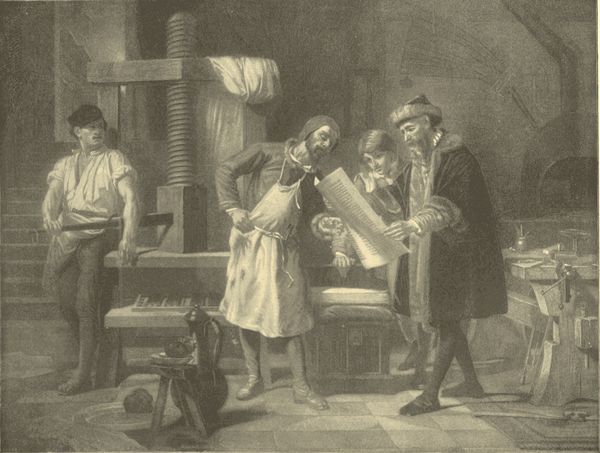
Gutenberg's Invention.
But great tribulation awaited him after his triumph. We have seen that the necessity of procuring funds obliged him to take partners. The necessity that subsequently arose of getting assistance for the multifarious labor of a great printing establishment obliged him to confide his occupation, and even the secret of his process, to his partners and to a number of workmen. His partners, tired of supplying funds to an enterprise which, for want of perfection, was not then remunerative, refused to persevere in the ungrateful occupation. Gutenberg begged them not to abandon him at the very moment that fortune and glory were within his grasp. They consented to make fresh advances, but only on condition of sharing completely his secret, his profits, his property, and his fame.
He sold his fame to procure success to his work. The name of Gutenberg disappeared. The firm absorbed the inventor, who soon became a mere workman in his own workshop. It was a parallel to the case of Christopher Columbus brought back in irons on board his own vessel, by a crew to whom he had opened a new world.
This was not all. The heirs of one of the partners brought an action against him to contest his invention, his property, and his right of carrying on the work. They compelled him to appear before the judges at Strasburg, to make him submit to some more complete and more legal spoliation than the voluntary abandonment he had himself acknowledged. His perplexity before the court was extreme. To justify himself, it was necessary to enter into all the technical details of his art, which he did not as yet wish to make completely public, reserving to himself, at least, the secret of his hopes. The judges, being inquisitive, pressed him with insidious questions, the answers to which would have exposed the secret of all his processes. He evaded them, preferring an adverse decision to the publication of his art. To succeed in penetrating the secret of the discovery which filled people's imaginations, the judges summoned his most confidential workmen, and required them to give evidence of what they knew. These men, simple-minded, yet faithful and strongly attached to Gutenberg, refused to reveal anything. Their master's secret was safer in their hearts than in the breasts of his more grasping associates. None of the great mysteries of the art transpired. Gutenberg, ruined, condemned, perhaps banished, retired alone and in poverty to Mainz, his native place, to recommence his labors and begin his life and fame anew.
He was still young, and the report of his lawsuit at Strasburg had made his fame known all over Germany, but he returned a workman to a city which he had quitted as a knight. Humiliation, poverty, and glory contended with each other in his fate and in the behavior of his fellow-citizens. Love alone recognized him for what he had been, and for what he was one day to become.
On his return to Mainz, having been relieved from degradation and ruin by the woman he loved, as Mohammed was by his first wife, Gutenberg gave himself entirely up to his art, entered into partnership with Faust and Schœffer, Faust's son-in-law; established offices at Mainz, and published, still under the name of the firm, Bibles and Psalters, of remarkable perfection of type.
Schœffer had for a long time carried on the business of a scrivener, and a trade in manuscripts in Paris. His travels, and his intimacy with the artists of that town, had made him acquainted with mechanical processes for working in metals, which he adapted, on his return to Mainz, to the art of printing. These new means enabled him to cast movable leaden types in a copper matrix, with greater precision than before, and thus to give great neatness to the letters. It was by this new process that the Psalter, the first book bearing a date, was printed in 1457. Soon afterward the Mainz Bible, recognized as a masterpiece of art, was produced under the direction of Gutenberg, from types founded by Peter Schœffer's process.
The tendency of the new art, which began by cheapening sacred books under the auspices of the Church alone, escaped, during the first years of its existence, the notice of the Roman court, which saw an auxiliary in what it afterward considered as an opponent.
"Among the number of blessings which we ought to praise God for having vouchsafed during your pontificate," says a dedication in the time of Paul II., "is this invention, which enables the poorest to procure libraries at a low price. Is it not a great glory to your Holiness, that volumes which used to cost one hundred pieces of gold are now to be bought for four, or even less, and that the fruits of genius, heretofore the prey of the worms and buried in dust, begin under your reign to arise from the dead, and to multiply profusely over all the earth?"
Meanwhile, Faust the banker, and Schœffer the workman, Gutenberg's new partners, were not long in giving way, like his former partner, one Mentel or Metelin at Strasburg, to the temptation of absorbing by degrees Gutenberg's glory, the most tempting of all possessions, because of its immortality. Like many others, they hoped to deceive posterity, if not their own contemporaries. After recognizing, in the Epistle Dedicatory prefixed to the German translation of Livy, printed by Hans Schœffer, and addressed to the Emperor Maximilian, "that the art of printing was invented at Mainz by that sublime mechanician Hans von Gutenberg," they forgot this confession, and seven years later assumed to themselves all the merit and honor of the discovery.
A short time afterward, the Emperor Maximilian, erecting the printers and compositors into a species of intellectual priesthood, relieved them by the nobility of their occupation from all degradation of rank. He ennobled the art and the artists together; he authorized them to wear robes embroidered with gold and silver, which nobles only had a right to wear, and gave them for armorial bearings an eagle with his wings spread over a globe, a symbol of the flight of written thoughts, and of its conquest of the world.
But Gutenberg was no longer upon earth to enjoy the possession of that intellectual world, religious and political, of which he had only had a glimpse, like Moses, in the vision of his dream in the monastery of St. Arbogast. Despoiled by his partners of his property and of his fame; expelled again, and for the last time, from his country by poverty, his only consolation being that he was followed by his wife, who remained faithful through all his troubles; deprived by death of all his children; advanced in years, without bread, and soon afterward, by his wife's decease, a widower, he was received by the Elector of Nassau, the generous Adolphus. The elector created him his counsellor of state and chamberlain, in order to enjoy in an honorable familiarity the conversation of this surpassing genius, who was afterward to hold converse with all times and all places. This shelter afforded to Gutenberg sheds everlasting lustre on Nassau and its prince. We meet in history with instances where a generous hospitality has given happiness and immortal fame to the most insignificant potentates and to the smallest of states.
Gutenberg continued printing with his own hands, at Nassau, under the eyes of his Mæcenas, the elector, during several years of peace and quiet. He died at the age of sixty-eight, leaving his sister no inheritance, but bequeathing to the world the empire of the human mind, discovered and achieved by a workman.
"I bequeath," he says in his will, "to my sister all the books which I printed at the monastery of St. Arbogast." The poor inventor's only legacy to his surviving relative was the common property of almost all inventors like himself—wasted youth, a persecuted life, a name aspersed, toil, watchings, and the oblivion of his contemporaries.[Back to Contents]
WILLIAM CAXTON (1412-1491)
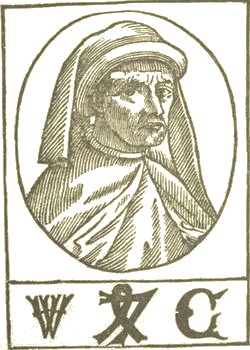
William Caxton, to whom England owes the introduction of printing, was born, according to his own statement, in the Weald of Kent. Of the date of his birth nothing is known with certainty, though Oldys places it in 1412. Lewis and Oldys suppose that between his fifteenth and eighteenth years he was put apprentice to one Robert Large, a mercer or merchant of considerable eminence, who was afterward, successively, sheriff and lord mayor of London, and who upon his death, in 1441, remembered Caxton in his will by a legacy of 20 marks. Caxton at this time had become a freeman of the Company of Mercers. His knowledge of business, however, induced him, either upon his own account or as agent of some merchant, to travel to the Low Countries for a short time. In 1464 we find him joined in a commission with one Robert Whitehill, to continue and confirm a treaty of trade and commerce between Edward IV. and Philip, Duke of Burgundy; or if they find it necessary, to make a new one. They are styled in it ambassadors and special deputies. This commission at least affords a proof that Caxton had acquired a reputation for knowledge of business. Seven years afterward Caxton describes himself as leading a life of ease, when, "having no great charge or occupation," he set about finishing the translation of Raoul le Fevre's "Recueil des Histoires de Troye," which he had commenced two years before, in 1469. The original was the first book he printed, and this translation the third. Of Caxton's pursuits and travels abroad, we know little more than that in his peregrinations he confined himself, for the most part, to the countries of Brabant, Flanders, Holland, and Zealand, and finally entered into the service, or at least the household, of Margaret, Duchess of Burgundy, who encouraged him to finish his translation of Le Fevre's "History of Troy," assisted him with her criticisms upon his English, and amply rewarded him upon the completion of his labor. From the prologues and epilogues of this work we discover that he was now somewhat advanced in years, and that he had learnt to exercise the art of printing, but by what step he had acquired this knowledge cannot be discovered; his types only show that he acquired it in the Low Countries. He does not appear to have seen any of the beautiful productions of the Roman, Venetian, and Parisian presses before he had caused his own font of letters to be cut.
The original of Raoul's "History," the "Oration of John Russell on Charles, Duke of Burgundy, being created a Knight of the Garter," and the "Translation" of Raoul, were, as far as we know, Caxton's first three works; the last finished in 1471. A "Stanza," by Wynkyn de Worde, notices an edition of "Bartholomœus, de Proprietatibus Rerum," as printed by Caxton at Cologne (about 1470), but the actual existence of this edition is unknown. Nor has more certain information yet been obtained of the exact period of Caxton's return to his native country. The usual supposition has been that he brought the art of printing into England in 1474, and this date is indicated by the figures which are united in the centre of his device as a printer. In 1477, however, he had undoubtedly quitted the Low Countries and taken up his residence in the vicinity of Westminster Abbey, where and in which year he printed his "Dictes and Sayings of the Philosophers." Stowe says he first exercised his business in an old chapel near the entrance of the abbey; but a very curious placard, a copy of which, in Caxton's largest type, is now at Oxford in the late Mr. Douce's library, shows that he printed in the Almonry. It is as follows: "If it plese any man spirituel or temporel to bye ony Pyes of two and thre comemoracions of Salisburi vse emprynted, after the forme of this present lettre whiche ben wel and truly correct, late hym come to Westmonester in to the Almonesrye at the reed pole and he shal have them good chepe. Supplico stet cedula." According to Bagford, Caxton's office was afterward removed to King Street.
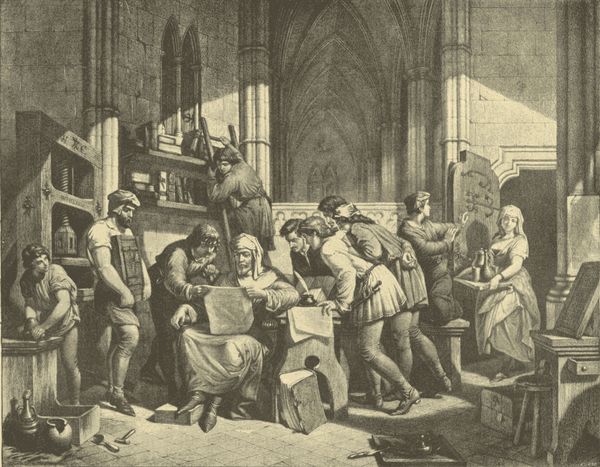
The First Sheet from Caxton's Press.
From the evidence of Wynkyn de Worde, in the colophon of his edition of "Vitæ Patrum," 1495, it appears that these "Lives of the Fathers" were "translated out of French into English by William Caxton, of Westminster, lately dead," and that he finished the work "at the last day of his life." His death, however, seems fixed, by two or three entries in the parish accounts of St. Margaret, Westminster, to the year 1491 or 1492, in which we read, "Item: atte bureyng of William Caxton for iiij, torches vjs viijd. Item: for the belle at same Bureyng vjd." Wynkyn de Worde no doubt referred to this time.
Caxton, Mr. Warton observes, by translating, or procuring to be translated, a great number of books from the French, greatly contributed to promote the state of literature in England. In regard to his types, Mr. Dibdin says he appears to have made use of five distinct sets, or fonts, of letters, which, in his account of Caxton's works, he has engraved plates in fac-simile. Edward Rowe Mores, in his "Dissertation upon English Typographical Founders and Foundries," says Caxton's letter was originally of the sort called Secretary, and of this he had two fonts; afterward he came nearer to the English face, and had three fonts of Great Primer, a rude one which he used anno 1474, another something better, and a third cut about 1482; one of Double Pica, good, which first appears 1490; and one of Long Primer, at least nearly agreeing with the bodies which have since been called by those names. All of Caxton's works were printed in what are called black letter.[Back to Contents]
CHRISTOPHER COLUMBUS[9] By A. R. Spofford, LL.D. (1436-1506)
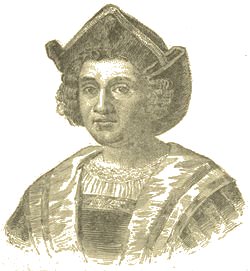
The discovery and the discoverer of America have furnished an almost inexhaustible theme for the critic, the biographer, and the historian. In the year 1892 there was celebrated an event which has come by common consent to be regarded as a world-famous epoch, worthy to be held in everlasting remembrance. We commemorated the man whose discovery almost doubled the extent of the habitable globe.
The life, the voyages, the brilliant triumphs, and the mournful end of Columbus are already familiar to most readers. To recount them at length would be here a needless repetition. Let us rather attempt to glance at some of the historic disputes involving the character and acts of the great discoverer, to sketch briefly the sources of information about him, and to characterize some of the more important writings upon the subject.
There is no lack of biographical material concerning the discoverer of America. He has left memorials of his personality and life-history more abundant than most of the men who have influenced their age. There are more than sixty authentic letters of Columbus in existence. There are long narratives of his expeditions and discoveries, by persons who knew him more or less intimately. There is an extended biography of him written by his own son, Ferdinand Columbus, or from materials furnished by him. There are numerous documents and state papers authenticating his acts, his privileges, and his dignities. And yet, with all the wealth of material, so copious upon his character and his career, it would seem, from recent developments, that the true discoverer of America is yet to be discovered.
Among the many lives of Columbus that have been written, there exist some twenty-five in the English language. Of these two or three only have any historical or critical value. The mass of biographies, both English and American, are mere echoes or abridgments, in other forms of language, of the great work of Washington Irving, first published in 1828. This book was written in Spain, and based upon collections of documents (manuscript and printed) not previously used by biographers. Hence its value as the most copious and systematic life of Columbus which had appeared in any language. The finished and graceful style which characterizes all the works of its accomplished author gave it a high place in literature, which it has maintained for more than half a century, being constantly reprinted.
Next in point of time to Irving, though treating Columbus with less fulness of detail, came the polished historian Prescott, whose "History of Ferdinand and Isabella" was published in 1837. This ardent and laborious scholar was, like Irving, constitutionally inclined to the optimistic view of his leading characters. To magnify the virtues and to minimize the faults of their heroes has always been the besetting sin of biographers. The pomp and picturesque circumstance of the Spanish court, the splendid administrative abilities of Ferdinand, the beauty, amiability, and devoted piety of Isabella, are depicted in glowing colors, but the crimes and cruelties which they sanctioned, while condemned upon one page, are softly extenuated upon others. Columbus appears as a romantic figure in history, the glory of whose successful discovery atones for his many failings.
Of the original sources of information about Columbus the most important are:
1. The great collection of original documents printed in Spanish by Navarrete, in 1825-37, in five volumes, and partly reprinted in a French translation in 1828. These contain the precious letters of Columbus, many of which have been translated and recently published in English.
2. The "Historia general de las Indias," of Oviedo, first published in 1535.
3. The "Historia de las Indias," of the Spanish Bishop Las Casas, composed in 1527 to 1561, which remained in manuscript until 1875, when it was printed from the original Spanish.
4. The "Letters and the Decades of Peter Martyr," written in part contemporaneously with the discovery of America, and printed in Latin in 1530, and in English in 1555.
5. The "Historia de las Reyes Catolicos," of Andres Bernaldez.
6. The "Life of the Discoverer," by Ferdinand Columbus, first published in 1571 at Venice, in Italian.
The last five writers had personal knowledge or intercourse with Columbus, while Las Casas, Oviedo, and Ferdinand had the advantage of residence in America, and intimate knowledge of the aborigines, and of the men and events of the period.
Almost every item involved in the checkered and eventful life of Columbus has afforded a fruitful theme for controversy. His birth, even, is disputed, under stress of evidence, as falling anywhere between 1435 and 1447—a discrepancy of twelve years. His birthplace is claimed by more towns than that of Homer, although his own statement, that he was a native of Genoa, has met general concurrence. His knowledge of geography, astronomy, and navigation is asserted and denied with various degrees of pertinacity. His treatment by the sovereigns of Portugal, Castile, and Aragon is so far in question that irreconcilable differences of opinion exist. How much Columbus really owed to the aid of the crown, and how much to private enterprise, in fitting out his expeditions of discovery, cannot be definitely ascertained. How far he was hindered by the bigotry, or helped by the enlightenment of powerful ecclesiastics, as at the council of Salamanca, is a theme of perennial controversy.
The island where he first landed is so far from being identified, that many books have been written to prove the claims of this, that, or the other gem of the sea to be the true land-fall of Columbus. His treatment of the natives has been made the subject of unsparing denunciation and of undiscriminating eulogy. His conduct toward his own, often mutinous, crews is alternately lauded as humane and generous, or denounced as arrogant and cruel, according to the sympathies or the point of view of the critic. His imprisonment and attempted disgrace have been made the theme of indignant comment and of extenuating apology. His moral character and marital relations are subjects of irreconcilable differences of judgment. His deep religious bias, so manifest in nearly all his writings, has been praised as a mark of exalted merit by some writers, and stigmatized by others as cant and superstition. The last resting-place of his bones, even, is in doubt, which it required an elaborate investigation by the Royal Academy of History of Madrid to solve in favor of Havana, as against the cathedral of Santo Domingo; though its report is still controverted, and M. A. Pinart has proved to the satisfaction of many that a misprision took place and that the true remains of Columbus still rest at Santo Domingo. The movement to canonize the great discoverer has been championed with more zeal than discretion by some over-ardent churchmen, while the too-evident human frailties of the proposed candidate for the honors of sainthood have inspired an abundant caution in the councils of the Vatican.
On a subject fraught with so much inherent difficulty, contradictory evidence, and conflict of opinion, he is on the safest ground who candidly holds his judgment in reserve. In the light of the keenly-sifted evidence which modern critical study has brought to bear, the laudatory judgments of Irving and Prescott, rendered sixty years ago, cannot stand wholly approved.
Neither can a discerning reader accept the fulsome laudations of his principal French biographer, Roselly de Lorgues, whose rhetorical panegyrics and pious eulogies place its author in the front rank of the canonizers.
On the other hand, those who have taken the unfavorable view of Columbus, have done their utmost to divest him of most of the honors which the general voice of history has assigned him as America's greatest discoverer. The established fact that parts of North America were seen centuries before, though no permanent settlement nor continuity of intercourse ensued, has been used to discredit him, though he was undeniably the pioneer who set out with a plan to discover, and did discover by design, what others found only by accident. His geographical ideas were derived, they say, from Behaim and Toscanelli; his nautical skill from Pinzon; his certainty of finding new lands from Alonzo Sanchez; his courage and daring from some of his fellow-voyagers.
We are pointed to his double reckoning on his first voyage, by which he deceived his sailors as to their true distance from Spain, as evidence of a false nature. He is charged with ambition, cupidity, and arrogance, in demanding titles, dignities, and money as fruits of his discoveries. He was, we are told, a fanatic, a visionary, a tyrant, a buccaneer, a liar, and a slave-trader. He was proud, cruel, and vindictive.
What manner of man, then, was this Columbus, with whose name the trump of fame has been busy so long? As to his person, we have no verified portrait, while the likenesses (of all periods) claiming to represent his features, present irreconcilable differences. But here is the description of him given by Herrera: "Columbus was tall of stature, long-visaged, of a majestic aspect, his nose hooked, his eyes gray, of a clear complexion, somewhat ruddy. He was witty and pleasant, well-spoken and eloquent, moderately grave, affable to strangers, to his own family mild. His conversation was discreet, which gained him the affection of those he had to deal with, and his presence attracted respect, having an air of authority and grandeur. He was a man of undaunted courage and high thoughts, patient, unmoved in the many troubles and adversities that attended him, ever relying on the Divine Providence." Gomara describes him as "a man of good height, strong-limbed, with a long countenance, fresh and rosy in aspect, somewhat given to anger, hardy in exposure to fatigues."
Benzoni says that Columbus was "a man of exalted intellect, of a pleasant and ingenuous countenance."
Bernaldez, the historian of Ferdinand and Isabella, who knew him intimately in his later years, says "he was a man of very lofty genius, and of marvellously honored memory."
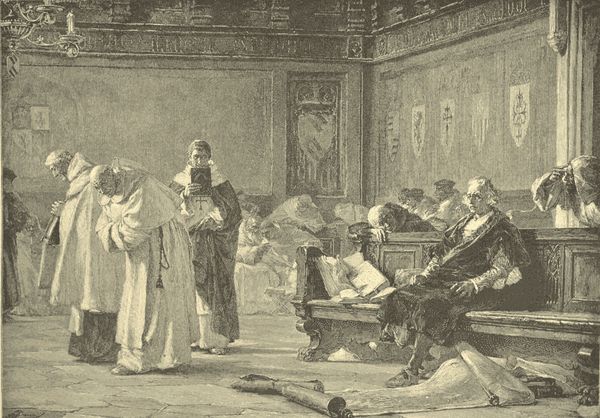
Columbus ridiculed at the Council of Salamanca.
With these personal characteristics, Columbus united a restless spirit, a firm will, and a singularly enthusiastic temperament. The latter faculty gave him a consuming zeal for his undertakings, which was as rare as it proved ultimately successful in compassing his great discovery. He was discouraged by no rebuffs, would take no denials. His motto seemed to be never to despair, and never to let go. His spiritual nature was as remarkable as his intellectual. Here, his imagination was the predominant faculty. He firmly believed himself divinely commissioned to find out the Indies, and to bring their inhabitants into the fold of the true faith. He had early vowed to devote the profits of his enterprise, if successful, to rescue the tomb of Christ from the infidels. Himself a devout son of the Church, he fervently believed that he had miraculous aid on many perilous occasions of his life. Humble before God, he was sufficiently proud and independent before men. He insisted upon conditions with the haughty sovereigns of Spain which they deemed exacting, but the high views and tenacity of Columbus carried the day, and his own terms were granted at last. He never forgot, in all his subsequent trials and humiliations, that he was a Spanish admiral, and Viceroy of the Indies.
Such was the character of Columbus. Let us now look at his environment, which in all men contributes so much to make or modify character. Born in Genoa, the headquarters in that day of navigation, Columbus early imbibed a passion for maritime affairs. His youthful days and nights were given to the study of astronomy and of navigation. He was a trained sailor and map-maker from his boyhood. He brooded over the problems involved in the spherical form of the earth. He caught up all the hints and allusions in classical and mediæval writers that came in his way, of other lands than those already known. The Atlantis of Plato, and the clear prediction in Seneca of another world in the west, fired his imagination. He himself tells us that he voyaged to the Ultima Thule of his day, which was Iceland, besides various expeditions in the Atlantic and Mediterranean.
The early fancies of isles in the western sea loomed up before his eyes, and repeated themselves in his dreams. These visions were heightened by that vague sense of wonder that is linked with the unknown. No wonder, then, that Columbus, with a bent almost preternatural toward the undiscovered regions of the globe, should dream of new lands, new men, new scenery, and new wealth. But to his vivid imagination dreams became realities, until he believed with all the force of his ardent nature that he was divinely commissioned to be a discoverer. Hitherto the Portuguese voyages familiar to Columbus had only skirted the coast of Africa, and discovered the Cape Verde Islands and the Azores. It was not till 1486, years after the idea of his western voyage took firm root in his mind, that the Cape of Good Hope was at last doubled by Vasco da Gama. All voyages prior to his had been only tentative and brief, slowly creeping from headland to headland, or else finding new islands by being drifted out of courses long familiar to mariners.
It was the supreme merit of Columbus that he was the first to cut loose from one continent to find another, and to steer boldly across an unknown sea, in search of an unknown world. We need not belittle (still less need we deny) the finding of Greenland and of other parts of North America by the Norsemen in the ninth and tenth centuries. We may hail Eric the Red and his stout son, Leif Ericson, as pioneers in what may be termed coasting voyages of discovery. But the story of America gains as little from these shadowy and abortive voyages as civilization has gained from their fruitless results.
On the first voyage of Columbus, he was more fortunate in the uncertain elements which always affect sea voyages so overpoweringly than in some of his later ones. His own vessel, with single deck, was about ninety feet long, by a breadth of twenty feet. The Pinta, a faster sailer, and the Nina (or "baby") were smaller caravels, and without decks, commanded respectively by the brothers Martin and Vicente Pinzon. The three vessels carried ninety persons, sailing September 6, 1492, running first south to the Canaries, and then stretching straight westward on the twenty-eighth parallel for what the admiral believed to be the coast of Japan. Delightful weather favored the voyagers, but when, on the tenth day out from Spain, the caravels struck into that wonderful stretch of seaweed and grass, known as the Sargasso Sea, fear lest they should run aground or soon be unable to sail in either direction took possession of the crews. In five days the caravels ran into smooth water again. But as their distance from Spain grew greater, the spirit of protest and mutiny grew louder. Columbus needed all of his invincible constancy and firmness of purpose to quell and to animate his despairing crews. At last, October 21, 1492—day ever memorable in the annals of this world—the unknown land rose from the bosom of the water. It was named by its pious discoverer San Salvador—Holy Saviour. The charm of climate and of landscape enchanted all, and fear and despondency gave way to delight and joy and the most extravagant anticipations. The subsequent history of this first voyage, the wreck of the admiral's flag-ship Santa Maria, the base desertion of Pinzon, and his baffled attempt to forestall Columbus in the credit of the discovery, the triumphal honors paid to the successful admiral, and the pope's bull conferring upon Spain all lands west of a meridian one hundred leagues from the Azores—all this is familiar to most readers. The actual discoveries of the first voyage included Cuba and Hispaniola (or Haiti), with some little islands of the Bahama group, of small importance.
On his second voyage Columbus found no difficulty in collecting seventeen ships and 1,500 adventurers, so popular had the new way to the Indies become when the way was once found. He set sail six months after his return to Spain, or on September 15, 1493. He returned in June, 1496, after three years of explorations, interrupted by a long illness, and having discovered Jamaica, Porto Rico, Santa Cruz, Antigua, Montserrat, Dominica, and Guadaloupe.
The third voyage began May 30, 1498, and embraced six vessels and 200 men. Columbus struck southwestward from the Cape Verde Islands and ran nearly to the equator, into a region of torrid heat, discovering Trinidad, Tobago, Grenada, and the Gulf of Paria, and making his first landing on the continent, at the Pearl Coast, near the mouth of the Orinoco, in what is now Venezuela. This voyage witnessed many disasters—the rebellion of Roldan, the severe prostration of the admiral by fever, and his seizure and imprisonment in chains by the infamous Bobadilla.
The fourth and last voyage of Columbus, with four small caravels and 150 men, was begun May 11, 1502. On this voyage he discovered Martinique and the coasts of Honduras, Nicaragua, and Veragua, on the mainland, returning to Spain, after untold disasters and miseries, on November 7, 1504. Then followed the weary struggle of the infirm old voyager to secure justice and a part of his hard-earned benefits from the crown. But Isabella had died, and Ferdinand, under the influence of the hard-hearted and cruel bigot, Fonseca, postponed all the claims of Columbus. He who had given a world died in poverty, a suppliant for the means of an honorable existence.
It is easy enough for the writers of the nineteenth century to criticise the actors of the fifteenth; and learned scholars, sitting in luxurious easy-chairs in great libraries, can pass swift and severe judgment upon the acts and motives of Columbus. But let them go back four hundred years, and divest themselves of the bias which the science of to-day unconsciously inspires; let them quit the age of steam-engines, telegraphs, democratic governments, printing-presses, and Sunday-schools; let them orient themselves, and become Spaniards of 1492, instead of Americans of 1892; let them take the place of Columbus—if they are gifted with imagination enough among their manifold endowments to do it; let them think his thoughts, endure his trials, cherish his resolves, encounter his rebuffs, overcome his obstacles, launch out on his voyage, govern his mutinous crew, deal with his savage and hostile tribes, combat the traitors in his camp, suffer his shipwrecks, struggle with his disappointments, bear the ignominy of his chains, see his visions, and pray his prayers.
Behold him, launched on his uncertain voyage across the "sea of darkness," in three little caravels, no larger than the modern yacht, and far less seaworthy. Watch his devoted and anxious look, his solitary self-communings, his all-night vigils under the silent stars. See his motley crew, picked up at random in Palos streets, ignorant, superstitious, and full of fears, dreading every added mile of the voyage, and alarmed at the prevalent east winds which they thought would never permit them to sail back to Spain; so that Columbus, on a contrary head-wind springing up, thanked God with all the fervency of his pious soul. Pursue his career in his later expeditions, hampered by the mutinous vagabonds whom fate had thrust upon him as followers, many of them desperadoes just out of jail. See his baffled endeavors to maintain order and discipline among such a crew; to restrain their excesses, curb their lawless acts of violence, and secure some semblance of decency in their conduct toward the natives. Many of them, we read, were so given over to idleness and sloth, that they actually made the islanders beasts of burden, to carry them on their backs. It is a most unhappy fact that the missionaries of the cross were often accompanied by bands of miscreants, who wantonly broke every commandment in the decalogue and trampled upon every precept of the gospel. See him in his last voyage, beating about the rocks and shoals of an unknown archipelago, overtaken by West India hurricanes, almost engulfed in waterspouts, scudding under bare poles amid perilous breakers, blinded by lightning, deafened by incessant peals of thunder, his crazy little barks tossed about like cockle-shells in the raging waves, his anchors lost, his worm-eaten vessels as full of holes as a honey-comb, two caravels abandoned, and the two remaining run ashore at Jamaica, where Columbus built huts on their decks to shelter his forlorn crew. See him stranded here, pressed by hunger and want, visited by sickness and almost blindness, burning with fever under the wilting, fiery heat of the tropics, desolate, forsaken, infirm, and old. There he lay a whole year without relief, until the cup of his misery was full.
If Columbus was sometimes harsh and cruel, we are to remember that he lived in an age when the most cruel and barbarous punishments were common. There are numerous instances of his clemency both to natives and to his revolted Spaniards, and he more than once jeopardized his own life by sparing theirs. Among a treacherous and vindictive race, many of whom were continually plotting for his overthrow, the admiral, endowed with full power over the lives and acts of his followers, was compelled to make examples of the worst, many of whom were criminals released from the prisons of Spain. Like other fighters, he met treachery with treachery, cruelty with cruelty. He had never learned to love his enemies, nor to turn his cheek for the second blow. Show us the man invested with absolute power, in that or in any former age, who abused it less. Try him by the moral standards, not of our humane and enlightened age, but by those of his own. Compared with the deeds of darkness that were done by Bobadilla and Ovando, the governors who replaced him, the reign of Columbus appears, even at its worst, to have been mild and merciful.
By the side of the atrocities and cruel massacres perpetrated under Cortes in Mexico, and Pizarro in Peru, the few deeds of blood under Columbus appear slight indeed. While we have no right to extenuate his errors and his abuses, we have as little right to hold him to a standard nowhere set up in his day. He had learned his ethics in a school which taught that, for great and pious objects, the end justified the means. In the ardor of his zeal for what he deemed the Christian faith, Columbus committed many glaring mistakes and errors; but what over-zealous apostle or reformer has failed to do the same? Columbus was unduly eager after gold, they say; but in our advanced age, when that which Virgil called "the accursed hunger for gold" pervades all ranks, and our cities are nothing but great encampments of fortune-hunters, does it lie in our mouths to condemn him?
The age of Columbus took him as he was—all full of human imperfections and frailties, but full also to overflowing with a great idea, and with a will, a perseverance, a constancy, and a faith so sublime, as fairly to conquer every obstacle, after a weary struggle of eighteen years, and to carry forward his arduous enterprise to triumphant success. That the great discoverer failed as a governor and administrator makes nothing against his merits as a discoverer. That his light at last went out in darkness—that the world he discovered brought nothing to Spain but disappointment and Dead Sea ashes—that he dragged out a miserable old age in rotten and unseaworthy ships, lying ill in the torrid heats of the West Indies, racked with excruciating pain, and in absolute penury and want—all this but adds point to a life so full of paradox that we may almost pardon him for believing in miracles. After so much glory and so much fame, his life darkened down to its dreary and pathetic close. His ardent soul went at last where wicked governments cease from troubling, and weary mariners are at rest. On May 20, 1506, worn out by disease, anxieties, and labors, the great discoverer launched forth on his last voyage of discovery, beyond the border of that unknown land whose boundaries are hid from mortal ken.
His place among the immortals is secure. By the power of the unconquerable mind with which nature had endowed him, he achieved a fame so imperishable that neither the arrows of malice, nor the shafts of envy, nor the keenest pens of critics, nor the assaults of iconoclasts can avail to destroy it.[Back to Contents]

VASCO DA GAMA[10] By Judge Albion W. Tourgée (1460-1525)
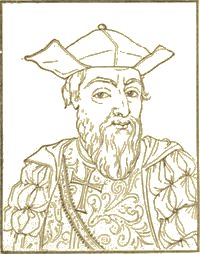
Vasco da Gama was the pet of fortune. Never did a man win immortality more easily. As a discoverer and a navigator he should rank not only below Columbus, but also below Bartolemeo Diaz and Cabral among his own countrymen, as well as Vespucius and Magellan, who carried the Spanish flag, and the Cabots, who established England's claim to the most important portions of the New World. As a commander, an administrator, and ruler of newly discovered regions, however, he ranks easily above them all. He not only led the way to India, but laid securely the foundations of Portuguese empire in the East.
Even in the hour of his birth he was fortunate. Prince Henry, surnamed "the Navigator," to whose indefatigable exertions for more than forty years was due that impulse to maritime achievement of which the discoveries of the fifteenth and sixteenth centuries were the result, had just died, and his influence hung like an inspiration over the little kingdom for which he had wrought with such self-denying patience. This grandson of John of Gaunt has received scant credit for that wonderful series of discoveries by which the accessible earth was more than quadrupled in extent. Yet without him, there is no reason to believe that either the coast of Africa would have been explored, the Cape of Good Hope passed, or the American continents discovered for a century, at least, perhaps for two or three centuries afterward. He was the father of discovery, and it was his hand more than any or all others that rolled up the curtain of darkness which hid the major part of the habitable globe. All the navigators and discoverers of that marvellous age were but the agents of his genius and the creatures of his indefatigable exertion.
The son of the most noted sovereign of Portugal, and grandson of that rugged Englishman from whose loins have sprung so many royal lines, he was fitted by descent and training for the heroic part which he performed. Distinguished for military achievement before he had come to man's estate, urged by four of the leading sovereigns of Europe to take command of their armies, and made Grand Master of the Order of Christ before he was twenty-five, there is hardly any limit to the military distinction he might have won or the power he might have secured, had he sought his own advancement.
But he gave himself to Portugal, and determined to raise the little kingdom his father had so gallantly held against jealous and powerful neighbors, to the rank of a first-class power. To seek to enlarge a realm shut in by mountains on one side and the sea upon the other, by constant strife with embittered enemies, he saw at once was to invite annihilation. The sea afforded the only avenue of hope, the continent of Africa, where his father had already gained something from the Moor, in battling with whom he had himself won renown, the only visible opportunity. So he determined to explore, and finally, to circumnavigate Africa, and give to Portugal whatever of power or wealth the ocean or the dark continent might hide. He believed that India might be reached by sailing round its southern extremity, and he determined to pour the wealth of the Orient into the treasury of the kingdom his father had established.
In 1418, therefore, he turned his back on personal ambition, laid aside the glory of military renown, and sat himself down to a hermit's life and a scholar's labors on the promontory of Sagres, in the province of Algarve, that point on the coast of Portugal which stretches farthest out into the Atlantic in the direction of his hope. Here he built an observatory whose light was the last his captains saw as they went forth, and the first to greet them on their return. Here he opened a school of navigation, and here were trained the discoverers who opened the way for all who came afterward. Here was not only nourished the impulse which fired the hearts of Columbus and his contemporaries, but here was taught the science and here were gathered the facts which enabled them to achieve success.
Up to that time, Cape Nun had been the boundary of the modern world to the southward. With infinite patience, Prince Henry labored to convince his captains that the terrors which they thought lay at the southward of this point were wholly imaginary. Little by little his caravels crept down the coast of Africa. Every year he sent out two or three. Navigators and geographers flocked to his service. In two years he re-discovered Madeira and Porto Santo, of which latter he afterward made Perestrello, the father of Columbus's wife, the governor. By 1433 his ships had reached Cape Bojador; eight years afterward they passed Cape Blanco; in 1445 they were at the mouth of the Senegal. Still he urged them on toward that "thesaurus Arabum et divitia Indiæ," to which he set himself the task of opening up the way. The crown of Portugal assumed all the cost of these expeditions. Gold, ivory, cinnabar, dye-woods, spices, and slaves, added to the wealth of the kingdom only to furnish forth new ventures.
He died before the end came, but not until many of the most important problems of cosmographic condition had been solved. It was known by actual experience that the "steaming sea" was a myth. Ships had crossed the equator, and their crews came back to tell of southward-stretching shadows. Ships were able, it was seen, to sail up the southern slope of the world as well as down it. Why they did not fall off into space, none knew, but that they did not was proved. Gravitation was a force whose laws and character were yet unformulated. The diurnal motion of the earth was hardly suspected until a hundred years later. But the facts on which these two fundamental truths are based were being gathered for Newton and Copernicus. When he died, those whom he had inspired and instructed continued the work to which he had devoted himself, under the patronage of his brother Alfonso and his nephew João II.; until, in 1486, Bartholomeo Diaz had sailed two hundred miles to the eastward of the Cape of Good Hope and returned to assure his sovereign that the way to India had at length been found.
It was not, however, until Dom Manoel had succeeded to the throne, in 1495, that any successful effort was made to follow up the success which Diaz had achieved. The way to India was indeed open, but no one seems to have had sufficient fortitude to undertake so long a voyage in order to reach it by that route. Dom Manoel had, however, but one idea. He was not a geographer like his predecessor, João, "the perfect," but he was a man of action, and determined that the route Prince Henry's navigators had opened to India should not remain unused. Vasco da Gama was then in his thirty-fifth year, the handsomest man of his age, of ancient family, and it is claimed was not without royal blood in his veins. As a soldier he was trained in the war with Castile; as a navigator he had served under Prince Henry's best captains. Camoens, the historical poet of Portugal, declares that he was familiar not only with the recorded achievements of his predecessors, but with all the regions they had discovered. Dom João, on the return of Diaz, selected him to command the fleet he meant to send to follow up this discovery. In the ten years that elapsed before he actually sailed, it is probable that he had grown to be not only a better geographer, but also a stronger, more cool-headed, and reliable man. That he was able to command, those mutineers who cavilled at his severity during the stormy passage of four months from Lisbon to Table Bay, found out when they demanded that he give up trying to reach India and return to Portugal as other captains had done, at the behest of their crews. He made short work of them, and in his whole career, so salutary was the lesson, no one under his command ever again refused to obey his orders.
It was July 8, 1497, when he sailed from Lisbon, and it was not until December 1st that he left Delagoa Bay, the farthest eastward point which Diaz had reached, to pass over the actually unknown water that lay between him and India. Even this could hardly be called "unknown water," for Corvilhan, who a dozen years before had made his way overland to Aden, had sent back to Dom João II. this message:
"Anyone who will persist, is sure to sail around the southernmost point of Africa, and can then easily make his way up the eastern shore and across the gulf to India."
Literally were his words fulfilled. With favoring breezes, Gama reached Malinda early in January, 1498, and securing the services of an Indian pilot, who had not only sailed hither from Calicut, but seemed as familiar as Gama himself with compass and astrolabe, he set out boldly across the Indian Ocean, and in May arrived at Calicut. When we consider that this latter part of the voyage was with a pilot accustomed to make the trip in the far more fragile crafts of the Arabs, the boldness of the undertaking does not seem so apparent to one of our day. Compared with the voyages of Columbus, Magellan, Vespucius, or Cabral over absolutely unknown seas, without pilots or charts of any kind, the passage from Aden to India hardly seems remarkable. Yet upon this the fame of Gama as an explorer rests, and as has been remarked, "few men have won fame so easily." His real merit lay in the fact that he did what so few of his predecessors were able to accomplish, controlled the mutinous crews, who had after all been the most serious obstacle in the path of Portugal to the coveted Indian possessions. It is probable that if Prince Henry had encouraged his captains to exercise greater severity, the darling object of his life might have been attained before his death and the birth of the fortunate explorer, whose cheaply-won fame has obscured his own, even with the king-loving Portuguese.
It would seem as if the capacity to control men, which was so prominent a characteristic of the "Discoverer of India," was not of a conciliatory character, for the Zamorin of Calicut received him but coldly, and before his ships were loaded the difference had ripened into a quarrel, and he was obliged to cut his way out of the harbor to begin his homeward voyage. This lack of complaisance on the part of the Zamorin he attributed, not without reason, to the jealousy of the Arab merchants, whose swift-sailing dhows crowded the port. Why should they not be jealous of him who came to take away their immemorial privilege? Theretofore the treasures of the Orient had reached the western world only through the hands of the Arab merchants. The dhow and the camel had been its carriers. Gama had brought the more capacious caravel to bear them over a new highway to the western consumers. His success meant the loss of a great part of the business on which the sailors, merchants, and camel-drivers of Arabia depended for a livelihood. Why should they not conspire to kill him and destroy his fleet?
His homeward passage was as fortunate as the outward one had been. That he did not experience the disasters which befell others, was no doubt largely due to the fact that he foresaw and avoided peril whenever possible. He was one of those men who, while shrinking from no unavoidable danger, take no unnecessary risks. He was received with unprecedented honors when, after two years and two months' absence, his ships were again anchored in the Tagus. Their rich cargo attested the rare value of the trade he had opened up. Despite the gold which the miners of Española were beginning to send to Spain, and the pearls which had come from Cubagua, the apparent value of the discoveries of Columbus were as nothing to the boundless wealth which Gama's voyage assured to Portugal. By the bull of Pope Alexander VI., all lands discovered east of the meridian of the Azores belonged to the King of Portugal. It was not only half the world, but that half which was of most inexhaustible richness, Asia and Africa. Titles and honors and wealth were conferred upon the fortunate explorer. In consideration perhaps of his royal extraction, he was permitted to affix the kingly title, "Dom," to his name. No wonder he was thus honored, when the cargo of one small caravel loaded with spices, yielded a greater sum than the whole outfit of the fleet Columbus commanded on his first voyage!
In an incredibly short time, thirteen ships were fitted out, and under that prince of navigators, Cabral, set sail to secure the results of Gama's discovery. On him, too, fortune smiled as it rarely has on them that "go down to the sea in ships." Blown out of his course by head-winds, his very mishaps ripened into the rarest fortune, for he discovered Brazil, and thus added to his master's realm what was destined to be one of the richest kingdoms of the world. With the instinct of genius, and a courage as rare as it was heroic, he did not return to notify his king of the new continent which had risen out of the deep before him, but sending back a single caravel with the marvellous news, he turned his battered prows to that point of the compass where he judged the Cape of Good Hope to be, and after passing three thousand miles of water that had never known a keel before, he rounded the southern point of Africa and proceeded to carry out his orders. He lacked, however, the soldierly qualities and administrative power of the "Discoverer of India," who the year after his return was sent out to complete his work. This time he had a fleet of twenty sail, and from the outset was bent not only on taking permanent possession of the countries whose trade it was desirable to secure, but on avenging the affront that had before been offered him by the Zamorin of Calicut and the Arab traders who had inspired the action.
On his way he founded the colonies of Mozambique and Sofala, and sailed to Travancore. During the passage he fell in with a ship which was carrying many Indian Mussulmans to Mecca, laden with rich presents for the shrine of the Prophet. This he pillaged and burned, with all of her 300 passengers except twenty women and children, whom he saved more for his own pleasure, no doubt, than from any pity for them. He excused this act of savagery, so far as any excuse was necessary, on the ground that they were paynim Moors, and some among them had incited the attack upon him at Calicut on his former voyage. The truth is they were rich; he wanted the plunder; and there was less likelihood of trouble if he killed them than if they were left alive to publish and avenge their losses. It was merely an application of the freebooter's maxim, that "dead men tell no tales."
Arriving at Calicut, he found that forty Portuguese who had been left to establish a permanent post, had been killed. With unusual deliberation, he investigated the matter and demanded reparation, submission, and a treaty acknowledging the sovereignty of Portugal over India. This being refused, he bombarded the city, burned the ships in the harbor, and compelled the Zamorin himself and all the native princes of the region to submit and acknowledge themselves feudatories of Portugal. So rapid were his movements, and so accurate his calculations, that before the close of 1503 he had reached Lisbon again with thirteen vessels laden to the gunwale with the plunder of the Orient—by all odds the richest argosy that had come to any European port since the days of the Romans.
Da Gama was now forty-three years old, and must have been in the very prime of manhood. Why so skilled a navigator, so intrepid a commander, so shrewd a negotiator, and so successful an administrator, who had established the power of Portugal from Delagoa Bay to Calcutta, should, at that period of his life, have been laid upon the shelf for twenty years, is a conundrum hard to answer. Knowing the character of Dom Manoel, it is not difficult to guess that his sordidness lay somewhere at the bottom of the trouble; but it is said to Gama's credit, that he neither whined nor remonstrated.
It must be admitted, however, that he was succeeded by one who was greatly his superior both as a general, a statesman, and an administrator. If Vasco da Gama laid the foundations of Portuguese empire in the East, Alfonso d'Albuquerque, "the Great," broadened and built upon them as he could never have done. From Aden to Cochin blood flowed beneath his blows, but peace followed; and though he was termed "the Portuguese Mars," his justice became traditional, and his sagacity was shown in the permanence of the settlements he made, even under the incompetent viceroys who followed him.
It was twenty years since Vasco da Gama had commanded a ship. Albuquerque was dead, and his successors had brought shame and defeat upon the Portuguese power in the East. Dom Manoel was dead also, and whatever grievance he had against "the Discoverer of India," seems to have died with him. His successor, Dom João III., casting about for someone to bring order out of confusion, success out of failure, and honor out of shame, called again into his service the courtly and sagacious mariner, now over sixty years of age; and conferring upon him the title of viceroy, sent him to retrieve the prestige his successors had lost. His high spirit was yet undaunted, and when he neared the coast of India and found the waters in a strange ferment for which no one could account, as there was neither wind nor tide, he said loftily: "The sea beholds its conqueror and trembles before him!" It sounds bombastic, but in the mouth of one who had first guided a civilized keel over its surface, such arrogance is at least pardonable.
In the few months that intervened before his death he made the power of Portugal once more respected in the East. When he died in Cochin, in 1525, he was mourned by the natives as a just ruler, and by his countrymen as one who had saved to Portugal the richest part of the national domain. It is not strange, therefore, that when his ashes were conveyed to Lisbon, they were received with a pomp almost equal to that which greeted him when he came as the discoverer of the Orient and its priceless treasures. It is rare in history that one receives two triumphs, the one while living and the other when dead, especially in connection with the same achievement; but it is rarer still that one who has won immortality should leave a record so singularly free from bickering and strife as that of the dignified and self-contained Portuguese rival of Columbus, Dom Vasco da Gama, the "Discoverer and Sixth Viceroy of India, Count of Vidigueira," where he lies entombed. Little is known of his private life; but there seems no doubt that it was free from the stains that obscure his great rival's fame, from whom he also differed in the fact that he neither begged nor boasted, and in old age was honored even more than in his prime.[Back to Contents]

THE CHEVALIER BAYARD By Herbert Greenhough Smith (1476-1524)
Pierre Du Terrail was born in 1476, at Castle Bayard, in Dauphiny. The house of Terrail belonged to the Scarlet of the ancient peers of France. The Lords of Bayard, during many generations, had died under the flags of battle. Poictiers, Agincourt, and Montlhéry had taken, in succession, the last three; and in 1479, when Pierre was in his nurse's arms, his father, Aymon du Terrail, was carried from the field of Guinegate with a frightful wound, from the effects of which, although he survived for seventeen years to limp about his castle with the help of sticks, he never again put on his shirt of mail.
The old knight was thus debarred from bringing up his son as his own squire. But the Bishop of Grenoble, his wife's brother, was a close friend of Charles the Warrior, the great Duke of Savoy. When Pierre was in his fourteenth year it was proposed that he should begin his knightly education among the pages of the duke. The bishop promised to present him. A little horse was bought; a tailor was set to work to make a gorgeous suit of silk and velvet; and Pierre was ready to set out.
During six months the palace of Charles became his home. The lovable and handsome boy soon won all hearts about him. The duke with delight saw him leap and wrestle, throw the bar, and ride a horse better than any page about the court. The duchess and her ladies loved to send him on their dainty missions. His temper was bright and joyous; his only fault, if fault it can be called, was an over-generosity of nature. His purse was always empty; and when he had no money, any trifling service of a lackey or a groom would be requited with a silver button, a dagger, or a clasp of gold. And such was to be his character through life. Time after time, in after years, his share of treasure, after some great victory, would have paid a prince's ransom; yet often he could not lay his hand on five gold pieces.
When Pierre had lived at the palace about half a year, the duke made a visit to Lyons, to pay his duty to the king. That king was Charles the Eighth, then a boy of twenty, who was making his days fly merrily with tilts and hawking parties, and his nights with dances and the whispers of fair dames. The duke desired to carry with him to his sovereign a present worthy of a king's acceptance. A happy notion struck him. He resolved to present the king with Bayard and his horse.
King Charles, delighted with his new page, placed him in the palace of Lord Ligny, a prince of the great house of Luxemburg, and there for three years he continued to reside. During that time his training was the usual training of a page. But the child was the father of the man. Thoughts of great deeds, of tilts and battle-fields, of champions going down before his lance, of crowns of myrtle, and the smiles of lovely ladies—such already were the dreams which set his soul on fire.
At seventeen Pierre received the rank of gentleman. Thenceforward he was free to follow his own fortune; he was free to seek the glorious Dulcinea of his dreams—a fame as bright and sparkling as his sword. And thereupon begins to pass before us, brilliant as the long-drawn scenes of a dissolving view, the strange and splendid series of his exploits. He had not ceased to be a page ten days before the court was ringing with his name.
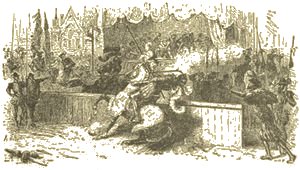
Sir Claude de Vauldre, Lord of Burgundy, was regarded as the stoutest knight in France. He was then at Lyons, and was about to hold a tilt, with lance and battle-axe, before the ladies and the king. His shield was hanging in the Ainay meadows, and beside it Montjoy, the king-at-arms, sat all day with his book open, taking down the names of those who struck the shield. Among these came Bayard. Montjoy laughed as he wrote down his name; the king, Lord Ligny, and his own companions, heard with mingled trepidation and delight that Bayard had struck the blazon of Sir Claude. But no one had a thought of what was coming. The day arrived, the tilt was held, and Bayard, by the voice of all the ladies, bore off the prize above the head of every knight in Lyons.
The glory of this exploit was extreme. It quickly spread. Three days later Bayard went to join the garrison at Aire. He found, as he rode into the little town, that the fame of his achievement had arrived before him. Heads were everywhere thrust out of windows, and a band of fifty of his future comrades issued on horseback from the garrison to bid him welcome. A few days after his arrival he held a tilt in his own person, after the example of Sir Claude. The palms were a diamond and a clasp of gold. Forty-eight of his companions struck his shield, and rode into the lists against him. Bayard overthrew the whole band, one by one, and was once more hailed at sunset by the notes of trumpets as the champion of the tourney.
It is not in tournaments and tilts, however, that a knight can win his spurs. Bayard burned for battle. For many months he burned in vain; but at last the banners of the king were given to the wind, and Bayard, to his unspeakable delight, found himself marching under Lord Ligny against Naples.
The two armies faced each other at Fornovo. The odds against the French were six to one, and the fight was long and bloody. When the great victory was at last decided, Bayard was among the first of those called up before the king. That day two horses had dropped dead beneath him; his cuirass and sword were hacked and battered, and a captured standard, blazing with the arms of Naples, was in his hand. At the king's order he knelt down, and received upon the spot the rank of knight. At one bound he had achieved the height of glory—to be knighted by his sovereign on the field of battle.
Bayard was not yet nineteen. His figure at that age was tall and slender; his hair and eyes were black; his complexion was a sunny brown; and his countenance had something of the eagle's.
He was now for some time idle. He was left in garrison in Lombardy. But fiercer fields were soon to call him. Ludovico Sforza took Milan. At Binasco, Lord Bernardino Cazache, one of Sforza's captains, had three hundred horse; and twenty miles from Milan was Bayard's place of garrison. With fifty of his comrades he rode out one morning, bent on assaulting Lord Bernardino's force. The latter, warned by a scout of their approach, armed his party, and rushed fiercely from the fort. The strife was fought with fury; but the Lombards, slowly driven back toward Milan, at length wheeled round their horses and galloped like the wind into the city.
Bayard, darting in his spurs, waving his bare blade, and shouting out his battle-cry of "France," was far ahead of his companions. Before he knew his danger, he had dashed in with the fugitives at the city gates and reached the middle of the square in front of Sforza's palace. He found himself alone in the midst of the fierce enemy—with the white crosses of France emblazoned on his shield.
Sforza, hearing a tremendous uproar in the square, came to a window of the palace and looked down. The square was swarming with the soldiers of Binasco, savage, hacked, and bloody; and in the centre of the yelling tumult, Bayard, still on horseback, was slashing at those who strove to pull him from his seat.
Sforza, in a voice of thunder, bade the knight be brought before him. Bayard, seeing that resistance was mere madness, surrendered to Lord Bernardino, and was led, disarmed, into the palace. Sforza was a soldier more given to the ferocity than to the courtesies of war. But when the young knight stood before him, when he heard his story, when he looked upon his bold yet modest bearing, the fierce and moody prince was moved to admiration. "Lord Bayard," he said, "I will not treat you as a prisoner. I set you free; I will take no ransom; and I will grant you any favor in my power." "My Lord Prince," said Bayard, "I thank you for your courtesy with all my soul. I will ask you only for my horse and armor." The horse was brought; Bayard sprang into the saddle, and an hour later was received by his companions with raptures of surprise and joy, as one who had come alive out of the lion's den.
Milan fell; Sforza was taken; and Bayard went into garrison at Monervino. At Andri, some miles distant, was a Spanish garrison under the command of Don Alonzo de Sotomayor, one of the most famous knights in Spain. Bayard, with fifty men, rode out one morning, in the hope of falling in with some adventure. It happened that he came across Alonzo, with an equal party, abroad on the same quest. Their forces met; both sides flew joyously to battle, and for an hour the victory hung in the balance. But at last Bayard, with his own sword, forced Alonzo to surrender; and his party, carrying with them a large band of prisoners, rode back in triumph to the garrison.
Sotomayor behaved in most unknightly fashion, and after being ransomed, accused Bayard of ill-treating him. Bayard sent him the lie, and challenging him to a duel to the death, slew him. A few days later, the Spaniards, panting for reprisal, proposed to meet a party of the French in combat, for the glory of their nations. Bayard received the challenge with delight. On the appointed day, thirteen knights of either side, glittering in full harness, armed with sword and battle-axe, and prepared for a contest to the death, rode forth into the lists.
By the laws of such a tilt a knight unhorsed, or forced across the boundary, became a prisoner, and could fight no longer. The Spaniards, with great cunning, set themselves to maim the horses; and by these tactics, eleven of the French were soon dismounted. Two alone were left to carry on the contest, Bayard and Lord Orose.
Then followed such a feat of arms as struck the gazers dumb. For four hours these two held good their ground against the whole thirteen. The Spaniards, stung with rage and shame, spurred till their heels dripped blood. In vain. Night fell; the bugles sounded; and still the unconquerable pair rode round the ring.
But great as this feat was, it was soon to be succeeded by a greater. A few weeks afterward the French and Spanish camps were posted on opposite sides of the river Gargliano. Between them was a bridge, in the possession of the French; and some way farther down the river was a ford, known only to the Spanish general, Pedro de Paez. He proposed to lure the French guards from the bridge, and then to seize it. And his stratagem was ready.
Early in the morning the French soldiers at the bridge were startled to perceive a party of the enemy, each horseman bearing a foot-soldier on his crupper, approach the river at the ford and begin to move across it. Instantly, as Paez had intended, they left the bridge and rushed toward the spot. Bayard, attended by Le Basque, was in the act of putting on his armor. He sprang into the saddle, and was about to spur after his companions, when he perceived, across the river, a party of two hundred Spaniards making for the bridge. The danger was extreme; for if the bridge were taken the camp itself would be in the most deadly peril. Bayard bade Le Basque gallop for his life to bring assistance. And he himself rode forward to the bridge, alone.
The Spaniards, on seeing a solitary knight advance against them, laughed loudly at his folly. Their foremost horsemen were already half-way over when Bayard, with his lance in rest, came flying down upon them. His onset swept the first three off the bridge into the river, and instantly the rest, with cries of vengeance, rushed furiously upon him. Bayard, not to be surrounded, backed his horse against the railing of the bridge, rose up in his stirrups, swung his falchion with both hands above his head, and lashed out with such fury that, with every blow a bloody Spaniard fell into the river, and the whole troop recoiled in wonder and dismay, as if before a demon. While they still stood, half-dazed, two hundred glaring at one man, a shout was heard, and Le Basque, with a band of horsemen, was seen approaching like a whirlwind. In two minutes the Spaniards were swept back upon the land in hopeless rout—and the French camp was saved.
Bayard received for this great feat the blazon of a porcupine, with this inscription, Unus agminis vires habet—"One man has the might of armies."
And still came exploit after exploit in succession—exploits of every kind of fiery daring. At Genoa, when the town revolted, Bayard stormed the fort of the insurgents, quelled the riot, forced the city to surrender, and hanged the leader on a pole. At Agnadello, against the troops of Venice, he waded with his men through fens and ditches, took the picked bands of Lord d'Alvicino on the flank, scattered them to the winds, and won the day. At Padua, during the long siege, he scoured the country with his band of horse, and frequently rode back to camp at nightfall with more prisoners than armed men. At Mirandola, where he faced the papal armies, he laid a scheme to take the Pope himself. A snowstorm kept the fiery Julius in his tent, and Bayard lost him. A few days afterward the pontiff's life was in his hands. A traitor offered, for a purse of gold, to poison the Pope's wine. But it is not the Bayards of the world who fight with pots of poison; and the slippery Judas had to fly in terror from the camp, or Bayard would infallibly have hanged him.
So far, amid his life of perils, Bayard had escaped without a wound. But now his time had come.
Brescia was taken by the troops of Venice. Gaston de Foix, the thunderbolt of Italy, marched with 12,000 men to its relief. Bayard was among them. At the head of the storming-party he was first across the ramparts, and was turning round to cheer his men to victory when a pike struck him in the thigh. The shaft broke off, and the iron head remained embedded in the wound.
Two of his archers caught him as he fell, bore him out of the rush of battle, and partly stanched the wound by stripping up the linen of their shirts. They then bore him to a mansion close at hand. The master of the house, who seems to have been a person of more wealth than valor, had disappeared, and was thought to be hiding somewhere in a convent, leaving his wife and his two daughters to themselves. The girls had fled into a hay-loft, and plunged themselves beneath the hay; but, on the thunderous knocking of the archers, the lady of the house came trembling to the door. Bayard was carried in, a surgeon was luckily discovered close at hand, and the pike-head was extracted. The wound was pronounced to be not dangerous. But Bayard, to his great vexation, found he was doomed to lie in idleness for several weeks.
According to the laws of war, the house was his, and all the inmates were his prisoners. And the fact was well for them. Outside the house existed such a scene of horror as, even in that age, was rare. Ten thousand men lay dead in the great square; the city was given up to pillage, and it is said that the conquerors gorged themselves that day with booty worth three million crowns. The troops were drunk with victory and rapine. No man's life, no woman's honor, was in safety for an instant.
Bayard set his archers at the door-way. His name was a talisman against the boldest; and in the midst of the fierce tumult that raged all round it, the house in which he lay remained a sanctuary of peace.
The ladies of the house were soon reassured. Bayard refused to regard them as his prisoners or to take a coin of ransom. The daughters, two lovely and accomplished girls, were delighted to attend the wounded knight. They talked and sang to him, they touched the mandolin, they woke the music of the virginals. In such society the hours flew lightly by. The wound healed, and in six weeks Bayard was himself again.
On the day of his departure the lady of the house came into his apartment, and besought him, as their preserver, to accept a certain little box of steel. The box contained two thousand five hundred golden ducats. Bayard took it. "But five hundred ducats," he said, "I desire you to divide for me among the nuns whose convents have been pillaged." Then, turning to her daughters, "Ladies," he said, "I owe you more than thanks for your kind care of me. Soldiers do not carry with them pretty things for ladies; but I pray each of you to accept from me a thousand ducats, to aid your marriage portions." And with that he poured the coins into their aprons.
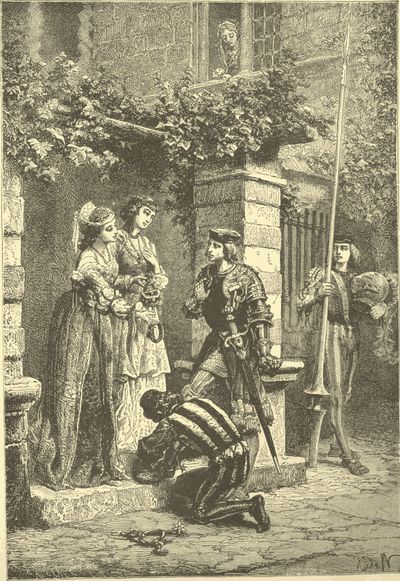
Bayard taking Leave of The Ladies of Brescia.
His horse was brought, and he was about to mount, when the girls came stealing down the steps into the castle court, each with a little present, worked by their own hands, which they desired him to accept. One brought a pair of armlets, made of gold and silver thread; the other, a purse of crimson satin. And this was all the spoil that Bayard carried from the inestimable wealth of Brescia—the little keepsakes of two girls whom he had saved.
The scenes of Bayard's life at which we have been glancing have been chiefly those of his great feats of arms. And so it must be still; for it is these of which the details have survived in history. And yet it was such incidents as these at Brescia which made the fame of Bayard what it was and what it is. To his foes, he was the flower of chivalry; but to his friends, he was, besides, the most adored of men. It is said that in his native province of Dauphiny, at his death, more than a hundred ancient soldiers owed to him the roof that covered their old age; that more than a hundred orphan girls had received their marriage portions from his bounty. But of such acts the vast majority are unrecorded; for these are not the deeds which shine in the world's eye.
Gaston de Foix was now before Ravenna. Bayard rode thither with all speed; he was just in time. Two days after his arrival came the battle. Weak though he still was from his long illness, Bayard on that day was seen, as ever, "shining above his fellow-men." He turned the tide of victory; he tore two standards from the foe with his own hand; and he was first in the pursuit.
Two months after, Bayard was at Pavia. The little troop with which he was then serving had there sought refuge under Louis d'Ars. The armies of the Swiss burst in upon them. Bayard, with a handful of soldiers in the market-place, held, for two hours, their whole force at bay, while his companions were retreating from the town across a bridge of boats. As he himself was crossing, last of all, a shot struck him in the shoulder, and stripped it to the bone. No surgeon was at hand. The wound, roughly stanched with moss, brought on a fever, and for some time he lay in danger of his life.
And now Bayard was to follow a new master. Louis XII. died; Francis I. received the crown; and Bayard, with the young king, marched to Milan, which the Swiss had seized and held.
On Thursday, September 13, 1515, King Francis pitched his camp at Marignano, before the city of the spires. No danger of attack was apprehended; the king sat calmly down to supper in his tent; when all at once the Swiss, aroused to madness by the fiery eloquence of Cardinal de Sion, broke like a tempest from the city, and fell upon the camp. The French, by the red light of sunset, flew to arms, and fought with fury till night fell. Both armies sat all night on horseback, waiting for the dawn; and with the first streaks of morning, flew again to battle. It was noon before the bitter contest ended, and the Swiss, still fighting every inch of ground, drew slowly back toward the city. It had been, indeed, as Trevulzio called it, a Battle of the Giants. And the greatest of the giants had been Bayard and the king.
That evening Francis held, before his tent, the ceremony of creating knights of valor. But before the ceremony began, a proclamation by the heralds startled and delighted all the camp. Francis had determined to receive the rank in his own person. Bayard was to knight the king!
In the days of the primeval chivalry, when even princes were compelled to win their spurs, such a spectacle was not uncommon. But not for ages had a king been knighted by a subject on a field of battle. Nor was any splendor wanting that could make the spectacle impressive. Nowhere in Ariosto is a picture of more gorgeous details than is presented by this scene of history; the great crimson silk pavilion, the seat spread with cloth of gold, the blazoned banners, the heralds with their silver trumpets, the multitude all hushed in wonder, the plumed and glittering company of knights and men-at-arms. Such were the surroundings amid which Francis knelt, and Bayard, with his drawn sword, gave the accolade.
The sword with which he had performed the ceremony Bayard kept religiously until his death. It was then mislaid, and never rediscovered. The loss is a misfortune. For few relics could exist of more romantic interest than the sword with which the noblest of all knights did honor to the most magnificent of kings.
Bayard's glory had long been at such a height that hardly any exploit could increase it. And yet an exploit was at hand at which, even when Bayard was the actor of it, all France and Germany were to stand in wonder.
The German emperor, marching with a mighty army on Champagne, took Monson by surprise, and advanced against Mézières. If Mézières were taken, the whole province would be in the most deadly peril. And yet defence seemed hopeless; the place had no artillery, and the ramparts were in ruins. At this crisis Bayard volunteered to hold the crazy city. "No walls are weak," he said, in his own noble style, "which are defended by brave men."
With a small but chosen band he hastened to Mézières. Two days after his arrival the Count of Nassau, with a vast array of men and cannon, appeared before the walls. The siege began—a siege which seemed impossible to last twelve hours.
But day after day went by, and still the town was standing. Every day the ramparts gaped with cannon-shot; but every night, as if by miracle, they rose again. The defenders suffered from wounds, pestilence, and famine; but Bayard had put every man on oath to eat his horse, and then his boots, before he would surrender. Three weeks passed; and when at last the king arrived with forces to relieve the town, he found a few gaunt spectres still glaring defiance from the battered ramparts against a hundred cannon and more than forty thousand men.
Nothing can more strikingly describe the part of Bayard than the testimony of his enemies themselves. Some time after, Mary of Hungary asked the Count of Nassau in disdain how it came to pass that with a host of troops and guns he could not take a crazy pigeon-house. "Because," replied the count, "there was an eagle in it."
It was Bayard's last great exploit. It had been his lifelong wish that he might fall upon the field of battle. And so it was to be.
Early in the spring of 1524, the French camp was posted at Biagrasso. Lord Bonnivet, who was in command, found himself, after a prolonged resistance, at last compelled by famine and sickness to retire before the Spaniards. It was Bayard's constant custom to be first in an advance and last in retreat, and that day he was, as usual, in the post of danger. It was for the last time. Friends and enemies were to hear, before night fell, the thrilling tidings that Bayard was no more.