Volume 3 — STATESMEN AND SAGES (continued 6)
Reading edition
The Shakespeare plays continue to be poured forth, and Bacon suffers from a siege of "Jews and duns." He describes himself "as poor and sick, working for bread." "I am purposed," he says, "not to follow the practice of the law." "It is easier," says Mr. Spedding, Bacon's biographer, "to understand why Bacon was resolved not to devote his life to the ordinary practice of a lawyer, than what plan he had to clear himself of the difficulties which were now accumulating upon him, and to obtain the means of living and working. What course he betook himself to at the crisis at which we have now arrived, I cannot possibly say." We have here the time, the opportunity, the incentive, and the necessity for the composition of the Shakespeare plays; part of the fruits of the representation of which made Shakespeare very wealthy.
In January, 1597, the first acknowledged work of Bacon—his "Essays"—was published. They were ten in number. Bacon said of them he hoped they would be "like the late new half-pence, which, though the pieces are small, the silver is good."
Until he was forty-four years of age, Bacon was kept poor and out of office by his uncle Burleigh, and his cousin Cecil; during the life-time of Queen Elizabeth he was steadily passed over and suppressed; and even during the first years of the reign of King James I., the influence of Cecil, then the Earl of Salisbury, was sufficient to keep him out of office. In 1605, Bacon published his first great philosophical work, "The Advancement of Learning;" in 1607, he became Solicitor-General; and in 1612, Attorney-General, and member of the Privy Council. He was then fifty-one years of age, and Shakespeare forty-eight. After the appointment of Bacon as Attorney-General, no more of the Shakespeare plays appeared; the "Tempest," which is evidently the last of the series, for in it Prospero declares—
"I'll break my staff, Bury it certain fathoms in the earth, And deeper than did ever plummet sound, I'll drown my book;"
is set down by the commentators, as written between 1609 and 1611. At that time Shakespeare was forty-five or forty-seven years of age, and lived for five or seven years thereafter in utter intellectual idleness, in Stratford.
In 1609 Bacon published "The Wisdom of the Ancients," a prose work of great poetical beauty. His professional practice was large and his income princely. In 1617 he succeeded Ellesmere, the Lord Chancellor, with the title of lord-keeper. In January, 1618, he was created lord high chancellor, and the same year was raised to the peerage as Baron of Verulam; and in 1621 he was made Viscount St. Albans. The "Novum Organum," his great life-work, was printed in October, 1620. His extraordinary industry is revealed in the fact that it had been copied and revised twelve times before it took its present shape. The new philosophy meant the study of nature and the acquisition of the knowledge of things. In this search the "most common," "base, illiberal and filthy matters," are not to be overlooked. We find in the plays the same novel philosophy:
"Some kinds of baseness Are nobly undergone; and most poor matters Point to rich ends." (Tempest, iii. 1.)
"Bacon's leading thought was the good of humanity. He held that study, instead of employing itself in wearisome and sterile speculations, should be engaged in mastering the secrets of nature and life, and in applying them to human use. His method, in the attainment of this end, was rigid and pure observation, aided by experiment and fructified by induction.... He clearly invented a thermometer; he instituted ingenious experiments on the compressibility of bodies, and on the density and weight of air; he suggested chemical processes; he suggested the law of universal gravitation, afterward demonstrated by Newton; he foresaw the true explication of the tides, and the cause of colors." ["American Cyclopedia." Vol. II., p. 204.]
This great work, the "Novum Organum," as often happens, was received by the majority of readers of his time with laughter and ridicule. Coke wrote on the title-page of a presentation copy:
"It deserveth not to be read in schools, But to be freighted in the ship of fools."
The ill-fortune which had so shrouded Bacon's struggling youth, and which had given way to such a magnificent sun-burst of splendid prosperity, was again massing its clouds and determined to cover his old age with shame, gloom and sorrow. He had been Lord Chancellor but three years, when, on March 15, 1621, a committee of the House of Commons reported two cases of bribery or corruption against him. Twenty-two other cases were also soon after presented. The House of Lords proceeded to investigate these charges, and Bacon defended himself. It was shown that fourteen of the twenty-four cases were presents given long after the suits were terminated; three more were sums of money loaned in the ordinary course of business; another case was an arbitration where compensation was due him; in another case the gift was sent back; another present, a piece of furniture, had never been accepted; another case was a New Year's gift, and in other cases the money was openly paid to the officers of his court. "Thus," says Hepworth Dixon, "after the most rigid scrutiny into his official acts, and into the official acts of his servants, not a single fee or remembrance, traced to the chancellor, can, by any fair construction, be called a bribe. Not one appears to have been given on a promise; not one appears to have been given in secret; not one is alleged to have corrupted justice."
It must be remembered that the salaries of all the high officers of the government were at that time paid in gifts and fees. Thus the king gave the lord chancellor but £81 6s. 8d. a year, while the place was worth £10,000 to £15,000; worth in our money to-day $125,000. "The judges had enough to buy their gloves and robes, not more." The lord chancellor had to maintain a huge retinue: "his court, his household, and his followers, gentlemen of quality, sons of peers and prelates; magistrates, deputy lieutenants of counties, knights of the shire, have all to live on fees and presents." It is still true that in England the law will not help a barrister or a physician to recover a fee; their compensation is, in theory, at least, supposed to be a gratuity for those they serve.
But it may be urged that Bacon plead guilty to corruption and bribery. He did nothing of the kind. He acknowledged that he "partook of the abuses of the times," and that the existing customs should be reformed; but he solemnly declared to Buckingham, May 31, 1621: "I have been a trusty and honest and Christ-loving friend to your lordship and the justest chancellor that hath been in the five charges since my father's time." Again, he said: "I had no bribe or reward in my eye or thought when I pronounced any sentence or order.... I take myself to be as innocent as any babe born on St. Innocent's day in my heart." All attempts to subsequently reverse his decrees failed, although his enemies were in possession of power. But King James urged him to make no defence, "to trust his honor and his safety to the crown.... He pleads guilty to carelessness, not to crime." He desired to live to finish up his philosophical works. To resist the king's wishes was to leave himself at the mercy of his life-long enemy, Coke; he yielded. The king remitted his fine of £40,000 and released him from the Tower. Bacon goes back to his books and writes in cipher: "I was the justest judge that was in England these fifty years; but it was the justest censure that was in Parliament these two hundred years." He meant thereby, that while personally innocent of corruption, the sentence would end gift-giving to judges. His formal confession to Parliament is a justification of every act complained of, for he relieves it, while acknowledging it, of those details which imply bribery.
He devoted the last five years of his life to putting forth the greatest works ever published by man; including the first complete edition of the so-called Shakespeare plays. Fortunate is it for the world that he was driven from the task of settling petty squabbles about the trash of the time, listening to "weary lawyers with endless tongues;" adjudicating questions of pounds, shillings, and pence between litigants whose very names have disappeared; and was shipwrecked by the stress of the great storm that struck him, like Prospero, on an island of solicitude, with books that "he prized above his dukedom," to perform labors in which all mankind will be interested even to the consummation of civilization on earth.
His patience, his gentleness, his forbearance were saint-like; still in his right hand he carried "gentle peace to silence envious tongues." His appearance, we are told, struck all men who beheld him with a great sense of awe. Those who were most closely associated with him loved him most dearly. His purposes were Godlike. They were "the glory of the Creator and the relief of man's estate." Macaulay says of Bacon's experimental philosophy:
"It has lengthened life; it has mitigated pain; it has extinguished diseases; it has increased the fertility of the soil; it has given new securities to the mariner; it has furnished new arms to the warrior; it has spanned great rivers and estuaries with bridges of form unknown to our fathers; it has guided the thunderbolt innocuously from heaven to earth; it has lighted up the night with the splendor of the day; it has extended the range of the human vision; it has multiplied the power of human muscle; it has accelerated motion; it has annihilated distance; it has facilitated intercourse, correspondence, all friendly offices, all despatch of business; it has enabled men to descend to the depths of the sea; to soar into the air; to penetrate securely into the noxious recesses of the earth; to traverse the land with cars which whirl along without horses; and the ocean with ships which sail against the wind."
In other words, the brain of this tremendous, this incomprehensible, this complex man, lies at the base of all our literature and of all our modern progress and civilization. The world is hardly big enough for his fame, and the praises of mankind cannot fill the measure of his greatness.[Back to Contents]
GALILEO-GALILEI (1564-1642)
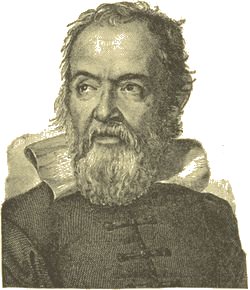
The great Tuscan astronomer is best known as the first telescopic observer, the fortunate discoverer of the Medicean stars (so Jupiter's satellites were first named); and what discovery more fitted to immortalize its author than one which revealed new worlds and thus gave additional force to the lesson, that the universe, of which we form so small a part, was not created only for our use or pleasure? Those, however, who consider Galileo only as a fortunate observer, form a very inadequate estimate of one of the most meritorious and successful of those great men who have bestowed their time for the advantage of mankind in tracing out the hidden things of nature. Galileo-Galilei was born at Pisa, February 15, 1564. In childhood he displayed considerable mechanical ingenuity, with a decided taste for the accomplishments of music and painting. His father formed a just estimate of his talents, and at some inconvenience entered him, when nineteen years old, at the university of his native town, intending that he should pursue the medical profession. Galileo was then entirely ignorant of mathematics; and he was led to the study of geometry by a desire thoroughly to understand the principles of his favorite arts. This new pursuit proved so congenial to his taste, that from thenceforward his medical books were entirely neglected. The elder Galilei, a man of liberal acquirements and enlarged mind, did not require the devotion of his son's life to a distasteful pursuit. Fortunately the young man's talents attracted notice, and in 1589 he was appointed mathematical lecturer in the University of Pisa. There is reason to believe that, at an early period of his studentship, he embraced, upon inquiry and conviction, the doctrines of Copernicus, of which through life he was an ardent supporter.
Galileo and his colleagues did not long remain on good terms. The latter were content with the superstructure which à priori reasoners had raised upon Aristotle, and were by no means desirous of the trouble of learning more. Galileo chose to investigate physical truths for himself; he engaged in experiments to determine the truth of some of Aristotle's positions, and when he found him in the wrong, he said so, and so taught his pupils. This made the "paper philosophers," as he calls them, very angry. He repeated his experiments in their presence, but they set aside the evidence of their senses and quoted Aristotle as much as before. The enmity arising from these disputes rendered his situation so unpleasant, that in 1592, at the invitation of the Venetian commonwealth, he gladly accepted the professorship of mathematics at Padua. The period of his appointment being only six years, he was re-elected in 1598, and again in 1606, each time with an increase of salary; a strong proof of the esteem in which he was held, even before those astronomical discoveries which have immortalized his name. His lectures at this period were so fully attended that he was sometimes obliged to adjourn them to the open air. In 1609 he received an invitation to return to his original situation at Pisa. This produced a letter, still extant, from which we quote a catalogue of the undertakings on which he was already employed. "The works which I have to finish are principally two books on the 'System or Structure of the Universe,' an immense work, full of philosophy, astronomy, and geometry; three books on 'Local Motion,' a science entirely new, no one, either ancient or modern, having discovered any of the very many admirable accidents which I demonstrate in natural and violent motions, so that I may, with very great reason, call it a new science, and invented by me from its very first principles; three books of mechanics, two on the demonstration of principles and one of problems; and although others have treated this same matter, yet all that has been hitherto written, neither in quantity nor otherwise, is the quarter of what I am writing on it. I have also different treatises on natural subjects—on Sound and Speech, on Light and Colors, on the Tides, on the Composition of Continuous Quantity, on the Motions of Animals, and others besides. I have also an idea of writing some books relating to the military art, giving not only a model of a soldier, but teaching with very exact rules everything which it is his duty to know, that depends upon mathematics, as the knowledge of castrametation, drawing up of battalions, fortification, assaults, planning, surveying, the knowledge of artillery, the use of instruments, etc." Out of this comprehensive list, the treatises on the universe, on motion and mechanics, on tides, on fortification, or other works upon the same subjects, have been made known to the world. Many, however, of Galileo's manuscripts, through fear of the Inquisition, were destroyed, or concealed and lost, after the author's death.
In the same year, 1609, Galileo heard the report that a spectacle-maker of Middleburg, in Holland, had made an instrument by which distant objects appeared nearer. He tasked his ingenuity to discover the construction, and soon succeeded in manufacturing a telescope. His telescope, however, seems to have been made on a different construction from that of the Dutch optician. It consisted of a convex and concave glass, distant from each other by the difference of their focal lengths, like a modern opera-glass; while there is reason to believe that the other was made up of two convex lenses, distant by the sum of their focal lengths, the common construction of the astronomical telescope. Galileo's attention naturally was first turned to the moon. He discovered that her surface, instead of being smooth and perfectly spherical, was rough with mountains and apparently varied like the earth, by land and water. He next applied to Jupiter, and was struck by the appearance of three small stars, almost in a straight line and close to him. At first he did not suspect the nature of these bodies; but careful observation soon convinced him that these three, together with a fourth, which was at first invisible, were in reality four moons revolving round their primary planet. These he named the Medicean stars. They have long ceased to be known by that name; but so highly prized was the distinction thus conferred upon the ducal house of Florence, that Galileo received an intimation that he would "do a thing just and proper in itself, and at the same time render himself and his family rich and powerful forever," if he "named the next star which he should discover after the name of the great star of France, as well as the most brilliant of all the earth," Henry IV. These discoveries were made known in 1610, in a work entitled "Nuncius Sidereus," the Newsman of the Stars; in which Galileo further announced that he had seen many stars invisible to the naked eye, and ascertained that the nebulæ scattered through the heavens consist of assemblages of innumerable small stars. The ignorant and unprejudiced were struck with admiration; indeed, curiosity had been raised so high before the publication of this book, as materially to interfere with the convenience of those who possessed telescopes. Galileo was employed a month in exhibiting his own to the principal persons in Venice; and our unfortunate astronomer was surrounded by a crowd who kept him in durance for several hours, while they passed his glass from one to another. He left Venice the next morning, to pursue his inquiries in some less inquisitive place. But the great bulk of the philosophers of the day were far from joining in the general feeling. They raised an outcry against the impudent fictions of Galileo, and one, a professor of Padua, refused repeatedly to look through the telescope, lest he should be compelled to admit that which he had pre-determined to deny.
It was not long before Galileo had new and equally important matter to announce. He observed a remarkable appearance in Saturn, as if it were composed of three stars touching each other; his telescope was not sufficiently powerful to resolve them into Saturn and his ring. Within a month he ascertained that Venus exhibits phases like those of the moon—a discovery of great importance in confirming the Copernican system. The same phenomenon he afterward detected in Mars. We close the list with the discovery of the revolution of the sun round his axis, in the space of about a lunar month, derived from careful observation of the spots on his surface.
About this time (1610-1611) Galileo took up his abode in Tuscany, upon the invitation of the grand duke, who offered to him his original situation at Pisa, with a liberal salary, exemption from the necessity of residence, and complete leisure to pursue his studies. In 1612 he published a discourse on "Floating Bodies," in which he investigates the theory of buoyancy, and refutes, by a series of beautiful and conclusive experiments, the opinion that the floating or sinking of bodies depends on their shape.
Neither Copernicus nor his immediate followers suffered inconvenience or restraint on account of their astronomical doctrines; nor had Galileo, until this period of his life, incurred ecclesiastical censure for anything which he had said or written. But the Inquisition now took up the matter as heretical and contrary to the express words of Scripture; and in 1616, Copernicus's work, "De Revolutionibus," Kepler's "Epitome," and some of Galileo's own letters, were placed on the list of prohibited books; and he himself, being then in Rome, received formal notice not to teach that the earth revolves round the sun. He returned to Florence full of indignation; and considering his hasty temper, love of truth, and full belief of the condemned theory, it is rather wonderful that he kept silence so long, than that he incurred at last the censures of the hierarchy. He did, however, restrain himself from any open advocacy of the heretical doctrines, even in composing his great work, the "Dialogue on the Ptolemaic and Copernican Systems." This was completed in 1630, but not printed till 1632, under license from officers of the church, both at Rome and Florence. It is a dialogue between Simplicio, an Aristotelian, Salviati, who represents the author, and Sagredo, a half convert to Salviati's opinions. It professes "indeterminately to propose the philosophical arguments, as well on one side as on the other;" but the neutrality is but ill kept up, and was probably assumed, not with any hope that the court of Rome would be blinded as to the real tendency of the book, but merely that it would accept this nominal submission as a sufficient homage to its authority. If this were so, the author was disappointed; the Inquisition took cognizance of the matter, and summoned him to Rome to undergo a personal examination. Age and infirmity were in vain pleaded as excuses; still, through the urgent and indignant remonstrances of the Grand Duke of Tuscany, he was treated with a consideration rarely shown by that stern tribunal. He was allowed to remain at the Florentine ambassador's palace, with the exception of a short period, from his arrival in February, until the passing of sentence, June 21, 1633. He was then condemned, in the presence of the Inquisitors, to curse and abjure the "false doctrines," which his life had been spent in proving, to be confined in the prison of the Holy Office during pleasure, and to recite the seven penitential psalms once a week during three years. The sentence and the abjuration are given at full length in the "Life of Galileo," in the "Library of Useful Knowledge." "It is said," continues the biographer, "that Galileo, as he rose from his knees, stamped on the ground, and whispered to one of his friends, 'e pur si muove,' it does move though."
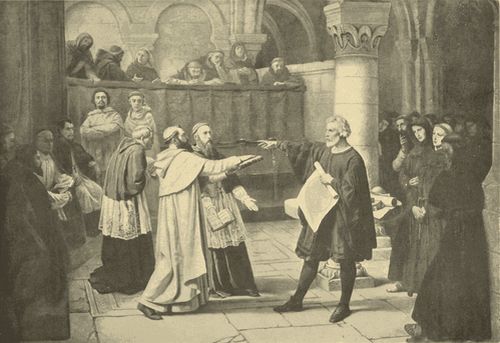
Galileo before the Inquisition.
Galileo's imprisonment was not long or rigorous, for after four days he was reconducted to the Florentine ambassador's palace; but he was still kept under strict surveillance. In July he was sent to Sienna, where he remained five months in strict seclusion. He obtained permission in December to return to his villa at Arcetri, near Florence: but there, as at Sienna, he was confined to his own premises, and strictly forbidden to receive his friends. It is painful to contemplate the variety of evils which overcast the evening of this great man's life. In addition to a distressing chronic complaint, contracted in youth, he was now suffering under a painful infirmity which by some is said to have been produced by torture, applied in the prisons of the Inquisition to extort a recantation. But the arguments brought forward to show that the Inquisitors did resort to this extremity do not amount to anything like direct proof. In April, 1634, Galileo's afflictions were increased by the death of a favorite, intelligent, and attached daughter. He consoled his solitude, and lightened the hours of sickness, by continuing the observations which he was now forbidden to publish to the world; and the last of his long train of discoveries was the phenomenon known by the name of the moon's libration. In the course of 1636-37 he lost successively the sight of both his eyes. He mentions this calamity in a tone of pious submission, mingled with a not unpleasing pride. "Alas, your dear friend and servant Galileo has become totally and irreparably blind; so that this heaven, this earth, this universe, which with wonderful observations I had enlarged a hundred thousand times beyond the belief of by-gone ages, henceforward for me is shrunk into the narrow space which I myself fill in it. So it pleases God: it shall therefore please me also." In 1638 he obtained leave to visit Florence, still under the same restrictions as to society; but at the end of a few months he was remanded to Arcetri, which he never again quitted. From that time, however, the strictness of his confinement was relaxed, and he was allowed to receive the friends who crowded round him, as well as the many distinguished foreigners who eagerly visited him. Among these we must not forget Milton, whose poems contain several allusions to the celestial wonders observed and published by the Tuscan astronomer. Though blind and nearly deaf, Galileo retained to the last his intellectual powers; and his friend and pupil, the celebrated Torricelli, was employed in arranging his thoughts on the nature of percussion, when he was attacked by his last illness. He died January 8, 1642, aged seventy-eight.
It was disputed whether, as a prisoner of the Inquisition, Galileo had a right to burial in consecrated ground. The point was conceded; but Pope Urban VIII. himself interfered to prevent the erection of a monument to him in the church of Santa Croce, in Florence, for which a large sum had been subscribed. A splendid monument now covers the spot in which his remains repose with those of his friend and pupil, the eminent mathematician Viviani.
For an account of Galileo's application of the pendulum to the mensuration of time; his invention of the thermometer, though in an inaccurate and inconvenient form; his methods of discovering the longitude, and a variety of other points well worth attention, we must refer to the Life of Galileo already quoted. The numerous extracts from Galileo's works convey a lively notion of the author's character, and are distinguished by a peculiar tone of quaint humor. In conclusion, we quote the estimate of Galileo's character, from the same masterly memoir. "The numberless inventions of his acute industry; the use of the telescope, and the brilliant discoveries to which it led; the patient investigation of the laws of weight and motion, must all be looked upon as forming but a part of his real merits, as merely particular demonstrations of the spirit in which he everywhere withstood the despotism of ignorance, and appealed boldly from traditional opinions to the judgment of reason and common sense. He claimed and bequeathed to us the right of exercising our faculties in examining the beautiful creation which surrounds us. Idolized by his friends, he deserved their affection by numberless acts of kindness; by his good humor, his affability, and by the benevolent generosity with which he devoted himself, and a great part of his limited income, to advance their talents and fortunes. If an intense desire of being useful is everywhere worthy of honor; if its value is immeasurably increased when united to genius of the highest order; if we feel for one, who, notwithstanding such titles to regard, is harassed by cruel persecution, then none deserve our sympathy, our admiration, and our gratitude, more than Galileo."[Back to Contents]
CARDINAL RICHELIEU (1585-1642)
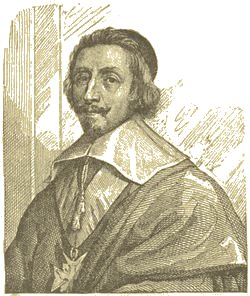
Armand Jean Du Plessis, Duke of Richelieu, the future cardinal, was the third son of François Du Plessis, Grand Provost of the French Court, and was born on September 5, 1585, at Paris, say his biographers, Aubery and Leclerc; while tradition claims this honor for the family château in Poitou. He received the elements of education at home from the Prior of St. Florent, but soon quitted the paternal mansion, first for the College of Navarre, subsequently for that of Lisieux. From thence he removed to a military academy, being intended for the profession of arms. But on his brother, who was Bishop of Luçon, resolving to quit the world for the cloister, young Armand was advised to abandon the sword for the gown, in order that he might succeed to his brother's bishopric.
He adopted the advice, entered with zeal into the study of theology, and soon qualified himself to pass creditably through the exercises necessary to obtain the degree of doctor in theology. He already wore the insignia of his bishopric, but the Pope's sanction was still wanting, and was withheld on account of the extreme youth of the expectant. Resolved to overcome this difficulty, he set off to Rome, addressed the pontiff in a Latin oration, and gave such proofs of talent and acquirements above his age, that he was consecrated at Rome on the Easter of 1607, being as yet but twenty-two years of age.
This position attained, Richelieu endeavored to make the utmost advantage of it. He acquired the good-will of his diocese by rigid attention to the affairs that fell under his jurisdiction; while in frequent visits to the capital, he sought to acquire reputation by preaching. In the Estates General of 1614, he was chosen deputy by his diocese, and was afterward selected by the clergy of the States to present their cahier or vote of grievances to the monarch. It was an opportunity not to be thrown away by the ambition of Richelieu, who instantly put himself forward as the champion of the queen-mother against the cabal of the high noblesse. He at the same time pointed out where she might find auxiliaries, by complaining that ecclesiastics had no longer a place in the public administration, and were thus degraded from their ancient and legitimate share of influence. Richelieu was rewarded with the place of almoner to the queen; and he was soon admitted to her confidence as well as to that of her favorite, the Maréchal D'Ancre.
In 1616 he was appointed secretary of state; but aware by what slender tenure the office was held, he refused to give up his bishopric. This excited not only the animadversions of the public, but the anger of the favorite. Richelieu offered to give up his secretaryship, but the queen could not dispense with his talents. The assassination of the favorite, however, soon overthrew the influence of the queen herself. Still Richelieu remained attached to her, and followed her to Blois; but the triumphant party, dreading his talents for intrigue, ordered him to quit the queen and repair to one of his priories in Anjou. He was subsequently commanded to retire to his bishopric, and at last exiled to Avignon. Here he sought to avert suspicion by affecting to devote himself once more to theological pursuits. During this period he published one or two polemical tracts, the mediocrity of which proves either that his genius lay not in this path, or, as is probable, that his interest and thoughts were elsewhere.
The escape of the queen-mother from her place of confinement, excited the fears of her enemies and the hopes of Richelieu. He wrote instantly to court, to proffer his services toward bringing about an accommodation. In the difficulty of the moment, the king and his favorite accepted the offer. Richelieu was released from exile, and allowed to join the queen at Angoulême, where he certainly labored to bring about a reconciliation. There were long and bitter struggles, but an agreement was finally concluded, and it was found that Richelieu, the negotiator, had himself reaped all the benefits. He received the cardinal's hat from the king's hand at Lyons, toward the close of the year 1622.
Not content with this advancement of her counsellor, Mary de Medici continued to press the king to admit Richelieu to his cabinet. Louis long resisted her solicitations, such was his instinctive dread of the man destined to rule him. Nor was it until 1624, after the lapse of sixteen months, and when embarrassed with difficult state questions, which no one then in office was capable of managing, that the royal will was declared admitting Richelieu to the council. Even this grace was accompanied by the drawback that the cardinal was allowed to give merely his opinion, not his vote.
Once, however, seated at the council table, the colleagues of the cardinal shrunk before him into ciphers. He boldly avowed his determination to adopt the policy and resume the scheme of Henry IV., for the humiliation of the House of Austria. His anchor of safety was in the confidence reposed in him by Louis XIII. This prince, although of most feeble will, was not without the just pride of a monarch; he could not but perceive that his former ministers or favorites were but the instruments or slaves of the noblesse, who consulted but their own interests, and provided but for the difficulties of the moment. Richelieu, on the contrary, though eager for power, sought it as an instrument to great ends, to the consolidation of the monarchy, and to its ascendancy in Europe. He was in the habit of unfolding these high views to Louis, who, though himself incapable of putting them into effect, nevertheless had the spirit to admire and approve them. Richelieu proposed to render his reign illustrious abroad, and at home to convert the chief of a turbulent aristocracy into a real monarch. It forms indeed the noblest part of this great statesman's character, that he won upon the royal mind, not by vulgar flattery, but by exciting within it a love of glory and of greatness to which, at the same time, he pointed the way.
Accordingly, through all the plots formed against him, Louis XIII. remained firmly attached to Richelieu, sacrificing to this minister's pre-eminence his nobility, his brother Gaston, Duke of Orleans, his queen, and finally the queen-mother herself, when she too became jealous of the man whom she had raised.
If Richelieu thus imprudently indulged his passion or his pique, he redeemed the error by activity and exertion unusual to the age. He at once formed the project of attacking the Huguenots in their chief stronghold of La Rochelle. Buckingham, the English minister, could not fail to attempt the relief of this sea-port, and the cardinal anticipated the triumph of personally defeating a rival. He accordingly himself proceeded to preside over the operations of the siege. To render the blockade effectual, it was requisite to stop up the port. The military officers whom he employed could suggest no means of doing this. Richelieu took counsel of his classic reading, and having learned from Quintus Curtius how Alexander the Great reduced Tyre, by carrying out a mole against it through the sea, he was encouraged to undertake a similar work. The great mound was accordingly commenced, and well-nigh finished, when a storm arose and destroyed it in a single night. But Richelieu was only rendered more obstinate: he recommenced the mole, and was seen with the volume of Alexander's History in his hand, encouraging the workmen and overruling the objections of the tacticians of the army. The second attempt succeeded, the harbor was blocked up, and the promised aid of England rendered fruitless. The cardinal triumphed, for La Rochelle surrendered. In his treatment of the vanquished, Richelieu showed a moderation seldom observable in his conduct. He was lenient, and even tolerant, toward the Huguenots, content with having humbled the pride of his rival, Buckingham.
La Rochelle was no sooner taken, and Richelieu rewarded by the title of prime minister than he resumed those projects of humbling the House of Austria, in which he had previously been interrupted. A quarrel about the succession to Mantua afforded him a pretext to interfere; and he did so, after his fashion, not by mere negotiations, but by an army. This expedition proved a source of quarrel between him and the queen-mother, Mary de Medici, who hitherto had been his firm and efficient friend.
The voice of the conqueror of La Rochelle triumphed in council, and his project in the field. The French were victorious in Italy, and the minister equally so over the mind of the monarch.
But Mary de Medici could not forgive, and she now openly showed her hatred of Richelieu, and exerted herself to the utmost to injure him with the king. Though daily defeating her intrigues, the cardinal dreaded her perseverance, and resolved to drag the king with him to another Italian campaign. Louis obeyed, and the court set out for the south, the queen-mother herself accompanying it. Richelieu, however, did not tarry for the slow motions of the monarch. He flew to the army, took upon him the command, and displayed all the abilities of a great general in out-manœuvring and worsting the generals and armies of Savoy. In the meantime Louis fell dangerously ill at Lyons. His mother, an affectionate attendant on his sick-couch, resumed her former empire over him. At one moment his imminent death seemed to threaten the cardinal with ruin. Louis recovered, however, and his first act was to compel a reconciliation, in form at least, between the cardinal and the queen-mother.
The king's illness, although not so immediately fatal to Richelieu as his enemies had hoped, was still attended with serious consequences to him. The French army met with ill success through the treachery of the general, Marillac, who was secretly attached to the queen's party, and the failure was attributed to Richelieu.
Mary de Medici renewed her solicitations to her son, that he would dismiss his minister. Louis, it appears, made a promise to that effect; a reluctant promise, given to get rid of her importunity. Mary calculated too securely upon his keeping it; she broke forth in bitter contumely against Richelieu; deprived him of his superintendence over her household, and treated Madame de Combalet, the cardinal's niece, who had sunk on her knees to entreat her to moderate her anger almost with insult. The king was present, and seemed to sanction her violence so that Richelieu withdrew to make his preparations for exile. Louis, dissatisfied and irresolute, retired to Versailles; while Mary remained triumphant at the Luxembourg, receiving the congratulations of her party. Richelieu, in the meantime, ere taking his departure, repaired to Versailles, and, once there, resumed the ascendant over the monarch. The tidings of this was a thunder-stroke to Mary and her party, who became instantly the victims of the cardinal's revenge. Marillac was beheaded, and Mary de Medici, herself at length completely vanquished by her rival, was driven out of France to spend the rest of her days in exile.
The trial of Marillac had roused the spirit and indignation even of those nobles who had previously respected, and bowed to, the minister of the royal choice. Richelieu not only threatened their order with the scaffold, but his measures of administration were directed to deprive them of their ancient privileges, and means of wealth and domination. One of these was the right of governors of provinces to raise the revenue within their jurisdiction, and to employ or divert no small portion of it to their use. Richelieu, to remedy this, transferred the office of collecting the revenue to new officers, called the Elect. He tried this in Languedoc, then governed by the Duc de Montmorenci, a noble of the first rank, whose example, consequently, would have weight, and who had always proved himself obedient and loyal. Moved, however, by his private wrongs, as well as that of his order, he now joined the party of the nobles and the king's brother, Gaston, Duke of Orleans. That weak prince, after forming an alliance with the Duke of Lorraine, had raised an army. Richelieu lost not a moment in despatching a force which reduced Lorraine, and humbled its hitherto independent duke almost to the rank of a subject. Gaston then marched his army to Languedoc and joined Montmorenci. The Maréchal de Brezé, Richelieu's brother-in-law, led the loyal troops against them, defeated Gaston at Castelnaudari, and took Montmorenci prisoner. This noble had been the friend and supporter of Richelieu, who even called him his son; yet the cardinal's cruel policy determined that he should die. There was difficulty in proving before the judges that he had actually borne arms against the king. "The smoke and dust," said St. Reuil, the witness, "rendered it impossible to recognize any combatant distinctly. But when I saw one advance alone, and cut his way through five ranks of gens-d'armes, I knew that it must be Montmorenci."
This gallant descendant of five constables of France perished on the scaffold at Toulouse. Richelieu deemed the example necessary to strike terror into the nobility. And he immediately took advantage of that terror, by removing all the governors of provinces, and replacing them throughout with officers personally attached to his interests.
Having thus made, as it were, a clear stage for the fulfilment of his great political schemes, Richelieu turned his exertions to his original plan of humbling the House of Austria, and extending the territories of France at its expense. He formed an alliance with the great Gustavus Adolphus, who then victoriously supported the cause of religious liberty in Germany. Richelieu drew more advantage from the death than from the victories of his ally; since, as the price of his renewing his alliance with the Swedes, he acquired the possession of Philipsburg, and opened the way toward completing that darling project of France and every French statesman, the acquisition of the Rhine as a frontier.
The French having manifested their design to get possession of Trèves, the Spaniards anticipated them; and open war ensued betwixt the two monarchies. Richelieu in his wars was one of those scientific combatants who seek to weary out an enemy, and who husband their strength in order not to crush at once, but to ruin in the end. Such, at least, were the tactics by which he came triumphant out of the struggle with Spain. He made no conquests at first, gained no striking victories; but he compensated for his apparent want of success by perseverance, by taking advantage of defeat to improve the army, and by laboring to transfer to the crown the financial and other resources which had been previously absorbed by the aristocracy. Thus the war, though little brilliant at first, produced at last these very important results. Arras in the north, Turin in the south, Alsace in the east, fell into the hands of the French; Roussillon was annexed to the monarchy; and Catalonia revolted from Spain. Richelieu might boast that he had achieved the great purposes of Henry IV., not so gloriously indeed as that heroic prince might have done, but no less effectually. This was effected not so much by arms as by administration. The foundation was laid for that martial pre-eminence which Louis XIV. long enjoyed; and which he might have retained, had the virtue of moderation been known to him.
It was not without incurring great personal perils, with proportionate address and good fortune, that Cardinal Richelieu arrived at such great results. Constant plots were formed against him, the most remarkable of which was that of Cinq-Mars, a young nobleman selected to be the king's favorite, on account of his presumed frivolity. But he was capable of deep thoughts and passions; and wearied by the solitude in which the monarch lived, and to which he was reduced by the minister's monopoly of all power, he dared to plot the cardinal's overthrow. This bold attempt was sanctioned by the king himself, who at intervals complained of the yoke put upon him.
Great interests were at stake, for Richelieu, reckoning upon the monarch's weak health, meditated procuring the regency for himself. The Queen, Anne of Austria, aware of this intention, approved of the project of Cinq-Mars, which, of course, implied the assassination of the cardinal. No other mode of defying his power and talent could have been contemplated. But Richelieu was on the watch. The court was then in the south of France, engaged in the conquest of Roussillon, a situation favorable for the relation of the conspirators with Spain. The minister surprised one of the emissaries, had the fortune to seize a treaty concluded between them and the enemies of France; and with this flagrant proof of their treason, he repaired to Louis, and forced from him an order for their arrest. It was tantamount to their condemnation. Cinq-Mars and his friends perished on the scaffold; Anne of Austria was again humbled; and every enemy of the cardinal shrunk in awe and submission before his ascendancy. Among them was the king himself, whom Richelieu looked upon as an equal in dignity, an inferior in mind and in power. The guards of the cardinal were as numerous as the monarch's, and independent of any authority save that of their immediate master. A treaty was even drawn up between king and minister, as between two potentates. But the power and the pride of Richelieu reached at once their height and their termination. A mortal illness seized him in the latter days of 1642, a few months after the execution of Cinq-Mars. No abatement of his pride marked his last moments. He summoned the monarch like a servant to his couch, instructed him what policy to follow and appointed the minister who was to be his own successor.
Such was the career of this supereminent statesman, who, although in the position of Damocles all his life, with the sword of the assassin suspended over his head, surrounded with enemies, and with insecure and treacherous support even from the monarch whom he served, still not only maintained his own station, but possessed time and zeal to frame and execute gigantic projects for the advancement of his country and of his age. It makes no small part of Henry IV.'s glory that he conceived a plan for diminishing the power of the House of Austria. Richelieu, without either the security or the advantages of the king and the warrior, achieved it. Not only this, but he dared to enter upon the war at the very same time when he was humbling that aristocracy which had hitherto composed the martial force of the country.
The effects of his domestic policy were indeed more durable than those of what he most prided himself upon, his foreign policy. He it was, in fact, who founded the French monarchy, such as it existed until near the end of the eighteenth century—a grand, indeed, rather than a happy result. He was a man of penetrating and commanding intellect, who visibly influenced the fortunes of Europe to an extent which few princes or ministers have equalled. Unscrupulous in his purposes, he was no less so in the means by which he effected them. But so long as men are honored, not for their moral excellences, but for the great things which they have done for themselves, or their country, the name of Richelieu will be recollected with respect, as that of one of the most successful statesmen that ever lived.
As a patron of letters and of the arts, Richelieu has acquired a reputation almost rivalling that of his statesmanship. His first and earliest success in life had been as a scholar supporting his theses; and, as it is continually observed that great men form very erroneous judgments of their own excellences, he ever prided himself especially in his powers as a penman.[Back to Contents]
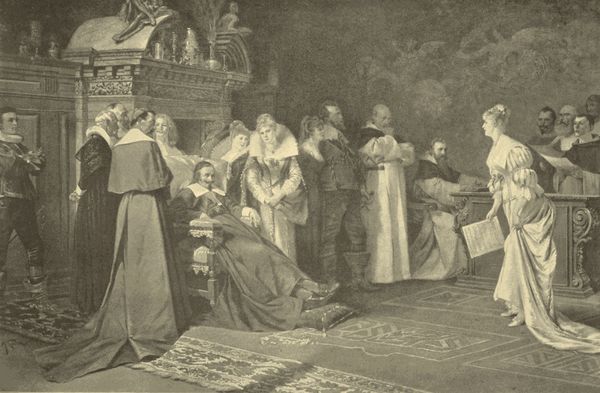
A Concert At Richelieu's Palace.
WILLIAM BRADFORD[15] By Elbridge S. Brooks (1589-1657)
Greatness is not allied to rank alone, nor is heroism to blood. The noblest of the Pilgrims of Plymouth was sprung from the people. For generations the little farming village of Austerfield, a royal manor of the West Riding of Yorkshire close to the Nottingham line, had known the family of Bradfurth or Bradford as a race of tenant-yeomen who, besides tilling the lands of the Mortons, possessed also a freehold of their own. But no man or woman of the Bradford name had given it prominence or worth until, on March 19, 1589, William Bradford was born in that low-roofed farm-house on the great plain of York. Puritan writers speak of Austerfield as a "profane and irreligious" village in which was to be found "no bible and a careless priest." Whatever the facts, the environments, undoubtedly, were not such as would suggest the making of a leader or the development of a religious nature. But we are assured that, before the age of twelve, the boy William Bradford, brought up in that Austerfield farm-house "in the innocent trade of husbandry," displayed alike a thoughtful temperament and "a pious mind." At sixteen he fell, in some unknown way, under the influence of one of the much-maligned Puritan preachers of Scrooby, a Nottinghamshire village but a few miles from Austerfield. As a result he gave up his farming-life, left his Austerfield home, and in the face of bitter opposition, distrust, censure, and persecution, joined the Puritan church and settlement at Scrooby, established there by William Brewster, the postmaster of Scrooby and a prominent leader in the new sect of dissenters from the English church, known first as separatists and, later, because of their frequent changes and wanderings, as Pilgrims.
From his earliest association with this feeble and despised communion, William Bradford was zealous in his readiness to stand boldly for his faith, whatever the risk involved. He was one of the first to appreciate the real meaning of the struggle; he saw that dissent implied not alone a religious opposition, but a political defiance as well, and that its followers, braving the will of England's royal bigot, James Stuart, and denying his assumption of the divine right of kings, would ere long do open battle in the cause of the people against despotism, and stand for that deeper question of liberty which the Pilgrims of Scrooby and Leyden first fully grasped.
Bradford was one of that venturesome company which, in 1607, embarking at Boston, in Lincolnshire, sought to flee from English tyranny, and find a home in Holland. They were betrayed, turned back, and imprisoned. The next year this young eighteen-year old enthusiast escaped from his jailers, and made his way to Amsterdam. Here he apprenticed himself to a silk-weaver, and became an efficient member of the association of English exiles in Holland.
Upon his coming of age in 1610, he sold off the Austerfield lands that had descended to him upon the death of his father, and entered upon an unsuccessful business investment in Amsterdam. This failing, he joined himself to the Pilgrim colony that Brewster and Robinson, the Pilgrim preachers, had established at Leyden.
When those far-seeing reformers awoke to the fact that an English-speaking community in Holland must, in time, become Dutch in manners, speech, and life, and looked across the western ocean with the dream of founding a religious republic of English-speaking folk in the New World, Bradford was one of the most earnest in adopting and carrying out their views, and was one of that famous company which, on September 16, 1620, sailed from Plymouth in England, to cast anchor, three months later, in the harbor of the new Plymouth in New England.
It has been said that if William Brewster was the Aaron of the Plymouth enterprise, William Bradford was its Moses. Certainly he was, almost from its inception, its leader and deliverer. It was his brain that conceived and his hand that executed that memorable compact which the forty-one earnest men signed in the cabin of the Mayflower, as she rode at anchor in Provincetown harbor—"the first instrument of civil government ever subscribed as the act of the whole people." It was into his hands, when Carver, the first governor, died of sunstroke in the spring of 1621, that the colonists gave the guidance of their affairs, electing him governor of the Plymouth colony on April 21, 1621—"the first American citizen of English race who bore rule by the free choice of his brethren." More than this, we may look upon William Bradford, so says Mr. Doyle, the English historian of the Puritan colonies, "as heading that bead-roll of worthies that, from his day, America has never wanted—men who, with no early training in political life, and lacking much that the Old World has deemed needful in her rulers, have yet, by inborn strength of mind and lofty public spirit, shown themselves in all things worthy of high office."
Certainly William Bradford showed himself worthy the trust and confidence of his fellows. For nearly forty years he filled the office of governor of the Plymouth colony. His hand guided it through the perils of its early years, his brain planned that systematic development of its slender resources that made it the one successful episode in America's beginnings. His treatment of the Indians was always firm but friendly; his dealings with the grasping "London adventurers," whose greed would have seriously crippled the colony had it not been for his restraining hand, were courteous but convincing; it was Bradford who led the colony from the unsatisfactory communism of its first years to the system of individual property that, from 1623, held sway, and turned an uncertain venture into a career of industrial prosperity. Always tolerant, never injudicious, and alike pure-minded, liberty-loving, courageous, and wise, no hand could have better guided than did his, or have more systematically shaped, the destinies of the infant State. The testimony of contemporaries and the judgment of historians unite in crediting to William Bradford that rare combination of intelligence and industry, of judicial and executive ability, by which a small and obscure band of persecuted fugitives laid in an unexplored wilderness the foundations of a great and prosperous commonwealth.
His methods were as simple as was his own noble nature. Each advance was the outgrowth of his own observation and the colony's necessities, and while the corner-stone of the community was religion, he stood himself for religious liberty, and never permitted the zeal of his associates to degenerate into intolerance and persecution. While other of the early American colonies were narrow, bigoted, and vindictive, it is to the credit of the Pilgrim colony of Plymouth that the cargo of the Mayflower contained no seeds of persecution, and throughout the long administration of Governor William Bradford the colony he guided had, in his time at least, a clear comprehension of the meaning of religious and political freedom, and did not descend into the harrying of so-called heretics, the scourging of Quakers, nor the burning of witches. Whatever intolerance of this sort may, at a later day, have stained the records of the colony, was of foreign growth and contrary to the heritage of charity left by William Bradford.
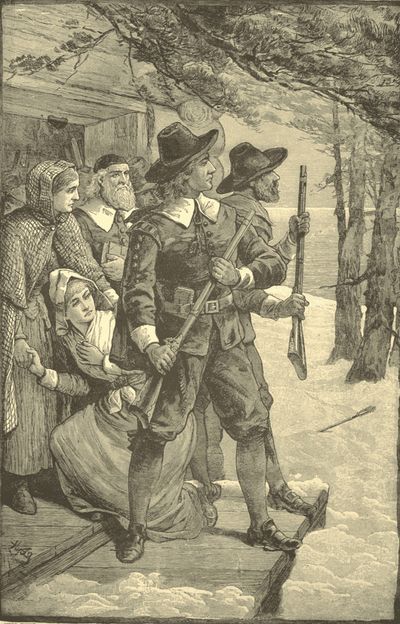
A Puritan Christmas.
This willingness to serve, to spend and be spent, is apparent throughout the whole story of Bradford's life. It displayed itself in the boyish spirit of renunciation that led him to join the Scrooby society, and held him loyal to his association even through imprisonment and persecution, through exile, flight, and emigration. Again and again through his long service as governor of the Plymouth colony, he wished to lay aside the burden, but always yielded to the wishes of his comrades. Elected by the suffrages of his associates, he himself restricted his own authority by the formation, in 1624, of the governor's council of five members, increased in 1633 to seven, in which the only privilege held by the governor was a double vote. In 1624 he with seven of his associates assumed, what was for that day and the uncertainties involved, a great risk, and bought out the "London Adventurers" who had so feebly backed the colonists. In 1629 he obtained a patent that conferred upon himself, his associates, and assigns the title to the whole Plymouth tract, and in 1640 he conveyed this valuable title to the colony, reserving only his personal proportion as a settler.
It was this unselfishness of disposition, this loyalty to duty—accepting honors as trusts and burdens as obligations—this union of justice and faith that made William Bradford great and kept him noble.
"With malice toward none, with charity for all," even as had that great American of two centuries later, Bradford could keep the even tenor of his way in the midst of obstacles and discouragements. Unmoved by the ingratitude of Weston, the insolence of Morton, the treachery of Oldham and Lyford, and the selfishness of Allerton; calm amid the controversies brought about by the arrogance of the greater colony of Massachusetts Bay, the encroachments of the French in Maine, and of the Dutch on the Connecticut, he could yet, when occasion demanded, display that stern justice that meted out the extreme penalty of the law to offenders, and condemned to death Billington, the first murderer in the colony, and Peach, the assassin of a defenceless Indian.
William Bradford is one of the most interesting figures in the history of New England. He is the noblest of the Puritans—a type of their best element, an exponent of their highest effort, a pioneer in their struggle for liberty for justice, and for law. The boy who could brave opposition and contumely for conscience's sake, could also be of gentlest manners and serenest mood when called to lead and govern those who put their trust in him; the same native courage and independence that held him loyal to his convictions in his early years made him, when responsibilities multiplied and burdens were laid upon him, the very staff and hope of the Pilgrim colony of Plymouth.
He combined with executive ability other notable gifts. Though bred to the soil in an age when the farmer was a drudge and had no ambition beyond his crops, he yet, when opportunity offered, applied himself to study with such good results that he was learned in Latin, Greek, and Hebrew, and conversed in French and Dutch. He was acquainted with the history and philosophy of his day, was deeply versed in theology, and even attempted poetry. He wrote much and well. His most important production was his "History of the Plymouth Plantations"—a detailed chronicle of the history of the Pilgrims from 1608 to 1646. Carried away from the old South Church by British soldiers, it was completely lost, until almost providentially discovered, though partially destroyed, in the shop of a Halifax grocer, and to-day it tells us almost all that we know of the Plymouth settlers, from the day when they left Lincolnshire till they became a prosperous commonwealth in America.
Of this important contribution to American history, Mr. Doyle, the English historian, says: "Gratitude is quickened when we compare the simple, vigorous, and picturesque chronicle set before us by Bradford, with the tedious and pedantic writings from which so much of the later history of New England has to be extracted.... His work is in the true sense scholarly. The language is like the language of Bunyan, that of a man who trained himself not merely to speak but to think in the words of Scripture. Every expression is simple and effective, never far-fetched, never mean nor common. The substance is worthy of the style. Faults no doubt there are ... yet with all its defects Bradford's writings still remain the worthy first-fruits of Puritan literature in its new home. They are the work of a wise and good man, who tells with a right understanding the great things that he and his brethren have done."
The wise governor was loyal to his colony to the last. He resisted the ambition to take larger holdings of land and become great estate owners that influenced Standish and Brewster, Alden and Winslow, and other of his Mayflower companions, drawing them away from Plymouth to the broader acres at Duxbury and Scituate and Marshfield. The governor deplored this withdrawal as a desertion on the part of his old friends, and a menace to the welfare of the colony. He lived on in Plymouth, where his home on Leyden Street, still standing, gradually outgrew its early primitive dimensions as became the house of the governor of Plymouth. Here he died on May 9, 1657, "lamented by all the colonists of New England as a common blessing and father to them all," and the only special memorial that tangibly recalls his fame is the unpretentious obelisk on Burial Hill.
As Miles Standish and John Alden had a romance in their lives that has made them historic, so this Puritan governor of Plymouth had his. His first wife, gentle Dorothy May, was drowned in Cape Cod harbor while her husband was away exploring the new-found coast. He had married her in Leyden in 1613 and less than three years after her death, on August 14, 1623, he married Mistress Alice Carpenter Southworth, who in earlier days, it is alleged, had been young William Bradford's "dearest love." She came across the sea—at his call—a widow, to marry the widowed governor of Plymouth and thus complete the unwritten romance begun in his earlier years.
A self-made man, a scholar of repute, a writer of renown, an upright and fearless magistrate, a model citizen, a courageous leader, gentle, just and generous, practical and wise, William Bradford stands in history as the essence and exponent of what was best in the Puritanism of his day, the architect and builder of a God-fearing, independent, and progressive community that, throughout the ages, remains the most notable because the most typical of the foundation-stones that underlie the mighty structure of the Republic of the United States of America.[Back to Contents]
CHARLES I. OF ENGLAND By F. Hindes Groome (1600-1649)
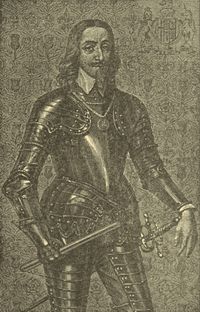
Charles I. was born at Dunfermline, November 19, 1600, was a sickly child, unable to speak till his fifth year, and so weak in the ankles that till his seventh he had to crawl upon his hands and knees. Except for a stammer, he outgrew both defects, and became a skilled tilter and marksman, as well as an accomplished scholar and a diligent student of theology. He was created Duke of Albany at his baptism, Duke of York in 1605, and Prince of Wales in 1616, four years after the death of his dear brother, Prince Henry, had left him heir to the crown of three kingdoms. A Spanish match had been mooted as early as 1614; but it was not till February 17, 1623, that, with Buckingham, his inseparable friend, Charles started on the romantic incognito journey to Madrid, its objects to win the hand of the Infanta, and to procure the restitution of the Palatinate to his brother-in-law, Frederick. Both he and his father swore to all possible concessions to the Catholics, but nothing short of his own conversion would have satisfied the Spanish and papal courts; and on October 5th he landed again in England, eager for rupture with Spain.
The nation's joy was speedily dashed by his betrothal to the French princess, Henrietta Maria (1609-69); for the marriage articles pledged him, in violation of solemn engagements to Parliament, to permit her and all her domestics the free exercise of the Catholic religion, and to give her the up-bringing of their children till the age of thirteen.
On March 27, 1625, Charles succeeded his father, James I.; on June 13th he welcomed his little bright-eyed queen at Dover, having married her by proxy six weeks earlier. Barely a twelvemonth was over when he packed off her troublesome retinue to France—a bishop and 29 priests, with 410 more male and female attendants. Thenceforth their domestic life was a happy one; and during the twelve years following the murder of Buckingham (1592-1628), in whose hands he had been a mere tool, Charles gradually came to yield himself up to her unwise influence—not wholly indeed, but more than to that of Stafford even, or Laud. Little meddlesome Laud, made archbishop in 1633, proceeded to war against the dominant Puritanism, to preach passive obedience, and uphold the divine right of kings; while great Stafford, from championing the Petition of Right (1628), passed over to the king's service, and entered on that policy of "Thorough" whose aim was to make his master absolute. Three Parliaments were summoned and dissolved in the first four years of the reign; then for eleven years Charles ruled with but one, in its stead, with subservient judges, and the courts of Star Chamber and High Commission. In 1627 he had blundered into an inglorious French war; but with France he concluded peace in 1629, with Spain in 1630. Peace, economy, and arbitrary taxation were to solve the great problem of his policy, how to get money, yet not account for it. Not that Charles cared for money in itself, or had far-reaching projects of tyranny (he failed to enter into Stafford's scheme); but he had inherited a boundless egoism, and content with his own petty self, had little sympathy with the dead heroism of the Tudor age, none at all with the nascent ardor of democracy. The extension of the ship-tax to the inland counties was met by Hampden's passive resistance (1637); Laud's attempt to Anglicize the Scottish Church, by the active resistance of the whole northern nation. Once more Charles had to call a Parliament; two met in 1640—the Short Parliament, which lasted but three weeks, and the Long, which outlasted Charles.
It met to pronounce Stafford's doom; and his plot with the army detected, Charles basely sacrificed his loyal servitor, his own kingly word, to fears for the queen's safety; no act weighed heavier on him afterward. The same signature that sent Stafford to the block gave assent to a second bill, by which the existing Parliament might not be dissolved without its own consent. That pledge, as extorted by force, Charles purposed to disregard; and during his visit to Edinburgh, in the autumn of 1641, he trusted by lavish concessions to bring over the Scots to his side. Instead, he got entangled in dark suspicions of plotting the murder of the covenanting lords, of connivance even in the Ulster massacre. Still, his return to London was welcomed with some enthusiasm, and a party was forming in the Commons itself, of men who revolted from the sweeping changes that menaced both church and state. Pym's "Grand Remonstrance" justified their fears, and Charles seemed to justify the "Grand Remonstrance" by his attempt to arrest the five members (January 4, 1642); but that ill-stricken blow was dictated by the knowledge of an impending impeachment of the queen herself. On August 22d he raised the royal standard at Nottingham; and the four years civil war commenced, in which, as at Naseby, he showed no lack of physical courage, and which resulted at Naseby in the utter annihilation of his cause (June 14, 1645).
No need here to track him through plot and counterplot with Catholics, Presbyterians, and Sectaries, with the Scots and the Irish, with the Parliament and the Army; enough that, quitting his last refuge, Oxford, he surrendered himself on May 5, 1646, to the Scots at Newark, and by them, in the following January, was handed over to the Parliament. His four months captivity at Holmby House, near Northampton; his seizure on June 3d by Cornet Joyce; the three months at Hampton Court; the fight on November 11th; the fresh captivity at Carisbrooke Castle, in the Isle of Wight—these lead up to the trial at Westminster of the tyrant, traitor, and murderer, Charles Stuart. He had drawn the sword, and by the sword he perished, for it was the Army, not Parliament, that stood at the back of the judges. Charles faced them bravely and with dignity. Thrice he refused to plead, denying the competence of such a court: and his refusal being treated as a confession, on the third day fifty-five out of seventy-one judges—sixty-four more never were present—affixed their names and seals to his death-warrant; four days later, sentence was pronounced.
No need here to tell the well-known story of his meekness toward his persecutors, of the pathetic parting from two of his younger children, of his preparation for a holy death; or how, on the morning of January 30, 1649, he passed to that death on the scaffold in front of Whitehall, with a courage worthy of a very martyr. On the snowy 7th of February they bore the "white king" to his grave at Windsor in Henry VIII.'s vault; in 1813 the Prince Regent had his leaden coffin opened. Six children survived him—Charles and James, his successors; Mary, Princess of Orange (1631-60); Elizabeth (1635-50); Henry, Duke of Gloucester (1639-60); and Henrietta, Duchess of Orleans (1644-70), the last born ten weeks after Charles's final parting from his queen. At the Restoration Charles II. appointed, on his sole authority, a form of prayer, with fasting, for the day of the martyrdom of the Blessed King Charles I., to be annexed to the Common Prayer Book, with the other state services; it kept its place there till 1859.
A far stronger man than Charles might scarcely have extricated himself from the difficulties that beset him; true, those difficulties were largely of his own creating. But was he right in abandoning Stafford? should he also have sacrificed wife, faith, and crown? If yes, then was he wholly in the wrong; if no, he was partly—for once at least—in the right. Vices, other than duplicity, he had none, as we use the word. He was vague, vacillating, obstinate, unable to lead or to be led; superstitious, heedful of omens; unsympathetic and reserved where he did not love; intolerant of opposition to his will. But he was a good husband, a good father, a good churchman—no man so good was ever so bad a king; no man so fallible believed so honestly in his infallibility. For Charles was honest to his own convictions. His very duplicity was due sometimes to schooling in "kingcraft," but oftener to inability to see two sides of a question. Now he saw one, and now the other, but never both sides at once; and, just as he saw, so he spoke. Milton's charges against him of "all manner of lewdness" rank with Milton's charge that he poisoned his father. Indeed, as a pattern of culture and purity, few princes are worthy to be named beside him.
His children all loved and respected him. His little daughter Elizabeth, held as a prisoner by his foes, wrote of him with such womanly sympathy and admiration as even now brings tears to our eyes. His last letter of advice to his son Charles is a model hardly to be improved on. Parts of it read as follows:
"I had rather you should be Charles le bon, than le grand, good, than great; I hope God hath designed you to be both; having so early put you into that exercise of His graces and gifts bestowed upon you, which may best weed out all vicious inclinations, and dispose you to those princely endowments and employments which will most gain the love, and intend the welfare of those over whom God shall place you.
"With God, I would have you begin and end, who is King of kings, the sovereign disposer of the kingdoms of the world, who pulleth down one and setteth up another.
"The best government and highest sovereignty you can attain to, is to be subject to Him, that the sceptre of His word and spirit may rule in your heart.
"The true glory of princes consists in advancing God's glory, in the maintenance of true religion and the church's good; also in the dispensation of civil power with justice and honor to the public peace.
"Piety will make you prosperous, at least it will keep you from becoming miserable; nor is he much a loser that loseth all, yet saveth his own soul at last.
"To which centre of true happiness, God (I trust) hath and will graciously direct all these black lines of affliction which He hath been pleased to draw on me, and by which He hath (I hope) drawn me nearer to Himself. You have already tasted of that cup whereof I have liberally drunk; which I look upon as God's physic, having that in healthfulness which it wants in pleasure.
"Take heed that outward circumstances and formalities of religion devour not all, or the best, encouragements of learning, industry, and piety; but with an equal eye and impartial hand distribute favors and rewards to all men, as you find them for their real goodness both in abilities and fidelity, worthy and capable of them.
"And if neither I nor you be ever restored to our right, but God, in His severest justice, will punish my subjects with continuance in their sin, and suffer them to be deluded with the prosperity of their wickedness, I hope God will give me and you that grace which will teach and enable us to want, as well as to wear, a crown, which is not worth taking up or enjoying upon sordid, dishonorable and irreligious terms.
"Keep you to true principles of piety, virtue, and honor; you shall never want a kingdom.
"A principal point of your honor will consist in your deferring all respect, love, and protection to your mother, my wife, who hath many ways deserved well of me, and chiefly in this, that having been a means to bless me with so many hopeful children (all which, with their mother, I recommend to your love and care), she hath been content with incomparable magnanimity and patience to suffer both for and with me and you.
"Farewell, till we meet, if not on earth, yet in heaven."
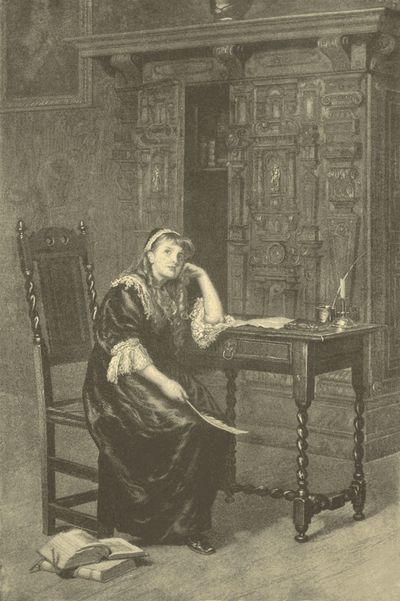
Princess Elizabeth in Prison.
But Charles was predestined to sorrow. "A tragic face!" said the sculptor Bernini, as he looked on the triple portrait by Vandyke. Already the shadow of a violent death overclouded those fine, weak features.[Back to Contents]
OLIVER CROMWELL Extracts from "The History of England," by Thomas B. Macaulay (1599-1658)
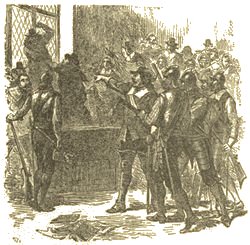
And now a new and alarming class of symptoms began to appear in the distempered body politic. There had been, from the first, in the Parliamentary party, some men whose minds were set on objects from which the majority of that party would have shrunk with horror. These men were, in religion, Independents. They conceived that every Christian congregation had, under Christ, supreme jurisdiction in things spiritual; that appeals to provincial and national synods were scarcely less unscriptural than appeals to the Court of Arches or to the Vatican; and that popery, prelacy, and Presbyterianism were merely three forms of one great apostasy. In politics they were, to use the phrase of their time, Root and Branch men, or, to use the kindred phrase of our own time, Radicals. Not content with limiting the power of the monarch, they were desirous to erect a commonwealth on the ruins of the old English polity. At first they had been inconsiderable both in numbers and in weight; but, before the war had lasted two years, they became, not indeed the largest, but the most powerful faction in the country. Some of the old Parliamentary leaders had been removed by death, and others had forfeited the public confidence. Pym had been borne, with princely honors, to a grave among the Plantagenets. Hampden had fallen, as became him, while vainly endeavoring, by his heroic example, to inspire his followers with courage to face the fiery cavalry of Rupert. Bedford had been untrue to the cause. Northumberland was known to be lukewarm. Essex and his lieutenants had shown little vigor and ability in the conduct of military operations. At such a conjuncture it was, that the Independent party, ardent, resolute, and uncompromising, began to raise its head both in the camp and in the Parliament.
The soul of that party was Oliver Cromwell. Bred to peaceful occupations, he had, at more than forty years of age, accepted a commission in the Parliamentary army. No sooner had he become a soldier, than he discerned, with the keen glance of genius, what Essex and men like Essex, with all their experience, were unable to perceive. He saw precisely where the strength of the Royalists lay, and by what means alone that strength could be overpowered. He saw that it was necessary to reconstruct the army of the Parliament. He saw, also, that there were abundant and excellent materials for the purpose; materials less showy, indeed, but more solid, than those of which the gallant squadrons of the king were composed. It was necessary to look for recruits who were not mere mercenaries; for recruits of decent station and grave character, fearing God and zealous for public liberty. With such men he filled his own regiment, and, while he subjected them to a discipline more rigid than had ever before been known in England, he administered to their intellectual and moral nature stimulants of fearful potency.
The events of the year 1644 fully proved the superiority of his abilities. In the south, where Essex held the command, the Parliamentary forces underwent a succession of shameful disasters, but in the north the victory of Marston Moor fully compensated for all that had been lost elsewhere. That victory was not a more serious blow to the Royalists than to the party which had hitherto been dominant at Westminster; for it was notorious that the day, disgracefully lost by the Presbyterians, had been retrieved by the energy of Cromwell, and by the steady valor of the warriors whom he had trained.
These events produced the Self-denying Ordinance and the new model of the army. Under decorous pretexts, and with every mark of respect, Essex and most of those who had held high posts under him were removed, and the conduct of the war was intrusted to very different hands. Fairfax, a brave soldier, but of mean understanding and irresolute temper, was the nominal lord-general of the forces, but Cromwell was their real head.
Cromwell made haste to organize the whole army on the same principles on which he had organized his own regiment. As soon as this process was complete, the event of the war was decided. The Cavaliers had now to encounter natural courage equal to their own, enthusiasm stronger than their own, and discipline such as was utterly wanting to them. It soon became a proverb that the soldiers of Fairfax and Cromwell were men of a different breed from the soldiers of Essex. At Naseby took place the first great encounter between the Royalists and the remodelled army of the Houses. The victory of the Roundheads was complete and decisive. It was followed by other triumphs in rapid succession. In a few months the authority of the Parliament was fully established over the whole kingdom. Charles fled to the Scots, and was by them, in a manner which did not much exalt their national character, delivered up to his English subjects.
But while the Houses were employing their authority thus, it suddenly passed out of their hands. It had been obtained by calling into existence a power which could not be controlled. In the summer of 1647, about twelve months after the last fortress of the Cavaliers had submitted to the Parliament, the Parliament was compelled to submit to its own soldiers.
Thirteen years followed, during which England was, under various names and forms, really governed by the sword. Never before that time, or since that time, was the civil power in our country subjected to military dictation.
To keep down the English people was no light task even for that army. No sooner was the first pressure of military tyranny felt, than the nation, unbroken to such servitude, began to struggle fiercely. Insurrections broke out even in those counties which, during the recent war, had been the most submissive to the Parliament. Indeed, the Parliament itself abhorred its old defenders more than its old enemies, and was desirous to come to terms of accommodation with Charles at the expense of the troops. In Scotland, at the same time, a coalition was formed between the Royalists and a large body of Presbyterians, who regarded the doctrines of the Independents with detestation. At length the storm burst. There were risings in Norfolk, Suffolk, Essex, Kent, Wales. The fleet in the Thames suddenly hoisted the royal colors, stood out to sea, and menaced the southern coast. A great Scottish force crossed the frontier and advanced into Lancashire. It might well be suspected that these movements were contemplated with secret complacency by a majority both of the Lords and of the Commons.
But the yoke of the army was not to be so shaken off. While Fairfax suppressed the risings in the neighborhood of the capital, Oliver routed the Welsh insurgents, and, leaving their castles in ruins, marched against the Scots. His troops were few when compared with the invaders; but he was little in the habit of counting his enemies. The Scottish army was utterly destroyed. A change in the Scottish government followed. An administration, hostile to the king, was formed at Edinburgh; and Cromwell, more than ever the darling of his soldiers, returned in triumph to London.
England had already ceased to struggle; but the two other kingdoms which had been governed by the Stuarts were hostile to the new republic. The Independent party was equally odious to the Roman Catholics of Ireland and to the Presbyterians of Scotland. Both these countries, lately in rebellion against Charles I., now acknowledged the authority of Charles II.
But everything yielded to the vigor and ability of Cromwell. In a few months he subjugated Ireland as Ireland had never been subjugated during the five centuries of slaughter which had elapsed since the landing of the first Norman settlers. He resolved to put an end to that conflict of races and religions which had so long distracted the island, by making the English and Protestant population decidedly predominant. For this end he gave the rein to the fierce enthusiasm of his followers, waged war resembling that which Israel waged on the Canaanites, smote the idolaters with the edge of the sword, so that great cities were left without inhabitants, drove many thousands to the Continent, shipped off many thousands to the West Indies, and supplied the void thus made, by pouring in numerous colonists of the Anglo-Saxon blood and of the Calvinistic faith. Strange to say, under that iron rule the conquered country began to wear an outward face of prosperity. Districts which had recently been as wild as those where the first white settlers of Connecticut were contending with the red men, were in a few years transformed into the likeness of Kent and Norfolk. New buildings, roads, and plantations were everywhere seen. The rent of estates rose fast; and soon the English land-owners began to complain that they were met in every market by the products of Ireland, and to clamor for protecting laws.
From Ireland the victorious chief, who was now in name, as he had long been in reality, lord-general of the armies of the commonwealth, turned to Scotland. The young king was there. He had consented to profess himself a Presbyterian, and to subscribe the Covenant; and, in return for these concessions, the austere Puritans who bore sway at Edinburgh had permitted him to hold, under their inspection and control, a solemn and melancholy court in the long-deserted halls of Holyrood. This mock royalty was of short duration. In two great battles Cromwell annihilated the military force of Scotland. Charles fled for his life, and, with extreme difficulty, escaped the fate of his father. The ancient kingdom of the Stuarts was reduced, for the first time, to profound submission. Of that independence, so manfully defended against the mightiest and ablest of the Plantagenets, no vestige was left. The English Parliament made laws for Scotland. The English judges held assizes in Scotland. Even that stubborn Church, which has held its own against so many governments, scarce dared to utter an audible murmur.
Thus far there had been at least the semblance of harmony between the warriors who subjugated Ireland and Scotland, and the politicians who sat at Westminster; but the alliance which had been cemented by danger was dissolved by victory. The Parliament forgot that it was but the creature of the Army. The Army was less disposed than ever to submit to the dictation of the Parliament. Indeed, the few members who made up what was contemptuously called the Rump of the House of Commons, had no more claim than the military chiefs to be esteemed the representatives of the nation. The dispute was soon brought to a decisive issue. Cromwell filled the house with armed men. The speaker was pulled out of his chair, the mace taken from the table, the room cleared, and the door locked. The nation, which loved neither of the contending parties, but which was forced, in its own despite, to respect the capacity and resolution of the general, looked on with patience, if not with complacency.
King, Lords, and Commons had now, in turn, been vanquished and destroyed, and Cromwell seemed to be left the sole heir of the powers of all three. Yet were certain limitations still imposed on him by the very army to which he owed his immense authority. That singular body of men was, for the most part, composed of zealous republicans. In the act of enslaving their country, they had deceived themselves into the belief that they were emancipating her. The book which they most venerated furnished them with a precedent which was frequently in their mouths. It was true that the ignorant and ungrateful nation murmured against its deliverers; even so had another chosen nation murmured against the leader who brought it, by painful and dreary paths, from the house of bondage to the land flowing with milk and honey. Yet had that leader rescued his brethren in spite of themselves; nor had he shrunk from making terrible examples of those who contemned the proffered freedom, and pined for the flesh-pots, the task-masters, and the idolatries of Egypt. The object of the warlike saints who surrounded Cromwell was the settlement of a free and pious commonwealth. For that end they were ready to employ, without scruple, any means, however violent and lawless. It was not impossible, therefore, to establish by their aid a monarchy absolute in effect; but it was probable that their aid would be at once withdrawn from a ruler who, even under strict constitutional restraints, should venture to assume the regal name and dignity.
The sentiments of Cromwell were widely different. He was not what he had been; nor would it be just to consider the change which his views had undergone as the effect merely of selfish ambition. When he came up to the Long Parliament, he brought with him from his rural retreat little knowledge of books, no experience of great affairs, and a temper galled by the long tyranny of the government and of the hierarchy. He had, during the thirteen years which followed, gone through a political education of no common kind. He had been a chief actor in a succession of revolutions. He had been long the soul, and at last the head, of a party. He had commanded armies, won battles, negotiated treaties, subdued, pacified, and regulated kingdoms. It would have been strange indeed if his notions had been still the same as in the days when his mind was principally occupied by his fields and his religion, and when the greatest events which diversified the course of his life were a cattle-fair, or a prayer-meeting at Huntingdon. He saw that some schemes of innovation for which he had once been zealous, whether good or bad in themselves, were opposed to the general feeling of the country, and that, if he persevered in those schemes, he had nothing before him but constant troubles, which must be suppressed by the constant use of the sword. He therefore wished to restore, in all essentials, that ancient constitution which the majority of the people had always loved, and for which they now pined. The course afterward taken by Monk was not taken by Cromwell. The memory of one terrible day separated the great regicide forever from the house of Stuart. What remained was that he should mount the ancient English throne, and reign according to the ancient English polity. If he could effect this, he might hope that the wounds of the lacerated state would heal fast. Great numbers of honest and quiet men would speedily rally round him. Those Royalists, whose attachment was rather to institutions than to persons, to the kingly office than to King Charles I. or King Charles II., would soon kiss the hand of King Oliver. The peers, who now remained sullenly at their country houses, and refused to take any part in public affairs, would, when summoned to their House by the writ of a king in possession, gladly resume their ancient functions. Northumberland and Bedford, Manchester and Pembroke, would be proud to bear the crown and the spurs, the sceptre and the globe, before the restorer of aristocracy. A sentiment of loyalty would gradually bind the people to the new dynasty, the royal dignity might descend with general acquiescence to his posterity.
How Oliver's Parliaments were constituted, however, was practically of little moment; for he possessed the means of conducting the administration without their support, and in defiance of their opposition. His wish seems to have been to govern constitutionally, and to substitute the empire of the laws for that of the sword; but he soon found that, hated as he was both by Royalists and Presbyterians, he could be safe only by being absolute. The first House of Commons which the people elected by his command questioned his authority, and was dissolved without having passed a single act. His second House of Commons, though it recognized him as Protector, and would gladly have made him king, obstinately refused to acknowledge his new lords. He had no course left but to dissolve the Parliament. "God," he exclaimed, at parting, "be judge between you and me!"
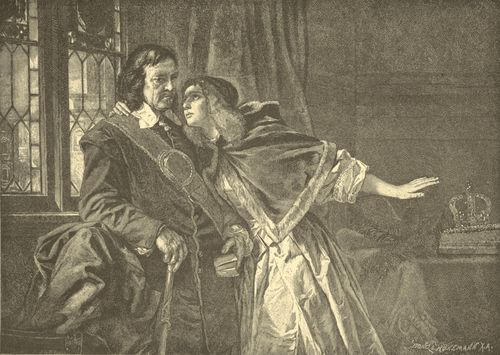
Cromwell's daughter entreats him to refuse the crown.
Yet was the energy of the Protector's administration in nowise relaxed by these dissensions. Those soldiers who would not suffer him to assume the kingly title stood by him when he ventured on acts of power as high as any English king has ever attempted. The government, therefore, though in form a republic, was in truth a despotism, moderated only by the wisdom, the sober-mindedness, and the magnanimity of the despot. The country was divided into military districts; these districts were placed under the command of major-generals. Every insurrectionary movement was promptly put down and punished. The fear inspired by the power of the sword in so strong, steady, and expert a hand, quelled the spirit both of Cavaliers and Levellers. The loyal gentry declared that they were still as ready as ever to risk their lives for the old government and the old dynasty, if there were the slightest hope of success; but to rush at the head of their serving-men and tenants on the pikes of brigades victorious in a hundred battles and sieges, would be a frantic waste of innocent and honorable blood. Both Royalists and Republicans, having no hope in open resistance, began to revolve dark schemes of assassination; but the Protector's intelligence was good; his vigilance was unremitting; and, whenever he moved beyond the walls of his palace, the drawn swords and cuirasses of his trusty body-guards encompassed him thick on every side.
Had he been a cruel, licentious, and rapacious prince, the nation might have found courage in despair, and might have made a convulsive effort to free itself from military domination; but the grievances which the country suffered, though such as excited serious discontent, were by no means such as impel great masses of men to stake their lives, their fortunes, and the welfare of their families against fearful odds. The taxation, though heavier than it had been under the Stuarts, was not heavy when compared with that of the neighboring states and with the resources of England. Property was secure. Even the Cavalier, who refrained from giving disturbance to the new settlement, enjoyed in peace whatever the civil troubles had left him. The laws were violated only in cases where the safety of the Protector's person and government were concerned. Justice was administered between man and man with an exactness and purity not before known. Under no English government since the Reformation had there been so little religious persecution. The unfortunate Roman Catholics, indeed, were held to be scarcely within the pale of Christian charity; but the clergy of the fallen Anglican Church were suffered to celebrate their worship on condition that they would abstain from preaching about politics. Even the Jews, whose public worship had, ever since the thirteenth century, been interdicted, were, in spite of the strong opposition of jealous traders and fanatical theologians, permitted to build a synagogue in London.
The Protector's foreign policy at the same time extorted the ungracious approbation of those who most detested him. The Cavaliers could scarcely refrain from wishing that one who had done so much to raise the fame of the nation had been a legitimate king; and the Republicans were forced to own that the tyrant suffered none but himself to wrong his country, and that, if he had robbed her of liberty, he had at least given her glory in exchange. After half a century, during which England had been of scarcely more weight in European politics than Venice or Saxony, she at once became the most formidable power in the world, dictated terms of peace to the United Provinces, avenged the common injuries of Christendom on the pirates of Barbary, vanquished the Spaniards by land and sea, seized one of the finest West India islands, and acquired on the Flemish coast a fortress which consoled the national pride for the loss of Calais. She was supreme on the ocean. She was the head of the Protestant interest. All the Reformed churches scattered over Roman Catholic kingdoms acknowledged Cromwell as their guardian. The Huguenots of Languedoc, the shepherds who, in the hamlets of the Alps, professed a Protestantism older than that of Augsburg, were secured from oppression by the mere terror of that great name. The Pope himself was forced to preach humanity and moderation to popish princes; for a voice which seldom threatened in vain had declared that, unless favor were shown to the people of God, the English guns should be heard in the Castle of St. Angelo. In truth, there was nothing which Cromwell had, for his own sake and that of his family, so much reason to desire as a general religious war in Europe. In such a war he must have been the captain of the Protestant armies. The heart of England would have been with him. His victories would have been hailed with a unanimous enthusiasm unknown in the country since the rout of the Armada, and would have effaced the stain which one act, condemned by the general voice of the nation, has left on his splendid fame. Unhappily for him, he had no opportunity of displaying his admirable military talents except against the inhabitants of the British Isles.
While he lived his power stood firm, an object of mingled aversion, admiration, and dread to his subjects. Few indeed loved his government; but those who hated it most, hated it less than they feared it. Had it been a worse government, it might, perhaps, have been overthrown in spite of all its strength. Had it been a weaker government, it would certainly have been overthrown in spite of all its merits. But it had moderation enough to abstain from those oppressions which drive men mad; and it had a force and energy which none but men driven mad by oppression would venture to encounter.