Volume 3 — STATESMEN AND SAGES (continued 5)
Reading edition
The fame of Copernicus is now wide as the world. He painted a portrait of himself which fell into the hands of Tycho Brahe; and he wrote an epigram upon the subject, to the effect that the whole earth could not contain the whole of the man who whirled it along the ocean of ether. Less extravagant was the grateful enthusiasm of Rhiticus, a disciple of Copernicus, when he wrote, "God has given to my excellent preceptor a reign without end, which may He vouchsafe to guide, govern, and increase, to the restoration of astronomical truth. Amen!"
"The Copernican system" is the name now generally given to the almost universal scientific belief that the earth and the planets revolve around the sun, though the system carried out and perfected by Kepler, Newton, Halley, Laplace, and others is by no means perfectly identical with the theory of the German astronomer. But the inextricable interweaving of his name with opinions sanctioned by the entire scientific world, is one of the noblest conceivable tributes to the magnitude and lustre of his renown.
His death was in harmony with his life. Shortly before he expired he repeated these words:
"Non parem Paulo gratiam requiro, Veniam Petri neque posco; sed quam In crucis ligno dederat latroni Sedulus oro."
He had lived a life of Christian virtue—imitating his master, who went about doing good, healing the sick and preaching the gospel to the poor—yet, so far from having anything whereof to boast before God, he said himself that he felt his need of infinite mercy, and in seeking the pardon of his sins he would not place himself on a level with Paul or Peter, but rather choose a point of self-humiliation by the side of the penitent thief.
His work on the revolution of the celestial bodies was passing through the press at the time of his fatal illness in 1543, when he had completed his seventieth year and was brought to him just before he breathed his last; and thus, as has been beautifully expressed, he was "made to touch the first printed copy of his book when the sense of touch was gone, seeing it only as a dim object through the deepening dusk."
He is buried under a flat stone in one of the side aisles of his own cathedral at Frauenburg. On his monument is painted a half-length portrait, pale, thin, aged, but with an expression of countenance intelligent and pleasant. His hair and eyes are black; he is habited as a priest; his hands are joined in prayer; before him is a crucifix, at his feet a skull, and behind him are a globe and a pair of compasses. His devotion, his deadness to the world, and his love of science are thus aptly symbolized.[Back to Contents]
MARTIN LUTHER (1483-1546)
Martin Luther, the greatest of the Protestant Reformers of the sixteenth century, was born at Eisleben on November 10, 1483. His father was a miner in humble circumstances; his mother, as Melancthon records, was a woman of exemplary virtue, and particularly esteemed in her walk of life. Shortly after Martin's birth his parents removed to Mansfeld, where their circumstances ere long improved by industry and perseverance. Their son was sent to school; and both at home and in school his training was severe. His father sometimes whipped him, he says, "for a mere trifle till the blood came," and he was subjected to the scholastic rod fifteen times in one day! Luther's schooling was completed at Magdeburg and Eisenach, and at the latter place he attracted by his singing the notice of a good lady of the name of Cotta, who welcomed the lad into her family and provided him with a comfortable home during his stay there. Here under Trebonius he made good progress in Latin. In 1501, when he had reached his eighteenth year, he entered the university of Erfurt, with the view of qualifying himself for the legal profession. He went through the usual studies in the classics and the schoolmen, and took his degree of doctor of philosophy, or master of arts, in 1505, when he was twenty-one years of age.
Previous to this, however, a profound change of feeling had begun in him. The death of a friend, and the terror of a thunder-storm, deeply impressed him. Chancing one day to examine the Vulgate in the university library, he saw with astonishment that there were more gospels and epistles than in the lectionaries. He was arrested by the contents of his newly found treasure. His heart was deeply touched, and he resolved to devote himself to a spiritual life. He separated himself from his friends and fellow-students, and withdrew into the Augustinian convent at Erfurt. Here he spent the next three years of his life—years of peculiar interest and significance; for it was during this time that he laid, in the study of the Bible and of Augustine, and with the assistance of his life-long friend Staupitz, the foundation of those doctrinal convictions which were afterward to rouse and strengthen him in his life-long struggle. He describes very vividly the spiritual crisis through which he passed, the burden of sin which so long lay upon him, "too heavy to be borne," and the relief that he at length found in the clear apprehension of the doctrine of the "forgiveness of sins," through the grace of Christ.
In the year 1507 Luther was ordained a priest, and in the following year he removed to Wittenberg, destined to derive its chief celebrity from his name. He became a teacher in the new university founded there by the Elector Frederick of Saxony. At first he lectured on dialectics and physics, but his heart was already given to theology, and in 1509 he became a bachelor of theology, and commenced lecturing on the Holy Scriptures. His lectures made a great impression, and the novelty of his views already began to excite attention. "This monk," said the rector of the university, "will puzzle our doctors and bring in a new doctrine." Besides lecturing, he began to preach, and his sermons reached a wider audience, and produced a still more powerful influence. They were printed and widely circulated in Germany, France, and England, so that his doctrines were diffused throughout Europe. His words, as Melancthon says, were "born not on his lips, but in his soul," and they moved profoundly the souls of all who heard them. In 1511 he was sent on a mission to Rome, and he has described very vividly what he saw and heard there. His devout and unquestioning reverence—for he was yet in his own subsequent view "a most insane papist"—appears in strange conflict with his awakened thoughtfulness and the moral indignation at the abuses of the papacy beginning to stir him.
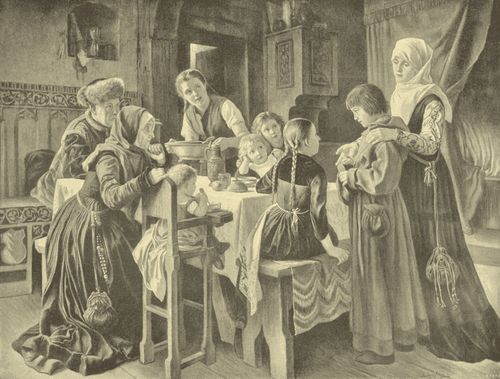
Luther introduced to the home of Frau Cotta.
On Luther's return from Rome he was made a doctor of the Holy Scriptures, and his career as a reformer may be said to have commenced. The system of indulgences had reached a scandalous height. The idea that it was in the power of the Church to forgive sin had gradually grown into the notion that the Pope could issue pardons of his own free will, which, being dispensed to the faithful, exonerated them from the consequences of their transgressions. The sale of these pardons had become an organized part of the papal system. Money was largely needed at Rome, and its numerous emissaries sought everywhere to raise funds by the sale of "indulgences;" the principal of these was John Tetzel, a Dominican friar, who had established himself at Jüterberg (1517). Luther's indignation at the shameless traffic which this man carried on, finally became irrepressible. "God willing," he exclaimed, "I will beat a hole in his drum." He drew out ninety-five theses on the doctrine of indulgences, which on October 31st he nailed up on the door of the church at Wittenberg, and which he offered to maintain in the university against all impugners. The general purport of these theses was to deny to the Pope all right to forgive sins. This sudden and bold step of Luther was all that was necessary to awaken a wide-spread excitement. Tetzel was forced to retreat from the borders of Saxony to Frankfort-on-the-Oder, where he drew out and published a set of counter-theses and publicly committed those of Luther to the flames. The students at Wittenberg retaliated by burning Tetzel's theses. The elector refused to interfere, and the excitement increased as new combatants—Hochstratten, Prierias, and Eck—entered the field. Eck was an able man, and an old friend of Luther's, and the argument between him and the reformer was especially vehement. In 1518 the latter was joined by Melancthon, who became one of his dearest and most trusted friends.
At first the Pope, Leo X., took little heed of the disturbance; he is reported even to have said, when he heard of it, that "Friar Martin was a man of genius, and that he did not wish to have him molested." Some of the cardinals, however, saw the real character of the movement, which gradually assumed a seriousness evident even to the Pope; and Luther received a summons to appear at Rome, and answer for his theses (1518). Once again in Rome, it is unlikely he would ever have been allowed to return. His university and the elector interfered, and a legate was sent to Germany to hear and determine the case. Cardinal Cajetan was the legate, and he was but little fitted to deal with Luther. He would enter into no argument with him, but merely called upon him to retract. Luther refused, and fled from Augsburg, whither he had gone to meet the papal representative. The task of negotiation was then undertaken by Miltitz, a German, who was envoy of the Pope to the Saxon court, and by his greater address, a temporary peace was obtained. This did not last long. The reformer was too deeply moved to keep silent. "God hurries and drives me," he said; "I am not master of myself; I wish to be quiet, and am hurried into the midst of tumults." Dr. Eck and he held a memorable disputation at Leipsic (1519), in which the subject of argument was no longer merely the question of indulgences, but the general power of the Pope. The disputation, of course, came to no practical result; each controversialist claimed the victory, and Luther in the meantime made progress in freedom of opinion, and attacked the papal system as a whole more boldly. Erasmus and Hutten joined in the conflict, which waxed more loud and threatening.
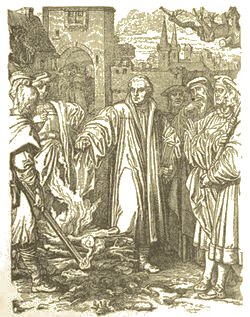
In 1520 the reformer published his famous address to the "Christian Nobles of Germany." This was followed in the same year by a treatise "On the Babylonish Captivity of the Church." In these works, both of which circulated widely and powerfully influenced many minds, Luther took firmer and broader ground; he attacked not only the abuses of the papacy and its pretensions to supremacy, but also the doctrinal system of the Church of Rome. "These works," Ranke says, "contain the kernel of the whole Reformation." The papal bull containing forty-one theses was issued against him; the dread document, with other papal books, was burned before an assembled multitude of doctors, students, and citizens, at the Elster Gate of Wittenberg. Germany was convulsed with excitement. Eck (who had been the chief agent in obtaining the bull) fled from place to place, glad to escape with his life, and Luther was everywhere the hero of the hour.
Charles V. had at this time succeeded to the empire, and he convened his first diet of the sovereigns and states at Worms. The diet met in the beginning of 1521; an order was issued for the destruction of Luther's books, and he himself was summoned to appear before the diet. This was above all what he desired—to confess the truth before the assembled powers of Germany. He resolved—having received a safe-conduct—to obey the summons, come what would. All Germany was moved by his heroism; his journey resembled a triumph; the threats of enemies and the anxieties of friends alike failed to move him. "I am resolved to enter Worms," he said, "although as many devils should set at me as there are tiles on the housetops." His appearance and demeanor before the diet, and the firmness with which he held his ground and refused to retract, all make a striking picture. He was not allowed to defend his opinions. "Unless I be convinced," he said, "by Scripture and reason, I neither can nor dare retract anything, for my conscience is a captive to God's word, and it is neither safe nor right to go against conscience. There I take my stand. I can do no otherwise. So help me God. Amen."
On his return from Worms he was seized, at the instigation of his friend, the Elector of Saxony, and safely lodged in the old castle of the Wartburg. The affair was made to assume an aspect of violence, but in reality it was designed to secure him from the destruction which his conduct at Worms would certainly have provoked, he having been placed under the ban of the empire. He remained in this shelter for about a year, concealed in the guise of a knight. His chief employment was his translation of the Scriptures into his native language. He composed various treatises besides, and injured his health by sedentary habits and hard study. His imagination became morbidly excited, and he thought he saw and heard the Evil One mocking him while engaged in his literary tasks; the blot from the inkstand that he hurled at him is still shown on the wall of his chamber. The subject of the personality and presence of Satan was a familiar one with Luther, and he has many things about it in his Table-talk.
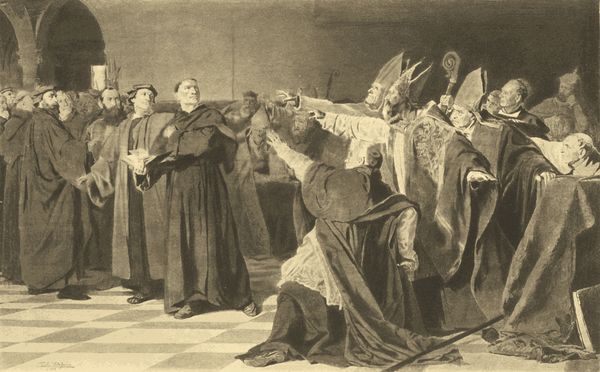
Martin Luther before the Council of Worms.
The disorders which sprang up in the progress of the Reformation recalled Luther to Wittenberg. He felt that his presence was necessary to restrain Carlstadt and others, and, defying any danger to which he might still be exposed, he returned in 1522 to the old scene of his labors, rebuked the unruly spirits who had acquired power in his absence, and resumed with renewed energy his interrupted work. He strove to arrest the excesses of the Zwickau fanatics, and counselled peace and order to the inflamed peasants; while he warned the princes and nobles of the unchristian cruelty of many of their doings, which had driven the people to exasperation and frenzy. At no period of his life is he greater than now, in the stand which he made against lawlessness on the one hand and tyranny on the other. He vindicated his claim to be a reformer in the highest sense by the wise and manly part which he acted in this great social crisis in the history of Germany. In this year also he published his acrimonious reply to Henry VIII. on the seven sacraments. Although he had been at first united in a common cause with Erasmus, estrangement had gradually sprung up between the scholar of Rotterdam and the enthusiastic reformer of Wittenberg. This estrangement came to an open breach in the year 1525, when Erasmus published his treatise "De Libero Arbitrio." Luther immediately followed with his counter-treatise "De Servo Arbitrio." The controversy raged loudly between them; and in the vehemence of his hostility to the doctrine of Erasmus, Luther was led into various assertions of a very questionable kind, besides indulging in the wild abuse of his opponent's character. The quarrel was an unhappy one on both sides; and it must be confessed there is especially a want of generosity in the manner in which Luther continued to cherish the dislike which sprang out of it.
In the course of the same year Luther married Katharina von Bora, one of nine nuns who, under the influence of his teaching, had emancipated themselves from their religious vows. The step rejoiced his enemies and even alarmed some of his friends, like Melancthon. But it greatly contributed to his happiness, while it served to enrich and strengthen his character. All the most interesting and touching glimpses we get of him henceforth are in connection with his wife and children.
Two years after his marriage he fell into a dangerous sickness and depression of spirits, from which he was only aroused by the dangers besetting Christendom from the advance of the Turks. Two years later, in 1529, he engaged in his famous conference at Marburg with Zwingli and other Swiss divines. The following year finds him at Coburg, while the diet sat at Augsburg. It was deemed prudent to intrust the interests of the Protestant cause to Melancthon, who attended the diet, but Luther removed to Coburg to be at hand for consultation. The drawing up of the Augsburg Confession marks the culmination of the German Reformation (1530); and the life of Luther from henceforth possesses comparatively little interest. He survived sixteen years longer, but they are years marked by few incidents of importance. He died at Eisleben on February 18, 1546, and was buried at Wittenberg.
Luther's character presents an imposing combination of great qualities. Endowed with broad human sympathies, massive energy, manly and affectionate simplicity, and rich, if sometimes coarse humor, he is at the same time a spiritual genius. His intuitions of divine truth were bold, vivid, and penetrating, if not comprehensive; and he possessed the art which God alone gives to the finer and abler spirits that He calls to do special work in this world, of kindling other souls with the fire of his own convictions, and awakening them to a higher consciousness of religion and duty. He was a leader of men, therefore, and a Reformer in the highest sense. His powers were fitted to his appointed task; it was a task of Titanic magnitude, and he was a Titan in intellectual robustness and moral strength and courage. It was only the divine energy which swayed him, and of which he recognized himself the organ, that could have accomplished what he did.
View him as a mere theologian, and there are others who take higher rank. There is a lack of patient thoughtfulness and philosophical temper in his doctrinal discussions; but the absence of these very qualities gave vigor to his bold, if sometimes crude, conceptions, and enabled him to triumph in the struggle for life and death in which he was engaged. To initiate the religious movement which was destined to renew the face of Europe, required a gigantic will, which, instead of being crushed by opposition, or frightened by hatred, should only gather strength from the fierceness of the conflict before it. To clear the air thoroughly, as he himself said, thunder and lightning are necessary. Upon the whole, it may be said that history presents few greater characters—few that excite at once more love and admiration, and in which we see tenderness, humor, and a certain picturesque grace and poetic sensibility more happily combined with a lofty and magnanimous, if sometimes rugged, sublimity.
Luther's works are very voluminous, partly in Latin, and partly in German. Among those of more general interest are his Table-Talk, his letters, and sermons. His Commentaries on Galatians and the Psalms are still read; and he was one of the great leaders of sacred song, his hymns, rugged but intense and expressive, having an enduring power.
As an example of his more tender writing, take his letter to his little son Hans:
"Grace and peace in Christ. My dear little son, I am glad to hear that thou learnest well and prayest diligently. Do this, my son, and continue it; when I return home I will bring thee a fine fairing.
"I know a beautiful, cheerful garden, in which many children walk about. They have golden coats on, and gather beautiful apples under the trees, and pears, and cherries, and plums; they sing and jump about, and are merry; they have also fine little horses with golden bridles and silver saddles. And I asked the man, 'Whose children are they?' He replied, 'These are the children who like to pray and learn and are pious.' Then I said, 'My good man, I have a son; his name is Hans Luther; may he not also come to this garden to eat such nice apples and pears, and ride such fine little horses, and play with these children?' And the man said, 'If he likes to pray and learn, and is pious, he shall come to this garden with Lippus and Just; and when they all come together, they shall have pipes and cymbals, lutes, and other musical instruments; and dance and shoot with little cross-bows.'
"And he showed me a fine meadow in the garden, prepared for dancing: there being nothing but golden pipes, cymbals, and beautiful silver cross-bows. But it was yet early, and the children had not dined. Therefore I could not wait for the dancing, and said to the man, 'My good master, I will go quickly and write all this to my dear little son Hans, that he may pray diligently, learn well, and be pious, that he also may be admitted into this garden; but he hath an aunt Lena whom he must bring with him.' The man answered, 'So be it; go and write this to him.'
"Therefore, my dear little son Hans, learn and pray with all confidence; and tell this to Lippus and Just, that they also may learn and pray; and ye will all meet in this beautiful garden. Herewith I commend thee to Almighty God. Give greetings to Aunt Lena, and also a kiss from me,[Back to Contents]
"Thy loving father,
"Martin Luther."
CHARLES V. OF GERMANY (1500-1558)
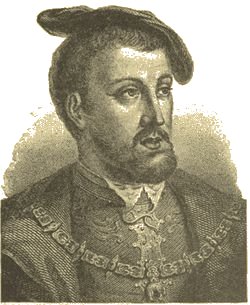
Charles V., who ruled over more kingdoms than any other European monarch before or since, who was the most powerful ruler of his century, and who, on the whole, used his great power wisely and well, was born at Ghent, February 24, 1500. His parents were the Archduke Philip, son of the Emperor Maximilian, and Joanna, daughter of Ferdinand of Aragon and Isabella of Castile. To those united kingdoms Charles succeeded on the death of his grandfather Ferdinand, in 1516. The early part of his reign was stormy; a Flemish regency and Flemish ministers became hateful to the Spaniards, and their discontent broke out into civil war. The Castilian rebels assumed the name of The Holy League, and seemed animated by a spirit not unlike that of the English Commons under the Stuarts. Spain was harassed by these internal contests until 1522, when they were calmed by the presence of Charles, whose prudence and, we may hope, his humanity, put an end to the rebellion. He made some examples, but soon held his hand, with the declaration, that "too much blood had been spilt." An amnesty was more effectual than severities, and the royal authority was strengthened, as it will seldom fail to be, by clemency. Some of his courtiers informed him of the place where one of the ring leaders was concealed. His answer is worthy of everlasting remembrance: "You ought to warn him that I am here, rather than acquaint me where he is."
Spain, the Two Sicilies, the Low Countries, and Franche Comté, belonged to Charles V. by inheritance; and by his grandfather Maximilian's intervention he was elected king of the Romans; nor had he to wait long before that prince's death, in 1519, cleared his path to the empire. But Francis I. of France was also a candidate for the imperial crown, with the advantage of being six years senior to Charles, and of having already given proof of military talent. The Germans, however, were jealous of their liberties; and not unreasonably dreading the power of each competitor, rejected both. Their choice fell on Frederic, Elector of Saxony, surnamed the Wise, celebrated as the protector of Luther; but that prince declined the splendid boon, and recommended Charles, on the plea that a powerful emperor was required to stop the rapid progress of the Turkish arms.
The political jealousy, embittered by personal emulation, which existed between the Emperor and the King of France, broke out into war in 1521. France, Navarre, and the Low Countries were at times the seat of the long contest which ensued; but chiefly Italy. The duchy of Milan had been conquered by Francis in 1515. It was again wrested from the French by the emperor in 1522. In 1523, a strong confederacy was formed against France, by the Pope, the Emperor, the King of England, the Archduke Ferdinand, to whom his brother Charles had ceded the German dominions of the House of Austria, the states of Milan, Venice, and Genoa; all united against a single power. And in addition, the celebrated Constable of Bourbon became a traitor to France to gratify his revenge; brought his brilliant military talents to the emperor's service, and was invested with the command of the Imperial troops in Italy. To this formidable enemy Francis opposed his weak and presumptuous favorite, the Admiral Bonnivet, who was driven out of Italy in 1524, the year in which the gallant Bayard lost his life in striving to redeem his commander's errors.
The confidence of Francis seemed to increase with his dangers, and his faults with his confidence. He again entered the Milanese in 1525, and retook the capital. But Bonnivet was his only counsellor; and under such guidance the siege of Pavia was prosecuted with inconceivable rashness, and the battle of Pavia fought without a chance of gaining it. Francis was taken prisoner, and wrote thus to his mother, the Duchess of Angoulême: "Everything is lost, except our honor." This Spartan spirit has been much admired; but whether justly, may be a question. From a Bayard, nothing could have been better; but the honor of a king is not confined to fighting a battle; and this specimen, like the conduct of Francis in general, proves him to have been the mirror of knighthood, rather than of royalty.
Charles, notwithstanding his victory at Pavia, did not invade France, but, as the price of freedom, he prescribed the harshest conditions to the captive king. At first they were rejected, but his haughty spirit and conscience were at length both reconciled to the casuistry that the fulfilment of forced promises may be eluded. Francis, therefore, consented to the treaty of Madrid, made in 1526, by which it was stipulated that he should give up his claims in Italy and the Low Countries; surrender the Duchy of Burgundy to Spain; and return into captivity if these conditions were not fulfilled in six weeks. When once at large, instead of executing the treaty, he formed a league with the Pope, the King of England, and the Venetians, to maintain the liberty of Italy. The Pope absolved him from his oaths, and he refused to return into Spain. The passions of the rival monarchs were now much excited, and challenges and the lie were exchanged between them. No duel was fought, nor probably intended; but the notoriety of the challenge went far to establish a false point of punctilio, we will not call it honor, among gentlemen, and single combats became more frequent than in the ages of barbarism.
In 1529, the course of these calamities was suspended by the treaty of Cambray, negotiated in person by two women. The Duchess of Angoulême and Margaret of Austria, governess of the Low Countries, met in that city, and settled the terms of pacification between the rival monarchs.
For Charles's honorable conduct on Luther's appearance before the diet of Worms, the reader may refer to the life of the reformer in the present volume. The cause of Lutheranism gained ground at the diet of Nuremberg; and if Charles had declared in favor of the Lutherans, all Germany would probably have changed its religion. As it was, the Reformation made progress during the war between the emperor and Clement VII. All that Charles acquired from the diet of Spire, in 1526, was to wait patiently for a general council, without encouraging novelties. In 1530, he assisted in person at the diet of Augsburg, when the Protestants (a name bestowed on the reformers in consequence of the protest entered by the Elector of Saxony and others at the second diet of Spire) presented their confession, drawn up by Melancthon, the most moderate of Luther's disciples. About this time Charles procured the election of his brother Ferdinand as king of the Romans, on the plea that, in his absence, the empire required a powerful chief to make head against the Turks. This might be only a pretence for family aggrandizement; but the emperor became seriously apprehensive lest the Lutherans, if provoked, should abandon the cause of Christendom, and policy therefore conceded what zeal would have refused. By a treaty concluded with the Protestants at Nuremberg, and ratified at Ratisbon in 1531, Charles granted them liberty of conscience till a council should be held, and annulled all sentences passed against them by the imperial chamber; on this they engaged to give him powerful assistance against the Turks.
In 1535, Muley Hassan, the exiled king of Tunis, implored Charles's aid against the pirate Barbarossa, who had usurped his throne. The emperor eagerly seized the opportunity of acquiring fame by the destruction of that pest of Spain and Italy. He carried a large army into Africa, defeated Barbarossa, and marched to Tunis. The city surrendered, being in no condition to resist, and while the conqueror was deliberating what terms to grant, the soldiery sacked it, committed the most atrocious violence, and are said to have massacred more than thirty thousand persons. This outrage tarnished the glory of the expedition, which was entirely successful. Muley Hassan was restored to his throne.
In 1536 a fresh dispute for the possession of the Milanese broke out between the King of France and the Emperor. It began with negotiation, artfully protracted by Charles, who promised the investiture, sometimes to the second, sometimes to the youngest, son of his formerly impetuous rival, whom he thus amused, while he took measures to crush him by the weight of his arms. But if misfortune had made the King of France too cautious, prosperity had inspired Charles with a haughty presumption, which gave the semblance of stability to every chimerical vision of pride. In 1536 he attempted the conquest of France by invading Provence; but his designs were frustrated by a conduct so opposite to the national genius of the French that it induced them to murmur against their general. Charles, however, felt by experience the prudence of those measures which sacrificed individual interests to the general good by making a desert of the whole country. Francis marked his impotent hatred by summoning the emperor before parliament by the simple name of Charles of Austria, as his vassal for the counties of Artois and Flanders. The charge was the infraction of the treaty of Cambray, the offence was laid as felony, to abide the judgment of the court of peers. On the expiration of the legal term, two fiefs were decreed to be confiscated. A fresh source of hostility broke out on the death of the young Dauphin of France, who was said to have been poisoned, and the king accused Charles V. of the crime. But there is neither proof nor probability to support the charge; and the accused could have no interest to commit the act imputed to him, since there were two surviving sons still left to Francis.
But the resources even of Charles were exhausted by his great exertions; arrears were due to his troops, who mutinied everywhere from his inability to pay them. He therefore assembled the Cortes, or states-general, of Castile, at Toledo, in 1539, stated his wants, and demanded subsidies. The clergy and nobility pleaded their own exemption and refused to impose new taxes on the other orders. Charles, in anger, dissolved the Cortes, and declared the nobles and prelates forever excluded from that body, on the ground that men who pay no taxes have no right to a voice in the national assemblies. But the people of Ghent made a more serious resistance to authority, on account of a tax which infringed their privileges. They offered to transfer their allegiance to Francis, who did not avail himself of the proposal, not from either conscientious or chivalrous scruples, but because his views were all centred in Milan; he therefore betrayed his Flemish clients to the emperor, in hopes of obtaining the investiture of the Italian duchy. By holding out the expectation of this boon, Charles obtained a safe-conduct for his passage through France into Flanders, whither he was anxious to repair without loss of time. His presence soon reduced the insurgents. The inhabitants of Ghent opened their gates to him on his fortieth birthday, in 1540; and he entered his native city, in his own words, "as their sovereign and their judge, with the sceptre and the sword." He punished twenty-nine of the principal citizens with death, the town with the forfeiture of its privileges, and the people by a heavy fine for the building of a citadel to coerce them. He broke his word with Francis by bestowing the Milanese on his own son, afterward Philip II.
Our limits will not allow of our detailing the circumstances of the emperor's calamitous expedition against Algiers; but his courage, constancy, and humanity in distress and danger, claim a sympathy for his misfortunes which is withheld from the selfish and wily career of his prosperity.
Francis devised new grounds for war, and allied himself with Sweden, Denmark, and the Sultan Soliman. This is the first instance of a confederacy with the North. But he had alienated the Protestants of Germany by his severe measures against the Lutherans, and Henry VIII. by crossing the marriage of his son Edward with Mary of Scotland, yet in her cradle. Henry therefore leagued with the emperor, who found it convenient to bury the injuries of Catherine of Aragon in her grave. The war was continued during the two following years with varying success: the most remarkable events were the capture of Boulogne by the English, and the great victory won by the French over the Imperialists at Cerisolles, Piedmont, in 1544. In the autumn of that year a treaty was concluded at Crespi, between Charles and Francis, involving the ordinary conditions of marriage and mutual renunciations, with the curious clause that both should make joint war against the Turks. In the same year the embarrassments created by the war, and the imminent danger of Hungary, increased the boldness of the German Protestants belonging to the league of Smalkald, and the emperor, while presiding at the diet of Spire, won them over by consenting to the free exercise of their religion.
The Catholics had always demanded a council, which was convened at Trent in 1545. The Protestants refused to acknowledge its authority, and the emperor no longer affected fairness toward them. In 1546 he joined Pope Paul III. in a league against them, by a treaty in terms contradictory to his own public protestations. Paul himself was so imprudent as to reveal the secret, and it enabled the Protestants to raise a formidable army in defence of their religion and liberties. But the Electors of Cologne and Brandenburg, and the Elector Palatine, resolved to remain neuter. Notwithstanding this secession, the war might have been ended at once, had the confederates attacked Charles while he lay at Ratisbon with very few troops, instead of wasting time by writing a manifesto, which he answered by putting the Elector of Saxony and the Landgrave of Hesse under the ban of the empire. He foresaw those divisions which soon came to pass by Maurice of Saxony's seizure of his cousin's electorate.
Delivered by the death of Francis in 1547, in which year Henry VIII. also died, from the watchful supervision of a jealous and powerful rival, and relieved from the fear of the Turks by a five years' truce, Charles was at liberty to bend his whole strength against the revolted princes of Germany. He marched against the Elector Frederick of Saxony, who was defeated at Mulhausen, taken prisoner, and condemned to death by a court-martial composed of Italians and Spaniards, in contempt of the laws of the empire. The sentence was communicated to the prisoner while playing at chess; his firmness was not shaken, and he tranquilly said, "I shall die without reluctance, if my death will save the honor of my family and the inheritance of my children." He then finished his game. But his wife and family could not look at his death so calmly; at their entreaty he surrendered his electorate into the emperor's hands. The other chief of the Protestant league, the Landgrave of Hesse, was also forced to submit, and detained in captivity, contrary to the pledged word of the emperor; who, fearless of any further resistance to his supreme authority, convoked a diet at Augsburg in 1548. At that assembly Maurice was invested with Saxony, and the emperor, in the vain hope of enforcing a uniformity of religious practice, published by his own authority a body of doctrine called the "Interim," to be in force till a general council should be assembled. This necessarily was unsatisfactory to both parties, but its observance was enforced by a master with whom terror was the engine of obedience.
These measures, however, did not preserve tranquillity long in Germany. Maurice of Saxony and the Elector of Brandenburg urged the deliverance of the Landgrave of Hesse, as having made themselves sureties against violence to his person. Charles answered by absolving them from their pledges. The Protestants, of course, charged him as arrogating the same spiritual authority with the popes. And Maurice, offended at the slight put upon him, directed his artful policy to the humiliation of Charles. He had compelled his subjects to conform to the Interim by the help of the timid Melancthon, who was no longer supported by the firmness of Luther. On the other hand, he had silenced the clamors of the more sturdy by a public avowal of his zeal for the Reformation. In the meantime the diet of Augsburg, completely at the emperor's devotion, had named him general of the war against Magdeburg, which had been placed under the ban of the empire for opposition to the Interim. He took that Lutheran city, but by private assurances regained the good-will of the inhabitants. He also engaged in a league with France, but still wore the mask. He even deceived the able Granville, Bishop of Arras, afterward cardinal, who boasted that "a drunken German could never impose on him;" yet was he of all others most imposed on. At last, in 1552, Maurice declared himself; and Henry II. of France published a manifesto, assuming the title of "Protector of the liberties of Germany and its captive princes." He began with the conquest of the three bishoprics of Toul, Baden, and Metz. In conjunction with Maurice he had lain a plan for surprising Charles at Innspruck, and getting possession of his person, and the daring attempt had almost succeeded. Charles was forced to escape by night during a storm, in a paroxysm of gout, and was carried across the Alps in a litter. These disputes were adjusted in 1555, at the diet of Augsburg, by the solemn grant of entire freedom of worship to the Protestants. The King of France was abandoned by his allies, and scarcely named in the treaty.
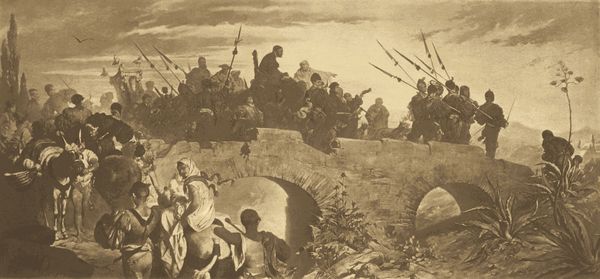
Charles V. on his way to the convent.
Henry resolved to defend his acquisition of the three bishoprics, and Charles to employ his whole force for their recovery. The Duke of Guise made adequate preparations for the defence of Metz, the siege of which the emperor was compelled to raise after sixty-five days spent in fruitless efforts, with the loss of 30,000 men by skirmishes and battles, and by diseases incident to the severity of the season. "I perceive," said he, "that Fortune, like other females, forsakes old men, to lavish her favors on the young." This sentiment probably sunk deeper into his reflections than might be inferred from the sarcastic terms in which it was clothed: for in the year 1556, after various events of war, alternately calamitous to the subjects of both nations, he astonished Europe by his abdication in favor of his son. In an assembly of the states at Brussels, he addressed Philip in a speech which melted the audience into tears. The concluding passage, as given by Robertson, is worth transcribing. "Preserve an inviolable regard for religion; maintain the Catholic faith in its purity; let the laws of your country be sacred in your eyes; encroach not on the rights and privileges of your people; and if the time should ever come when you shall wish to enjoy the tranquillity of private life, may you have a son endowed with such qualities that you can resign your sceptre to him with as much satisfaction as I give up mine to you!" Charles retired into a monastery, where he died after more than two years passed in deep melancholy, and in practices of devotion inconsistent with sound health, when only between fifty-eight and fifty-nine years of age. His activity and talents had been the theme of universal admiration, the ardor of his ambitious policy had been extreme, and his knowledge of mankind profound; but he should have followed up the objects of his high aspirations by a straighter road. His glory would have been truly enviable had he devoted his efforts to the happiness of his subjects, instead of harassing their minds by dissensions, and mowing down their lives by hundreds of thousands in war.
To the statesman or the politician the history of this period is an inexhaustible fund of instruction and interest, and to the general reader it is rendered more than usually attractive by the almost dramatic contrast of character among the principal actors in the scene. Francis seems to have been the representative of the expiring school of chivalry; Charles was not the representative, but the founder of the modern system of state policy; Henry was the representative of ostentation, violence, and selfishness, to be found in all ages.[Back to Contents]
JOHN CALVIN (1509-1564)
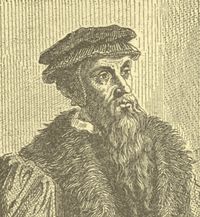
John Calvin was born at Noyon, in Picardy, on July 10, 1509. His father, Gerard Caulvin or Cauvin, was procureur-fiscal of the district of Noyon, and secretary of the diocese. He was one of six children—four sons and two daughters. All the three sons who survived were ecclesiastics; and the reformer himself, while still only twelve years of age, was appointed to a chaplaincy in the cathedral church of Noyon. Calvin was educated in circumstances of ease and even affluence. The noble family of De Mortmar, in the neighborhood, invited him to share in the studies of their children; he was in some measure adopted by them; and when the family went to Paris, in his fourteenth year, he accompanied them. He was entered as a pupil in the College de la Marche, under the regency of Mathurin Cordier, better remembered, perhaps, by his Latin name of Corderius. It was under this distinguished master that Calvin laid the foundation of his own wonderful mastery of the Latin language. During this early period he was so distinguished by the great activity of his mental powers and the grave severity of his manners that his companions, it is said, surnamed him "The Accusative."
For a while his attention was directed to the study of law, and his father sent him to the university of Orleans, then adorned by Pierre de l'Étoile, one of the most famous jurists of his day. At Orleans he continued the same life of rigorous temperance and earnest studiousness for which he was already noted. It was while a law-student in Orleans that he became acquainted with the Scriptures, and received his first impulse to the theological studies which have made his name so distinguished. A relative of his own, Pierre Robert Olivetan, was there engaged in a translation of the Scriptures; and this had the effect of drawing Calvin's attention, and awakening within him the religious instinct which was soon to prove the master-principle of his life. The seeds of the new faith were now beyond doubt sown in his heart, and from this time, although he still continued for a while longer to pursue his legal studies, his main interests appear to have been religious and theological. From Orleans he went to Bourges, where he acquired the knowledge of Greek, under the tuition of a learned German, Melchior Wolmar. He began here to preach the reformed doctrines, and passed over into the ranks of Protestantism, under the slow but sure growth of his new convictions rather than under the agitation of any violent feeling. Here, as everywhere, his life presents a marked contrast to that of Luther.
He proceeded to Paris in 1533, which at this date had become a centre of the "new learning," under the teaching of Lefèvre and Farel, and the influence of the Queen of Navarre, sister of Francis I. The Sorbonne itself had not escaped the infection. There was a growing religious excitement in the university, in the court, and even among the bishops. This, however, was not to last. The king was soon stirred up to take active measures to quell this rising spirit, and the result was that Calvin and others were obliged to flee for their lives. After this he repaired for a short time to his native place, resigned the preferment he held in the Roman Catholic Church, and for a year or two led a wandering life, sheltered in various places. We find him at Saintorge; at Nerac, the residence of the Queen of Navarre; at Angoulême, with his friend Louis du Tillet; then for a brief while at Paris again. Persecutions against the Protestants at this time raged so hotly that Calvin was no longer safe in France, and he betook himself to Basel, whence he issued, in the year 1536, the first edition of his "Christianæ Religionis Institutio," with the famous preface addressed to Francis I. The concentrated vigor and intensity of feeling of this address, rising into indignant remonstrance, and at times into pathetic and powerful influence, make it one of the most memorable documents in connection with the Reformation. After completing this great service to the cause of Protestantism, he made a short visit to Italy, to Renée, the Duchess of Ferrara. Finally, he revisited his native town, sold the paternal estate, which had devolved to him on the death of his eldest brother, and, bidding Noyon adieu, set out, in company with his younger brother and sister, on his way to Strasbourg. The direct road being rendered dangerous by the armies of Charles V., which had penetrated into France, he sought a circuitous route through Savoy and Geneva.
The result of this journey was memorable for the cause of the Reformation. Arrived in Geneva, in the autumn of 1536, he met there his friend, Louis du Tillet, who communicated the fact of his arrival to Farel, then in the very midst of his struggle to promote the Reformation. Farel hastened to see him, and urge upon him the duty of remaining where he was, and undertaking his share of the work of God. Calvin did not at first respond to the call. He was given, he himself says, to his "own intense thoughts and private studies." He wished to devote himself to the service of the reformed churches generally, rather than to the care of any particular church. By some strange insight, however, Farel penetrated to the higher fitness of the young stranger who stood before him, and he ventured to lay the curse of God upon him and his studies if he refused his aid to the church of Geneva in her time of need. "It was," Calvin said, "as if God had seized me by his awful hand from heaven." He abandoned his intention of pursuing his journey, and joined eagerly with Farel in the work of reformation.
Having entered upon his task, he soon infused an energy into it which crowned the struggling efforts of Farel with success. The hierarchical authority was already overturned before his arrival; the citizens had asserted their independence against the Duke of Savoy. The magistrates and people eagerly joined with the reformers in the first heat of their freedom and their zeal. A Protestant Confession of Faith was drawn out, approved of by the Council of Two Hundred, and then proclaimed in the cathedral church of St. Peter. Great and marvellous changes were wrought in a short time upon the manners of the people; where license and frivolity had reigned, a strict moral severity began to characterize the whole aspect of society. The strain, however, was too sudden and too extreme. A spirit of rebellion against the rule of Calvin and Farel broke forth; but they refused to yield to the wishes of a party animated by a more easy and liberal spirit than themselves, and known in the history of Geneva under the nickname of Libertines; and the consequence was that they were both expelled from the city after less than two years' residence.
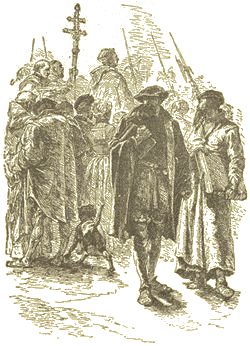
Calvin retreated to Strasbourg, and devoted himself to theological study, especially to his critical labors on the New Testament. Here, in October, 1539, he married the widow of a converted Anabaptist.
The Genevans found, after a short time, that they could not well get on without Calvin. His rule might be rigid; but an authority even such as his was better than no settled authority at all; and the Libertine party seem to have been unable to construct any efficient and beneficent form of government. Accordingly, they invited Calvin to return; and, after some delay on his part, in order to test the spirit in which they were acting, he acceded to their invitation, and in the autumn of 1541, after three years' absence, once more made his entry into Geneva.
Now, at length, he succeeded in establishing his plan of church-government. By his College of Pastors and Doctors, and his Consistorial Court of Discipline, he founded a theocracy, which aimed virtually to direct all the affairs of the city, and to control and modify both the social and individual life of the citizens. The Libertines still remained a strong party, which was even augmented after Calvin's return, by men such as Ami Perrin, who had strongly concurred in the invitation to Calvin, but who were afterward alienated from him by the high hand with which he pursued his designs, as well as by their own schemes of ambition. The struggle with this party lasted, with varying fortune, for no less a period than fifteen years, and was only terminated in 1555, after a somewhat ridiculous émeute in the streets. Perrin and others, driven from the city, were executed in effigy; and the reformer's authority from this date was confirmed into an absolute supremacy. During the long struggle with the Libertines occurred also Calvin's controversies with Sebastian Castellio, Jerome Bolsec, and above all, Michael Servetus.
After the execution of Servetus, and the expulsion of the Libertines two years later, Calvin's power in Geneva was firmly established, and he used it vigorously and beneficently for the defence of Protestantism throughout Europe. By the mediation of Beza he made his influence felt in France in the great struggle that was there going on between the hierarchical party, with the Guises at its head, and the Protestants, led by Condé and Coligny. In 1561 his energies began to fail. He had been long suffering from bad health, though his strength of will and buoyancy of intellect sustained him; but his health grew very much worse, and although he survived for more than two years, he never regained any vigor. He died on May 27, 1564.
Very different estimates have been formed of Calvin's character. None, however, can dispute his intellectual greatness or the powerful services which he rendered to the cause of Protestantism. Stern in spirit and unyielding in will, he is never selfish or petty in his motives. Nowhere amiable, he is everywhere strong. Arbitrary and cruel when it suits him, he is yet heroic in his aims, and beneficent in the scope of his ambition. His moral purpose is always clear and definite: to live a life of duty, to shape circumstances to such divine ends as he apprehended, and in whatever sphere he might be placed, to work out the glory of God.
He rendered a double service to Protestantism, which, apart from anything else, would have made his name illustrious: he systematized its doctrine, and he organized its ecclesiastical discipline. He was at once the great theologian of the Reformation, and the founder of a new church polity which did more than all other influences together to consolidate the scattered forces of the Reformation and give them an enduring strength. As a religious teacher, as a social legislator, and as a writer, especially of the French language, whose modern prose style was then in process of formation, his fame is second to none in his age, and must always conspicuously adorn the history of civilization.
His famous "Institutio" entitles Calvin to the foremost place among the dogmatic theologians of the Reformed Church. This masterpiece of luminous argument presents a complete system of Christian faith, based on the Protestant principle that the Scriptures are the source of Christian truth. "Two things there are," says Hooker, in the preface to the "Ecclesiastical Polity," "which have deservedly procured him honor throughout the world—the one, his exceeding pains in composing the 'Institutions of the Christian Religion;' the other, his no less industrious travails for exposition of Holy Scripture." His Commentaries embrace the greater part of the Old Testament and the whole of the New, except the Revelation, and place him in the front rank of expositors of Scripture.[Back to Contents]
JOHN KNOX By P. Hume Brown (1505-1572)
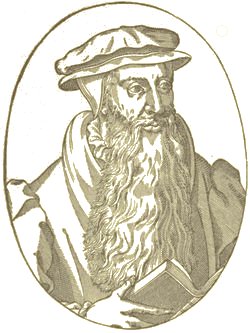
John Knox, the great Scottish Reformer, was born at Giffordgate, a suburb of the town of Haddington, in 1505, the year preceding the birth of his famous countryman, George Buchanan. Knox has himself told us in a single sentence all that is definitely known of his family connections: "My lord," he represents himself as saying to the notorious Earl of Bothwell, "my grandfather, grandsire (maternal grandfather), and father have served under your lordship's predecessors, and some of them have died under their standards." He received the elements of his education in the grammar school of his native town, and in 1522 was sent to the University of Glasgow. St. Andrews was nearer his home, and possessed the more famous university; but he was probably drawn to Glasgow by the fame of the most distinguished literary Scotchman of his generation—John Major, the schoolman. For this reason, at least, Buchanan was sent to St. Andrews, though Glasgow was nearer his native place, when Major had migrated to the former university. At Glasgow, under Major, Knox could have been subjected to none of the influences of the great intellectual revolution which substituted for the studies and methods of mediævalism the ideas of the Revival of Letters. Like all his educated contemporaries, he learned to speak and write Latin with perfect fluency; but it was always with an idiom that showed he had none of the humanist's scruples regarding purity of language. What he learned from Major was the art for which that scholar was renowned throughout Europe—the art of logical exercitation; and Knox's writings everywhere show that all through life he had a natural delight in the play of dialectic. He left the university without taking the degree of master of arts, thus by the conditions of all the mediæval universities precluding himself from the career of an academic teacher.
During the eighteen years that follow his leaving the university, Knox passes completely out of sight. All that is known of him during this period is that, from 1540 to 1543, he acted as notary in his native town of Haddington. As in the documents that establish this fact his name appears with the addition of "Sir," the title of priests who were not Masters of Arts, Knox must have been in orders in the Church of Rome till as late as 1543. In 1544 we find him acting as tutor to the sons of Douglas of Lorgniddry and Cockburn of Ormiston—families, it is to be noted, both favorably disposed to the new opinions in religion now making their way in Scotland. Through these families he was brought into contact with George Wishart, who had lately returned from travelling in Germany and England, with the burning zeal to gain his country to the Lutheran reformation. From this period the future direction of Knox's life was decided, and thenceforward, with an intensity and self-devotion never surpassed, he is the apostle of the cause with which his name is forever identified—the establishment in Scotland of what he deemed the only true conception of the primitive church as based on the teaching of Christ and the apostles. We have reason to believe that, even before this date, his sympathies were on the side of reform in religion, but the teaching and example of Wishart seem first to have brought to him the clear consciousness of his mission. Knox identified himself with Wishart with all the impetuosity of his character, and was in the habit, he tells us, of carrying a two-handed sword before the preacher. When Wishart was seized by the emissaries of Cardinal Beaton, Knox would willingly have attended him to the last; but Wishart, who knew the fate in store for him, rejected the offer. "Return to your bairns" (meaning Knox's pupils), he said, "and God bless you. One is sufficient for one sacrifice."
Wishart was burned in St. Andrews in March, 1546, and in May of the same year Cardinal Beaton was murdered. The cardinal's murderers held possession of the castle of St. Andrews; and, as Knox was known to be the enemy of Beaton (though he had no share in his assassination), he was forced (1547) for his own safety to join them with his pupils. Here his zeal and theological attainments made him so conspicuous that, at the instance of the leaders of the reforming party (Sir David Lyndsay among the rest), he was formally called to the ministry, and preached with much acceptance in the castle and parish church of St. Andrews. A few months later the castle surrendered to the French; and, in the teeth of the express terms of capitulation, the more prominent of the besieged party were sent as prisoners on board the French galleys. For eighteen months Knox remained a captive, his first winter being spent in a galley on the Loire, the second in prison in Rouen. His constitution was not naturally robust, and his hard experience during these two years seriously impaired his health for the rest of his life. The breach of faith on the part of the French, and the ignominy to which he was subjected, were never forgotten by Knox, and must in part explain and justify his life-long conviction that no good thing could come of French policy or French religion.
In February, 1549, on the express intercession of Edward VI., Knox regained his liberty. As it was still unsafe for him to return to Scotland, for the next four years, till the death of Edward VI., he made his home in England. From all that is known of him during these years, it is clear that he made himself a person to be reckoned with by those at the centre of authority in the country. By his preaching at Berwick he gave such offence to the Bishop of Durham that he was removed to Newcastle, where it was supposed his influence would be less mischievous. In 1551 he was appointed one of six chaplains to Edward VI., and in 1552, at the suggestion of the Duke of Northumberland, he was offered the bishopric of Rochester. As the duke's object in suggesting the appointment was simply to check, as far as he could, what he deemed the dangerous activity of Knox, the offer was unhesitatingly rejected. Knox's importance in England is still further proved by the fact that, along with five others, he was consulted by Archbishop Cranmer regarding his forty-five (afterward forty-two) articles of religion.
On Mary's accession, Knox, like the majority of the Reformed ministers, had to seek refuge on the continent. That he might be within call, should circumstances permit his return either to Scotland or England, he took up his abode at Dieppe till the beginning of the following year (1554), when he proceeded to Geneva. In July of this year he was again in Dieppe, "to learn the estate of England;" but with Mary of Lorraine as regent in Scotland, and Mary Tudor as Queen of England, he was convinced that for the present both these countries were closed against him. He accordingly accepted a call from the English congregation at Frankfort-on-the-Main, where, however, on account of a dispute regarding the use of the Book of Common Prayer, he remained only a few months. At Geneva he found a congregation of his own way of thinking; but, eager to be an apostle in his own country, he once more returned to Dieppe (August, 1555), whence he ventured into Scotland in September. He remained in Scotland till July of the next year, residing chiefly in Edinburgh, but making preaching journeys into various parts of the country. The new doctrines were steadily spreading in Scotland, but as yet their supporters were not strong enough to present a confident front against the government. It was at his own risk, therefore, that Knox remained in the country; and at the prayer of the congregation in Geneva, he returned to that town in July, 1556. It was probably during this visit to Scotland that he married his first wife, Marjory Bowes, to whom he seems to have been engaged during his sojourn in Newcastle. For the next two years he remained in Geneva, ministering to his congregation, and seeing much of Calvin, whose influence on Knox regarding all the great questions of the time was afterward to bear fruit in the ordering of affairs in Scotland. To this period also belong several of his minor writings, and notably his "First Blast of the Trumpet against the Monstrous Regiment of Women," the publication of which he must afterward have regretted in the interest of the cause he had most at heart.
Meanwhile, in Scotland the ground was being prepared for the great work in store for Knox. Under Mary of Lorraine as regent, the French influence had come to be regarded as a danger to the independence of the country, and a sense of this danger threw many into the party of reform. The unworthy lives of the old clergy, and the cupidity of many of the nobles, worked in the same direction. In 1557 the advocates of reform bound themselves, by what is known as the First Covenant, to do all in their power to effect a religious revolution, and by 1558 they felt themselves strong enough to summon Knox to their aid in the work he deemed the mission of his life.
In May, 1559, Knox found himself again in Scotland, which he never again left for a prolonged period. He at once became the life and soul of his party. At the moment of his arrival the Lords of the Congregation, as the Protestant nobility termed themselves, were in open revolt against the regent. By his preaching at Perth and St. Andrews Knox gained these important towns to his cause, and by his labors in Edinburgh, of which he was appointed minister, he also won a strong party against the government. But the reformers, of their own resources, could not hold their ground against the regent, subsidized by France with money and soldiers. Mainly, therefore, through the efforts of Knox, who all through his public career was deep in the politics of the time, the assistance of England was obtained against what was now deemed the French invasion. The help of England proved effective, and by the treaty of Leith (1560), and the death of the regent the same year, the insurgent party became masters of the country. The estates of Parliament having met on August 1st, the ministers were ordered to draw up a Confession of Faith which should embody the new teaching, and on August 17th Protestantism was formally established as the religion of the country. Having gained thus much, the ministers, desirous of practical results from their victory, drew up the first Book of Discipline—a document ever memorable in the history of Scotland, and admirable in itself for its wise and liberal suggestions for the religious and educational organization of the country. These suggestions, however, were little to the mind of the majority of the Protestant nobles, who, "perceiving their carnal liberty and worldly commodity to be impaired thereby," sneeringly spoke of them as "devote imaginationis." In the revolution that had been accomplished Knox had been the leading spirit; but he saw that the victory was as yet only half gained, and that the deadliest struggle had still to be decided.
The return of the young queen to Scotland (August, 1561) revived all the old dissensions, and introduced new elements into the strife of parties. By every opinion she held on religion, on the relations of prince and subject, on the fundamental principles of life, Mary was separated as by an abyss from the party represented by Knox. If we may judge from the language which each used of the other, Knox and she failed to find one point on which genial intercourse was possible. As the minister of St. Giles (then the only Reformed church in Edinburgh), Knox believed that Mary was his special charge. Her personal conduct, therefore, no less than her public policy, were made the subject of his most stringent criticism; and during the six years of her reign his attitude toward her was that of uncompromising insistence. The celebration of mass in Holyrood Chapel, in defiance of the late religious settlement, first roused his wrath; and a sermon delivered by him in St. Giles led to the first of those famous interviews with Mary, the record of which makes such a remarkable portion of his "History of the Reformation." The division of ecclesiastical property, by which those in actual possession received two-thirds, the reformed ministers one-third, was a further ground of quarrel with the new government. The delay of Mary to confirm the late religious settlement also gave rise to the greatest anxiety on the part of Knox and his brother ministers. In view of the precarious interests of the great cause, Knox spoke out with such frankness as to alienate the most powerful noble in the country, and the one whom he respected most—Lord James Stuart, afterward the Regent Moray. The marriage of Mary with Darnley (1565), again, however, led them to common counsels, as both saw in this marriage the most serious menace against the new religion. In the subsequent revolt, headed by Moray and the other Protestant nobles, Knox nevertheless took no part, and remained at his charge in Edinburgh. But after the murder of Rizzio, he deemed it wise, considering Mary's disposition toward him, to withdraw to Kyle, in Ayrshire, where he appears to have written the greater part of his history.
The events of the next two years—the murder of Darnley, Mary's marriage with Bothwell, and her subsequent flight into England—again threw the management of affairs into the hands of the Protestant party; and under Moray as regent the acts of 1560, in favor of the reformed religion, were duly ratified by the estates of the realm. As in the former revolution, Knox was still the same formidable force the nobles had to reckon with; and at Stirling, at the coronation of James VI. (1567), he preached in that strain which gave his sermons the character and importance of public manifestoes. The assassination of Moray, in 1570, and the consequent formation of a strong party in favor of Mary, once more endangered the cause to which he had devoted his life, and the possession of the castle of Edinburgh by the queen's supporters forced him to remove to St. Andrews for safety. He had already had a stroke of apoplexy, and he was now but the wreck of his former self, but his spirit was as indomitable as ever. The description of him at this period, by James Melville, can never be omitted in any account of Knox. "Being in St. Andrews, he was very weak. I saw him every day of his doctrine go hulie and fear with a furring of martricks about his neck, a staff in the one hand, and good, godly Richart Ballanden, his servant, holding up the other, oxter from the abbey to the parish church; and be the said Richart and another servant lifted up to the pulpit where he behooved to loan, at his first entry, but or he had done with his sermon, he was so active and vigorous that he was like to ding that pulpit in blads, and fly out of it."
It was the desire of his congregation of St. Giles to hear him once more before he died. Accordingly, by short stages, he made his way to Edinburgh, and on November 9, 1572, at the induction of his successor in office, he made his last public appearance. He died the same month, at the age of sixty-seven, and was buried in the churchyard then attached to St. Giles, behind which church a small square stone in the pavement of Parliament Square, marked "J. K., 1572," now indicates the spot where he is supposed to lie. The saying of Regent Morton at his grave, "Here lieth a man who in his life never feared the face of man" (Calderwood), was the most memorable panegyric that could have been pronounced to his memory.
Knox was twice married. His first wife, Marjory Bowes, died in 1560, leaving him two sons. By his second wife, Margaret Stewart, daughter of Lord Ochiltree, whom (little more than a girl) he married in 1564, he had three daughters. His widow and all his family survived him.
In their broader features the character of Knox and of the work he achieved cannot be misread. In himself he stands as the pre-eminent type of the religious reformer—dominated by his one transcendent idea, indifferent or hostile to every interest of life that did not subserve its realization. He is sometimes spoken of as a fanatic; but the term is hardly applicable to one who combined in such a degree as Knox, the shrewdest worldly sense with an ever-ready wit and a native humor that declares itself in his most serious moments and in the treatment of the loftiest subjects. To blame him for intolerance or harshness is but to pass judgment on his age and on the type to which he belongs. It is his unquestionable tribute, that the work he accomplished was the fashioning anew of his country's destinies. It has to be added that by his "History of the Reformation in Scotland," Knox holds a place of his own in the history of literature. His narrative, as was to be expected, is that of one who saw only a single aspect of the events he chronicles; but the impress of the writer's individuality, stamped on every page, renders his work possibly unique in English literature.[Back to Contents]
ELIZABETH, QUEEN OF ENGLAND By Samuel L. Knapp (1533-1603)
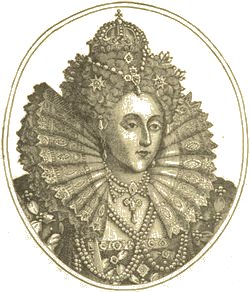
If the question respecting the equality of the sexes was to be determined by an appeal to the characters of sovereign princes, the comparison is, in proportion, manifestly in favor of woman, and that without having recourse to the trite and flippant observation, proved to have been ill-founded, of male and female influence. Elizabeth of England affords a glorious example in truth of this position.
Daughter of Henry VIII., a capricious tyrant, and of the imprudent and unfortunate Anne Boleyn, Elizabeth was born at Greenwich, on the banks of the Thames, September 7, 1533. Her infancy was unfortunate through the unhappy fate of her mother, but she was nevertheless educated with care and attention; in her yet infant faculties her father had the discernment to perceive uncommon strength and promise. Lady Champernoun, an accomplished and excellent woman, was appointed by Henry governess to the young princess. It appears to have been the custom of the times to instruct young women in the learned languages, an admirable substitute for fashionable and frivolous acquisitions; habits of real study and application have a tendency to strengthen the faculties and discipline the imagination. Mr. William Grindal was Elizabeth's first classical tutor; with him she made a rapid progress. From other masters she received the rudiments of modern languages; at eleven years of age she translated out of French verse into English prose "The Mirror of the Sinful Soul," which she dedicated to Catherine Parr, sixth wife to Henry VIII. At twelve years of age she translated from the English into Latin, French, and Italian, prayers and meditations, etc., collected from different authors by Catherine, Queen of England. These she dedicated to her father, December 30, 1545; MS. in the royal library at Westminster. She also, about the same period, translated from the French "The Meditations of Margaret, Queen of Navarre, etc.," published by Bale, 1548.
Mr. Ascham thus speaks of Elizabeth in a letter to Sir John Cheke: "It can scarcely be credited to what degree of skill in the Latin and Greek she might arrive, if she should proceed in that course of study wherein she hath begun by the guidance of Grindal." In 1548 she had the misfortune to lose her tutor, who died of the plague. At this time, it is observed by Camden, that she was versed in the Latin, French, Spanish, and Italian tongues, had some knowledge of the Greek, was well skilled in music, and both sung and played with art and sweetness.
After the death of her father, her brother, King Edward, who tenderly loved her, encouraged her in her studies and literary pursuits, while, without imposition or restraint, he left her to choose her own principles and preceptors. To supply the loss of her tutor she addressed herself to the celebrated Roger Ascham, who, at her solicitation, left Cambridge and consented to become her instructor. Under him she read the orations of Æschines, and Demosthenes' "On the Crown," in Greek, and understood at first sight not only the force and propriety of the language and the meaning of the orator, but the whole scheme of the laws, customs, and manners of the Athenians. By Doctor Grindal, professor of theology, she was initiated into the subtleties of polemic divinity, to which she gave assiduous application. Such, during the short reign of her brother, was the laudable and tranquil time of her life, and by these occupations and pursuits she was prepared for the great part she was to act on the theatre of Europe.
In July, 1553, Mary, after the death of Edward, succeeded to the throne; and having received from her sister many favors and testimonies of esteem, she treated her at first with a form of regard; but Elizabeth was afterward imprisoned and harshly treated, even to the hazard of her life. Her sufferings were, however, mitigated by the interposition of Philip, the husband of Mary, for which she was ever grateful.
The reign, the bigotry, and the butchery of Mary, who, to do God service, amused herself by burning and torturing her people, lasted five years and four months. She died, fortunately for the nation, November 17, 1558. A parliament had been assembled a few days previous to her death, to which the chancellor notified the event. "God save Queen Elizabeth," resounded in joyful acclamations through both houses, while by the people a transport still more general and fervent was expressed.
The commencement of her reign was not less auspicious than its duration was prosperous to the country and glorious to herself. It is observed by Bayle that to say only that no woman reigned with more glory would be saying little. "It must be added that there have been but few great kings whose reigns are comparable to hers, it being the most beautiful period of English history."
Elizabeth when informed of the death of her sister, was at Hatfield, whence, after a few days, she proceeded to London, through crowds of people, who contended with each other in testimonies of joy and attachment. On entering the Tower she was affected with the comparison of her past and present situation; once a captive, exposed to the bigotry and malignity of her enemies, now a sovereign, triumphant over her adversaries, and the hope and joy of the nation. Falling on her knees she expressed her gratitude to heaven for the deliverance she had experienced from her persecutors, a deliverance, she declared, not less miraculous than that of Daniel from the den of lions. With a magnanimity that did her honor, and a prudence that evinced her judgment, she threw a veil over every offence that had been committed against her, and received graciously and with affability the most virulent of her enemies.
On the death of her sister, Elizabeth had, by her ambassador, signified her accession to the Pope, whose precipitate temper, insolent reflections, and extravagant demands, determined her to persevere in the plan she had already secretly embraced. While, to conciliate the Catholics she retained in her cabinet eleven of her sister's counsellors, she took care to balance their power by adding to their number eight partisans of the Protestant faith; among whom were Sir Nicholas Bacon, whom she created lord keeper, and Sir William Cecil, made Secretary of State.
Cecil assured her that the greater part of the nation, since the reign of her father, inclined to the reformation, though constrained to conceal their principles by the cruelties practised under the late reign. These arguments, to which other considerations and reasonings were added, founded on policy and on a knowledge of mankind, had their just weight with Elizabeth, and determined her to adopt the party which education and political wisdom equally inclined to her favor. Yet she wisely resolved to proceed gradually by safe and progressive steps. As symptoms of her future intentions, and with a view of encouraging the Protestants, whom persecution had discouraged and depressed, she recalled all the exiles, and gave liberty to those who had, on account of their religion, been confined in prison. She also altered the religious service, and gave orders that the Lord's prayer, the litany, the creed, and the gospels, should be read in the churches in the vulgar tongue; and she forbade the elevation of the host in her presence.
The bishops, foreseeing in these measures the impending change, refused to officiate at her coronation; and it was not without difficulty that the Bishop of Carlisle was at length prevailed upon to perform the ceremony. Amid the joyful acclamations of her subjects, as she was conducted through London, a boy, personating Truth, let down from a triumphal arch, presented to her a copy of the Bible. She received the present graciously, placed it near her heart, and declared that of all the costly testimonies of attachment given to her that day by the city, this was the most precious and acceptable. Elizabeth insinuated herself into the affections of the people by the most laudable art; frank in her address, and on all public occasions affable, conciliating, and easy of access, she appeared delighted with the concourse that crowded around her; entered, without forgetting her dignity, into the pleasures and amusements of her subjects, and acquired a popularity unknown to her predecessors. Her youth, her graces, her prudence, her fortitude, and her talents, attracted the admiration of one sex and afforded to the other a subject of pride and triumph. Individuals were captivated by her complacency, the public won by her services, while her authority, chastened by religion and law, appeared to be derived from its legitimate source, the choice and affections of the people.
The Commons entreated her, with all humility, that she would make choice of a husband to share with her the weight of government, a request which they hoped, from her sex and age, would not be displeasing or offensive. To this Elizabeth replied, that as their application was expressed in general terms, merely recommending marriage, without pretending to direct her choice, she could not be offended or regard their wishes otherwise than as a new instance of their attachment toward her; but that any farther interposition respecting this subject, on their part, it would ill become them as subjects to make, or her, as an independent princess, to endure. England was the husband which she had betrothed to her; Englishmen were her children; while employed in rearing and governing such a family, she could not deem herself sterile or her life useless. She desired, for her own part, no higher character, nor fairer remembrance of her to be transmitted to posterity, than to have this inscription, when she should pay the debt of nature, engraven on her tomb: "Here lies Queen Elizabeth, who lived and died a maiden queen."
Misfortune threw the Queen of Scots into the power of Elizabeth, and she was denied those services to which the unfortunate are entitled. Driven beyond endurance, she openly and bitterly defied her more fortunate rival, who viewed her with jealousy as heir to the crown, and was fearful that her beauty and influence might supplant her own popularity. Mary was kept in prison eighteen years and then executed on the scaffold. This transaction will ever remain a foul blot on the character of Elizabeth.
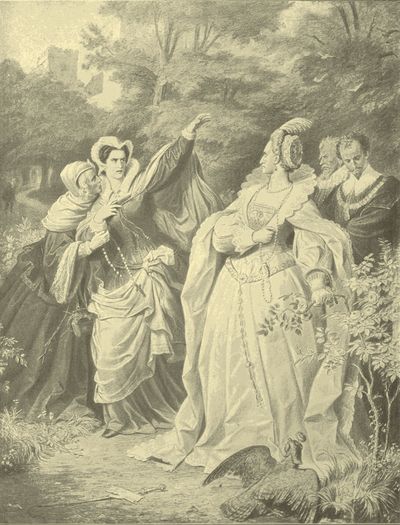
Elizabeth defied by Mary Stuart.
Neither the cares of government nor the infirmities of approaching age weaned her from the love of letters, which at every interval of leisure were her great delight. When nearly sixty years of age, in 1592, she made a second visit to Oxford, where, having been entertained with orations, disputations, etc., she pronounced on her departure, a Latin oration to the vice-chancellors and doctors, when she took her last farewell of the university. In the ensuing year she translated from Latin into English, Boethius's "De Consolatione Philosophæ." In 1598, when the disturbances in Ireland occupied a considerable share of her attention, she translated Sallust's "De bello Jugurthino," also the greater part of Horace's "De Arte Poetica," and Plutarch's book, "De Curiositate," all of which were written in her own hand.
But Elizabeth no longer took an interest in public concerns; her sun was setting, overshadowed by a dark cloud. Prosperity and glory palled upon her sense; an incurable melancholy had fixed itself on her heart. The anxiety of her mind made swift ravages upon her feeble frame; the period of her life visibly approached. The Archbishop of Canterbury advised her to fix her thoughts on God. She did so, she replied, nor did her mind in the least wander from Him. Her voice and her senses soon after failing, she fell into a lethargic slumber, which having continued some hours, she expired gently, without a struggle, March 24, 1603, in the seventieth year of her age and the forty-fifth of her reign.
The character of Elizabeth appears to have been exalted by her friends and depreciated by her enemies, in nearly equal proportions. As a monarch, her activity and force of mind, her magnanimity, sagacity, prudence, vigilance, and address, have scarcely been surpassed in royal annals, and are worthy of the highest admiration. Pope Sixtus V. spoke of her on all occasions as "a woman with a strong head," and gave her a place among the three persons who only, in his opinion, deserved to reign; the remaining two were himself and Henry IV. of France. "Your queen," said he once to an Englishman, "is born fortunate; she governs her kingdom with great happiness; she wants only to be married to me to give the world a second Alexander."
Her temper and her talents equally fitted her for government. Capable of self-command, and of controlling her own passions, she acquired an unlimited ascendency over those of her people. She possessed courage without temerity; spirit, resource, and activity in war, with the love of peace and tranquillity. Her frugality was exempt from avarice, it was the result rather of her love of independence than a passion for accumulation. She never amassed any treasures. Her friendships were uniform and steady, yet she was never governed by her favorites—a criterion of a strong mind. Her choice in her ministers gave proof of her sagacity, as her constancy in supporting them did of her firmness. If a conduct less rigorous, less imperious, and more indulgent would have thrown greater lustre over her character, let it be remembered that some good qualities appear to be incompatible with others; nor let the seductive and corrupting nature of power be left out in the account. Her insincerity was perhaps the greatest blot in her character and the fruitful source of all the vexatious incidents of her reign. Though unacquainted with philosophical toleration, the only method of disarming the turbulence of religious factions, she yet preserved her people, by her prudence and good sense, from those theological disputes which desolated the neighboring nations.
Beset with enemies, both at home and abroad, among the most powerful princes in Europe, the most enterprising and the least scrupulous, the vigor of her administration enabled her to defeat all their purposes, to annoy and plunder them in their own dominions, and to preserve her own dignity untouched and unimpaired. Few monarchs have succeeded to a throne in more difficult circumstances, nor have any ever reigned with more uniform success and prosperity.
If, as a woman, cut off by the peculiarities of her situation from the sympathies of nature and the charm of equal affections, Elizabeth, at times suffered under these privations, which even gave to her sensibility additional force and acuteness, the strength of her reason still triumphed over her passions, and the struggle which her victories cost her served but to display the firmness of her resolution and the loftiness of her mind.
The praises which have by some been bestowed upon Elizabeth for her regard for the constitution and tender concern for the liberties of the people, are wholly without foundation. Few princes have exerted with more arbitrary power the regal prerogatives which had been transmitted to her by her immediate predecessors; yet no censure belongs to her for this conduct, in the principles of which she had been trained and of the justice of which she was persuaded. What potentate, what man, has voluntarily resigned the power in which those beneath him quietly acquiesced? Compared with the reigns of her father and sister, that of Elizabeth might be termed a golden age.[Back to Contents]
FRANCIS BACON[14] By Hon. Ignatius Donnelly (1561-1626)
Francis Bacon was born in York House, London, on January 22, 1561. Of this building only the ancient water-gate, fronting the Thames, survives the waste of time. His father, Sir Nicholas Bacon, was for twenty years Lord Keeper of the Great Seal under Elizabeth—a famous statesman, orator, and wit. His mother, Lady Ann Bacon, was the second daughter of the celebrated Sir Anthony Cooke, formerly tutor of King Edward VI., Henry VIII.'s short-lived son. She was a woman of great learning and many accomplishments, and of a strong, earnest, passionate, affectionate, and religious nature.
Francis was the youngest of eight children, six of whom were by the first wife of Sir Nicholas. He belonged to the aristocracy of England, but not to that ancient, warlike race of battle-crowned warriors, whose pedigree dated back beyond the Crusades. His father was a lawyer. Both his father's family and his mother's seem to have risen from the ranks on the great wave of the Reformation; they belonged to the intellectual new age, then dawning; rather than to the rude, fighting age which was about to pass away. Francis was no accident. We can see in him the two natures of his father and his mother—the commingling of the powerful, practical, sagacious politician and man of affairs, with the studious, contemplative, imaginative, affectionate, religious enthusiast.
His birthplace was a palace; the country seat of Gorhamsbury, near Saint Albans' village, is in the midst of the most charming rural scenery in England, or in the world. There a great part of his youth and early manhood was passed.
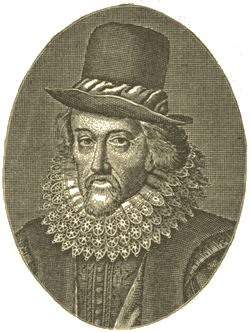
He came into this breathing world when the human race were upon the threshold of the tremendous development which now surrounds us. He was born sixty-nine years after Columbus had re-opened the long-closed pathway from the eastern to the western shores of the Atlantic Ocean; twenty-seven years after the French took possession of Canada; twelve years after the Portuguese settled in Brazil; and forty-six years before the first English colonists landed at Jamestown, Va. The degree of advancement of the mind of the age will be understood when it is remembered that it was only one hundred and twenty-five years, at the date of Bacon's birth, since Guttenberg had invented movable types, in Germany; and but eighty-seven years since Caxton set up his printing press at Westminster. No man has ever lived who did more than Bacon to change the opinions and condition of those who came after him.
It was a "day of little things." England contained less than five million inhabitants, and of these probably not one-tenth spoke a language which could be understood to-day by the English-using people of the world. The mass of the populace were steeped to the lips in brutality and ignorance. The houses of the peasants were built of "sticks and dirt;" many of them "without chimneys or glazed windows;" the habits of the people were "inconceivably filthy;" "scurvy and leprosy were endemic;" the schools did not, as a rule, teach English; the amusements of the populace were bear-baitings and dancing naked in barns; the people of one county could not understand the speech of the inhabitants of the next county; "the disputes about tithes and boundaries were usually settled by bands of armed men, and the records of the Star-Chamber swarm with such cases." Education was at a low ebb. "In one year, 1570 (Bacon was then nine years of age), the scholars of Trinity College, Cambridge, consumed 2,250 barrels of beer." Many of the graduates became beggars; and so extensive was this evil that Parliament, by an act of 14th Elizabeth, declared that "all scholars of the Universities of Oxford or Cambridge that go about begging, not being authorized under the seal of the said universities," are declared "vagabonds" and punished as such. But even this was an improvement on Henry VIII.'s time when three hundred men were hanged in London for soliciting alms.
The only illuminated spot in all this darkness was the Court in London. Here they talked something which we would to-day call English; here they caught, through France and Italy, a reflected light from the dying glories of the ancient Roman civilization; here the travelled wealthy, "the picked men of countries," brought home some of the culture of more refined races. Bacon says:
"Courts are but only superficial schools To dandle fools; The rural parts are turned into a den Of savage men; And where's the city, from foul vice so free, But may be termed the worst of all the three?"
In this curious, primitive, rude, ensmalled age, grew up the great man who was to do so much to change it all.
From his early years he manifested that vastly active intellect "which knew no rest save in motion." He studied, as a child, the nature of echoes in a tunnel. At fifteen years of age (so his chaplain Rawley and his biographer Spedding assure us), he had realized the shallowness of the Aristotelian philosophy and had thought out those principles which have since revolutionized human society. There are reasons to believe that he was the child of fifteen, referred to by the Rosicrucians, who planned the foundation of their society, and, at that early age, wrote the "Chymical Marriage of Christian Rosencreutz," first published in 1616.
At about twelve years of age he went to Cambridge—to Trinity College—rooming with his brother Anthony, who was two years his senior. In June, 1576, he left the university and became an ancient of the Gray's Inn law-society. On September 25, 1576, he accompanied Sir Amias Paulet, the English ambassador, to France. Here he witnessed the sixth civil war of the French people. He followed the court through several of the French provinces; he resided for three months at Poitiers. About February 17, 1579, he dreamed that his father's house in the country was all covered over with black mortar. At the same time his father was taken sick and died in three days thereafter. He returned home on March 20, 1579, to find himself poor. As he said, he could not "live to study," but had "to study to live." He became a practising lawyer, but he did not like the profession. He feared "the bar would be his bier;" it absorbed time which he thought should be dedicated to better ends. We think we find the expression of his heart in the lines of the so-called Shakespeare Sonnet:
"O, for my sake, do thou with fortune chide, The guilty goddess of my harmful deeds, That did not better for my life provide, Than public means, which public manners breeds."
His pecuniary embarrassments were numerous, and continuous. Falstaff doubtless expresses a thought which often recurred to him: "I can get no remedy against this consumption of the purse; borrowing only lingers and lingers it out, but the disease is incurable." More than once he was thrown into a "sponging-house" for debt. His brother Anthony loaned him money repeatedly. In 1592 a "hard Jew or Lombard" put him in confinement for a debt on a bond. Anthony mortgaged his property to pay his debts. In 1594 Malone believes the play of "The Merchant of Venice" was in existence, in which Bassanio, being in debt to a hard Jew, his friend, Antonius, mortgages his own flesh to help him out of his troubles; and the Jew money-lender is sent down through all the ages the terrible type and exemplar of the merciless usurer. Bacon continues a "briefless barrister," with much time at his disposal. He helps in the composition of the play called "The Misfortunes of Arthur." He writes a Sonnet to the Queen. About this time, 1592, the Shakespeare plays begin to appear. Bacon assists in the preparation of several "masks" and "revels," gotten up by Gray's Inn. "The Comedy of Errors" first appears in the hall of that society, which still stands in London. The "Venus and Adonis" and "Lucrece" appear, dedicated to Bacon's intimate friend, Lord Southampton; and that nobleman in 1594 contributes a large sum to the construction of the Globe play-house, Bacon having observed that the stage is a powerful instrumentality to "play on the minds" of the people; and on this stage a series of historical plays are put forth, everyone of which represents kings as monsters or imbeciles.