WILLIS DUFF PIERCY (continued 3)
Reading edition
He died in New York City, July 15, 1868, and was buried in Mount Auburn Cemetery, Cambridge, Massachusetts, perhaps the most beautiful and illustrious of American burial places.
The monument of Dr. Morton in Mount Auburn bears this inscription: "William T. G. Morton, inventor and revealer of anæsthetic inhalation, by whom pain in surgery was averted and annulled; before whom, in all time, surgery was agony; since whom, science has control of pain." He is included among the fifty-three illustrious sons of Massachusetts whose names are inscribed upon the dome of the new Hall of Representatives in the State House at Boston; and is among the five hundred noted men whose names adorn the facade of the Boston Public Library.
The news of Morton's discovery reached England December 17, 1846. Within five days ether was in use as an anæsthetic by the English dentists and surgeons. A year later Sir J. Y. Simpson, of Edinburgh discovered the anæsthetic properties of chloroform, which has since that time been the preferred anæsthetic in Europe. Ether has continued in general use in America.
CHAPTER XI
STEEL AND RUBBER
It has been shown already in this volume that the materials from which man has made his tools, and those tools themselves, are the best means of determining his advance in civilization. Man passed from the Stone Age with its few, crude implements into the Bronze Age, and from this into the Iron Age, with each succeeding step increasing the number and efficiency of his tools. The race has lately passed into an age which might well be named the Age of Steel. The discovery or invention of this metal—for there is in it the nature of both invention and discovery—is sufficiently important to mark a distinct era in human progress.
Steel is not found native, but is a compound of iron and carbon and is produced artificially. The great value of steel lies in the fact that it can be made so hard that it can cut and shape almost every other substance known to man, and yet this very quality of hardness can be so modified as to make the metal capable of cutting and otherwise shaping itself. Steel can be made nearly as hard as the diamond, or so soft that it can be cut, bent, or hammered into this shape or that, rolled into sheets, or drawn out into the finest wire. Nearly the whole of the compound is iron, the carbon ranging from one-fourth of one per cent to two and one half per cent. Ordinary steel contains certain other chemicals, such as silicon, manganese, sulphur, and phosphorus, but these are mere natural impurities existing in the metal. The essential ingredients are iron and carbon. Steel is hardened by being heated to a high temperature and then suddenly cooled by contact with cold water, or in other like ways. Fixing the degree of hardness in a piece of steel is called tempering. The degree of hardness is dependent upon the suddenness of cooling.
The widespread use of steel and its importance in the life of to-day are due to Sir Henry Bessemer, an English inventor, who was born January 19, 1813, and died March 15, 1898. The substance was known, made, and used before the time of Bessemer, but its production was so costly that it was little used. By his process of production the cost was greatly reduced and steel consequently came into much wider usage. By the Bessemer process molten iron is poured into a vessel with holes in the bottom. Air at a powerful pressure is forced through these openings, so that the pressure of the air prevents the melted metal from running out. The air removes the carbon from the molten iron. Afterward the required amount of carbon is admitted to the iron, and the result of the union is a piece of steel. The process of Bessemer was patented in 1856.
Steel is used in the construction of great modern buildings, bridges, and battleships; and in making cannon, railroad cars and rails, pipe, wire, bolts and nails, swords, knives, saws, watch-springs, needles, and innumerable tools and articles of every-day usage. Manifestly a material that is used in the manufacture of articles ranging from a needle to a great city sky-scraper or a battleship must be of prime importance to the human race.
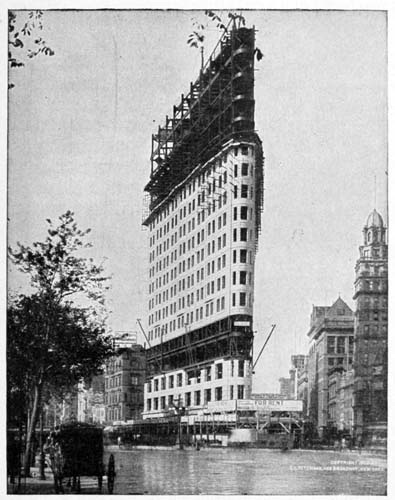
Steel Framework of the Flatiron Building, New York City
The United States Steel Corporation is the largest combination of capital in the world. It was organized in March, 1901, under the laws of New Jersey, for the manufacture and sale of steel products. This giant corporation was formed by the union of ten large corporations, each of which was, in turn, made up of smaller companies. Its total capitalization is $1,404,000,000, or one half of all the money in the United States. Its property consists of 149 steel works, with an annual capacity of 9,000,000 tons; 18,000 coke furnaces; over 100,000 acres of land; and 125 lake vessels and several small railroads. The Corporation employs over 150,000 men, to whom it pays in Wages annually over $120,000,000.
When on a wet morning one puts on rubbers and a rain coat, one scarcely wonders about the history of the articles that give so much protection and comfort. The story of rubber is an interesting one. The substance at first was called "elastic gum." About 1770 it was discovered that the gum would rub out lead pencil marks. It was imported into Great Britain and sold for this purpose, and because of this property its name was changed to rubber. The correct name of the material now is caoutchouc, though its common name is India-rubber or simply rubber. It is obtained from the sap of certain tropical trees and shrubs. The best quality of rubber comes from Brazil, though supplies are procured from other parts of South America, from Central America, the West Indies, Africa, and parts of tropical Asia.
The details of collecting the sap and preparing it for market vary somewhat according to locality and the nature of the trees or shrubs from which it comes. In the region of the Amazon, when the sap is to be obtained from a tree, cuts are made each morning in the bark. The milky sap that exudes is collected in little tin or clay cups fastened to the trunk. At the end of about ten hours these cups are emptied into larger ones, and on the morning of the following day new incisions are made in each tree, about eight inches below the old ones. This process is continued until incisions have been made in the bark from a height of about six feet down to the ground; the lower down on the trunk of the tree, the better is the quality of the sap. For the evaporation of the sap, a fire is built of material yielding dense volumes of smoke. Workmen dip wooden paddles into the liquid and hold them in the smoke until the sap solidifies and acquires a slightly yellow tinge. They repeat the process of dipping the paddle into the sap and holding it in the smoke, until the paddle is covered with a layer of the dried gum about an inch and a half in thickness. This layer is then removed from the paddle and hung up to dry; and the process of evaporation is commenced anew. The raw material, which is an elastic, yellowish, gum-like substance, is sent away to be vulcanized. From the vulcanized product are made the rubber goods of commerce.
As far back as 1615 A.D. the Spaniards used rubber for waxing canvas cloaks so as to make them water-proof. But it was not until two centuries later that caoutchouc began to attract general attention. Charles Goodyear, an American inventor, found a way for making it commonly useful, and brought about its practical and widespread utility.
The story of Goodyear's life is pathetically interesting. He was born in New Haven, Connecticut, December 29, 1800. His father was Amasa Goodyear, a pioneer hardware manufacturer, from whom the son inherited much of his inventive ability. Charles Goodyear was educated in the schools of New Haven, and spent much of his time on his father's farm and in the factory, where the father manufactured steel implements and pearl buttons, the first ever made in America. The son intended to become a preacher, but obstacles arose and he abandoned his purpose. Though he was not to minister to man's spiritual needs, yet he was to bring to the race a material blessing of great value.
Goodyear entered into the hardware business with his father in Connecticut and at Philadelphia, but their business failed. During the ten years extending from 1830 to 1840 he was frequently imprisoned for debt. All this time he was working to perfect unfinished inventions in order that his creditors might be paid.
While a boy on his father's farm, he one day picked up a scale of rubber peeled from a bottle, and conceived the notion that this substance could be turned into a most useful material if it were made uniformly thin and prepared in such way as to prevent its melting and sticking together in a solid mass. When he was first imprisoned for debt, the use of rubber was attracting general attention. He became strongly interested in finding a way for making the article more useful. The chief difficulty in treating rubber lay in its susceptibility to extremes of temperature; it melted in summer and became stiffened in winter. Strenuous effort had been expended in attempting to overcome this difficulty, but without success. Goodyear dedicated his energies to a solution of the problem. His experiments were conducted in Philadelphia, in New York, and in Massachusetts towns.
During this period he and his family lived literally from hand to mouth, and more than once subsisted upon what was virtually the charity of friends. Sometimes it was necessary to sell the children's books and articles of household furniture to drive the wolf of hunger from the door. Much of his experimentation was carried on in prison, with no encouragement from any source to cheer him on. At times his hopes arose as victory seemed near; they soon fell, as what he had mistaken for triumph proved to be defeat. He became the butt of those who did not share his own constant faith in the ultimate success of his labors. He was calm in defeat, patient in ridicule, and always bore himself with magnificent fortitude.
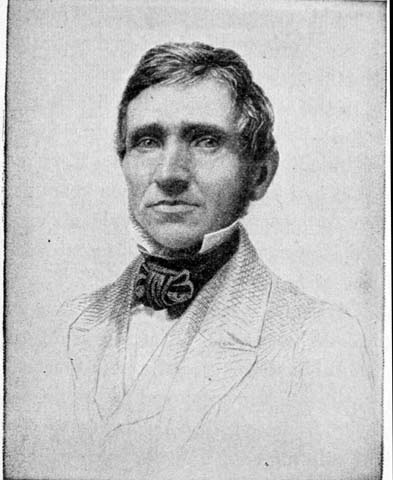
Charles Goodyear
In the early months of 1839 Goodyear could shout with the old Syracusan mathematician, "Eureka!"—"I have found it!" He had discovered that rubber coated with sulphur and then heated to a high degree of heat is rendered uniformly elastic in all temperatures. He had solved the problem, but it was two long years before he could convince any one of the fact. William Rider, of New York, finally furnished capital for carrying on the business of manufacturing rubber goods according to the new process. The firm was successful and Goodyear had soon paid off thirty-five thousand dollars of indebtedness owed to creditors of his old business that had failed ten or fifteen years before.
The new process was called vulcanizing. Vulcan was the old Roman god of fire and metal working, and was patron of handicrafts generally. The word volcano is derived from vulcan, and melted sulphur is associated with volcanoes. The term vulcanize, therefore, is traceable either directly or indirectly, through the fire or the sulphur employed in the process, to the name of the Roman god. According to the relative amount of sulphur used and the temperature to which the compound is raised, either soft or hard rubber may be produced. Hard rubber contains a greater quantity of sulphur and is heated to a higher temperature. The heat used in vulcanization reaches as much as three hundred degrees Fahrenheit.
Goodyear's first patent was taken out in 1844, the year in which Samuel F. B. Morse invented the telegraph. About this time he was imprisoned for debt for the last time in the United States, though he suffered a jail sentence for debt in France later. His patents were repeatedly infringed in this country, and he could not secure any patents in Great Britain or France. The United States Commissioner of Patents said of Goodyear, "No inventor, probably, has ever been so harassed, so trampled upon, so plundered by pirates as he, their spoliations upon him having unquestionably amounted to millions of dollars." Daniel Webster was the lawyer employed in the trial in which Goodyear's legal right to the honor and profits of his invention was established. For his services in this case Webster received a fee of twenty-five thousand dollars.
Goodyear himself made no very large sum of money from his invention, though he added to life not merely a new material but a new class of materials, applicable to many cases. Before his death he had seen rubber put to more than five hundred different uses, and thousands of persons engaged in manufacturing the various articles fashioned from it. Goodyear died in New York City, July 1, 1860.
CHAPTER XII
STENOGRAPHY AND THE TYPEWRITER
It is difficult to see how man could now dispense with any of the great inventions and discoveries that give him power over time and space. Not one of them could be sacrificed without corresponding loss of power. Among the great devices that economize time are stenography and the typewriter. Stenography is the world's business alphabet; the typewriter, its commercial printing press.
The word stenography is derived from the Greek adjective stenos meaning "narrow" or "close," and the Greek verb graphein signifying "to write." Stenography, therefore, is the art of close or narrow writing, so named, perhaps, from the great amount of meaning that by its use is packed into a narrow compass. It is a phonetic system in which brief signs are used to represent single sounds, groups of sounds, whole words, or groups of words.
The idea of stenography or shorthand writing originated in ancient times. Antiquarians have tried to show, with more or less plausibility, that it was practised more than a thousand years before the birth of Christ by the Persians, Egyptians, and Hebrews. Abbreviated writing, for taking down lectures and preserving poems recited at the Olympic and other games, was used by the Greeks. The first known practitioner of the art of shorthand writing was Tiro, who lived in Rome 63 B.C., and who was the stenographer of the great orator Cicero. He took down in shorthand the speeches of his master, by whom they were afterward revised. Plutarch says that when the Roman Senate was voting on the charge which Cicero had preferred against Catiline, Cicero distributed shorthand reporters throughout the Senate House for the purpose of taking down the speeches of some of the leading Senators. At the close of St. Paul's letter to the Colossians there is a note to the effect that the Epistle was written from Rome by Tychicus and Onesimus. It has been supposed that Tychicus acted as shorthand writer and Onesimus as transcriber. Certain it is that the early Christian fathers employed a system of shorthand writing. Saint Augustine refers to a church meeting held at Carthage in the fourth century of the Christian era, at which eight shorthand writers were employed, two working at a time. Charlemagne, the great king of the Franks, who died in 814 A.D., delved deep into the art of shorthand writing as practised by Tiro, Cicero's stenographer.
In Chapter xxxviii of David Copperfield, Charles Dickens describes his own experience with shorthand thus: "I bought an approved scheme of the noble art and mystery of stenography (which cost me ten and sixpence), and plunged into a sea of perplexity that brought me, in a few weeks, to the confines of distraction. The changes that were rung upon dots, which in such a position meant such a thing, and in such another position something else, entirely different; the wonderful vagaries that were played by circles; the unaccountable consequences that resulted from marks like flies' legs; the tremendous effects of a curve in a wrong place—not only troubled my waking hours, but reappeared before me in my sleep. When I had groped my way, blindly, through these difficulties, and had mastered the alphabet, which was an Egyptian temple in itself, there then appeared a procession of new horrors, called arbitrary characters, the most despotic characters I have ever known; who insisted, for instance, that a thing like the beginning of a cobweb meant expectation, and that a pen-and-ink sky-rocket stood for disadvantageous. When I had fixed these wretches in my mind, I found that they had driven everything else out of it; then, beginning again, I forgot them; while I was picking them up, I dropped the other fragments of the system; in short, it was almost heart-breaking. "
Till near the middle of the last century all systems of shorthand writing were more or less crude and illogical. About 1837 Isaac Pitman, an Englishman, put stenography upon a phonetic basis and therefore a scientific basis. As there are in the English language forty-three different sounds represented by twenty-six letters, Pitman adopted a shorthand alphabet in which consonants were represented by simple straight or curved strokes, the light sounds denoted by light strokes and the heavy sounds by heavy strokes. "The leading heavy vowels are represented by six heavy dots and a like number of heavy dashes, placed at the beginning, middle, or end of the strokes, and before or after as they precede or follow the consonants. The same course is followed with the light vowels. Diphthongs are provided for by a combination of dash forms, and by a small semicircle, differently formed and placed in different positions. Circles, hooks, and loops are employed in distinct offices."
Pitman's invention of a phonographic alphabet for shorthand was the beginning of verbatim reporting that has spread to every land which Anglo-Saxon civilization has touched. There is scarcely a legislative body, a court of importance, or a great convention of any kind, whose proceedings are not taken down on the spot in shorthand, accurately and at once, to say nothing of the very wide use of stenography in private business. In this bewildering commercial whirl of the twentieth century time is money, and stenography is time.
The typewriter, invented about forty years ago, is parallel to stenography in importance. The daily volume of the world's business could not be accomplished without it. And, as in the case of all the great inventions, men do not see how they got on before it came. The world owes the typewriter to two Americans, John Pratt and Christopher L. Sholes. Pratt was born in Unionville, South Carolina, April 14, 1831. In 1867, while in England, he produced the first working typewriter that ever secured a sale. A description of his machine in one of the English periodicals attracted the attention of Sholes, who was born in Pennsylvania in 1819, but who at that time was living in Milwaukee, Wisconsin. He began working at the idea of the typewriter borrowed from Pratt, and in the same year that Pratt's machine was first made, Sholes produced a typewriter that was practically successful and started the manufacture of a machine that was to become increasingly useful, and finally indispensable.
No business in recent years has grown more rapidly than the typewriter industry. From nothing forty years ago, it has grown into an industry producing nearly a quarter of a million machines a year and employing thousands of workmen. American manufacturers not only supply the home trade with their output, but export machines to every part of the civilized world, making this country the home and center of the world's typewriter industry.
CHAPTER XIII
THE FRICTION MATCH
The biggest things are not always the most important. A little article, used many times in the course of every day and familiar to every person, is one of the world's great inventions. It is the friction match.
Fire is one of man's absolute necessities. Without it civilization would have been impossible, and life could scarcely continue. The story of man's power to produce and use fire is practically the story of civilization itself. So far as history can reveal there has never been in any time a people who were without the knowledge and use of fire; which, on its beneficent side, is man's indispensable friend; and in its wrath, a terrible destroyer.
A mass of mythological stories has come down from the days of antiquity regarding the origin of fire. The Persian tradition is that fire was discovered by one of the hero dragon-fighters. He hurled a huge stone at a dragon, but missed his aim. The stone struck another rock. According to the story, "the heart of the rock flashed out in glory, and fire was seen for the first time in the world." The Dakota Indians of North America believed that their ancestors produced fire from the sparks which a friendly panther struck with its claws in scampering over a stony hill. Finnish poems describe how "fire, the child of the sun, came down from heaven, where it was rocked in a tube of yellow copper, in a large pail of gold." Some of the Australian tribes have a myth that fire came from the breaking of a staff held in the hands of an old man's daughter. In another Australian legend fire was stolen by a hawk and given to man; in still another a man held his spear to the sun and thus procured fire.
According to Greek mythology, fire was stolen from heaven by Prometheus, friend of men, and brought to them in a hollow stalk of fennel. As the legend runs, he took away from mankind the evil gift of foreseeing the future, and gave them instead the better gifts of hope and fire. For the bestowing of these gifts upon the human race, Prometheus was sorely punished by Zeus, king of the gods. The myth that fire was stolen from heaven by a hero is not confined to the Greeks; it is scattered among the traditions of all nations. It is not strange that primitive man should ascribe the origin of fire to supernatural causes. Before he learned how to use and control it, he must have been strangely impressed with its various manifestations—the flash of the lightning, the hissing eruption of the volcano, the burning heat of the sun, and perhaps the wild devastation of forest and prairie fires caused by spontaneous combustion.
Because of its mysterious origin and its uncontrollable power for good or ill, fire was supposed from the earliest times to be divine. The Bible tells us that the Lord went before the children of Israel in their journey from Egypt to the Promised Land in a pillar of fire by night. From the earliest hours of religious history the sun has been worshiped as a god. All the tribes of antiquity had a fire god. It was Agni in ancient India; Moloch among the Phœnicians; Hephaestus in Greece; Vulcan among the Romans; Osiris in Egypt; and Loki among the Scandinavians. In ancient religious belief fire and the human soul were supposed to be one and the same in substance. In some instances fire was held to be the very soul of nature, the essence of everything that had shape. "From Jupiter to the fly, from the wandering star to the tiniest blade of grass, all beings owed existence to the fiery element." This theory was believed by the Aztecs, who invoked in their prayers "fire the most ancient divinity, the father and mother of all gods." Of these ancient fire-divinities some were good and some evil; just as fire itself is both beneficent and malignant.
Among some peoples fire was used for purification from sin and the cure of disease. It also burned upon the tombs of the dead to dispel evil spirits. Greek colonists, in setting out from the mother country for the purpose of founding new homes, took fire from the home altar with which to kindle fires in their new homes. Upon some altars fires were kept constantly burning, and their extinguishment was considered a matter of great alarm. If by chance the fire that burned in the Roman temple of Vesta went out, all tribunals, all authority, all public and private business had to stop immediately until the fire should be relighted. The Greeks and the Aztecs received ambassadors of foreign countries in their temples of fire, where at the national hearth they prepared feasts for their guests. In some cases ambassadors were not received until they had stood close to fire in order that any impurities they might have brought should be singed away. No Greek or Roman army crossed a frontier without taking an altar whereon burned night and day fire brought from the public council hall and temple at home. The Egyptians had a fire burning night and day in every temple, and the Greeks, Romans, and Persians had such a fire in every town and village.
Among our Anglo-Saxon ancestors the ordeal by fire was one of the modes of trying cases of law. The accused was compelled to walk blindfolded over red-hot plowshares. If these burned him, he was adjudged guilty; if not, he was acquitted, for it was supposed that the purity of fire would not permit an innocent man to suffer. The custom of the North American Indians was to discuss important tribal affairs around the council fire. Each sachem marched around it thrice, turning to it all sides of his person. Among peoples in both hemispheres it has been the practice to free fields from the demons of barrenness by lighting huge fires. The fields were supposed to be made fertile as far as the flames could be seen. In Bavaria seeds were passed through fire before they were sown to insure fertility. In some places children were held over the flame of an altar fire for purposes of purification.
Nothing has played a more important part in the history of the race than fire. Human culture began with the use of it, and increased in proportion as its use increased. For ages man felt his helplessness before fire; he did not know how to produce it, or to turn it to good account. By and by the secret was discovered; mind began to gain the mastery over this great force.
The most primitive method of producing fire artificially was by rubbing two sticks together. This method was probably discovered by accident. Fire from friction was caused also by pushing the end of a stick along a groove in another piece of wood, or by twirling rapidly a stick which had its end placed perpendicularly in a hole made in another piece of wood. Focusing the rays of the sun powerfully upon a given point by means of a lens or concave mirror, was another method used for starting fire. The story is told that when the ancient city of Syracuse in Sicily was being besieged, the great mathematician Archimedes, who was a resident of that city, set on fire the enemy's ships by focusing the sun's rays upon them with a mirror. In China the burning-glass was widely used not very long ago. When iron came into use, it was employed for making fire. A piece of flint was struck against an iron object. The concussion produced a spark, which fell into a box containing charred cotton called tinder. The tinder took fire but did not burst into flame. The flame came by touching the burning tinder with a strip of wood tipped with sulphur. This flint-and-steel method was used for producing fire until less than a century ago.
No attempt was made to produce fire by chemical means until 1805. In that year M. Chancel, a Paris professor, invented an apparatus consisting of a small bottle containing asbestos, saturated with sulphuric acid, and wooden splints or matches coated with sulphur, chlorate of potash, and sugar. The wooden splint, when dipped into the bottle, was ignited. The first really successful friction matches were made in 1827 by John Walker, an English druggist. They consisted of wooden splints coated with sulphur and tipped with antimony, chlorate of potash, and gum. They were sold at a shilling or twenty-four cents per box, each box containing eighty-four matches.
The modern phosphorus friction match came into use about 1833. It is not possible to ascertain precisely who the inventor was. But in that year Preschel had a factory in Vienna, Austria, for the manufacture of friction matches with phosphorus as the chief chemical. For years Austria and the States in the south of Germany were the center of the match industry. Phosphorus is still used as the principal chemical ingredient in the manufacture of matches. The first patent in the United States for a friction match was issued October 24, 1836, to Alonzo D. Phillips, of Springfield, Massachusetts. The "safety match," which will not ignite unless brought into contact with the side of the box in which it is packed, was invented by Lundström of Sweden, in 1855. The match industry in Norway and Sweden has developed during the last few years with great rapidity. About sixty factories are in operation in these countries. One town alone contains six thousand matchmakers. In France the government has the sole right to manufacture matches.
Phosphorus is very poisonous, and the early manufacture of phosphorus matches was attended with loss of life and great suffering. Inhalation of phosphorus fumes produced necrosis, or decay of the bone, usually of the lower jaw. In the first years of phosphorus match making, the business was chiefly carried on by the poorer people in large cities. The work was done in damp, foul cellars; and the peculiar disease of the bone caused by the phosphorus fumes became so widespread that the different governments drove the match factories out of the cellars and ordered that the business be conducted in better ventilated buildings. But the discovery of red phosphorus, which never produces the disease, the use of lessened quantities of the ordinary phosphorus, and better ventilation have all combined to make the malady now very rare.
The first matches were made by hand, one by one, and were of necessity few and costly. Matches are now made and boxed by machinery. One million splints can be cut in an hour with the machinery in use. Some single manufacturing firms make as many as one hundred millions of matches in a day. With diminished cost of production have come decreased prices, so that now a large box can be purchased for a very few cents. Until about 1860 railroads in the United States would not receive matches for transportation, owing to the danger involved. The distribution before that year was mainly by canal or wagon. A match is a little thing, but it is one of the world's really great inventions.
CHAPTER XIV
PHOTOGRAPHY
Photography is one of the many triumphs of the human mind over time and space. Thousands of miles are between you and the wonderful Taj Mahal. You may never be able to go to it. But as the mountain would not go to Mohammed and Mohammed therefore went to the mountain, so photography brings the Taj Mahal to you. The chief struggle for civilization is with these two abstract antagonists—time and space. In this struggle the achievements of photography are such as to win it a place among the world's great inventions and discoveries.
Here, again, we borrow words from the Greeks. Photography comes from the Greek noun phos meaning "light" and the Greek verb graphein signifying "to write," already referred to several times in this volume. Photography is therefore the science and the art of writing or reproducing objects by means of light. The science of photography depends upon the action of light on certain chemicals, usually compounds of silver. These chemicals are spread upon a delicately sensitized metallic plate, which is exposed to light. The action of light fixes the object desired upon this plate, from which copies of the picture are made on paper of suitable kind.
Like most of the great discoveries and inventions, photography is not old. It had its beginning in 1777, when the Swedish chemist Scheele began to inquire scientifically into the reason and effect of the darkening of silver chloride by the rays of the sun. The first picture ever made by the use of light on a sensitive surface was made in 1791 by Thomas Wedgewood, an Englishman. The principle of the photographer's camera was discovered in 1569 by Della Porta, of Naples. To Nicéphore Niepce, a Frenchman, belongs the honor of producing the first camera picture. This was in 1827 after thirteen years of experimenting. He called his process "heliography," helios being the Greek word for sun. His process consisted of coating a piece of plated silver or glass with asphaltum or bitumen, and exposing the plate in the camera for a time varying in length from four to six hours. The light acted on the asphaltum in such a way as to leave the image on the plate.
The predecessor of the modern photograph was the daguerreotype. It was named for its inventor, Louis Daguerre, a French scene-painter, who was born in 1789. In 1829 he formed a partnership with Niepce, and together they labored to advance the art of photography. The discovery of the daguerreotyping process was announced in January, 1839. The process of Daguerre consisted in "exposing a metal plate covered with iodide of silver for a suitable time in a photographic camera, the plate being afterwards transferred to a dark room, and exposed to the vapor of mercury, which develops the latent image, it being afterwards fixed. Although this process has become almost obsolete, it was really the first which was of any practical value, and experts all agree that no other known process reproduces some subjects—for example, the human face—with such fidelity and beauty."
A little while before the daguerreotyping process was announced, Fox Talbot, a British investigator, discovered a method of making pictures by means of the action of light on chemically prepared paper instead of metal, as in the case of Daguerre. Talbot originated the terms negative and positive which are still used in photography. Daguerre in France and Talbot in Great Britain had independently achieved success in producing pictures, but neither had discovered a way to make photographs permanent. In the course of time the pictures faded. In 1839 Sir John Herschel of England found a chemical process for making photographs permanent, by removing the cause for their fading. The first sunlight photograph of a human face was that of Miss Dorothy Catherine Draper, made by her brother, Prof. John William Draper, of the University of the City of New York, early in 1840.
Various chemical discoveries for improving photographs have been made by different persons from time to time, until the art of photography has now reached a high state of development. An important improvement is in the lessening of the time of exposure to light necessary for producing a photograph. Formerly hours were required, but under improved conditions only the shortest instant of time is requisite.
In 1906 a photographic paper for producing prints in color from an ordinary negative was placed on the market. This paper is coated with three layers of pigmented gelatin, colored respectively red, yellow, and blue. After being exposed to the daylight in the usual way, the paper is placed in hot water, where the image is developed. The grays and blacks of the negative are translated into the colors they represent in the object.
The brothers Lumière of Paris have found a method of producing a photograph on a sensitive plate which, viewed as a transparency, shows the object in its original colors. No prints can be taken from this plate, and the picture cannot be viewed by reflected light, but the colors are true and brilliant.
The cinematograph is an instrument by which about fifteen photographs per second can be received on a film, each representing the photographed group at a different instant from the others. The advantages of this mode of photographing and of throwing pictures on a screen over the older methods are obvious. By controlling the rate at which the pictures are represented on the screen, movements too rapid to be analyzed by the eye may be made slow enough to permit observation; and, similarly, movements too slow for comprehension or rapid observation may often be quickened. The busy life of a city street, the progress of races or other competitions, many scenes in nature, and even the growth of a plant from seed to maturity, may be shown by means of a "moving picture."
Photography is a noble servant of mind and soul. It brings to us likenesses of eminent persons and objects of nature and art which perhaps we should never be able to see otherwise. It has been used in measuring the velocity of bullets and in showing the true positions of animals in motion. Photography has created the "new astronomy." Immediately after its discovery, photography was applied to the science of the stars, and it has been ever since of incalculable service in this field of inquiry. Photographs of the moon were made as early as 1840, and much that is known to-day of the sun has been revealed by photography. So sensitive is the modern photographic plate to the influence of light, that photography has discovered and located stars which are invisible through a strong telescope. Astronomers are now engaged in making a photographic chart of the sky.
CHAPTER XV
CLOCKS
The matters of every-day life, much less the affairs of a complex civilization, could scarcely be carried on without some accurate and uniform system of measuring time. Nature herself furnishes measurements for certain divisions of time. The "two great lights" that God made, as the Bible tells us, were designed "for signs, and for seasons, and for days and for years." The revolution of the earth around the sun marks the year; the revolution of the moon around the earth determines the month; the rotation of the earth on its axis causes and measures day and night. But no object of nature distinguishes the hours of the day or the divisions of the hour.
Man requires a smaller unit of time than the day. He must divide the day into hours; the hours into minutes; the minutes into seconds. The division of the day into twenty-four hours is as old as authentic history. But the means for determining the hours and their subdivisions were at first quite crude and inefficient.
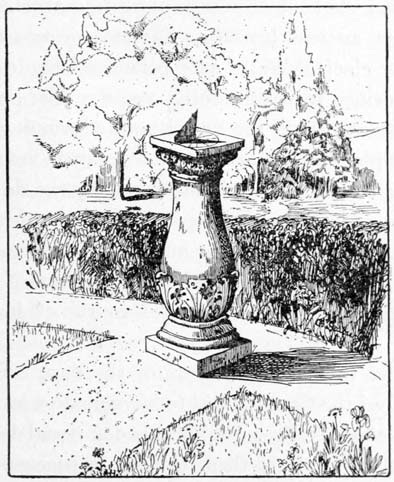
A Sun Dial
Perhaps the most primitive of all time-measuring devices was a stick or pole planted upright in a sunny place. The position of the shadow which it cast marked time. The sun-dial was a development of this simple device. It consisted essentially of two parts: a flat plate of metal marked off much like the dial of a modern clock or watch, and an upright piece, usually also of metal, fastened to the center of the dial. To make the direction of the shadow uniform for any given hour throughout the year, the upright piece was made parallel to the axis of the earth. As the earth rotated on its axis the shadow cast by the upright piece moved from point to point on the dial, measuring the flight of time. The sun-dial was in use among the earliest nations. Herodotus is authority for the statement that the Greeks borrowed it from the Babylonians. The sun-dial was obviously of no use on cloudy days or dark nights, and even in sunny weather it could not accurately or delicately indicate the passage of time. However, it continued in use so long that to the end of the seventeenth century the art of dialling was considered a necessary element of every course in mathematics.
Another ancient invention for measuring time was the water-clock. Water was permitted to drop from a small orifice in a containing vessel. The period required for emptying the vessel marked a unit of time. Its principle was the same as the common hour-glass, according to which time is measured by the slow dropping of sand from one receptacle into another. The water-clock was used by the ancient Chaldeans and the Hindoos, and also by the Greeks and Romans. Demosthenes mentions its use in the courts of justice at Athens.
In order to mark the hours of the day, the Saxon King Alfred the Great is said to have made wax candles twelve inches in length, each marked at equal distances. The burning of six of these candles in succession consumed, roughly, just twenty-four hours. To prevent the wind from extinguishing them they were inclosed in cases of thin, white, transparent horn. The candles thus inclosed were the ancestors of the modern lantern.
Our word clock comes from the Anglo-Saxon verb clocean meaning "to strike," "to give out a sound." It is impossible to ascertain by whom clocks were invented, or when or where. It is fairly clear, however, that a Benedictine Monk named Gerbert, who afterward became Pope Sylvester II, made a clock for the German city of Magdeburg a little before the year 1000 A.D. Clocks may have been made before this, but if so it would be hard to establish the fact. In Gerbert's clock weights were the motive power for the mechanism. Weight clocks were used in the monasteries of Europe in the eleventh century, but it is probable that these early clocks struck a bell at certain intervals as a call to prayer, and did not have dials for showing the time of day.
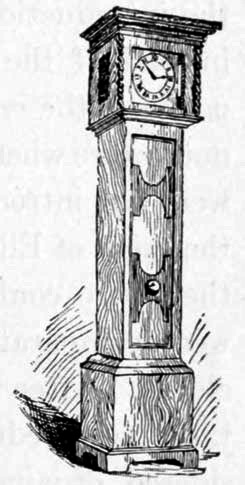
A "Grandfather's Clock," belonging to William Penn
The first clocks were comparatively by large and were stationary. Portable ones appeared about the beginning of the fourteenth century, though the inventor is not known, nor the exact time or place of invention. When portable clocks were invented, the motive power must have been changed from weights to main-springs, and this change in motive force marks an era in the development of the clock. The introduction of the pendulum as a regulating agent was, however, the greatest event in clock development. This invention has been credited to Huygens, a Dutch philosopher, who was certainly, if not the discoverer of the pendulum, the first to bring it into practical use, about 1657. Credit for inventing the pendulum is also claimed for Harris, a London clockmaker; for Hooke, the great English philosopher; for a son of Galileo, the celebrated Italian scientist; and for others.
The modern watch is in reality but a developed type of the clock. Watches were made possible by the introduction of the coiled spring as motive power, instead of the weight. The coiled spring came into use near the end of the fifteenth century, though it is not known where or by whom it was invented. Watches were not introduced into general use in England until the reign of Elizabeth, and then on account of the cost they were confined to the wealthy. At first watches were comparatively large and struck the hours like clocks. After the striking mechanism was abandoned, they were reduced in size and for a time were considered ornamental rather than useful. They were richly adorned with pictures in enamel and with costly jewels. They were set in the heads of canes, in bracelets, and in finger-rings.
Watches and clocks had originally only one hand, which indicated the hour. Minute and second hands were added later. Devices have been introduced to counteract the effect of temperature on the mechanism of time-pieces, so that they run uniformly in all kinds of weather. Within recent years clocks operated with electricity have been invented. With the advent of clock and watch manufacture by machinery, the cost has been so reduced that practically any one may own an accurate time-piece. The United States is one of the foremost countries of the world in the manufacture and sale of clocks and watches.
CHAPTER XVI
SOME MACHINES
The Sewing Machine
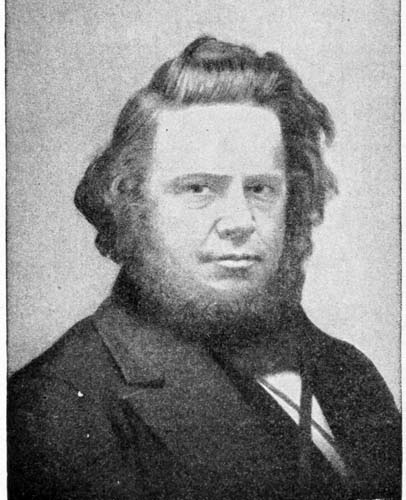
Civilization owes the invention of the sewing machine to Elias Howe, an American. Howe was born at Spencer, Massachusetts, July 9, 1819. His father was a miller, and work in the mills gave the son's mind a bent toward machinery. One day in 1839 while Howe was working in a machine-shop in Boston, he overheard a conversation among some men regarding the invention of a knitting machine. "What are you bothering yourselves with a knitting machine for? Why don't you make a sewing machine?" asked one. "I wish I could," was the reply, "but it can't be done." "Oh, yes it can," said the first, "I can make a sewing machine myself." "Well, you do it," replied the second, "and I'll insure you an independent fortune."
This conversation impressed Howe with the idea of producing a sewing machine. The hope of relieving his extreme poverty set him to work on the invention in earnest in the year 1843. George Fisher, a coal and wood dealer of Cambridge, Massachusetts, who was a former schoolmate of Howe, formed a partnership with him for producing the invention. In December, 1844, Howe moved into Fisher's house, set up his shop in the garret, and went to work. In the following April he sewed the first seam with his new machine, and by the middle of May he had sewed all the seams of two suits of clothes, one for himself and one for his partner.
On September 10, 1846, a patent on the sewing machine was issued to Howe from the United States Patent Office at Washington.
The tailors of Boston, believing that a sewing machine would destroy their business, waged fierce warfare against it. In the spring of 1846, seeing no prospect of revenue from his invention, Howe took employment as a railroad engineer on one of the roads entering Boston, but this labor proved too hard for him and he soon gave it up. Howe's partner, Fisher, could see no profit in the machine and became wholly discouraged. Howe then determined to try to market his invention in England, and sent a machine to London. An English machinist examined it, approved it, and paid $250 for it, together with the right to use as many others in his own business as he might desire. Howe was afterward of the opinion that the investment of this $250 by the English machinist brought ultimately to that man a profit of one million dollars.
Elias Howe
During all this time Howe was extremely poor. He and his wife and children had gone to England, but on account of poverty he was compelled to send his family back to America. His fourth machine, which he had constructed in England, he was obliged to sell for 5 pounds (about $25), although it was worth ten times as much, in order to procure money enough to pay his return passage to America. He also pawned his first-made machine and his patent on the invention. In April, 1849, he landed at New York with only an English half-crown in his pocket. Procuring employment in a machine-shop, the inventor took up his abode in one of the cheapest emigrant boarding-houses. At this time his wife lay dying in Cambridge, Massachusetts, and his father had to send him ten dollars to enable him to go to her.
Finally the sewing machine began to succeed commercially. The inventor's long night of discouragement was breaking on a day of assured prosperity. In 1850 Howe was in New York superintending the manufacture of fourteen sewing machines. His office was equipped with a five-dollar desk and two fifty-cent chairs. A few years later he was rich. Isaac Merritt Singer became acquainted with his machine, and submitted to him the sketch of an improved one. It was Singer who first forced the sewing machine upon the attention of the United States. Howe charged that Singer was infringing his patent rights. Litigation ensued. Judge Sprague of Massachusetts decided in favor of Howe. In his opinion he stated that "there is no evidence in this case that leaves a shadow of doubt that, for all the benefit conferred upon the public by the introduction of a sewing machine the public are indebted to Mr. Howe." From this time Howe began to reap the financial reward of his labors. His revenues from the sewing machine amounted ultimately to more than $200,000 a year. He spent vast sums, however, in defending his patent rights, and many others of the "sewing machine kings" were wealthier than he. Howe died at Brooklyn, New York, October 3, 1867.
The sewing machine is used not only for sewing cloth into all kinds of garments, but for making leather into boots, shoes, harness, and other necessary articles of daily life. Great improvements have been made in the sewing machine since its invention, but its essential principles to-day are for the most part those that the inventor discovered and brought into successful operation in his first machine. It is agreed by disinterested and competent persons that "Howe carried the invention of the sewing machine further toward its complete and final utility than any other inventor before him had ever brought a first-rate invention at the first trial."
The Reaper
In the Louvre at Paris is one of the noblest and most famous paintings of modern art, purchased some years ago at a cost of three hundred thousand francs. It is "The Gleaners" from the brush of the French artist Jean François Millet. It pictures three peasant women who have gone out into the fields to glean at the end of the harvest. They are picking up the grain left by the reapers, seeking the little that is left on the ground. In the background are the field, the groups of reapers, the loaded wagons and the horses bringing the garnered sheaves to the rick, the farmer on horseback among his men, and the homestead among the trees. The transparent atmosphere of the summer day, the burning rays of the sun, and the short yellow stubble are all as if they were nature and not art. In the foreground are the three gleaners, "heroic types of labor fulfilling its task until 'the night cometh when no man can work.'"
One of the most beautiful stories of the Bible is the tale of Ruth, the Moabitess, who went out into the fields of Palestine to glean. "And she went, and came, and gleaned in the field after the reapers; and her hap was to light on a part of the field belonging unto Boaz, who was of the kindred of Elimilech."
According to the old English law, gleaners had the right to go into the fields and glean. And those needy ones who went for the leavings of the reapers could not be sued for trespass.
But it is not with reaping in art, literature, or law that we are here concerned, but with the reaper as a machine, a concrete thing, a tool, an instrument of civilization.
From the earliest times until nearly the middle of the last century the cutting of grain was done by means of a hand sickle or curved reaping-hook. The sickles used by the ancient Jews, Egyptians, and Chinese differed very little from those of our own ancestors. This tool was only slightly improved as the centuries went by, and to this day the sickle may be seen in use. In many parts of the British Isles the reaping-hook gave place to the scythe in the earlier part of the nineteenth century. An attempt to trace the idea of a machine for reaping would carry us far back into the early stages of agriculture; Pliny, the Roman writer, born early in the first century of the Christian era, found a crude kind of reaper in the fields of Gaul. For the great modern invention of the reaping machine, civilization is indebted to Cyrus Hall McCormick, an American.
McCormick was born in Rockbridge County, Virginia, February 15, 1809. His father, Robert McCormick, a farmer of inventive mind, worked long to produce a reaper. In 1831 he put a reaping machine in the field for trial, but it failed to work and its inventor was completely discouraged. Against the counsel of his father, Cyrus McCormick began a study of the machine that had failed, to determine and to overcome the causes of failure. He produced another reaper, and in the late harvest of 1831 he tested it in the wheat fields of his father's farm and in some fields of oats belonging to a neighbor. The machine was a success.
McCormick's invention, soon destined to revolutionize agriculture, was combated for the alleged reason that it would destroy the occupation of farm laborers during the harvest season. It was some years before McCormick himself realized the importance of his invention, and he did not take out a patent on it until June 21, 1834. It was not until 1840 that he began manufacturing reapers for the market. In that year he constructed one and sold it to a neighbor. For the harvest of 1843 he made and sold twenty-nine machines. These had all been built upon the home farm by hand, the workmen being himself, his father, and his brothers. In 1844 he traveled with his reaper from Virginia to New York State, and from there through the wheat fields of Wisconsin, Illinois, Ohio, and Missouri, showing the machine at work in the grain and enlisting the interest of agricultural men.
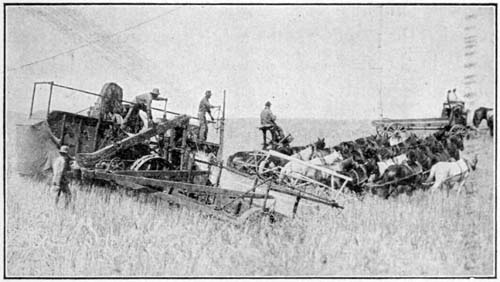
A Modern Reaper This machine cuts, threshes, winnows, and sacks the wheat
In 1847 and 1848 Chicago was but a trading village. McCormick, foreseeing its future growth, located his reaper factory there. In that factory he constructed about nine hundred reapers for the harvest of 1848.
In 1851 he exhibited his invention at the World's Fair in London. The London Times facetiously called it "a cross between a wheel-barrow and a flying machine." Later the same paper said of the reaper that it was "the most valuable contribution to the Exposition, and worth to the farmers of England more than the entire cost of the Exposition."
In 1848 McCormick's patent on the reaper expired. Although his claim as the inventor was clearly established, and the commissioner of patents paid him the highest compliments in words for his invention, a renewal of the patent was denied. Other reapers had been made in the meantime, and others have been brought out subsequently. It is an historical fact, however, and one now seldom questioned, that every harvesting machine which has ever been constructed is in its essential parts the invention of Cyrus Hall McCormick.
Besides being a great inventor and successful business man, McCormick was a liberal philanthropist. He gave freely to educational and religious institutions. He died at his home in Chicago, May 13, 1884.
An improved type of the ordinary reaper of McCormick is the self-binder, now in common use, a machine which not only reaps the stalks of grain but binds them together in sheaves.
The most primitive method of threshing grain from the straw was doubtless by beating it with a stick. The ancient Egyptians and Israelites spread out their loosened sheaves upon a circular plot of earth and threshed out the grain by driving oxen back and forth over it. Later a threshing-sledge was dragged over the sheaves. The Greeks and the Romans beat out grain with a stick, trod it out with men or horses, or used the threshing-sledge. The primitive implement for threshing in northern Europe was the stick. A modification of this was the flail, made of two sticks loosely fastened together at one end by means of stout thongs. This implement was used by our ancestors in America and has not yet entirely disappeared from all parts of the world. The threshing machine was invented in 1787 by Andrew Meikle, a Scotchman. Only a few years ago threshing machines were drawn by horses, but of late years they have been moved with self-propelling steam engines, commonly called traction engines.
A remarkable combination machine has come into use recently, particularly in the vast wheat fields of California, eastern Washington, and the West. This machine is drawn by as many as thirty-two horses. At one operation it cuts the grain, threshes it, winnows it, and puts it into bags ready for the market.
Spinning and Weaving Machines
The low, monotonous hum of the spinning-wheel in the old farmhouse on winter evenings, as the housewife spun the yarn which she was afterward to knit into warm stockings for the family, has not entirely passed away from the memory of the older generation of to-day. Thomas Buchanan Read has a pathetic allusion to the old spinning-wheel in one of his best poems, "The Closing Scene." And who has not felt the charm of the spinning-wheel scene in Longfellow's "The Courtship of Miles Standish," which pictures John Alden as he sits clumsily holding on his hands the skein which Priscilla winds for knitting.
There are two essential principles in the art of spinning: first, the drawing out of uniform quantities of fiber in a continuous manner; and second, the twisting of the fiber so as to give it coherency and strength. The earliest spinning apparatus, and for ages the only one, was the distaff and spindle. The former was a staff upon which was loosely bound a bundle of the fiber to be spun. It was held in the left hand or was fastened in the belt. The spindle, a tapering rod smaller than the distaff, was held in the right hand. The rotation of the spindle gave the necessary twist to the thread, and around the spindle the thread was wound as it was twisted. The next development in spinning machinery was the spinning-wheel, which has continued in use in some rural parts of the world practically to the present day.
The series of inventions that overthrew hand spinning, and made this industry possible on a large scale, really began in 1738 when Lewis Paul, an English inventor, discovered a process for drawing out and attenuating threads of wool or cotton by passing the fiber through successive pairs of rollers. To-day this principle forms a fundamental feature of all spinning machinery. In 1764 James Hargreaves, an illiterate weaver and carpenter of Lancashire, England, invented the spinning-jenny, a device by which eight threads could be spun at once. With a little improvement in this invention, eighty threads were produced as easily as eight. The idea of the spinning-jenny is said to have been accidentally suggested to its inventor by watching the motions of a common spinning-wheel which one of his children had unintentionally upset.
Hargreaves is another in the long list of those who have suffered persecution because of having done something to make the world better. His fellow-spinners, filled with prejudice toward his invention because they feared it might rob them of employment, broke into his house and destroyed his machine. He then moved to Nottingham, where he erected a spinning mill. In 1770 Hargreaves took out a patent on his invention, but the patent was subsequently annulled on the ground that he had sold a few machines before patenting the invention.
Valuable as was the spinning-jenny of Hargreaves, it was adapted only to producing the transverse threads, or the woof. It could not produce sufficient firmness and hardness for the longitudinal threads, or the warp. In 1767 Richard Arkwright, another native of Lancashire, invented the spinning-frame, which was able to yield a thread fine enough and firm enough to make the warp. At the time of his invention Arkwright was so poor that he had to be furnished with a suit of clothes before he looked respectable enough to appear at an election. Like Hargreaves, he also was persecuted. Both were driven out of Lancashire to Nottingham to escape popular rage. Arkwright's patent was annulled, and at one time his factory was destroyed by the populace in the presence of a powerful military and police force, who did nothing to restrain it. And why were Hargreaves and Arkwright driven out of Lancashire? They had invented machines that would produce more and cheaper clothing; that would give powerful impetus to the cotton and the woolen industries; that would lift the race higher in the path-way of civilization. What was the reason? Misunderstanding, prejudice, and selfishness. The interests of the few were shutting out the interests of the world. And these interests of the few were imaginary.
In spite of all opposition, however, Arkwright succeeded, and may be regarded as the founder of the modern factory system.
In 1779 Samuel Crompton, another Lancashire inventor, produced an improved spinning machine called the spinning-mule. This invention combined the good qualities of the spinning-jenny of Hargreaves and the spinning-frame of Arkwright. Its chief point of excellence lay in the fineness of the threads which it spun; from this kind of thread could be made finer fabrics than were possible with the machines of Hargreaves and of Arkwright.
Crompton was very poor. By day he worked at the loom or on the farm to earn bread for himself, his mother, and his two sisters, and at night he toiled away on his invention. No sooner had he perfected his machine than he was beset by persons seeking to rob him of its benefits. All kinds of devices were employed for learning the secret. Ladders were placed against his windows in order that unscrupulous spectators might get a view of the machine. He did not dare to leave the house, lest his secret be stolen from him. He had spent his last farthing upon the invention and had no funds for securing a patent. A manufacturer persuaded him to disclose to the trade the nature of his invention under promise of a liberal subscription; but Crompton received only a paltry sum amounting to less than $350. He finally saved up enough money to begin manufacturing on a small scale, but his rivals had already out-distanced him. He died in June, 1827, disspirited at the ill treatment he had received, but not until he had seen his invention a powerful agency in British cloth manufacturing.
An interesting glimpse of the days when weaving was done by hand in England may be found in the first chapter of George Eliot's Silas Marner, the Weaver of Raveloe. The hand-loom in weaving was superseded by the power-loom early in the nineteenth century. The loom was the invention of the Rev. Edmund Cartwright, an English clergyman, poet, and inventor. The date of the invention was 1785. Cartwright's first loom was very crude, but he subsequently improved it. The idea for the invention of his power-loom came to Cartwright after a visit to the spinning mills of Arkwright. He too was subjected to opposition from the weavers on account of his invention. At one time he was associated with Robert Fulton in his experiments in applying steam to navigation.
CHAPTER XVII
AERONAUTICS
To fly in the air has been the dream of all peoples in all ages. "Oh that I had wings like a dove! Then would I fly away and be at rest!" sang the Psalmist. It would seem from the recent inventions in the science of aeronautics that this dream is to become in the near future a practical experience of our every-day lives.
A balloon is an apparatus with an envelope filled with gas, the specific gravity of which is less than that of the atmosphere near the surface of the earth. It is practically at the mercy of air-currents. The science of balloon aeronautics dates definitely from 1783, when the Montgolfier brothers at Angonay in France constructed their first balloons. These Frenchmen and their successors developed the spherical balloons to a state of efficiency which has scarcely been improved upon to this day. The balloon in time came to be adopted throughout Europe for military uses, mainly for the purpose of spying out the enemy's position and defenses.
A dirigible balloon usually has an elongated envelope and is equipped with a motor and a rudder by which it can be steered at will against a moderate wind. Balloon aeronautics became popular in 1898, when Santos-Dumont, a wealthy young Brazilian, performed a series of spectacular feats with his dirigible balloon. Immediately ballooning became the sporting fad in France and the craze spread rapidly over the Continent and to England. Numerous airships of the dirigible type made their appearance and many balloon factories were established.
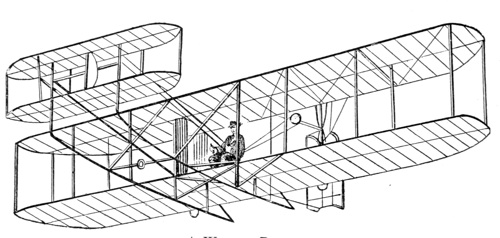
A Wright Biplane By Courtesy of Brooks Brothers
In Germany every community has its aero club. In the United States there are about 300,000 club members scattered throughout the land who individually or collectively own over 200 balloons. All of the great nations own one or more aerial warships of the dirigible type, as well as numerous spherical balloons.
An aeroplane, as commonly known, is a machine which is sustained in the air by one, two, or three sets of rigid surfaces or planes. Unlike the balloon, it is heavier than air, and it must therefore maintain its position in the air by some form of mechanical propulsion. It must, in other words, fly like a bird.
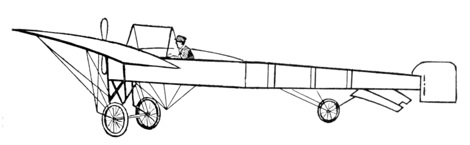
A Bleriot Monoplane
The first aeroplane was invented by Henson, an Englishman, who in 1843 flew his machine, using a two-horse-power steam engine. In 1888 and in 1900 two other practically successful models appeared, one made by a French and the other by an English inventor. Langley, an American, who began experimenting in 1885, managed to fly over the Potomac in 1896. The Wright brothers made their initial flights under motor power in 1903.
During the years since 1903 innumerable types of aeroplanes have been developed, all based upon the lines laid down by Langley, Henson, Maxim, and other pioneers. Among the most successful experimenters have been Farman, Delagrange, Bleriot, Curtiss, and the Voisins.
The flapping-wing machine is called an orthopter (orthos, straight, + ptera, wing) and is supposed to copy bird flight. Screw-flyers, called helicopters, lift themselves from the ground by the thrust of varying numbers of rapidly moving propellers, revolving horizontally.
Some startling feats have been performed in the field of aeronautics. On August 7, 1910, John B. Moisant, an American, flew in a Bleriot monoplane across the English Channel, a distance of about twenty-five miles, in thirty-two minutes. He carried one passenger. On September 12, 1910, Claude Grahame-White, an Englishman, flew in a Farman biplane thirty-three miles in thirty-four minutes, near Boston, winning a prize of ten thousand dollars.
Every day new ideas take shape and are developed in some form that promotes the pleasure, comfort, or safety of mankind. There seems to be literally no limit to man's inventive power. His brain teems with thoughts and his hands labor incessantly to force his thoughts into material forms. He mounts higher and higher on the scale of civilization, casting away old ideas, inefficient methods, and worn-out machines, and substituting the new and wonderful things which he has achieved.
Graded Supplementary Reading Series
Classic Fables. For First and Second Grades. Selected and edited by Edna Henry Lee Turpin. 127 pages, 12mo, cloth 30 cents
Grimm's Fairy Tales. For Second and Third Grades. Selected and edited by Edna Henry Lee Turpin. 207 pages, 12mo, cloth 40 cents
Andersen's Fairy Tales. For Third and Fourth Grades. Selected and edited by Edna Henry Lee Turpin. 253 pages, cloth 40 cents
Stories from American History. For Fourth and Fifth Grades. Selected and edited by Edna Henry Lee Turpin. 191 pages, 12mo, cloth 40 cents
Stories from Greek History. For Fourth and Fifth Grades. By Louise Diman. 239 pages, 12mo, cloth 40 cents
Heroes of History. For Fifth and Sixth Grades. By Ida Prentice Whitcomb. 448 pages, 12mo, cloth 60 cents
Brief Biographies from American History. For Fifth and Sixth Grades. By Edna Henry Lee Turpin. 299 pages, 12mo, cloth 50 cents
Part I. For Fifth Grade. 142 pages, 12mo, cloth 35 cents
Part II. For Sixth Grade. 163 pages, 12mo, cloth 35 cents
English History Stories. For Sixth and Seventh Grades. 320 pages, 12mo, cloth 50 cents
The Young American. A Civic Reader. For Sixth, Seventh and Eight Grades. Pratt Judson, LL.D. 259 pages, 12mo, cloth 50 cents