WILLIS DUFF PIERCY (continued 2)
Reading edition
The electric light had its beginning about 1800 in the experiments of Sir Humphry Davy, a British investigator. He discovered that if two pieces of carbon are brought into contact, completing a circuit through which an electric current flows, and if the carbon points are separated by a short distance, the points will become intensely hot and emit a brilliant light. The word arc, used in connection with the arc lamp or light, refers to the gap or arc between the two carbon points, across which the electric current leaps in creating the light.
Following Sir Humphry Davy's experiments, several arc lights were invented, with greater or less degree of success, and about 1860 electricity was tried successfully for lighting in some lighthouses along the British coast. The widespread usage and the usefulness of the arc electric light, however, are due to Charles Francis Brush, an electrical inventor of Cleveland, Ohio, who in 1876 simplified the arc light so as to bring it into general use for lighting streets, large rooms, halls, and outdoor spaces. Brush was also the inventor of an electric-dynamo machine that has added to his fame. After the invention of the arc light, he took out more than fifty other patents. The incandescent electric light, for lighting residences and small rooms, came a little later as the invention of Edison.
Thomas Alva Edison is one of the most remarkable men of all times and places. Alexander, Caesar, and Napoleon together did not benefit mankind as has this quiet American inventor. He was born at Milan, Ohio, February 11, 1847. His father was of Dutch descent and his mother was Scotch. The mother, who had been a teacher, gave him all the schooling he received. Early in life he showed great mental vigor and ingenuity. When he was twelve years old, he is said to have read the histories of Hume and Gibbon.
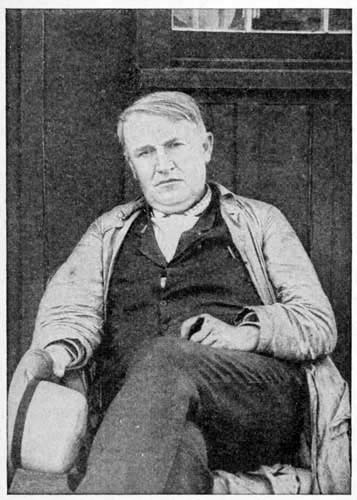
Thomas A. Edison
When Thomas was seven years old, the Edison family moved to Port Huron, Michigan. He soon became a newsboy on the Grand Trunk railway running into Detroit. He also became proprietor of a news stand, a book store, and a vegetable market, each a separate enterprise in Port Huron, employing eleven boys in all. His spare hours in Detroit, between the arrival and departure of his train, he spent reading in the Free Library. Before long he had bought a small hand printing press, some old type, and plates for "patent insides" from the proprietor of a Detroit newspaper, and using the baggage car for an office, he started the Grand Trunk Herald, the first and only newspaper ever published on a railway train. His inquiring mind led him one day to make some chemical experiments in the car. He overturned a bottle of phosphorus, set the car on fire, and as a result was not permitted to use it longer for a newspaper office.
One day young Edison snatched the child of the station agent at Mount Clemens, Michigan, from beneath the wheels of a locomotive. In gratitude for this act, the station agent taught him telegraphy. In a few months his ingenuity, one of the chief characteristics of the great inventor, led him to string a private telegraph wire from the depot to the town. Over this wire he forwarded messages, charging ten cents for each message. Next he went to Stratford, Canada, as night operator for the Grand Trunk railway. One night he received an order to hold a train. He stopped to reply before signaling the train, and when he reached the platform the train had passed. A collision resulted, though not a serious one, and Edison was ordered to report at the office of the general manager. Edison hastily climbed on a freight train, went to Port Huron, and probably has not yet called on the general manager.
Edison worked as telegraph operator at various places. Although he was a brilliant and rapid telegrapher, his fondness for playing pranks and making fun lost him several positions. After making his first experiments with a telegraph repeater, he left Indianapolis for Cincinnati, where he earned sixty dollars per month, besides something extra for night work. He Worked next in Louisville and Memphis. He was poor in purse, for all his money went to defray the expenses of his experiments. His fondness for Victor Hugo's great work, Les Miserables, gained for him the nicknames of "Victor" and "Hugo."
At Memphis he perfected his telegraph repeater and was the first to bring New Orleans into direct communication with New York. However, the manager at Memphis was jealous of him and dismissed him. Shabby and destitute, he made his way back to Louisville, walking a hundred miles of the way, and resumed his old position. After he had worked in the Louisville office for two years, his experimenting again got him into trouble. He upset some sulphuric acid, part of which trickled through the floor and spoiled the carpet in the manager's room below. For this he was discharged. He next went to New Orleans, intending to sail for Brazil; but the ship had gone and an old Spanish sailor advised him to stay in America. He went back to Cincinnati, where he made some of his first experiments in duplex telegraphy, a system whereby two messages may be sent over the same wire at the same time.
A little while afterward, as poor as ever and as unattractive in dress, he walked into the telegraph office in Boston, where he had procured work. His co-workers there, thinking they would have some fun at his expense, set him to receiving messages from the most rapid operators in New York. Instead of throwing up his hands in defeat, as his companions expected, he received the messages easily, with a good margin to spare, and asked the operator sending at the other end of the line to "please send with the other foot." He was at once placed regularly on the New York wire. While in Boston, Edison opened a small workshop, put many of his ideas into definite shape, and took out his first patent. It was upon a chemical apparatus to record votes. He tried to introduce this into Congress, but failed, although he proved that it "would work."
He left Boston not only without money, but in debt, and went to New York. This was in 1871 when he was twenty-four years old. At that time an apparatus called a "gold indicator" was in use in the offices of about six hundred brokers, to show fluctuations in the prices of gold. The system was operated from a central office near Wall street. One day this central office was filled with six hundred messenger boys, each bringing the complaint that the machinery had broken. No one knew how to repair it. A stranger walked up, looked at the apparatus, and said to the manager, "Mr. Law, I think I can show you where the trouble is." The machinery was repaired, the office was cleared, and order was restored. "What is your name, sir?" asked the delighted manager. "Edison," was the reply. He was engaged as superintendent at a salary of $200 per month, and from that hour his fortunes were assured.
Edison at once busied himself with inventing. He improved and invented various machines used in the stock markets, and in 1872 perfected his system of duplex telegraphy. Two years later he brought out the wonderful quadruplex system, by which four messages may be sent over the same wire at the same time. This system saved millions of dollars and dispensed with thousands of miles of poles and wires.
He started a large factory at Newark, New Jersey, employing some three hundred men. Sometimes he was working on as many as forty-five improvements and original inventions at once. In 1876 he stopped manufacturing and turned all his attention to inventing. In that year he established a laboratory at Menlo Park, New Jersey, twenty-five miles from New York City. When this laboratory was outgrown, he founded a new one at Orange, New Jersey, the largest laboratory ever established by one man for scientific research and invention. It comprises one building 250 feet long and three stories high, and four smaller buildings, each one hundred feet long and one story high. The principal building contains a library of thirty thousand reference books, a lecture room, and an exhibition room, where a remarkable collection of instruments of almost every kind is to be seen.
When Edison began working to produce an incandescent electric light for illuminating residences and small rooms, most of the scientists of England said that such a light could not be produced. For nine years he worked on this invention. The chief problem was to find, for the horseshoe thread or filament used to give off the light, a material that should glow with sufficient intensity and yet not be consumed by the great heat necessary to produce the light. In his search for this material he tried all kinds of rags and textiles steeped in various chemicals, different kinds of paper, wood, inner and outer bark, cornstalks, etc. Finally he sent one of his assistants to the East, and in Japan a kind of bamboo was found answering the requirements. Perseverance won, and the incandescent electric light became a reality about 1880.
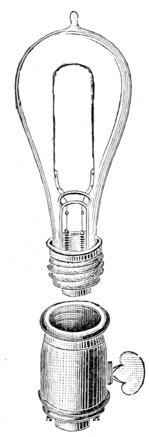
An Incandescent Light
Thomas Edison is one of the most systematic of workers, and nearly all his inventions have been the result of intelligent and methodical labor directed toward a definite aim. He reads carefully what other investigators have found out, so as not to waste time in going over fruitless ground. He also keeps copious note books of his own operations, so that there may be no loss of time and energy. His invention of the phonograph, however, was accidental. While he was working to improve the telephone, the idea of the phonograph suddenly came into his mind. A little while afterward the first phonograph, crude but successful, was finished. At first this instrument was regarded as a toy, but later the invention was sold for a million dollars.
Edison is a man of remarkable personality. Once when someone referred to him as a genius and said that he supposed a genius worked only when the spirit moved him, the inventor replied, "Genius is two per cent inspiration and ninety-eight per cent perspiration." He certainly possesses great native talent for inventing. This was apparent in his early boyhood. But much of his marvelous success is due to the intelligent direction of effort, to tireless perseverance, and to long hours of work. In 1897 he devoted his attention exclusively to the invention of a new storage battery, upon which he had been working for five years. For more than a year he worked harder than a day laborer. He was in his laboratory by half past seven in the morning; his luncheon was sent to him there; he went home to dinner, but he returned by eight o'clock. At half past eleven his carriage called for him, but often the coachman was compelled to wait three or four hours before the inventor was willing to suspend his work. While the first incandescent electric lighting plant was being prepared in New York City, Edison himself worked part of the time in the trenches, to be sure that the work would be properly done.
There is scarcely an electrical apparatus or an electrical process in existence to-day that does not bear the mark of some great change for the better coming from this most ingenious of American inventors. He has taken out more than four hundred patents on original inventions and improvements. Mr. Edison is still living in his beautiful home at West Orange, New Jersey, near his laboratory. He is frequently called the "Wizard of Menlo Park."
The idea of using electricity as motive power on railroads is nearly as old as the railroads themselves. In 1837, when the utility of steam for purposes of transportation was doubted, Robert Davidson propelled a car with an electric engine on the Edinburgh and Glasgow road. In the fifties Thomas Davenport, a Vermont blacksmith, constructed an electric engine containing all the essential elements of the modern electric motor. Little progress, however, was made in the use of electricity for motive power, because the cost of producing the electric current was so great. In 1887 Lieut. Sprague, overcoming most of the difficulties then existing, installed at Richmond, Virginia, the first successful electric railway in the world. Managers of street railways in other cities visited Richmond, and after an inspection of what Sprague had done there, decided to substitute electricity for animal power. No other construction has had a more rapid growth since the time of its invention than the electric railway. In 1890 there were only thirteen unimportant electric roads. Now there is hardly a city of the civilized world where the hum of the electric street car is not heard at all hours of day and night. Modern urban life could scarcely exist without it. It is rapidly pushing its way into the country and giving the farmer the privilege of rapid and cheap transit.
The uses of electricity are by no means exhausted in the four major inventions of the telegraph, the telephone, the electric light, and the electric street car. It has been put to many minor uses. Among the most interesting and important of these are the Roentgen or X-rays, discovered by Wilhelm Konrad von Roentgen, a German physicist, in 1895. They were named X-rays by their discoverer, because the ultimate nature of their radiation was unknown, the letter X being commonly used in algebra to represent an unknown quantity. The X-rays are peculiar electric rays having the power to penetrate wood, flesh, and other opaque substances. They are of much value to surgery in disclosing the location of bullets, foreign substances of various kinds, and other objective points in the interior of the human body.
The United States government has demonstrated through its Department of Agriculture that electricity applied to the soil will quicken and help the growth of certain vegetables. It has also shown that certain crops are forwarded by the application of electric light.
The New York legislature in 1888 passed a law providing that criminals should be executed in that state thereafter by electrocution, that is, by sending through the body of the condemned person, a current of electricity strong enough to produce death. Execution in this way makes death quicker and apparently less painful than by hanging, the method used previously, and subsequently several other states have passed laws for electrical execution, following the example of New York.
Elisha Gray, who contested with Bell the invention of the telephone, was the inventor of a peculiar machine called the telautograph. Tele and graph have been previously explained. Auto is from a Greek word meaning "itself." The meaning of telautograph, therefore, is "to write afar by itself." By means of the telautograph, which is operated with electric currents, if a person writes with an ordinary lead pencil on paper, say in Washington or any other place, at the same time the writing will be reproduced with pen and paper at the other end of the line, in New York or wherever the message may be sent.
One of the important uses of electricity is in connection with the electric block signal. This is a device for preventing railroad collisions. The signals are operated with electricity, and show engineers whether or not a certain section of the track ahead of them is clear.
Electricity is used also in the production of certain chemical substances; in covering base metals with a coating of a precious metal, as gold or silver, called electroplating; in producing a solid metal page from rows of type, called an electrotype, which is used in printing; in the navigation of small boats and the propulsion of automobiles; in playing organs and pianos; in driving electric fans; in drawing elevators in high buildings; in call-bells and door-bells; in police-alarms and fire-alarms; in the treatment of certain diseases; and in many other useful ways. What electricity may do for the future cannot even be guessed.
CHAPTER VI
THE DISCOVERY OF AMERICA
The birthplace of mankind is supposed to have been somewhere in Asia, untold thousands of years ago. The race is thought to have spread thence to the northern coast of Africa and to the peninsulas that jut down from the south of Europe. The travelers of ancient times were the Phœnicians. They occupied a narrow strip of land along the eastern shore of the Mediterranean Sea. Their country was small and with difficulty supported an increasing population. To the east of them were barbaric hordes, who poured over the mountains and pushed the Phœnicians to the sea, making of them traders and colonizers. As early as twelve centuries before Christ they were founding colonies, exploring strange lands, trading all over the known world, and leaving their alphabet wherever they went. Arriving at a favorable place, they would pull their ships ashore, plant a crop, wait till it had matured, reap it, and go on. They founded many colonies on such sites.
Herodotus, a Greek, born in Asia Minor nearly five hundred years before Christ, is called the father of history and geography. He tells us that in his time the earth was thought to consist of the coast regions of the Mediterranean Sea, extending rather vaguely north and south, and bounded on the west by the Atlantic Ocean and on the east by the great Persian Empire. The word Mediterranean is made up of two Latin words meaning "the middle of the earth." Eratosthenes, a Greek geographer who was born on the northern coast of Africa about three centuries before Christ, wrote a geographical treatise in which he announced his belief that the earth was in the form of a sphere revolving on its own axis. He succeeded in convincing only a few, however, that his theory was right. The next great geographer was Strabo, born in the northeast part of Asia Minor in the year 64 B.C. He was a great traveler and observer, and wrote a work on geography that has come down to us. The parts dealing with his own observations are especially valuable.
The great traveler of mediæval times was Marco Polo, an Italian, born in Venice in 1254 A.D. He traveled widely, had many adventures, and published an account of his travels. His experiences were a great stimulus to geographical inquiry and discovery. About this time also the mariners' compass was introduced into Europe. Civilization seems to be indebted to the Chinese for the compass, for it is mentioned by them as an instrument of navigation as early as the third or fourth century after Christ. With the advent of the compass, seamen were no longer compelled to hug the shore; they acquired more daring to sail the open sea, and geographical exploration was correspondingly widened.
Geographical knowledge grew very slowly. By the beginning of the eighteenth century, explorers had become familiar with the range of the ocean, the outline of the continents, and with many islands. At the beginning of the nineteenth century, four fifths of the land area of the entire globe was unknown. Africa, except a narrow rim of coast, was almost as little known as the planet Mars is to-day. At the opening of the last century men knew little more about Asia than did Marco Polo, three or four centuries earlier. In America the whole vast area west of the Mississippi River was unknown in 1800. The coast of Australia had not yet been traced, and nothing was known of its interior. At that time South America was better known than any other of the continental land masses, except Europe; now it is the least explored of all. The nineteenth century, wonderful for advancement in many fields of human endeavor, was a marvelous one for the growth of geographical knowledge. As we stand in the doorway of the twentieth century, there is scarcely one eleventh of the land area of the whole earth that remains unexplored. Lewis and Clark pushed their way through the unknown vastness of the American Northwest; Livingstone and Stanley penetrated the dark continent of Africa; and in September, 1909, Lieut. Robert E. Peary of the United States Navy startled civilization by announcing his discovery of the North Pole. With the exception of a few interior tracts to-day, the only portions of the earth unknown and unmapped lie around the poles, and these are being rapidly sought out and brought to knowledge.
Of all geographical conquests, by far the greatest is the discovery of America by Christopher Columbus in 1492 A.D. The story of Columbus is one of the most interesting and pathetic in history. It is a story of toil, hardship, perseverance, and great success, requited with disappointment and disgrace.
Christophoro Colombo was born in Genoa, Italy, about 1435 or 1436 A.D. Following the custom of those times in giving names Latin forms, his name became Christopher Columbus. In Latin the word columba means "dove." His father was a wool-comber who was wealthy enough to send his son to a university, where he studied mathematics and astronomy. On leaving the university, he worked a few months at his father's trade, but when he was fifteen years old he determined to be a sailor.
Of the late boyhood and early manhood of Columbus little is known. He seems to have traveled much, and it is certain that he studied much. It was popularly supposed in the time of Columbus that the earth was flat; that it was surrounded by a great world-river called "Oceanus" or the ocean, and that if one should come to the edge he would plunge down into illimitable space. From the time of Eratosthenes and Aristotle, Greek thinkers and scholars who lived several hundreds of years before the birth of Christ had known that the earth was round, and Columbus believed this fact too. He mastered the books, both ancient and contemporary, on geography and navigation, learned to draw charts and to construct spheres, and fitted himself to be a practical seaman and navigator.
In 1470 he arrived at Lisbon, Portugal, after he had been shipwrecked in a sea fight and had escaped to land on a plank. In Portugal he married the daughter of an old sea captain. He pored over the logs and papers of his father-in-law, and talked with old seamen of their voyages and of the mysteries of the western sea. About this time he seems to have arrived at the conclusion that much of the world remained undiscovered. There were strange rumors about the western sea. Navigators had seen queer pieces of wood and some canes in the ocean, and the bodies of two strange men had been washed ashore, "very broad-faced, and differing in aspect from Christians." European commerce was in need of a shorter route to Asia than the overland route then in use. Columbus hoped that he could reach the eastern coast of Asia by sailing west. He did not believe the earth as large as it really is, and he over-estimated the size of Asia, so that he did not realize the breadth of the Atlantic or the magnitude of the task before him.
Columbus was poor, and money was required for so huge an undertaking as a voyage to Asia. It was necessary, therefore, for him to seek aid in the enterprise. He asked help first from the senate of his native town, Genoa; but Genoa turned to him an unhearing ear. He applied next to King John of Portugal. The king referred the matter to a council of geographers, who reported against it. With the lurking hope that there might be something in the plan, the king was dishonorable enough to send out an expedition secretly to test it. The sailors who made the attempt soon lost heart and returned without having accomplished anything. When Columbus learned of the king's secret attempt, he was so outraged that he left Portugal for Spain. At about the same time he sent his brother Bartholomew to England to enlist the assistance of the British sovereign, King Henry VII. After much waiting and much vexation, Columbus at last gained the interest of the Spanish king, Ferdinand, who referred the proposition to a council of his astronomers and geographers. They finally decided that the project was vain and visionary and that they could have nothing more to do with it.
In great discouragement Columbus began preparations to go to France. At the door of a monastery in the little maritime town of Palos, he knocked and asked for bread and water for his son, Diego, who was accompanying him. He was received at the monastery, and there he met some persons of influence who interceded for him with the Spanish queen, Isabella. He went to the Court again, his plan was once more investigated, and once more Columbus was refused the aid he was seeking. He set out for France and had journeyed some distance on the way. In the meantime an official won the queen's consent to the enterprise, and there is a story that in her enthusiasm she offered to pledge her jewels to raise money for the expedition. A messenger who was sent to overtake Columbus brought him back, and on the seventeenth of April, 1492, the formal agreement between him and the king and queen of Spain was entered into, signed, and sealed.
Columbus's aim was to find the east coast of Asia. For the accomplishment of this he had a number of motives. He wanted to win wealth and fame for himself, to provide a shorter and cheaper route for commerce with the East, and to convert to Christianity the Grand Khan, a great Asiatic ruler, to whom he bore a letter of introduction from the rulers of Spain.
Great difficulty was experienced in finding sailors for so uncertain and terrifying a trip. Freedom was offered to convicts and bankrupts if they would accompany the expedition. At last seamen were secured to man three small ships, stores were provided, and everything was made ready for the voyage. The adventurers numbered, all told, one hundred and twenty. The shore presented a strange spectacle on the morning of departure. The friends of the sailors stood on shore weeping and wringing their hands, confident in the belief that their loved ones would be swallowed up by some fabulous monster of the western deep, or in some way be forever lost to them. On the morning of Friday, August 3, 1492, at eight o'clock, the little fleet of three ships weighed anchor at the port of Palos, Spain, and set out on the most uncertain and the greatest of all ocean voyages.
The ships had been on the sea three weeks, and no land had yet been sighted. The compass no longer pointed due north. A meteor fell into the ocean not far from the ships. The sailors lost courage. They declared that they must perish if they went on, and that their commander ought to be compelled to return. Some of them proposed to throw him into the sea. Columbus kept two reckonings; a correct one for himself, and an incorrect one to appease the sailors. He pleaded with his men to be courageous, as long as mild methods availed. He then grew harsh and commanded them. Through all the uncertainty and the mutterings of the sailors, he clung unwaveringly to his purpose—to push forward. He had no thought of going back.
Flying birds and floating objects promised land, but time went on and no land appeared. The sailors grew more and more violent. On the night of the eleventh of October, Columbus himself saw a light in the distance, which sometimes flickered and sometimes disappeared, as if it might be a torch borne by some one walking. All were now in eager expectancy. At two o'clock on the morning of Friday, October twelfth, a cannon fired from one of the vessels announced that a sailor had actually discovered land.
When daylight came, Columbus landed. The first thing he did upon reaching the shore was to fall upon his knees, kiss the earth, and with tears of joy thank God for deliverance from the perils of such a voyage. His men, ashamed of their mutiny and distrust, threw themselves at his feet, imploring his forgiveness. Columbus next drew his sword, planted the royal banner, and in the name of the Spanish sovereigns took possession of the country. In honor of his deliverance he named the place San Salvador, which means Saint Savior, or Holy Savior.
One of his three vessels was wrecked by a storm near the island of Santo Domingo, called also Hayti and Hispaniola. Columbus built a fort on this island from the wrecked ship, and left in it a colony of about forty of the crew. Desirous of returning to Spain with an account of his voyage, he set sail in January, 1493, on the return trip. A terrific storm was encountered. Columbus, fearing that his ships might sink, and wishing to preserve a record of what he had done, wrote an account of the voyage on a piece of parchment and placed it in a cask, which he threw overboard in the hope that it might be carried to shore and found. The storm abated, however, and on the fifteenth of March he sailed with two of his vessels into the port of Palos.
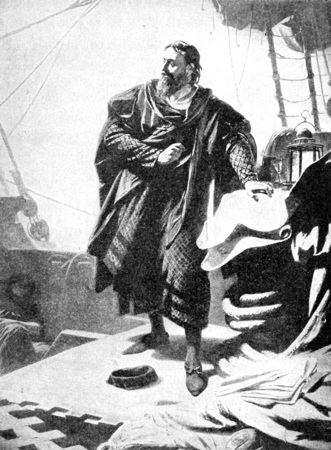
Columbus on the Deck of the Santa Maria From the painting by von Piloty.
He entered the city amid the shouts of the people, the booming of cannons, and the ringing of bells. Hastening to Barcelona, where the king and queen were then holding court, he was received with a triumphal procession. Seated next to the throne, he gave an account of his discoveries and exhibited the new country's products which he had brought back—gold, cotton, parrots, curious weapons, strange plants, unknown birds and beasts, and the nine Indians whom he had brought with him for baptism. Great honors were poured upon him. The king and queen could scarcely do enough for him.
In September, 1493, Columbus sailed westward on his second voyage. The fort which he had built on Santo Domingo was found burned, and the colony was scattered. He decided to build a second fort, and coasting forty miles east of Cape Haytien he selected a site where he founded the town of Isabella, named in honor of the Spanish queen. He discovered and explored a number of the islands of the West Indies, including Porto Rico, which has belonged to the United States since the recent war with Spain. The second voyage closed with his return to Spain in June, 1496.
On next to the last day of May, 1498, with six ships Columbus set out on his third voyage. On the first day of August he discovered the Continent of South America. He thought it was only an island. Sailing along the shore, he believed that the various capes which he passed were islands, and not until he reached the mouth of the great Orinoco River did he conclude that what he had discovered was not an island but a great continent.
On his return to the new town of Isabella, he found that matters had not gone well there while he was away. The natives had risen in revolt against the tyranny of the governor whom Columbus left to rule the island in his absence. For some time Columbus's enemies, who had become jealous of him, had been trying to poison the minds of the Spanish king and queen against him. Finally the Spanish rulers sent an officer to inquire into the affairs of the new colony. When this officer arrived, he took possession of Columbus's house, put Columbus in chains, and sent him back to Spain. These chains Columbus kept to the day of his death, and his son Hernando says his father requested that they might be buried with him. After he arrived in Spain, he was restored to the good will of the king and queen who soon sent him on another voyage.
In May, 1502, Columbus set sail on his fourth and last voyage, during which he endured very great dangers. Two of his vessels were destroyed by a storm and the other two were wrecked off the coast of Jamaica. Separated from all the rest of the world, a number of his companions revolted, threatened his life, deserted him, and settled on another part of the island. The natives ceased to bring him food, and death seemed imminent. In this extremity he took advantage of an approaching eclipse of the moon. He told the natives that his God would destroy the moon as a token of the punishment to be inflicted upon them, if they did not bring the white men food. When the eclipse came, the natives implored Columbus to intercede for them with his God, and they brought him food in abundance. After the shipwreck, the navigator sent some of his boldest men in canoes to ask relief of the governor of the colony in Hispaniola. The messengers reached the colony in safety, but the governor would not undertake the rescue of Columbus. They bought a vessel, took it to Jamaica, and after a year of danger and anxiety on the island, in June, 1504, Columbus started on his homeward voyage. In September of this year he landed on Spanish soil for the last time. This final voyage was not productive of any important results.
Soon after his return Queen Isabella died, and about two years later, on May 12, 1506, Columbus himself died at Valladolid, Spain. He was buried first at Valladolid, but his remains were soon transferred to a monastery in Seville, Spain. They were exhumed in 1536 and taken across the sea to the city of Santo Domingo, on the island of Hayti, which he had discovered. In 1796 the remains were taken to Havana, Cuba, where they remained until the close of the Spanish-American war. In 1898, after the island of Cuba had passed from Spain to the United States, the body of the great admiral was taken across the Atlantic again to Spain, where it now rests.
In person Columbus was tall and well formed. Early in life he had auburn hair, but by the time he was thirty years old his hair had been turned white with care, hardship, and trouble. His face was long, and he had gray eyes and an aquiline nose. He was moderate in all his habits, and was one of the most religious of men. He was of a poetic temperament and thus lacked some of the essential qualities of great leadership. He was broad in his outlook, noble in his aspirations, and benevolent in spirit.
Columbus died ignorant of the fact that he had discovered a new world. He believed that the great continent which he gave to civilization was Asia, and that he had only found a new way to that country. He called the natives whom he found "Indians," thinking that they were inhabitants of India. When it was known that a new country had actually been discovered, it was named "America" in honor of Amerigo Vespucci, an Italian geographer and navigator, who visited, it seems, the mainland of this country in 1497. The land discovered by Columbus on the night of October 12, 1492, is believed to have been Watling's island, one of the groups of the West Indies.
Eighteen years elapsed between the time when Christopher Columbus conceived his enterprise and that August morning in 1492 when he set sail on his first voyage of discovery. He had gone about from place to place seeking aid, but spurned everywhere. These years were spent in almost hopeless anxiety, in poverty, and in neglect. The people of his day thought him crazy. When he passed by, they pointed to their foreheads and smiled. He braved the dangers of unknown waters, of mutinous crews, of hostile natives, and of starvation. What is worse, he endured the arrows of jealousy, slander, and misrepresentation. He had a contract with the Spanish crown whereby he was to receive certain honors and wealth as a result of his discoveries. He could not get King Ferdinand to fulfill the contract. He was sent home in chains from the great hemisphere he had discovered, and even the honor of its name went to another who had no claim to it.
Through the career of every successful man there runs a grim determination to do the thing in hand. Columbus had this determination and with it he triumphed. The stars hid themselves behind storms; the compass refused to act normally; a strange and terrible ocean roared; mutiny howled and jealousy hissed, but on one thing he was determined—he would do his best to accomplish the thing he had set himself to accomplish; and he did it.
One of the most inspiring poems in American literature is Joaquin Miller's "Columbus:"—
Behind him lay the gray Azores, Behind the Gate of Hercules; Before him not the ghost of shores, Before him only shoreless seas. The good mate said: "Now must we pray, For lo! the very stars are gone. Brave Adm'r'l, speak, what shall I say?" "Why, say: 'Sail on! sail on! and on!'" "My men grow mutinous day by day; My men grow ghastly wan and weak." The stout mate thought of home; a spray Of salt wave washed his swarthy cheek. "What shall I say, brave Adm'r'l, say, If we sight naught but seas at dawn?" "Why, you shall say at break of day: 'Sail on! sail on! sail on! and on!'" They sailed and sailed, as winds might blow, Until at last the blanched mate said: "Why, now not even God would know Should I and all my men fall dead. These very winds forget their way, For God from these dread seas is gone. Now speak, brave Adm'r'l, speak and say"— He said: "Sail on! sail on! and on!" They sailed. They sailed. Then spake the mate: "This mad sea shows his teeth to-night. He curls his lips, he lies in wait, With lifted teeth as if to bite! Brave Adm'r'l, say but one good word: What shall we do when hope is gone?" The word leapt like a leaping sword: "Sail on! sail on! sail on! and on!" Then, pale and worn he kept his deck And peered through darkness. Ah, that night Of all dark nights! And then a speck— A light! a light! a light! a light! It grew, a starlit flag unfurled! It grew to be time's burst of dawn. He gained a world; he gave that world Its grandest lesson: "Oh! sail on!"
CHAPTER VII
WEAPONS AND GUNPOWDER
Man's weapons of warfare, offensive and defensive, have been many and curious. David slew Goliath with a stone from a sling. The Scriptures tell us that Samson, the mighty man of the Bible, killed a thousand Philistines at one time with the jaw-bone of an ass. The study of the development of arms makes one of the most significant chapters in the history of civilization.
The use of stone weapons seems to have been universally characteristic of the earlier races of mankind, as it still is distinctive of the ruder races. The weapons made from stone were necessarily few and simple. The most common was an ax, made from various kinds of stone and with varying degrees of skill. Spear-points and arrow-heads were made of flint. These show a comparatively high type of workmanship. The highest efforts of the ancient stone-workers culminated in a leaf-shaped dagger or knife of flint, various in form but uniform in type. These flint daggers differed also in size, but seldom exceeded a foot in length. They were never ground or polished, but delicately chipped to a fine, straight edge, and were often beautiful.
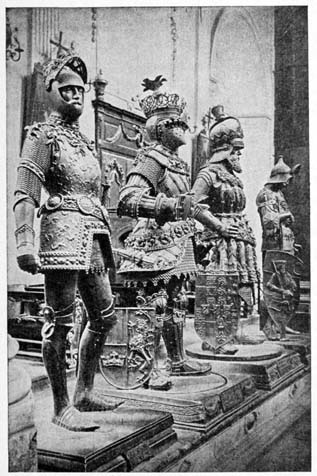
Statues Showing Knights in Armor
In the Bronze Age several kinds of bronze daggers were made. The characteristic weapon of this period, however, was the leaf-shaped bronze sword. "No warlike weapon of any period is more graceful in form or more beautifully finished." This sword had a very thin edge on both sides running from hilt to point, and the handle was of bone, horn, or wood. The thinness of the edge seems to have been produced without the aid of hammer or file. The weapon was better fitted for stabbing and thrusting than for cutting with the edge. Bronze spear-points have been found, but throughout the Bronze Age arrow-heads were made of flint. There were also shields of bronze, held in the hand by a handle fastened to the center. The period of transition between the Bronze Age and the Iron Age is marked by an iron sword, which was similar in form to the leaf-shaped bronze sword.
Homer, the great Greek bard who is supposed to have lived about a thousand years before the birth of Christ, in speaking of the wars of the Greeks, describes their weapons somewhat fully. They used a double-edged, bronze-bladed sword, the hilt and scabbard of which were adorned with gold and silver. In the combats of the Homeric age, however, the spear, lance, or javelin played the principal part; swords were used only for fighting at close range. Bows and arrows also were used. The only iron weapon specifically mentioned is the arrow-head. This was inserted in a split shaft, precisely like the flint arrow-heads of the early North American Indians and other modern savages. The defensive armor of the heroic age of Greece was entirely of bronze. It consisted of a helmet for the head, cuirass for the chest, greaves for the legs, and a shield. The bronze cuirass was often ornamented with gold. The shield was round or oval in shape, very large, and covered with hide. The Greeks of the later or historic age fought chiefly with long, heavy spears. Later the shield was reduced in size and the sword increased in length. The light-armed troops were furnished with a light javelin having a strap or thong fastened to the middle to assist in hurling. A linen corselet came into use instead of the heavy metal cuirass. The mounted troops were supplied with a longer sword, a javelin, and a short dagger.
The military strength of early Egypt lay in her archers, who fought either on foot or from chariots. The Egyptian bow was a little shorter than a man's height. The string was of hide or cord; the arrows were of reed, winged with three feathers and pointed with bronze heads, and were from two to three feet in length. The Egyptian archers carried a curved, broad-bladed sword, and a dagger or a battle-axe for combat at close quarters. Their defensive armor consisted of a quilted head-piece and coat. They used no shield, as this would have interfered with the use of the bow. The infantry were classified according to the weapons with which they fought—as spearmen, swordsmen, clubmen, and slingers. The spears were five or six feet long and had triangular or leaf-shaped heads of bronze. The spearmen carried shields shaped like a door with a curved top, having a hole in the upper portion through which they could look. These shields were about half as high as a man and were covered with hairy hide, with the hair attached. The early swords of Egypt were of bronze, straight, double-edged, tapering from hilt to point, and measuring from two and a half to three feet in length.
The ancient Assyrians fought with swords somewhat like those of Egypt. They used also bows, lances, spears, and javelins. Their shields were round and convex; and their cuirass was a close-fitting garment made of many layers of flax, plaited together or interwoven, and cemented and hardened with glue. This linen corselet was found also among the Egyptians, the Greeks, and the Romans.
The characteristic weapon of the Romans, the greatest warriors of ancient times, was what the Romans themselves called the "pilum." This weapon was a pike having a stout iron head carried on a rod of iron. The iron rod was about twenty inches long and terminated in a socket for the insertion of the wooden shaft, which was a little more than three feet in length. The entire weapon was therefore about five feet long. The pilum could be hurled as a javelin with great effect. Piercing the shield of the enemy, the slender iron rod bent under the weight of the shaft, which trailed along the ground, making the shield useless for purposes of defense. When used at close quarters, the pilum had something of the efficiency of the modern bayonet; and when wielded firmly in both hands, it served to ward off sword-strokes, which fell harmlessly upon the long and strong iron neck of the weapon. No warrior of ancient times was more formidable than the Roman with his pilum. The Romans had also swords of bronze and bronze armor, resembling the armor and the swords of the Greeks. In the prosperous days of Rome, her legions, under one of the greatest military commanders of all time, Julius Caesar, brought nearly all the world of that day to the feet of their general.
The Franks, a Germanic people who lived early in the Christian era and who gave their name to France, used the battle-ax as their chief weapon. It had a broad blade and a short handle and was used as a missile. It is said that a blow of an ax, when hurled, would pierce an enemy's shield or kill him, and that the Franks rarely missed their aim. They wore no armor, not even helmets, though they carried swords, round shields, and darts with barbed iron heads, which were used for throwing or thrusting. When this dart became fixed in an adversary's shield, it was the habit of the Frank to bound forward, place a foot upon one end of the trailing dart, and, compelling the enemy to lower his shield, slay him with the battle-ax. The Franks used also a short, straight, broad-bladed sword, double-edged and obtuse at the point. The military organization of the later Franks changed from infantry to cavalry, and this change gave way in time to the era of chivalry. The superior soldiers of the time of Charlemagne had added to their equipment the celebrated coat of mail.
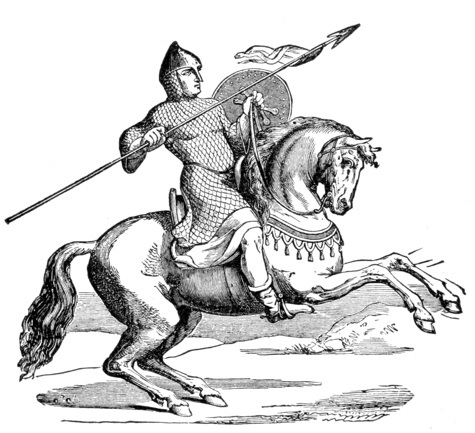
A Knight in Action
Our early Anglo-Saxon fathers fought with swords, spears, axes, and a heavy, single-edged knife. The sword was especially the weapon of the horseman, and was not carried by anyone under the rank of thane. The infantry bore the other weapons. The early Anglo-Saxons do not appear to have used the bow and arrow, though in later times the long bow was an important weapon in England. The Anglo-Saxons of olden times were not strong in cavalry. Saxon warriors carried round or oval shields made of wood and covered with leather. Suits of metal armor were worn for defense.
The gallant knights of the Middle Ages fought on horseback, as they went about protecting the weak, redressing the wrongs of the injured, and upholding right against might. They were clad in armor of metal, with swords buckled to their sides. Mail armor of interlinked metallic rings was used until the beginning of the fourteenth century. From this time to the beginning of the seventeenth century, armor was made of solid plates of metal. After 1600, armor was gradually replaced by a new agent of warfare, against which it was no protection. Likewise the shield, the dagger, and the bow gave way, though the long bow continued in use as an English weapon until the close of Queen Elizabeth's reign.
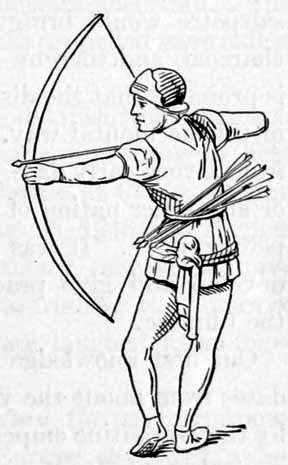
An Archer of the Fifteenth Century
The invention of gunpowder was one of the most far-reaching events of all history. This terrific substance has not only revolutionized warfare, but has changed the current of human history itself. It is not known who invented gunpowder, or when it was first used. It is a compound of saltpetre, charcoal, and sulphur; the proportions in which these three ingredients are mixed vary in different countries and in different kinds of powders. It seems likely that powder was invented in the Far East, perhaps in China. Saltpetre comes, for the most part, from China and India, on whose vast plains it is found mixed with the soil. An ordinary wood fire kindled on ground containing saltpetre would bring the saltpetre into contact with charcoal, and thereby practically produce powder. It is probable that the discovery of the explosive occurred in this accidental way. Fireworks were used in China from a very early date, but it is doubtful if the Chinese, or any other nation of Asia, used gunpowder as a propelling force. It was left for the Western nations to develop and give practical value to the discovery of the Chinese.
Our first knowledge of powder as an agency of war dates from about the year 700 A.D., when it was used by the Byzantine emperors in defending Constantinople against the Saracens. It was employed there, however, not as a propelling force, but in the form of rockets or a fiery liquid called Greek fire. Its first real use in Europe as a power for propulsion was in Spain, where the Moors and the Christians both used some kind of artillery as early as the twelfth century after Christ. Gunpowder was first introduced into England by Roger Bacon, a British scientist, who was born early in the thirteenth century. He probably did not discover its properties independently, but by reading ancient manuscripts. Owing to the crude and uncertain methods of making gunpowder, it did not attain much value until Berthold Schwarz, a German monk, at about 1320 A.D. introduced an improved method of manufacture. The improved powder thus made was first used in England by King Edward III in his war against the Scotch in 1327. It was perhaps used on the continent of Europe earlier than this, but the occasions are uncertain. The tubes from which the missiles were propelled were called "crakeys of war."
Spenser called cannon "those devilish iron engines." They were probably used for the first time in field warfare by the English in the battle at Crécy, a small town in France, where on August 26, 1346, the English defeated the French. The artillery seemed to have been used in this battle merely to frighten the horses of the enemy, and the cannon were laughed at as ingenious toys.
From the Battle of Crécy onward, the use of gunpowder spread rapidly throughout Europe, the Russians being the last to adopt it. Saltpetre, at first used in its natural state, began to be produced artificially, and then the manufacture of powder extended among the nations. During the French Revolution, according to Carlyle, the revolutionists were driven to such extremities for want of powder that they scraped old cellars seeking material for its manufacture. Many recent improvements have been made in the production of gunpowder, the most important resulting in the smokeless powder.
Before the introduction of cannon using gunpowder as a propelling force, various machines were used in warfare for hurling missiles. Large stones and heavy darts or arrows were thrown by means of tightly twisted ropes, like the action of a bow, or through the aid of a lever and sling. Various names were applied to these weapons, the chief of which were the ballista and the catapult. The ballista hurled stones by means of a twisted cord or a lever; the catapult by darts or arrows could throw a projectile half a mile. Both machines were used by the Romans with great effect, in both defensive and offensive warfare. In destroying the wall of a besieged town, the Romans used a battering-ram. It consisted of a beam of wood with a mass of bronze or iron on the end resembling a ram's head. In its earliest form, the battering-ram was beaten against the wall by the soldiers; later it was suspended in a frame and made to swing with ropes. Another kind moved on rollers, the swinging movement being given to it also by means of ropes. The beam of the ram was from sixty to one hundred and twenty feet long, the head sometimes weighed more than a ton, and as many as a hundred men were necessary to swing it. For the protection of the soldiers using it, a wooden roof covered it, and the whole was mounted on wheels. Scarcely any wall could resist the continued blows of the battering-ram. The Romans were the most effective in the use of this engine, though they borrowed it from the Greeks.
The first cannon were clumsy and comparatively inefficient. They were made of wooden bars held together with iron hoops, and they shot balls of stone. Cannon of bronze were next made, and in the latter part of the fifteenth century iron cannon came into use. The next improvement was the production of cannon of steel, and for some years past the best artillery has been made of this material. After stone balls ceased to be used, round balls of iron were utilized. These in time gave way to cylindrical projectiles of steel. Originally cannon were loaded at the muzzle, but in recent years breech-loading devices have been developed, so that now all of the best modern guns are loaded from the rear.
Within the last twenty-five years, rapid-fire guns have been developed. These have a mechanism by which the breech is opened and closed again by a single motion of a lever. The loading with projectile and powder is also done with one motion. The rapidity of firing varies from two hundred shots per minute in the smallest guns to one shot in two minutes in the largest. The largest British cannon are nearly eighteen inches in calibre (diameter of bore), weigh a hundred tons, are thirty-five feet long, shoot a shell weighing nearly a ton, consume at each charge 450 pounds of powder, and have the power of penetrating solid iron armor plate to the depth of almost two feet, at a distance of one thousand yards. At least a year and a quarter is required for making one of the great, heavy guns, and often a longer time. The cost of constructing one of the largest English cannon is about $117,000, and it costs about $175 to fire the gun once. Some of the most powerful cannon may be relied upon to hit an object ten feet high at a distance of about nine thousand yards. In battle, however, owing to conditions of atmosphere and the limitations of human vision, fire would rarely be opened at a greater distance than three thousand yards, or not quite two miles.
Guns discharged by machinery have been introduced within the last half-century. The fire from machine guns is practically continuous. Several kinds have been invented and improved by various persons. One of the best types of this kind of ordnance is the Gatling gun, invented in 1860 by Dr. R. J. Gatling, of Indianapolis. It consists of a number of parallel barrels, usually ten, grouped around and fastened to a central shaft. Each barrel has its own mechanism for firing. As the barrels revolve, loaded cartridges are fed into them by machinery and the empty cartridges are ejected. By means of an automatic mechanism, the bullets may be scattered over such an arc in front as may be desired, or concentrated upon a narrower range. The Gatling gun can fire at the rate of 1200 shots per minute; it literally hails bullets.
The greatest name connected with the manufacture of modern cannon is that of Herr Alfred Krupp, of Germany, who was born at Essen in 1812 in humble circumstances. He erected the first Bessemer steel works in Germany in the city of his birth, and was the pioneer in the introduction of steel for the manufacture of heavy guns. He believed in the utility of steel when the great governments of the earth had no faith in it. The works at Essen cover in all about one thousand acres, and in them twenty thousand persons find employment. To Krupp Germany owed much, and was not negligent in paying him honor. His factory supplied artillery to nearly all the nations of Europe. He died in July, 1887, and was succeeded in the management of the works by his son Alfred, who also died recently. The plant still continues in operation.
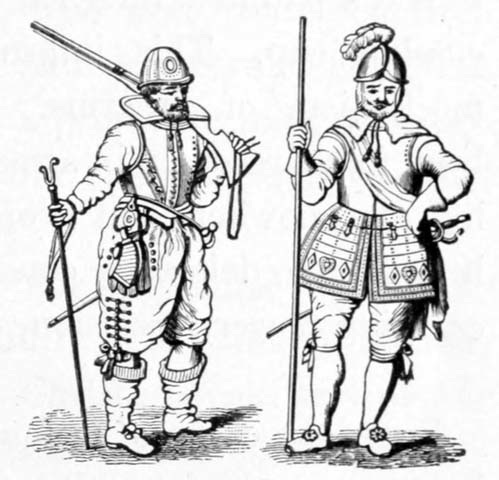
Musketeer and Pikeman of the Early Seventeenth Century
The first portable or hand gun consisted of a simple iron or brass tube fastened to a straight stock of wood. Horsemen used the first guns, and fired them by placing the end of the stock against the breast and letting the barrel rest on a fork fastened to the saddle. The gun was discharged by applying a lighted match to a touch-hole in the top of the barrel. One kind of powder was used for priming; another for firing. Before the invention of cartridges, the powder and bullets were loaded separately at the muzzle, with some kind of packing between. The colonial rifles in America were loaded in this way. In a fight at close quarters, after a gun had been once discharged, the soldier had to fight with his sword. About the middle of the seventeenth century, the bayonet was invented, taking its name from the town of Bayonne, in France, where the inventor lived.
The lighted match which soldiers originally carried for igniting their guns gave way to the flint and steel; and in 1807 a Scotch clergyman named Forsyth obtained a patent which led to the invention of the percussion cap. This improvement revolutionized the mechanism of firearms. Many improvements have been made recently in arms, so that cartridges containing cap, powder, and projectile are fed automatically into guns so delicately constructed that they have great carrying power, precision, and rapidity.
From the dawn of human existence man has sought by some method or other to overcome natural barriers of water. The idea of the ship is as old almost as the race itself. The most primitive form of vessel was the raft. In prehistoric ages men made vessels by hollowing out the trunks of trees, either with fire or with such crude tools as they possessed. The Latin poet Virgil mentions "hollowed alders" used for boats, and indeed canoes were made from hollowed tree trunks as long ago as the Stone Age. The next step forward in the art of shipbuilding was the bark canoe. In countries where bark is scarce, small vessels were made of skins, felt, or canvas covered with pitch. In process of time, boats were made by fastening timbers together, and in this method the basic principle of modern shipbuilding was reached.
It is the relation of ships to purposes of war that interests us here. When the curtain rose for the drama of civilization in Egypt five thousand years ago, men were fighting at sea. The oldest ships of which we have knowledge were Egyptian. The vessels of war were then propelled by oarsmen, who were protected from the missiles of the enemy by planks. On the Egyptian war-galleys there was often a projecting bow to which was attached a metal head for ramming the vessels of the enemy.
Our knowledge of Greek fighting ships—thanks to Greek literature—is fairly full. In the time of Homer, about ten centuries before Christ, Greek men-of-war carried crews of from fifty to one hundred and twenty men, nearly all of whom took part in the labor of rowing. A military boat called the "bireme" came into use in Greece about six or seven centuries before Christ. The word means a vessel with two rows or banks of oarsmen on each side, one row above the other. This disposition of rowers was evidently for the purpose of securing the largest possible number in the least possible space. It is probable that the Greeks did not originate the bireme, but borrowed the idea from the Phœnicians or possibly from Egypt. When Athens was at the zenith of her glory, the principal war vessel was the "trireme," a ship with three rows of oarsmen to the side, each rising above another. Larger ships were subsequently constructed with four, five, and even sixteen banks of rowers to a side, tier above tier.
The Romans, although they were so powerful in land warfare, were not strong in naval achievement until after the First Punic War. In this war they learned the art of naval construction from their enemies, the Carthaginians. A Carthaginian "quinquereme," or boat with five banks of oars, drifted to the Roman coast. The Romans copied it, set up frames on dry land in which crews were taught to row, and in sixty days from the time the trees were felled they had built and manned a fleet. Later the Romans used grappling hooks with which they bound together their own and an opposing ship. They then boarded the enemy's vessel and carried on the fight at close quarters. These tactics gave the Romans command of the sea, and their war galley came to be the supreme object of terror in the naval history of Roman days.
Sails and wind superseded rowers as the motive force of ships. Then came steam. But after gunpowder and steam had worked a revolution in the modes of naval combat, vessels of war continued to be made of wood.
The first fight between iron ships in the history of the world was fought on the ninth of March, 1862, in Hampton Roads, near Norfolk, Virginia, during the Civil War in America. The battle was the combat between the Merrimac and the Monitor. This engagement marked the end of wooden navies. Thenceforth the nations of earth were to make their warships of iron and steel.
Among the largest battleships built for the United States navy are the Delaware and the North Dakota. Each of these battleships is five hundred and ten feet long, a little more than eighty-five feet wide, sinks to the depth of nearly twenty-seven feet in the water, and travels at the rate of twenty-one knots per hour. Each vessel weighs twenty thousand tons, and is armed with ten great guns a foot in diameter at the mouth. The North Dakota required 4688 tons of steel armor at a cost of more than four hundred dollars per ton. Each of its great twelve-inch guns cost nearly $110,000, weighs fifty-two tons, and hurls a projectile weighing 850 pounds a distance of twelve miles. Three hundred and eighty-five pounds of powder are consumed at a single discharge. At a distance of more than a mile and a half the projectiles of the North Dakota will penetrate steel armor to a depth of nearly twenty inches. When these projectiles leave the guns, they fly through the air at the rate of 2,800 feet in a second. When one hundred shots have been fired from one of these guns, it is worn so that it will be useless until repaired. The cost of a single discharge from one of these guns is about $350.
Sub-marine navigation has always been attended by the most woeful catastrophes, but in spite of numerous accidents the development of the submarine boat has progressed uninterruptedly. Each new model presents new preventive devices. Flasks of oxylithic powder are carried for purifying the air in the water-tight compartments in which the crews live while the boat is below the surface of the water. There is also a special apparatus for signalling other vessels or the shore, in case of danger. In 1904 three vessels, designated X, Y, and Z, were completed, which could achieve submersion in the short space of two minutes. The boats were armed with six torpedoes each. France owns the largest fleet of under-water warships in the world. England stands next, and the United States government is third.
CHAPTER VIII
ASTRONOMICAL DISCOVERIES AND INVENTIONS
"When I consider thy heavens, the work of thy fingers, the moon and the stars, which thou hast ordained, what is man, that thou art mindful of him?" The Hebrew psalmist feels the insignificance of man compared with the infinitude of the heavens. Victor Hugo expresses the opposite thought: "There is one spectacle grander than the sea—that is the sky; there is one spectacle grander than the sky—that is the interior of the soul."
There is nothing more dignified, more sublime, more awful, than a contemplation of the heavens. In point of grandeur, astronomy may be regarded as king of the sciences. It is also their patriarch. Thousands of years before the birth of Christ the priests of Chaldea, from the tops of their flat-roofed temples, studied the stars and laid the foundations of the science of astronomy. The heavens, with their teeming, whirling, circling congregation, obeying laws that have no "variableness neither shadow of turning" do, indeed, "declare the glory of God."
From the earliest times the stars were supposed to influence for good and ill the lives of men. There were supposed to be stars of good luck and of bad omen. The cool, calculating Cassius tells Brutus,
"The fault, dear Brutus, is not in our stars, But in ourselves, that we are underlings."
When you look up into the heavens at the flickering dots of light which we call the stars, you are looking at worlds, many of them far larger than our earth. They seem small because of vast distances from us. Our own solar system, great as it is, in comparison with the celestial universe is but a clod in an acre. At the center of our system is the sun, a huge ball of fiery matter 93,000,000 miles from the earth, and as large as 330,000 worlds like ours. Circling around the sun like maddened horses around a race course are eight planets. These planets, with the sun and some comets, constitute our solar system; our system, for how many solar systems there are in space no one knows. These planets, in their order outward from the sun, are Mercury, Venus, our Earth, Mars, Jupiter, Saturn, Uranus, and Neptune. Of these, Mercury is the smallest and Jupiter is the largest. The following table shows some interesting facts about the planets:
Name Diameter in miles Number of planets required to equal sun in size Distance from sun in millions of miles Time required for one revolution around sunin days Velocity in orbit, miles per hour
Mercury 3,008 5,000,000 36 88 107,012
Venus 7,480 425,000 66 225 78,284
Earth 7,926 332,260 92 365¼ 66,579
Mars 4,999 3,093,500 141 687 53,938
Jupiter 88,439 1,048 483 4,332 29,203
Saturn 75,036 3,502 886 10,759 21,560
Uranus 30,875 22,600 1,783 30,687 15,202
Neptune 37,205 19,400 2,794 60,127 12,156
The moon is 240,000 miles from the earth, and it would require nearly 24,500,000 moons to equal the sun in size. Other planets have moons, some of them several. If you lived on the planet Mercury, your annual birthday would come around about once in three of our months. If you had your home out on the border land of the solar system, on the planet Neptune, you would have a birthday once in about 165 years, as we count time on the earth. It will be observed that the closer the planet is to the sun, the faster it travels in its orbit. This fact is due to the power of gravitation toward the sun. This strange influence drives the planets around the sun, and the nearer the planet is to the sun the greater is the power and consequently the faster the revolution. The law of gravitation was discovered by Sir Isaac Newton.
Newton was born in 1642 in Lincolnshire, England. His father was a farmer, and the farmhouse in which the son was born is still preserved. He was educated at a grammar school in Lincolnshire, and later entered Trinity College, Cambridge, from which he was graduated in 1665. Early in life he displayed a great liking for mathematics. Within a few years after he entered college, he had mastered the leading mathematical works of the day and had begun to make some progress in original mathematical investigation.
Newton's great life work—the achievement which insured to his name a place among the immortals—was suggested to him by accident. As the story goes, while he was walking one day in a garden, he saw an apple fall from a tree. He speculated upon the reasons for its falling, and ultimately concluded that the same force which causes an apple to fall from a tree holds the heavenly bodies in their places. Further investigation brought him to the unfolding of this general law of gravitation: "Every body in nature attracts every other body with a force directly as its mass, and inversely as the square of its distance." This law is the greatest law of nature. It is the central fact of the physical universe, the cement of the material world, the mighty, mystic shepherdess of space, that keeps the planets from wandering off alone. It is this awful, silent power reaching out from the enormous mass of the sun, that lashes the planets in their furious race, and yet holds them tightly reined in their orbits.
Newton was one of the greatest mathematicians, scientists, and thinkers in the history of the world. He died at Kensington, England, on March 20, 1727, and was buried in Westminster Abbey, with the illustrious dead of Great Britain.
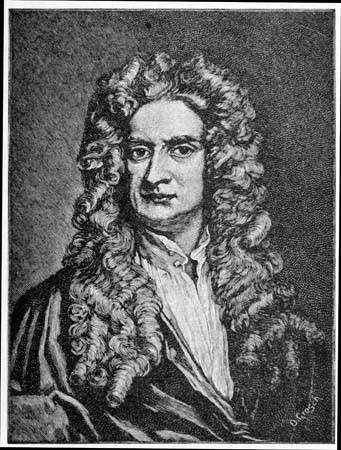
Sir Isaac Newton
The operation of this law of gravitation pointed the way to the discovery of the planet Neptune, which is considered the greatest triumph of mathematical astronomy since the days of Newton. Prior to the discovery of Neptune, Uranus was the outermost known planet of the solar system. It was noticed that Uranus was being pulled out of its proper path. It was being tugged away by some strange force beyond the edge of the known planetary system. As the result of a skilful and laborious investigation, Leverrier, a young French astronomer, wrote in substance to an assistant in the observatory at Berlin: "Direct your telescope to a point on the ecliptic in the constellation of Aquarius in longitude 326°, and you will find within a degree of that place a new planet, looking like a star of the ninth magnitude, and having a perceptible disk." Leverrier did not know of the existence of such a planet. He calculated its existence, location, and mass from the fact that some such body must be there, to account for the disturbance caused to Uranus. The telescope in the Berlin Observatory was directed to the place designated by Leverrier, and on the night of September 23, 1846, in exact accordance with his prediction and within half an hour after the astronomers had begun looking, Neptune was discovered within less than one degree from the exact spot where Leverrier had calculated it must be. Such are the triumphs of the human mind. Such are the failures of nature to hide her secrets from the inquiry of man, even behind untold millions of miles.
According to the principles of gravitation as unfolded by Newton, the power of attraction decreases directly as the square of the distance between the sun and a planet. Neptune, being on the outer rim of the system and hence farthest away from the sun, moves in its orbit around the sun more sluggishly than any other planet. Life such as we know it on the earth could not exist on Neptune; it would be too cold. The light and heat from the sun on Neptune are only one nine hundredth part of what we get on the earth. But even so, the sunlight falling upon Neptune is equal in power to seven hundred of our full moons. It was thought that Uranus was the last planet of the solar system until Neptune was found. Whether Neptune is the last, or whether other worlds are roaming around beyond it, is not known.
Ptolemy, who was one of the most celebrated astronomers of earlier times, was born in Egypt about a century and a half after Christ. According to the Ptolemaic system of astronomy, which Ptolemy expounded but did not originate, the earth was considered the center of the universe, and around it the other planets and the sun were believed to revolve. A passage in the Bible in which Joshua commanded the sun to stand still indicates that the old Hebrews believed the sun circled around the earth. The Ptolemaic theory did not account for all the facts observed by astronomers, but for nearly fifteen centuries it held practically universal sway over the belief of men, until another thinker set the matter right.
Nicholas Copernicus was born in Prussia, February 19, 1473. He studied mathematics, medicine, theology, and painting, but his greatest achievements were in astronomy. He made holes in the walls of his room, through which he might observe the stars. Copernicus did not believe in the theory of Ptolemy that the earth was the center of the universe, but held that the solar system had for its center the sun, and that around it the planets, including the earth, revolved. In working out this belief, which science has subsequently shown to be correct, he laid the foundations of the modern system of astronomy.
The book in which Copernicus expounded his theory was begun in 1507 and was completed in 1530. He could not be induced to publish it, however, until shortly before his death. On May 24, 1543, he lay dying in Frauenburg. A few hours before his death, when reason, memory, and life were slipping away from him, the first printed copy of his book was borne to Frauenburg and placed in the great astronomer's hands. He touched the book, looked at it for a time, and seemed conscious of what it was. Quickly afterward he lapsed into insensibility and was gone.
Johann Kepler, who was born in Germany in 1571, contributed several important facts to astronomy. He studied the motions and laws of the celestial bodies. Copernicus taught that the planets revolved around the sun in circular orbits, but Kepler discovered that their paths are ellipses. He also found that the nearer the planets are to the sun the faster they travel. Kepler's discoveries were embodied in three great laws of astronomy known as Kepler's laws. These furnished the foundation for Newton's discoveries and are the basis of modern astronomy. Kepler died in November, 1630.
Many of the wonderful discoveries that have been made in the field of astronomy could not have been possible without the telescope, the most important instrument used by astronomers. The first part of the word is the same Greek adverb meaning "afar," found in telegraph and telephone; the last part is derived from a Greek verb meaning "to see." The telescope, therefore, is an instrument for seeing objects that are far off. It is a long tube With lenses so arranged as to make objects appear much larger than they would to the naked eye. The telescope was invented by a Dutch optician named Hans Lippershey about three hundred years ago. The Italian scientist Galileo, who was born at Pisa in February, 1564, heard of the invention, began studying the principles upon which it depends, and greatly improved it. Galileo was the first to use the telescope for astronomical purposes. With it he discovered the satellites of Jupiter, the spots on the sun, and the hills and valleys of the moon.
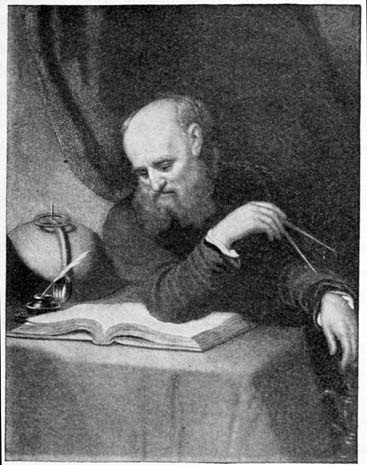
Galileo
At the present time the largest telescopes in the world are made and owned in America. The largest is the Yerkes telescope, belonging to the University of Chicago and located on the shores of Lake Geneva, Wisconsin. Microscopes, opera glasses, and other magnifying instruments depend upon the same principles as the telescope.
One of the most astounding of man's tools is the spectroscope, an instrument used for analyzing light. Through a knowledge of chemistry scientists can establish scientific relations between different substances and the light which they emit. By analyzing the light from the heavenly bodies with the aid of the spectroscope, and comparing this result with the light sent out from different known kinds of matter, man can stand on this little flying speck of matter we call the earth and discover of what substances the stars are made.
One of the most interesting questions arising in a study of the heavenly bodies is whether or not any of them besides the earth are inhabited. Is there any good reason for supposing that our pigmy planet, so insignificant compared with many celestial bodies, is the only one containing life? On the other hand, life such as we know it could not exist on some of the other planets. Mercury would be too hot; Neptune too cold. Climatic conditions on Mars are most nearly like those of the earth. Within recent years the telescope has revealed on the surface of Mars a number of peculiar, regular lines. Many scientists hold that these are artificial canals or irrigation ditches, and that the planet must be inhabited. The theory does not seem at all unreasonable. But the most that can be safely said is that if any of the other planets are inhabited, the most likely one is Mars.
CHAPTER IX
THE COTTON-GIN
Another great invention is the cotton-gin. It is great because of the commercial prosperity which it brought to the Southern states; because it cheapened and extended the use of an almost necessary article of life; and because of its effect on American history. The inventor was an American, Eli Whitney.
The word gin is an abbreviation of engine, and in former days was often used to denote a handy mechanical device of any kind. The cotton-gin is a machine for removing the seed from the fiber of the cotton-plant. Its essential parts are a number of saws which tear the fiber from the seeds, some stiff brushes used to remove the fiber from the saws, and a revolving fan which blows the lighter substance of the cotton away from the saws and brushes. The original cotton-gin has been little changed by improvement since its invention. It seems to be one of those inventions which have been perfected by the inventor himself.
Eli Whitney was born in Westborough, Worcester County, Massachusetts, December 8, 1765. His father was a thrifty farmer. Nature bestowed upon the son marked ability in the use of tools. While he was yet a child, his inventive genius manifested itself. Before he was ten years old, he could use every tool in the farm workshop with the ease and skill of an old workman. He made a violin before he was twelve and later he came to be noted in the neighborhood as a skilful mender of fiddles. He also turned his attention to making nails, which in Revolutionary days were made by hand, and became the best nail-maker in Worcester County. When he was twenty-four years of age, a desire for a college education possessed him. His father agreed to furnish the money to pay for his schooling, with the stipulation that the son should pay it back. He entered Yale, where he was graduated in 1792.
After graduation Whitney went South to act as tutor in a private family. Upon arrival at his destination, he found that the position was already filled. At that time the widow of General Nathanael Greene, who fought in the Revolutionary War, lived near Savannah, Georgia. She had become interested in young Whitney and invited him to make her plantation his home. She noted his inventive skill, and one day when a group of Georgia planters was discussing at her home the desirability of a machine for removing cotton-seeds from the fiber, Mrs. Greene said: "Gentlemen, apply to my friend, Mr. Whitney; he can make anything." Whitney was called in and the planters laid the matter of the machine before him. At this time he had never even seen cotton fiber. But he made up his mind to try what he could do toward solving the problem.
He went to Savannah and searched among the warehouses and flat-boats for samples of cotton. Mrs. Greene encouraged him in his undertaking and gave him a room in the basement of her house for his workshop. Here he shut himself up with his task, and was heard early and late hammering, sawing, and filing. No one was admitted to the room but Mrs. Greene and Phineas Miller, the tutor of Mrs. Greene's children. At the outset Whitney had neither money nor tools. The money was supplied by an old college friend; the tools Whitney made himself. He could procure no wire in Savannah for constructing his machine, and was compelled to make his own, which he did with much perseverance and skill.
In 1793 the gin was sufficiently completed to convince the inventor that it would be a complete success. Mrs. Greene invited a number of distinguished planters and merchants to witness the working of the machine. The spectators were not slow in realizing the success and the significance of the invention. They saw that with this little machine one man could separate as much cotton from the seed in one day as he could separate by hand in a whole winter. With the gin the cotton grown on a large plantation could be separated in a few days; by hand, the separation would require a hundred workmen for several months.
One dark night some unscrupulous persons broke open the shed in which the unfinished machine had been placed and carried it away. Filled with rage and despair at the wrong which had been done him, Whitney left Georgia and went to Connecticut to complete his invention. But he had scarcely left Savannah when two other claimants for the honor of the invention appeared in Georgia. A few weeks later a gin very closely resembling Whitney's came out. His stolen gin was doubtless used as a model by these false claimants.
On March 14, 1794, Whitney received a patent on his gin. Phineas Miller, who had become the husband of Mrs. Greene, entered into a partnership with Whitney for managing the new invention. Whitney was to manufacture the gins in the North and Miller was to furnish the capital and attend to the interests of the business in the South. They planned not to sell machines or patent rights, but to make and own the gins, loaning them to planters for a rental of one pound in every three pounds of cotton ginned. They would have been wiser if they had manufactured and sold the machines outright. In the first place, it required a larger capital than the firm had to manufacture the necessary number of machines. In the second place, no one firm could make gins fast enough to supply the rapidly increasing demand, and consequently great encouragement was given to infringements on the patent rights. Unending troubles beset the new firm. Whitney himself was a victim to severe illness in the winter of 1794. Scarlet fever raged that year in New Haven, Connecticut, where the manufacturing was being done, and many of the workmen in the gin factory were unable to work. In 1795 Whitney was again seized with severe sickness, and to add to the vexations of the business, the books, papers, and machinery were destroyed by fire. Besides all this, rival claimants circulated a report that Whitney's gin ruined the fiber of the cotton, and that for this reason cotton ginned by the patent process was discriminated against in the markets of England. Another gin which did its work by crushing the seeds between rollers and leaving the crushed seeds in the fiber was represented as superior to Whitney's machine.
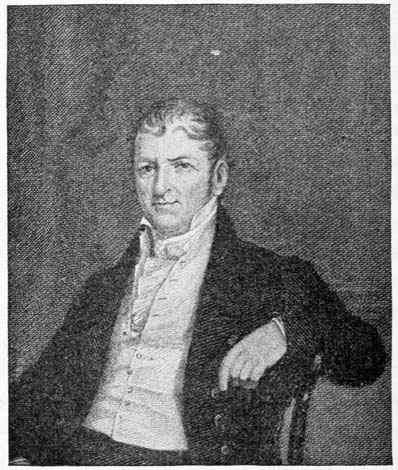
Eli Whitney
In speaking of his troubles Whitney said: "The difficulties with which I have had to contend have originated principally in the want of a disposition in mankind to do justice. My invention was new and distinct from every other; it stood alone. It was not interwoven with anything before known; and it can seldom happen that an invention or improvement is so strongly marked, and can be so clearly and specifically identified; and I have always believed that I should have had no difficulty in causing my rights to be respected, if it had been less valuable and been used only by a small portion of the community. But the use of this machine being immensely profitable to almost every planter in the cotton districts, all were interested in trespassing on the patent right, and each kept the other in countenance.... At one time but few men in Georgia dared to come into court and testify to the most simple facts within their knowledge relative to the use of the machine. In one instance I had great difficulty in proving that the machine had been used in Georgia, although at the same moment there were three separate sets of this machinery in motion within fifty yards of the building in which the court sat, and all so near that the rattle of the wheels was distinctly heard on the steps of the court house."
Whitney never received fair and proper compensation for his invention. The machine itself was stolen; others sought to rob him of his honor; he was opposed by an unlimited train of vexations; and after the expiration of his patent he was never able to secure a renewal.
The effect of the invention of the cotton-gin was far-reaching, industrially and historically. In 1807, at a session of the United States District Court held in Savannah, Georgia, the inventor finally obtained judgment against the persons who had stolen his invention. In the opinion rendered in favor of Whitney, Judge Johnson said of the cotton-gin: "Is there a man who hears us who has not experienced its utility? The whole interior of the, Southern states was languishing, and its inhabitants were emigrating for the want of some object to engage their attention and employ their industry, when the invention of this machine at once opened new views to them which set the whole country in active motion. Individuals who were depressed with poverty and sunk in idleness have suddenly risen to wealth and respectability. Our debts have been paid off, our capitals have increased, and our lands have trebled themselves in value. We cannot express the weight of the obligation the country owes to this invention. The extent of it cannot now be seen. Some faint presentiment may be formed from the reflection that cotton is rapidly supplanting wool, flax, silk, and even furs, in manufactures, and may one day profitably supply the use of specie in our East India trade. Our sister states also participate in the benefits of this invention; for besides affording the raw material for their manufactures, the bulkiness and quantity of the article afford a valuable employment for their shipping."
In the South "Cotton is king." The rise of the cotton industry dates from the invention of Eli Whitney's cotton-gin. Before its invention the labor of removing the seed from the fiber was so tedious that the growth of the cotton was not profitable. Partly because of this fact and partly because the Revolutionary War was just over, the South lay dormant; its plantations were heavily mortgaged, its people were moving away in streams. Then came a little machine that awoke the South from its sleep and made it rouse itself. It brought energy, hope, and prosperity, where before were languor, indifference, and stagnation. It increased the exportation of American cotton from less than 190,000 pounds in 1791 to 41,000,000 pounds in 1803.
From the historical point of view the invention of the cotton-gin was tremendous in its influence. This machine multiplied by many times the demand in the South for slave labor and made slaves far more profitable. One writer has said of Whitney: "He was, through his invention, probably one of the most potent agencies for the extension of slavery and the terrible struggle that marked the first half-century of our nation's existence. While he was quietly sleeping in his grave, the very earth was shaken with the tread of contending armies that he had done more than any other one man to call forth to battle; for there is little doubt that but for the invention of the cotton-gin slavery would not have lived out the century of the Revolution." Macaulay says: "What Peter the Great did to make Russia dominant, Eli Whitney's invention of the cotton-gin has more than equaled in its relation to the power and progress of the United States." In the light of the wonderful, widespread material growth and prosperity that have come to the whole of our country in recent years, Macaulay's statement is overdrawn. But as matters were when it was written by the great Englishman, it was probably true.
Whitney achieved much success as the inventor of improved methods of manufacturing firearms. He was the first to conceive the plan of making the different parts of firearms by machinery, so that any part of a weapon would fit any other like weapon equally well. This principle has made possible the production of cheap watches, clocks, and sewing machines. He died in New Haven, Connecticut, January 8, 1825.
CHAPTER X
ANÆSTHETICS
If those inventions and discoveries out of which have come widespread safety, happiness, or prosperity to mankind are to be considered great, then Dr. Morton's discovery of anæsthetics and its application to surgery is entitled to a high place among the world's discoveries and inventions. The pain that has been destroyed, the lives that have been saved, the sorrow that has been averted, give their testimony to the value of this discovery to humanity.
An anæsthetic is administered to produce temporary insensibility to pain. At least something of anæsthetics was known to the ancients. Homer mentions nepenthe, a potion which was said to make persons forget their pains and sorrows. The word appears occasionally in literature. In "Evangeline" Longfellow refers to it in this line:
"Crown us with asphodel flowers, that are wet with the dews of nepenthe."
Virgil and other classical writers mention a mythical river Lethe which was supposed to surround Hades. Souls passing over to the happy fields of Elysium first drank from this river, whose waters caused them to forget their sorrows. Milton speaks of the mythical stream in the following passage from "Paradise Lost:"
"Far off from these a slow and silent stream, Lethe, the river of oblivion, rolls her watery labyrinth."
Herodotus wrote that it was the practice of the Scythians to inhale the vapors of a certain kind of hemp to produce intoxication. The use of the mandrake plant as an anæsthetic is spoken of as far back as Pliny, the Roman historian. The sleep-producing effects of the mandragora or mandrake are alluded to by Shakespeare. He also frequently mentions in a general way draughts that act as anæsthetics, without making clear their specific natures. An old Chinese manuscript indicates that a physician of that country named Hoa-tho in the third century after Christ used a preparation of hemp as an anæsthetic in surgical operations. Although the ancients had knowledge of anæsthetics of one kind or other, the practice of anæsthesia never became general, and surgeons of the ancient world appear to have looked upon it with disfavor.
When in modern times Joseph Priestley, the English scientist (born in 1733, died 1804) gave great impetus to chemical research by his discoveries in that science, the nature of gases and vapors was more and more closely studied. The belief soon sprang up that many gases and vapors would ultimately become of great value in medicine and surgery. In 1800 Sir Humphry Davy experimented with nitrous oxide gas, called "laughing gas," and discovered its anæsthetic qualities. He suggested its use in surgery, but for practically half a century his suggestion passed unheeded. Other scientists experimented with greater or less success, seeking to find something that would alleviate physical pain; but to Dr. William T. G. Morton, an American, belongs the credit for the practical introduction of anæsthetics into modern surgery.
Dr. Morton was born in Charlton, Massachusetts, August 9, 1819. His ancestors were of Scotch extraction. He passed his early years in farm work. At the age of thirteen he entered an academy at Oxford, Massachusetts, where he remained only a few months, attending school thereafter at Northfield and Leicester. His father's financial condition caused him to leave school in 1836 and enter the employ of a publishing firm in Boston. Deciding to engage in the practice of dentistry, in 1840 he took a course in the Baltimore College of Dental Surgery. Two years afterward he began the practice of his profession in Boston. As dentistry at that time was in its beginnings as a distinct profession, Dr. Morton took up, in addition to it, the study of general medicine and surgery in the Harvard Medical School.
In the days prior to the use of anæsthetics, the operations of dental surgery were attended by much pain. Dr. Morton began seeking some means for alleviating it. In the course of his investigations he became acquainted with the effects of sulphuric ether as a local anæsthetic, and frequently used this drug in minor operations. On one occasion he applied it with unusual freedom in the treatment of a very sensitive tooth. Observing how completely the tissues were benumbed by the ether, he conceived the idea of bringing the entire system under its influence, thereby producing temporary insensibility in all the sensory nerves. The most serious problem with which he had to deal was the manner of applying the ether. Although the soporific tendencies of both ether and nitrous oxide gas were well known, it had not been proved that they could be inhaled in sufficiently large quantities, or, if so, that they would produce perfect insensibility. After a long series of experiments with various animals, Dr. Morton succeeded in fully establishing the narcotic power of ether.
On October 16, 1846, he made his first public demonstration of the new discovery in the operating room of the Massachusetts General Hospital, in Boston, when he painlessly removed a tumor from the jaw of a patient. This operation was wholly convincing to the medical profession, and created profound public interest. Dr. Morton was brought into immediate prominence. A meeting of the leading physicians of Boston was held to choose an appropriate name for the new process. A long list of words was presented, from which Dr. Morton selected the term letheon, related to the Lethe of Virgil and the classical writers. The words anæsthetic and anæsthesia were coined from the Greek by Dr. Oliver Wendell Holmes, the American poet and physician, who was then living in Boston. The words proposed by Dr. Holmes have become the established terms of the subject, superseding the letheon of the discoverer.
Dr. William T. G. Morton
Dr. Morton secured a patent on his discovery, but derived little pecuniary profit from it. Although he permitted the free use of his anæsthetic in charitable institutions, his patent was frequently infringed. He vainly applied to Congress for compensation in 1846 and 1849. A bill to give him one hundred thousand dollars as a national testimonial of his contribution to the welfare of the race was introduced into Congress in 1852 and defeated. Measures in his behalf at sessions of Congress in 1853 and 1854 were likewise voted down. The only money that ever came to Dr. Morton for his discovery was a small prize from the French Academy of Sciences and the sum of one thousand dollars from the trustees of the Massachusetts General Hospital. The governments of Russia and of Norway and Sweden conferred upon him certain awards of honor in recognition of his great contribution to science.