Chapter IX · Wellington
Reading edition
Arthur Wellesley was born in 1769, a few weeks before the birth of Napoleon. His family belonged to “the English in Ireland”—a happy expression of Mr. Froude; and the future soldier and statesman in his great career displayed many of the distinctive qualities of a ruling caste which, though of late decried by traders in faction for selfish purposes, has nevertheless given more than a due proportion of eminent men to the service of England. The ancient seat of the Wellesleys has been long a ruin; the traditions of Meath yield few records concerning a House which produced two of the most illustrious names in our eventful history, and all that is really known about the first years of Arthur is that he was a sickly child, overlooked by his parents. At Eton the boy showed none of the brilliancy of his elder brother Richard, a precocious genius; he was unnoticed at the military school of Angers, and no one who saw the two youths in these years would have thought that the fame of “the Wellesley of Assaye” would eclipse that of “the Wellesley of Mysore.”
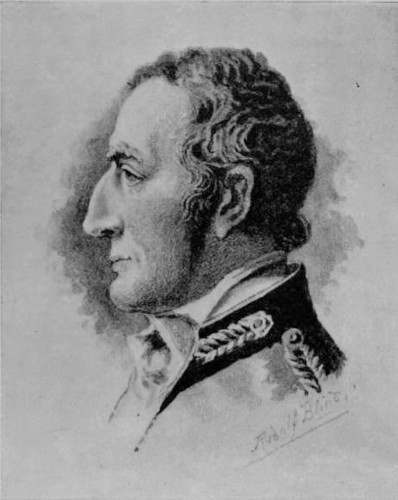
WELLINGTON.
Arthur obtained his first commission in 1787; passed rapidly through the intermediate grades, after the bad fashion of that age of privilege, and was placed, through interest, at the head of the Thirty-third, just as the Great War with France had begun. During the intervening period he had held a seat for the borough of Trim in the Irish Parliament, and had been on the staff of the Lord Lieutenant Camden; and some faint memories of his life in those days have survived down to the present time. Passing by idle gossip, the young member spoke on the Catholic Relief Bill of 1798; the speech, though dry and blunt, goes straight to the point, and is characteristic in many ways; and an old house on the quays of Dublin which commands the Liffey and the adjoining streets, and which, it is said, he urged the Government to buy, remains to this day to prove that Wellington had in early youth a true military eye. It is impossible to doubt that, even in these years, Arthur had studied and read a great deal, and was well-versed in his professional work. He had acquired a command of the English and French tongues which made him the master of a vigorous style, not brilliant or striking, but clear and solid; his writings nearly of this date give proof of thorough information on many subjects, and of singularly ripe and disciplined thought; and from the first moment that he obtained a regiment, he made his mark as a most promising officer. Like Turenne, Wellesley addressed himself with untiring industry to the care of his men; he enforced discipline with a steady hand, and showed that he had the faculty of command; and, like Turenne, he was soon able to boast that his corps was well-ordered and very efficient. The occasion quickly came when the young colonel was to show that he possessed qualities above those of the common herd of men.
In the unfortunate campaign of 1794 the Thirty-third formed part of the British army, which, under the command of the Duke of York, had been separated from the main allied force retreating on a divergent line to the Meuse, and which, hardly pressed by the Republican levies, advancing upon the flood-tide of victory, was endeavouring to make its way into Holland. Wellesley distinguished himself in several rearguard actions, displaying from the first the skill in defence, the resource in danger, and the perfect self-reliance, which were peculiar gifts of the future chief; and it is significant that he was chosen to cover the retreat, a task he performed with marked ability. These experiences made a profound impression on a remarkably penetrating and sagacious mind; they seem to have led him to observe carefully, and to form an admirably just estimate of what he called “the new methods” of French warfare, and of what was good and defective in them; they enabled him to realise the immense abuses then prevalent in the Continental armies, and to a considerable extent in our own; and, unquestionably, they were of the greatest use as a preparation for the Peninsular War. It is remarkable that, after this first essay in arms, most honourable as it had been to him, Wellesley tried to give up a military career, and actually applied for a post in the Civil Service; the reason he assigned was that he saw little chance of advancement through merit in the British army, to the shortcomings of which he had become fully alive.
Fate happily disregarded Wellesley’s prayers; and having escaped exile to the West Indies, he was sent off to Calcutta in 1797. A short time afterwards, his brother Richard, the Marquis Wellesley of a later day, arrived in India as Governor-General, and the real career of Arthur may be said to have opened. Much of his correspondence of this period remains, and it bears the marks of the prudent forethought, of the clear insight into men and things, and, above all, of the moderation of view, which distinguished Wellington when at the summit of fame. He was often consulted by the Governor-General, and it is interesting to note how the ambitious statesman,[26] a more brilliant but a less scrupulous man, was more than once restrained by the calm-minded soldier. Arthur Wellesley’s judgments on Indian affairs were such as Marcus Aurelius might have made had he been a Pro-consul in a province of Rome; he was the constant advocate of peace with honour, of keeping the strictest faith with the Princes of Hindustan, of no undue extension of our growing Empire; and yet he thoroughly understood the true nature of that wonderful domination which, in spite of itself, was winning its way to supremacy in the East, in virtue partly of its own force, and in part of the decay of all powers around it, and of the jealousies and discords of its numerous foes. Another characteristic of these papers is this: they show that the writer had admirable views on military and civil administration alike; and the remarks on the whole system of our Indian Government, which repeatedly occur, are profound and striking. Peace in India at this time had become impossible; the inglorious satrapy of Sir John Shore had only encouraged the hopes of our enemies; and the news of Napoleon’s descent on Egypt, and of his avowed project to march to the Indus, had animated Tippoo Sahib to endeavour to break the settlement made by Cornwallis in 1793. I shall not repeat the often-told tale of the dealings of “citizen Tippoo” with the Directory of France; of the assistance he received from French soldiers of fortune; of the siege of Seringapatam, and his death; this scarcely belongs to Wellesley’s career, who was a subordinate only in the attack on the fortress, and who, in these operations, happened to meet one of the few reverses he met through life. He was made Governor of Seringapatam, and afterwards of Mysore; and in this position he first gave proof not only of great administrative powers, but of that capacity for ruling alien races—for reconciling the ascendency of the English name with the obedience of people completely different—a gift partly due, perhaps,[27] to his Irish experience, and partly to firmness, patience, and a strict regard to justice, which stood him in good stead in Spain and Portugal. Ere long Wellesley, now raised to the rank of General, had an opportunity to show what he was in command.
He had distinguished himself, when at Mysore, in putting down a Mahratta partisan who had ravaged the country with part of Tippoo’s forces; and when Scindiah and Holkar in 1803 made a determined effort to destroy our Empire, Wellesley was placed at the head of an independent army, and advanced from Madras into the Central Provinces. I pass over his forced march to Poona, considered in those days a remarkable feat, and his rapid operations in the Deccan; and I proceed at once to the really grand exploit which gave him, for the first time, a great name in India. Wellesley and Stevenson, in September 1803, were near the Kaitna, one of the Godavery’s streams, at the head of about 16,000 men; Scindiah’s army, 50,000 strong, commanded and organized by French officers, was in camp at no great distance; and the two Englishmen agreed to attack it, on lines divided by a wide range of hills, strategy which, even in the case of Indian warfare, was too hazardous, and cannot be justified. Wellesley came up with the enemy at Assaye, his colleague being still far away; and, as more than once was seen in his career, his boldness on the ground and his quickness in action made more than amends for a strategic error. Disregarding all odds, like Clive at Plassey, he instantly fell on the masses before him; and though the issue of the battle was doubtful for a time, nothing could stand against his British foot and horsemen, and in a few hours he gained a complete victory. Stevenson arrived before long, and the campaign ended in the easy triumph of Wellesley’s arms, and in a large increase of our Indian dominions. Yet Assaye had, perhaps, other results; the strategy of Wellesley was, no doubt, faulty; and the battle probably gave Napoleon, who let nothing escape him in war, that first false impression of the “Sepoy general,” which caused him greatly to undervalue Wellington, with fatal consequences to France in the Peninsular contest.
Wellington always looked back on India with pride; and nearly two generations after Assaye, when he had been for many years the first of living Englishmen, he actually proposed to set off for the East, when danger threatened our power on the Indus. An attentive observer will, indeed, perceive that his career in Hindustan foreshadows, in part, his more renowned career in Portugal and Spain; we see in both the same sober wisdom, the same administrative gifts, the same intrepid conduct, if Wellesley had no opportunity to display his skill in defence in Asiatic warfare. He was back in England a few weeks before the memorable events of Ulm and Trafalgar; but he was relegated at first to a civil post, and he became Chief Secretary for Ireland under the Duke of Richmond.
The state of the island was very critical; the fires of 1798 were still smouldering, and the unpopularity of the Union strengthened the hands of the remains of the rebel Irish faction, which continually looked to France for aid, though, characteristically, scorned by Napoleon. Wellesley ruled after the fashion of those days: that is, he kept Celtic discontent down and threw bribes and places to greedy seekers of both, in order to extend ministerial influence; but he was perfectly aware of the many abuses then prevalent in the social condition of Ireland, and his warnings on the subject now appear prophetic. He was at the bombardment of Copenhagen in 1807; was chosen by Lord Cathcart to arrange the terms of the surrender of the fleet with the Danish commander; and won golden opinions in this delicate task from brave enemies, whom he seems to have pitied. At last, in the summer of 1808, fortune found for him a place on the theatre of the great events which were stirring the Continent especially adapted to his peculiar genius, and launched him on the career which has made him famous. By this time Napoleon’s first invasion of Spain was ending in calamitous failure; the French armies were falling back at all points, and the British Government resolved to strike a blow at Junot and his corps, isolated in the midst of Portugal. Wellesley set off from Cork in the middle of July, at the head of about 10,000 men; and a remark he made to his friend Croker, when leaving, shows the character of the man and his strong nature. “The French armies,” he said, “have beaten all the Continent. They have, it seems, adopted a new system; they have out-manœuvred every enemy they have met, but I do not think they will outmanœuvre me, though, as a matter of course, I may be outnumbered.”
Wellesley had landed at Mondego Bay in the first week of August; he was soon joined by about 5,000 men under General Spencer, from the south of Spain, and he ultimately had nearly 20,000 troops, by the addition of a British division and some Portuguese auxiliaries. The effect of the descent was to throw a superior hostile force on the communications of Junot’s army, and to place it in grave peril, for it was split in fractions; and Wellesley hoped to cut it off from Lisbon, and, should a detachment under Sir John Moore co-operate, even to intercept its retreat on Elvas, and so to cause its complete ruin. This able plan was frustrated by a series of accidents, though it led to a brilliant if not a decisive victory. Wellesley attacked and defeated a French division at Roliça on the 17th of August; and he was in turn assailed when on the march to Lisbon, at Vimeiro, not far from the coast, by Junot, who had assumed the offensive with from 14,000 to 16,000 men. The efforts of the French completely failed; and as their defeated columns drew off, Wellesley eagerly tried to follow up his success, and to force Junot against the Tagus, where, even without the aid of Moore, he might destroy the Marshal. This bold and brilliant stroke was, however, prevented by the interference of Sir Harry Burrard, a veteran of the old school, who had come from England, unluckily, to take the chief command, and the French army escaped unmolested. The Convention of Cintra soon followed; and though a storm of indignation arose at the time, because Junot and his troops were landed in France, it is but fair to remark that as Moore did not complete the operation laid out for him, the French would probably have made good their retreat. The one real opportunity was lost at Vimeiro, owing to a change of leaders at a critical moment.
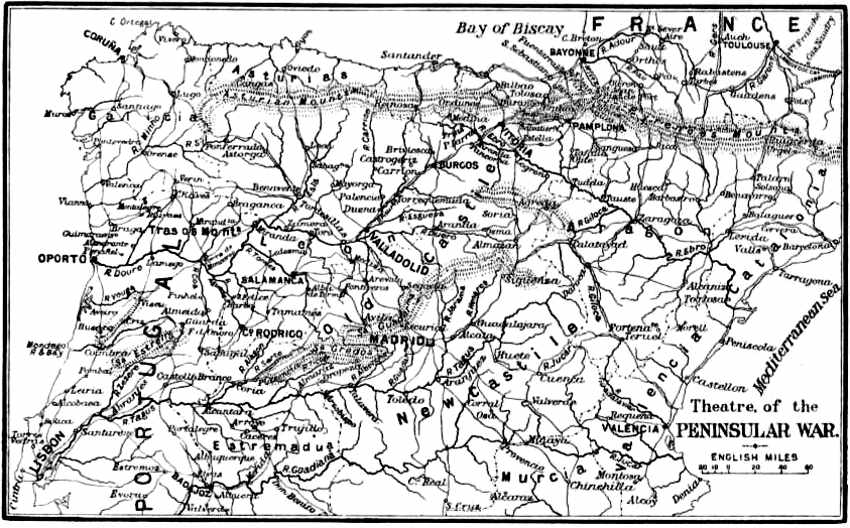
Theatre, of the PENINSULAR WAR.
This short campaign brought out one of the gifts of Wellesley, capacity for bold offensive movements, not on a grand scale but within limits where readiness and vigour are of special value. His ability was recognized at the inquiry held in England, after the affair of Cintra; and he returned to Portugal in the spring of 1809 in supreme command of a mixed force of British and of Portuguese troops, perhaps altogether 40,000 strong, which had been assembled for the defence of Lisbon, and had been organized by Generals Cradock and Beresford. Affairs in the Peninsula had, by this time, completely changed since the year before; and it was universally believed in Europe that the whole country would in a few months become a vassal province of the French Empire. Napoleon had invaded Spain for the second time, at the head of forces that nothing could resist; he had swept aside the rude levies that crossed his path. Saragossa had fallen; a British army, led by Moore, had narrowly escaped destruction; the national insurrection seemed, for the moment, crushed; and fully 300,000 veteran soldiers, commanded by skilful and successful chiefs, were gathered round the eagles for a march of conquest from the Ebro to the mouth of the Tagus. Yet Wellesley, with deep sagacity and grand strength of character, refused, in this state of things, to despair; and he drew elements of hope from the peculiar nature of a theatre of operations he had carefully scanned, and from the conditions of French invasion in Spain and Portugal. Portugal, open to England through the command of the sea, and scarcely accessible from the Spanish frontier, the only avenue open to the French armies, could, he insisted, be defended with success, by a small British force if well supported by the national militia and the Portuguese Government; and he relied greatly on the immense impediments which would necessarily beset the French in Spain, owing partly to the ubiquitous guerrilla risings, partly to the intricacies of a region of mountains and defiles, partly to the exposed state of the communications with France, assailable along a vast line, and partly to the extreme difficulty of concentrating and supporting large forces which, upon Napoleon’s principles of war, would be compelled to subsist in a poor and barren country on resources principally drawn from the spot. These admirable views, set out in detail before Wellesley reached Portugal in 1809, anticipate the course of the Peninsular war, and in a great measure foreshadow its event; and if they do not equal Napoleon’s conceptions in splendour, science, and imaginative force, they indicate real genius for defence and military wisdom of the highest order. Wellesley’s first operations were of happy augury, and realised his predictions with full completeness. Napoleon, before he set off for Wagram, had made preparations to invade Portugal on what he considered a sufficient scale, while he continued to extend his power in Spain; and for this purpose he had directed Soult to march on Lisbon with an army supposed to be at least 40,000 strong, while Victor was to second the movement by the valley of the Tagus with about an equal force. Soult, however, pursued by swarms of guerrillas and making his way with extreme difficulty, reached Oporto with less than 25,000 men; though Victor routed a Spanish army, he never approached the Portuguese frontier; and when Wellesley arrived in Lisbon the two Marshals were far from each other, unable to co-operate, nay, perhaps, unwilling, and not in sufficient force to subdue Portugal. Wellesley, rightly aiming at his nearest foe, marched against Soult with about 30,000 men; and the operations that followed were very brilliant.
Soult, dreaming of a throne for himself in Portugal, and a somewhat indolent though a very able man, was surprised and assailed by his bold adversary; the Douro was crossed by the British army, under the eyes of a powerful hostile force, by a movement of singular daring and skill; and a detachment ably sent off by Wellesley all but cut off the Marshal’s retreat, and nearly involved him in utter ruin. In fact, Soult only contrived to escape by abandoning his impedimenta, and crossing the ranges that lead into Spain with the wreck of an army, and the invasion of Portugal ignominiously failed.
The passage of the Douro in the face of Soult is another instance of the skill of Wellesley in offensive movements upon a contracted theatre. He now turned his attention towards Victor, far off, yet in the lowlands of the Tagus; but a long pause in the operations took place, due, partly, to the maladministration of the British army, partly to disputes with the dullard Cuesta, in command of the Spanish army of the west, and partly, too, perhaps, because the English general had not the fierce energy, in a situation like this, of the warrior of the campaign of Italy. Wellesley had defeated Soult by the middle of May; he did not even attempt to advance against Victor until the last days of June, and it was the third week of July before his army, having effected its junction with that of Cuesta, was in the valley of the Upper Tagus, marching in pursuit of the French Marshal. The allied chiefs were now at the head of about 20,000 British troops and 40,000 Spaniards, mostly new levies; their purpose was to attack Victor, falling back leisurely towards Talavera; and they moved up the Tagus, not without hope that they might ultimately reach the Spanish capital, for they expected aid from a Spanish army in the south.
The long delay which had occurred, however, had enabled the French armies in the Peninsula to draw towards each other in formidable strength; the corps of Soult, reorganized and recruited, that of Ney, and that of Mortier were but a few marches off, behind the screen of the Avila range. King Joseph at Madrid had a considerable force, which might easily join hands with Victor; and Wellesley and Cuesta were in fact moving into the midst of immensely superior foes, strategy difficult to understand and not to be justified. In the operations that followed, the French lost one of the best opportunities they ever had to destroy our power in Portugal and Spain; and the glitter of success ought not to blind us to the perils incurred by the British commander, from which he only escaped by accident. In the last days of July Joseph had come into line with Victor, who had been well-nigh caught. Their united armies were near Talavera, at least 45,000 strong; and pressing orders had been given to Soult, to fall on the flank of the allied army, with the corps of Ney, of Mortier, and his own, 60,000 excellent troops at least; a movement not in any way difficult, for it only required a short march, and the passes from the hills were but weakly guarded. These dispositions were by no means perfect, but they promised brilliant and decisive success; and they failed only through a series of mishaps and errors. On the 27th of July Victor attacked the Allies, in position at Talavera, between the Tagus on their right and a set of knolls and low hills on the left; and his first effort altogether failed, though he concentrated his main strength against the British troops.
The attack was premature and imprudent, for obviously it was the true course of the French to wait until the advance of Soult would enable them to assail the Allies, in front and flank, in overwhelming strength; but Victor, jealous perhaps of his colleague, and eager to win on his own account, insisted on renewing the fight on the 28th. The battle raged furiously for several hours; all the attacks on the British left were baffled; but the intrepidity and skill of Wellesley were taxed to the utmost to save the centre, and though he undoubtedly gained the day, the French army drew off unbroken. Ere long, however, the advanced guard of Soult made its appearance in the plains of the Tagus; the defeated army resumed the offensive, and in the first days of August a great French host, from 85,000 to 100,000 strong, was menacing the Allies in front and rear, and seemed as if on the verge of a splendid triumph. Had the counsels of Soult, to press on and attack, prevailed at this juncture, it is difficult to see how Wellesley and Cuesta could have escaped; and in that event the combined French armies would not improbably have overrun Portugal, and, perhaps, have even attained Lisbon. The danger, however, passed away; the French chiefs separated, and did nothing; and Wellesley, placing the Tagus between himself and his foes, made good his retreat across the frontier, though unsupported by his worthless ally, whose conduct, it has been thought, was not free from treachery.
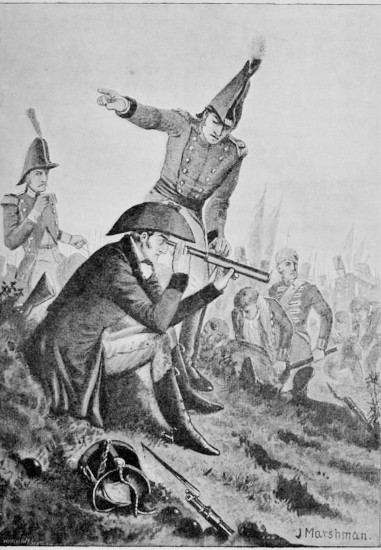
WELLINGTON AT TALAVERA.
Wellesley received a peerage for Talavera, and the battle is honourable to the British army and its chief. The attacks of Victor were ill conducted, but fully 35,000 French soldiers were opposed to less than 20,000 Englishmen; and yet they retired from the field, defeated. Talavera, indeed, like Vimeiro before, had proved that the modern French tactics were not calculated to achieve success against those long in use in the British service, as regards defensive battles at least; columns and skirmishers failed to make an impression on the formidable line of the British infantry, a result which was seen two thousand years ago in the inferiority of the Greek phalanx to the Roman legion. Wellesley’s first dispositions were not very good; he did not occupy the ground in force on his left; but he displayed great resource and skill on the 28th, and he deserved the victory he fairly won. His strategy, however, in this campaign was ill conceived, and, indeed, bad; and it can be explained, perhaps, on the supposition only that he had no idea what a great hostile force was ready to descend through the hills on his flank, as he marched in fancied security up the Tagus. As for the French operations, the plan of the double movement of Victor and Soult was not ill designed; but it was frustrated by the inconsiderate haste of Victor, who attacked before the approach of his colleague; and Napoleon truly observed that combinations like these are ever liable to mischance and failure, and that Wellesley ought to have been allowed to advance until the net was made certain to close around him. Wellesley, however, as it was, only just escaped. The wrath of Napoleon[28] knew no bounds, for a great opportunity had no doubt been lost; and the mistake of the English commander confirmed the Emperor in the low estimate he had formed of an enemy, who was anything but “the presumptuous, rash sciolist” he held up to ridicule after this campaign.
By this time Wagram had been fought. After the defeat of Austria, the whole Continent was more than ever under the yoke of Napoleon; Spain and Portugal were the only points where there was even a show of resistance to that colossal force; and as the Emperor poured fresh masses of troops into Spain, and announced that he would march on Lisbon in person, even the British Government, injured at home by the calamitous issue of the descent on Walcheren, began to quail and to wish to give up the contest. Yet Wellington—we now use the revered name—retained his calm and unbroken confidence; and though the subjugation of Spain seemed imminent—for three Spanish armies had been completely routed, and Andalusia was being overrun—he still contended that the defence of Portugal could be successfully maintained even in existing circumstances. After his retreat from the Tagus, he had returned to Lisbon; and, in the autumn of 1809, despite of the fears of ministers at home, and of the reluctant aid afforded by the Portuguese Regency—a corrupt and incapable body of men—he made preparations for the memorable stand in Portugal which has gained him enduring renown. His own army was now about 30,000 strong; the Portuguese army, drilled and led by Englishmen, had become a trustworthy force of about equal strength; and the addition of other Peninsular levies had placed him in command of more than 100,000 men. Such arrays, however, Wellington clearly saw could not hope to contend, even in Portugal, against the masses of which Napoleon disposed, unless means were taken to place a barrier in the way of the invaders, behind which the forces of the defence could be securely rallied. For this purpose he chose a position between the Atlantic and the mouths of the Tagus, covered in front by a succession of heights, and most difficult to turn on either flank; and thousands of labourers were quietly employed, with a secrecy which appears surprising, in constructing the famous Lines which will make the name of Torres Vedras long live in history. These great works formed a triple range of entrenchments, thirty miles in length on their exterior face and about eight in their second extension; the third was a vast fortified camp, from which the army, if forced, could embark; and the whole were protected by all the means available to the art of the engineer, redoubts, inundations, stockades, escarpments, and formidable batteries commanding vulnerable points. In this “impregnable citadel,” as has well been said, Wellington “deposited the independence” of Portugal at first, and ultimately, as it turned out, of Spain; and clinging to a rock on the verge of the ocean, while all was fear and mistrust around, he steadily confronted the might of Napoleon, the undisputed lord of a vanquished Continent. History has no grander instance of heroic constancy, and of self-reliance justified by the event.
By the early summer of 1810, the French armies in Spain had reached the enormous number of 350,000 fighting men, and Napoleon believed the whole Peninsula to be within his grasp. Engrossed, however, with his overgrown Empire, and meditating already the invasion of Russia, he had renounced the idea of crossing the Pyrenees, and conducting the approaching campaign himself; and this was one of the greatest mistakes of his life. The Emperor, shut out from the sea by England, and unable to procure intelligence in Spain, had not the least notion, strange as it may appear, of the real force in the hands of Wellington, still less of the Lines of Torres Vedras, and his plan for the contest, formed without knowledge, was misconceived and false to his own strategy. He believed that the British army was not 25,000 strong; he took no account of the Portuguese forces; he thought that the way to Lisbon was open, or barred only by natural obstacles; and instead of concentrating 200,000 men, in order to overpower Wellington and to turn the Lines on the landward side, at the verge of the mouth of the Tagus—a difficult but a possible enterprise—he disposed his armies in such a fashion that, as the event proved, they were largely wasted and were not strong enough on the decisive point on the theatre. Reasoning on his false data, he left Macdonald and Suchet to reduce the east of Spain; he allowed Soult to remain in the south with a great army, to no useful purpose, and calculating that this force would be more than sufficient, he placed 70,000 men in the hands of Masséna, by far the first of the imperial marshals, with orders to besiege the north-eastern frontier fortresses, and to “drive the English into their ships from Lisbon.” This dissemination of his military strength, so contrary to the principles of war, was due not to wilfulness or over-confidence, but simply to ignorance of the real facts; the Emperor knew that the British army was the one enemy he should first dispose of, and he conceived that he had made this result certain; but his reckonings and previsions were wholly wrong, and his projects were based on disastrous errors. The remarkable campaign of 1810 was to illustrate this in a most striking way, and forms Wellington’s true title to glory in war. Masséna began operations in the first days of June by investing Ciudad Rodrigo, a famous stronghold and the key of Portugal from the west of Spain, and as he was not to advance until after the summer heats, he conducted the siege in a leisurely manner, though disease and want had begun to prey on his army. Wellington, who had approached the beleaguered fortress at the head of about 30,000 men, when made aware of the strength of the French merely observed the enemy from secure positions; and all the devices of Masséna to tempt him to fight were fruitless against his steadfast prudence. Ciudad had fallen by the middle of July; Almeida, a neighbouring stronghold, met the same fate, and Masséna had set his army in motion—it numbered about 60,000 men—to invade Portugal in the third week of September, the Marshal advancing along the Mondego, and the British commander falling back before him. By the 27th the French had entered a region of mountains and defiles between the great ranges of the Sierra Alcoba and the Sierra Estrella, and they found Wellington and his troops in position on the ridge of Busaco, awaiting their enemy. Masséna did not hesitate to attack, for he had a great superiority of force; but once more the column was repulsed by the line, and the assailants only reached the well-defended heights to be smitten down by the steady British footmen. The Marshal, bold and persevering, now discovered a track which enabled him to move his army and turn Wellington’s left. This was not the fault of the English chief, for he had given directions to secure the pass; but his position had become no longer tenable, and the French entered Coimbra in high heart, and confident that they would soon attain Lisbon.
Masséna, utterly ignorant of what was before him, shared this hope with Ney and Junot, his chief lieutenants; and leaving his wounded and sick men at Coimbra, spite of a guerrilla warfare gathering on his path, “the spoiled child of victory” pressed boldly forward, making for the Lower Tagus and the Portuguese capital. To his great astonishment, the hostile army, which had retreated slowly and made scarcely a sign, seemed suddenly to disappear from his view; and Masséna only discovered the cause when, in the middle of October, he saw the Lines of Torres Vedras rising in formidable strength, and his enemy, he knew, was entrenched behind them.
Masséna’s army had, by this time, been reduced to about 50,000 men, and his adversary had fully 100,000, within lines not to be attacked in front. Ney and Junot were for an immediate retreat, but the warrior of Zürich, of Genoa, of Essling, whose great merit was tenacious boldness, refused to listen to these desponding counsels. He searched the barrier before him at every point, and only fell back when the state of his troops had warned him that a further stay was impossible. In his march from Busaco, Wellington had given orders to ravage the country, and to destroy its harvests; and though we may, perhaps, regret that he had recourse to a barbarous and obsolete mode of warfare, it was very efficacious against invaders who had no magazines when they left the frontier, and relied for supplies on organized plunder. Within a few weeks after it had reached the Lines, Masséna’s army, practised as it was in extortion and rapine, was half-famished; and the Marshal recoiled from Torres Vedras baffled and indignant, but not disheartened. Concealing the movement with great skill, he established his troops in strong positions round Santarem, on the Lower Tagus, where he was almost inaccessible to attack, and where, at the same time, he had several lines of retreat, and he might receive aid from the French army in the South should it advance to the opposite bank of the river. Here the Marshal made a determined stand, disregarding the murmurs of inferior men; he sent flying columns through the surrounding region to obtain means of subsistence by force or terror; he constructed bridges to cross the Tagus, and he despatched Foy, a very able man, to Paris, to ask for reinforcements and to inform the Emperor of the critical state of affairs in Portugal.
Napoleon saw his messenger before the end of November, and it might have been supposed that the first of strategists would have sent every available man, as quickly as possible, to Masséna’s aid, for everything, it had become manifest, depended on the course of events on the Tagus. But the Emperor was not pleased with the Marshal, on account of Busaco and the march from Coimbra. He persisted in holding Wellington cheap; he refused to believe in the strength of the Lines; he would see no foes but the British army, and the measures he adopted were quite inadequate to meet a situation already of peril. He ordered a detachment to be sent from the North of Spain, and to join hands with Masséna’s army; and he directed Soult to the Tagus from Andalusia, a distance requiring a long and arduous march, giving his lieutenant, besides, a dangerous latitude. The results, due partly to want of knowledge, but principally to obstinacy and unwise arrogance, proved most disastrous to the Imperial arms.
The detachment from the north reached Masséna’s camp, but instead of being 20,000 strong, as had been promised, it was not 10,000, a reinforcement of little worth; and Soult never approached the Marshal, either because the difficulties in his way were immense or because, as has often happened with French commanders, and was conspicuously seen in the Peninsular War, he was selfishly jealous of a superior colleague. Yet Masséna clung to his positions to the last. In this unfortunate campaign he showed the great qualities which have deservedly given him renown in history; and it was not until the whole adjoining country had been turned into a desolate waste that he reluctantly yielded to dire necessity. He broke up from Santarem in March 1811, having, to Wellington’s amazement, contrived to live for nearly four months on the tracts around him; and his retreat was one of extreme difficulty, for the British army was soon pressing on his rear; Coimbra had been taken, and swarms of partisans were gathering around on every side. The Marshal, however, proved equal to himself; he conducted the movement with the greatest skill; Ney distinguished himself in more than one action; and the French army ultimately recrossed the frontier, having saved its honour, it may be truly said, but having injured its fair fame by atrocious excesses. It had been reduced to 40,000 men, in miserable plight and greatly demoralized; a quarrel between Masséna and Ney increased disorder and destroyed discipline; and Portugal had been set free, and, as time was to show, was not to be invaded by Frenchmen again.
Torres Vedras is Wellington’s crown of fame, and gives him his true place among great commanders. The Lines might have, perhaps, been turned, had Napoleon put forth his whole strength; but they baffled the force believed by the Emperor to be sufficient to conquer Portugal and to drive Wellington out of the entire Peninsula. The conception of the defence was very fine, for Torres Vedras was all but impregnable; but the conception was nothing to the moral grandeur of the attitude of the heroic soldier, who from this rocky nook defied the mighty hosts which certainly might have been arrayed against him. It adds, too, to the just renown of Wellington that he met a foeman worthy of his steel. Masséna possibly made mistakes; he ought not to have fought at Busaco; it is astonishing that he was not informed of the Lines when he reached Coimbra, a few marches distant; and he ought not, perhaps, to have quitted that place, leaving thousands of enemies gathering on his rear. But the Marshal gave proof of powers of a very high order; he stood before Torres Vedras to the last moment, surrounded by, but overcoming danger; his choice of his positions at Santarem may almost be called a stroke of genius; and he conducted the retreat with consummate judgment. Apart, indeed, from the decisive effects caused by Wellington’s masterly defence, the failure of the campaign should be ascribed, not to Masséna, but to the French Emperor. Napoleon, ignorant of the real state of affairs, did not give his lieutenant a sufficient army; when made aware of the existence of the Lines, and of the strength of his enemy’s forces, he took half measures, which proved abortive; and the condemnation he passed on his greatest Marshal was simply a device to screen his own errors, want of real knowledge, contempt of his foes, and directing war at a distance from the scene. The results of Torres Vedras were immense; the glory of the French arms was deeply tarnished; a great general had suddenly appeared, who had baffled completely the Imperial legions. Continental soldiers began to study the methods of Wellington with eager hope; the fears of the Government at home vanished, and it resolved to prosecute the war with vigour; the complaints of the Junta at Lisbon were silenced; and, above all, Wellington had been confirmed in the accuracy of his views respecting the contest, and became the master of largely increased resources. Secure for the present from attack in Portugal, he began to make preparations to resist the French along the western frontier of Spain; and he already hoped that the day was at hand when he might carry the war into Castile and Leon.
The campaign of 1811 was a prelude to operations he had already planned; but it was one of many vicissitudes, and of doubtful fortune. Wellington commanding the resources of England from the sea, really wielding the power of the Portuguese Government, and turning to account the great advantage afforded him by a central position between enemies divided and scattered, besieged Almeida, Ciudad Rodrigo, and Badajoz, which, with Napoleon, he correctly judged should be mastered to make Portugal secure, and to open an avenue to enter Spain. He failed, however, against the two last strongholds; and though Barrosa and Albuera shed splendid lustre on the British arms, the campaign had no marked results, and Wellington was, more than once, in the gravest peril. The power of Napoleon, though diminished by drafts from Spain for the invasion of Russia, was, in fact, still prodigiously strong; and had the Emperor directed it, he would, humanly speaking, have even now subjugated Spain and Portugal. Masséna, having reinforced his army, attacked Wellington at Fuentes de Onoro; the English only just escaped defeat, owing to a dispute between two French chiefs; and Wellington, indeed, has fairly acknowledged that “had Boney been in command” he would have lost the battle. On two occasions, moreover, the British commander might have been overwhelmed if ably assailed. Marmont—who replaced Masséna, unjustly disgraced—and Soult assembled a great army to relieve Badajoz, and ought to have won a real victory had they fallen on Wellington; and Marmont might soon afterwards have attacked his enemy at Fuentes Guinaldos with fourfold numbers. But the tide in the affairs of men was setting against Napoleon, and was leading his sagacious foe to fortune. The conditions of the war, which he had clearly foreseen, made the dangers of Wellington less than they seemed; the French Marshals, far apart from each other, and unable to feed their troops in a wasted country, could not draw together their divided forces for anything like a well-combined movement; and their increasing discords, the neglect of their master to examine thoroughly the situation in Spain, and, above all, the ascendency of success already gained by the British army and its chief, told with powerful effect on the course of events.
During the last months of 1811, the British chief made great preparations to renew his efforts against Ciudad Rodrigo and Badajoz. He had secretly brought up a powerful siege train to the frontier without the enemy’s knowledge; he had made his communications with the sea easy, by opening the navigation of the Upper Douro; and the position of the French armies on the theatre of war remarkably favoured his audacious enterprize. The forces of Napoleon in Spain still numbered at least 250,000 men; but part of Marmont’s army had been detached to the East; Soult was in cantonments around Seville; no other French army was near Portugal; and the fortresses had been left almost uncovered, for the Emperor had not the least idea that Wellington had the means to besiege and take them. The English commander first pounced on Ciudad, and captured it, after a furious assault, in the first days of January of 1812; and in a few weeks he had triumphed at Badajoz, the heroism of the attack and the skill of the defence forming a grand episode of the Peninsular War. His troops suffered enormous losses, and the British engineers were not, perhaps, as experienced as the French, in this part of the craft; but Wellington’s only chance was to hurry on the attack; two relieving armies were not distant; and he properly made sacrifices for a great object. The fall of the two strongholds incensed Napoleon; but here again he had himself to blame; Marmont had fairly warned him of the danger at hand; and this is another striking instance of his ignorance of what was going on in Spain, and of the mischief of regulating its affairs from Paris. The success of the British chief at Ciudad and Badajoz laid open the Spanish frontier from Portugal, and he resolved to carry out his project of entering Spain; for though his army was very inferior in force to those of Marmont and Soult combined, the conditions of the war remained in his favour.
The marshals, as in 1811, were widely apart; they could hardly unite their armies in a ruined country; and their enemy held a position between them with an army whose wants were well supplied, and with little apprehension that the hostile forces in his front could be largely increased. The first care of Wellington was to seize the passages on the Tagus which enabled Soult and Marmont to communicate with each other by a short line; and then, leaving a detachment to observe Soult, he crossed the frontier in the second week of June and marched against Marmont with about 40,000 men. The marshal fell back behind the Douro, in order to collect his scattered forces, abandoning works which he had constructed as a centre of defence, in the place of Ciudad; but he was a brilliant, if not a great chief; and he quickly showed that he had no notion of abandoning the initiative to the British general. Marmont recrossed the Douro on the 16th of July, about equal in force to Wellington, but the passage was only a feint; he crossed the river once more, and made for Tordesillas, an able movement which brought him near to reinforcements coming from Madrid, and threatened his adversary’s right and communications with Portugal. A series of fine manœuvres followed, the French chief ever trying to outflank his enemy, and the English seeking to cover his line of retreat; and there can be no doubt that in this game of marches, the French army was the more agile of the two, and Marmont gained a distinct advantage. By the 22nd, the marshal had nearly reached the road from Salamanca to Ciudad Rodrigo, the main communication of his foe with the frontier; and Wellington was about to decamp as he best could, when a single false movement gave him a chance and enabled him to win a glorious victory. Marmont, eager and impetuous, and perhaps jealous that Jourdan, the leader of the succours at hand, would claim a share in the hoped-for triumph, incautiously extended his left too far, in order to cut off the retreat of his enemy. A gap was thus made in the French line; Wellington seized the occasion with his accustomed promptness, and he instantly directed a fierce attack against his antagonist’s left and exposed centre. The marshal at this moment fell wounded, but his fall could not have changed the event; his able lieutenant, Clausel, made a fine effort to reform the French on a new position, and even assumed an offensive attitude, but the error had been made, and been turned to account; and though the French made a really gallant stand, their weakened line was pierced through and through, and they were forced to abandon the fatal field, where Marmont had hoped to avenge his countrymen for a long succession of repeated defeats.
Salamanca and the operations before it are characteristic of Wellington as a chief. He was certainly out-generalled in the first movements, mainly because the French marched better than the British army; but probably he would have escaped unscathed, though Marmont had gained a position on his flank, had he been allowed to retreat unmolested. He was, however, unwisely attacked and in a reckless fashion; he instantly fell on the enemy’s centre, with the quickness and daring which marked his offensive movements on the ground, and he made the French general pay dearly for venturing on a flank march within reach of his enemy. Salamanca, in fact, has a strong resemblance to Austerlitz up to a certain point, but it wants the grandeur and effect of Austerlitz; and in this, as in all instances, Wellington showed that he could not follow up a victory with the energy and wonderful art of Napoleon.
As for Marmont, he was at first dexterous, but he made an immense mistake in extending his left. Like Victor at Talavera, he should have waited until his reinforcements had come into line; and this, no doubt, is another example how[29] the characteristic envy of French commanders had the worst effects in the Peninsular War. The results of Salamanca were very great, though Clausel rallied the beaten army with an ability deserving of high praise, and was soon out of the reach of pursuit; the battle exposed the long line of the communications of the French with Madrid, and the prospect of a formidable attack on this vital point, as Wellington had foreseen from the first—and this, too, was Napoleon’s judgment—placed the entire fabric of the Emperor’s power in the Peninsula in no small danger.
Napoleon was now far away in the wilds of Russia; and in his absence the conduct of the French chiefs was marked by precipitate fear and haste, which, critical as the situation was, was unwarranted, and does them no small discredit. Joseph fled in inglorious haste from Madrid; the forces of Clausel and those in the north were drawn together to hold and guard the communications between Bayonne and Castile; Suchet in the far east was directed to move; and Soult, in the south, received positive orders to evacuate Andalusia and to join the King, though the Marshal was pressing the siege of Cadiz and had matured projects, not ill-designed, for invading Portugal while Wellington was away. A single well-aimed stroke had, in short, imperilled the whole position of the French in Spain, and their operations were so faulty that their domination seemed about to collapse.
In this state of affairs a single incident caused, for a time, a turn in the tide of fortune, and even placed Wellington in such straits that he would have been, not improbably, crushed had Napoleon commanded the French armies. He had entered Madrid in triumph in the middle of August, but he was soon on the track of the retreating enemy; and having driven Clausel’s army before him, he sat down before Burgos towards the close of September, hoping to master the great avenue from France into Spain. The fortress was small, but had an able commandant; the British chief had scarcely a heavy gun; the garrison made a stern resistance, and after fierce efforts and very great losses, the assailants were compelled to raise the siege and to fall back before a host of enemies.
The annals of war present few such examples of the value of a well-defended stronghold at a critical juncture. Burgos had held out for a whole month. The time thus gained enabled Soult to come into line with the other French armies being collected in Castile and the north, and Wellington had no choice but to retreat at once before the huge masses directed against him. He conducted the movement with real ability, but his troops were to a great extent demoralized, and on one occasion the English commander was saved by a mere chance from the gravest danger. His army had reached Salamanca by the middle of November; it was within easy reach of the united French armies, twofold probably, at least, in strength, and had the French generals fallen boldly on they ought to have gained a decisive victory. Jourdan eagerly counselled the true course, but Soult, by nature rather a thoughtful strategist than an energetic and determined soldier, and borne down by the ascendency of the British arms, insisted on merely pressing the retreat, and Wellington was soon across the Spanish frontier. The Marshals had lost another of the great occasions afforded them in the Peninsular War.
The campaign of 1812, notwithstanding the disastrous retreat from Burgos, was nevertheless ruinous in its effects to the French. Salamanca had been a decisive defeat; the Imperial commanders had not attacked Wellington, falling back with a much weaker force; the invaders had permanently quitted the south; above all, the precarious nature of Napoleon’s power in the Peninsula had been clearly established. In this position of affairs, the tremendous tale of the destruction of the Grand Army in Russia fell with immense effect on the minds of men; it raised the hopes of Wellington to the highest pitch—he had always foretold that some catastrophe would befall Napoleon in his career of conquest—it animated his troops with fresh confidence; it sent a thrill of exultation through Spain and Portugal; it awed and paralyzed the leaders of the French armies. By this time Wellington had all England at his back; he was supreme in Portugal, and swayed the Regency by the glory of success, by his administrative power, by his impartial justice to the Portuguese race; and he was made Commander-in-Chief of the Spanish armies, and disposed for the first time of the military strength of Spain, in spite of the clamour of factions in the distracted Cortes against a “heretic and domineering foreigner.” He was now able to place in the field forces nearly equal in numbers to his foes, and in the spring of 1813 he had his preparations made for a great effort to set the Peninsula free. The Imperial armies, however, were still formidably strong, from 190,000 to 200,000 men; they were superior to the Spanish and Portuguese levies, and as we look back at the course of events, we see that even now, had they been ably led, they possibly might have achieved success, and certainly might have avoided disaster. But they were ill-distributed on the theatre of war; Suchet, in the east, had by far too large a force; Soult had left Spain, deprived of his command; Jourdan and Joseph were very inferior men; the strength of the army confronting Wellington on the frontier was by no means sufficient; the guerrilla rising was more fierce than ever; and the French commanders had lost hope and confidence. The general plan of Wellington was to assail the enemy from many points, in order to distract and detain his forces, and at the same time to fall in great strength on the exposed line of the communications of the French; and though faults may, perhaps, be found in his strategy, the conception was fine, and was admirably carried out. Suchet was held in check by Murray with a small body of men; Joseph, who had returned to Madrid, was menaced from the south; a large Spanish army was assembled in the north; and, meanwhile, Wellington prepared the master stroke on which he relied for final success. His army, now about 90,000 strong, advanced from the frontier in the last days of May, divided into three great masses on a wide front, with hill ranges between; its chief gave an opportunity, perhaps, but there was no great warrior to cross his path. It had soon mastered the line of the Douro, driving before it foes much weaker in numbers; it gradually united, joined hands with the levies of the north, and found a new base on the Biscayan seaboard in the English fleet; and then it seized the main avenues between France and Spain, and sped in full force to the Upper Ebro. This formidable movement compelled Joseph to evacuate Madrid, and to draw together all available troops to attempt a defence; and the French armies in Castile were ere long concentrated around Vitoria upon the Zadorra—confused masses, already disheartened, and burdened by impedimenta such as never before weighed down unlucky troops in retreat. The battle that followed, fought on the 21st of June, was of enormous importance in its results, but has little interest for the student of war. The French were, perhaps, 70,000 strong; but 15,000 men had been detached to guard convoys, and to secure a retreat; the English commander had about 80,000, and the event was never for a moment doubtful. Nothing could stand against the onset of the British troops, superior in numbers, and flushed with success; their foes fought well, as they always did, and Reille, the descendant of an Irish exile, distinguished himself by skill and valour; but the main road to Bayonne was lost, and the French were gradually thrown back on the mountain roads that extend to the frontier. The beaten army, however, was not hardly pressed; it effected its retreat in fair order, but it lost nearly all its guns and matériel, and it left behind the spoils of a ravaged country, accumulated through years of unscrupulous plunder, and strewn over the field in immense profusion.
Vitoria, fitly called the Leipsic of the south, drove all the French armies out of Spain, with the exception of Suchet’s force in the east, and the garrisons of Pampeluna and San Sebastian, reinforced by Joseph before he crossed the Pyrenees. Napoleon, by this time, had made a prodigious effort to retrieve the disasters of the campaign in Russia; France had answered his summons to the field with energy; and he had won great victories at Lützen and Bautzen, followed by the suspension of arms at Pleistwitz. Austria now held the balance between the belligerent Powers; she had long inclined to the allied cause, but she dreaded Napoleon, and held aloof until Vitoria determined her purpose and she threw in her lot with the Coalition which, in a few months, overthrew the Emperor. The campaign of 1813 in Spain, therefore, was really of supreme importance, and a word of comment should be pronounced upon it. The general plan of Wellington was, perhaps, to be justified, as affairs stood; it was his only offensive combination on a grand scale; it was perfectly executed, and it was completely successful. Yet it was no masterpiece of science or genius. The movements by which the old base of Portugal was thrown off, and a new base acquired, and by which the French armies were ever outflanked and their communications threatened and seized, and the march on Vitoria, have been justly admired; but the wide dislocation of Wellington’s forces as they left the frontier was, in theory, a fault, and it would have given Turenne or Napoleon an immense chance, which they would have turned to such advantage that the course of events might have been changed at the outset. The splendour of the result cannot conceal the fact that the issue of the campaign was rather due to the incapacity and the demoralization of the French commanders than to conspicuous excellence in the strategy of their foe. Could they have defended the line of the Douro, as Bonaparte had defended the line of the Adige, nay, had they fallen back on the Ebro in time, and concentrated their still fine armies for a decisive battle on equal terms, they might even yet have repulsed Wellington, and assuredly they would not have lost Spain. This was Napoleon’s judgment, and, in this instance, I think it certainly was correct; his views on the military situation in Spain in 1813 are worthy of him; and here, again, had he been in command, events would probably have taken a different turn. He was naturally indignant at the rout of Vitoria; and having summarily got rid of Joseph and Jourdan, he sent Soult, with extensive powers, to the Pyrenees, to take the command of his shattered forces, and to endeavour at least to defend the frontier. The next phase of the contest is of extreme interest, and deserves careful and impartial study. Soult found the French army—a confused wreck of armies—in a pitiable state of want and despondency; and his first care was to secure a base at Bayonne, and to reorganize and restore his defeated forces. He effected a great deal in a few weeks, for he was an administrator of no ordinary powers; and by the close of July he had his preparations made to assume the offensive with happy promise.
At this time the forces of Wellington—altogether about 70,000 strong—were before Pampeluna and San Sebastian, and along the range of the western Pyrenees; and this gave Soult—he was about equal in force—an extremely favourable opportunity to attack, for he commanded the passes which led from the plains. He concentrated a very superior force against his adversary’s right, concealing the movement with great skill; and his first operations had real success; he fairly bore back the weak hostile wing, and he nearly reached Pampeluna and relieved the garrison. But Wellington, always ready on the ground, was too quick for an enemy able in thought but in execution rather dull and weak; he raised the siege of San Sebastian and reinforced his right; Soult attacked at Sauroren, and was repulsed, one of his lieutenants, D’Erlon, being not up in time, on this as on a far greater occasion; the ascendency of unbroken success did the rest, and in a subsequent effort the French Marshal was nearly surrounded at the head of his troops. He recrossed the frontier, a well-designed plan having ended in heavy loss and discomfiture.
The English commander, free from attack for a time, now resolved to take Pampeluna and San Sebastian before attempting to invade France. This conduct has been described as timid, and it enabled Soult to prepare large means of defence, but obviously it was judicious and right; the issue of the war in Saxony was still uncertain, and should Soult be joined by Suchet they would be in great strength. San Sebastian made a protracted resistance, but the place was stormed in the second week of September, Soult having tried in vain to relieve it, and Pampeluna fell at the close of October. Wellington had invaded France a short time previously, and it should be observed that he crossed the frontier before Leipsic, and months before the Allies were on the Rhine. The time spent in the sieges had, nevertheless, given Soult opportunities which he had made the most of; he had constructed lines on the Bidassoa and Nivelle, the last almost as strong as those of Torres Vedras, and he awaited his enemy in a situation like that of Villars in 1710–11. His army, however, had lost heart, and was crowded with rude levies and mutinous Germans; he had not the inspiration of the renowned Villars, and nothing could stand against the overpowering force of the British soldiery in the full pride of victory. Wellington carried the lines in the second week of November, displaying great skill in his dispositions for the attack, and before long he had approached Bayonne, on the confluence of the Nive and the Adour, where Soult had entrenched himself in very strong positions. The British commander, perhaps over confident, perhaps from the want of strategic genius—this undoubtedly was characteristic of him—escaped narrowly a severe reverse; he had divided his army upon the Nive, and Soult, availing himself of his command of the rivers, and of the interior line he possessed, fell on his adversary with skill in design, and tried to overwhelm his separated foes. The peril of Wellington was great for a time, but Soult had the manner of Napoleon, not his masterly power; he did not press the attack home, and his troops were beaten by the tenacity of the British footmen. A pause in the operations followed, and had the Emperor, even at this supreme crisis, ordered Suchet to come into line with Soult, abandoning Spain, now really lost, the French would have been superior in force to Wellington, and affairs might have taken a different aspect. But Napoleon would strike for his whole Empire, a false conception which mars the splendour of the memorable campaign of 1814; he left Suchet in Catalonia, holding the fortresses; the two marshals, besides, did not agree, with the usual tendencies of French commanders; the organized plunder of the French army, in marked contrast with that of the Allies, exasperated the populations of the south against it; the Royalist party began to lift its head after the first defeats of Napoleon in Champagne, and Soult was left isolated to resist Wellington amidst the ruin and crash of a perishing Empire. The British general resumed the offensive in the early spring of 1814; he had won golden opinions, even from the invaded Gascons, for the strict discipline he made his troops observe, for the exactness with which he paid for supplies, for his humane government of the country he held, and though he was not without real difficulties of his own—he was condemned in the Cortes and denounced in Portugal, and he actually sent back a large Spanish detachment because he could not control their excesses—still he was greatly superior in strength to his foe, and his arms were obviously on the verge of triumph. Nevertheless, Soult made an admirable stand; his army was being constantly weakened by drafts for the army on the Marne and Seine; it was oppressed by the prospect of coming defeat, and yet the Marshal proved that he was a real chief, and this is the best part of his chequered career. He disputed stubbornly every inch of the country between the lines of the Adour and the Garonne; he kept Wellington many weeks in check, and though ultimately repulsed with loss, he very nearly won a battle at Orthez, and at last he took a formidable position at Toulouse, still doggedly contending against adverse fortune. The battle was fought on the 10th of April, unhappily after peace had been made; superiority in numbers and the moral power of success explain, and partly justify, Wellington’s tactics; but he risked a flank march of peculiar danger, under the eye of an enemy watching to strike, and had Soult struck home at the decisive moment he probably would have won a victory. The Marshal, however, as was his wont, was remiss in action; the French army was unequal to itself, and Wellington forced his adversary to leave Toulouse, though the battle was really nearly drawn. Toulouse, indeed, adds nothing to his renown as a warrior; his true titles to fame in this campaign are his administrative virtues, and the most significant fact that he detained forces in the south which might have turned the scales of fortune in the struggle in Champagne.
Wellington was back in England in 1814, justly greeted by the acclaim of the nation, raised to the highest honour the Peerage can give, and ever since known as “the Duke” to his countrymen. His exploits, indeed, had been truly great; with an army, swelled no doubt by auxiliaries, but seldom numbering more than 30,000 British troops, he had destroyed the power of Napoleon in Spain and Portugal, backed by 300,000 French veterans, had defeated the best Marshals of France one after the other, had fought his way from the Tagus to the Garonne, had thrown his sword, with effect, into the balance of events trembling in the east of France, had ruled the Peninsula with a far-sighted wisdom, spite of the passions of faction, admired everywhere. The fame of Wellington as a commander depends, beyond question, on his direction of the Peninsular war; and an impartial judgment should be pronounced upon it. We may pass by enthusiasts who ascribe his success to genius never approached in his day, and the notion current seventy years ago that an English soldier can beat three Frenchmen; and we may equally reject the French delusion that Wellington owed everything to the freaks of Fortune. It must be recognized that in the war, small as his force was compared to his foes, he had certain advantages of peculiar value; he had the command of the sea, and of the resources of England; his position in Portugal was formidably strong; he was supported by a vast national rising; he stood in the centre of divided enemies; whereas the French armies, large as they were, had most vulnerable communications to guard, were exposed to swarms of destructive guerrillas, were necessarily separated by vast hill ranges, and, owing mainly to the Napoleonic system of warfare, were unable to muster for any time in strength because they could not subsist in a barren country. These conditions of the strife were all in favour of the British chief, and told powerfully; but this does not in the least detract from his merits; he anticipated them with prophetic insight, and they simply made his defence possible; just as Napoleon’s choice of the Adige enabled him to baffle the whole power of Austria. It should be admitted, too, that throughout the contest he was greatly seconded by the shortcomings of his foes; more than once he ought to have been overwhelmed or crushed, but for the miserable discords of the French marshals; and Napoleon himself played into his hands by his ignorance of events, by his lust of conquest, by the false system of directing war from an immense distance; above all, by his contemptuous disregard of an adversary most unwisely scorned. Yet this, the only meaning of what has been called the “good fortune that attended Wellington,” does not lessen his title to fame; I certainly think, had he had to encounter Napoleon with all the Peninsular armies he would have been forced out of Spain and Portugal, nay, he might have been beaten in 1811, 1812, and 1813; but, tried by this test, we might just as well deny Napoleon genius in war; he would not have won Rivoli, Jena, Austerlitz, had he been opposed to really great captains. Undoubtedly, moreover, in these campaigns the generalship of Wellington was not of as high an order as some eulogists have made it out to be; he committed grave strategic mistakes; his plan for the offensive on a great scale, and at a distance, is not very striking—I refer especially to 1813; his tactics were sometimes far from perfect; he was not masterly in following up success; there is something narrow and contracted in some of his movements. But when this has been said, he gave proof of genius in defence of the rarest kind; his campaign of Torres Vedras reaches the sublime, in conception and execution alike; he was admirable in rapid and bold attack; he was almost always great on the field; his tenacity and judgment are above praise. Add his most remarkable administrative powers, his capacity for ruling foreign races, and his moderation in the hour of success, resembling in this the great warriors of Rome, and we shall understand how he will live in history. A word, too, should be said on his British troops; that army—largely his own creation—which he said—and Wellington was no boaster—“could go anywhere and do anything.” From the first moment his soldiery showed the high qualities of their race, endurance, vigour, fierceness in attack, perseverance in defence, and the skill in the use of their arms of the archers of Crecy. The army, however, was for a time ill-organized; its movements were slow, and it was overburdened with camp-followers and impedimenta; its officers, heroes in the fight, were seldom skilful; in short, it was an imperfect instrument of war. It is one of Wellington’s distinctive merits that he made that army, always superior to the French in discipline, fortitude, and steadiness in the field—and this, indeed, is the true reason why its line was able to defeat their columns—equal to the best of Napoleon’s armies—the Emperor has made the admission himself—in readiness, in training, in skill in manœuvring; though Salamanca tends to show that in the power of movement it was not the equal of its most agile foes.
Great as a soldier, but certainly greater as a man, it was the destiny of Wellington in 1815 to meet the most perfect master of modern war. The campaign of Waterloo belongs to the career of Napoleon, and in a sketch of his extraordinary deeds I have endeavoured to retrace its main features. Idle flatterers and the idolaters of success have given Wellington the palm in this mighty conflict, but he knew that he was out-manœuvred, and he did not claim it; and he disliked the subject, when all the facts were known, though he wrote on it in extreme old age. The simple truth is that Blücher and Wellington, considering the enormous hosts being arrayed against him, did not think that Napoleon would spring on Belgium; even their own forces, they well knew, were nearly double those of their foe; and though they made dispositions on the supposition of an attack, these were ill-conceived and essentially faulty. Their armies, in the first place, were spread along an immense line, with divergent bases; in the second, they were scattered up and down Belgium; in the third, they were far too near the frontier, at the points of concentration marked out for them; and in the fourth, the two chiefs were too far from each other, and could not communicate without perilous delays.
Availing himself of these palpable mistakes, Napoleon broke in on the exposed centre of his adversaries with a grandeur of design and a skill in execution never surpassed; he was close to their weak line on the 15th of June, and a single march had placed them in extreme danger. Then came the confusion and the divided counsels common with allied chiefs, and foreseen by their foe. Blücher rushed hastily to confront the Emperor before his army had been drawn together; Wellington, misconceiving the real state of affairs, stopped, hesitated, and left a wide gap open; and an opportunity was afforded to the General of 1796, as favourable as ever was won by genius. But for a series of misadventures I have noticed elsewhere, he ought to have overwhelmed Blücher with ease on the 16th; and, in that event, nothing could have saved Wellington, though the French were only 128,000 against 224,000[30] men. Strategy had only just missed one of its grandest triumphs; in fact, the allied chiefs were all but checkmated, though Wellington made an able stand at Quatre Bras, and this went some way to baffle the Emperor. Napoleon was given another chance on the 17th, by the double retreat on Wavre and Waterloo, which might have proved fatal to both his adversaries; but he was not well, and his lieutenants failed him. Soult, always indolent, was greatly to blame; the retreat of the Prussians was not followed up; Grouchy was detached late to hold Blücher in check; and when Napoleon, true to the principles of the art, turned against Wellington and attained Waterloo, he was not aware that the Prussians were near and were ready to unite with the Duke, mainly owing to the faults of the incapable Grouchy.
The morning of the 18th saw Napoleon and Wellington confronting each other for the first time; the state of the weather, no doubt, gave the British chief an unforeseen advantage. The Emperor’s plan of attack was perfect; but Wellington’s dispositions were also excellent, except that he made the strategic error of leaving a large detachment behind at Hal. In the great battle that followed Napoleon was ill, and the tactics of the French were incoherent and bad; the genius of Wellington in defence reappeared, and shone out with conspicuous lustre; and this great quality largely redeemed his shortcomings in this memorable campaign. He fought Waterloo on the assumption that Blücher would join him early with the whole Prussian army; no aid reached him until nearly 5 P.M.; Ziethen and Pirch, who decided the result of the day, were not on the field until after 8 P.M.; and yet Wellington, with a very inferior army, contrived, during seven long hours, to resist successfully the Imperial host, and he had fairly repulsed the attack of the Guard before Ziethen and Pirch dealt the final stroke. His intrepidity, his tenacity, his tactical power on that memorable day were worthy of him; no other general on the allied side, it may confidently be said, would have made such a stand; and though he would almost certainly have lost the battle but for the arrival of Bülow in the early afternoon, still the defeat would not, I think, have been crushing, and Napoleon must have at last succumbed. Nevertheless, Waterloo, as I have endeavoured to prove, was decided by operations outside the field. Had Grouchy been equal to his appointed task, Blücher ought not to have been able to reach his colleague; the strategy of Napoleon throughout the campaign, spite of mistakes and failures, well-nigh triumphed; and the one merit of Wellington—and it was immense—was the masterly defence he made at Waterloo.
The Duke commanded the Army of Occupation in France, after the second fall of Napoleon and the return of the Bourbons, and he admirably fulfilled a most arduous mission. He has been condemned for not saving Ney; but he had no right to interfere with the Government of France, and he showed characteristic tact and clemency in his relations with the French army, the Court, and the nation. His grand civil career begins at this point; but I must pass from it with scarcely a word of comment. He was a representative of England at the great Congress which met at Vienna to resettle Europe; and he was engaged in other important missions of the kind. In these diplomatic duties he was, no doubt, inferior to Marlborough in suavity and delicate art; he was sometimes, indeed, outspoken and blunt, but his simplicity, his candour, his ripe judgment, made him a negotiator of a very high order. His position as a statesman was noble and striking. His nature and profession drew him to the Tory Party, and he was for years its acknowledged head; his ideal was a strong aristocratic government; he detested modern Radical cant and theory; and though he was a Constitutional politician in the broadest sense, he did not understand the play and tendency of popular forces. But he had no sympathy with extreme Toryism; he ridiculed the Holy Alliance and its dreams; he knew how to make concessions in time; no reformer more sternly put down abuses; he was always Conservative, but wise and moderate. He commanded the army for some years; in this high office, unlike Turenne, with whom he had certain points in common, he was not in advance of the ideas of his time; he was rather obstinate and narrow in his views; but one great work he at least prepared; he urged the necessity for assuring the defence of England, and this generation at last has accepted his teaching. He spoke very often in the House of Lords; as an orator he had no accomplishments, but it was said he always “hit the nail on the head,” and his sagacity was, perhaps, the more noted because it was not set off by eloquence. As he grew old, he became the national mentor; his counsels were felt to be words of wisdom, and his place in the State was one of commanding dignity.
He passed quietly away in 1852; England mourned him as her foremost citizen, and she justly regards him as the most illustrious of her worthies of the nineteenth century. It ought to be possible to pronounce a sound judgment on his military career, after all these years, and yet impartiality is still difficult. Wellington was endowed by nature with real wisdom, with strength of character seldom equalled, with singular moderation and calmness of thought, and yet with a rapid intelligence and clear insight. She denied him imagination, passion, and, in some measure, sympathy; and we see these excellences and defects in his life as a warrior. As a strategist, on the offensive, he stands low; for strategy, in this aspect, must see into the unknown, and requires a fiery energy he did not possess; and he was incapable of such exploits as the campaign of Marengo. In defensive strategy, however, he has been never excelled; for here the elements of the problem are easier to ascertain, and sagacity and firmness are most effective; and his campaign of Torres Vedras is, beyond comparison, the finest specimen of defence, in the strict sense of the word, that was seen in the Great War with France. As a tactician he was admirable in attack and defence, for when the field was before him, his promptness, his coolness, his constancy, stood him in good stead; but he was, on the whole, better in defence than attack; his Salamanca falls short of his Waterloo; and he was inferior to some tacticians in his arrangements on the ground, and, conspicuously, in following up a victory. Though there was something contracted in his exhibitions of the art, he has no doubtful place among great captains; and yet Wellington was greatest, perhaps, as a citizen, by reason of his profound wisdom, his administrative powers, his statesmanlike views, and, above all, his capacity for ruling alien races. In one quality of a chief he was, no doubt, deficient. He was respected, but not beloved, by his officers and men; he could not command their hearts like Napoleon or Condé, and this was largely due to the Spartan turn of character which distinguishes the aristocratic caste of Ireland. Taken altogether, he was one of the most illustrious men who have ever appeared on the stage of History; his grand life justified the poet’s epitaph: “O Tower full square to all the winds that blew!”
