Chapter X · Moltke.
Reading edition
I feel it difficult to attempt a sketch which must be inadequate, and perhaps partial. Moltke is a living man, though in extreme old age; flattery and envy have obscured his real image; and his place among great commanders is still a problem. Yet the General who triumphed in 1866–70, and whose name history links with Sadowa and Sedan, is assuredly a master of modern war; and I shall try to disengage his personality from the facts accumulated around it and still imperfectly known. Helmuth Charles von Moltke was born in 1800, a scion of a noble Danish house, of ancient descent but shattered fortunes. The family had produced more than one good soldier. It appears in the Thirty Years’ War; the father of Moltke attained the rank of General in his country’s service, and was, perhaps, an officer in the Prussian army; and one of his uncles perished amidst the wreck of the Grand Army in the retreat from Moscow. Little is known about him in early boyhood, except that he grew up under the cold shade of poverty; his first recollection was of the sack of Lübeck, where Blücher succumbed after the ruin of Jena; in his case, the strong impressions of youth were formed by the events of the gigantic strife which marked the beginning of the present century; he saw the Continent at the feet of Napoleon; he was a witness of the great rising of Germany; he may be said to have watched Leipsic, Montmirail, and Waterloo. The image of war, therefore, in its grandest aspects, and with consequences akin to a world-wide earthquake, was stamped on his mind when it was most ductile; and these associations, doubtless, had much to do with the distrust of France as the disturber of Europe, and the blended scorn and dislike of all that is French which were to be characteristic of the future warrior. Moltke became a cadet at the Military School of Copenhagen at an early age; and some years afterwards, having meanwhile obtained a commission in the Prussian service, he was a pupil at the Staff College of Berlin, an institution which may be traced to Frederick, and which has always been of very high repute. The youth made his mark at both these seminaries; privation had steeled his strong nature; his intelligence was superior, and his industry intense; he had a special faculty for mastering facts, and a fine taste in Letters and Science, resembling Frederick in all these respects; and it is no mere tradition that his promise was great, when he received his first appointment on the Prussian staff. Moltke passed some years at a desk in Berlin, doing the routine duties of the War Office; and as he had fallen on the days of the Long Peace, which followed the Revolutionary and Napoleonic wars, the prospect was faint that the accomplished soldier would ever become an illustrious warrior.
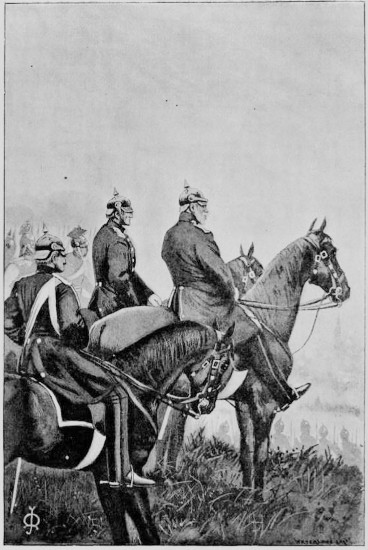
MOLTKE AND HIS MASTER.
When he was past thirty, however, he found an opening for the display of some of his eminent parts; when travelling through the East, he attracted the notice of Sultan Mahmoud, lately engaged in the task of transforming the Turkish army; and Moltke gave him valuable advice, especially on the defence of the Dardanelles and the Bosphorus. Like Eugene of Savoy, it was his fortune also to see war for the first time, as it was carried on by the arms of Islam. In company with a small party of Prussian officers, he was present at the decisive fight of Nisib, which made Mehemet Ali an independent ruler; and it has been said that he recommended a movement which might have made the result of the battle different. Moltke has left a record of these experiences in a series of letters, still of value; but a history from his pen of the Russian invasion of the Ottoman Empire in 1828–29 is the most important monument of this part of his career. The book reveals the nature of the man; it wants imagination and the charm of genius; but it is thoroughly well-informed and full of good criticism; and while it does justice to the powers of Diebitsch, its peculiar characteristic is the minute attention bestowed by the writer on all that relates to the mechanism and organization of the contending armies, and to the geography of the theatre of war. The reputation of Moltke grew by degrees; in the fine words of the Roman poet, it was like the silent growth of a tree; he rose slowly to the rank of general, and he was for some time the first aide-de-camp of the Crown Prince of Prussia, the late Emperor Frederick of no inglorious memory. He made several visits of state with his chief, and has left an interesting account of all that he saw; but his mind was engrossed by what belongs to war; and it is curious to observe that he has far more praise for the steadiness and obedience of the Russian infantry than for the agility and intelligence of the French soldiery, associated in his mind with carelessness and want of discipline.
In 1857 Moltke received the office of Chief of the Staff of the Prussian army. The position was one of the highest eminence; it had been filled by distinguished men; but the names of these are of no significance compared to that of the renowned soldier who has made it famous in all lands. Moltke was in his fifty-eighth year when he was raised to the post; he had never commanded troops in the field, nay, had taken no part in European warfare; and yet he possessed qualities which made his selection for the place a great day in Prussian history, for scarcely a living man so thoroughly understood what were to be the true conditions of war in our time, what its characteristics, and its coming development. We shall perceive this better if we glance at the state of the art during the long period of almost unbroken peace which succeeded Waterloo. For more than thirty years after 1815, every Power in Europe felt the exhaustion caused by the gigantic strife at the first part of the century; and though “the war drum was not hushed,” in the poet’s language, their energies were mainly directed to the great problems, political and social, which had come into question. In this state of affairs they generally reduced their armies; what was more important, they took little heed of all that concerns the military art, and their war offices were, without exception, directed by men whose minds had been formed on the battle-fields of the preceding age. When the Revolution of 1848 passed over the Continent, the Russian army was far the most powerful in Europe; the armies of France, of Austria, of Prussia, of England, had largely declined from their old standards; and the great names of Wellington, of Soult, of Paskiévitch, were typical of the system of unchanging routine, which, in every service, prevailed in high places.
This strong conservatism was not much shaken by the memorable events of the next few years. The military operations of 1848–49 resembled those of 1805–14, except that they displayed less genius; and even the experience of the Crimean War did not produce a wide-spread conviction that a new era in the art was about to open. Nevertheless, throughout those long years since the Peace, forces of all kinds had been steadily at work, which were to affect greatly the phenomena of war, and if not to change the essential truths it teaches, to modify it profoundly in some of its aspects. The population of every State had continued to increase, especially in Central and Eastern Europe; and the rude material, therefore, of military power had been augmented, and was still growing. The resources of most nations had been doubled and trebled; agriculture had made enormous strides; roads and communications had become more numerous; and while this progress, dating from centuries before, had been going on with accelerated speed, a new element of mighty force had appeared in the railway system, which, spreading over Europe, had made the means of transport and of locomotion infinitely more easy, more vast, and more rapid than ever had been known before in history. Though the truth had not dawned on ordinary minds, it had become certain, thirty years ago, that in any great European contest armies would be larger than they had ever been; and the facilities of moving huge bodies of troops, and of munitions and supplies on a prodigious scale, it is now perceived, were to have these results; that the efficacy of fortresses was still further to decline, and that military operations might be more ample, have more celerity, and be more decisive than had been the case even in the age of Napoleon. Other influences, too, had made themselves felt, to be attended with great results in war. The age was one of material inventions; the weapons of destruction used by armies had been almost transformed within a brief period; and appliances of a different kind had, to a certain extent, been turned to account. Rifled cannon and the breech-loading musket had been manufactured and partly employed; these mechanical improvements, it is now apparent, have necessarily led to changed formations and tactics; and the discovery of the field telegraph has, in some measure perhaps, affected strategy. Education, moreover, after the Peace had been generally diffused through Europe, especially in Prussia and Northern Germany; this had greatly increased the self-reliance and the intelligence of the individual soldier; and the result, we can now see, has had a potent influence in the conduct of armies and the arrangements of war.
It was the distinctive merit, I have said, of Moltke, that he appreciated these facts, and all that resulted from them, with perfect judgment and the most sagacious insight. He was deeply versed in the history of war; like every true student of it, he had seen that Napoleon was, by many degrees, the first of captains, and he had the capacity to perceive that the new conditions, especially the development of the railway system, favoured the grand and daring Napoleonic strategy. He grasped the truth, too, that the immense size of the armies in coming European conflicts would lead to more independence in separate commands, and would require a larger number of able chiefs than ever had been the case before; and he saw that preparation was more than ever necessary, the operations of modern war being so quick and decisive. The superiority of a rapid and bold offensive, the advantage of the diffusion of skill in the high ranks of an army, and the value of careful organization and well-planned arrangement, formed, so to speak, his military faith; and, coming to other details, he distinctly declared that the new arms would make the efficacy of fire the greatest element of success, that the importance of mere charges would largely decline, that formations in the field would become more flexible, and less dense than they had been formerly, and that real culture and mental training made a man an infinitely better soldier.
Moltke impressed these principles, which thirty years ago were not generally accepted or understood, on the Prussian army from the first moment, and with what results is now well known. The first great event in this part of his life was the reorganization of the military strength of Prussia, a reform completed in 1860. This vast work was probably due more to the king and Roon than to anyone else; but Moltke, we may be sure, approved of the measures by which the numbers of the army were largely increased and its real efficiency was, perhaps, quadrupled. The new arrangements did not change the bases on which the military power of Prussia rested, the general duty of the subject to serve, and the organization of the army on the local system; but the yearly contingent of recruits was augmented a third, the time for service in the reserve was doubled, and the army, which had become too like a militia by a large admixture of landwehr, was made a completely distinct force, the landwehr forming only its last reserve. The hand of Moltke may be distinctly seen in almost every improvement thenceforward made in this great force, composed, after 1860, of fully half a million of trained fighting-men. Holding fast to the principle that offensive strategy would more than ever succeed in modern war, he directed his efforts to have the Prussian army ready to take the field as quickly as possible, and to be prepared to attack at once; with this object in view, the local arrangement of the national forces was steadily retained, for it assured the rapid assembly of masses of troops; but it was subjected to minute and careful central direction; and elaborate preparations of all kinds were made to secure speedy “mobilization,” and the regular transport of whatever is required for the conduct of a campaign by turning railways and other communications to account. Another great object of Moltke was to provide for general efficiency through all commands, from the highest down to the lowest grades. He had excellent materials for this at hand, in the practised officers who abound in Prussia; and steadily applying himself to his task, he succeeded by degrees in placing the army under the control of capable men, from top to bottom, producing in this way that hierarchy of good leaders which Thucydides declared, two thousand years ago, was one of the secrets of Spartan success; and creating that division of skilful labour which has become a necessity in modern war. Moltke addressed himself, also, to the reforms in tactics which he had foreseen were to be essential; but here his exertions were less successful; he was steadily obstructed by routine and tradition; his own views, probably, were not fully formed, and years were to elapse before the Prussian army was to attain its present excellence in this sphere of the art. The greatest reform, however, effected by Moltke remains to be stated, and had immense results. The Prussian Staff stood high since the days of Frederick; but under the care of its greatest chief, it gradually reached a state of extreme perfection. Divided mainly into two branches, it supplied the commanders of corps with able advisers, trained in strategy, in tactics, in the direction of troops, and in providing for their needs in the field; and it has accumulated stores of knowledge in all that relates to military history, to the geography of war, to the resources and armies of civilized states, which have proved to be of the greatest practical value. Moltke, it should be added, like all true leaders, inspired the army generally with his high aims and spirit; he encouraged the mental training of soldiers and officers, but he paid special attention to order, discipline, and to everything that secures obedience to command.
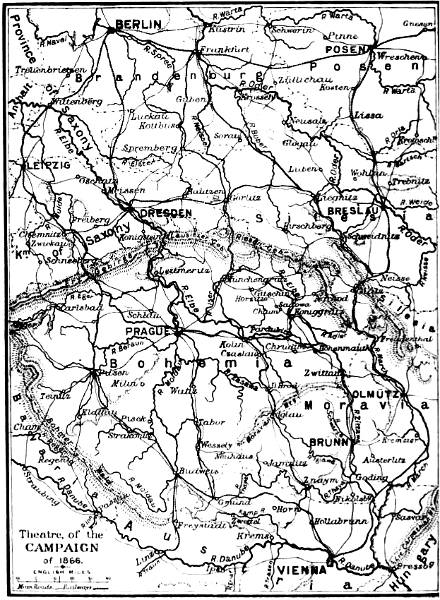
Theatre, of the CAMPAIGN of 1866.
Moltke could never have accomplished these tasks had he not had the all-powerful support of the King, a really able and far-sighted ruler, and a soldier of no ordinary gifts. Within seven years from the time when he was raised to his post, the Prussian army, which since 1848 had fallen low in universal repute, had, under Moltke’s care, become, we know now, unquestionably the first of European armies, as superior to those of every other State as the army of Frederick was to the armies of his day. The time was at hand when the strength and worth of this mighty instrument was to be proved in the field. I pass over the petty Danish war, and proceed to the great conflict of 1866, fought with memorable and lasting results for the Continent. Prussia instantly took a bold offensive attitude, and the celerity with which her main forces were “mobilized” and directed towards the Bohemian frontier, with every requirement to begin a campaign, surprised all who understood the subject. The invasion, too, of the Northern German States was admirably planned and well carried out; and the ability with which a small Prussian army held in check and baffled the whole of South Germany remains a specimen of fine generalship. The distribution, however, of the principal army on the theatre of war to oppose Austria can be praised by the courtiers of fortune only, and is certainly open to grave objections.
On the 15th of June 1866 this huge array, about 250,000 strong, and divided into three great masses, was disseminated along an immense front, extending from the Elbe almost to the Oder, and not far from the main Bohemian range; the right, the Army of the Elbe, being near Torgau, the centre, or First Army, being around Sorau, the Second Army, the left, holding the tract round Neisse. At this moment the chief Austrian army, nearly equal in numbers, reckoning its Saxon allies, was in Moravia, spreading about Olmütz; it held a central position between scattered foes, and it is now acknowledged that it was ready to advance, and could have assumed a decided offensive. It is vain to deny that in this state of affairs it already possessed an immense advantage; and, whatever the cause, the Prussian strategy which gave it this grand chance must be deemed faulty. All the apologies that have been made on this subject will not mislead the true student of war. It has been urged that the dislocation of the Prussian armies was necessary “to cover Berlin and Breslau”; but this argument is of no avail. You should never risk a whole army for such objects, and if you try to defend everything, you run all hazards. It has been said, again, that it was not possible to assemble the Prussian forces in any other way, regard being had to the lines of railways; but that is no reason why the three armies should have been distant from each other near the Bohemian frontier. Lastly, it has been alleged that the superior quality of the Prussian troops, if considered, excuses their chiefs; but this superiority had yet to be proved; and any operation, however defective, may be justified by this kind of reasoning. The examples set by really great captains show what Benedek—a good soldier, but unfit to command a large army—might have accomplished at this conjuncture. Napoleon, in the place of the Austrian chief, would have made for the salient of the Bohemian hills—would have debouched through the passes into the Saxon plains, and holding the army of the Elbe by a detachment in check, would have fallen in superior force on the First Army, and then would have turned victoriously against the Second Army, which, thrown forward into Upper Silesia, might have been cut off from its base and destroyed. Turenne, less daring but more safe, would have advanced to the southern verge of the Bohemian range, and, occupying the position he always sought to gain, would have invited the attack of his divided enemies, and interposing between them would have beaten them in detail. In either case, the Prussians should have been defeated; and, indeed, why they were placed in this way on the theatre has never yet been really explained.
On the 16th of June the Army of the Elbe entered Saxony, and had soon seized Dresden; and about the 20th it had nearly joined hands with the First Army which, under Prince Frederick Charles, had been moved close to the Bohemian frontier. The Prussian right and centre were thus almost united; but the left, commanded by the Crown Prince, which had advanced from Neisse towards the passes near Glatz, was isolated from its supports, and at a great distance; and if the invaders were not in immediate danger—for Benedek had only begun to move—their strategic position remained critical. In this situation the Prussian armies, now practically two, not three masses, were directed to pass through the range, and, approaching each other, to effect their junction around Gitschin, a point considerably to the south of the hills, not far from where Benedek had some troops, and where he might have had five-sixths of his army. This strategy was exactly the same in kind as that which had proved fatal in 1796, when attempted against the chief of Rivoli; and the excuses that have been made for it are weak and baseless. Two large armies, such as those of Prussia were, though far from each other, are no doubt in less peril if they invite the attack of a single army equal to both in strength, than two small armies would be under like conditions, and this would specially be the case where, as in the present instance, the field of manœuvre was somewhat contracted. All this, however, proves no more than that the converging movement of 1866 was less to be blamed than that of Würmser; it does not show that it can be justified, and the experience of ages clearly condemns it. Benedek, who broke up from Olmütz on the 17th of June, might have reached Gitschin with the mass of his forces before the Prussian armies could have come into line; and in that event he would have had at least an opportunity to fall on his divided enemies, and to achieve success, more or less important. Unfortunately for himself, however, the Austrian chief was unable to seize the occasion before him; instead of turning his central position to account, and advancing northward with all his corps in hand, he adopted half-measures of extreme feebleness. He sent a detachment only, comparatively small, to hold the Prussian right and centre in check. He struck at the Prussian left with inferior forces, and he hung back himself with the mass of his army, irresolute, hesitating, and, at best, inactive.
The result was what might have been expected. Clam Gallas and the Saxon contingent were overpowered by Prince Frederick Charles, who attacked with largely superior forces; the Crown Prince, as he emerged from the defiles, defeated with ease the three hostile corps opposed to his much more powerful army, and though the issue was partly due to the excellence of the Prussian infantry, and to the efficacy of the arms they wielded, it is chiefly to be ascribed to the grave faults and the shortcomings of the Austrian leader. The victorious armies, though still far apart, now advanced along the heads of the Iser and the Elbe. The Austrians, beaten and demoralized, slowly fell back; and yet such was the inherent advantage of the central position still held by Benedek, that had he known how to make a true use of it he might even yet have turned the tide of ill-fortune. By the 29th of June he had his army nearly united; the two Prussian armies were leagues from each other, and part of the First Army was dangerously exposed; and it has been justly remarked that had Benedek boldly attacked Prince Frederick Charles on this day, he ought to have won a real victory, and, in that event, he would still have had a chance to strike and defeat the Crown Prince of Prussia. As is well known, however, the ill-fated chief did not attempt an offensive return, and continued his retreat until he had passed the Bistritz; here, like Daun, he took a position of defence, and he passively awaited the onset of his foes, anticipating already impending ruin. Yet even at this moment, had he been a general of a high order, he might perhaps have triumphed. I have no space to describe the great day of Sadowa; it was, no doubt, a splendid and decisive victory; but the operations of the Prussians once more gave their enemy an advantage which he might have seized, and turned to account with immense results. The First and Second Armies remained still divided; for many hours on that eventful forenoon, an almost insignificant force was opposed to the mass of the Austrian army; and it was only when the Crown Prince reached the field, at about 2 P.M., and was able to attack, that the chances of the battle became equal, and that success was made even possible. Had Benedek at any previous moment fallen in full force on Prince Frederick Charles, it is difficult to suppose that the Austrian chief might not have, at least, averted defeat.
The campaign of Sadowa is a striking instance how generals who steadily carry out ably a plan essentially faulty in itself may defeat a commander who waits on his foe, and cannot take the initiative or seize the occasion. In justice, however, to a departed veteran, let us say that the Prussian army was, in most respects, very superior to that arrayed against it; the Austrian army was crowded with discontented levies; the Prussians, too, possessed a breech-loading rifle, the fire of which had great effect, though it is idle to contend that it decided the war; and these facts told in the final issue. As for the Prussian strategy, it was not good. We can imagine the shades of Turenne and Napoleon indignant that a violation of their art should have been followed by ill-deserved success; and if Moltke really directed these operations of 1866, his first essays in war are not admirable. The movements, however, which led to Sadowa are almost identical with those of Frederick in Bohemia in 1756–57; and I cannot help conjecturing that King William—his reverence for his ancestor was a kind of worship—was in a great measure their true author, though those of Frederick have been condemned by Napoleon with no uncertain censure.
After the events of 1866, it became apparent that Prussia and France would ere long quarrel; and I must say a word on the preparations made by the two Powers before the impending conflict, and on their military resources when it at last broke out. Northern Germany was practically added to Prussia; treaties were made with the Southern German States; the unity of Germany for war was well-nigh accomplished; and the German armies which could be brought into the field, more or less organized on the Prussian model, reached the enormous number of a million of men, 500,000 forming the first fighting line. Extraordinary attention, moreover, was given to the improvement of the instrument of war which had crushed the power of Austria in three weeks, and to the removal of every defect which had been discovered in it. The “mobilization” was made more effective; the experience of 1866 was turned to account to make the evolutions of foot more quick and exact, and to adapt infantry tactics to modern arms. Great pains were taken to reform the cavalry, which had been scarcely equal to the fine squadrons of Austria, led by the brilliant Edelsheim, and to give it celerity and strength in the field; and the artillery, it may be said, was transformed, old smooth-bore guns being finally condemned, and artillery tactics being greatly changed by abandoning the system of huge reserves of guns—a tradition of the Napoleonic era, but obsolete under the new conditions of war—and by directing every battery that could be made available as quickly as possible to the front of battle. By these means the Prussian army of 1866 was expanded into the vast German army which overran France from the Rhine to the Loire; and the hosts which triumphed at Metz and Sedan were infinitely more formidable in all respects than that which had overwhelmed Benedek.
Let us now turn to the attitude of France, in view of the contest known to be imminent. Napoleon III. and one or two French chiefs had not failed to observe the immense increase of the military power of Prussia and Germany; and they perceived how enormous was the importance of the great trained reserve of the German system, which had nothing corresponding to it in their own. The Emperor and Marshal Niel accordingly proposed that the nominal reserves of the French army—masses of men on paper—should be in some degree disciplined, and that the Garde Mobile, a new force, should be formed; and had this been effected the military power of France would have been largely augmented, though it would have been still very inferior to that of Germany. Tradition and faction, however, prevailed; a reform, of which Napoleon had laid down the lines at St. Helena fifty years before, was disregarded and not carried out; and the strength of France for war was left as it was, that is, miserably weak compared to that of Germany. This difference was in itself immense, but there were other differences of perhaps equal moment. France was not prepared for a great modern war; her military organization was out of joint; she had not had a good Minister of War since Soult; her chiefs, formed for the most part in Africa, had little strategic or scientific knowledge; she had nothing resembling the Prussian Staff, the brain of the army, as it has well been called; she had not in her service the perfect gradation of united commands which was one secret of the success of Prussia in 1866. Her whole military hierarchy, and all that depends on it was, therefore, in far from a good state; her chiefs had no settled convictions in war, and were divided upon the great question whether the offensive or defensive was the better strategy; and, besides that it was weak and without a real reserve, the condition of her army was very defective. It was, no doubt, a fine professional army; but it had been injured by the system of commuting service; it had many bad and worn-out soldiers; it had not been practised in manœuvres in the field; it had not anything like fixed rules of tactics; and though its infantry possessed an excellent rifle, much better than the needle-gun of Prussia, and its cavalry was a noble arm, its artillery was very inferior to that of the Germans. The most marked distinction, however, between the two nations in their capacity for a campaign has yet to be noted. The railway system of Germany was designed for war; that of France was formed on no such principle; the local system of Prussia made it quite certain that the German army would be placed in the field more quickly than that of France could be under her centralized and ill-arranged system; and these two circumstances, little perceived at the time, were of extreme if not of decisive importance.
The general result of this state of things was that Germany could “mobilize” and send into the field half a million of men, backed by enormous reserves, well organized, disciplined, trained, and commanded, within three weeks after a declaration of war; that France could hardly assemble three hundred thousand soldiers, unsupported by any solid reserve, ill-prepared, and under inefficient chiefs; and that, in point of time, she would be far behind her enemy. There was no comparison, therefore, between the two powers, and France had scarcely a chance of success, though if her military strength had been well directed, she need never have signed the Treaty of Frankfort. The conflict began in July 1870. Napoleon III., the mere shadow of a mighty name, assumed the command of the French armies, and his plan was to advance from behind Metz and Strasbourg, to cross the Rhine between Spires and Landau, and to interpose between the South and North German forces, which, it was assumed, would not be ready in time, and divided. The project, the Emperor has told us himself, was founded on that of his uncle in 1815; but Moltke had foreseen and provided against it, and it is useless to examine a mere scheme on paper, which was no sooner conceived than it proved abortive. Napoleon III. calculated that he would have 250,000 men round Metz and Strasbourg ready to march, with 50,000 in immediate reserve; but he had little administrative power or resource; the existing system of France proved inefficient; her organization for war broke down, the “mobilization” of her troops was slow and partial, and when the Emperor reached Metz in the third week of July, he had not assembled 200,000 soldiers, and these were hardly in a state to take the field. This was very different from that prodigy of skill, the concentration on the Sambre before Waterloo; and in these circumstances, the unhappy sovereign ought to have renounced a hopeless offensive, and to have placed his army on the line of the Moselle, in order to defend the Vosges and Alsace, a course which Moltke believed he would take. But the Emperor thought he had no choice. He was goaded on by opinion in France; the folly of allowing politics to master strategy, one main cause of the disasters that followed, had already begun to produce its results; and he advanced to the frontier with forces, compared to those of the Germans, pitiably weak, and but ill-provided with all kinds of requirements. When he had attained Alsace and the Sarre he paused, afraid to strike, but he felt that he was not in nearly sufficient strength, and, waiting on his enemy, he allowed his army to be disseminated upon a vast arc, extending from Thionville to the gap of Belfort, and dangerously exposed along its front.
The conduct of Germany and of the German chiefs contrasted most strikingly with this exhibition of maladministration, feebleness, and incapacity for war. The contest, Frenchmen thought, was a mere affair of “glory”; in Germany it caused a great national rising for unity and independence, and to avenge Jena. The Teutonic race sprang fiercely to arms; the feuds between North and South Germany ceased; the orders for the “mobilization” of the German armies were carried out with wonderful skill and precision, and more than 300,000 men, with great reserves behind, were in a few days arrayed on the frontier, an astonishing result of patriotism and organization for war, partly due to a well-planned railway system. Three great armies were now quickly formed. This time Moltke certainly had the general direction of operations in the field, and he instantly assumed a determined offensive. The situation dictated his plan; there was nothing original in it, as has been said by flatterers. In fact, it was that of Marlborough in 1705, and it had been actually laid down by Gneisenau; it consisted, simply, in invading France from the Palatinate, along her most exposed frontier, but it was executed in the main ably, and with conspicuous forethought and vigour. The First Army, led by the veteran Steinmetz, advanced from Treves towards the Lower Sarre; the Second, under Prince Frederick Charles, moved from Mayence through the German Vosges; and the Third, commanded by the Crown Prince of Prussia, marched across the Rhine and attained the Lauter, the three masses acting well in concert. The poor affair of Sarrebruck only quickened the movement; and, in the first week of August, a great tempest of war burst over the verge of Lorraine and Alsace. The first efforts of the Germans were, no doubt, premature; Frossard might have gained some success at Spicheren had he been seconded by the corps in his rear, and the impatience of the invaders, and of one or two of their chiefs, precipitated the well-fought battle of Wörth. Moltke, however, is not to be blamed for this; he was far away from those scenes of action, and his strategy completely attained his object, though his subordinates made more than one mistake. As for Wörth, it does honour to the arms of France; on that day 45,000 Frenchmen held double their number, for hours, at bay; and the issue might have been very different had De Failly come into line, as was possible. Macmahon, however, a soldier but no chief, cannot escape blame for not having drawn off his troops while retreat was still open and safe, especially when the great superiority of the enemy in force and in artillery had become clearly manifest.
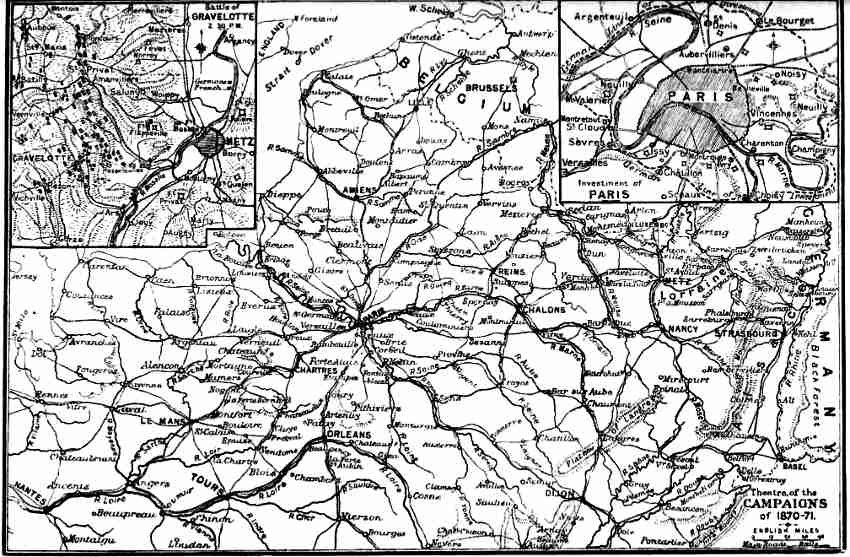
Theatre of the CAMPAIGNS of 1870–71.
Spicheren shattered the front of the French army—it had been named the Army of the Rhine; and Wörth forced its right wing in confusion and rout far to the south, in eccentric retreat, laying bare the defeated centre and left. Napoleon III. fell back with his beaten forces; and the next few days, big with the fate of France, witnessed a wretched succession of divided counsels. It was proposed to attempt a stand on the Nied, in Lorraine, to join Macmahon, or to call him up to Metz; but all that was done was to retreat on the fortress, to cause a weak reserve to advance from Châlons, and to impair the moral worth of the French soldiery, when ill-led, never great in misfortune. Meanwhile, the hosts of the invaders, largely reinforced, were moving slowly through the passes of the Vosges; the First and Second Armies filling the tracts between the Sarre, the Nied, and the Seille, the Third Army far to the south, round Nancy; and, whatever may be said, ample time was given to their enemy to make good a retreat westward. This movement was not arranged until the 12th of August, a precious week having been thrown away; and the Emperor handed over his command to Bazaine, a chief, whose antecedents had, at best, been doubtful, with a general direction to fall back on the Meuse. Moltke’s plan of operations became now developed; the First Army was moved towards Metz, in order to detain the retreating enemy; part of the Second Army was pushed across the Moselle, its march screened with remarkable skill; and the Third Army made a step westward, the object being to force the Army of the Rhine into the north of France, and to cut it off from Paris.
Steinmetz attacked Bazaine on the 14th of August. The battle was stern and well contested; but it kept the French back for a whole day, and it facilitated, as was intended, the forward movement of the Second and Third Armies, which was Moltke’s object. A great mistake, however, was here made; the German chief believed that the Army of the Rhine was already far to the north of Metz; but Bazaine was moving directly westward, and on the evening of the 15th he had his whole army, at least 140,000 strong, concentrated along the roads that lead from Metz to Verdun, by Mars La Tour and Etain. One German corps only was on the spot; Prince Frederick Charles, no doubt unaware of the immense superiority of his enemy in force, attacked on the morning of the 16th; and had Bazaine had any skill in war, he ought to have swept his assailant from his path. The Marshal, however, could not handle an army; he kept the Imperial Guard inactive near Metz, he made little use of two of his corps; the hard pressed Germans were reinforced by degrees; a magnificent effort of the German cavalry had a marked effect on the fortunes of the day; and evening fell on a scene of carnage, in which neither side could lay a claim to victory. The result proved the ascendency won by the Germans, and was for them a splendid passage of arms; but the effects of Moltke’s error were not yet got over—it was like that of Napoleon before Auerstadt—for, as I have remarked, the campaign of 1870 resembles that of Jena in many respects; he had not 80,000 men in hand, and Bazaine had still a strategic advantage, from which a real chief would have at least plucked safety. As Prince Frederick Charles has said, he should have attacked on the 17th; and in that event he ought to have won a battle, or, at all events, have made good his way to Verdun, a result which would have given a new turn to the war. A much grander game, however, was open to him; and a German commentator—Moltke, I suspect—has remarked that Napoleon would have played it, and have perhaps gained important success. On this day, a decisive moment in the campaign, the First Army was still east of Metz; the Second Army was partly west of the Moselle; the Third Army was leagues away to the south; and the communications of the invaders would be dangerously exposed, could an enemy descend from Metz on Nancy. Had Bazaine, therefore, fallen back on the fortress, and issued from it in force on the 18th, advancing between the Moselle and the Seille, he ought to have been able to seize and hold the line of operations of the hostile armies, and the consequences must have been very great. He might have stopped the invasion, perhaps for weeks; he would have certainly saved himself and his army, and the situation would have been wholly changed.
Unhappily for France, she had not a captain who could seize the one great occasion given by Fortune in the first part of the war of 1870–71. Bazaine, a soldier fit to command a division, but utterly unable to direct large masses, had experience of the power of modern arms, and he had a fixed belief that mere defensive tactics were the means to assure success in battle. He resolved, therefore, to stand and to fight; and he arranged his forces, still 120,000 strong, along a range of uplands, from near Metz on the left to St. Privat and Roncourt on the right, which formed a fine position for a passive defence, the system on which the Marshal relied. Moltke, on the 17th, drew together the greater part of the First and Second Armies across the Moselle; the huge masses, probably 210,000 men, were west of Metz on the morning of the 18th, intercepting, a retreat to the Meuse and Verdun; but, strange as it may appear, the German commander was still ill-informed of his enemy’s movements; he believed that Bazaine was falling back northwards, and when he discovered where the French were, he was convinced, for some hours, that the positions they held did not extend nearly as far as Roncourt. This and other mistakes dispose of the theory that Moltke is a kind of Providence on the field, gravely asserted by certain worshippers of success, and tend to show that German reconnoitring may be less perfect than has been said; but fools only can claim omniscience for chiefs; and, in fact, under the new conditions of war, with its vast operations and its immense battles, the ablest captains will fall into error more frequently than has been the case formerly.
Partly owing to the miscalculations of the German leader, and partly to tactics essentially false, the tremendous battle of the 18th of August—known to history by the name of Gravelotte—was undecided up to the last moment, large as was the superiority of Moltke’s forces. The assailants, thinking they were turning the French right, fell in front on the centre strongly entrenched, and failed to make the slightest impression on it; Steinmetz, on the German right, made repeated charges, in the close columns of the days of his youth, and the First Army suffered enormous losses. The Prussian Guard, too, were cruelly stricken in an attempt to carry St. Privat by storm; indeed, until near nightfall, the Army of the Rhine had a marked advantage along the whole line of battle; and had it been able to make a grand counter-attack, especially when the right of its foe was shattered, it not improbably would have achieved success. At last, however, the inherent vices of a passive defence became manifest; the German chiefs, given the offensive all through, and allowed to search the positions of the French everywhere, brought their masses to bear against the extreme French right; Roncourt was carried by a great turning movement; the whole position became untenable, and the French army gradually fell back on Metz. Yet no doubt can now exist that had Bazaine been a capable chief on that terrible day, the battle would have been at least drawn, inferior as were his troops in numbers, and, in some degree, disheartened by defeat. Had the Imperial Guard, as was quite possible, been moved to the aid of the French right, the last effort of the Germans must have failed; and in that event the contending armies would have retained their places on the field unchanged. The Marshal, however, unequal to his task, and thinking only of merely holding his ground, kept this noble reserve near Metz unengaged; and 20,000 men were left out of the struggle who could have turned the balance in the scales of Fortune. Gravelotte, in truth, is a notable instance how a resolute offensive, even though ill-conducted, may, notwithstanding the arms of the age, prevail over passive tactics of defence; the attack on the French right, made at the last moment, after many mistakes, gained decisive success; and all the efforts of an army which had not the means to attempt at any time a counter-attack, and simply waited in position on its foes, proved ultimately fruitless, though for hours hopeful. The battle, the student of war will note, has a strong resemblance to that of Malplaquet; but the operations of the Germans are not to be compared in skill to those of Marlborough and Eugene; and the tricolour was defended by a very different chief from the illustrious warrior who upheld the lilies.
Within two or three days after Gravelotte, the German armies had closed around Metz and the army of Bazaine, which had clung to the fortress. The left wing and centre of the whole French army were thus, so to speak, removed from the theatre, at least for active operations in the field; and, notwithstanding mistakes and shortcomings, the plan of Moltke, if not realised, had been attended with more than expected success. The right wing, half destroyed at Wörth, remained, and we turn to the movements of this force, on which the fortune of France for the time depended. Macmahon had been joined by De Failly and his troops, by the corps which had been placed at Belfort, and by a new corps despatched from the capital; and by the 20th of August the collected array, numbering from 120,000 to 130,000 men, was assembled around the great camp of Châlons. The Marshal was in supreme command; he properly resolved to keep the only army now left to France to defend Paris; but as Bazaine conceivably might be not distant, he marched on the 21st to Rheims, holding a position on the flank of the German invasion, and in the hope that his brother chief might approach, but with the determination to fall back on the capital. This was in conformity with the principles of war; and had Macmahon kept firm to his purpose, the catastrophe that followed would not have happened, and France would not have mourned for the extreme of disaster. Unfortunately, however, the Duke of Magenta, a hero in the field but a weak man—the character is by no means uncommon—was led astray by pernicious counsels; Palikao, a new Minister of War, whose chief thought was for the tottering Empire, and to satisfy the desires of Paris, insisted that Metz must be relieved; and he urged Macmahon to advance to the Meuse, to slip outside the flank of the hostile armies, and descending from Montmédy on the beleaguered fortresses, to join hands with and to extricate Bazaine, and to strike a bold stroke for a decisive victory. In an evil hour for France and himself, the marshal gave ear to a fatal project, as reckless as ever was made in war; for the march to the Meuse, and thence as far as Metz, would be a flank march of the most hazardous kind, the enemy holding the chord of the arc; it would be a march perilously near the Belgian frontier, where a lost battle would mean ruin; it was a march to be made by an enfeebled army in the midst of the victorious Germans, threefold in numbers; above all, it was a march which would draw away from Paris, the centre and vital point of the national defence, the only organized force that remained to protect it. Macmahon, it is said, was still doubting—he knew that the course proposed was insensate, not strategy, but the throw of a gambler—when an ambiguous message sent by Bazaine, and implying that he was on his way from Metz northwards, at last caused the luckless commander to yield. Once more the plainest military rules were sacrificed to political ends; and once more Bellona, who brooks no rival, was, so to speak, challenged and wildly provoked. The army of Châlons broke up from Rheims on the 23rd, and it was on the Upper Aisne on the 25th, approaching the region of defiles and forests, which extends from the Ardennes to the Meuse. Macmahon spared no effort to make the movement rapid, for celerity he knew was his only chance; but the march of his army became slow, and by the 27th it was still far from the Meuse, in the tract between Tourteron, Le Chêne, and Buzancy. It had already begun to shows signs of weakness; it was ill-provided and badly organized; the soldiers were discontented and ill-disciplined, and the mind of its chief was full of misgivings.
I proceed to the operations of the German armies, very different from those of their ill-directed enemies. The main body of the First and Second Armies was required for the investment of Metz; but three corps, called the Army of the Meuse, were detached to co-operate with the Third Army, by this time west of the Moselle, in the borderlands of Lorraine and Champagne; and the converging masses, 230,000 strong, advanced steadily upon a broad front towards the heads of the Marne and the great roads to Paris. By the 24th of August, the cavalry outposts which preceded the movement had ascertained that the Army of Châlons had left Rheims, and was on its way to the Aisne eastward; but Moltke refused for some time to credit the rumour that it was making for Metz, for this, he rightly thought, would be the height of folly. He learned the truth, however, positively on the 25th, and his resolution was formed with that prompt decision which is a characteristic of real chiefs, and has been exhibited by him at grave crises. The measures he took to baffle Palikao’s scheme were not wonders of genius, as has been said by flatterers, but they show true insight, and most comprehensive judgment; and they were carried out with consummate skill. The Army of the Meuse was directed to recross the river; two corps were detached from Metz to join it, and to stop Macmahon should he get near the fortress; and the Third Army was ordered to advance northwards through the district of the Argonnes and the Ardennes—the scene of the campaign of Valmy—and to gather on the flank and rear of the Army of Châlons, which would thus be placed in a difficult strait at least. The execution of this fine strategic movement was admirable in the highest degree; the great invading hosts, ruled by one master’s will, well-led, supplied, and trained for the field, marched with speed and precision through an intricate country, and the careful preparation, the organization for war, the perfect unity and gradation of command, and the intelligence of the individual soldier, which are distinctive marks of the army of Prussia, were made fully and grandly manifest.
By the 27th of August the German squadrons were gathering rapidly upon their foes; Macmahon, though without the least notion of the enormous force that was closing round him, perceived that his army was in grave peril, and he gave orders for a retreat on Mézières, hoping to attain Paris by a march from the frontier. For the second time, however, the incapable chief succumbed to the temptation he should have spurned. A message, that “revolution would break out should Bazaine be abandoned at Metz,” induced him to continue the advance to the Meuse, and to court the ruin which he knew was probable; and it is but just to observe that Napoleon III.—he accompanied the Marshal since he had left Châlons—protested against conduct which was almost criminal.[31] Macmahon now tried to make a forced march; his army was divided into two great columns, in order to make its movements rapid, and the first column reached the river safely, and had crossed it by the 29th of August. The second column, however, was far to the south, and separated by a full march from the first; it was largely composed of beaten troops, already desponding, nay, half-mutinous; it was charged with impedimenta of all kinds, and it toiled slowly through the passes and thickets it had to traverse on its way to the Meuse. This gave Moltke the opportunity to strike; the Army of the Meuse was recalled to the west of the stream, the two corps from Metz having been sent back; a part of the Third Army was pushed forward, and the Germans fell with terrible effect on their enemies, caught in flank and surprised, at Beaumont and other places in their march. The second column was routed with immense loss; it reached the Meuse a mere shattered wreck, pursued by the indefatigable Prussian horsemen; and its ruin involved a part of the first column, which crossed the river to give it support. By the evening of the 30th the Army of Châlons, one corps of it as far as Carignan, was on the eastern bank of the Meuse, but half of the French troops were a demoralized mass; and the German advanced guards were already at hand, in close communication with the hosts in their rear.
Macmahon, at this time, was at Carignan; he confidently expected that he would reach Metz; he boasted, it is said, that victory was at hand. The news of the events of the 30th dispelled these dreams; he hurriedly fell back with his one intact corps, and by the morning of the 31st he had assembled the still large, but beaten, Army of Châlons in the tract that surrounds the fortress and town of Sedan. The state of the French troops was of the worst omen; but an occasion was still open to a great chief, to extricate them from impending ruin. Mézières was not distant, and a French corps had reached the place to support the Marshal; the Meuse spread between his army and the foe, and had he left his impedimenta behind, and made a rapid march, without the loss of an hour, he would certainly have escaped with the great mass of his forces. It is this circumstance which makes the strategy of Moltke inferior, fine as it was, to that which shut up Mack in Ulm; and the Grand Army, it will be borne in mind, had been saved on the Beresina when in far worse straits. Macmahon, however, would not stir from Sedan; there is reason to believe he never knew the immense strength of the hostile force, and he arrayed his army, “ready,” he said, “to fight,” along the uplands, encircled by streams and villages, which overlook Sedan and the valley below. The evening of the 31st had come; the German horsemen made the situation known; and Moltke, who up to this time had only hoped that he might succeed in forcing his enemy across the frontier, saw that he could reckon on a decisive triumph. Orders were issued for an immediate night march; the great German divisions, perfectly led, and the men scenting approaching victory, moved rapidly over the space between, and preparations were made to assail and surround the feeble and shattered Army of Châlons.
It is unnecessary to retrace the scenes of Sedan, the just retribution of foolishness in command, a battle decreed by Fate, in its irony, to be fought around the birthplace of Turenne. The French were first attacked, on that fatal morning, on their southern and eastern front towards the Chiers; and they made for a time a gallant resistance, though the fall of Macmahon and a squabble between two of his lieutenants had a bad effect on the troops. By degrees, however, the overwhelming pressure of forces immensely superior told; the line of defence on the Givonne was carried; and the French were driven back, on Sedan, routed, and huddled around the walls of the fortress. Meanwhile a tremendous attack had been made on the northern and western fronts of the defence; the Germans advancing to the heights of Illy, and moving from the opposite side round the bend of the Meuse, which half encircles the outskirts of Sedan, closed gradually round their doomed foes; and though the French cavalry made heroic efforts, and one corps nobly struggled to the last, it was impossible to withstand overpowering numbers. The last remains of the Army of Châlons were forced, like the first, against the fortress; the German artillery—throughout the campaign it had proved an arm of enormous strength—was brought to bear in masses on the perishing wreck; the fire of 500 pieces searched the scene of carnage; and a white flag soon announced that resistance, no longer possible, had completely ceased. Within a few hours 85,000 men, the survivors of more than 120,000, the victims of worse than insensate leading, were a collection of helpless prisoners of war; and their cries of impotent fury and despair—this was the attitude of by far the greater part—only provoked the pitying scorn of the victors.
This immense disaster, added to that of Metz, all but destroyed the military power of Imperial France on the theatre of war. Moltke had acted harshly at the capitulation of Sedan; he had no respect for the French character; like Hannibal and Napoleon, he treated the force of patriotic passion with contempt; and, leaving a considerable detachment behind, he directed an immediate advance on Paris. The German armies rolled steadily onward, through the valleys of the Aisne, the Oise, and the Marne, masking fortresses and occupying points on their way; and they appeared before the capital on the 19th of September, the chiefs convinced they would meet no resistance. Their expectations seemed about to be realised; an attempt to assail the invaders in flank, as they gathered upon the uplands south of the Seine, was easily defeated, and had bad results; and the Germans were permitted, without a further effort, to surround and invest the beleaguered city. Their lines, constructed with skill and forethought, spread on a circumference of great extent, from the confluence of the Seine and the Marne, by St. Denis, round through Versailles to Bonneuil; and though the besieging forces were at this moment not 150,000 strong, no doubt existed in the German camp—it was, indeed, the general belief of Europe—that a few days would see the surrender of Paris.
Weeks, however, passed, and it became apparent that this calculation was a complete error. The Empire had fallen on the 4th of September; a Government of national defence had been formed; and this Revolution, in the main caused by the passionate wrath of the great mass of the citizens, quickened the general resolve that the capital should hold out, and confront the power of the German armies. Preparations had been made to stand a siege; immense supplies of provisions had been stored; the enceinte and the forts which protect the city had been hastily manned and armed; enormous bodies of men had been assembled to take part in the defence of the place; these were supported by a corps of trained soldiers, and by the corps which had appeared at Mézières, and had been brought back after a skilful retreat; and though these arrangements were rude and imperfect, the strength of the city to resist attack was infinitely greater than Moltke had supposed. Sorties began to be made by degrees; these, though always repulsed, were not contemptible; the armament of the forts was completed; redoubts and entrenchments rose at many points to strengthen and to perfect the zone of defence; the citizens, warlike in all ages, though in peace addicted to pleasure and ease, acquired gradually something like discipline; the materials at least of armies were formed, and Paris assumed the aspect of a huge fortified camp, with a garrison certainly immense in numbers. Moltke took pains to secure his position; he tacitly admitted that he had made a mistake in marching on the capital without having his communications or his base assured, and with forces comparatively small; but he held his ground with determined constancy; he summoned reinforcements to head-quarters, and several corps were employed in besieging Strasbourg and other strongholds on the way from the frontier, and in overrunning Burgundy and Franche Comté. The front and lines of the invasion were thus strengthened; and, though time had passed, the submission of France was held to be a fact of the immediate future. The German chief was to be again deceived, as many warriors had been before, in his estimate of a people, great and heroic, despite of many national faults and failings. It is all very well for the Prussian Staff to sneer at Gambetta, as it has done in its book; but he was a man of great powers, if of real shortcomings; and he was but the most striking figure of millions of Frenchmen. A great and sudden national rising took place; it was more spontaneous than that of 1793; in an incredibly short time 250,000 men were in arms to resist the German hosts; and by making use of the resources of France for war—old soldiers, troops in depôts, and reserves—vast arrays were mustered, which at least contained the elements of real military power. These levies, of course, were bad soldiers, but they were formidable in numbers and in aptitude for war; and, whatever may be said, the position of Moltke had become critical as October was closing; the German armies were, for the most part, engaged on the investment of Paris and to the east of Metz; they were conquerors, and had all the power of success; but they were exposed to attack from within and without at the centres to which they were, as it were, bound; and they were in the midst of an immense insurrection spreading all round.
At this conjuncture, a great disaster showed that Fortune was still most adverse to France. Bazaine had been shut up since Gravelotte at Metz; he had kept his army almost inactive, and he had made no real effort to break the investment. I cannot examine the crooked intrigues in which he played an ignoble part; but he surrendered the great fortress on the 28th of October, and the world beheld the most disgraceful capitulation ever known in war. Even on his pitiful system of passive defence, the Marshal did not nearly do his duty; the place could have held out a fortnight longer, and the respite would have been of extreme importance. The First and Second Armies were now set free to take part in the great invasion; several corps were sent to the north, to crush levies formed in Normandy and other provinces. One was despatched to support the siege; and the remainder, under Prince Frederick Charles, held the tract between the heads of the Seine and Burgundy. The grasp of the Germans on France was thus greatly strengthened; yet the position of Moltke was so unsafe that it was endangered by a single trifling reverse. An army, partly composed of good troops, but in the main of improvised levies, had been assembled south of the Loire; it had been placed in the hands of D’Aurelle, a veteran of real organizing skill, and in a few weeks it numbered 60,000 men, and had acquired something like military worth and power. A Bavarian detachment, perhaps 20,000 strong, and a division under the Grand-Duke of Mecklenburg, sent off to put down insurrection in the west, were the only hostile forces between this large mass of Frenchmen and the lines round Paris; and D’Aurelle, aided by a young chief, Chanzy, who was to prove that France had yet real captains, resolved to attack the Bavarians and to retake Orleans, which had fallen into the enemy’s hands. The Army of the Loire broke up from its camps, and crossed the river in the first days in November; it fell on the Bavarians near the little town of Coulmiers. Had the orders of Chanzy been well carried out, and a turning movement been completed in time, the invaders must have been utterly routed; but, as it was, they were beaten with loss; and they were compelled to fall back on the roads to Paris, abandoning Orleans and the adjoining region.
When this intelligence arrived, unfeigned alarm prevailed at the German head-quarters at Versailles; the besiegers were threatened by an army of relief, and by the unknown multitudes of armed men in Paris; and disseminated as they were on an immense circumference, they were in a situation of no common peril. Moltke made up his mind, as became a true chief; he despatched pressing orders to Prince Frederick Charles to hasten to the capital by forced marches; and, like Bonaparte before Mantua—a Journal, said to be his, alludes to this—he resolved, whatever the result, to raise the siege should the Army of the Loire appear from the south. This single circumstance shows how precarious the position of the Germans had become; and had D’Aurelle boldly followed up his success the consequences to France might have been momentous. Chanzy, it is known, was for the more daring course; Napoleon would have taken it, I cannot doubt; and though it is idle to speculate now, the siege would certainly have been given up and the war would have taken a different turn. D’Aurelle, however, refused to advance; he constructed a great entrenched camp near Orleans; and here he increased and trained his levies, hoping before long to resume the offensive. This, probably, was too great caution; but there were reasons for the step of real weight. Prince Frederick Charles was but a few marches off, and should he reach the flank of the Army of the Loire, on its way to the capital, he would perhaps destroy the best organized force possessed by France. This clearly shows that had Metz resisted, and detained the Prince only a few days longer, the French chief would have had, and perhaps would have seized, an admirable occasion offered by Fortune; and, indeed, a German writer has drily remarked that “the capitulation came in the very nick of time.”
The victory of Coulmiers sent a thrill through France, enormously increased the power of Gambetta, and caused levies to flock to the war in thousands. Notwithstanding the fall of Metz, and all that followed from it, the situation of the Germans was still critical; and owing to the undoubted strategic mistake of marching on Paris with too weak a force, their movements had been incoherent, and far from masterly. By the close of November the Great City had formed three armies out of her armed multitudes; and two of them, probably 150,000 strong, had acquired a certain degree of efficiency; the third, perhaps 200,000 men, being only fit to defend the ramparts. I cannot describe the great sortie which followed; Ducrot crossed the Marne and carried two villages, which had been made part of the besiegers’ lines; but ultimately he was compelled to retreat; and, in fact, the effort was doomed to failure, for the zone of investment and the zone of defence had by this time become all but impregnable, or could be mastered only by the art of the engineer. The sortie from Paris was contemporaneous with an advance of the army of D’Aurelle’s northwards; but here Gambetta unhappily intervened, and his meddling and presumption did enormous mischief. The young civilian had done, no doubt, great things, but since Coulmiers, he had become a kind of Dictator—the history of France has too many examples how foolish hero-worship has such results—he insisted that the Army of the Loire should make for the capital, whatever the risk, though Prince Frederick Charles was near at hand; and, as he had made that army 150,000 strong, he refused to believe that there was serious danger. D’Aurelle and Chanzy protested in vain; two detached corps of the Army of the Loire were directed against Prince Frederick Charles, and were easily defeated by an inferior force; and the Prince, a chief of a very high order, made immediate preparations for a great counter-stroke. The Grand Duke and the Bavarians had been approaching; he quickly united these forces to his own, and he bore down in irresistible strength on the army, mainly of recruits, opposed to him. The centre of the Army of the Loire was broken; its wings fell off in eccentric retreat; one part was driven across the river, and the triumphant invaders re-entered Orleans, having gained rapid and complete success. By the first days of December it had become apparent that Paris could not burst the chain cast around her; and the army had been shattered which had been employed, unwisely at the moment, as an army of relief.
The prospect for France was dark and mournful; but light shone at one point on the gloomy scene. D’Aurelle had been unjustly dismissed by Gambetta; and the part of his defeated army which had crossed the Loire had been placed in the hands of Bourbaki, the chief of the late Imperial Guard. Chanzy, however, commanded the remaining part; and a series of operations followed which show that he had real genius in war. He was attacked by the Grand Duke in all the flush of victory; but he had been reinforced by Gambetta’s orders; he took a strong position, covering both his flanks; and then with true insight he assumed the offensive, essential in the case of French soldiers; and, on the whole, he obtained some success. Prince Frederick Charles now fiercely turned against him; he concentrated all his available forces; but Chanzy made a magnificent stand; and his conduct deserves the very highest praise. Perceiving that the relief of Paris should be the true object of the French armies in the field, he fell back from the Loire to the Sarthe, drawing toward the capital with great skill; and in this he showed that he was a real strategist. Nor was he less admirable as a tactician; he continually, in retreat, took an offensive attitude; he turned defensive positions to the best account, and he contrived that the superiority of the French rifle should tell with full effect on the advancing enemy. Prince Frederick Charles pursued in vain; Chanzy made good his way to Le Mans; he was nearer to Paris than when he had left the Loire; his army had not been once beaten; and the Germans were not only worn out, but showed signs of demoralization and fear, for thousands had perished to no purpose; the hardships of the winter campaign had been frightful; and it seemed impossible to overcome the enemy.[32]
A pause in the conflict now occurred, to the astonishment of Europe, still doubtful—a war of races, in which colossal force was confronted by a national rising. The Germans were still, for the most part, victorious; their armies surrounded imprisoned Paris; they had mastered most of the fortresses of France, proved to be of little use in the struggle; and they had made their lines of operations secure, and had overrun a full third of the country. But Chanzy was in the field unconquered; Faidherbe, a commander of real gifts, had admirably conducted a campaign in the north, attacking the invaders when he saw a chance, and falling back on the strongholds of the Somme; Bourbaki was at the head of a great force, continually increasing, on the Middle Loire; and France had realised her proud boast that she had but “to stamp her foot, and legions would spring from the earth at her bidding.” Grave[33] anxiety was felt at head-quarters at Versailles, spite of noisy boasting of German triumphs; and Moltke, reading the facts with a true general’s eye, insisted on having large reinforcements to strengthen the wearied and thinned invaders. Troops in tens of thousands from the trained reserves of Germany were called into the field; shrunken regiments and corps were restored in numbers; new corps entered the east of France, and preparations were made on an immense scale to quicken, by a bombardment, the fall of Paris. The organization of the German armies, though strained to the utmost, bore the test; and if the trials of the war had told heavily on the young soldiers who crowded the ranks, a fierce national passion still upheld the invasion. Moltke made excellent use of these new forces. Up to this time, his movements had suffered from the effects of the premature advance on Paris; but the error was now completely rectified, and his dispositions were able in the extreme. Keeping his grasp on the capital with stern tenacity, he so distributed his corps on the theatre of war that a far-spreading external zone of resistance protected the inner zone of investment; and should an attempt, therefore, be made to relieve Paris, he would have a double set of armies to oppose the French and interior lines on the whole circumference. Secure within this circle, he defied the enemy, but he was ready at all points to take a bold offensive, and he eschewed the whole system of mere passive defence. The exertions of France were also prodigious. Independently of the Parisian forces, she had placed 500,000 men in the field, with from 1,300 to 1,400 guns, and history, despite the Prussian staff, will pronounce this a gigantic effort. These levies, however, were most inferior troops. They were no match for their trained adversaries; they were not equal to long marches, and at this supreme moment they were wrongly directed. Chanzy, the master-spirit of the national defence, saw what the situation was, and what it required; he appreciated the ability of Moltke’s strategy; but even now he did not despair of success, and in a despatch, marked with true insight in war, he urged that all the provincial armies should endeavour to combine and march on the capital, which, in turn, should fiercely attack the besiegers. This last effort would, I believe, have failed; but it was the true course and perfectly conceived; and it was that which Moltke expected and feared. Unhappily for France, Gambetta rejected the counsels of her most distinguished soldier, and, giving ear to a silly theorist, he adopted a plan for the operations at hand, false in principle and, as facts stood, ruinous. At this moment Werder, in the east of France, was engaged with his corps in the siege of Belfort; the garrison was making a firm stand; Bourbaki, in command of his large army, was in the Nivernais, on the verge of Burgundy; Garibaldi had a motley array near Dijon, and a large army was ready to march from the south. In this state of affairs, instead of directing all the forces of France in a march on Paris, Gambetta resolved to make a great effect to relieve Belfort and to enter Alsace. For this purpose the collective forces of Bourbaki, Garibaldi, and the south were to join, and the result, it was hoped, would place the French armies on the communications of the invaders from the Rhine, and would have great and glorious results. This plan, strikingly resembling those of Carnot in 1793–1794, was, even in the abstract, misconceived; the detachment to the east of the French armies would expose and isolate Chanzy on the west, and even were the communications of the Germans reached, this would be at a point too remote to relieve Paris, or seriously to affect the issue of the campaign. But, in the actual state of affairs, the project was little less than foolishness; the armies intended to relieve Belfort and to attain Alsace were not equal to a great operation of real danger, and the scheme in truth was of much the same kind as that which had led to the catastrophe of Sedan.
In the last days of December, Bourbaki’s army set off from the Nivernais to reach Franche Comté. The march of the columns was pitiably slow; the troops suffered terribly from cold and disease; and signs of evil omen had become manifest long before Belfort had been approached. This eccentric movement set the Grand Duke and Prince Frederick Charles completely free to attack Chanzy upon the Sarthe; and the German chiefs, who had had their forces recruited to a very large extent, broke up from Chartres, Nogent le Rotrou, and Orleans, and bore down on the French commander, advancing on an ever narrowing front. Chanzy had detached flying columns to observe the enemy; these fell back as the assailants drew near; and the French army, by the 10th of January, was concentrated within its lines at Le Mans, which had been fortified with skill and care. A fierce and protracted struggle followed; Chanzy, very different from the incapable Bazaine, really did wonders with his raw young troops; but, at nightfall on the 11th, his extreme right was turned by a desperate effort of Prince Frederick Charles. He evacuated Le Mans, and lost thousands of prisoners; but he made good his way to the Mayenne; and here he still kept his foes at bay, having in his retreat drawn nearer Paris. He was still full of hope, and wrote in that sense; but before long a tremendous disaster befell the ill-fated forces of France in the east. Bourbaki was joined by a part of Garibaldi’s troops, and by the army moving from the south; and with this force, fully 130,000 strong, he crossed the Ognon, and almost reached Belfort. He was, however, defeated with ease by Werder, with a force very inferior in numbers; and, after one or two fruitless efforts to outmanœuvre his victorious enemy, he fell back baffled, and made for Besançon. Here he gave up his command, and tried to commit suicide; his ruined army continued to retreat, but Moltke saw that his opportunity had come and he turned it to account, with great skill and decision. Three corps were detached from the external zone; Manteuffel, at the head of them, bore down on the enemy; Werder, with part of his corps, pressed forward from Belfort; and Bourbaki’s whole army, under its new chief, Clinchant, was surrounded and driven across the Swiss frontier. This was the end of Gambetta’s ambitious enterprise, which alike had caused the defeat of Chanzy and had ruined the last hope of success for the provincial armies.
It fared almost as ill with France in the north, on the theatre where Faidherbe conducted the war. That skilful officer had continued the game of harassing the enemy, and falling back; and he had even fought a battle at Bapaume, which he had some right to describe as a victory. But about the middle of January he advanced towards St. Quentin, in the hope, it is supposed, of either relieving Paris, or of making eastward towards Bourbaki’s army. Moltke sent off a corps from the zone of investment, and defeated him with considerable loss; and, though he effected his retreat to Lille, his forces were for the time paralyzed. The military strength of France outside Paris was thus rendered almost powerless; Moltke had made the best use of his interior lines, on a great and complex field of manœuvre; and the false direction given to Bourbaki’s army had practically decided the contest in the field. The proud capital alone remained; and invincible famine was already at hand. In the first days of January the bombardment began; for fully three weeks shot and shell crashed through all parts of the beleaguered city; but no impression was made on the enceinte or the forts, and still less on the great mass of the citizens. The attack, in fact, altogether failed; it does no credit to the German Engineers, and it attests Moltke’s dislike of Frenchmen; and it must be condemned as barbarous warfare, for it was known that Paris must ere long surrender. Towards the end of the month the end came; a last sortie for the honour of arms was easily repulsed with great slaughter; and on the 28th of January 1871 the capitulation was signed. German horsemen defiled under the Arch of the Star, a monument to the Grand Army, as the Guards of Napoleon had passed through Berlin; the tricolour has been plucked down from Metz and Strasbourg; and France mourns the calamitous Peace of Frankfort. Yet the defence of Paris, and the efforts made by the improvised armies of Chanzy and Faidherbe, were exploits worthy of a great nation; in the hour of misfortune France may say, like her king, that she has not lost honour; the resistance she made, all things considered, was grander than that of 1793, and it has redeemed the ignominy of Metz and Sedan.
The success of the conquerors in this gigantic war is the greatest, perhaps, recorded in history. The Imperial Army of France was carried away captive; her improvised armies were nearly half destroyed; her fortresses yielded one after another; her capital held out, but succumbed to famine. The theme is a fine idol for the worshippers of success; and Moltke has been held up to the admiration of mankind as the greatest military genius in the annals of war. Yet, if we calmly examine the course of the contest, we perceive that the operations of the German chief do not reveal one grand strategic conception, and are characterized by several grave errors; they exhibit science, decision, and strength of character, and perfect execution of the thoughts of others, not originality, or “the faultlessness” claimed for them. Moltke—and this does not detract from his fame—owed much to his foes, and much to fortune; Bazaine and MacMahon, in different ways, sink to the level of the Soubises and Clermonts; the fall of Metz was a godsend to Germany; but Chanzy was a warrior of real powers; he kept the issue of the struggle long doubtful, and had he had the supreme control of the forces of France, it is impossible to say what might not have happened. Some of the lessons taught by the war are commonplace; well-organized armies, of overwhelming strength, defeat armies inferior in every respect; trained and disciplined troops beat raw levies; disaster is all but certain to follow when the simplest rules of the military art are disregarded for supposed reasons of State. Two great facts, however, require special notice; the German armies are the most formidable which have ever appeared in the modern world; there is an element of weakness in their young soldiers, but they represent a mighty race in arms, ready at any moment to march on to conquest; and this has been the result of years of training. On the other hand, the national rising of France, after Metz and Sedan, was a noble movement; it was marked by heroic courage and self-sacrifice; and yet it failed, and probably was doomed to fail, though the resources of France for war are enormous, and the French are a people of born soldiers.
I have come to the last of my Great Commanders; what is Moltke’s place in that august succession? It is difficult to catch a true likeness of a figure not in the perspective of Time, and whose career belongs to the history of the day. Moltke has many, I think, of the gifts of Frederick; he is a thoroughly accomplished and educated man; he has extraordinary force of application and thought; his perseverance deserves the highest praise; and though he has not been tried by the test of ill-fortune, he has evidently the tenacity and firmness of the Prussian king. Like Frederick, however, he wants supreme genius and the imaginative power of the greatest chiefs; but he is far superior to Frederick in all that relates to the large combinations and movements of war, though probably his inferior on the field of battle. It is his special characteristic that he was one of the first to see what are the new conditions of war in this age, and that he turned them to the very best account; the Prussian Army and that of the lesser German States have been, in a great measure, created by him; and Moltke, I conceive, has “organized victory” more thoroughly than has ever before been seen. His place as a strategist is more doubtful; his countrymen have called him “the great strategist,” but this is the exaggeration of national sympathy; and in this sphere of the art, I certainly think he holds an inferior rank to Turenne, and he has not even approached the height of Napoleon. We miss originality in his conceptions of war. If he really directed the converging movement into Bohemia, in 1866, whatever have been the modifications of the art, this was inconsistent with its true principles; his advance on Paris was a distinct mistake; and in his operations at Metz we see many errors which Bazaine possibly might have made disastrous. His peculiar strategic merit is that he can work out to perfection accepted views, and improve upon the ideas of others; but in this there is not the masterly power seen in the campaigns of 1674 and 1675, of 1796 and of 1800. Still Moltke is a real chief of the grand school of Napoleon; he can move large armies on a wide theatre with remarkable forethought and scientific skill; his marches against the army of Châlons, and the army of Bourbaki, are very fine, and he made the best use of his interior lines in the final operations around Paris. His merits as a tactician are less easy to estimate; in the case of the immense battles of the present day, the real head of an army can do no more than make arrangements of a general kind; but if he directed Gravelotte, it was ill-directed, though it is well known he condemned Steinmetz; and in theory he is a master of modern tactics. Moltke seems to have a cold and passionless nature; like Wellington, he has commanded the respect of officers and men but not their devotion; Prince Frederick Charles was the real hero, in the eyes of the German soldiery in 1870–71; and this remarkable chief possessed in a high degree the peculiar gifts of his greatest ancestor. It is astonishing, however, if we bear in mind that Moltke was in his sixty-seventh year when he first commanded an army in the field, that he should have achieved what he has achieved. He is a great commander, beyond dispute, and as an administrator in war he has never been excelled.

Map of BELGIUM
THE CAMPAIGN OF 1815.