RUFFED GROUSE SHOOTING.
Reading edition
———
BY HENRY WILLIAM HERBERT, AUTHOR OF FRANK FORESTER’S “FIELD SPORTS,” “FISH AND FISHING,” ETC.
———
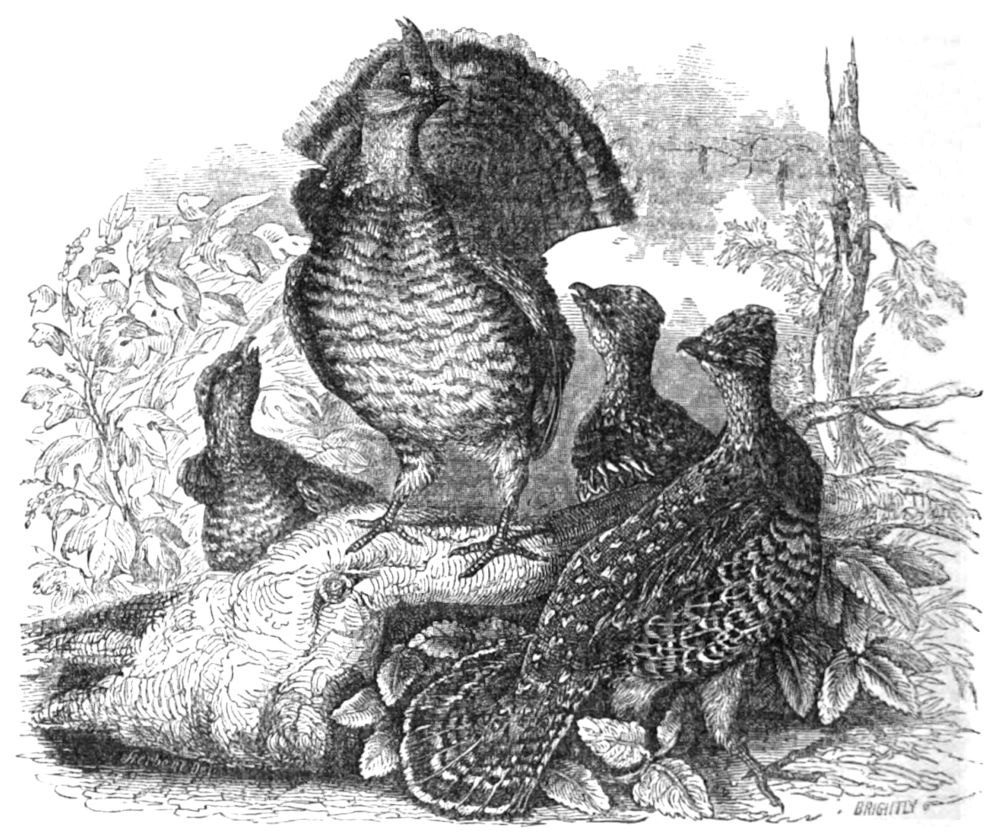
THE RUFFED GROUSE. (Tetrao Umbellus.)
The beautiful bird which is depicted above, is that known as the Partridge, in New Jersey, and all the States east and north of the Delaware, and as the Pheasant everywhere to the westward of that fine stream; and by these provincial vulgarisms it is like to be known and designated, until sportsmen will take the trouble of acquiring a little knowledge of their own trade, and will cease to regard naturalists as mere theorizing bookmen, and scientific names and distinctions as supererogatory humbug. The distinction between the Grouse and other birds of the gallinaceous order, is that the former are invariably, the latter never, feathered below the knee. This distinction never fails, and is very easily noted; although, in different species of the genus, the extent of the feathering differs. In the Ruffed Grouse the soft fleecy feathering of the leg is sparse, and descends only to the middle of the shank. In the Pinnated Grouse, Prairie Hen of the West, and Grouse of Pennsylvania, New Jersey, and Rhode Island, the legs are feathered the whole way down the shank, to the insertion of the toes; and the same is the case of the Canada Grouse, or Spruce Partridge of the remote Eastern States. In all those species of Grouse, which are known as Ptarmigan, dwellers of the extreme north, or in the northern temperature of iced mountain-tops, the feathering continues the whole length of the toes quite to the insertion of the claws—this I merely mention par parenthese, as there is but one of the Ptarmigans likely to fall within reach of the sportsman; namely, the Willow-Grouse, or Red-Necked Partridge of the extreme parts of Maine, and the Easternmost British provinces, and thence so far as to the Arctic Circle.
These distinctions are easily borne in mind, nor will be found all-sufficient to the discriminating woodsman, who desires to be able to call things by their right names, and to give a reason for doing so.
The true Pheasant is a native of Asia originally, though it has been naturalized in Europe, since a very early period, and is now abundant in France and England. No species of this bird, which is distinguished by a pointed tail, above half a yard in length, and by its splendidly gorgeous coloring, little inferior in intensity to that of the Peacock, has ever been found, or is believed to exist in any portion of the Western hemisphere; although those singular and showy birds, the Curaçoas of South America, have some relation to it.
The same is true of the real Partridge; although the Quail of this continent would seem to be its equivalent; being as it were a connecting link between the European Quail, and the Partridge of Europe.
The Ruffed Grouse ranges over a very wide portion of the United States and British provinces, from the 51st degree of north latitude to the Atlantic sea-board, although it is much more scarce in the Southern States than in the midland and northern regions. It is remarkable also that it varies exceedingly in color; those to the northward being comparatively dull and gray, to those of Pennsylvania, Kentucky, and more genial regions.
The distinctive feature, whence this bird derives his title of Ruffed Grouse, is the tuft or tippet of jet-black feathers, glossed with metallic hues, which are shown more or less distinctly in each of the figures in the woodcut at the head of this paper, but the most decidedly in the cock-bird, represented as standing on a fallen log, in the act of drumming, with these ruffs elevated, and his tail erected and expanded after the manner of a Turkey or Peacock, in the season of his amorous phantasies.
This drumming, a sound sufficiently familiar to all ears accustomed to the sights and noises of the forest, is no less than the call of the male bird to his harem of attendant wives; for the Ruffed Grouse, unlike our pretty, constant, and domestic Quail, selects himself no one fond partner, whom to cheer with his loved notes, to comfort and amuse during the breeding season, but rejoices like a veritable grand Signor in a multiplicity of fair sultanas, whom so soon as they betake themselves to the cares of maternity, he abandons, like a roué as he is, and passes the remainder of the season, until the broods disperse in the autumn, in company with small packs of his own faithless sex, reveling and enjoying himself on the mountain sides, in his loved pines and hemlocks, while his forgotten loves brood patient over the hopes of the coming season.
“This drumming,” says Wilson, in his eloquent and animated page, “is most common in spring, and is the call of the cock to a favorite female. It is produced in the following manner: the bird, standing on an old prostrate log, generally in a retired situation, lowers his wings, erects his expanded tail, contracts his throat, elevates the two tufts of feathers on the neck, and inflates his whole body something in the manner of a Turkey cock strutting and wheeling about in great stateliness. After a few manœuvres of this kind, he begins to strike his stiffened wings in short and quick strokes, which become more and more rapid until they run into each other, resembling the rumbling sound of very distant thunder dying away gradually on the ear. After a few minutes’ pause, this is again repeated, and in a calm day may be heard nearly a mile off. This is most common in the morning and evening, though I have heard them drumming at all hours of the day.”
It is singular, that so exact an authority as Wilson has proved himself to be, should fall into the strange error of speaking of this singular amorous sound as a call to a single female; and elsewhere of the Pheasant, as he erroneously calls it, paining; when it is notorious to all who have closely observed the habits of this bird, that it is polygamous. Such, I believe, will be found the case with all those gallinaceous birds which have on especial summons, or peculiar display of attitudes, airs, and splendors by which to attract the females; as may be observed of the common Game-cock, the Turkey, the Peacock, and the European Pheasant; no one of which takes to himself an especial and chosen partner, but disports himself in his wanton seraglio.
On many occasions, during this particular season, I have stolen up to within a few yards of the log, whereon the Ruffed Grouse was so busily employed in summoning his dames and demoiselles around him, that he had no ears or eyes for my approach, which at any other period he would have discovered long before, and whirred away tumultuous on terrified and sounding pinions. I have lain concealed, for an hour at a time, watching with intense gratification the beautiful and animated gestures of the cock, now strutting and drumming on his log, proud as an eastern despot, now descending to caress and dally with his numerous Roxolanas, and then reascending to his post of pride, to send his resonant call far through the haunted echoes of the umbrageous pine-woods. On one such chance, I saw no less than seven hen birds gathered around a single male, all in turn expectant of his looked-for attentions, and all gratified by a share of his notice. If this be not Polygamy, I should like to receive the Grand Turk’s opinion on the subject, as I confess myself, if it be any thing less, in a state of absolute benightedness.
The Ruffed Grouse begins her nest very early in May, and lays from eight to fifteen brownish-white, unspotted eggs, nearly the size of those of a pullet. With the exact period of this bird’s incubation I am not acquainted; the young birds run the instant they clip the shell; obey the cluck of the mother, as chickens that of the hen; and are tended by her with extreme care and solicitude. In case of her being surprised with her young about her, she resorts to all the artifices practiced by the Quail, and even by the comparatively dull and stolid Woodcock, to draw away the intruder from the vicinity, feigning lameness and incapacity to fly, until she shall have lured away the pursuer far from the hiding-place of her fledglings. Then she shall whirr away on resonant and powerful pinions, up, up above the tops of the tall pines and hemlocks, and thence skate homeward noiseless on balanced wings, where she will find them close ensconced among the sheltering fern-tufts, or the matted winter-greens and whortleberry bushes, viewless to the most prying eye, and undiscoverable, save to the nose of the unerring spaniel. But once returned, you shall see them emerge, chirping feebly at the soft maternal cluck, and hurrying to enshroud them under the shelter of her guardian wing, and nestle, happy younglings, among the downy plumage of her maternal breast. Curses upon the sacrilegious hand that would interrupt that sweet and tender scene by the sharp click of the murderous trigger; yet there be brutes, in the guise of men, who scruple not to butcher the drumming cock, taken at fatal disadvantage, amid his admiring harem; scruple not to slaughter the brooding mother above her miserable younglings—but to such we cry avaunt! to such we deny the name of sportsmen, nay, but of Christians, or of men! Get ye behind us, murderous pot-hunters!
The young broods grow rapidly; and by the time they have reached the size of the Quail, fly well and strongly on the wing. By the middle, or latter end of August, they are three parts grown, and fully feathered, with the exception of the tail, which is not yet complete, and retains a pointed form. The blundering legislation of this country in general, on the subject of the game-laws, has, in this instance, to my ideas, exceeded itself; for during the months of September and October, when the broods are still united under the care of the mother, the birds lying well to the setter, and when flushed scattering themselves singly here and there among low undergrowth or bushes, and rarely or never taking to the tree, we are prohibited from shooting this bold, hardy, rambling, and shy bird; this, at a later season, wild hunter of inaccessible rock-ledges, impenetrable rhododendron brakes, and deep sequestered hemlock-swamps; this, the most uncomatable and self-protecting bird of all the varieties of American game; the only variety, perhaps, which never can by any means, fair or unfair, be exterminated from among us, so long us the rock-ribbed mountains tower toward the skies, and the forests clothe them with foliage never sere.
At this period they would afford rare sport, as at all other seasons they afford none; and are, moreover, in far the best condition for the table, as the old birds are apt to be dry, unless hung up for several weeks before being cooked, which can, of course, only be done in winter, when the coldness of the weather prevents their becoming tainted, without absolutely freezing them.
In my opinion, therefore, this, the only bird of American game, which might well exist apart from almost all protection, is now so protected as to be almost rendered impossible to the gun of the fair sportsman; while for others, the tamest, the most easily killed, and the most rapidly decreasing of all our winged tribes, as the Woodcock, for example, the mock protection afforded to them is but another word for the license to slaughter them half-fledged and half-grown, while the second brood is yet in the black-down, and unable to exist without the parent’s care.
I would myself desire to see the legitimate season for Ruffed Grouse-shooting made to commence with the first day of September, the young birds by that time, and in truth much earlier, being quite fit for the gun, and to cease on the fifteenth of December, or at Christmas at the latest, before the snows of winter admit of their being snared and trapped by thousands.
Toward the middle of October, the old hens drive off the broods, or the young birds now perfectly mature, stray from them of their own accord; and thenceforth they are found sometimes in little companies of two, three, or four, but far more often singly, in wild, difficult upland woods, through which they love to ramble deviously for miles, as they are led in search of their favorite food, or sometimes, as it would seem, by mere whim. On one occasion, many years since, when I was but a young sportsman on this side the Atlantic, I remember footing a small party of five birds, in a light snow, for above ten miles among the Wawayanda mountains, in Orange County, New York, without getting up to them; although it was easily seen by their hurried and agitated tracks that for a great part of the distance, they were within hearing of me, and were running from my pursuit. I had no dogs with me. Had I been out with setters, the Grouse would have trailed them for miles, and unquestionably risen at last out of shot. With spaniels, or curs, trained to run in upon them, and pursue, yelping loudly, as the mode is in the backwoods where men do not shoot but gun, they would have taken to the trees, and would have sat close to the trunk with their bodies erect, and their necks elongated, and might have been killed easily, the only difficulty being that of perceiving them, a difficulty far more considerable than would be imagined to an unpracticed eye. To shoot birds sitting, however, whether on trees or on the ground, is not sport for a sportsman; the only case where it is ever allowable, is to the woodsman on a tramp through the primitive and boundless forest, where his camp-kettle must be filled by the contents of his bag, and where to throw away a chance is, perhaps, in the end to go supperless to bed. In such a case, while canoeing it last Autumn “with a goodly companye” up the northern rivers that debouche into Lake Huron, we shot many, while portaging around cataracts or rapids on the Severn; and on one occasion a gentlemen of the party shot three birds, out of one small pine-tree, without any of them moving or appearing alarmed at the gun-shots. This has often been related as a constant and ordinary habit of the bird; and from that occurrence, I am induced to believe that when the bird is in its natural solitudes, unacquainted with man and his murderous weapons, such may be the case; in the settlements, however, it might have been when they were rare and sparse, this is the habit of the Ruffed Grouse no longer. I have never in my life, save in the instance mentioned, observed any thing of the kind; on the contrary, I have ever found them the wildest, the most wary, and, unless by some mere chance, the least approachable of all wild birds.
During the latter autumn, they eschew flat, bushy tracts, and even swamps with heavy thicket, their instinct probably telling them that in such covert they are liable to be taken napping. If, however, one have the fortune to find them in such tracts, he is likely to have sport over setters; and in no other sort of ground do I deem that possible, as the law now stands. Once, many years since, sporting in the heavy thorn-brakes around Pine Brook, in New Jersey, I found them with a friend in low underwood, and we had great sport, bagging eight brace of Ruffed Grouse over points, in addition to some eighteen or twenty brace of Quail.
In general, however, they frequent either open groves of tall, thrifty timber, with a carpet of wintergreens, cranberries and whortleberries, which constitute their favorite food; or the steep mountain-ledges, under the interlaced branches of tall evergreen trees, among brakes of mountain rhododendron, or, as it is commonly called, though erroneously, laurel. In both these species of ground, all being clear below, the birds can hear and see the sportsman long before he can approach them, and take wing, for the most part, entirely out of gun-shot range. If, however, they are surprised unawares, they have a singular tact of dodging behind the first bush, or massive trunk, and flying off in a right line, keeping the obstacle directly between the sportsman and themselves, so as to frustrate all his efforts to obtain a shot; this I have seen done so often as to satisfy me that it is the result, not of chance, but of a deliberate instinct.
The Ruffed Grouse rises, at first, when surprised, with a heavy whirring and laborious flutter, and if taken at that moment within range, is easily shot; he rises for the most part a little higher than the head of a tall man, and goes away swift and strong nearly in a horizontal line. If struck behind, he will carry away a heavy load of shot, and he has a trick of flying until his breath leaves him in the air, and then falls dead before he strikes the ground. Occasionally he towers up with the wind, and then setting his wings, skates down before it at a prodigious rate, without moving a feather; and if you get a shot at him, gentle reader, under such circumstances, crossing you at long range, be sure that you shoot two, or by ’r lady three feet ahead of him, or you may cut off his extreme tail-feathers, but of a surety kill him you shall not.
The Ruffed Grouse usually flies in a perfectly right line, so that if you flush one without getting a shot, and can preserve his line exactly, you may find him, if he have not treed, which it is ten to one he has; wherefore I advise you not to follow him. The exception to this right line of flight, is when the ground is broken into ridges with parallel ravines, in which case the bird, on crossing a ridge at right angles, will rarely cross the ravine also, but will dive up or down, as the covert may invite.
When birds lie in narrow ravines, filled with good covert, by throwing the guns forward on the brow of the ridges a hundred yards ahead of the dogs, which must be left behind with a person to hunt and restrain them, and letting the sportsmen carefully keep that distance in advance, going very gingerly and silently, sport may be had; and so I think only—especially over slow, mute, cocking spaniels, for as the birds, after running before the dogs, will be likely to take wing abreast of, or perhaps even behind the unexpected shooter, who has thus stolen a march on them, and as they rarely, if ever, cross the ridges, but fly straight along the gorge, they so afford fair shots.
For my own part, I do not consider it worth the while, as the law now stands, to go out in pursuit of Ruffed Grouse with dogs, where you expect to find no other species of game; for, in the first place, they ramble so widely, that there is no certainty of finding them within ten miles of the spot where you may have seen them daily for a month; and, secondly, if you do find them, there is no certainty of having sport with them, but rather a probability of reverse. As an adjunct to other kinds of shooting they are excellent, but as sole objects of pursuit, I think, worthless. I have often blundered on them by chance while hunting for other game; but when I have gone out expressly in pursuit of them, I have never had even tolerable sport.
If the law were altered, and September shooting permitted, the case would be altered also; and in many regions of our country, as the Kaatskill Mountains, and some parts of Columbia and Saratoga counties, in New York; the Pocono Mountains, and the Blue Ridge, generally, in Pennsylvania; and many districts of Maine, Massachusetts, Connecticut, and Rhode Island, rare sport might be had. For September shooting, No. 8 shot will be found sufficient; but after that, No. 7; and very late in the season, Eley’s wire cartridges will be found the most effective.
This widely extended bird is too well known to require any peculiar description; and I shall content myself with observing, in aid of my portraiture of the Ruffed Grouse, that the upper part of its head and hind neck are reddish-brown, the back rich chestnut, mottled with heart-shaped spots of white, edged with black. The tail is bright reddish-yellow, barred and speckled with black, and bordered by a broad, black belt between two narrow white bands, one at the extremity of the tail. The iris of the eye hazel, bill brown, feet brownish gray. Loral band cream color. Throat and fore neck, brownish-yellow. Upper ruff-feathers barred with brown. Wings brownish-red, streaked with black. Breast and abdomen cream colored, closely barred above, and laterally spotted below, with dark chocolate. Length 18 inches, spread of wings 2 feet. The Ruffed Grouse is a capital bird on the table. The breast white meat, back and thighs brown. It should be roasted quickly, eaten with bread sauce and fried crumbs, and washed down with sherry or red wine.