REVIEW OF NEW BOOKS.
Reading edition
Astræa; The Balance of Delusions. A Poem Delivered before the Phi Beta Kappa Society of Yale College, Aug 14, 1850. By Oliver Wendall Holmes. Boston: Ticknor, Reed & Fields. 1 vol. 16mo.
Few college poems have attained, at the period of their delivery, so fluttering a fame as did this last product of Dr. Holmes’s forgetive and flashing brain; and it is now published “by request of the Society,” and demand of the public. Though it has not the geniality of “Urania,” nor its sustained sweetness and subtility of sentiment, it is the greatest of the author’s long poems in decision and depth both of feeling and satire, and exhibits, perhaps, more than his usual command of the powers and delicacies of expression. The verse is a study for all heroic rhymers, being fully equal to all the purposes of wit, fancy, imagination and passion, and combining the utmost finish in separate lines with a bounding movement in the whole. The poem is a succession of beautiful pictures, grave and mirthful, each of which symbolizes some powerful thought or tender feeling, and some of which are hardly matched in our poetry for brilliancy of effect. The satire is less frolicksome than usual; here and there, indeed, its sting draws blood; and the whole poem is conceived and executed in a sterner and more earnest spirit than is common with Dr. Holmes.
The opening paragraphs contain a most beautiful and delicate tribute to the author’s father, who was educated at Yale. The following lines refer, we suppose, to Dr. Stiles, the president of the college at the time the elder Holmes was a student, and contain an exquisite picture of the filial relations of master and pupil:
How the great Master, reverend, solemn, wise,
Fixed on his face those calm, majestic eyes,
Full of grave meaning, where a child might read
The Hebraist’s patience and the Pilgrim’s creed.
But warm with flashes of parental fire
That drew the stripling to his second sire;
How kindness ripened, till the youth might dare
Take the low seat beside his sacred chair,
While the gray scholar, bending o’er the young,
Spelled the square types of Abraham’s ancient tongue,
Or with mild rapture stooped devoutly o’er
His small coarse leaf, alive with curious lore;
Tales of grim judges, at whose awful beck
Flashed the broad blade across a royal neck,
Or learned dreams of Israel’s long lost child
Found in the wanderer of the western wild.
The revival of nature at the approach of spring has been often described by poets, but the following passage prints the scenes fresh and bright on the heart and imagination, as if it had never before found its painter. The reader cannot fail to notice the nice propriety of the descriptive epithets, and the combination of the naturalist’s minute observation with the poet’s suggestive imagination, in the whole representation:
Winter is past; the heart of Nature warms
Beneath the wrecks of unresisted storms;
Doubtful at first, suspected more than seen,
The southern slopes are fringed with tender green;
On sheltered banks, beneath the dripping eaves,
Spring’s earliest nurslings spread their glowing leaves,
Bright with the hues from wider pictures won,
White, azure, golden—drift, or sky, or sun;—
The snowdrop, bearing on her patient breast
The frozen trophy torn from winter’s crest;
The violet, gazing on the arch of blue
Till her own iris wears its deepened hue;
The spendthrift crocus, bursting through the mould
Naked and shivering with his cup of gold.
Swelled with new life, the darkening elm on high
Prints her thick buds against the spotted sky;
On all her boughs the stately chestnut cleaves
The gummy shroud that wraps her embryo leaves;
The house-fly, stealing from his narrow grave,
Drugged with the opiate that November gave,
From shaded chinks of lichen-crusted walls,
In languid curves, the gliding serpent crawls;
The bog’s green harper, thawing from his sleep,
Twangs a hoarse note and tries a shortened leap;
On floating rails that face the softening noons
The still shy turtles range their dark platoons,
Or toiling, aimless, o’er the mellowing fields,
Trail through the grass their tessellated shields.
At last young April, ever frail and fair,
Wooed by her playmate with the golden hair,
Chased to the margin of receding floods
O’er the soft meadows starred with opening buds,
In tears and blushes sighs herself away,
And hides her cheek beneath the flowers of May.
Then the proud tulip lights her beacon blaze,
Her clustering curls the hyacinth displays,
O’er her tall blades the crested fleur-de-lis,
Like blue-eyed Pallas, towers erect and free;
With yellower flames the lengthened sunshine glows,
And love lays bare the passion-breathing rose;
Queen of the lake, along its reedy verge
The rival lily hastens to emerge,
Her snowy shoulders glistening as she strips
Till morn is sultan of her parted lips.
We have not space for what follows in celebration of the birds, though we cannot resist the temptation to extract four intoxicating couplets:
The thrush, poor wanderer, drooping meekly down,
Clad in his remnant of autumnal brown;
The oriole, drifting like a flake of fire
Rent by the whirlwind from a blazing spire.
The robin, jerking his spasmodic throat,
Repeats, staccato, his peremptory note;
The crack-brained bobolink courts his crazy mate,
Poised on a bulrush tipsy with his weight.
The satirical part of the poem is introduced with a few lines on the danger of meddling with popular delusions and foibles; and after speaking of the “earthquake of a nation’s hiss,” he concludes with this saucy salutation to the newspapers:
And oh, remember the indignant press;
Honey is bitter to its fond caress,
But the black venom that its hate lets fall
Would shame to sweetness the hyena’s gall.
The gem of this portion of the poem is the representation of the Moral Bully, a picture worthy of Pope or Young:
Yon whey-faced brother, who delights to wear
A weedy flux of ill-conditioned hair,
Seems of the sort that in a crowded place
One elbows freely into smallest space;
A timid creature, lax of knee and hip,
Whom small disturbance whitens round the lip;
One of those harmless, spectacled machines,
Ignored by waiters when they call for greens,
Whom schoolboys question it their walk transcends
The last advices of maternal friends,
Whom John, obedient to his master’s sign,
Conduct laborious, up to ninety-nine,
While Peter, glistening with luxurious scorn,
Husks his white ivories like an ear of corn;
Dark in the brow and bilious in the cheek,
Whose yellowish linen flowers but once a week,
Conspicuous, annual, in their threadbare suits,
And the laced high-lows which they call their boots.
Well may’st thou shun that dingy front severe,
But him, O stranger, him thou canst not fear!
Be slow to judge, and slower to despise,
Man of broad shoulders and heroic size!
The tiger, writhing from the boa’s rings,
Drops at the fountain where the cobra stings.
In that lean phantom, whose extended glove
Points to the text of universal love,
Behold the master that can tame thee down
To crouch, the vassal of his Sunday frown;
His velvet throat against thy corded wrist,
His loosened tongue against thy doubled fist!
The Moral Bully, though he never swears,
Nor kicks intruders down his entry stairs,
Though meekness plants his backward sloping hat,
And non-resistance ties his white cravat,
Though his black broadcloath glories to be seen
In the same plight with Shylock’s gaberdine,
Hugs the same passion to his narrow breast,
That heaves the cuirass on the trooper’s chest.
—
Heaven keep us all! Is every rascal clown,
Whose arm is stronger, free to knock us down?
Has every scarecrow, whose cachetic soul
Seems fresh from Bedlam, airing on parole,
Who, though he carries but a doubtful trace
Of angel visits on his hungry face,
From lack of marrow or the coins to pay,
Has dodged some vices in a shabby way,
The right to stick us with his cut-throat terms,
And bait his homilies with his brother worms?
If generous fortune give me leave to choose
My saucy neighbors barefoot or in shoes,
I leave the hero blustering while he dares
On platforms furnished with posterior stairs,
Till prudence drives him to his “earnest” legs
With large bequest of disappointed eggs,
And take the brawler whose unstudied dress
Becomes him better, and protects him less;
Give me the bullying of the scoundrel crew,
If swaggering virtue wont insult me too!
Leaving, with this impersonation, “The noisy tribe in panta-loons or -lets,” the poet drives directly at the august cities of Boston and New York, and ruthlessly smashes all the literary crockery in those two emporiums of letters. Here is his gird at the modern Athens:
The pseudo-critic-editorial race
Owns no allegiance but the law of place;
Each to his region sticks through thick and thin,
Stiff as a beetle spiked upon a pin.
Plant him in Boston, and his sheet he fills
With all the slipslop of his threefold hills,
Talks as if nature kept her choicest smiles
Within his radius of a dozen miles,
And nations waited till his next Review
Had made it plain what Providence must do.
Would you believe him, water is not damp
Except in buckets with the Hingham stamp,
And Heaven should build the walls of Paradise
Of Quincy granite lined with Wenham ice.
Now this would give “wondrous great contentment” to the denizens of Manhattan, did not the satirist pounce down upon them with even more ironical fury. We have only space for the conclusion, and would particularly emphasize the hit at the scholars. It must be borne in mind that the poem was originally delivered at Yale College, the head-quarters of Websterism in spelling.
When our first Soldiers’ swords of honor gild
The stately mansions that her tradesmen build;
When our first Statesmen take the Broadway track,
Our first Historians following at their back;
When our first Painters, dying, leave behind
On her proud walls the shadows of their mind;
When our first Poets flock from farthest scenes
To take in hand her pictured Magazines;
When our first Scholars are content to dwell
Where their own printers teach them how to spell;
When world-known Science crowds toward her gates,
Then shall the children of our hundred States
Hail her a true Metropolis of men,
The nation’s centre. Then, and not till then!
No one can read this poem without wishing, with more earnestness than the wish originally came from the throat of Macbeth, that the author would throw “physic to the dogs,” and devote himself exclusively to literature. He is now but an “occasional” poet, though every piece he produces evidences that his mind is a Fortunatus’ purse, from which an endless succession of treasures might be drawn, with little effort on his own part, but with great delight to the public and great profit to his own reputation. His wit, whether expressed in prose or verse, is ever the pointed expression of sound sense, of accurate observation, of searching, subtle thought, and has, therefore, a permanent flavor, sharp and sweet, which improves rather than deteriorates with familiar acquaintance. Every thing he writes, whether he reasons, observes, or creates, is distinguished pre-eminently by vigor—a vigor which goes directly to its object, and always succeeds in mastering and expressing it. We wish he would not only write more poems, but that he would invade the domain of romance, and bring us back a novel. It would certainly be as original as any ever produced by an American, and would exhibit to great advantage his peculiar vein of sentiment—a vein as peculiar as that of Tennyson, and capable of being embodied in character with more perfection than he has yet succeeded in expressing it in couplets.
Pictorial Field Book of the Revolution. By Benson J. Lossing. New York: Harper & Brothers. No. 7.
We again call attention to this delightful serial work, containing illustrations, by pen and pencil, of the history, scenery, biography, relics, and traditions of the Revolution. It is elegantly and compactly printed, is full of exquisite wood engravings, and is well written. The author combines the habits of an antiquary with the brain of an enthusiast; and we are acquainted with no other work of American history which gives the same kind of information.
Five Years of a Hunter’s Life in the Far Interior of South Africa. By R. Gordon Cumming. New York: Harper & Brothers. 2 vols. 12mo.
A rare sportsman is Gordon Cumming—none of your followers of snipe and grouse, of fox or stag, but a Cæsar or Napoleon among hunters, a shooter of the giraffe and the rhinoceros, the lion and the elephant, and a great many other wild beasts, which your “even Christian” trembles to behold in their tamed and caged menagerie representatives. Seriously, this book is the most exciting production of the kind we have ever read, and though full of marvels, detailed in a style a little Mendez-Pintoish, is probably substantially true. The author is a kinsman of the Duke of Argyle, (to whom the volumes are dedicated,) is an English officer, and a “Person of Honor;” his statements, we suppose, must be taken as facts, as nobility, like figures, cannot lie, and as the author’s gentle blood did not come to him in a line of descent from William Longbow. Whether, however, Gordon Cumming has drawn a great deal from his imagination or not, his book is an interesting one, and proclaims him a cool, daring, invincible hunter—the greatest since Nimrod. Take away from him a hundred of the elephants he swears he shot, and he will have left enough to make a great reputation. In addition to the hunting scenes, the volumes contain no little information respecting the Hottentots and Bushmen, and some splendid descriptions of African scenery.
Leaflets of Memory; an Illuminated Annual for 1851. Edited by Reynell Coates, M. D. Philadelphia: E. H. Butler & Co.
The enterprising publishers of this most beautiful book, deserve the warmest thanks of the public for the exquisite taste displayed in all of their gift books for 1851; but especially for the wealth of elegance which marks the volume before us in all its appointments. To Butler & Co. justly belongs the credit of having rescued the Annuals of the country from that contempt to which they were fast sinking, and placing them side by side with the highest efforts of art in Europe. Nor has the editor failed to do his part nobly. The marks of the severe and elegant taste of Dr. Coates are visible on every page, and his fine mind sends forth its flashes like sparkles from a diamond in his own articles.
The illuminated plates by Sinclair are wonders of art, surpassing in delicacy of execution any that we have seen in this style; and Sartain, in his beautiful mezzotints, seems to have shared the inspiration largely of his co-laborers in this garden of beauty. We shall be amazed, if an immense sale of the Leaflets does not reward the prodigality of Mr. Butler.
The Female Poets of America. Edited by Thomas Buchanan Read. Philadelphia: E. H. Butler & Co.
This is a magnificent holyday gift, issued in a style of splendor that Butler alone can be chargeable with. Printed on superb paper, and filled with fine portraits of the leading American female writers, and gorgeous with illuminated plates by Sinclair. Mr. Read, the Editor, who is both poet and painter, has given us a token of remembrance in this fine volume that will live in many libraries and many hearts. It is just the volume to present to a lady of taste for a New Year’s Gift. No reader of “Graham” should fail to look at it.
Proverbial Philosophy. By Martin Farquhar Tupper. With Sixteen Illustrations. Philadelphia: E. H. Butler & Co.
Few readers of this Magazine are ignorant of these superior writings of Tupper; but very few, we will venture to say, have ever seen so superb an edition. The letter-press, the illustrations, and binding, are all of the very highest order, and the book is in every way entitled to a permanent place in the drawing-room of the educated and refined. In addition to its numerous superior engravings, the volume is graced by a fine likeness of Tupper, by Richie, which is of itself a treasure to his admirers.
The Recent Progress of Astronomy; Especially in the United States. By Elias Loomis. New York: Harper & Brothers. 1 vol. 12mo.
The object of this volume is to exhibit, in a form as popular as the nature of the subject will allow, the most important astronomical discoveries of the last ten years. The chapter on the Discovery of the Planet Neptune, is the clearest account we have seen of that scientific event. The portions on the Recent Additions to our knowledge of Comets, Fixed Stars and Nebulæ, convey a great deal of information in a rigorously systematized form. There are a hundred pages devoted to the progress of Astronomy in the United States, which will be read with much interest, as they enable us to understand the grounds of a remark of the Astronomer Royal of Great Britain, that “the Americans, although late in the field of astronomical enterprise, have now taken up that science with their characteristic energy, and have already shown their ability to instruct their former masters.”
Lives of Eminent Literary and Scientific Men of America. By James Wynne, M. D. New York: D. Appleton & Co. 1 vol. 12 mo.
This volume contains lives of Franklin, Jonathan Edwards, Fulton, Marshall, Rittenhouse, and Whitney. They are altogether superior to the general run of such biographies, both in style and matter, and we have read with particular pleasure those of Franklin, Edwards, and Fulton. The life of the second of these is little known beyond the boundaries of his sect; and Dr. Wynne’s view of his character is the most correct we have ever seen. The author’s diction is admirably adapted for narrative.
The Deerslayer: or the First War-Path. By J. Fenimore Cooper. New York: George P. Putnam. 1 vol. 12mo.
This is the first volume of a reprint of Cooper’s Leather-Stocking Tales, the best works of their Author. It is uniform with the Putnam’s edition of “The Spy,” and “The Pilot.”
The Life of Silas Talbot, a Commodore in the Navy of the United States. By Henry T. Tuckerman. New York: J. C. Riker. 1 vol. 16mo.
In this little volume, Mr. Tuckerman appears as the biographer of a revolutionary hero, as a describer of land fights and sea fights, and as a commentator on military and naval character. In this department of literature he seems as much at home as in writing genial essays on poets and social phenomena, and has made a charming book. In narrative, his style, without parting with any of its grace, has an increased energy and rapidity of movement. He lingers less over his matter. The subject of his biography is a grand one, and he has treated it finely, exhibiting judgment, research, and a marked descriptive power.
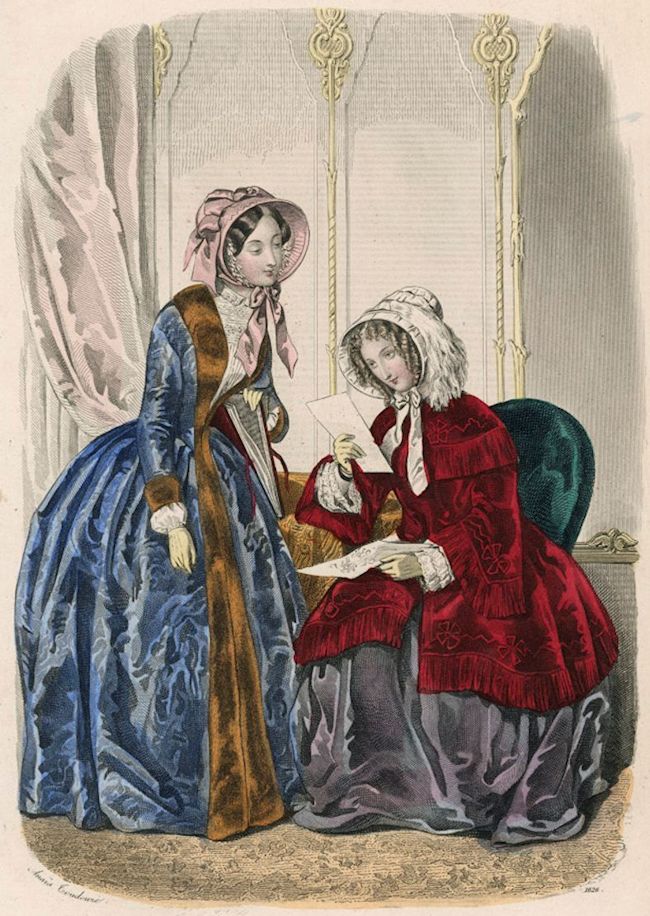
Anaïs Toudouze
LE FOLLET
Boulevart St. Martin, 69.
Robes de Mme. Verrier Richard, r. Richelieu, 73—Chapeaux de Mlle. Grafeton, r. de la Paix, 24.
The styles of Goods here represented can be had of Messrs. L. J. Levy & Co. Philadelphia
and at Stewart’s, New-York.
Graham’s Magazine, 134 Chestnut Street.