TEAL AND TEAL SHOOTING.
Reading edition
———
BY HENRY WILLIAM HERBERT, AUTHOR OF FRANK FORESTER’S “FIELD SPORTS,” “FISH AND FISHING,” ETC.
———
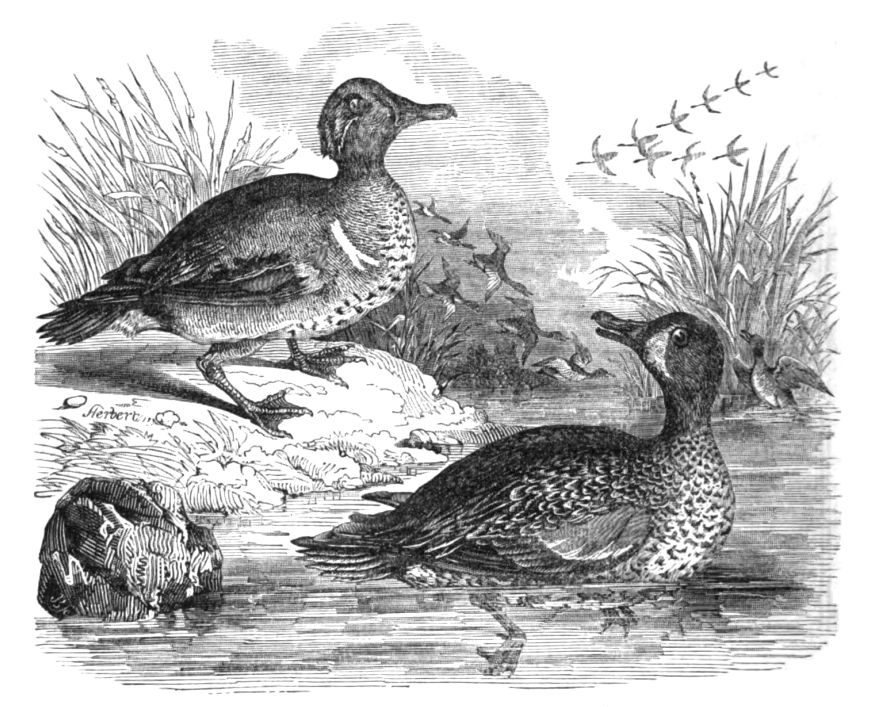
THE GREEN-WINGED TEAL. (Anas Carolinensis.) THE BLUE-WINGED TEAL. (Anas Discors.)
In this present month, the sport of duck-shooting on the inland streams, rivers, and lakelets, may be held to commence in earnest, as contrasted to the pursuit of the same tribes on the outer bays, estuaries, and surf-banks. About the end of September, and thenceforth through this and the next ensuing month, according to the variations of the seasons, and the longer or shorter endurance of that delicious time, the most delicious and most gorgeous of the whole American year, known throughout this continent as Indian Summer, the Mallard, and the two beautiful species which we have placed at the head of this article, begin to make their appearance on the little lakes of the interior, and in the various streams and rivers which fall into them, and thence downward to the Atlantic seaboard.
In the vast northern solitudes of the great lakes of the northwest, in all the streams of Upper Canada, even to the feeders of Lake Superior, and throughout the western country so far south as Texas, and northward to the Columbia and the fur countries, the Blue-Winged Teal breeds, literally by myriads. Throughout the great lakes, it is abundant in the early autumn, becoming excessively fat on the seed of the wild rice, with which the shallows of all those waters are overgrown, and being deservedly esteemed as one of the best, if not the very best, of the duck tribe. But it is the first of its race to remove from the wild, limpid waters, and wood-embosomed rivers of the great west, to the seaboard tide-waters, taking the inland water-courses on their route, rarely visiting the actual sea-shores, and proceeding on the occurrence of the first frosts, for they are singularly susceptible of cold, to the Southern States, where they swarm, especially in the inundated rice-fields of Georgia and South Carolina, during the winter months.
The Green-Winged Teal, which is the nearest congener, and frequently the associate of the Blue-Wing, has a far less extensive range, so far as regards its breeding-grounds, in as much as it never, so far as has been satisfactorily shown, has nidificated or produced its young south of the Great Lakes, nor even there in great numbers, its favorite haunts, for the purposes of reproduction, being the extreme northern swamps and wooded morasses almost up to the verge of the arctic circles. It does not come down on its southward migration, at nearly so early a period of the autumn as its congener, being less susceptible of cold, and tarrying on the Great Lakes till the frosts set in with sufficient severity to prevent its frequenting its favorite haunts with pleasure, or obtaining its food with facility. It is rarely or never seen in the Middle States during the summer, but is tolerably abundant during the autumn on all the marshy lakes and pools, and along the shores of all the reedy rivers from the great lakes downward to the sea-board, though, like the last named species, it is purely a fresh-water duck, never frequenting the sea-shores or salt bays, finding no food thereon with which to gratify its delicate and fastidious palate, which, eschewing fish, the larvæ of insects, and the lesser crustaceæ, relishes only the seeds of the various water plants and grasses, the tender leaves of some vegetables, and more especially the grain of the wild rice, Zizania panicula effusa, which is its favorite article of subsistence, and one to which may be ascribed the excellence of every bird of air or water which feeds on it, from the Rice-Bird and the Rail, to the Teal, the Canvas-Back, and even the large Thick-Billed Fuligula, closely allied to the Scoter, the Velvet Duck, and other uneatable sea-fowl of Lake Huron, which are scarcely, if at all, inferior to the Red Heads of Chesapeake Bay, the Gunpowder, or the Potomac. On the Susquehanna and the Delaware, both these beautiful little ducks were in past years excessively abundant, so that a good gunner, paddling one of the sharp, swift skiffs peculiar to those waters, was certain of filling his boat with these delicious ducks within a few hours’ shooting. Both of these species are rather tame than otherwise, the blue-winged bird more particularly, which has a habit, on the lower waters of the Delaware especially, of congregating on the mud in vast flocks, sunning themselves in the serene and golden light of a September noon, so careless and easy of approach, that the gunner is frequently enabled to paddle his skiff within a few yards of them, and to rake them with close discharges of his heavy batteries. At times, when the tide is out, and the birds are assembled on the flats out of gunshot from the water’s edge, the thorough-going sportsman, reckless of wet feet or muddy breeches, will run his skiff ashore, several hundred yards above or below the flock, and getting cautiously overboard, will push it before him over the smooth, slippery mud-flats, keeping himself carefully concealed under its stern until within gunshot, which he can sometimes reduce to so little as fifteen or twenty yards, by this murderous and stealthy method. The Green-Winged Teal is much less apt to congregate, especially on shore, than the other, and consequently, affords less sport to the boat-shooter, keeping for the most part afloat in little companies, or trips, as they are technically called, very much on the alert, and springing rapidly on the wing when disturbed. They, and the Blue-Wings also, fly very rapidly, dodging occasionally on the wing, not unlike to a wild, sharp-flying Woodcock, and when they alight, darting downward with a short, sudden twist among the reeds or rushy covert, exactly after the fashion of the same bird.
The commoner and, in our opinion—where these birds are abundant either along the courses of winding drains or streamlets, or in large reedy marshes, with wet soil and occasional pools or splashes—far the more exciting way of killing them is to go carefully and warily on foot, with a good medium-sized double-gun, say of eight to ten pounds weight, and a thoroughly well broke and steady spaniel, to retrieve and occasionally to flush the birds, which will sometimes, though rarely, lie very hard. A good sportsman will frequently, thus late in the autumn, when the mornings are sharp and biting, and the noons warm and hazy, but before the ice makes, pick up, on favorable ground, his eight or nine couple in a day’s walking, with a chance of picking up at the same time a few Snipe, Golden Plovers, Curlew, or Godwit; and this, in our mind, is equal to slaughtering a boat load by sneaking up in ambush to within twenty yards of a great company, whistling to make them lift their heads and ruffle up their loosened plumage, so as to give easy entrance to the shot, and then pouring into them at half point-blank range, a half pound of heavy shot.
In the southern States they are commonly taken, says Wilson, “in vast numbers, in traps placed on the small dry eminences that here and there rise above the water of the inundated rice fields. These places are strewed with rice, and by the common contrivance called a figure four, they are caught alive in hollow traps.” This we, of course, merely mention as illustrative of the habits of the bird; for, of course, no sportsman would dream of resorting to so worse than poacher-like a proceeding. The mode described by the eloquent pioneer of American natural history, is probably practised, for the most part, by the negroes for the supply of their masters’ table, and furnishing their own pockets with a little extra change, and is not used by the planters as a means of sport or amusement. It must be remembered, also, that Wilson, than whom there is no writer more to be relied on in matters which he relates of his own knowledge, and as occurring in his own days, must often be taken cum grano salis, as to the numbers of birds slain in this way or that within a certain time—things which he records, probably, on hearsay, and on which—we are sorry to say it—even good sportsmen, men who on any other subject would scorn to deviate one hair’s breadth from the truth, will not hesitate to draw a bow as long and as strong as Munchausen’s. Again, he writes of times when sporting was but little pursued, otherwise than as a method of procuring superior food for the table, or for the purpose of destroying noxious vermin and beasts of prey; when the rules of sportsmanship were little understood and as little regarded; and, lastly, when game abounded to a degree literally inconceivable in our day—although we have ourselves seen, with sorrow, the diminution, amounting in many regions around our large cities almost to extinction, of all birds and beasts—nay, but even fish of chase, within the last twenty years. We must be careful therefore not to charge exaggeration on a writer who, beyond a doubt, faithfully recorded that which he himself saw and enjoyed in his day; which we might see likewise and enjoy in our generation, and our children and grand-children after us, if it were not for the greedy, stupid, selfish, and brutal pot-hunting propensities of our population, alike rural of the country and mechanical of the cities, which seems resolutely and of set purpose bent on the utter annihilation of every species of game, whether of fur, fin or feather, which is yet found within our boundaries.
In my opinion, the common error of all American fowlers and duck shooters, lies, in the first place, in the overloading the gun altogether, causing it to recoil so much as to be exceedingly disagreeable and even painful, and in the same degree diminishing the effect of the discharge; for it must never be forgotten that when a gun recoils, whatever force is expended on the retrogressive motion of the breech, that same force is to be deducted from the propulsion of the charge. In the second place, he erroneously loads with extremely large and heavy shot, the result of which is, in two respects, inferior to that of a lighter and higher number. First, as there will be three or four pellets of No. 4 for every one pellet of A or B in a charge, and, consequently, as the load is thereby so much the more regularly distributed, and so much the more likely to strike the object, and that in several places more, in the ratio of three or four to one, than could be effected by A’s or B’s. Second, as the flesh will constantly close over the wound made by a small shot, so as to cause the bleeding to go on internally to the engorgement of the tissues and suffocation by hemorrhage; whereas the wound made by the large grain will relieve itself by copious bleeding, and the bird so injured will oftentimes recover, after having fallen even to the surface of the water, or lain flapping, as it were, in the death-struggle on the blood-stained sand or grassy hassocks. This fact has been well noticed, and several examples adduced to prove its truth, by Mr. Giraud, in his exceedingly clear and correct, though, to our taste, far too brief volume on the “Birds of Long Island.”
For my own use I invariably adopt for all the smaller species of duck—as the two varieties of Teal, the Summer Duck, the Golden Eye, and the Buffel-headed Duck, Anates, Carolinensis, Discors, Sponsa, and Fuligulæ, Clanguid, and Albeola—the same shot which is generally used for the various birds known on our shores and rivers as bay-snipe, viz: No. 4 or 5—the latter best for the Plovers, the former for duck, whether in large or small guns. In this relation I may observe that, on one occasion—the only one, by the way, on which I ever saw a green-winged teal in the summer season—I killed a couple of these beautiful birds, right and left, while woodcock shooting, in Orange County, New York, with No. 8 shot. They sprang quite unexpectedly from behind a willow bush, on the Wuwayanda creek, and I dropped them both quite dead, some what to my own astonishment, and to the utter astounding of Fat Tom, who witnessed it, into the middle of the stream, respectively at twenty and twenty-five yards distance. Until I recovered them I supposed that they were young wood ducks, but on examination they proved to be young green-winged teal, of that season, in their immature plumage. This must have been in the last week of July or the first of August—it was many years since, and as at that time I kept no shooting diary, I unfortunately am unable to verify the exact date. The birds must, I conclude, have been bred in that vicinity, by what means I cannot conjecture, unless that the parent birds might have been wounded in the spring, and disabled from completing their northern migration, and that this, as is some times the case with the minor birds of passage, might have superinduced their breeding in that, for them, far southern region. In corroboration of this I may add that, in the spring of 1846, a couple of these birds haunted a small reedy island in front of my house, on the Passaic, to so late a day in summer—the 29th, if I do not err, of May—that I sedulously avoided disturbing them, in the hope that they would breed there. This I yet think would have been the case but for the constant disturbance of that lovely river throughout the summer by gangs of ruffianly loafers, with whom the neighboring town of Newark abounds beyond any other town of its size in the known world, boating upon its silvery surface day and night, and rendering day and night equally hideous with their howls and blasphemies.
Before proceeding to the description of these birds it is well to observe that it will be found the better way, in approaching them, as indeed all wild fowl, to work, if possible, up wind to them; not that wild fowl have the power, as some pretend, of scenting the odor of the human enemy on the tainted gale, as is undoubtedly the case with deer and many other quadrupeds, but that their hearing is exceedingly acute, and that their heads are pricked up to listen, at the occurrence of the least unusual sound, and at the next moment—hey, presto!—they are off.
The little cut at the head of this paper, for his spirited and faithful execution of which the author and artist must be permitted to return his acknowledgments to his friend, Mr. Brightly, represents a favorite feeding ground of the various tribes of water fowl, as is indicated by the large gaggle of geese passing over, from right to left, and the trip of green-wings alighting to the call of a clamorous drake in the background. On a rocky spur of the shore, in the right foreground, is a male Green-Winged Teal, in the act of springing, with his legs already gathered under him; and, still nearer to the front of the picture, on the right, a Blue-Winged Drake, swimming on the limpid water, soliciting his congener, with reverted neck, and the harsh gabble—whence his name—to take wing and greet the new-comers—it being the object of the draftsman to give an idea not merely of the markings and form of these two most beautiful and graceful of the duck tribe, but of their motions, the character of their flights, and the nature of their feeding grounds and habitations.
The head of the Green-Winged Teal is of moderate size and compressed; the bill nearly as long as the head, deeper than broad at the base, depressed at the tip; neck slender, of moderate length; body full and depressed; wings rather small, feet short and rather far back.
The plumage is short and blended; that of the hinder head and neck elongated into a soft filamentous drooping crest. The bill is black; iris hazel; feet light blue; head and upper part of neck bright chestnut brown; a broad band of shining rich bottle-green, narrowings from the eye backward and downward to the nape, margined below with black, anterior to which is a white line; chin dusky brown. Upper parts and flanks white, beautifully and closely undulated with narrow lines of deep gray. Anterior to the wings is a broad transverse lunated white bar—this alone distinguishing the American from the European bird. The wing coverts, scapulars and quills gray. The speculum bright green above, blue-black below, margined posteriorly with pure white. Tail brownish gray, margined with paler brown. Lower part of the neck undulated, like the back. Breast pale rufous, spotted and banded with black; white below. Abdomen white, barred with gray. A black patch under the tail; the lateral tail coverts tawny, the larger black, white-tipped and margined. Length of male bird, 14¾.24. Female, 13¾.22½.
The description and drawing of this bird are taken, by kind permission, which the writer gratefully acknowledges, from a fine specimen in the Academy of Natural Science of this city.
The Blue-Winged Teal is rather larger than the above, the male measuring 16.31½, the female 15.24.
The shape and proportions of this bird closely resemble those of the latter, but in plumage it widely differs from it. The bill is blueish black; iris dark hazel; feet dull yellow, webs dusky; upper part of the head black, a semilunar patch of pure white, margined with black anterior to the eye; the rest of the head and upper neck deep purplish gray, with changeable ruddy reflections. The lower hind neck, back, alula, and upper parts generally, rich chocolate brown, every feather margined with paler tints, from reddish buff to pale reddish gray, with black central markings, changing to metallic green in the centres. Upper wing coverts rich ultra-marine blue, with a metallic lustre; the lower parts pale reddish orange, shaded on the breast with purplish red, and thickly spotted with roundish or eliptical black spots; axillary feathers, lower wing coverts, and a patch on the side of the rump, pure white; lower tail coverts brownish black.
These, with the exception of the Buffel-Headed Duck, are the two smallest; with the exception of the Summer Duck, the two loveliest; with the exception of the Canvas-Back the two best of the duck tribe. Well met be they, whether on the board or in the field—shot be they with No. 4—eaten roast, underdone, with cayenne and a squeeze of a lemon, lubricated with red wine, quantum suff.